
- Home
- »
- Power Generation & Storage
- »
-
Fuel Cell Market Size, Share And Trends Report, 2026-2033GVR Report cover

Fuel Cell Market (2026 - 2033)
Size, Share & Trends Analysis Report By Application (Stationary, Transportation, Portable), By Product (PEMFC, PAFC, SOFC), By Region (North America, Europe, Asia Pacific, Latin America, Middle East & Africa), And Segment Forecasts
Market Size, 2025
$10.8BMarket Estimate, 2026
$13.6BMarket Forecast, 2033
$33.7BCAGR, 2026–2033
13.8%Fuel Cell Market Summary
The global fuel cell market size was valued at USD 10.8 billion in 2025 and is projected to grow from USD 13.6 billion in 2026 to USD 33.7 billion by 2033, at a CAGR of 13.8% from 2026 to 2033. Asia Pacific dominated the market with the largest revenue share of 66.3% in 2025. Fuel cells are electrochemical devices that convert the chemical energy of hydrogen or other fuels directly into electricity, emitting only water and heat as byproducts.
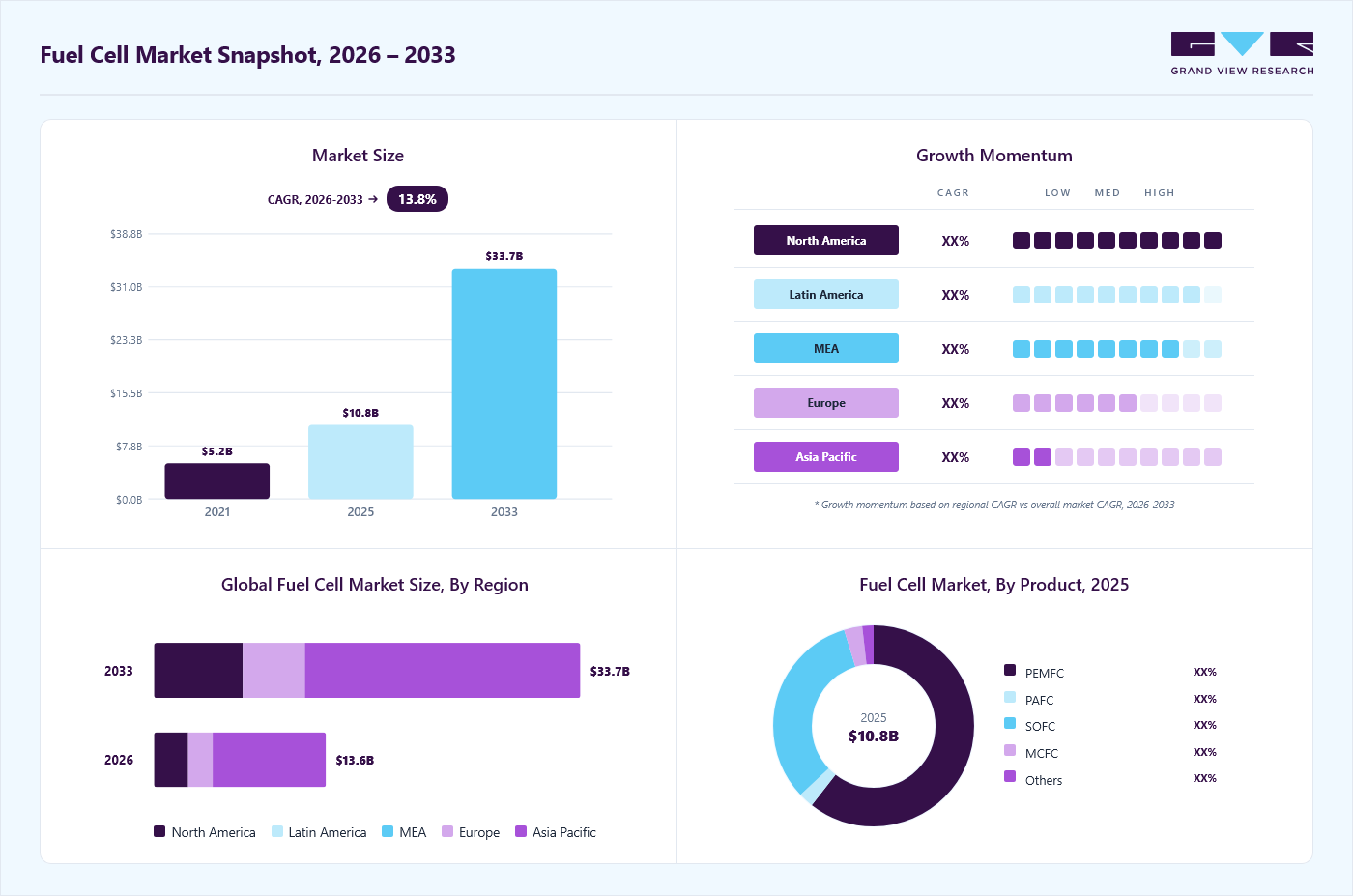 Source: Grand View Research, IR Documents, Primary Interviews, Paid DatabasesTo learn more about this report,
 Download Free Sample Report
 Key Market Trends & Insights
- By product: PEMFC segment dominated the market, with a revenue share of 60.5% in 2025.
- By application: Stationary segment led the market with the largest revenue share of 69.1% in 2025.
Regional Highlights
- Largest regional market: Asia Pacific (66.3% revenue share, 2025)
- By country: The Japan held the largest market share in 2025.
Market Size & Forecast
- Market size in 2025: USD 10.8 Billion
- Estimated market size in 2026: USD 13.6 Billion
- Projected market size by 2033: USD 33.7 Billion
- CAGR (2026-2033): 13.8%
Three ways to get this report
Buy it, customize it, or ask a question.Ask an Analyst
Analyst response in 1 business day
- AccessReport author, directly
- Reply timeWithin 1 working day
- No sales callDirect answer only
- FormatEmail reply
- CostFree, no cost
Get the Full Report
What the study covers
- FormatsPDF · Excel · Dashboard
- Timeline2026–2033 annual, 2025 base
- Coverage20+ countries, 5 regions
- Companies10+ key players profiled
Customize the Report
20% free customization
- IncludeCountries, segments, points
- TailorTo your product definition
- ExtendDeeper competitor detail
- OrA fully bespoke study
- Turnaround5–10 working days
With rising concerns over greenhouse gas emissions and fossil fuel dependency, fuel cells are gaining traction as a clean energy solution across stationary, transportation, and portable power applications. The market’s growth is primarily driven by increased adoption of hydrogen fuel cell technologies, government incentives for zero-emission vehicles, and growing investments in clean energy infrastructure. Advancements in fuel cell efficiency, durability, and cost reduction, especially in proton exchange membrane (PEM) and solid oxide fuel cell (SOFC) technologies, also enhance their commercial viability across industries. To learn more about this report, Download Free Sample Report
 Fuel cells are widely used in sectors focused on high energy efficiency, reliability, and sustainability. In transportation, they are increasingly utilized in fuel cell electric vehicles (FCEVs), buses, trucks, and trains, while stationary applications include backup power, combined heat and power (CHP) systems, and microgrids. Fuel cells are also adopted in industrial settings to reduce carbon emissions and comply with environmental regulations. Key regions for growth include the United States, Japan, South Korea, Germany, and China, where governments actively promote hydrogen-based technologies through national roadmaps and funding initiatives. Additionally, expanding hydrogen refueling networks and collaborations among automotive, energy, and utility companies are speeding up commercialization. As the global energy landscape shifts toward low-carbon options, fuel cells are expected to play a vital role in reaching long-term climate targets, especially in sectors that are difficult to electrify.
Market Dynamics
Fuel cells are gaining traction because they generate electricity with low emissions and high efficiency. Growing focus on clean energy and reducing carbon emissions is increasing their adoption across transportation, power generation, and backup power applications. Fuel cells also offer advantages such as quick refueling, longer operating times, and reliable performance. Increasing investments in hydrogen production and infrastructure are further supporting the growth of fuel cell technologies worldwide.
Growing global efforts to reduce carbon emissions and achieve net-zero targets are driving the adoption of fuel cell technologies. Governments and industries are increasingly investing in clean energy solutions to reduce dependence on fossil fuels and support long-term climate goals. Fuel cells produce electricity with very low emissions and can operate using hydrogen generated from renewable energy sources, making them an effective option for decarbonizing sectors such as transportation, power generation, and industrial operations.
Stricter emission regulations are accelerating the deployment of fuel cell systems, particularly in heavy-duty transportation. Governments are introducing policies, pilot projects, and regulatory frameworks to support hydrogen-powered vehicles and related infrastructure. For instance, in March 2025, India’s Ministry of New and Renewable Energy launched five pilot projects under the National Green Hydrogen Mission for hydrogen-fueled buses and trucks across multiple routes in the country. The initiative includes 37 hydrogen-powered vehicles and 9 hydrogen refueling stations, supporting the transition toward low-emission transport solutions.
The lack of robust hydrogen production, transportation, and refueling infrastructure remains a key challenge for the fuel cell market. Fuel cell vehicles and hydrogen-powered systems depend on a reliable hydrogen supply chain, but many regions continue to face limited refueling networks and logistical constraints. The development of hydrogen infrastructure requires significant capital investment and coordination across multiple stakeholders, resulting in slower deployment compared to conventional fueling and charging networks.
For instance, in April 2026, California's hydrogen refueling network experienced significant disruptions following an incident involving a high-pressure gaseous hydrogen trailer in Colton, California. The disruption resulted in widespread hydrogen shortages, leaving numerous refueling stations offline and reducing overall network uptime to just above 40% during March 2026. Concurrent liquid hydrogen supply constraints further affected station availability, highlighting the challenges associated with maintaining a reliable hydrogen supply chain and refueling infrastructure for fuel cell vehicles.
The rapid expansion of artificial intelligence (AI), cloud computing, and hyperscale data centers is creating significant opportunities for the fuel cell market. AI workloads require large amounts of continuous and reliable electricity, placing increasing pressure on existing power grids and raising concerns about energy availability. Fuel cells, particularly SOFCs, offer a highly efficient and scalable solution for on-site power generation, providing continuous electricity with lower emissions and reduced dependence on grid infrastructure.
The growing interest in alternative power technologies for AI infrastructure is accelerating investment in fuel cell deployment. For example, in 2025, Bloom Energy announced multiple agreements to supply SOFC-based power systems for AI-driven data centers, highlighting increasing demand for fuel cells as utilities struggle to keep pace with the power requirements of next-generation computing facilities. As AI adoption continues to expand globally, the need for reliable, low-emission, and rapidly deployable power solutions is expected to create substantial growth opportunities for fuel cell manufacturers.
Analyst Perspective
The fuel cell market is entering a critical commercialization phase as governments and industries increasingly prioritize decarbonization in sectors where direct electrification remains challenging. Long-term growth will be driven not only by transportation applications but also by the expanding role of fuel cells in stationary power, distributed energy systems, and emerging high-demand applications such as AI-driven data centers. While hydrogen infrastructure limitations and cost competitiveness continue to constrain adoption, the market's long-term trajectory will favor companies that can integrate fuel cell technologies with broader hydrogen value chains, reduce system costs, and secure large-scale commercial deployments. As the hydrogen economy matures, competitive advantage is expected to shift from technology differentiation alone toward ecosystem development, infrastructure access, and the ability to deliver reliable, scalable, and economically viable clean power solutions.
Application Insights
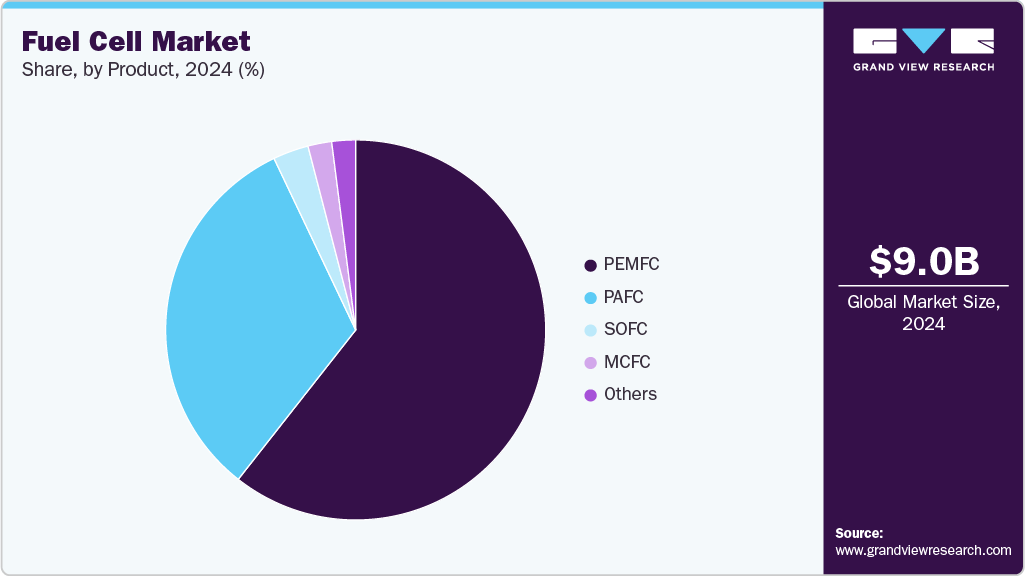
Based on application, the stationary segment led the market with the largest revenue share of 69.1% in 2025. This dominance is due to the increasing demand for reliable, continuous, and clean power generation across residential, commercial, and industrial sectors. Stationary fuel cells are extensively used in applications such as combined heat and power (CHP) systems, backup power for critical infrastructure, and grid support in urban and remote areas. Their high efficiency, low emissions, and ability to operate independently of the traditional grid make them a preferred choice for utilities, data centers, hospitals, and telecommunications facilities seeking energy resilience and sustainability.
 To learn more about this report, Download Free Sample Report
 The segment’s growth is further driven by increasing investments in hydrogen infrastructure and policies promoting the decarbonization of stationary energy systems. Advances in fuel cell stack design, thermal integration, and system durability have made stationary fuel cells more commercially viable. In emerging markets, they are gaining traction for rural electrification and off-grid renewable integration, where extending the grid is unfeasible or too costly. Additionally, the rising frequency of extreme weather events and the increasing need for energy security are prompting governments and businesses to invest in distributed, fuel cell-based power systems. As a result, the stationary segment is expected to stay dominant throughout the forecast period.
Product Insights
Based on product, the PEMFC segment led the market with the largest revenue share of 60.5% in 2025. This dominance is mainly driven by PEMFC’s versatility, quick start-up, high power density, and relatively low operating temperature, making it suitable for various uses including transportation, stationary backup power, and portable devices. PEMFCs are especially popular in fuel cell electric vehicles (FCEVs), such as cars, buses, and trucks, because of their fast response to load changes and compact size. Their scalability and efficiency also make them ideal for residential and small commercial power systems.
The segment is expected to experience strong growth during the forecast period, driven by rising investments in hydrogen infrastructure and increasing demand for zero-emission mobility solutions. Governments in North America, Europe, and Asia-Pacific are actively supporting hydrogen-powered transportation and funding PEMFC R&D programs to improve system durability and lower costs. Additionally, the growing use of PEMFCs in off-grid and emergency backup power systems helps expand their adoption in both developed and developing economies. Although other fuel cell types like SOFCs and PAFCs serve niche markets, PEMFCs remain the market leaders because of their technological maturity, ongoing cost reductions, and broad commercial applications across industries.
Regional Insights
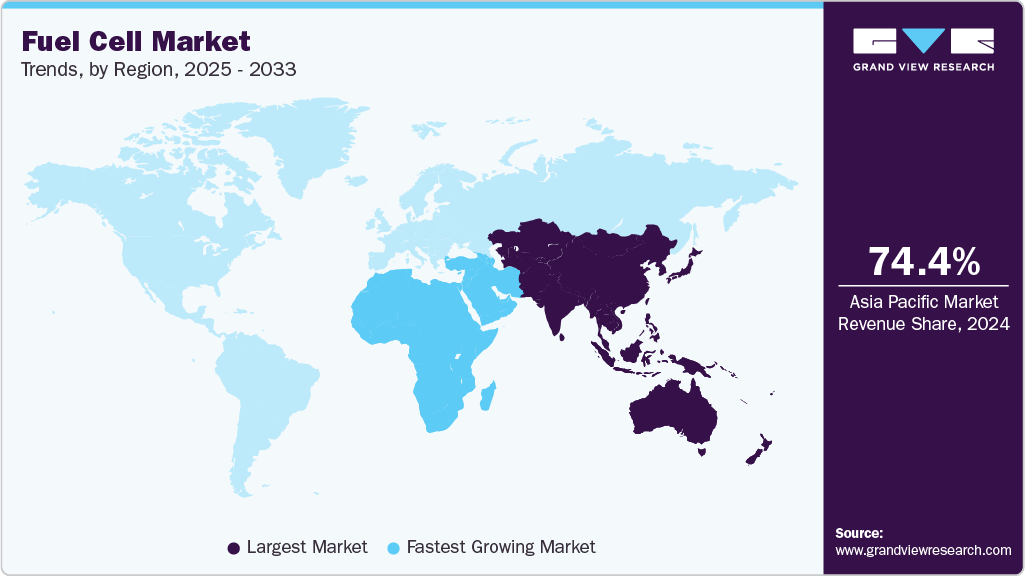
Asia Pacific dominated the fuel cell market with the largest revenue share of 66.3% in 2025. Rapid industrialization, ambitious renewable energy goals, and increasing demand for clean power technologies in countries such as China, Japan, South Korea, and India drive the region's leadership. National hydrogen strategies and government-supported subsidies are speeding up the adoption of fuel cell technologies in transportation, stationary, and portable uses. Japan and South Korea continue to lead globally in fuel cell vehicle (FCV) deployment, while China is quickly expanding its hydrogen refueling infrastructure and pilot projects in industrial sectors. Additionally, strong manufacturing capabilities, low production costs, and technological partnerships support the large-scale deployment of PEMFC and SOFC systems across various end-use industries.
 To learn more about this report, Download Free Sample Report
 The increasing need for energy security and decarbonization across APAC drives investments in hydrogen production and fuel cell R&D. Countries also focus on deploying stationary fuel cells in microgrids and combined heat and power (CHP) systems for residential and commercial use. Off-grid electrification in Southeast Asia and modular hydrogen power solutions for disaster-prone and remote areas are opening new market opportunities. As green hydrogen gains momentum, the Asia Pacific will remain at the forefront of fuel cell adoption and innovation throughout the forecast period.
Japan Fuel Cell Market Trends
The fuel cell market in Japan held the largest share in the Asia Pacific region in 2025. Japan's fuel cell market is supported by strong government policies promoting hydrogen adoption as part of the country's long-term energy transition strategy. National initiatives focused on expanding hydrogen infrastructure, enhancing energy security, and achieving carbon neutrality are encouraging the deployment of fuel cell technologies across residential, transportation, and industrial sectors. Continued investments in hydrogen production, storage, distribution networks, and refueling stations are creating a favorable environment for market growth. The presence of leading industry participants such as Toyota Motor Corporation, Panasonic Holdings Corporation, and Mitsubishi Power further supports technology development and commercialization. These efforts, combined with public-private partnerships and fuel cell adoption programs, continue to strengthen Japan's role in the global fuel cell market.
North America Fuel Cell Market Trends
The North American fuel cell market continues to expand, driven by growing decarbonization efforts, clean mobility initiatives, and federal funding for hydrogen infrastructure. The United States remains a key contributor, with large-scale deployments of stationary fuel cells in data centers, government buildings, and backup power systems. California leads with a robust hydrogen vehicle network in the mobility sector, supported by zero-emission mandates and incentives for FCEVs. Integrating fuel cells into hybrid microgrids and commercial fleets further accelerate adoption across industrial and utility industries.
Technological innovation and private-sector investment shape a dynamic market landscape, particularly from automotive and energy majors. Initiatives like the U.S. Department of Energy's Hydrogen Shot are reducing the cost of clean hydrogen, making fuel cells more economically viable. Fuel cells' scalability, environmental benefits, and off-grid reliability position them as a strategic solution for achieving energy resilience and climate goals in North America.
The U.S. represents North America's largest fuel cell market, driven by a strong policy framework, ongoing hydrogen infrastructure development, and wide-ranging use cases. Due to their reliability and minimal emissions, major U.S. corporations and utilities are adopting fuel cells for stationary power and backup systems. Federal and state-level tax incentives and funding, including support through the Inflation Reduction Act, stimulate hydrogen production and distribution investment. FCEVs and hydrogen-powered buses are gaining momentum in the transportation sector, particularly in California, where supportive legislation and public-private partnerships are accelerating deployment.
With increasing attention on grid resilience, energy storage, and industrial decarbonization, the U.S. fuel cell market is poised for significant growth. Expansion of hydrogen hubs and collaboration between national laboratories and private companies foster innovation in fuel cell design, durability, and affordability.
Europe Fuel Cell Market Trends
Ambitious climate targets, hydrogen roadmaps, and green transition policies under frameworks such as the European Green Deal and REPowerEU propel Europe's Fuel Cell market. Countries like Germany, France, and the Netherlands invest heavily in hydrogen production and refueling infrastructure, supporting the widespread use of fuel cells in transportation and industry. Fuel cells are increasingly important in decentralized power systems, particularly in urban environments and logistics hubs where space and emissions are critical constraints.
European manufacturers are also advancing solid oxide and PEM fuel cell technologies for combined heat and power, heavy-duty transport, and maritime applications. The region's commitment to phasing out fossil fuels and deploying green hydrogen positions Europe as a leading innovator and adopter in the global fuel cell landscape.
Latin America Fuel Cell Market Trends
The fuel cell market in Latin America is gaining traction due to the region's growing focus on clean energy, industrial development, and energy reliability. Countries such as Brazil, Chile, and Argentina are exploring hydrogen-based technologies for decarbonizing mining, refining, and energy production. With abundant renewable resources, particularly solar and wind, Latin America has significant potential for green hydrogen production, which supports downstream fuel cell applications.
Fuel cells are being tested for use in remote and off-grid regions. They provide reliable, emission-free power in areas where traditional grid expansion is unfeasible. Fuel cells' modular and low-maintenance characteristics make them well-suited for deployment in Latin America's diverse geographies and industrial environments.
Middle East & Africa Fuel Cell Market Trends
The Middle East and Africa (MEA) region is witnessing a steady rise in fuel cell adoption, led by national visions emphasizing economic diversification and energy innovation. Countries such as Saudi Arabia, the UAE, and South Africa are investing in hydrogen strategies and pilot projects focused on transport, power generation, and industrial decarbonization. Fuel cells offer scalable, off-grid solutions for power generation in mining, construction, and remote communities, making them valuable tools in regions with limited grid access.
Initiatives in Africa aimed at enhancing rural electrification and reducing reliance on diesel generators are supporting the integration of stationary fuel cell systems. The MEA region's abundant solar resources and interest in green hydrogen production position it as an emerging market for fuel cell deployment in the coming decade.
Key Fuel Cell Company Insights
Some of the key players operating in the global fuel cell market include Ballard Power Systems, Bloom Energy, Ceres Power Holdings PLC, Doosan Fuel Cell America, Inc., FuelCell Energy, Inc., Hydrogenics Corporation, Nedstack Fuel Cell Technology B.V., Nuvera Fuel Cells LLC, Plug Power, Inc., and SFC Energy AG. These companies are at the forefront of innovation, focusing on advanced fuel cell stack development, system integration, and cost optimization.
Key Fuel Cell Companies
The following key companies have been profiled for this study on the fuel cell market.
-
Ballard Power Systems
-
Bloom Energy
-
Ceres Power Holdings PLC
-
Doosan Fuel Cell America, Inc.
-
FuelCell Energy, Inc
-
Hydrogenics Corporation
-
Nedstack Fuel Cell Technology B.V.
-
Nuvera Fuel Cells LLC
-
Plug Power, Inc.
-
SFC Energy AG
Competitive Benchmarking
Category
Operating Strategies
Competitive Edge
Weakness
Established Players (Ballard Power Systems; Bloom Energy; Doosan Fuel Cell Co., Ltd.; FuelCell Energy, Inc.; Cummins Inc.; Plug Power, Inc.)
- Expand commercial deployments across transportation and stationary applications through large-scale manufacturing and strategic partnerships.
- Invest in hydrogen infrastructure, product development, and global market expansion.
- Strong brand recognition, established customer relationships, and proven deployment experience.
- Large manufacturing capacity and financial resources support continuous innovation and growth.
- High capital and operating costs associated with scaling production and infrastructure.
- Greater exposure to project delays, policy changes, and profitability challenges.
Emerging Players (Ceres Power Holdings plc; Nedstack Fuel Cell Technology; Nuvera Fuel Cells LLC; SFC Energy AG)
- Focus on specialized fuel cell technologies and niche applications with high growth potential.
- Leverage partnerships, licensing agreements, and technology collaborations to accelerate commercialization.
- Greater flexibility and faster innovation cycles enable rapid technology development.
- Strong technical expertise allows differentiation in specific fuel cell segments.
- Limited manufacturing scale and lower market visibility compared to larger competitors.
- Higher dependence on external funding, partnerships, and successful technology adoption.
Recent Developments
-
In February 2025, Bloom Energy announced the expansion of its modular fuel cell production facility in Frankfurt, Germany. The upgraded plant aims to accelerate the manufacturing of prefabricated, medium- and high-product electrical houses tailored for rapid deployment in industrial, utility, and renewable energy projects. This strategic investment supports the growing global demand for compact, plug-and-play power solutions, especially as infrastructure developers seek faster, more flexible alternatives to traditional on-site substation construction.
Fuel Cell Market Report Scope
Report Attribute
Details
Market size in 2025
USD 10.8 billion
Estimated market size in 2026
USD 13.6 billion
Projected market size by 2033
USD 33.7 billion
Growth rate
CAGR of 13.8% from 2026 to 2033
Base year for estimation
2025
Historical data
2021 - 2024
Forecast period
2026 - 2033
Quantitative units
Revenue in USD million/billion, Capacity in MW, Volume in Units, and CAGR from 2026 to 2033
Report coverage
Revenue forecast, company ranking, competitive landscape, growth factors, and trends
Segments covered
Application, product, region
Regional scope
North America; Europe; Asia Pacific; Latin America; MEA
Country scope
U.S.; Canada; Mexico; Germany; UK; France; Italy; Spain; China; India; Japan; South Korea; Taiwan; Australia; Brazil; Saudi Arabia
Key companies profiled
Ballard Power Systems; Bloom Energy; Ceres Power Holdings plc; Doosan Fuel Cell Co., Ltd. FuelCell Energy, Inc; Cummins Inc.; Nedstack Fuel Cell Technology; Hyster-Yale Materials Handling, Inc. (Nuvera Fuel Cells LLC); Plug Power, Inc.; SFC Energy AG
Customization scope
Free report customization (equivalent up to 8 analysts' working days) with purchase. Addition or alteration to country, regional & segment scope.
Pricing and purchase options
Avail customized purchase options to meet your exact research needs. Explore purchase options
Global Fuel Cell Market Report Segmentation
This report forecasts revenue growth at global, regional, and country levels and provides an analysis of the latest industry trends in each of the sub-segments from 2021 to 2033. For the purpose of this study, Grand View Research has segmented the global fuel cell market report on the basis of application, product and region:
 To learn more about this report, Download Free Sample Report
 -
Application Outlook (Revenue, USD Million; Capacity, MW; Volume, Units; 2021 - 2033)
-
Stationary
-
Transportation
-
Portable
-
-
Product Outlook (Revenue, USD Million; Capacity, MW; Volume, Units; 2021 - 2033)
-
PEMFC
-
PAFC
-
SOFC
-
MCFC
-
Others
-
-
Regional Outlook (Revenue, USD Million; Capacity, MW; Volume, Units; 2021 - 2033)
-
North America
-
U.S.
-
Canada
-
Mexico
-
-
Europe
-
Germany
-
UK
-
France
-
Italy
-
Spain
-
-
Asia Pacific
-
China
-
India
-
Japan
-
South Korea
-
Taiwan
-
Australia
-
-
Latin America
-
Brazil
-
-
Middle East & Africa
-
Saudi Arabia
-
-
Research Methodology
Segment Definition
Segment - Application
Revenue capture definition
Stationary
Revenue is generated through the sale and installation of stationary fuel cell systems used for primary, distributed, and backup power generation.
Transportation
Revenue is generated through the sale of fuel cell systems and stacks used in transportation applications.
Portable
Revenue is generated through the sale of portable fuel cell systems used for mobile and off-grid power needs.
Segment - Product
Revenue capture definition
PEMFC (Proton Exchange Membrane Fuel Cell)
Revenue is primarily generated through the sale of PEMFC stacks, modules, and complete systems.
PAFC (Phosphoric Acid Fuel Cell)
Revenue is generated through the sale of PAFC systems for power generation and combined heat and power applications.
SOFC (Solid Oxide Fuel Cell)
Revenue is generated through the sale of SOFC systems for efficient power generation.
MCFC (Molten Carbonate Fuel Cell)
Revenue is generated through the sale of MCFC systems for large-scale power generation applications.
Other Products (AFCs and DMFCs)
This segment includes revenue generated from the sale of alternative fuel cell technologies such as alkaline fuel cells (AFCs) and direct methanol fuel cells (DMFCs).
Estimation Model
Layer Name
Key Question
Description
Addressable Energy Demand Layer
Which energy applications require fuel cells?
Identify sectors where fuel cells offer a viable alternative to conventional power generation and battery-based systems, including stationary power generation, transportation, and portable power applications.
Technology Adoption Layer
Where are fuel cells economically feasible?
Apply technology adoption rates based on fuel cell competitiveness relative to batteries, diesel generators, gas turbines, and internal combustion engines.
Behavioural Layer
Which fuel cell technologies are actually deployed?
Allocate demand among fuel cell technologies based on application suitability.
Revenue Realization Layer
How much market revenue is generated?
Convert installed capacity and units into market revenue using technology-specific Average Selling Prices (ASP).
Delivered Customizations
This report has been delivered with the following In-depth customizations
Client Request
Customization Delivered
Value Adds
Taiwan Fuel Cell Market Assessment
Conducted a focused analysis of Taiwan's fuel cell ecosystem, including hydrogen policies, infrastructure development, government initiatives, key market participants, and adoption trends across transportation and stationary power applications.
Helps stakeholders evaluate market entry opportunities, understand regulatory support mechanisms, and identify growth prospects within Taiwan's emerging hydrogen economy.
Cross-Segmentation Analysis
Developed a detailed cross-segmentation analysis of fuel cell products (PEMFC, PAFC, SOFC, MCFC, and Others) across application Transportation segment, assessing revenue contribution, capacity deployment, and volume trends for each segment combination.
Enables stakeholders to identify the most attractive product-application combinations, evaluate growth opportunities, and optimize investment and market-entry strategies.
Company Profiling
Developed detailed profiles of key fuel cell manufacturers, covering product portfolios, technology focus, strategic initiatives, partnerships, geographic presence, and competitive positioning across application segments.
Supports competitive intelligence and strategic planning by highlighting market leaders, emerging innovators, and key differentiation strategies across the fuel cell value chain.
Frequently Asked Questions About This Report
The fuel cell market size was estimated at USD 10.8 billion in 2025 and is expected to reach USD 13.6 billion in 2026.
The fuel cell market is expected to grow at a CAGR of 13.8% from 2026 to 2033 to reach USD 33.7 billion by 2033.
The key players operating in the fuel cell market are Ballard Power Systems; Bloom Energy; Ceres Power Holdings plc; Doosan Fuel Cell Co., Ltd. FuelCell Energy, Inc; Cummins Inc.; Nedstack Fuel Cell Technology; Hyster-Yale Materials Handling, Inc. (Nuvera Fuel Cells LLC); Plug Power, Inc.; SFC Energy AG
Asia Pacific dominated the market with a revenue share of 66.3% in 2025.
The stationary segment accounted for largest revenue share of 69.1% in 2025. This dominance is due to the increasing demand for reliable, continuous, and clean power generation across residential, commercial, and industrial sectors.
The PEMFC segment led the market with the largest revenue share of 60.5% in 2025.
The fuel cell market is primarily driven by the growing focus on decarbonization and clean energy adoption across transportation, stationary power, and industrial applications. Increasing investments in hydrogen infrastructure, supportive government policies, and advancements in fuel cell technology are further accelerating market growth.
About the Author(s)
Power Generation & Storage Research Team
Energy & Power · Power Generation & StorageThis report was authored by the power generation & storage research team at Grand View Research - comprising two research analysts, one senior research analyst, and one industry expert - with specialized expertise in the power generation & storage segment of the energy & power industry. All findings are based on proprietary energy & power databases, executive interviews, and regulatory analysis, subject to internal peer review prior to publication.
Last Updated:
Speak to Analyst

Customize this report to your needs - add regions, segments, or data points, with 20% free customization.
Or view our licence options:


ISO 9001:2015 & 27001:2022 Certified
We are GDPR and CCPA compliant! Your transaction & personal information is safe and secure. For more details, please read our privacy policy.


