
- Home
- »
- Food Additives & Nutricosmetics
- »
-
Malic Acid Market Size, Share & Trends Report, 2026-2033GVR Report cover
![Malic Acid Market (2026 - 2033)Report]()
Malic Acid Market (2026 - 2033)
Size, Share & Trends Analysis Report By Product (L-Malic Acid, D-Malic Acid, DL-Malic Acid), By End Use (Food & Beverage, Pharmaceuticals, Personal Care & Cosmetics), By Region, And Segment Forecasts
Market Size, 2025
$251.7MMarket Estimate, 2026
$264.3MMarket Forecast, 2033
$390.0MCAGR, 2026–2033
5.7%Malic Acid Market Summary
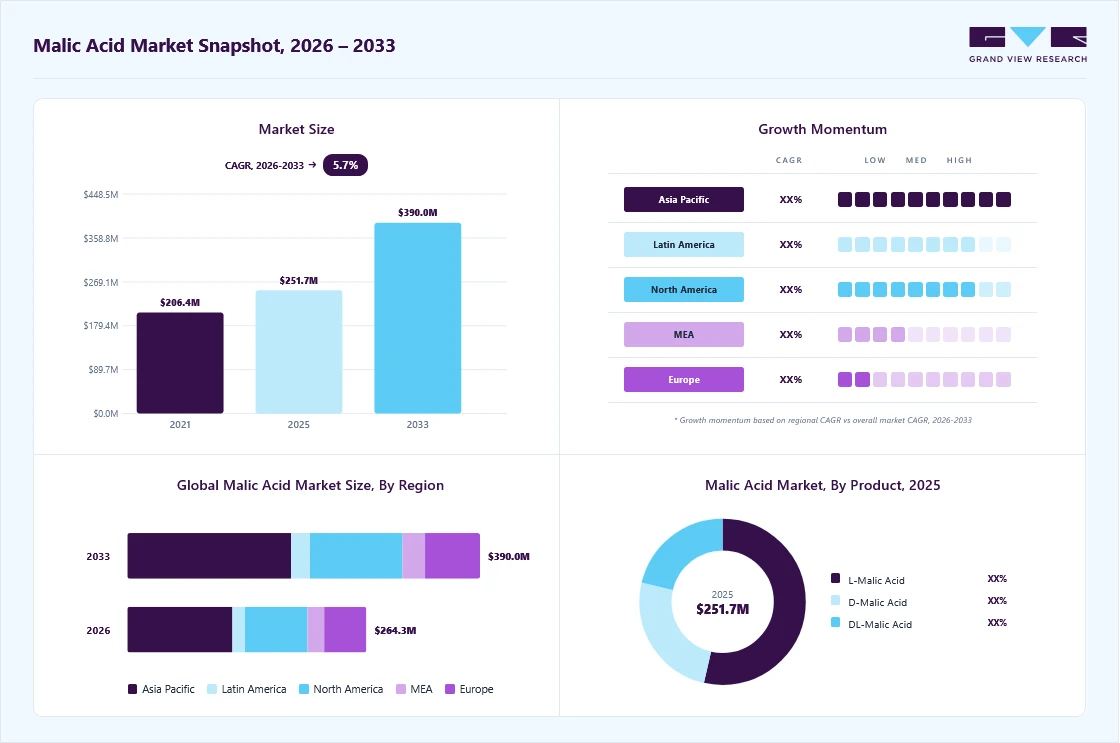
The global malic acid market size was valued at USD 251.7 million in 2025 and is projected to grow from USD 264.3 million in 2026 to USD 390.0 million by 2033, at a CAGR of 5.7% from 2026 to 2033. The market in Asia Pacific dominated with a revenue share of 43.6% in 2025. The increasing demand for malic acid in the food and beverage industry, particularly for its flavor-enhancing properties, is expected to drive market growth.
Key Market Trends & Insights
- By end use: Food & beverage segment held the largest market share of 84.1% in 2025.
- By product: L-malic acid segment held the largest market share of 53.5% in 2025.
Regional Highlights
- Largest regional market: Asia Pacific (43.6% revenue share, 2025)
- By country: China held the largest market share in 2025
Market Size & Forecast
- Market size in 2025: USD 251.7 Million
- Estimated market size in 2026: USD 264.3 Million
- Projected market size by 2033: USD 390.0 Million
- CAGR (2026-2033): 5.7%
Three ways to get this report
Buy it, customize it, or ask a question.Ask an Analyst
A direct answer, usually in 1 working day
- AccessReport author, directly
- Reply timeWithin 1 working day
- No sales callDirect answer only
- FormatEmail reply
- CostFree, no cost
Get the Full Report
What the study covers
- FormatsPDF · Excel · Dashboard
- Timeline2026–2033 annual, 2025 base
- Coverage20+ countries, 5 regions
- Companies10+ key players profiled
Customize the Report
20% free customization
- IncludeCountries, segments, points
- TailorTo your product definition
- ExtendDeeper competitor detail
- OrA fully bespoke study
- Turnaround5–10 working days
Malic acid is one of the preferred acidulants and flavoring agents used in food processing, owing to its excellent blending capabilities and ability to enhance the taste profile of various products. Applications of the product include beverages, confectionery, bakery items, desserts, and fruit preparations. It is widely used in carbonated soft drinks, fruit juices, and sports drinks as it provides a tart, clean taste. In addition, the changing consumer preferences and inclination among manufacturers toward the use of natural and clean-label ingredients support the adoption of the product, especially when derived from natural sources.The rapid expansion of the food and beverage processing industries, particularly in emerging economies such as China, India, Brazil, and Thailand, is expected to positively influence market growth. Rising urbanization, increasing disposable incomes, and changing dietary habits in these countries further contribute to the growth of packaged and processed food products, which boosts the need for flavoring agents such as malic acid.

Growing demand for carbonated soft drinks directly influences the demand for malic acid, which is widely used to enhance the flavor and acidity of these beverages. The prices in the Asia Pacific region have traditionally been low due to low production costs. Government incentives and a large number of small-scale producers catering to regional and overseas demand benefit China, a major producer in the region. Improvement in downstream demand coupled with stable benzene and butane prices, especially in China, is estimated to drive the growth of the malic acid industry.
Market Concentration & Characteristics
The market growth stage is medium, and the pace of growth is accelerating. Innovation in the market remains moderate, particularly in areas such as sustainable production methods and the development of new applications. While the market is relatively mature, ongoing research and development efforts are focused on improving manufacturing efficiency, reducing environmental impact, and exploring bio-based production techniques.
These advancements are driven by regulatory scenarios that promote sustainable practices and growing awareness regarding the use of environmentally friendly ingredients. Merger and acquisition activities in the market are limited. However, companies focus on strategic partnerships to strengthen their market presence.
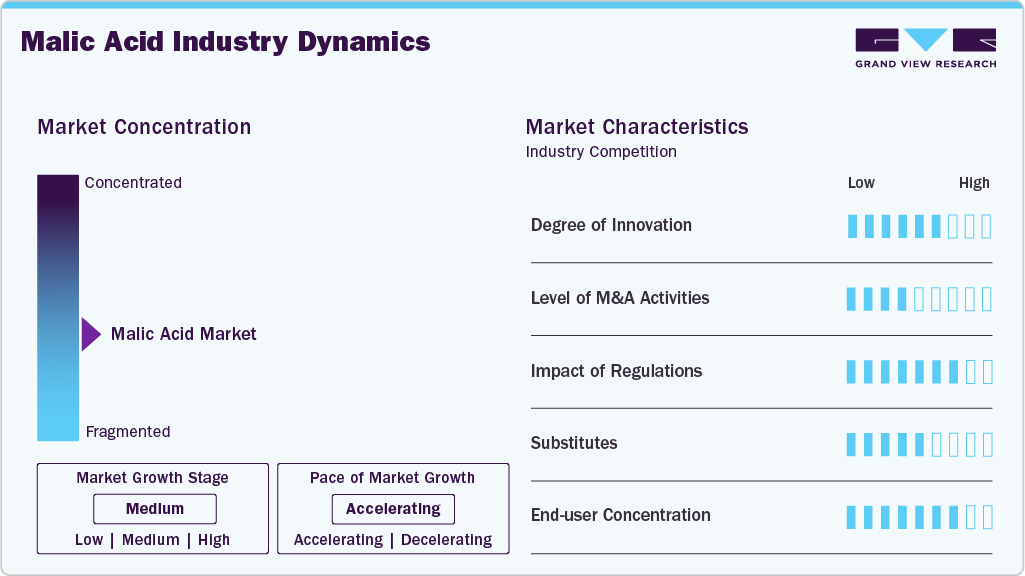
For instance, in November 2024, the Government of Canada announced its latest investment in Bartek Ingredients Inc., one of the key market participants in the malic acid industry. Government support is expected to aid Bartek’s plans and commitment to continue its efforts to develop a new facility featuring innovation-based processes and advanced equipment. Regulations play a significant role in shaping product formulations and raw material sourcing for multiple industries including food & beverages. Stringent food safety standards, various regulations, and guidelines regarding use of ingredients in industries such as personal care influence demand for the market product.
Alternative acidulants are available in the malic acid market, however the product maintains strong demand due to its unique properties, including its persistent sourness, excellent blending capabilities, and ability to enhance flavor without overpowering other ingredients. The food and beverage sector largely dominates the market, which continues to lead due to the increasing global demand for processed food. However, other industries such as personal care and pharmaceuticals are gradually expanding the use.
Product Insights
L-malic acid dominated the industry, accounting for a revenue share of 53.5% in 2025. This is attributed to its growing inclusion in several end-use industries, such as food & beverages and pharmaceuticals. In the food & beverages industry, L-malic acid is used as a sour conditioner and gives a flavor similar to the natural flavor of fruits. It is also used as a yeast growth-promoting agent by accelerating fermentation. The growing importance of L-malic acid in treating heart diseases is expected to propel the segment's growth over the forecast period. It is soluble in ethanol, methanol, ether, and water. The chemical name of L-malic acid is L-hydroxy butane diacid with a molecular weight of 134.09 g/mol. There are various methods to produce L-malic acid, including acid hydrolysis of polymalic acid, one-step fermentation, and enzymatic transformation of fumaric acid to L-malate.
The DL-Malic acid segment is set to grow at the fastest CAGR of 6.1% during the forecast period. It is primarily driven by the increasing adoption by numerous industries such as food and beverages, pharmaceuticals, and cosmetics. DL-Malic Acid is widely used as a flavor enhancer and acidulant in food products due to its ability to provide a smooth, tart taste. In addition, its role as a pH regulator in various industry offerings is expected to fuel its demand. The inclination toward the use of natural and clean-label ingredients also supports the growth of this segment. Moreover, expanding applications in pharmaceutical formulations, where DL-Malic Acid is used to improve drug stability and bioavailability, contributes significantly to market expansion.
End Use Insights
The food & beverage segment dominated the malic acid market with a revenue share of 84.1% in 2025. Significant increase in demand experienced by the food & beverages industry, especially in Asia Pacific, primarily fuels segment growth. Effective distribution strategies adopted by the key market participants in the beverage market and increasing market penetration of the quick commerce industry are expected to generate lucrative opportunities in countries such as India and China.
In addition, the launch of new food and beverage products incorporating malic acid as a natural flavor enhancer and acidulant further boosts demand. For instance, in March 2024, PepsiCo, one of the global brands offering an extensive portfolio of carbonated drinks, launched a new line of sparkling water beverages with six flavor varieties. The increase in such industry applications is likely to generate novel opportunities for this segment during the forecast period.

The personal care and cosmetics segment is expected to grow at the fastest CAGR of 6.6% during the forecast period. Growth of this segment is mainly driven by the product’s multifunctional properties, including its role as a pH adjuster and skin-conditioning agent. Its excellent exfoliating ability helps in the removal of dead skin cells, promoting a youthful and healthy skin appearance, which is highly valued in skincare formulations.
According to a report published by India Brand Equity Foundation, the cosmetics, beauty, and grooming market is expected to reach USD 20.0 billion by 2025. In the pharmaceutical industry, only about 5.0% of malic acid is used to manufacture a variety of syrups and tablets due to its functional properties, such as enhanced assimilation and absorption in the body. The product helps in reducing the effects of anti-cancer drugs on human body cells. The product is used to stabilize medicines and to formulate amino acid solutions for the treatment of diseases such as hypertension, liver disease, uremia, anemia, and many others.
Regional Insights
Asia Pacific Malic Acid Market Trends
The Asia Pacific malic acid industry held the largest global share of 43.6% in 2025. This market's strong growth is primarily driven by the growing adoption of processed food products in Asia Pacific and the increasing demand for malic acid from the beverage industry. Significant growth in new product launches by major food and beverage industry participants to improve revenue, customer engagement, and market share is expected to create new opportunities for this market.

The China malic acid market held the largest share of Asia Pacific in 2025. This dominance is driven by China’s strong industrial base and large-scale production capacity, making it a leading malic acid manufacturer and supplier. The expanding food and beverage industry, driven by rising domestic consumption and increasing demand for natural and clean-label ingredients, is a key growth driver. The presence of multiple manufacturers operating in user industries such as personal care products and pharmaceuticals is expected to fuel further growth.
North America Malic Acid Market Trends
North America accounted for a significant share of global revenue in 2025. Rising consumer demand for natural, clean-label ingredients is driving the use of malic acid, especially in food and beverages such as fruit juices, carbonated drinks, and confectionery. Health and wellness trends emphasizing low-calorie, sugar-reduced, and functional foods also contribute to growing demand. The increasing emergence of product portfolios that feature foods and beverage products for health-conscious consumers in the region is likely to support the growth of this market over the forecast period.
U.S. Malic Acid Market Trends
The U.S. malic acid industry held the largest revenue share of the regional industry in 2025. The growth is driven by strong demand from the food and beverage industry, where malic acid is widely used as a natural acidulant and flavor enhancer. In addition, increasing consumer inclination towards clean-label products and healthier offerings supports the rising adoption of malic acid. The expanding personal care and cosmetics industry also contributes to market growth, as malic acid is valued for its exfoliating and pH-regulating properties.
Europe Malic Acid Market Trends
Europe was identified as one of the key regions of the global malic acid industry in 2025. It is primarily driven by rising demand for natural, clean-label ingredients. European consumers increasingly seek natural, low-sugar, and functional foods, making malic acid a key ingredient in beverages, confectionery, and other food products. Expanding the usage in the pharmaceutical and cosmetics industries, particularly in oral care products and skincare, contributes to market growth.
The Germany malic acid market represents a mature and technologically advanced region in Europe, driven by strong demand from the food & beverage and personal care industries. The country’s emphasis on high-quality and clean-label ingredients is encouraging the use of naturally derived malic acid. Additionally, Germany’s well-established pharmaceutical and cosmetics sectors contribute to steady demand. Regulatory compliance and sustainability trends are shaping product innovation and sourcing strategies. The presence of advanced manufacturing capabilities and a strong distribution network further supports market stability and growth.
Latin America Malic Acid Market Trends
The market in Latin America is experiencing steady growth, supported by increasing demand from the food & beverage industry, particularly in beverages, confectionery, and processed foods. Countries such as Brazil and Mexico are key contributors due to their expanding food processing sectors. Rising urbanization and changing dietary patterns are further driving demand for flavor enhancers and acidulants. Additionally, growing exports of processed food products are supporting market expansion. However, economic volatility and price sensitivity may influence growth to some extent.
Middle East & Africa Malic Acid Market Trends
The Middle East & Africa malic acid industry is gradually expanding, driven by increasing consumption of packaged and convenience foods. Growth in the beverage industry, especially carbonated and flavored drinks, is a key demand driver. Rising population and improving retail infrastructure are supporting the adoption of processed food products. Additionally, the region is witnessing growing interest in personal care applications that use malic acid in formulations. However, limited local manufacturing and reliance on imports may pose challenges to market growth.
Key Malic Acid Company Insights
Some of the key companies in the global malic acid industry include Bartek Ingredients Inc.; FUSO CHEMICAL CO., LTD.; FUSO CHEMICAL CO., LTD; and Thirumalai Chemicals. Global companies are focusing on capacity expansions, signing partnership agreements with distributors, and various other operational strategies to gain an edge in the competitive market.
-
Bartek Ingredients Inc. is a global ingredient manufacturer. Its portfolio features food-grade fumaric acid, malic acid, and Pectin enhancer. It serves a variety of user industries, including food and beverages, animal nutrition, and confectionery.
-
Thirumalai Chemicals specializes in various products, including malic acid, fumaric acid, fine chemicals, and phthalic anhydride. Its diverse portfolio serves industries such as paints, plastics, cosmetics, pharmaceuticals, and food.
Key Malic Acid Companies:
The following key companies have been profiled for this study on the malic acid market.
- Bartek Ingredients Inc.
- FUSO CHEMICAL CO., LTD
- ISEGEN South Africa (Pty) Ltd
- Anhui Sealong Biotechnology Co., Ltd.
- Thirumalai Chemicals
- Yongsan Chemicals
- Polynt S.p.A.
- Lonza
- Prinova Group LLC
- Nacalai Tesque, Inc.
- Guangzhou ZIO Chemical Co., Ltd.
Recent Developments
-
In September 2023, Dialog Group Bhd announced an investment of approximately USD 88.1 million to construct a specialty chemical plant in Pahang, Malaysia. Malic acid was one of the primary products planned for the plant, with an expected annual capacity of 12,000 metric tons.
-
In July 2023, pH Plex launched malic acid-based shampoo and conditioner designed to protect and repair hair. The sulfate- and paraben-free formula is developed for all hair types.
Malic Acid Market Report Scope
Report Attribute
Details
Market size in 2025
USD 251.7 million
Estimated market size in 2026
USD 264.3 million
Projected market size by 2033
USD 390.0 million
Growth rate
CAGR of 5.7% from 2026 to 2033
Base year for estimation
2025
Historical data
2021 - 2024
Forecast period
2026 - 2033
Quantitative units
Revenue in USD million, volume in tons, and CAGR from 2026 to 2033
Report coverage
Revenue forecast, volume forecast, company ranking, competitive landscape, growth factors, and trends
Segments covered
Product, end use, and region
Regional scope
North America; Europe; Asia Pacific; Latin America; MEA
Country scope
U.S.; Canada; Mexico; Germany; UK; France; Italy; Spain; Russia; China; Japan; India; South Korea; Brazil; Argentina; Saudi Arabia; South Africa
Key companies profiled
Bartek Ingredients Inc.; FUSO CHEMICAL CO., LTD; ISEGEN South Africa (Pty) Ltd; Anhui Sealong Biotechnology Co., Ltd.; Thirumalai Chemicals; Yongsan Chemicals; Polynt S.p.A.; Lonza; Prinova Group LLC; Nacalai Tesque, Inc.; Guangzhou ZIO Chemical Co., Ltd.
Customization scope
Free report customization (equivalent up to 8 analysts working days) with purchase. Addition or alteration to country, regional & segment scope.
Pricing and purchase options
Avail customized purchase options to meet your exact research needs. Explore purchase options
Global Malic Acid Market Report Segmentation
This report forecasts volume & revenue growth at the global, regional & country levels and provides an analysis of the latest industry trends in each of the sub-segments from 2021 to 2033. For this study, Grand View Research has segmented the global malic acid market report based on product, end use, and region:

-
Product Outlook (Volume, Tons; Revenue, USD Million, 2021 - 2033)
-
L-Malic Acid
-
D-Malic Acid
-
DL-Malic Acid
-
-
End Use Outlook (Volume, Tons; Revenue, USD Million, 2021 - 2033)
-
Food & Beverage
-
Pharmaceuticals
-
Personal Care & Cosmetics
-
Textiles
-
Metals
-
Others
-
-
Regional Outlook (Volume, Tons; Revenue, USD Million, 2021 - 2033)
-
North America
-
U.S.
-
Canada
-
Mexico
-
-
Europe
-
UK
-
Germany
-
France
-
Italy
-
Spain
-
Russia
-
-
Asia Pacific
-
China
-
Japan
-
India
-
South Korea
-
-
Latin America
-
Brazil
-
Argentina
-
-
Middle East and Africa (MEA)
-
Saudi Arabia
-
South Africa
-
-
Frequently Asked Questions About This Report
The global malic acid market size was valued at USD 251.7 million in 2025 and is estimated at USD 264.3 million for 2026.
Key players include Bartek Ingredients Inc.; FUSO CHEMICAL CO., LTD; ISEGEN South Africa (Pty) Ltd; Anhui Sealong Biotechnology Co., Ltd.; Thirumalai Chemicals; Yongsan Chemicals; Polynt S.p.A.; Lonza; Prinova Group LLC; Nacalai Tesque, Inc.; Guangzhou ZIO Chemical Co., Ltd.
The global malic acid market is expected to grow at a CAGR of 5.7% from 2026 to 2033, reaching USD 390.0 million by 2033.
The Asia Pacific market held the largest share of global industry and accounted for 43.6% in 2025. This market's strong growth is primarily driven by the growing adoption of processed food products in Asia Pacific and the increasing demand for malic acid from the beverage industry
The increasing demand for malic acid in the food and beverage industry, particularly for its flavor-enhancing properties, is expected to drive growth for this market. Malic acid is one of the preferred acidulants and flavoring agents used in food processing, owing to its excellent blending capabilities and ability to enhance the taste profile of various products
The food & beverage segment led with a 84.1% revenue share in 2025, while personal care & cosmetics is the fastest-growing segment.
L-malic acid segment led with a 53.5% revenue share in 2025, while DL-Malic acid is the fastest-growing product.
About the Author(s)
Food Additives & Nutricosmetics Research Team
Specialty & Chemicals · Food Additives & NutricosmeticsThis report was authored by the food additives & nutricosmetics research team at Grand View Research - comprising two research analysts, one senior research analyst, and one industry expert - with specialized expertise in the food additives & nutricosmetics segment of the specialty & chemicals industry. All findings are based on proprietary specialty & chemicals databases, executive interviews, and regulatory analysis, subject to internal peer review prior to publication.
Last Updated:
Speak to Analyst


Customize this report to your needs - add regions, segments, or data points, with 20% free customization.
Or view our licence options:


ISO 9001:2015 & 27001:2022 Certified
We are GDPR and CCPA compliant! Your transaction & personal information is safe and secure. For more details, please read our privacy policy.


