
- Home
- »
- Organic Chemicals
- »
-
2-Ethylhexanol Market Size And Share Report, 2026-2033GVR Report cover
![2-Ethylhexanol Market (2026 - 2033)Report]()
2-Ethylhexanol Market (2026 - 2033)
Size, Share & Trends Analysis Report By Application (Plasticizers, 2-EH Acrylate, 2-EH Nitrate), By Region (North America, Europe, Asia Pacific, Latin America, Middle East & Africa), And Segment Forecasts
Market Size, 2025
$6.7BMarket Estimate, 2026
$6.9BMarket Forecast, 2033
$8.3BCAGR, 2026–2033
2.7%2-Ethylhexanol Market Summary
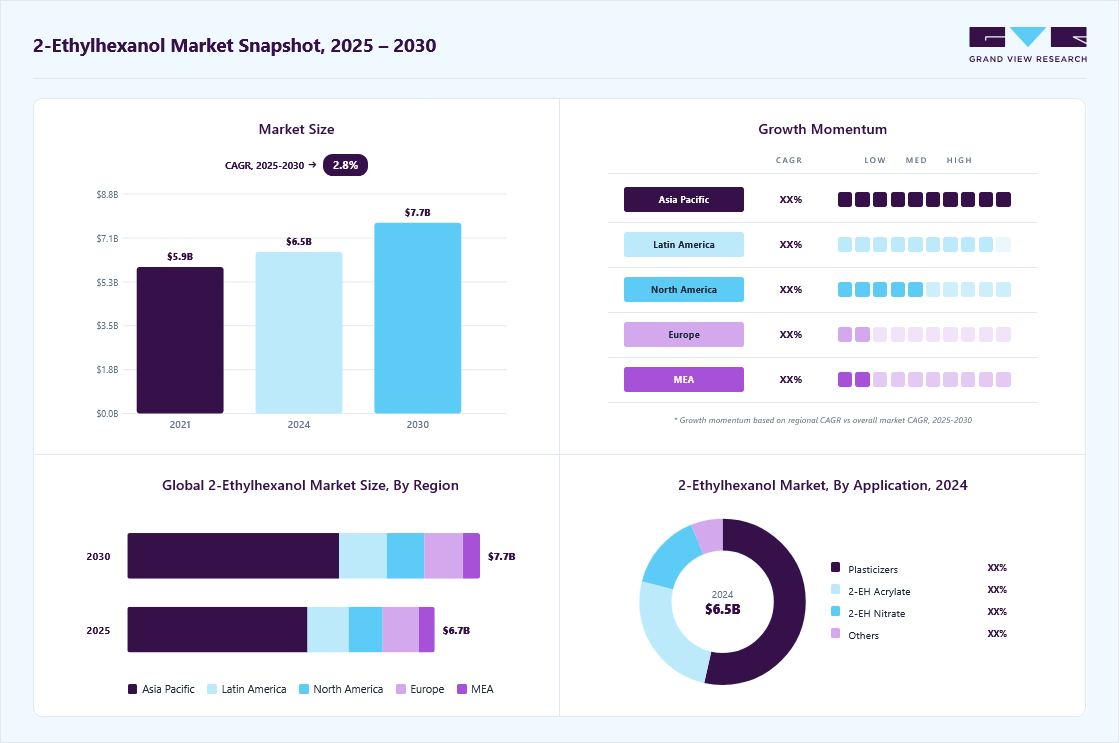
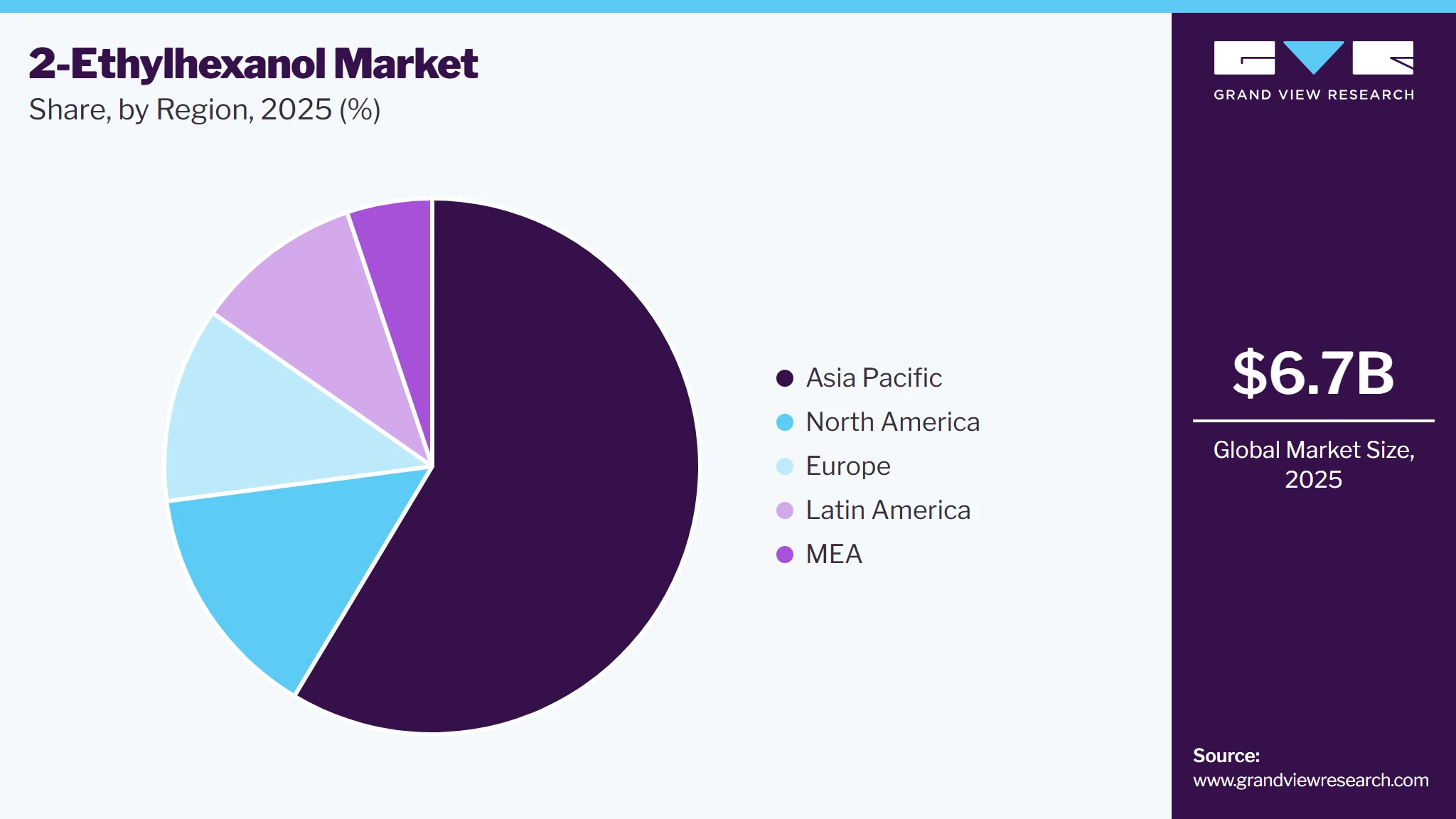
The global 2-ethylhexanol market size was valued at USD 6.7 billion in 2025 and is projected to grow from USD 6.9 billion in 2026 to USD 8.3 billion by 2033, growing at a CAGR of 2.7% from 2026 to 2033. The Asia Pacific held the largest share of 58.6% of the global market in 2025. The increasing demand for chemicals in various industries will create opportunities for the 2-ethyl hexanol market during the forecast period.
Key Market Trends & Insights
- By Application: Plasticizers segment accounted for the largest share of the 2-ethylhexanol market, representing 53.2% of total revenue in 2025.
Regional Highlights
- Largest regional market: Asia Pacific (58.6% revenue share, 2025)
- By country: The China held the largest market share in 2025.
Market Size & Forecast
- Market size in 2025: USD 6.7 Billion
- Estimated market size in 2026: USD 6.9 Billion
- Projected market size by 2033: USD 8.3 Billion
- CAGR (2026-2033): 2.7%
The Asia-Pacific region leads the global market, with countries like China, India, and Japan being the largest consumers. The market is driven by a growing demand for 2-EH acrylate, particularly from the paints, coatings, and construction industries. Additionally, rising disposable incomes in countries like the U.S., India, and China are expected to significantly boost demand for new houses and apartments in the coming years. However, the demand for plasticizers is limited in Europe and North America because of restrictions on their use in consumer goods, such as children's toys and related products.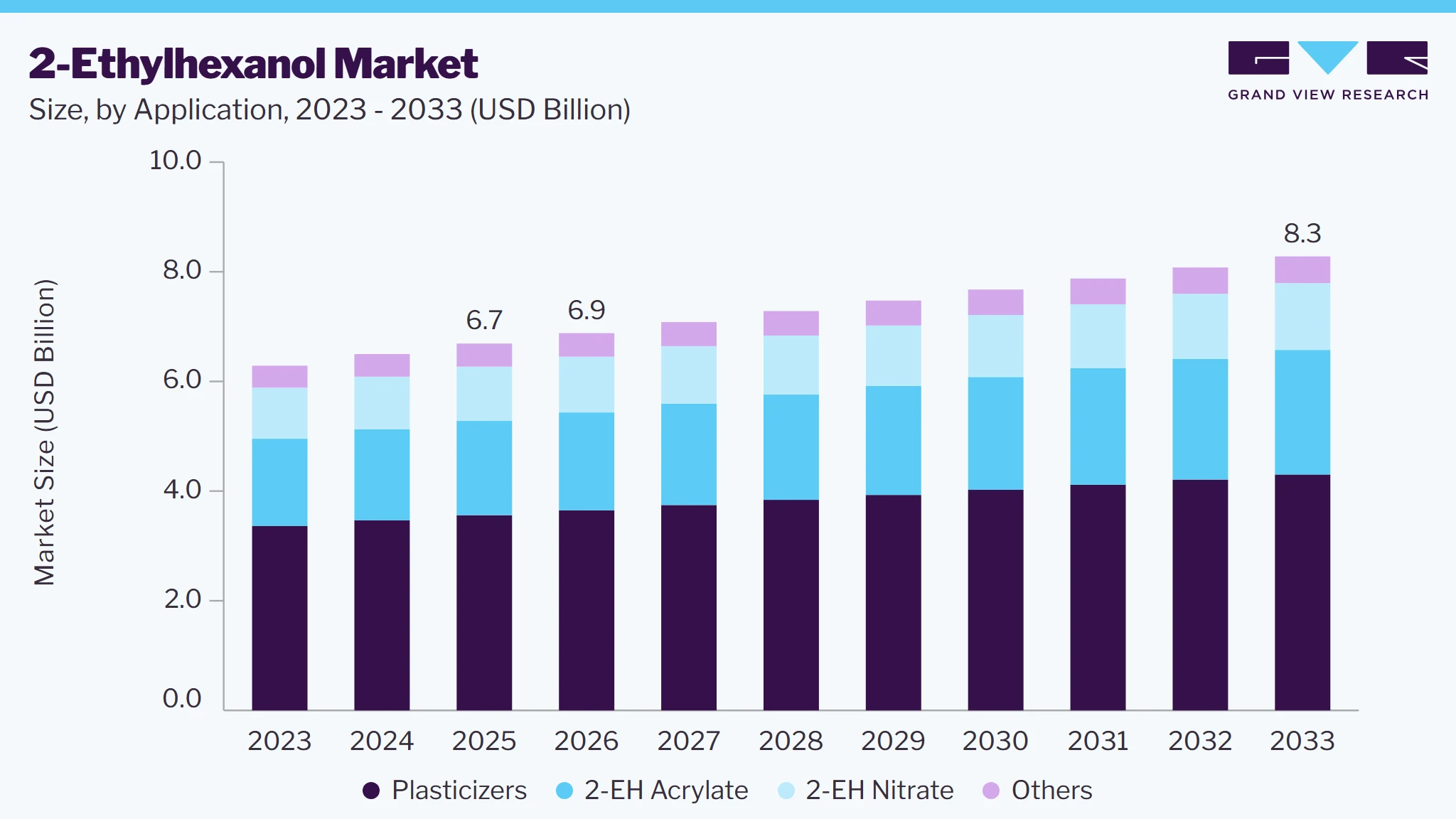
The market is primarily driven by its demand in various applications, particularly as a precursor for plasticizers in polyvinyl chloride (PVC) production. The growing construction and automotive industries contribute significantly to this demand due to the increasing use of flexible materials. In addition, the rise in the production of detergents and surfactants is boosting 2-EH consumption. Environmental regulations and a shift toward more sustainable products also influence market trends, prompting manufacturers to innovate and adapt. Furthermore, fluctuations in raw material prices can impact production costs and market dynamics.
This clear, odorless liquid is poorly soluble in water but mixes well with almost all organic solvents. The primary use of 2-ethylhexanol is in producing plasticizers, particularly dioctyl phthalate (DOP) and dioctyl terephthalate (DOTP), which are essential for creating flexible PVC. In addition, it plays a crucial role in synthesizing 2-ethylhexyl acrylate, a component found in paints, varnishes, and adhesives. Furthermore, 2-ethylhexanol is used to manufacture lubricants, herbicides, and other specialty chemicals. Its low volatility and ability to enhance the fluidity and flexibility of polymers underline its importance across various industrial applications, making it a vital chemical in the manufacturing sector.
2-ethylhexanol is primarily used in paints, coatings, adhesives, and construction industries. The robust growth of these sectors worldwide, particularly in emerging economies, is driven by increasing foreign investments and proactive policies to boost domestic demand. This trend is expected to be a key factor stimulating overall market growth.
The market is fragmented due to the presence of many manufacturers. It features a variety of raw materials used in the production of 2-EH and integration throughout the value chain. Technological innovations that introduce new processes to simplify 2-EH production are expected to drive demand in this market.
Market Dynamics
The 2-Ethylhexanol market is expanding due to steady consumption in plasticizers, acrylates, and specialty chemical formulations. Demand for flexible PVC products used in construction, automotive components, wires, cables, flooring, and packaging continues to increase across major economies. Growth in infrastructure projects and vehicle production supports higher plasticizer consumption, which directly influences 2-Ethylhexanol demand. Acrylate-based coatings, adhesives, and surface treatment products also require consistent supplies of 2-Ethylhexanol, creating a stable demand base across industrial and consumer applications.
A significant share of 2-Ethylhexanol production is used in the manufacture of plasticizers, particularly dioctyl phthalate and related compounds. These plasticizers improve flexibility, durability, and performance characteristics of PVC products used in flooring, wall coverings, cables, pipes, and automotive interiors. Growth in residential construction, commercial buildings, and transportation infrastructure continues to increase the requirement for these materials.
Automotive manufacturers also rely on flexible PVC components for interior applications, wiring systems, and protective coverings. As vehicle production increases across developing and established economies, demand for plasticizers remains strong. This consumption pattern creates sustained requirements for 2-Ethylhexanol, supporting production expansion and long term investment throughout the value chain.
Production of 2-Ethylhexanol depends heavily on petrochemical feedstocks such as propylene and syngas derived materials. Price fluctuations in crude oil and upstream petrochemical markets can significantly affect manufacturing costs. Sudden increases in feedstock prices often reduce profit margins, particularly when producers cannot immediately transfer higher costs to customers through product pricing.
The market is also influenced by supply disruptions within the petrochemical chain, including refinery maintenance, transportation constraints, and raw material shortages. These conditions can create uncertainty for manufacturers and buyers. Cost instability makes production planning more complex and may discourage capacity expansion decisions during periods of prolonged feedstock price volatility.
Growing use of acrylate esters in coatings, adhesives, sealants, and specialty formulations presents attractive opportunities for 2-Ethylhexanol manufacturers. Industries increasingly require durable surface protection products, decorative coatings, and industrial adhesives with improved performance characteristics. Since 2-Ethylhexanol serves as an important raw material in acrylate production, rising consumption supports future market potential.
Manufacturers can benefit by strengthening supply relationships with coating and adhesive producers while expanding production capabilities for high growth application areas. Demand from infrastructure renovation, industrial maintenance, and advanced manufacturing activities continues to support acrylate consumption. This environment creates opportunities for producers to diversify revenue sources beyond traditional plasticizer applications.
Analyst Perspective
The 2-Ethylhexanol market is experiencing steady growth due to its widespread use in plasticizer production, which remains the largest application segment. Demand from construction, automotive, coatings, and adhesives industries continues to support consumption across major markets. Strong downstream demand for flexible PVC products and acrylate derivatives is sustaining production activity. Asia-Pacific remains a key growth center, driven by expanding manufacturing output and increasing chemical production capacities.
Application Insights
The plasticizers segment accounted for the largest share of the 2-ethylhexanol market, representing 53.2% of total revenue in 2025. Plasticizers are utilized in various applications, including paints, rubber products, adhesives, sealants, and printing inks. Their use in these applications is strictly regulated due to their classification as hazardous products. The growth of the plastics industry, particularly in the Asia Pacific region, is expected to increase the demand for plasticizers, positively impacting the market.
2-EH Acrylate, derived from 2-Ethylhexanol, is a key component in producing various coatings, adhesives, and sealants. Its versatile properties make it suitable for applications requiring durability and flexibility, such as automotive and construction industries. The demand for eco-friendly and high-performance materials has further fueled its usage. Additionally, 2-EH Acrylate’s ability to enhance the chemical resistance and adhesion of formulations makes it a valuable ingredient in the acrylics segment, driving growth in the market.
Region Insights
North America is expected to experience significant growth, primarily driven by rising immigration, which increases the demand for housing and vehicles. Additionally, the need for coatings in various industries, especially aerospace and automotive, is contributing to the market for 2-ethylhexanol in the region. The automotive industry in North America is one of the largest in the world, and the increasing demand for high-performance coatings within this sector is further boosting the need for 2-ethylhexanol.
Asia Pacific 2-Ethylhexanol Market Trends
Asia Pacific accounted for 58.6% of the 2-ethylhexanol market revenue in 2025, making it the largest regional market. Asia Pacific 2-ethylhexanol market has a significant revenue share of the global demand for 2-EH and most end-use products. The region is expected to experience substantial growth during the forecast period, primarily due to China's high growth potential. Market players in the country are expanding their production capacity to meet the rising demand.
China maintained a leading position in the Asia Pacific 2-ethylhexanol market. It is expected to become the fastest-growing market, driven by the increasing demand for 2-ethylhexanol from various industries. Due to strong industrial growth, China is anticipated to be the Asia-Pacific primary revenue contributor. Factors such as increasing employment opportunities, economic strengthening, and rising disposable income support the growth of end-use industries like paints and coatings, plastics, and construction. In addition, growing investments in infrastructure in India, along with the government's Make in India initiative, will likely benefit the plasticizers and 2-EH acrylate segments.
Europe 2-Ethylhexanol Market Trends
The 2-ethyhexanol market in Europe is expected to experience steady growth throughout the forecast period. Various regulatory factors and changing end-user preferences have encouraged European coating companies to create multifunctional and sustainable solutions and offer value-added services to their customers. This trend is likely to have a positive impact on the European market during the forecast period. In addition, the expansion of the region's protective and automotive coating industries is anticipated to drive demand for these products.
Key 2-Ethylhexanol Company Insights
Several well-established companies, including a mix of medium and small regional players characterize the global market. Competition is fierce among market participants, as many are leading chemical companies with extensive distribution networks and a wide consumer base. Key players primarily serve industries such as paints and coatings, marine, transportation, and building and construction.
Key 2-Ethylhexanol Companies:
The following key companies have been profiled for this study on the 2-ethylhexanol market.
-
Dow
-
BASF SE
-
Eastman Chemical Company
-
SABIC
-
SINOPEC
-
Mitsubishi Chemical Corporation
-
LG Chem, Ltd.
-
INEOS Holdings Limited
-
Formosa Plastic Group
-
China National Petroleum Corporation
Competitive Benchmarking
Category
Operating Strategies
Competitive Edge
Weakness
Established Players (Dow, BASF SE, Eastman Chemical Company, SABIC, SINOPEC, Mitsubishi Chemical Corporation)
- Major producers emphasize integrated petrochemical operations, feedstock security, and large-scale manufacturing.
- Capacity optimization and global supply network expansion support stable product availability across key demand regions.
- Strong financial resources, extensive production infrastructure, and established customer relationships provide market leadership.
- Vertical integration improves cost efficiency and strengthens control over raw material sourcing.
- Large operational structures can reduce flexibility in responding to market changes.
- High capital expenditure requirements and exposure to feedstock price volatility may affect profitability during market fluctuations.
Category
Operating Strategies
Competitive Edge
Weakness
Emerging Players (LG Chem, INEOS Holdings Limited, Formosa Plastics Group, China National Petroleum Corporation (CNPC))
- These companies focus on regional expansion, operational efficiency improvements, and strengthening downstream chemical portfolios.
- Investments are directed toward serving growing demand centers, particularly across Asia-Pacific markets.
- Regional manufacturing presence, proximity to customers, and competitive production costs support market growth.
- Focused investments help improve responsiveness to changing customer and industry requirements.
- Compared with larger competitors, global market reach and brand influence can be more limited.
- Dependence on regional demand patterns may increase exposure to localized economic and industry cycles.
Recent Developments
-
In February 2024, Eastman partnered with Dentist Group Nord Pal Plast, a mechanical recycler, to enhance plastic recycling. This collaboration aims to improve plastic waste processing efficiency and expand the industry's recycling capabilities. By leveraging each other's expertise, the two companies seek to create a more sustainable approach to plastic recycling, ultimately contributing to reduced environmental impact and promoting circular economy principles.
2-Ethylhexanol Market Report Scope
Report Attribute
Details
Market size in 2025
USD 6.7 billion
Estimated market size in 2026
USD 6.9 billion
Projected market size by 2033
USD 8.3 billion
Growth rate
CAGR of 2.7% from 2026 to 2033
Base year for estimation
2025
Historical data
2021 - 2024
Forecast period
2026 - 2033
Quantitative units
Revenue in USD million/billion and CAGR from 2026 to 2033
Report coverage
Revenue forecast, company ranking, competitive landscape, growth factors, and trends
Segments covered
Application, region
Regional scope
North America; Europe; Asia Pacific; Latin America; MEA
Country scope
U.S.; Canada; Mexico; Germany; UK; France; Italy; Spain; China; Japan; India; South Korea; Brazil; Argentina; Saudi Arabia; South Africa;
Key companies profiled
Dow, BASF SE, Eastman Chemical Company, SABIC, SINOPEC, Mitsubishi Chemical Corporation, LG Chem, Ltd., INEOS Holdings Limited, Formosa Plastics Group, China National Petroleum Corporation (CNPC).
Customization scope
Free report customization (equivalent up to 8 analysts' working days) with purchase. Addition or alteration to country, regional & segment scope.
Pricing and purchase options
Avail customized purchase options to meet your exact research needs. Explore purchase options
Global 2-Ethylhexanol Market Report Segmentation
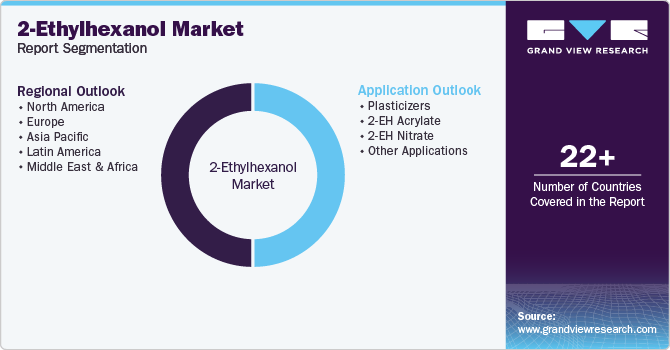
This report forecasts revenue and volume growth at the global, regional, and country levels and provides an analysis of the latest industry trends and opportunities in each of the sub-segments from 2021 to 2033. For this study, Grand View Research has segmented the global 2-ethylhexanol market report based on the application and region:
-
Application Outlook (Volume, Kilotons; Revenue, USD Million, 2021 - 2033)
-
Plasticizers
-
2-EH Acrylate
-
2-EH Nitrate
-
Other Applications
-
-
Regional Outlook (Volume, Kilotons; Revenue, USD Million, 2021 - 2033)
-
North America
-
U.S.
-
Canada
-
Mexico
-
-
Europe
-
Germany
-
UK
-
France
-
Italy
-
Spain
-
-
Asia Pacific
-
China
-
Japan
-
India
-
South Korea
-
-
Latin America
-
Brazil
-
Argentina
-
-
Middle East & Africa
-
Saudi Arabia
-
South Africa
-
-
Research Methodology
The 2-ethylhexanol market figures in this report are based on a proven research process that combines executive interviews with secondary research from proprietary databases, company filings, and recognized regulatory and institutional sources. Market size is built through value-chain sizing - reconciling supply-side and demand-side estimates - and triangulated with bottom-up and top-down approaches. Every estimate passes multiple levels of expert validation before publication, with each 2-ethylhexanol segment quantified using the revenue-capture definitions in the table below.
Segment Definition
Segment - Application
Revenue Capture Definition
Plasticizers
Revenue is captured through the sale of 2-Ethylhexanol used as a key raw material in the production of plasticizers for flexible PVC applications. Income is generated from continuous demand across construction, automotive, wire and cable, flooring, and packaging industries where plasticizers are required to improve flexibility, durability, and processing performance.
2-EH Acrylate
Revenue is generated through the supply of 2-Ethylhexanol for the manufacture of 2-EH acrylate used in coatings, adhesives, sealants, inks, and specialty formulations. Chemical producers capture value through recurring sales to downstream manufacturers seeking enhanced weather resistance, adhesion properties, and long-term performance in industrial and commercial applications.
2-EH Nitrate
Revenue is captured through the sale of 2-Ethylhexanol utilized in the production of 2-EH nitrate, a cetane improver commonly used in diesel fuel additives. Income is derived from demand within the fuel and transportation sectors, where additive manufacturers purchase 2-EH nitrate to improve combustion efficiency, fuel performance, and engine operation.
Other Applications
Revenue is generated through the supply of 2-Ethylhexanol for diverse chemical intermediates and specialty applications, including lubricants, solvents, extraction agents, and surfactants. Value is captured from sales to chemical processors and industrial manufacturers requiring 2-Ethylhexanol as a functional ingredient in various formulation and production processes.
Estimation Model
Layer Name
Key Question
Content
Downstream Industry Demand Base Layer
What forms the demand base?
Identify global demand from major downstream industries consuming 2-Ethylhexanol, including plasticizers, acrylates, fuel additives, lubricants, solvents, and specialty chemical intermediates. This layer establishes the total addressable demand generated by end-use sectors such as construction, automotive, packaging, coatings, adhesives, and chemicals.
Application Penetration Layer
Where is 2-Ethylhexanol consumed?
Estimate the utilization of 2-Ethylhexanol across key application segments including plasticizers, 2-EH acrylate, 2-EH nitrate, and other chemical intermediates. Demand is assessed based on application-specific consumption patterns, production requirements, and downstream industry adoption across major regional markets.
Consumption Intensity Layer
How much 2-Ethylhexanol is used?
Analyze average 2-Ethylhexanol consumption volumes required for the production of downstream products such as plasticizers, acrylates, fuel additives, and specialty formulations. Consumption intensity varies according to product specifications, manufacturing processes, regulatory requirements, and end-use performance characteristics.
Revenue Layer
How is market revenue generated?
Market revenue is quantified through the sale of 2-Ethylhexanol supplied to manufacturers of plasticizers, acrylates, fuel additives, lubricants, solvents, and specialty chemicals. Revenue is generated from recurring procurement by chemical producers, petrochemical companies, additive manufacturers, and downstream industrial processors operating across global markets.
Delivered Customizations
This report has been delivered with the following In-depth customizations
Client Request
Customization Delivered
Value Adds
Regional Segmentation
Detailed assessment of the 2-Ethylhexanol market across major regions, including demand trend, consumption patterns, pricing dynamics, and application-level opportunities. The analysis can also incorporate country-level evaluation within selected regions and provide insights for regions and countries outside the standard study scope based on specific client requirements.
Supports market entry planning, geographic expansion strategies, and investment decision-making by identifying regional growth pockets, supply-demand imbalances, and emerging opportunities. Enables stakeholders to evaluate both established and untapped markets through a broader regional and country-level perspective.
Competitive Benchmarking
Comprehensive benchmarking of leading 2-Ethylhexanol manufacturers based on production capacity, feedstock integration, geographic presence, application focus, distribution networks, expansion activities, and downstream market participation. The assessment evaluates each company's position within the global 2-Ethylhexanol value chain and competitive landscape.
Assists supplier selection, partnership evaluation, and competitive intelligence initiatives through a clear understanding of manufacturer strengths, market positioning, and operational capabilities across key regions and application sectors.
Opportunity Assessment
In-depth evaluation of growth opportunities linked to rising plasticizer consumption, expanding acrylate production, increasing demand for fuel additives, and growth in downstream specialty chemical applications. The analysis identifies regions, industries, and application segments expected to generate incremental demand for 2-Ethylhexanol over the forecast period.
Helps stakeholders identify high-potential revenue streams, target emerging demand centers, and develop expansion strategies focused on attractive end-use sectors and application areas with favorable long-term growth prospects.
Frequently Asked Questions About This Report
The global 2-ethylhexanol market is expected to grow at a compound annual growth rate of 2.7% from 2026 to 2033 to reach USD 8.3 billion by 2033.
Asia Pacific dominated the market with the largest revenue share of 58.6% in 2024.
Some key players operating in the 2-ethylhexanol market include The Dow Chemical Co., BASF SE, Eastman Chemical Company, Sigma-Aldrich, SABIC Industries, Grupa Azoty Zakłady Azotowe Kędzierzyn Spółka Akcyjna, Mitsubishi Chemical Corporation, and LG Chem, Ltd.
Key factors that are driving the market growth include increasing demand for 2-EH acrylate in the production of chemicals used in automotive and construction industries
Plasticizers segment accounted for the largest share of the 2-ethylhexanol market, representing 53.2% of total revenue in 2025.
The global 2-ethylhexanol market size was valued at USD 6.7 billion in 2025 and is expected to reach USD 6.9 billion in 2026.
About the Author(s)
Organic Chemicals Research Team
Bulk Chemicals · Organic ChemicalsThis report was authored by the organic chemicals research team at Grand View Research - comprising two research analysts, one senior research analyst, and one industry expert - with specialized expertise in the organic chemicals segment of the bulk chemicals industry. All findings are based on proprietary bulk chemicals databases, executive interviews, and regulatory analysis, subject to internal peer review prior to publication.
Last Updated:
Speak to Analyst

Need a Tailored Report?
Customize this report to your needs — add regions, segments, or data points, with 20% free customization.
Or view our licence options:


ISO 9001:2015 & 27001:2022 Certified
We are GDPR and CCPA compliant! Your transaction & personal information is safe and secure. For more details, please read our privacy policy.












