
- Home
- »
- Advanced Interior Materials
- »
-
3D Printing Filament Market Size & Share Report, 2026-2033GVR Report cover

3D Printing Filament Market (2026 - 2033) Size, Share & Trends Analysis Report By Type (Plastics, Metals, Ceramics), By Plastic (Polylactic Acid (PLA), Acrylonitrile Butadiene Styrene (ABS)), By Application (Industrial, Aerospace & Defense), By Region, And Segment Forecasts
Market Size, 2025
$1.1BMarket Estimate, 2026
$1.5BMarket Forecast, 2033
$7.1BCAGR, 2026–2033
25.4%3D Printing Filament Market Summary
The global 3D printing filament market size was valued at USD 1.1 billion in 2025 and is projected to grow from USD 1.5 billion in 2026 to USD 7.1 billion by 2033, at a CAGR of 25.4% from 2026 to 2033. The North America market held the largest share of 38.2% of the global market in 2025.
 Source: Grand View Research, IR Documents, Primary Interviews, Paid DatabasesTo learn more about this report,
 Download Free Sample Report
 Key Market Trends & Insights
- By type: Plastics segment held the largest revenue share of 61.3% in 2025
- By plastic: Polylactic acid (PLA) segment held the largest revenue share of 38.6% in 2025
- By application: Aerospace & defense segment held the largest revenue market share of 27.6% in 2025
Regional Highlights
- Largest regional market: North America (38.2% revenue share, 2025)
- Fastest-growing regional market: Asia Pacific (highest CAGR, 2026-2033)
- The U.S. 3D printing filament industry in the U.S. held the largest revenue share in 2025.
Market Size & Forecast
- Market size in 2025: USD 1.1 Billion
- Estimated market size in 2026: USD 1.5 Billion
- Projected market size by 2033: USD 7.1 Billion
- CAGR (2026-2033): 25.4%
Three ways to get this report
Buy it, customize it, or ask a question.Ask an Analyst
Analyst response in 1 business day
- AccessReport author, directly
- Reply timeWithin 1 working day
- No sales callDirect answer only
- FormatEmail reply
- CostFree, no cost
Get the Full Report
What the study covers
- FormatsPDF · Excel · Dashboard
- Timeline2026–2033 annual, 2025 base
- Coverage20+ countries, 5 regions
- Companies10+ key players profiled
Customize the Report
20% free customization
- IncludeCountries, segments, points
- TailorTo your product definition
- ExtendDeeper competitor detail
- OrA fully bespoke study
- Turnaround5–10 working days
Companies are increasingly shifting from traditional manufacturing to 3D printing to enable rapid prototyping, customization, and reduced material wastage. The growing need for lightweight and complex structures, particularly in aerospace and automotive sectors, is further boosting filament consumption. In addition, the rise of small-scale manufacturing and hobbyist usage has significantly contributed to market expansion. Educational institutions are also incorporating 3D printing technologies into their curriculum, increasing filament usage. To learn more about this report, Download Free Sample Report
 Key drivers of the market for 3D printing filament include technological advancements in material science and increasing industrial applications. The development of high-performance filaments such as carbon fiber-reinforced polymers, flexible filaments, and bio-based materials is enabling new use cases. Growth in sectors such as healthcare, prosthetics, and dental applications is significantly driving demand. The automotive industry is leveraging 3D printing for rapid tooling and component manufacturing, further accelerating filament consumption. Moreover, the push for supply chain optimization and localized manufacturing is encouraging companies to adopt additive manufacturing solutions.
The market is witnessing continuous innovation in filament materials and printing technologies. The development of eco-friendly and biodegradable filaments, such as PLA blends, is gaining traction amid sustainability concerns. Advanced filaments with enhanced properties such as heat resistance, strength, and flexibility are expanding industrial applications. Multi-material and composite filaments are becoming increasingly popular for complex manufacturing needs. Companies like Evonik Industries AG and Arkema S.A. are focusing on high-performance polymers for 3D printing. The integration of smart materials and conductive filaments is opening new opportunities in electronics and IoT applications.
Market Dynamics
The growing adoption of additive manufacturing technologies across industries such as aerospace, automotive, healthcare, consumer goods, and industrial manufacturing is a major factor driving demand for 3D printing filaments. Manufacturers are increasingly utilizing 3D printing for rapid prototyping, product customization, tooling, and low-volume production, owing to its ability to reduce material waste, shorten production cycles, and enhance design flexibility. Rising investments in advanced manufacturing technologies and digital production workflows are further supporting market expansion.
In addition, the increasing availability of high-performance and specialty filaments such as carbon fiber-reinforced, metal-filled, biodegradable, and engineering-grade thermoplastics is expanding the application scope of 3D printing. The growing demand for lightweight components, customized medical devices, and cost-effective production solutions is encouraging wider adoption of filament-based 3D printing technologies across commercial and industrial applications worldwide.
The 3D printing filament market faces challenges due to the relatively high cost of specialty and engineering-grade filaments compared to conventional manufacturing materials. In addition, limitations related to mechanical strength, thermal resistance, dimensional accuracy, and print consistency in certain filament materials restrict their adoption in high-performance and large-scale industrial applications. Variability in filament quality and compatibility issues across different 3D printers also create operational challenges for end users, limiting broader market penetration.
Market Concentration & Characteristics
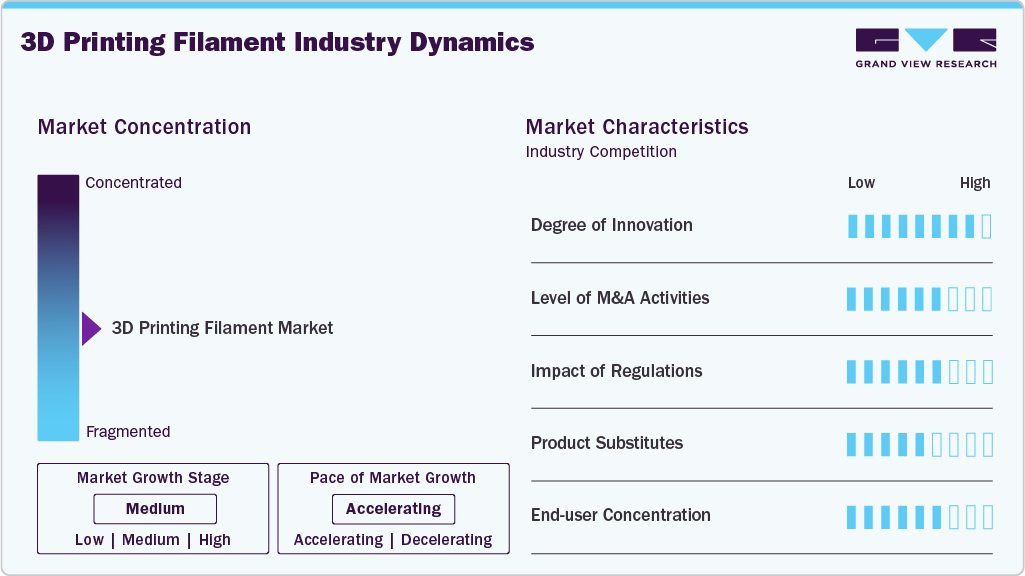
The 3D printing filament industry is moderately fragmented, with the presence of both global players and numerous regional manufacturers. Leading companies focus on product innovation, material diversification, and strategic partnerships to strengthen their market position. The entry barriers are relatively moderate, allowing new players to enter the market with specialized offerings. Competitive intensity is high due to continuous technological advancements and pricing strategies. Companies are also expanding their global footprint through collaborations and distribution networks. Mergers and acquisitions are gradually increasing to consolidate market presence. Overall, the market exhibits a mix of consolidation and fragmentation.
 To learn more about this report, Download Free Sample Report
 The primary substitutes for 3D printing filaments include alternative additive manufacturing materials such as resins used in stereolithography (SLA) and powders used in selective laser sintering (SLS). These materials offer different advantages, such as higher resolution or better mechanical properties, depending on the application. In addition, traditional manufacturing methods like injection molding and CNC machining continue to pose competition, especially for large-scale production. However, filaments remain preferred for cost-effective and rapid prototyping applications. The growing adoption of metal and ceramic 3D printing technologies could also impact filament demand in certain industries. Despite these substitutes, the versatility and affordability of filament-based printing maintain its strong market position.
Type Insights
The plastics segment held the largest revenue share of 61.3% in 2025, due to its wide applicability, cost-effectiveness, and ease of processing. Materials such as PLA, ABS, PETG, and nylon are extensively used across industries for prototyping and functional parts. Plastics offer advantages like lightweight properties, flexibility, and compatibility with most desktop and industrial 3D printers. Their availability in a variety of formulations and colors further enhances their adoption. Additionally, the growing demand from consumer goods and educational sectors continues to support segment dominance.
The metal segment is expected to grow at a CAGR of 25.0% over the forecast period, due to increasing demand for high-strength and durable components in industrial applications. Metal filaments are gaining traction in aerospace, automotive, and healthcare sectors where precision and performance are critical. Advancements in metal-infused filaments and sintering technologies are improving print quality and expanding use cases. Although relatively expensive compared to plastics, metals offer superior mechanical properties and thermal resistance. The shift toward end-use part production is further driving segment growth.
Plastic Insights
The polylactic acid (PLA) segment held the largest revenue share of 38.6% in 2025, owing to its biodegradability, ease of printing, and affordability. PLA is widely preferred by beginners, educational institutions, and professionals for rapid prototyping. Its low warping characteristics and minimal odor during printing make it highly user-friendly. In addition, increasing environmental concerns are driving the adoption of bio-based materials like PLA. The material’s versatility across various applications continues to support its leading position in the market.
The acrylonitrile butadiene styrene (ABS) segment is expected to grow at a CAGR of 25.5% over the forecast period, due to its superior strength, impact resistance, and durability. ABS is widely used in automotive and industrial applications where functional performance is essential. Its ability to withstand higher temperatures compared to PLA makes it suitable for engineering applications. Continuous improvements in ABS formulations to reduce warping and emissions are enhancing its adoption. The growing demand for robust and long-lasting 3D printed parts is driving this segment’s expansion.
Application Insights
The aerospace & defense segment held the largest revenue market share of 27.6% in 2025, due to the extensive use of 3D printing for lightweight and high-performance components. Filaments are used for rapid prototyping, tooling, and even end-use parts in aircraft and defense equipment. The need for weight reduction and fuel efficiency is a major factor driving adoption. In addition, strict performance requirements encourage the use of advanced filament materials. Continuous investments in additive manufacturing technologies further support segment dominance.
 To learn more about this report, Download Free Sample Report
 The healthcare segment is expected to grow at a CAGR of 25.5% over the forecast period, driven by the increasing adoption of 3D printing in medical devices, prosthetics, and dental solutions. Filaments are widely used to produce customized and patient-specific products, improving treatment outcomes. The rising demand for biocompatible and sterilizable materials is further driving innovation in this segment. Advancements in medical-grade filaments are enabling new applications in surgical planning and implants. Growing healthcare investments and technological adoption are key factors supporting segment growth.
Regional Insights
North America 3D printing filament industry dominated the global market and accounted for the largest revenue share of 38.2% in 2025, due to its advanced technological ecosystem and early adoption of additive manufacturing. The region benefits from strong research and development capabilities, along with widespread industrial adoption across aerospace, healthcare, and automotive sectors. High investment in innovation and digital manufacturing is supporting continuous material advancements. The presence of a well-established infrastructure for advanced manufacturing further strengthens market growth. Additionally, increasing demand for customized and high-performance products is driving filament consumption. Educational institutions and research centers are actively promoting 3D printing technologies. Government support and funding initiatives are also contributing to market expansion.
 To learn more about this report, Download Free Sample Report
 U.S. 3D Printing Filament Market Trends
The U.S. 3D printing filament industry leads the regional market due to early adoption of 3D printing technologies. Aerospace and defense industries are major consumers of filament materials. Companies are focusing on developing high-performance and specialty filaments. Government initiatives and funding support innovation. The presence of research institutions enhances technological advancements. Increasing demand for rapid prototyping is boosting filament usage. The market is also witnessing growth in healthcare applications.
Asia Pacific 3D Printing Filament Market Trends
Asia Pacific 3D printing filament industry is emerging as a fast-growing market due to its strong manufacturing base and rapid adoption of advanced production technologies. Countries across the region are increasingly integrating additive manufacturing into industrial processes to enhance efficiency and reduce costs. The availability of low-cost raw materials and labor further supports large-scale filament production and consumption. Growing investments in industrial automation and digital manufacturing are accelerating the use of 3D printing across sectors such as automotive, electronics, and healthcare.
China 3D printing filament industry is a major contributor to the regional market, driven by its robust manufacturing sector. The country is investing heavily in advanced manufacturing technologies, including 3D printing. Domestic companies are focusing on developing cost-effective filament materials. Government support and favorable policies are encouraging innovation. The expansion of industrial applications is boosting filament demand. China’s focus on self-reliance in manufacturing further supports market growth.
Europe 3D Printing Filament Market Trends
Europe 3D printing filament industry is experiencing steady growth in the global market due to increasing focus on sustainability. Countries are investing in eco-friendly materials and recycling technologies. The automotive and aerospace sectors are key contributors to demand. Companies are emphasizing high-performance and specialty filaments. Government regulations promoting sustainable manufacturing are influencing market trends. Collaborative research initiatives are driving innovation. The region’s strong industrial base supports growth.
Germany 3D printing filament industry is a leading market in Europe due to its advanced manufacturing sector. The country is focusing on Industry 4.0 and digital transformation. Automotive companies are major users of 3D printing filaments. Research institutions are actively developing new materials. Government support for innovation is driving market growth. The presence of established industry players enhances competitiveness. Germany’s focus on precision engineering supports filament demand.
Latin America 3D Printing Filament Market Trends
Latin America 3D printing filament industry is witnessing gradual growth in the global market. Increasing adoption of 3D printing in education and small businesses is driving demand. Countries like Brazil and Mexico are investing in advanced manufacturing technologies. The market is still in the early stages but shows strong potential. Government initiatives are supporting innovation and entrepreneurship. The availability of low-cost solutions is encouraging adoption.
Middle East & Africa 3D Printing Filament Market Trends
The Middle East & Africa 3D printing filament industry is emerging as a potential market for 3D printing filaments. Increasing investments in infrastructure and construction are driving adoption. Governments are focusing on diversifying economies through advanced technologies. The healthcare sector is also adopting 3D printing for medical applications. The market is supported by rising awareness and technological advancements. Educational initiatives are promoting adoption.
Key 3D Printing Filament Company Insights
Some of the key players operating in the market include Stratasys, Ltd. and Arkema S.A.
-
Stratasys, Ltd. is a leading player in the additive manufacturing industry, offering advanced 3D printing solutions along with a wide range of high-performance filament materials. The company focuses on industrial-grade applications, supporting sectors such as aerospace, automotive, and healthcare with reliable and innovative material offerings.
-
Arkema S.A. is a key materials provider in the 3D printing filament industry, specializing in high-performance polymers and specialty materials. The company emphasizes innovation in advanced thermoplastics and sustainable solutions, catering to demanding industrial applications.
ColorFabb and MatterHackers are some of the emerging market participants in the 3D printing filament industry.
-
ColorFabb is a prominent filament manufacturer known for its diverse portfolio of specialty and composite filaments. The company focuses on delivering high-quality, customizable materials for both professional users and advanced hobbyists.
-
MatterHackers is a well-known provider of 3D printing materials, including a broad range of filaments for desktop and industrial applications. The company supports the market through material distribution, product development, and strong engagement with the maker and professional communities.
Key 3D Printing Filament Companies:
The following key companies have been profiled for this study on the 3D printing filament market.
- Stratasys, Ltd.
- Arkema S.A
- Evonik Industries AG
- UltiMaker
- Polymaker
- eSUN
- MatterHackers
- ColorFabb
- 3DXTECH
- Bambu Lab
Competitive Benchmarking
Operating Strategies
Competitive Edge
Weaknesses
Mature Players: Stratasys, Ltd.; Arkema S.A.; Evonik Industries AG
- Investments in advanced polymer formulation and high-performance engineering filaments
- Expansion of material compatibility across industrial-grade 3D printing platforms
- Focus on sustainable and bio-based filament materials to strengthen product portfolios
- Strong brand recognition and established industrial customer base
- Broad portfolio of specialty and engineering-grade filament materials
- Advanced R&D capabilities and strong material innovation expertise
- High dependence on industrial manufacturing demand and capital spending cycles
- Premium pricing limits adoption among small-scale and entry-level users
Emerging Players: MatterHackers; ColorFabb; 3DXTECH
- Focus on niche and customized filament solutions for specialized applications
- Expansion through online distribution channels and regional reseller partnerships
- Greater flexibility in responding to evolving customer preferences and niche requirements
- Strong focus on specialty, composite, and customized filament materials
- Limited global manufacturing and distribution presence compared to established players
- Lower production capacities and weaker economies of scale
Recent Developments
-
In March 2025, Bambu Lab launched the H2D multi-functional system, integrating 3D printing with laser cutting and plotting, supporting multi-material usage and enhancing filament-based printing capabilities for advanced users.
-
In February 2024, Evonik Industries AG launched INFINAM FR 4100 L resin for additive manufacturing, offering flame-resistant and flexible properties, reflecting broader innovation in advanced 3D printing materials, including filament-grade polymers.
3D Printing Filament Market Report Scope
Report Attribute
Details
Market size in 2025
USD 1.1 Billion
Estimated market size in 2026
USD 1.5 billion
Projected market size by 2033
USD 7.1 billion
Growth rate
CAGR of 25.4% from 2026 to 2033
Base year for estimation
2025
Actual estimates/Historical data
2021 - 2024
Forecast period
2026 - 2033
Quantitative units
Revenue in USD million/billion and CAGR from 2026 to 2033
Report coverage
Revenue forecast, company ranking, competitive landscape, growth factors, and trends
Segments covered
Type, plastic, application, region
Regional scope
North America, Europe, Asia Pacific, Latin America, Middle East & Africa
Country scope
U.S.; Canada; Mexico; Germany; UK; France; China; Japan; India; Brazil
Key companies profiled
Stratasys, Ltd.; Arkema S.A.; Evonik Industries AG; UltiMaker; Polymaker; eSUN; MatterHackers; ColorFabb; 3DXTECH; Bambu Lab
Customization scope
Free report customization (equivalent up to 8 analysts working days) with purchase. Addition or alteration to country, regional & segment scope.
Pricing and purchase options
Avail customized purchase options to meet your exact research needs. Explore purchase options
Global 3D Printing Filament Market Report Segmentation
This report forecasts revenue growth at regional & country levels and provides an analysis on the industry trends in each of the sub-segments from 2021 to 2033. For this study, Grand View Research has segmented the global 3D printing filament market report based on type, plastic, application, and region:
 To learn more about this report, Download Free Sample Report
 -
Type Outlook (Revenue, USD Billion, 2021 - 2033)
-
Plastics
-
Metals
-
Ceramics
-
Others
-
-
Plastic Outlook (Revenue, USD Billion, 2021 - 2033)
-
Polylactic acid (PLA)
-
Acrylonitrile butadiene styrene (ABS)
-
Polyethylene terephthalate glycol (PETG)
-
Acrylonitrile styrene acrylate (ASA)
-
Others
-
-
Application Outlook (Revenue, USD Billion, 2021 - 2033)
-
Industrial
-
Aerospace & Defense
-
Automotive
-
Healthcare
-
Others
-
-
Regional Outlook (Revenue, USD Billion, 2021 - 2033)
-
North America
-
U.S.
-
Canada
-
Mexico
-
-
Europe
-
UK
-
Germany
-
France
-
Italy
-
Spain
-
-
Asia Pacific
-
China
-
Japan
-
India
-
-
Latin America
-
Brazil
-
Argentina
-
-
Middle East and Africa
-
Delivered Customizations
This report has been delivered with the following In-depth customizations
Client Request
Customization Delivered
Value Adds
Regional Segmentation
In-depth regional analysis of the 3D printing filament market. The assessment includes evaluation of regional manufacturing ecosystems, adoption of additive manufacturing technologies, availability of raw materials, investment trends, and country-level demand outlook across industrial and consumer applications.
Enable identification of region-specific growth opportunities and manufacturing hubs. Support strategic expansion planning, distribution network optimization, and understanding of regional technology adoption patterns and supply chain dynamics.
Competitive Benchmarking
Benchmarking of key 3D printing filament manufacturers based on product portfolio, production capacity, geographic presence, material innovation capabilities, pricing strategy, distribution network, and strategic initiatives such as partnerships, acquisitions, and new product launches.
Enable comparison of competitive positioning and identification of strategic gaps, differentiation opportunities, and innovation trends across the 3D printing filament industry.
Opportunity Assessment
Evaluation of growth opportunities across filament materials, printing technologies, applications, and end-use industries including aerospace, automotive, healthcare, consumer products, electronics, and industrial manufacturing, along with analysis of sustainable filament trends and advanced material development.
Identify high-growth applications and emerging demand areas. Support product development, market entry, and expansion strategies driven by increasing adoption of additive manufacturing technologies and high-performance printing materials.
Frequently Asked Questions About This Report
The global 3D printing filament market size was estimated at USD 1.1 billion in 2025 and is expected to reach USD 1.5 billion in 2026.
The global 3D printing filament market is expected to grow at a compound annual growth rate of 25.4% from 2026 to 2033 to reach USD 7.1 billion by 2033.
North America dominated with a 38.2% revenue share in 2025.
Asia Pacific is the fastest-growing region over the forecast period.
The polylactic acid (PLA) segment held the largest revenue share of 38.6% in 2025.
The aerospace & defense segment held the largest revenue market share of 27.6% in 2025.
The plastics segment held the highest revenue share of 61.3% in 2025, due to its wide applicability, cost-effectiveness, and ease of processing.
Some key players in the 3D printing filament market include Stratasys, Ltd., Arkema S.A, Evonik Industries AG, UltiMaker, Polymaker, eSUN, MatterHackers, ColorFabb, Bambu Lab, and 3DXTECH.
Rising adoption of additive manufacturing across industries, advancements in high-performance and sustainable materials, and increasing demand for rapid prototyping and customized production are key factors driving the 3D printing filament market.
About the Author(s)
Advanced Interior Materials Research Team
Advanced Materials · Advanced Interior MaterialsThis report was authored by the advanced interior materials research team at Grand View Research - comprising two research analysts, one senior research analyst, and one industry expert - with specialized expertise in the advanced interior materials segment of the advanced materials industry. All findings are based on proprietary advanced materials databases, executive interviews, and regulatory analysis, subject to internal peer review prior to publication.
Last Updated:
Speak to Analyst

Customize this report to your needs - add regions, segments, or data points, with 20% free customization.
Or view our licence options:


ISO 9001:2015 & 27001:2022 Certified
We are GDPR and CCPA compliant! Your transaction & personal information is safe and secure. For more details, please read our privacy policy.


