
- Home
- »
- Healthcare IT
- »
-
FemTech Market Size, Share & Trends Report, 2026-2033GVR Report cover

FemTech Market (2026 - 2033)
Size, Share & Trends Analysis Report By Type (Devices, Software, Services, Consumer Products), By Application (Menstrual Health, General Health), By End-use (Direct to Consumer, Hospitals, Fertility Clinics), By Region, And Segment Forecasts
Market Size, 2025
$45.6BMarket Estimate, 2026
$52.9BMarket Forecast, 2033
$145.5BCAGR, 2026–2033
15.5%FemTech Market Summary
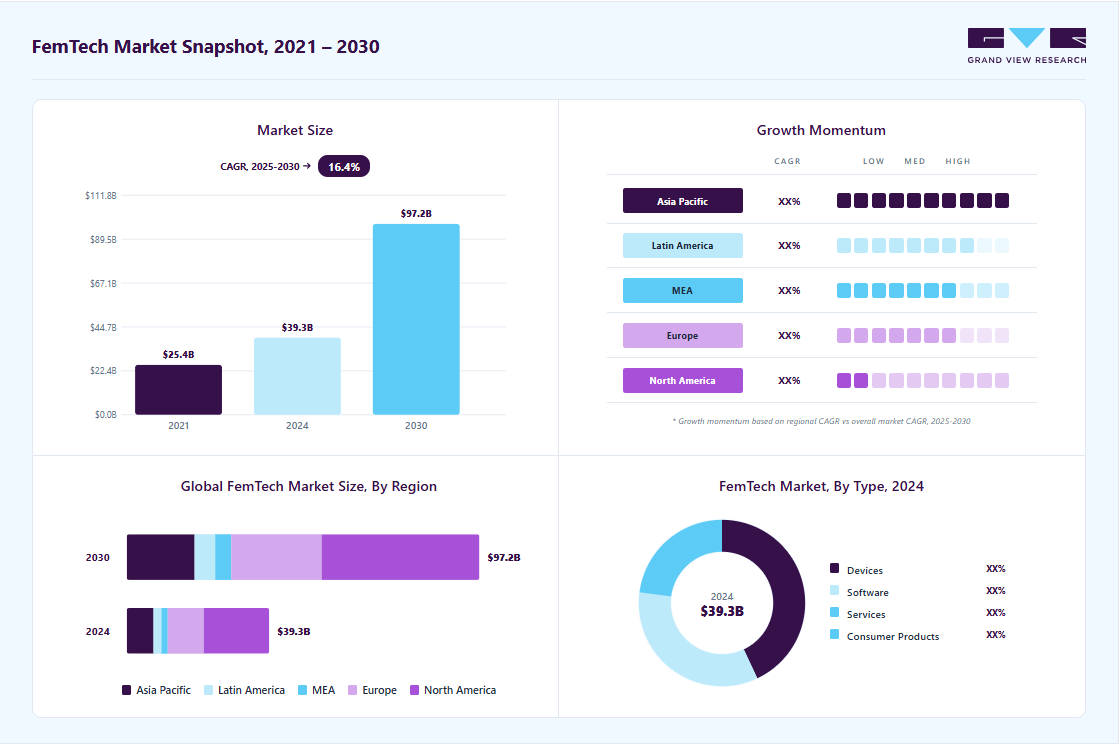
The global femtech market size was valued at USD 45.6 billion in 2025 and is projected to grow from USD 52.9 billion in 2026 to USD 145.5 billion in 2033, at a CAGR of 15.5% from 2026 to 2033. North America dominated the market, accounting for the largest share of 45.7% in 2025. The growth of the femtech industry is driven by rising awareness of women's health, the adoption of digital healthcare solutions, and the growing demand for technologies for fertility, pregnancy, menstrual, and menopause management.
 Source: Grand View Research, IR Documents, Primary Interviews, Paid DatabasesTo learn more about this report,
 Download Free Sample Report
 Key Market Trends & Insights
- By type: Devices segment held the largest share of 33.4% 2025
- By end use: Direct-to-consumer segment held the largest share of 30.7% in 2025
- By application: Pregnancy and nursing care segment held the largest share of 17.7% in 2025
Regional Highlights
- Largest regional market: North America (45.7% revenue share, 2025)
- Fastest-growing regional market: Asia Pacific (fastest CAGR, 2026-2033)
- By country: The U.S. held the largest revenue share of North America in 2025.
Market Size & Forecast
- Market Size in 2025: USD 45.6 Billion
- Estimated Market Size in 2026: USD 52.9 Billion
- Projected Market Size by 2033: USD 145.5 Billion
- CAGR (2026-2033): 15.5%
Three ways to get this report
Buy it, customize it, or ask a question.Ask an Analyst
A direct answer, usually in 1 working day
- AccessReport author, directly
- Reply timeWithin 1 working day
- No sales callDirect answer only
- FormatEmail reply
- CostFree, no cost
Get the Full Report
What the study covers
- FormatsPDF · Excel · Dashboard
- Timeline2026–2033 annual, 2025 base
- Coverage20+ countries, 5 regions
- Companies10+ key players profiled
Customize the Report
20% free customization
- IncludeCountries, segments, points
- TailorTo your product definition
- ExtendDeeper competitor detail
- OrA fully bespoke study
- Turnaround5–10 working days
In addition, the rising prevalence of infertility, PCOS, endometriosis, menopause-related conditions, and other reproductive health disorders is increasing the demand for femtech solutions. The growing adoption of mobile health applications, wearable devices, virtual care platforms, and AI-enabled diagnostic tools is improving access to personalized women’s healthcare. Companies such as Flo Health, Maven Clinic, Clue, Natural Cycles, Elvie, and Willow are strengthening their digital health offerings across fertility, menstrual health, pregnancy, menopause, and preventive care, thereby supporting the market expansion.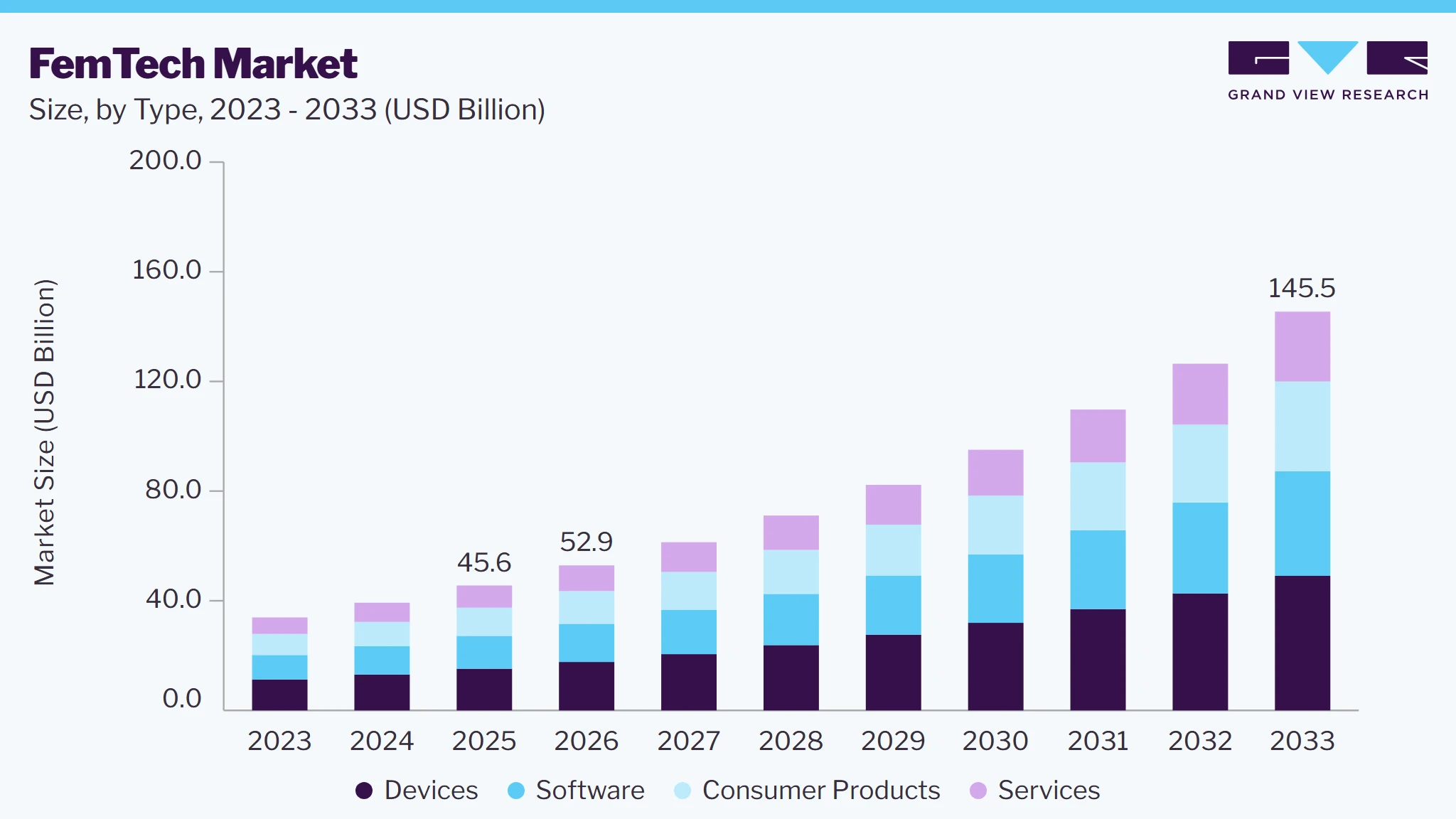 To learn more about this report, Download Free Sample Report
 Rising investment in women’s health startups is also supporting market growth by enabling companies to expand their product portfolios, strengthen technology capabilities, and improve access to digital care solutions. For instance, Maven Clinic raised USD 125 million in Series F funding in October 2024, increasing its valuation to USD 1.7 billion. The funding is expected to support the expansion of AI-enabled women’s healthcare services, fertility benefits, menopause care, and global digital health solutions. In 2025, Maven further partnered with ŌURA to integrate wearable biometric data into personalized women’s healthcare, highlighting the growing role of connected health technologies in femtech.
Market Dynamics
AI-powered women’s health platforms are accelerating the shift toward personalized and preventive care. These solutions support menstrual tracking, fertility planning, pregnancy monitoring, menopause management, and early risk assessment using real-time health data. AI-enabled platforms also improve access to care through virtual consultations, predictive analytics, and tailored health recommendations.
For instance, in June 2025, NITI Aayog’s Frontier Tech Hub recognized Mind & Mom, a Chennai-based femtech company, for its AI-driven maternal healthcare platform. The platform has supported over 200,000 women through menstrual cycle tracking, fertility planning, IVF guidance, pregnancy monitoring, and personalized maternal health recommendations. Similarly, at CES 2025, IdentifyHer launched Peri, an AI-enabled wearable for perimenopause support, demonstrating the growing use of AI in underserved areas of women’s health.
Data privacy concerns are restraining the femtech market’s growth, as platforms collect sensitive information such as menstrual cycles, fertility patterns, pregnancy status, reproductive history, and hormonal health data. Concerns about the misuse or sharing of this data can erode user trust and slow adoption of fertility-tracking apps, menstrual-health platforms, and digital reproductive-health solutions.
Regulatory scrutiny is also increasing compliance costs for femtech companies. For instance, in 2023, the U.S. Federal Trade Commission took action against Easy Healthcare Corporation, developer of the Premom fertility tracking app, over allegations of sharing sensitive reproductive health data with third parties without adequate consent. Such cases highlight the need for stronger data protection, consent management, and privacy compliance, which can increase operational burden and limit scalability, especially for early-stage startups.
The growing adoption of employer-sponsored women’s health benefits is creating opportunities for femtech companies. Employers are increasingly offering fertility, maternity, postpartum, menopause, and reproductive health support to improve employee wellness and retention, driving demand for digital platforms that provide virtual consultations, care navigation, and personalized health programs.
For instance, in 2024, Maven Clinic raised USD 125 million in Series F funding, reaching a valuation of USD 1.7 billion, supported by rising demand from employers and health plans. The company serves more than 2,000 customers across 175 countries through fertility, pregnancy, parenting, and menopause care solutions. Similarly, companies such as Carrot Fertility are supporting employer-sponsored fertility benefits, including fertility preservation, assisted reproduction, adoption, and surrogacy navigation. This shift is expected to support demand for subscription-based and enterprise femtech platforms.
Market Characteristics & Concentration
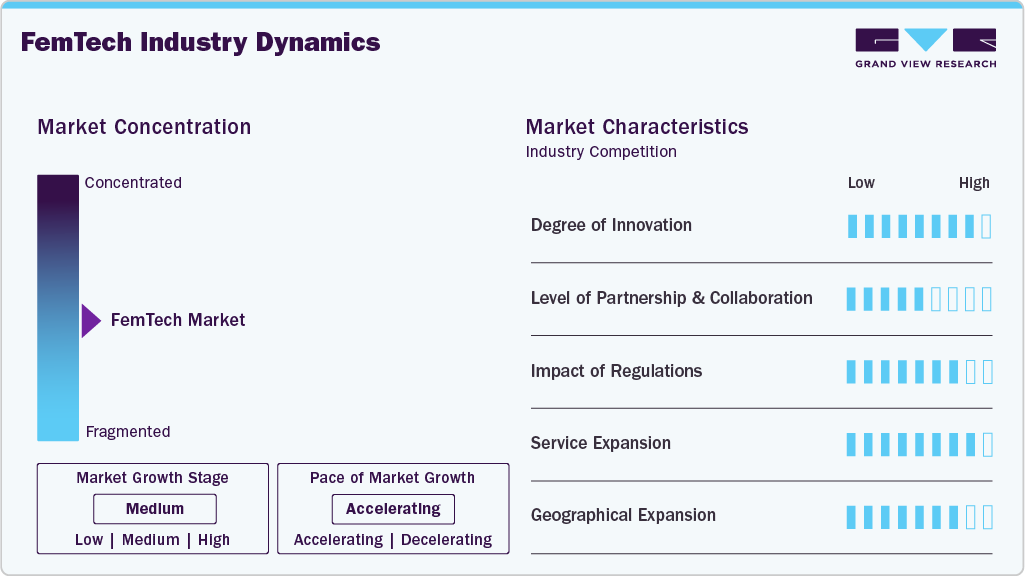
The chart below represents the relationship between industry concentration, industry characteristics, and industry participants. The femtech market remains fragmented, with numerous startups, digital health providers, medical device manufacturers, and healthcare platforms competing across fertility, pregnancy, menopause, menstrual health, pelvic care, and women's chronic disease management. The industry is characterized by a high degree of innovation, strong regulatory influence, moderately high levels of partnerships and collaborations, high service and product expansion, and high regional expansion. Growing investment in AI-enabled diagnostics, virtual care platforms, and personalized women's healthcare solutions continues to reshape the competitive landscape.
Strategic collaborations continue to strengthen product development, clinical validation, and commercialization across the femtech ecosystem. Partnerships between healthcare providers, technology companies, pharmaceutical firms, and digital health startups are helping expand access to women's healthcare services. In January 2025, Maven Clinic partnered with Amazon to provide comprehensive fertility, maternity, and menopause support for eligible employees through employer-sponsored healthcare benefits. Similarly, healthcare systems are increasingly collaborating with femtech companies to integrate virtual women's health services into routine clinical care, improving accessibility while supporting long-term market growth.
 To learn more about this report, Download Free Sample Report
 The femtech industry operates under stringent regulatory frameworks due to the clinical nature of many products, including medical devices, diagnostic software, and digital therapeutics. Regulatory approvals from agencies such as the U.S. Food and Drug Administration (FDA), the European Medicines Agency (EMA), and the UK Medicines and Healthcare Products Regulatory Agency (MHRA) are essential before commercialization. In 2024, the FDA continued expanding oversight of AI-enabled Software as a Medical Device (SaMD), requiring robust clinical validation, cybersecurity, and lifecycle monitoring for AI-based diagnostic tools. These evolving regulatory requirements increase development costs but also improve product quality, safety, and market confidence.
Companies are rapidly expanding beyond fertility and pregnancy solutions into menopause care, pelvic health, breast health, cardiovascular risk assessment, mental health, hormonal disorders, and preventive care. In May 2025, Maven Clinic expanded its integrated digital care platform by introducing enhanced menopause and midlife health services alongside fertility and maternity offerings for employers and health plans. Similarly, several femtech companies launched AI-enabled screening tools, at-home diagnostics, and virtual care services to address previously underserved areas of women's health, significantly broadening the industry's service portfolio.
Integration of AI in the FemTech Industry
AI is transforming the FemTech industry by enabling more predictive, personalized, and data-driven women’s healthcare solutions. AI-powered platforms are increasingly being used for menstrual health management, fertility tracking, pregnancy monitoring, menopause care, and early disease detection, improving diagnostic accuracy and clinical decision-making.
For instance, in June 2026, Xella Health launched an AI-powered precision health platform focused on XX-chromosome biology to improve diagnostic accuracy and address gaps in women’s health research. Similarly, in June 2025, Flo Health adopted the Databricks Data Intelligence Platform to strengthen AI-driven cycle prediction and personalized health recommendations.
These developments highlight the growing role of AI in improving personalization, early intervention, user engagement, and data-driven care delivery across the industry.
Type Insights
The devices segment dominated the femtech market with a revenue share of 33.4% in 2025 and is expected to grow at the fastest CAGR of 15.70% during the forecast period. Growth is driven by the rising adoption of wearable devices for menstrual health, fertility tracking, pregnancy monitoring, and menopause management. Advancements in biosensors, AI, wireless connectivity, and real-time monitoring are further increasing demand for connected femtech devices.
For instance, in 2025, Movano Health advanced the commercialization of its Evie Ring. This women-focused smart ring tracks menstrual cycles, sleep, heart rate, blood oxygen levels, stress, and other health metrics, reflecting the growing demand for personalized, continuous health-monitoring solutions.
The software segment accounted for the second-largest market share in 2025 and is expected to grow significantly during the forecast period. Growth is supported by rising smartphone penetration, digital healthcare adoption, and increasing demand for AI-powered women’s health apps used for menstrual tracking, fertility planning, pregnancy support, menopause care, and virtual consultations.
For instance, in May 2025, HeraMED partnered with Teladoc Health to integrate its digital pregnancy monitoring platform with Teladoc’s virtual care ecosystem, supporting the growing use of software-enabled femtech solutions for remote pregnancy monitoring and personalized maternal care.
Application Insights
The pregnancy and nursing care segment dominated the femtech industry with a revenue share of 17.7% in 2025. Growth is driven by the increasing adoption of digital pregnancy monitoring, virtual maternity care, remote patient monitoring, and connected maternal health solutions. Companies are developing AI-enabled pregnancy apps, fetal monitoring devices, lactation support platforms, and personalized maternity care solutions to improve prenatal and postpartum care.
For instance, in May 2025, HeraMED partnered with Teladoc Health to integrate its remote pregnancy monitoring platform with Teladoc’s virtual care services. The partnership supports real-time fetal and maternal health monitoring, strengthening the adoption of digital prenatal care solutions and driving segment growth.
The menstrual health segment is expected to register the fastest CAGR of 16.3% during the forecast period. Growth is supported by rising awareness of menstrual health, increasing prevalence of PCOS and endometriosis, and growing demand for digital cycle-tracking solutions. Advances in AI, wearables, and personalized analytics are encouraging the adoption of menstrual health apps and connected devices.
For instance, in 2025, Flo Health expanded its AI-powered menstrual and reproductive health platform with enhanced cycle predictions, symptom analysis, and educational support. This reflects the growing demand for intelligent menstrual health solutions and supports the segment’s long-term growth.
End-use Insights
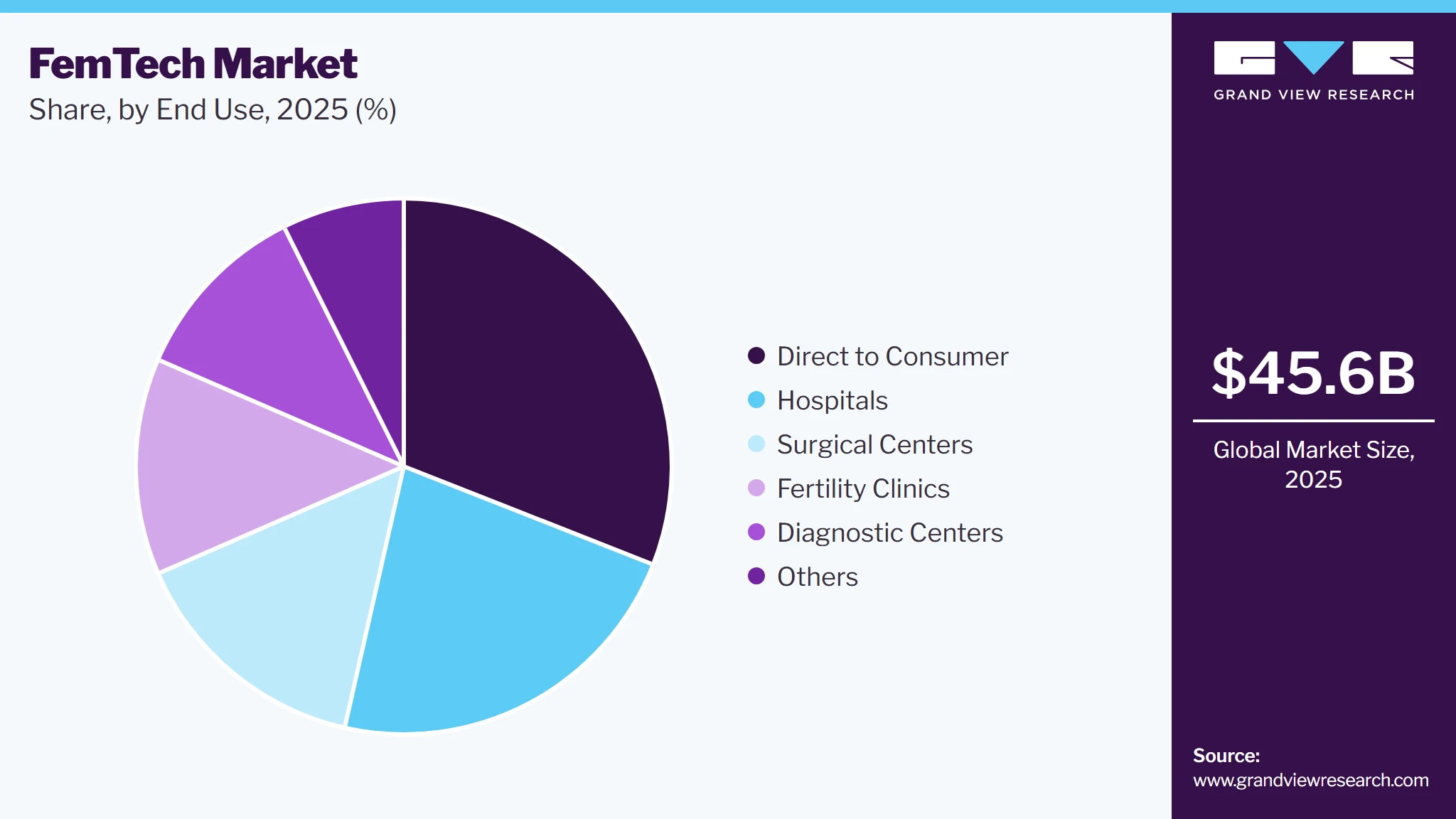
The direct-to-consumer segment dominated the femtech market with a revenue share of 30.7% in 2025 and is expected to register the fastest growth during the forecast period. Growth is driven by the convenience of online access, rising smartphone penetration, and increasing preference for personalized women’s health products and services. Consumers are increasingly using DTC platforms for fertility monitors, menstrual health apps, pregnancy care devices, menopause solutions, and wellness products.
For instance, in January 2025, Perelel Health expanded its personalized vitamin subscription platform with formulations for fertility, pregnancy, postpartum recovery, and menopause. This reflects the growing demand for convenient, subscription-based, and personalized women’s healthcare solutions, supporting DTC segment growth.
 To learn more about this report, Download Free Sample Report
 The hospitals segment is also expected to grow significantly during the forecast period. Hospitals are increasingly adopting femtech solutions for maternal care, reproductive health management, clinical decision support, and remote patient monitoring. For instance, in May 2025, HeraMED partnered with Teladoc Health to integrate remote pregnancy monitoring into Teladoc’s virtual care ecosystem, enabling clinicians to monitor maternal and fetal health remotely and improve access to personalized prenatal care.
Regional Insights
North America dominated the femtech market with a revenue share of 45.7% in 2025, driven by strong digital health adoption, advanced healthcare infrastructure, rising investment in women’s health, and the presence of leading femtech companies. Growing use of AI-powered platforms, wearable devices, and remote monitoring solutions is supporting regional growth. For instance, in January 2025, Willow Innovations launched the Willow Generation 4 Breast Pump with improved app connectivity and personalized pumping insights, reflecting the rising adoption of connected women’s health solutions.
 To learn more about this report, Download Free Sample Report
 U.S. Femtech Market Trends
The U.S. held the largest share of the North America femtech industry in 2025, supported by rising investment in digital women’s healthcare, virtual care adoption, fertility services, pregnancy monitoring, and menopause management platforms. For instance, in 2025, Maven Clinic expanded its AI-powered women’s health platform by strengthening maternity and menopause care services and employer partnerships, supporting market growth.
Asia Pacific Femtech Market Trends
The Asia Pacific femtech industry is expected to witness the fastest growth during the forecast period. The market is driven by increasing awareness of women's health, rapid digitalization of healthcare, rising smartphone penetration, and growing investments in femtech startups. Supportive government initiatives, improving healthcare infrastructure, and the growing adoption of AI-powered digital health solutions are further contributing to market growth across the region.
The China femtech market held a significant share of Asia Pacific in 2025. Growth is supported by rising demand for digital women’s healthcare, health technology investment, and local companies offering fertility, pregnancy, and menstrual health solutions. For instance, Babytree continued expanding its AI-enabled maternal and child healthcare platform, strengthening digital pregnancy management and online healthcare services.
The growth of the femtech market in India is driven by growing awareness of women’s health, digital healthcare adoption, startup activity, and government support for maternal and reproductive health. For instance, in 2025, NIRAMAI expanded the deployment of its AI-based breast cancer screening technology across hospitals and diagnostic centers, improving access to early and non-invasive screening.
Europe Femtech Market Trends
Europe is expected to grow significantly during the forecast period, supported by increasing investment in women’s health technologies, digital healthcare adoption, and product innovation across fertility, pregnancy, menopause care, menstrual health, pelvic health, and preventive care. For instance, in 2025, Elvie expanded its connected women’s health portfolio by enhancing app-based features across pelvic floor and breastfeeding solutions.
The UK femtech market is expected to grow significantly due to increasing investment, supportive healthcare initiatives, and innovation in women’s health technologies. Collaboration among the NHS, startups, and research organizations is supporting digital women’s healthcare. For instance, in 2025, the NHS expanded digital maternal health initiatives, strengthening the use of data and technology to improve maternity and women’s health services.
The femtech market in Germany held the largest share of Europe in 2025, driven by digital health adoption, supportive reimbursement policies, and investment in women’s health innovation. For instance, in 2025, Leona Health expanded its AI-powered platform for endometriosis diagnosis and care, supporting personalized digital disease management.
Latin America Femtech Market Trends
The Latin America femtech industry is expected to grow significantly during the forecast period due to increasing adoption of digital healthcare, rising awareness of women's health, and growing investment in health technology startups. The expansion of telehealth services, mobile health applications, and AI-enabled diagnostic solutions is creating new opportunities for femtech companies across the region.
The Brazil femtech market is expected to experience substantial growth, supported by increasing startup activity, digital health adoption, and demand for fertility, maternal health, and sexual wellness solutions. For instance, in 2025, the Women’s Health Innovation Summit Brazil brought together healthcare providers, startups, investors, and technology companies, highlighting the country’s expanding femtech ecosystem.
Middle East & Africa Femtech Market Trends
The Middle East & Africa femtech industry is expected to grow significantly due to improving digital healthcare infrastructure, increasing women’s health awareness, and rising investment in health technology. Government initiatives that support digital transformation and access to women’s healthcare are further driving market growth.
Key FemTech Company Insights
The market is highly fragmented, with the presence of many country-level service end uses. Some of the few startup players include Ava, Bloomlife, Bonzun, and Kegg.
Key FemTech Companies
The following key companies have been profiled for this study of the femtech market.
-
Chiaro Technology Limited
-
HeraMED
-
Flo Health, Inc.
-
Natural Cycles USA Corp
-
Glow, Inc.
-
Allara Health
-
NUVO Inc.
-
Bloomlife
-
Syrona Health
-
Sirona Hygiene Private Limited
-
Samplytics Technologies Private Limited
-
iSono Health, Inc.
-
Athena Feminine Technologies
Competitive Benchmarking
Operating Strategies
Competitive Edge
Weaknesses
Mature Players (Flo Health, Inc.; Natural Cycles USA Corp.; HeraMED; NUVO Inc.; Bloomlife; Glow, Inc.)
- Expand digital women’s healthcare ecosystem through AI-driven health tracking.
- Invest in clinical validation and regulatory approvals.
- Strengthen partnerships with hospitals, insurers, and employers.
- Expand into fertility, pregnancy, menopause, and chronic women’s health services.
- Increase global market presence through localized digital platforms.
- Strong brand recognition and large global user base.
- Advanced AI algorithms and data-driven personalized healthcare.
- Established regulatory approvals and clinical evidence.
- Strong funding and strategic partnerships.
- Broad product portfolios across multiple women’s health categories.
- High customer acquisition and retention costs.
- Increasing scrutiny over health data privacy and cybersecurity.
- Dependence on subscription-based revenue models.
- Regulatory variations across countries slow expansion.
- Intense competition from new digital health startups.
Emerging Players (Chiaro Technology Limited; Allara Health; Syrona Health; Sirona Hygiene Private Limited; Samplytics Technologies Private Limited; iSono Health, Inc.; Athena Feminine Technologies)
- Focus on underserved women’s health segments such as menopause, PCOS, breast health, and preventive care.
- Develop AI-enabled diagnostics and remote monitoring solutions.
- Collaborate with healthcare providers, employers, and research institutions.
- Raise venture funding to expand product development and commercialization.
- Leverage digital-first and telehealth business models.
- High innovation and niche specialization.
- Faster product development cycles.
- Personalized patient engagement through digital platforms.
- Ability to address unmet clinical needs ignored by traditional healthcare providers.
- Flexible and technology-driven business models.
- Limited financial resources compared with established companies.
- Smaller customer base and lower brand awareness.
- Dependence on external funding for scaling operations.
- Challenges in obtaining regulatory approvals and reimbursement.
- Limited international commercial presence.
Recent Developments
-
In September 2025, Wellcome Leap and Pivotal Ventures announced a USD 100 million partnership to accelerate innovation in women's health. The initiative will support research and commercialization of technologies focused on reproductive health, gynecological disorders, maternal health, and chronic diseases that disproportionately affect women, helping address long-standing funding gaps in women's health innovation.
"This partnership reflects our commitment to accelerating scientific breakthroughs that improve women's health outcomes and close critical research gaps." - Wellcome Leap and Pivotal Ventures Joint Statement
-
In October 2024, Maven Clinic secured USD 125 million in a Series F funding round, increasing its valuation to approximately USD 1.7 billion. The investment is being used to expand the company's global digital care platform across fertility, pregnancy, parenting, menopause, and women's health services while strengthening partnerships with employers and health plans.
"This investment enables us to expand access to comprehensive, virtual women's and family healthcare while supporting better health outcomes worldwide." - Kate Ryder, Founder and CEO, Maven Clinic
-
In June 2023, University of Bath graduates launched a new app, Epowar, that revolutionizes safety for women walking alone. This wearable technology includes a safety app designed for women. It detects physical attacks, alerts chosen contacts, shares live location data, and stores evidence in the cloud, addressing personal safety concerns.
-
In June 2023, MiMARK Diagnostic, a spin-off from the Vall d'Hebron Research Institute (VHIR) and based in the Barcelona Science Park, specializing in developing innovative solutions for gynecological diagnostics, raised USD 1.1 million in funding to advance the development of its endometrial cancer diagnostic test.
-
In August 2021, Labcorp acquired Ovia Health, formerly known as Ovuline, a personalized data-driven solution for reproductive health companies. Through this acquisition, Labcorp strengthened its business position as a go-to source for women’s health insights and ventured into new avenues for personalized care.
-
In March 2021, Clue received the U.S. FDA clearance for the launch of Clue Birth Control, a digital contraceptive built-in Clue application that can predict ovulation statistically by using a tool for birth control.
FemTech Market Report Scope
Report Attribute
Details
Market size in 2025
USD 45.6 billion
Estimated market size in 2026
USD 52.9 billion
Projected market size by 2033
USD 145.5 billion
Growth rate
CAGR of 15.5% from 2026 to 2033
Actual data
2021 - 2025
Forecast period
2026 - 2033
Quantitative units
Revenue in USD million/billion and CAGR from 2026 to 2033
Report coverage
Revenue forecast, company ranking, competitive landscape, growth factors, and trends
Segments covered
Type, application, end-use, region
Regional scope
North America; Europe; Asia Pacific; Latin America; MEA
Country scope
U.S.; Canada; Mexico; Germany; UK; France; Italy; Spain; Norway; Denmark; Sweden;Russia;Iceland;Finland; China; Japan; India; South Korea; Australia; Thailand; Singapore; Brazil; Argentina; Saudi Arabia; South Africa; UAE; Kuwait; Israel
Key companies profiled
Chiaro Technology Limited; HeraMED; Flo Health, Inc.; Natural Cycles USA Corp; Glow, Inc.; Allara Health; NUVO Inc.; Bloomlife; Syrona Health; Sirona Hygiene Private Limited; Samplytics Technologies Private Limited; iSono Health, Inc.;Athena Feminine Technologies
Customization scope
Free report customization (equivalent up to 8 analysts working days) with purchase. Addition or alteration to country, regional & segment scope.
Pricing and purchase options
Avail customized purchase options to meet your exact research needs. Explore purchase options
Global FemTech Market Report Segmentation
This report forecasts revenue growth at the global, regional & country levels and provides an analysis of the latest industry trends in each of the sub-segments from 2021 to 2033. For this study, Grand View Research has segmented the global femtech market report based on type, application, end-use, and region:
 To learn more about this report, Download Free Sample Report
 -
Type Outlook (Revenue, USD Million/Billion, 2021 - 2033)
-
Devices
-
Software
-
Services
-
Consumer Products
-
-
Application Outlook (Revenue, USD Million/Billion, 2021 - 2033)
-
Pregnancy and Nursing Care
-
Reproductive Health & Contraception
-
Menstrual Health
-
General Health
-
Pelvic & Uterine Health
-
Sexual Health
-
Women’s Wellness
-
Menopause Care
-
Longevity & Mental Health
-
-
End-use Outlook (Revenue, USD Million/Billion, 2021 - 2033)
-
Direct to Consumer
-
Hospitals
-
Surgical Centers
-
Fertility Clinics
-
Diagnostic Centers
-
Others
-
-
Regional Outlook (Revenue, USD Million/Billion, 2021 - 2033)
-
North America
-
U.S.
-
Canada
-
Mexico
-
-
Europe
-
UK
-
Germany
-
France
-
Italy
-
Spain
-
Denmark
-
Sweden
-
Norway
-
Russia
-
Iceland
-
Finland
-
-
Asia Pacific
-
China
-
Japan
-
India
-
South Korea
-
Australia
-
Thailand
-
Singapore
-
-
Latin America
-
Brazil
-
Argentina
-
-
Middle East and Africa (MEA)
-
South Africa
-
Saudi Arabia
-
UAE
-
Kuwait
-
Israel
-
-
Research Methodology
The FemTech market figures in this report are based on a proven research process that combines executive interviews with secondary research from proprietary databases, company filings, and recognized regulatory and institutional sources. Market size is built through value-chain sizing-reconciling supply-side and demand-side estimates-and triangulated with bottom-up and top-down approaches. Every estimate passes multiple levels of expert validation before publication, with each FemTech segment quantified using the revenue-capture definitions in the table below.
Methodology Overview
The FemTech market size was estimated using a bottom-up approach, beginning with the identification of the potential target female population across key application areas. Market penetration rates for various FemTech products and services were then derived through secondary research and primary interviews. Average selling prices and service costs were analyzed across segments and regions. The target population, penetration rates, and pricing assumptions were integrated to estimate segment-level revenues, which were subsequently aggregated to derive the global FemTech market size and forecast.
Delivered Customizations
This report has been delivered with the following In-depth customizations
Client Request
Customization Delivered
Value Adds
FemTech Company Benchmarking Analysis
Comprehensive benchmarking of leading femtech companies based on product portfolio, digital health capabilities, AI integration, funding activity, regulatory approvals, geographic presence, strategic partnerships, and innovation pipeline. Comparative assessment across fertility, pregnancy, menstrual health, menopause, pelvic health, diagnostics, and digital therapeutics segments.
Identifies competitive positioning, innovation leaders, investment opportunities, partnership prospects, and strategic gaps, enabling informed decisions on market entry and expansion.
Investment & Funding Landscape Analysis
Detailed assessment of venture capital funding trends, mergers & acquisitions, startup ecosystem, strategic investments, funding distribution by femtech segment, and investor activity across major regions. Includes analysis of funding stages and emerging investment themes.
Supports investment planning by identifying high-growth segments, attractive startups, funding gaps, and commercialization opportunities across the global femtech market.
Technology & Innovation Analysis
Evaluation of emerging technologies, including AI-enabled women’s health platforms, wearable devices, remote patient monitoring, digital therapeutics, predictive analytics, biosensors, and telehealth solutions. Includes assessment of product innovation and technology adoption trends.
Helps identify disruptive technologies, product differentiation opportunities, innovation trends, and future technology roadmaps to support strategic product development and long-term growth.
Frequently Asked Questions About This Report
The global FemTech market size was estimated at USD 45.6 billion in 2025 and and is estimated at USD 52.9 billion for 2026.
The growth of the Femtech industry is expected to be driven by several key factors such as Increased adoption of digital health solutions, Innovative technologies like AI and virtual assistants are enabling the development of more personalized, efficient, and accessible Femtech solutions. In addition, the Femtech industry has been attracting substantial investments and funding, which is expected to fuel further growth and innovation in the sector.
Some prominent players in the femtech market include Chiaro Technology Limited, HeraMED, Flo Health, Inc., Natural Cycles USA Corp, Glow, Inc, Allara Health, NUVO Inc., Bloomlife, Syrona Health, Sirona Hygiene Private Limited, Samplytics Technologies Private Limited, iSono Health, Inc., Athena Feminine Technologies
Devices segment led with a 33.4% revenue share in 2025, while software segment is the fastest-growing type.
Pregnancy and nursing care segment held the largest revenue share of 17.7% in 2025, while menstrual health segment is the fastest-growing.
Direct-to-consumer segment held the revenue share of 30.7% in 2025, while hospitals is the fastest-growing segment.
North America dominated with a 45.7% revenue share in 2025.
Asia Pacific is the fastest-growing region over the forecast period.
The global FemTech market is expected to grow at a compound annual growth rate of 15.5% from 2026 to 2033 to reach USD 145.5 billion by 2033.
About the Author(s)
Healthcare IT Research Team
Healthcare · Healthcare ITThis report was authored by the healthcare it research team at Grand View Research - comprising two research analysts, one senior research analyst, and one industry expert - with specialized expertise in the healthcare it segment of the healthcare industry. All findings are based on proprietary healthcare databases, executive interviews, and regulatory analysis, subject to internal peer review prior to publication.
Last Updated:
Speak to Analyst

Customize this report to your needs - add regions, segments, or data points, with 20% free customization.
Or view our licence options:


ISO 9001:2015 & 27001:2022 Certified
We are GDPR and CCPA compliant! Your transaction & personal information is safe and secure. For more details, please read our privacy policy.


