
- Home
- »
- IT Services & Applications
- »
-
Account Aggregator Market Size, Growth Report, 2026-2033GVR Report cover

Account Aggregator Market (2026 - 2033)
Size, Share & Trends Analysis Report By Component (Software, Services), By Solution Model (AI-driven Aggregators, Mobile-based Aggregators), By Application, By End Use, By Region, And Segment Forecasts
Market Size, 2025
$2.3BMarket Estimate, 2026
$2.6BMarket Forecast, 2033
$6.4BCAGR, 2026–2033
14.0%Account Aggregator Market Summary
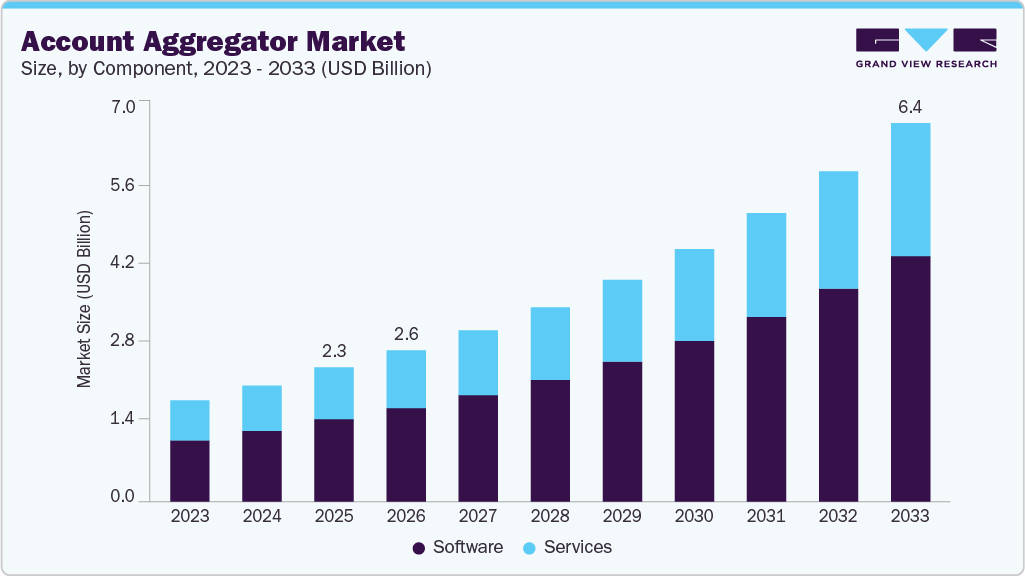
The global account aggregator market size was valued at USD 2.3 billion in 2025 and is projected to grow from USD 2.6 billion in 2026 to USD 6.4 billion by 2033, at a CAGR of 14.0% from 2026 to 2033. Asia Pacific dominated the global market, accounting for the largest revenue share of 33.2% in 2025.. The market is witnessing steady expansion as financial ecosystems transition toward data-driven and consent-based architectures, where users can securely share their financial information across institutions.
 Source: Grand View Research, IR Documents, Primary Interviews, Paid DatabasesTo learn more about this report,
 Download Free Sample Report
 Key Market Trends & Insights
- By component: Software segment accounted for the largest share of 61.4% in 2025.
- By solution model: Service-based models segment is expected to grow at the fastest CAGR during the forecast period.
- By application: Payments segment is projected to grow at the fastest CAGR during the forecast period.
- By end-use: Banks segment accounted for the largest share of 36.8% in 2025.
Regional Highlights
- Largest regional market: Asia Pacific (33.2% revenue share, 2025)
- By country: The U.S. account aggregator industry is a major contributor to the global market.
Market Size & Forecast
- Market size in 2025: USD 2.3 Billion
- Estimated market size in 2026: USD 2.6 Billion
- Projected market size by 2033: USD 6.4 Billion
- CAGR (2026-2033): 14.0%
Three ways to get this report
Buy it, customize it, or ask a question.Ask an Analyst
Analyst response in 1 business day
- AccessReport author, directly
- Reply timeWithin 1 working day
- No sales callDirect answer only
- FormatEmail reply
- CostFree, no cost
Get the Full Report
What the study covers
- FormatsPDF · Excel · Dashboard
- Timeline2026–2033 annual, 2025 base
- Coverage20+ countries, 5 regions
- Companies10+ key players profiled
Customize the Report
20% free customization
- IncludeCountries, segments, points
- TailorTo your product definition
- ExtendDeeper competitor detail
- OrA fully bespoke study
- Turnaround5–10 working days
Account aggregators are increasingly positioned as a core interoperability layer that bridges traditional banking systems with modern fintech platforms, enabling seamless financial data portability. The increasing standardization of financial APIs and interoperability protocols is transforming the way institutions exchange data, significantly boosting the adoption of account aggregators. Instead of siloed financial systems, institutions are moving toward connected ecosystems, where aggregators enable seamless data exchange across banks, lenders, insurers, and investment platforms. This shift is not only improving operational efficiency but also enabling the creation of innovative financial products and services tailored to user behavior.
 To learn more about this report, Download Free Sample Report
 Another key growth driver is the rising integration of aggregation capabilities into lending ecosystems. Financial institutions are leveraging aggregated data to gain a holistic view of borrower profiles, enabling faster loan approvals and improved risk assessment. This is particularly impactful in emerging markets, where traditional credit scoring models fail to capture the financial behavior of underserved populations.
At the same time, the rapid evolution of digital payment ecosystems is creating new opportunities for aggregation platforms. As users increasingly adopt multiple payment channels, including wallets, bank transfers, and embedded payment options, aggregators are playing a crucial role in consolidating transaction data and providing actionable insights. This is enabling both consumers and businesses to optimize cash flow management and financial planning.
The market is also benefiting from the increasing adoption of cloud-native architectures, which allow aggregation platforms to scale efficiently and handle large volumes of financial data. Cloud deployment enhances flexibility, reduces infrastructure costs, and supports real-time analytics, making it a preferred choice for both startups and established financial institutions.
However, challenges related to data security, privacy, and user consent management remain critical. Aggregator platforms must continuously invest in advanced encryption, authentication mechanisms, and compliance frameworks to ensure secure data handling. Regulatory scrutiny is expected to increase, further emphasizing the need for robust governance models.
Component Insights
The software segment accounted for the largest share of 61.4% in 2025 and is projected to grow at the fastest CAGR during the forecast period. Software platforms form the technological backbone of account aggregation, enabling API integration, data standardization, analytics, and user interface functionalities. The increasing adoption of cloud-native and SaaS-based platforms is further accelerating growth in this segment, as organizations seek scalable and cost-efficient solutions.
The services segment held a significant share in 2025, driven by the growing need for implementation, consulting, integration, and managed services. As financial institutions adopt complex aggregation frameworks, the demand for specialized expertise is increasing, supporting steady growth in this segment.
Solution Model Insights
The Software-based platforms segment dominated the market in 2025, as they provide scalable and flexible solutions that can handle large volumes of financial data across multiple sources. These platforms are widely used by banks and fintech companies to build integrated financial ecosystems.
Service-based models segment is expected to grow at the fastest CAGR during the forecast period. The increasing complexity of regulatory requirements and the need for customized solutions are driving demand for service-oriented offerings, particularly among traditional financial institutions undergoing digital transformation.
Application Insights
The lending segment held the largest share of the market in 2025. Account aggregators enable lenders to access comprehensive financial data, improving credit risk assessment and enabling faster loan approvals. This is particularly important in emerging markets, where access to traditional credit data is limited.
The payments segment is projected to grow at the fastest CAGR during the forecast period. The expansion of digital payment systems, including real-time payments and mobile wallets, is increasing the need for integrated platforms that can manage and analyze transaction data efficiently.
End Use Insights
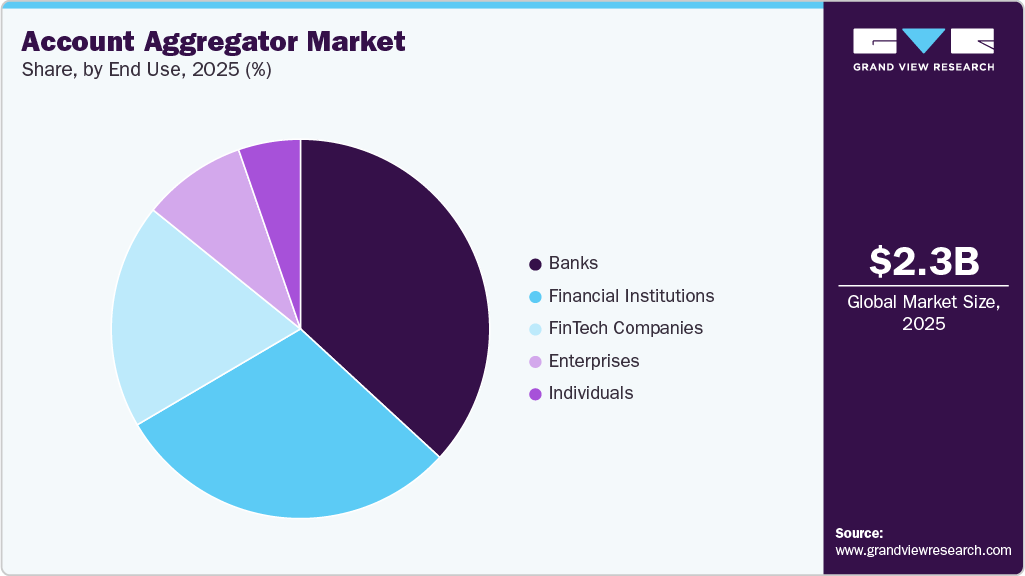
The banks segment dominated the market in 2025, as traditional financial institutions continue to invest heavily in digital transformation and data-driven customer engagement strategies. Banks are increasingly deploying account aggregation platforms to create a 360-degree view of customer finances, enabling them to deliver personalized offerings such as tailored loan products, automated savings tools, and intelligent financial advisory services.
 To learn more about this report, Download Free Sample Report
 The fintech companies segment is expected to grow at the fastest CAGR during the forecast period. Fintech firms are at the forefront of innovation, leveraging account aggregation to build next-generation financial solutions such as digital lending platforms, robo-advisors, embedded finance solutions, and personal finance management apps. Their agile development models and strong focus on user experience allow them to rapidly integrate aggregation capabilities and launch data-driven services.
Regional Insights
North America account aggregator market accounted for 31.7% of the global revenue in 2025, making it the second-largest regional market. The region benefits from a highly mature financial ecosystem, advanced technological infrastructure, and early adoption of open banking principles. Financial institutions and fintech companies in North America are leveraging aggregation platforms to deliver data-driven financial services, enhance customer engagement, and support innovation in digital banking and payments.
U.S. Account Aggregator Market Trends
The account aggregator market in the U.S. represents one of the most advanced markets, characterized by high consumer adoption of digital financial tools and a strong fintech ecosystem. The presence of leading fintech innovators and technology providers has accelerated the development of API-based financial services and data-sharing platforms.
Europe Account Aggregator Market Trends
The account aggregator market in Europe is largely shaped by regulatory frameworks such as PSD2, which mandate open banking and secure data sharing across financial institutions. These regulations have created a highly structured environment that encourages the adoption of aggregation platforms while ensuring data privacy and consumer protection.
Germany account aggregator market is characterized by a compliance-driven approach, with financial institutions focusing on secure and regulated data-sharing mechanisms. Aggregation platforms are increasingly being used in enterprise finance, lending analytics, and wealth management, particularly among SMEs.
The account aggregator market in the U.K. remains one of the most dynamic markets, supported by early adoption of open banking and a robust fintech ecosystem. Aggregation platforms are widely used for personal finance management, Service-based Models, and digital lending, making the U.K. a key innovation hub in Europe.
Asia Pacific Account Aggregator Market Trends
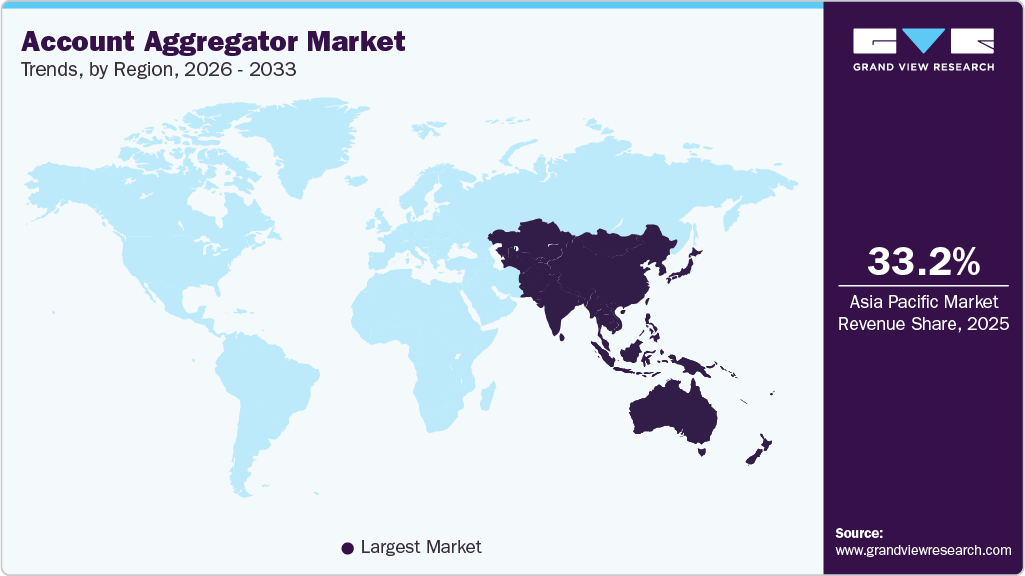
The account aggregator market in Asia Pacific held the largest share of 33.2% in 2025 and is projected to grow at the fastest CAGR of 16.7% during the forecast period. The region’s dominance is driven by rapid digital transformation, large unbanked populations, and strong government-backed financial inclusion initiatives. Countries across the Asia Pacific are adopting account aggregation frameworks to improve financial accessibility, streamline lending processes, and enable secure data sharing across financial ecosystems. The widespread adoption of mobile banking, digital wallets, and real-time payment systems is further accelerating the demand for aggregation platforms.
 To learn more about this report, Download Free Sample Report
 China account aggregator market has developed a highly integrated digital financial ecosystem, where aggregation capabilities are embedded within super-app platforms. These platforms combine payments, lending, and wealth management services, creating a seamless user experience.
The account aggregator market in India stands out as a key growth engine, supported by the Reserve Bank of India-regulated Account Aggregator framework. This system enables secure, consent-based financial data sharing across institutions, transforming the way financial services are delivered. Combined with the rapid growth of digital payment systems such as UPI, the framework is enabling faster credit access, improving financial inclusion, and driving innovation in lending and personal finance.
Key Account Aggregator Companies Insights
Some of the leading players in the account aggregator market include Plaid, Tink, MX, Envestnet, and Finicity, among others. These companies offer advanced account aggregation platforms that enable secure, consent-based access, consolidation, and analysis of financial data across banks, fintech applications, and enterprises. Their solutions are built around API-driven connectivity, data standardization, real-time data processing, and robust security frameworks, which are essential for supporting open banking and open finance ecosystems. By enabling seamless integration between multiple financial institutions and digital platforms, these players facilitate interoperability and data portability, which are critical for delivering unified financial experiences.
-
Plaid is a U.S.-based financial data network that connects applications to users’ bank accounts through secure APIs. The company enables Software-based Platforms, transaction enrichment, and identity verification services for a wide range of fintech applications. Plaid’s strong developer ecosystem and partnerships with major banks and digital platforms have positioned it as a key player in open banking innovation. Its continuous expansion into payments, lending, and Mobile-based Aggregators solutions is strengthening its role in the financial aggregator market.
-
MX specializes in data-driven financial insights and aggregation solutions, focusing on enhancing customer engagement for financial institutions. The company offers advanced data cleansing, categorization, and analytics tools that enable banks to deliver personalized financial experiences. MX’s platform integrates seamlessly with digital banking systems, supporting use cases such as personal finance management and credit decisioning. Its emphasis on data intelligence and user experience is driving adoption among banks and credit unions.
Key Account Aggregator Companies:
The following key companies have been profiled for this study on the account aggregator market.
- Plaid
- MX
- Envestnet
- Finicity
- Tink
- TrueLayer
- Salt Edge
- Akoya
- Yapily
- GoCardless
Recent Developments
-
In September 2025, Plaid and JPMorganChase extended their data access agreement for sharing consumer-permissioned data, keeping customers connected to the financial services they rely on while supporting continued open-banking innovation.
-
In September 2025, Envestnet completed the sale of Yodlee, its open finance and data analytics subsidiary, to STG, marking a major corporate shift for one of the best-known financial data aggregation brands.
Account Aggregator Market Report Scope
Report Attribute
Details
Market size in 2025
USD 2.3 billion
Estimated Market size in 2026
USD 2.6 billion
Projected Market size by 2033
USD 6.4 billion
Growth rate
CAGR of 14.0% from 2026 to 2033
Base year for estimation
2025
Historical data
2021 - 2024
Forecast period
2026 - 2033
Quantitative units
Revenue in USD million/billion and CAGR from 2026 to 2033
Report coverage
Revenue forecast, company ranking, competitive landscape, growth factors, and trends
Segments covered
Component, solution model, application, end use, region
Regional scope
North America; Europe; Asia Pacific; Latin America; MEA
Country scope
U.S.; Canada; Mexico; Germany; UK; France; China; Japan; India; South Korea; Australia; Brazil; KSA; UAE; South Africa
Key companies profiled
Plaid; MX; Envestnet; Finicity; Tink; TrueLayer; Salt Edge; Akoya; Yapily; GoCardless
Customization scope
Free report customization (equivalent up to 8 analysts working days) with purchase. Addition or alteration to country, regional & segment scope.
Pricing and purchase options
Avail customized purchase options to meet your exact research needs. Explore purchase options
Global Account Aggregator Market Report Segmentation
This report forecasts revenue growth at the global, regional, and country levels and provides an analysis of the latest industry trends in each of the sub-segments from 2021 to 2033. For this study, Grand View Research has segmented the global account aggregator market report based on component, solution model, application, end use, and region:
-
Component Outlook (Revenue, USD Million, 2021 - 2033)
-
Software
-
Services
-
-
Solution Model Outlook (Revenue, USD Million, 2021 - 2033)
-
Software-based Platforms
-
Service-based Models
-
AI-driven Aggregators
-
Mobile-based Aggregators
-
SaaS-based Aggregators
-
-
Application Outlook (Revenue, USD Million, 2021 - 2033)
-
Personal Finance
-
Business Finance
-
Wealth Management
-
Lending
-
Payments
-
Others
-
-
End Use Outlook (Revenue, USD Million, 2021 - 2033)
-
Banks
-
Financial Institutions
-
FinTech Companies
-
Enterprises
-
Individuals
-
-
Regional Outlook (Revenue, USD Million, 2021 - 2033)
-
North America
-
U.S.
-
Canada
-
Mexico
-
-
Europe
-
Germany
-
UK
-
France
-
-
Asia Pacific
-
China
-
Japan
-
India
-
South Korea
-
Australia
-
-
Latin America
-
Brazil
-
-
Middle East and Africa (MEA)
-
KSA
-
UAE
-
South Africa
-
-
Frequently Asked Questions About This Report
The software segment led with a 61.4% revenue share in 2025, and is the fastest-growing component.
The software-based platforms segment held the largest revenue share in 2025, while service-based models is the fastest-growing solution model.
The lending segment held the largest revenue share in 2025, while payments is the fastest-growing application.
Banks segment held the largest share (over 36.0%) in 2025, while fintech companies is the fastest-growing segment.
The global account aggregator market size was valued at USD 2.3 billion in 2025 and is estimated at USD 2.6 billion for 2026.
Key players include Plaid; MX; Envestnet; Finicity; Tink; TrueLayer; Salt Edge; Akoya; Yapily; GoCardless.
The global account aggregator market is expected to grow at a CAGR of 14.0% from 2026 to 2033, reaching USD 6.4 billion by 2033.
Asia Pacific held the largest market share of 33.2% in 2025. The region’s dominance is driven by rapid digital transformation, large unbanked populations, and strong government-backed financial inclusion initiatives.
The key driving trend in the account aggregator market is the increasing adoption of open banking frameworks and consent-based data sharing.
About the Author(s)
IT Services & Applications Research Team
Technology · IT Services & ApplicationsThis report was authored by the it services & applications research team at Grand View Research - comprising two research analysts, one senior research analyst, and one industry expert - with specialized expertise in the it services & applications segment of the technology industry. All findings are based on proprietary technology databases, executive interviews, and regulatory analysis, subject to internal peer review prior to publication.
Last Updated:
Speak to Analyst

Customize this report to your needs - add regions, segments, or data points, with 20% free customization.
Or view our licence options:


ISO 9001:2015 & 27001:2022 Certified
We are GDPR and CCPA compliant! Your transaction & personal information is safe and secure. For more details, please read our privacy policy.


