
- Home
- »
- Automotive & Transportation
- »
-
Active Power Steering Market Size, Share Report, 2026-2033GVR Report cover
![Active Power Steering Market (2026 - 2033)Report]()
Active Power Steering Market (2026 - 2033)
Size, Share & Trends Analysis Report By Type (Electric Power Steering System, Hydraulic Power Steering System), By Application (Passenger Car, Commercial Vehicle), By Region, And Segment Forecasts
Market Size, 2025
$13.2BMarket Estimate, 2026
$14.9BMarket Forecast, 2033
$38.9BCAGR, 2026–2033
14.7%Active Power Steering Market Summary
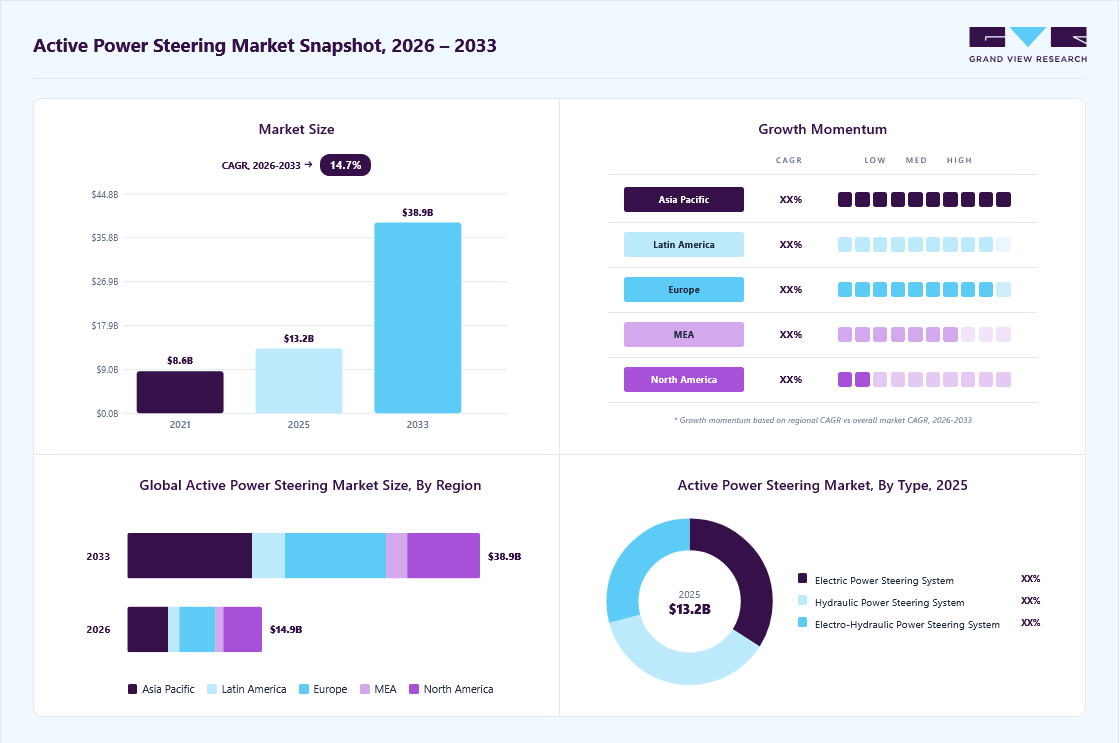
The global active power steering market size was valued at USD 13.2 billion in 2025 and is projected to grow from USD 14.9 billion in 2026 to USD 38.9 billion by 2033, at a CAGR of 14.7% from 2026 to 2033. North America dominated the global market with the largest revenue share of 30.0% in 2025. Active power steering is an advanced power steering technology that adjusts both the steering ratio and steering force based on driving speed and conditions.
Key Market Trends & Insights
- By type: Hydraulic Power Steering System segment dominated the market, with a revenue share of 36.8% in 2025.
- By application: Commercial Vehicle segment held the largest market share of 79.7% in 2025.
Regional Highlights
- Largest regional market: North America (30.0% revenue share, 2025)
- Fastest-growing regional market: Asia Pacific (highest CAGR, 2026-2033)
- By country: The U.S. held the largest market share in 2025.
Market Size & Forecast
- Market size in 2025: USD 13.2 Billion
- Estimated market size in 2026: USD 14.9 Billion
- Projected market size by 2033: USD 38.9 Billion
- CAGR (2026-2033): 14.7%
This growth of the market is driven by several factors, including the growing demand for advanced steering systems in commercial as well as passenger vehicles, technological innovations in automotive components, and the growing focus on vehicle safety and fuel efficiency. In addition, the integration of active power steering systems with advanced driver assistance systems (ADAS) and other automated driving technologies is anticipated to further drive market growth. The active power steering system market is increasingly witnessing the integration of ADAS. This integration enhances safety features such as lane-keeping assist, automatic lane changes, and collision avoidance. Automotive manufacturers are leveraging this technology to provide a more intuitive and safer driving experience. As a result, the demand for vehicles equipped with ADAS and active power steering systems is on the rise.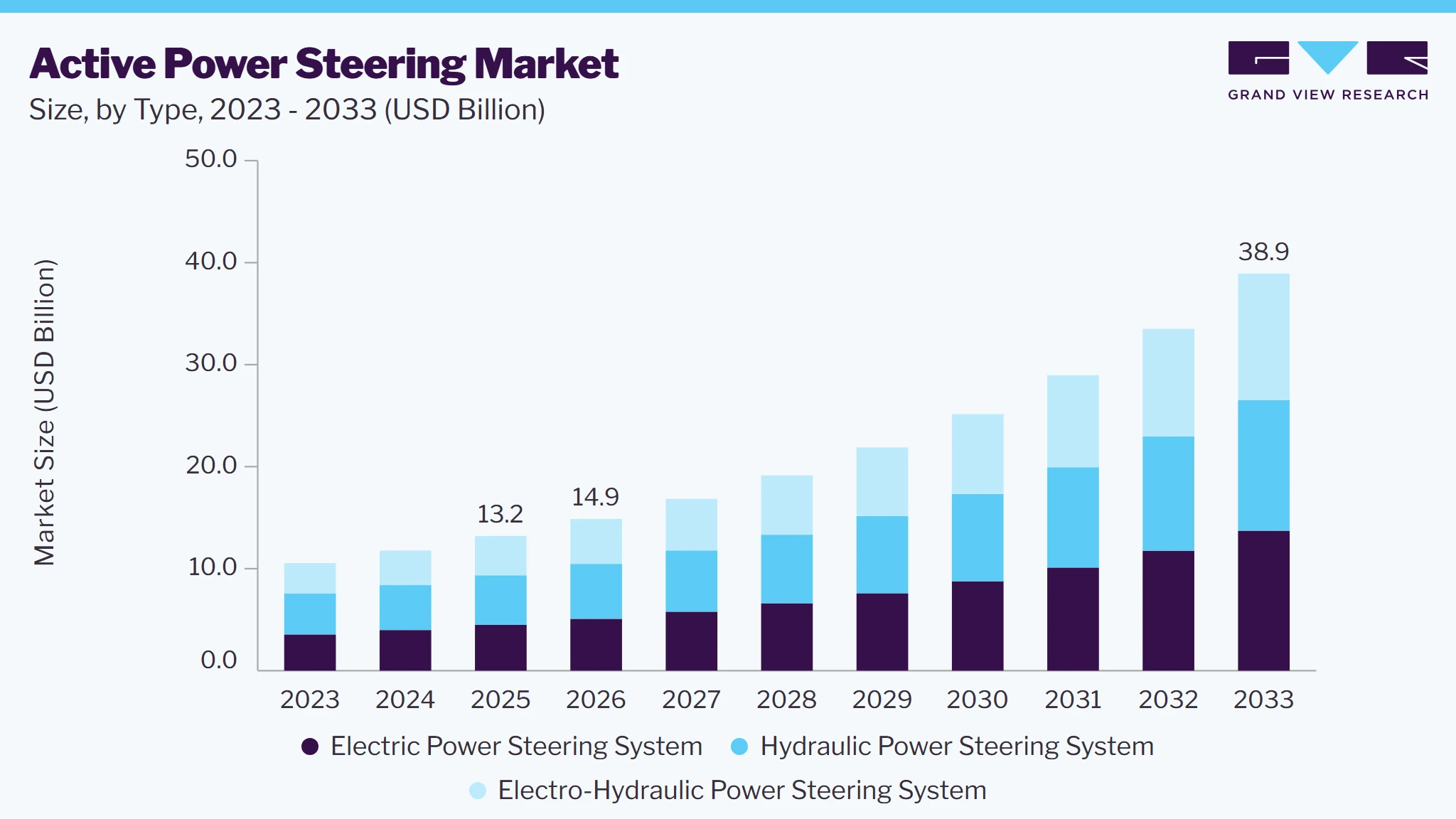
Ongoing technological advancements are driving the growth of active power steering systems market. Innovations such as steer-by-wire technology, which eliminates the mechanical connection between the steering wheel and wheels, are gaining traction. These advancements offer greater design flexibility and improved performance. For instance, in September 2023, Titan, a UK-based company specializing in EV steering systems, launched a steer-by-wire system. This system is designed for an extensive range of low-volume vehicles, spanning from light commercial vehicles and trucks to supercars. Such initiatives by several manufacturers are expected to bode well for the market’s growth.
Furthermore, the market is poised for substantial growth propelled by increasing demand for electric vehicles, and growing focus on the development of autonomous vehicles. Electric vehicles benefit from the efficiency and precision of active power steering, which is essential for optimal performance. Autonomous vehicles requiring advanced steering capabilities are driving further innovations in this technology. This trend is leading to increased investment and development within the active power steering sector.
The utilization of advanced technologies and materials in active power steering systems often results in higher costs, which may hinder their widespread adoption. In addition, integrating active power steering systems into commercial vehicles demands precise engineering and introduces complexities to vehicle design and manufacturing processes. These challenges can be particularly daunting for manufacturers managing a range of vehicle models and specifications. Thus, the high cost of active power steering systems, particularly in commercial vehicles, and the integration complexities of these systems could hamper the growth of the market.
Market Dynamics
Advancements in vehicle electrification, sensor technologies, electronic control units (ECUs), torque sensors, steer-by-wire architectures, and advanced driver assistance systems (ADAS) are significantly enhancing the performance, precision, energy efficiency, and safety of active power steering systems across passenger cars, commercial vehicles, and electric vehicles. The integration of real-time vehicle dynamics control, lane-keeping assistance, automated parking functions, and over-the-air software updates further improves steering responsiveness, driving comfort, fuel efficiency, and overall vehicle handling characteristics. However, high development and integration costs, increasing software complexity, stringent functional safety requirements, cybersecurity concerns, and the need for extensive validation and testing processes elevate production expenses and pose challenges, particularly for cost-sensitive vehicle segments. Meanwhile, the growing adoption of electric and hybrid vehicles, rising demand for autonomous and semi-autonomous driving capabilities, tightening fuel economy and emission regulations, and increasing consumer preference for enhanced driving comfort and safety features are creating opportunities for manufacturers to develop intelligent, lightweight, energy-efficient, and software-defined active power steering solutions tailored to next-generation connected and autonomous mobility platforms.
The increasing adoption of electric vehicles (EVs), hybrid vehicles, and advanced driver assistance systems (ADAS) is significantly driving demand for active power steering systems across passenger cars, light commercial vehicles, and heavy-duty vehicles. Modern active power steering systems equipped with electronic control units (ECUs), torque sensors, electric motors, and vehicle dynamics control technologies enable precise steering assistance, enhanced maneuverability, improved fuel efficiency, and superior driving comfort. These next-generation systems offer variable steering ratios, adaptive steering response, and seamless integration with safety and automation features, making them critical components in modern connected and electrified vehicles.
The market is also witnessing growing integration of artificial intelligence, software-defined vehicle architectures, and autonomous driving technologies. Intelligent steering control systems facilitate real-time vehicle monitoring, lane-keeping assistance, automated parking, crosswind compensation, and stability enhancement, helping automakers improve vehicle safety, handling performance, and energy efficiency. Additionally, the adoption of over-the-air (OTA) software updates, advanced sensor fusion technologies, and vehicle-to-everything (V2X) communication is enabling seamless coordination between active power steering systems, braking systems, ADAS platforms, and autonomous driving modules, supporting the transition toward highly automated and self-driving mobility solutions.
The development and deployment of active power steering systems require substantial investments in advanced electronic control units (ECUs), electric motors, torque sensors, steering actuators, software development, and functional safety validation processes. The high upfront costs associated with research and development, testing, calibration, and vehicle-specific customization often limit the adoption of advanced steering technologies, particularly in entry-level and cost-sensitive vehicle segments. Additionally, automotive manufacturers must invest in sophisticated manufacturing capabilities, cybersecurity frameworks, and compliance with stringent safety standards, further increasing overall system costs.
The market also faces challenges related to complex system integration and implementation requirements. Active power steering systems must operate seamlessly with advanced driver assistance systems (ADAS), braking systems, vehicle stability control, suspension systems, autonomous driving platforms, and centralized vehicle control architectures. Ensuring compatibility among multiple sensors, software modules, communication networks, and electronic subsystems requires extensive engineering expertise, prolonged validation cycles, and significant integration efforts. Moreover, meeting stringent functional safety requirements and maintaining system reliability under diverse driving conditions can extend development timelines and increase production costs, potentially affecting the pace of adoption, particularly among manufacturers targeting high-volume vehicle segments.
The rapid advancement of autonomous driving technologies connected mobility solutions, and software-defined vehicle architectures is creating significant opportunities for active power steering manufacturers worldwide. Increasing investments in higher levels of vehicle automation, growing consumer demand for enhanced safety and driving convenience, and the automotive industry's transition toward intelligent mobility platforms are accelerating the adoption of advanced steering systems. Active power steering plays a critical role in enabling lane centering, automated parking, collision avoidance, and trajectory control functions, making it an essential component of next-generation semi-autonomous and autonomous vehicles.
The market is also benefiting from the rapid expansion of electric vehicle production and the increasing integration of centralized vehicle computing platforms across passenger cars, commercial vehicles, and mobility fleets. As automakers seek to improve energy efficiency, reduce vehicle weight, and enhance software functionality, there is growing demand for steer-by-wire and electronically controlled steering systems that can seamlessly interact with advanced driver assistance systems (ADAS), braking systems, and vehicle dynamics control modules. This trend is generating substantial opportunities for manufacturers to develop intelligent, lightweight, cybersecurity-enabled, and over-the-air (OTA) upgradable active power steering solutions tailored for future connected, autonomous, and electrified mobility applications.
Analyst Perspective
The active power steering market is witnessing strong growth driven by the increasing adoption of EVs, ADAS, and vehicle automation technologies. Automakers are deploying active power steering systems to improve steering precision, vehicle stability, energy efficiency, and driver comfort. Advances in electric power steering, ECUs, torque sensors, steer-by-wire systems, and software-defined vehicle platforms are enhancing vehicle handling, safety, and reliability. Growing integration of vehicle dynamics control and intelligent motion control is further expanding application across passenger and commercial vehicles. Autonomous driving, sensor fusion, OTA updates, and cybersecurity technologies are creating additional opportunities for advanced steering systems. However, high R&D costs, complex system integration, stringent safety requirements, and lengthy validation cycles remain key challenges. Adoption may also be constrained in cost-sensitive vehicle segments due to higher system complexity and costs. Overall, continued investment in electrification, automation, and advanced safety technologies is expected to support steady market growth.
Type Insights
Based on type, the hydraulic power steering system segment led the market with the largest revenue share of 36.8% in 2025. Hydraulic power steering, commonly known as HPS, is the most traditional and widely used type of power steering system. It functions by using hydraulic fluid and a pump to assist the driver in turning the vehicle's steering wheel. The growing adoption of hydraulic power steering systems in heavy-duty commercial vehicle applications due to their reliability and performance is boosting the growth of the market.
The electric power steering system segment is projected to witness a notable growth from 2026 to 2033. Electric Power Steering (EPS) ensures consistent performance across various driving conditions. This system relies on an electric motor integrated with the steering mechanism and uses sensors to communicate with the Engine Control Unit (ECU). The ECU adjusts the steering settings based on vehicle speed and other factors, optimizing the steering response accordingly. Increasing adoption of EPS in modern electric vehicles due to their ease of integration into the steering column and several benefits is driving the segment’s growth.
Application Insights
Based on application, the commercial vehicle segment led the market with the largest revenue share of 79.7% in 2025. The use of active power steering is expanding in the commercial vehicle sector. These systems provide better maneuverability, stability, and safety for light, medium, and heavy commercial vehicles. As logistics and transportation industries grow, there is a greater need for advanced steering solutions to improve driver comfort and operational efficiency. In addition, heavy commercial vehicles need robust steering systems to manage heavy loads and long-distance travel. Thus, the increasing adoption of hydraulic and electro-hydraulic power steering systems in heavy commercial vehicles due to their strength and efficiency can be attributed to the segment growth.
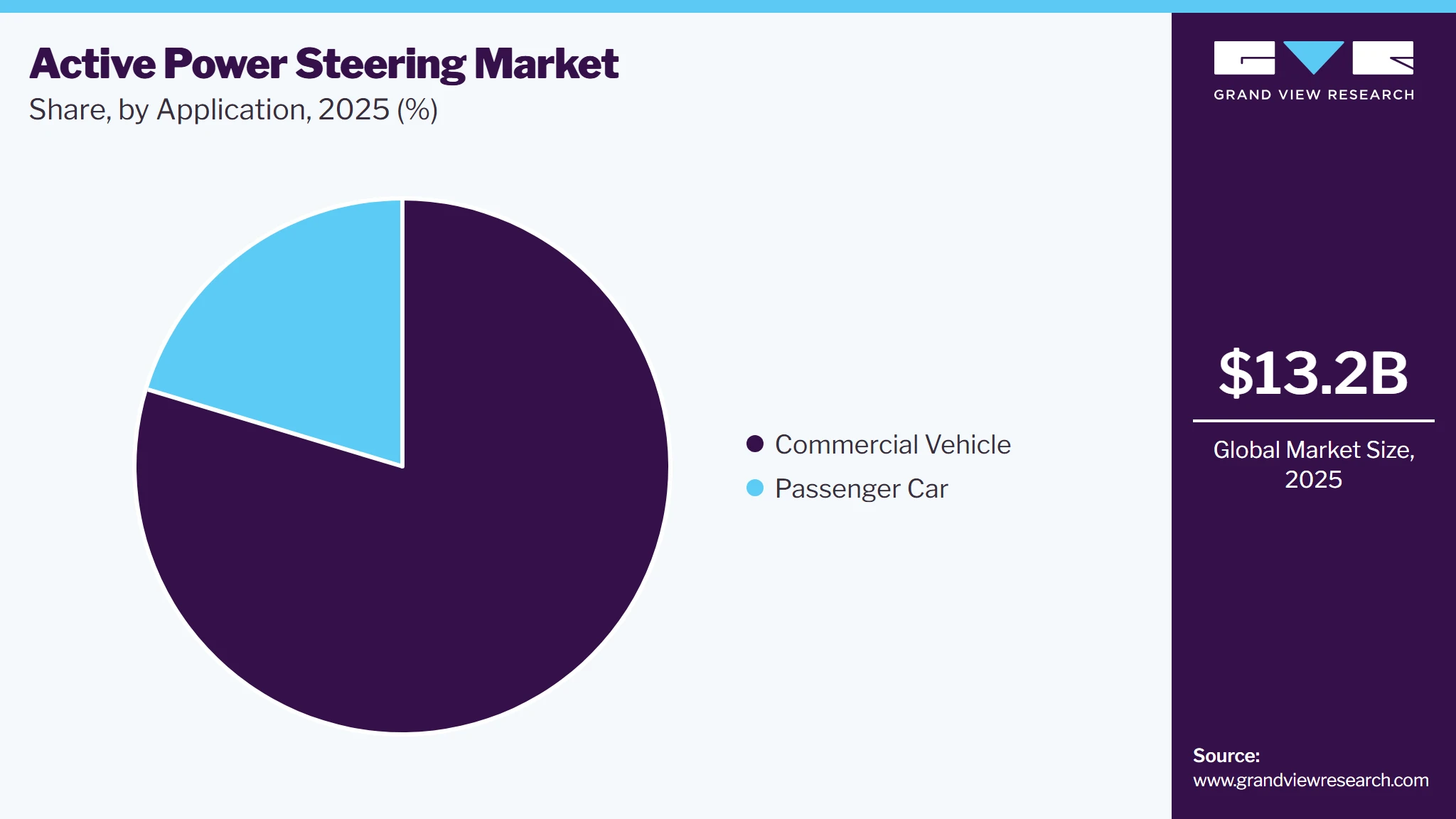
The passenger car segment is projected to witness significant growth from 2026 to 2033. Active power steering systems have gained significant traction in the passenger car segment due to their ability to enhance driving comfort and safety. In addition, advancements in automotive technology, such as electrification and autonomous driving features, are reshaping consumer preferences and driving demand. Furthermore, increasing urbanization and congestion are driving demand for compact and fuel-efficient passenger cars, ultimately driving the demand for active power steering systems in this segment.
Regional Insights
North America dominated the global active power steering market with the largest revenue share of 30.0% in 2025. The increasing demand for electric vehicles in the region, driven by national legislation, subsidies, and the growing emphasis on sustainable transportation is major driver behind the market’s growth. In addition, the integration of advanced steering technologies such as steer-by-wire and ADAS into autonomous vehicles is expected to fuel market growth by improving the performance and safety capabilities of active power steering systems.

U.S. Active Power Steering Market Trends
The U.S. is the fastest growing country in the North America active power steering market. The automotive sector in the U.S. is undergoing a notable transition towards electric and hybrid vehicles, which prioritize environmental sustainability. These vehicles heavily depend on EPS systems for their energy-efficient characteristics. As the popularity of electric and hybrid vehicles rises, the demand for advanced EPS technology is further expected to increase in the country. Moreover, there is a rising focus on safety and driver assistance features in the U.S. automotive industry, resulting in a growing priority on accident prevention and enhancing driver comfort.
Europe Active Power Steering Market Trends
Europe active power steering marketis expected to grow at a moderate CAGR from 2024 to 2030. The region's strong emphasis on reducing emissions and improving fuel efficiency has spurred the adoption of active power steering systems, which optimize energy use and contribute to eco-friendly driving solutions. Furthermore, increasing consumer demand for enhanced driving comfort and vehicle maneuverability is further propelling market growth as automakers introduce more advanced steering technologies to meet these expectations.
Asia Pacific Active Power Steering Market Trends
The active power steering market of Asia Pacific is expected to register the highest CAGR from 2026 to 2033. The increasing adoption of active power steering systems in passenger cars and commercial vehicles, particularly in countries like China, Japan, and India, is a major driving factor behind the market’s growth. In addition, the growing focus on enhancing vehicle safety and comfort, as well as the demand for reduced emissions and improved fuel efficiency, are further propelling the demand for active power steering technologies in the region.
Key Active Power Steering Company Insights
Key players operating in the market include Ognibene Power SpA, Robert Bosch GmbH, Knorr-Bremse Commercial Vehicle Systems GmbH, AB Volvo, ZF Friedrichshafen AG, NSK Ltd., Nexteer Automotive, MAN, JTEKT Corporation, and thyssenkrupp AG. The companies are focusing on various strategic initiatives, including new product development, partnerships & collaborations, and agreements to gain a competitive advantage over their rivals.
Key Active Power Steering Companies:
The following key companies have been profiled for this study on the in the active power steering market.
- Robert Bosch GmbH
- Knorr-Bremse Commercial Vehicle Systems GmbH
- AB Volvo
- ZF Friedrichshafen AG
- NSK Ltd
- Nexteer Automotive
- MAN
- JTEKT Corporation
- thyssenkrupp AG
Competitive Benchmarking
Category
Operating Strategies
Competitive Edge
Weakness
Established Players (Ognibene Power SpA; Robert Bosch GmbH; ZF Friedrichshafen AG; NSK Ltd.; Nexteer Automotive; JTEKT Corporation; thyssenkrupp AG)
- Focus on developing advanced electric power steering (EPS), electro-hydraulic steering systems, steer-by-wire technologies, and software-defined steering platforms.
- Continuous investments in vehicle electrification, ADAS integration, functional safety, cybersecurity, and autonomous driving technologies.
- Strengthen partnerships with automotive OEMs to support next-generation electric vehicles, connected vehicles, and highly automated mobility solutions.
- Strong global manufacturing footprint, extensive OEM relationships, and diversified product portfolios spanning passenger cars and commercial vehicles.
- Proven expertise in safety-critical automotive systems, large-scale production capabilities, and compliance with stringent automotive quality and functional safety standards.
- Significant investments in research and development, advanced testing facilities, and integrated vehicle motion control technologies provide a competitive advantage in emerging steer-by-wire and autonomous driving applications.
- High research and development expenditures associated with steer-by-wire technologies, autonomous driving capabilities, and software-intensive steering architectures.
- Long vehicle development and qualification cycles due to stringent validation, homologation, and functional safety requirements.
- Exposure to fluctuations in global automotive production volumes, supply chain disruptions, and pricing pressure from OEM customers.
Emerging and Commercial Vehicle-Focused Players (Knorr-Bremse Commercial Vehicle Systems GmbH; AB Volvo; MAN)
- Focus on developing advanced steering solutions tailored for commercial vehicles, buses, trucks, and autonomous transport applications.
- Emphasize integration of active steering with braking systems, vehicle stability controls, and automated driving functionalities for heavy-duty mobility platforms.
- Strong expertise in commercial vehicle engineering, fleet operations, and heavy-duty vehicle safety systems.
- Ability to offer integrated chassis, steering, braking, and vehicle control solutions optimized for logistics, public transportation, and long-haul applications
- Relatively narrower exposure to high-volume passenger vehicle markets compared to leading steering system suppliers.
- Dependence on commercial vehicle production cycles and fleet capital expenditure trends can create demand volatility.
Recent Developments
-
In June 2023, Nidec Corporation announced the development of an electric power steering motor power pack (EPS-PP). EPS-PP detects and corrects the torque ripple and friction of the motor and EPS unit as they are generated, effectively resolving the persistent issue of artificial steering feel.
-
In April 2023, Nexteer Automotive unveiled the Modular Rack-Assist Electric Power Steering (mREPS) system, broadening the company's range of modular, cost-effective EPS solutions. Nexteer Automotive’s mREPS offers the flexibility needed to efficiently meet the diverse requirements of OEMs for cutting-edge steering systems in heavier vehicles, including light commercial vehicles and EVs.
Active Power Steering Market Report Scope
Report Attribute
Details
Market size in 2025
USD 13.2 billion
Estimated market size in 2026
USD 14.9 billion
Projected market size by 2033
USD 38.9 billion
Growth rate
CAGR of 14.7% from 2026 to 2033
Base year for estimation
2025
Historical data
2021 - 2024
Forecast period
2026 - 2033
Quantitative units
Revenue in USD million/billion and CAGR from 2026 to 2033
Report coverage
Revenue forecast, company ranking, competitive landscape, growth factors, and trends
Segments covered
Type, application, region
Regional scope
North America; Europe; Asia Pacific; Latin America; MEA
Country scope
U.S.; Canada; Mexico; U.K.; Germany; France; China; Japan; India; Australia; South Korea; Australia; Brazil; Kingdom of Kingdom of Saudi Arabia (KSA); UAE; South Africa
Key companies profiled
Ognibene Power SpA; Robert Bosch GmbH; Knorr-Bremse Commercial Vehicle Systems GmbH; AB Volvo; ZF Friedrichshafen AG; NSK Ltd.; Nexteer Automotive; MAN; JTEKT Corporation; thyssenkrupp AG
Customization scope
Free report customization (equivalent up to 8 analysts' working days) with purchase. Addition or alteration to country, regional & segment scope.
Pricing and purchase options
Avail customized purchase options to meet your exact research needs. Explore purchase options
Global Active Power Steering Market Report Segmentation
The report forecasts revenue growth at global, regional, and country levels and provides an analysis of the latest industry trends in each of the sub-segments from 2021 to 2033. For this study, Grand View Research has segmented the global active power steering market based on type, application, and region:
-
Type Outlook (Revenue, USD Million, 2021 - 2033)
-
Electric Power Steering System
-
Hydraulic Power Steering System
-
Electro-Hydraulic Power Steering System
-
-
Application Outlook (Revenue, USD Million, 2021 - 2033)
-
Passenger Car
-
Commercial Vehicle
-
-
Regional Outlook (Revenue, USD Million, 2021 - 2033)
-
North America
-
U.S.
-
Canada
-
Mexico
-
-
Europe
-
Germany
-
UK
-
France
-
-
Asia Pacific
-
China
-
India
-
Japan
-
Australia
-
South Korea
-
-
Latin America
-
Brazil
-
-
Middle East & Africa
-
UAE
-
Kingdom of Saudi Arabia
-
South Africa
-
-
Research Methodology
The active power steering market figures in this report are based on a proven research process that combines executive interviews with secondary research from proprietary databases, company filings, and recognized regulatory and institutional sources. Market size is built through value-chain sizing - reconciling supply-side and demand-side estimates - and triangulated with bottom-up and top-down approaches. Every estimate passes multiple levels of expert validation before publication, with each active pPower steering segment quantified using the revenue-capture definitions in the table below.
Segment Definition
Segment - Type
Revenue Capture Definition
Electric Power Steering (EPS) System
This segment captures revenue generated from electric power steering systems that utilize electric motors and electronic control units (ECUs) to provide steering assistance. EPS systems are widely adopted in passenger cars, electric vehicles, and light commercial vehicles due to their superior energy efficiency, reduced maintenance requirements, compatibility with advanced driver assistance systems (ADAS), and ability to enhance vehicle handling, fuel economy, and driving comfort.
Hydraulic Power Steering (HPS) System
This segment includes revenue derived from hydraulic power steering systems that use hydraulic pumps, fluid reservoirs, hoses, and actuators to assist steering operations. These systems are commonly deployed in heavy-duty commercial vehicles, buses, trucks, and certain legacy passenger vehicle platforms where high steering assistance, durability, and reliable performance under demanding operating conditions are essential.
Electro-Hydraulic Power Steering (EHPS) System
This segment captures revenue generated from electro-hydraulic power steering systems that combine electric motor-driven hydraulic pumps with conventional hydraulic steering mechanisms. EHPS systems offer improved energy efficiency compared to traditional hydraulic systems while maintaining high steering assistance capabilities, making them suitable for premium passenger vehicles, sport utility vehicles (SUVs), and commercial vehicles requiring a balance between performance, efficiency, and steering feel.
Segment - Application
Revenue Capture Definition
Passenger Car
This segment captures revenue generated from active power steering systems installed in passenger vehicles, including hatchbacks, sedans, sport utility vehicles (SUVs), crossover utility vehicles (CUVs), and luxury automobiles. These systems enhance steering precision, maneuverability, fuel efficiency, ride comfort, and vehicle safety while enabling the integration of ADAS functionalities such as lane-keeping assistance, automated parking, and highway driving support. The increasing production of electric and connected passenger vehicles is further driving demand within this segment.
Commercial Vehicle
This segment includes revenue derived from active power steering systems deployed in light commercial vehicles (LCVs), medium-duty trucks, heavy-duty trucks, buses, and specialty vehicles. These steering solutions improve vehicle stability, driver comfort, operational safety, and handling performance, particularly during long-distance transportation, urban delivery operations, and heavy-load applications. Growing adoption of electrified commercial vehicles, fleet safety technologies, and semi-autonomous driving capabilities is supporting demand for advanced active power steering systems in this segment.
Estimation Model
Layer Name
Key Question
Description
Global Vehicle Production Layer
Where are active power steering systems used and what drives demand?
Establish the total potential demand base by identifying active power steering deployment across passenger cars, light commercial vehicles, medium- and heavy-duty trucks, buses, electric vehicles, hybrid vehicles, and autonomous vehicle platforms. Demand is primarily driven by global vehicle production volumes, vehicle electrification trends, fuel efficiency requirements, safety regulations, and increasing adoption of advanced driver assistance systems (ADAS).
Addressable Steering Technology Market Layer
Which vehicle segments can realistically adopt active power steering systems?
Refine the total vehicle production base into the realistically serviceable market by considering factors such as vehicle class, powertrain type, cost sensitivity, steering performance requirements, OEM technology roadmaps, regional regulatory standards, consumer preferences for comfort and safety features, and the penetration of electric power steering, electro-hydraulic steering, and steer-by-wire technologies.
Active Power Steering Procurement Layer
Who is actively purchasing, integrating, or upgrading active power steering systems?
Estimate annual demand generation by analyzing new vehicle production programs, electric vehicle launches, model refresh cycles, adoption of ADAS and autonomous driving technologies, replacement of conventional hydraulic steering systems, fleet modernization initiatives, and investments by automotive OEMs and Tier-1 suppliers in next-generation steering architectures.
Revenue Layer
How is revenue generated from active power steering sales?
Revenue is generated through the supply of active power steering systems across various technologies, including electric power steering (EPS), hydraulic power steering (HPS), and electro-hydraulic power steering (EHPS), serving passenger cars and commercial vehicles. Market revenue is calculated by considering vehicle production volumes, steering system penetration rates, system complexity, software and electronic content, integration with ADAS platforms, regional pricing variations, and value chain margins across steering system manufacturers, Tier-1 suppliers, and automotive OEMs.
Delivered Customizations
This report has been delivered with the following In-depth customizations
Client Request
Customization Delivered
Value Adds
Active Power Steering Market Assessment
Structured evaluation of market dynamics including key drivers, restraints, opportunities, and industry trends across the active power steering value chain.
Assessment of technology evolution across electric power steering (EPS), electro-hydraulic power steering (EHPS), hydraulic power steering (HPS), steer-by-wire systems, ADAS integration, and software-defined vehicle architectures.
Clear visibility into market growth drivers, technology transition trends, and adoption barriers.
Strategic input for market entry, expansion planning, product positioning, and investment decisions.
End-Use and Application Insights
Analysis of demand distribution across passenger cars, light commercial vehicles, heavy-duty trucks, buses, electric vehicles, and autonomous vehicle platforms.
Evaluation of evolving industry requirements related to vehicle electrification, fuel efficiency, driving comfort, functional safety, autonomous mobility, and advanced driver assistance systems (ADAS).
Identification of high-growth and high-value vehicle segments.
Support for targeted product development, OEM engagement strategies, and go-to-market initiatives.
Technology and Competitive Landscape Review
Benchmarking of key active power steering technologies including EPS, EHPS, HPS, steer-by-wire systems, torque sensing technologies, and intelligent steering control platforms.
Analysis of major players' innovation strategies, software capabilities, ADAS integration expertise, manufacturing footprints, strategic partnerships, and regional market presence.
Competitive intelligence for technology positioning and portfolio optimization.
Guidance for R&D prioritization, partnership evaluation, supply chain planning, and long-term growth strategies.
Frequently Asked Questions About This Report
Key players operating in the active power steering market include Ognibene Power SpA, Robert Bosch GmbH, Knorr-Bremse Commercial Vehicle Systems GmbH, AB Volvo, ZF Friedrichshafen AG, NSK Ltd., Nexteer Automotive, MAN, JTEKT Corporation, and thyssenkrupp AG.
The active power steering market growth is driven by several factors, including the increasing demand for advanced steering systems in both commercial and passenger vehicles and technological innovations in automotive components.
Hydraulic power steering system segment dominated the market, with a revenue share of 36.8% in 2025.
North America dominated with a 30.0% revenue share in 2025.
Commercial vehicle segment held the largest market share of 79.7% in 2025.
The global active power steering market size was estimated at USD 13.2 billion in 2025 and is expected to reach USD 14.9 billion in 2026.
The global active power steering market is expected to grow at a CAGR of 14.7% from 2026 to 2033, reaching USD 38.9 billion by 2033.
Asia Pacific is the fastest-growing region over the forecast period.
About the Author(s)
Automotive & Transportation Research Team
Technology · Automotive & TransportationThis report was authored by the automotive & transportation research team at Grand View Research - comprising two research analysts, one senior research analyst, and one industry expert - with specialized expertise in the automotive & transportation segment of the technology industry. All findings are based on proprietary technology databases, executive interviews, and regulatory analysis, subject to internal peer review prior to publication.
Last Updated:
Speak to Analyst


Customize this report to your needs — add regions, segments, or data points, with 20% free customization.
Or view our licence options:


ISO 9001:2015 & 27001:2022 Certified
We are GDPR and CCPA compliant! Your transaction & personal information is safe and secure. For more details, please read our privacy policy.


