
- Home
- »
- Advanced Interior Materials
- »
-
Advanced Ceramic Additives Market Size Report, 2026-2033GVR Report cover
![Advanced Ceramic Additives Market (2026 - 2033)Report]()
Advanced Ceramic Additives Market (2026 - 2033)
Size, Share & Trends Analysis Report By Product (Dispersants, Binders), By Application (Electrical & Electronics, Automotive, Machinery, Environmental, Medical), By Region, And Segment Forecasts
Market Size, 2025
$656.2MMarket Estimate, 2026
$691.7MMarket Forecast, 2033
$1,008.0MCAGR, 2026–2033
5.5%Advanced Ceramic Additives Market Summary
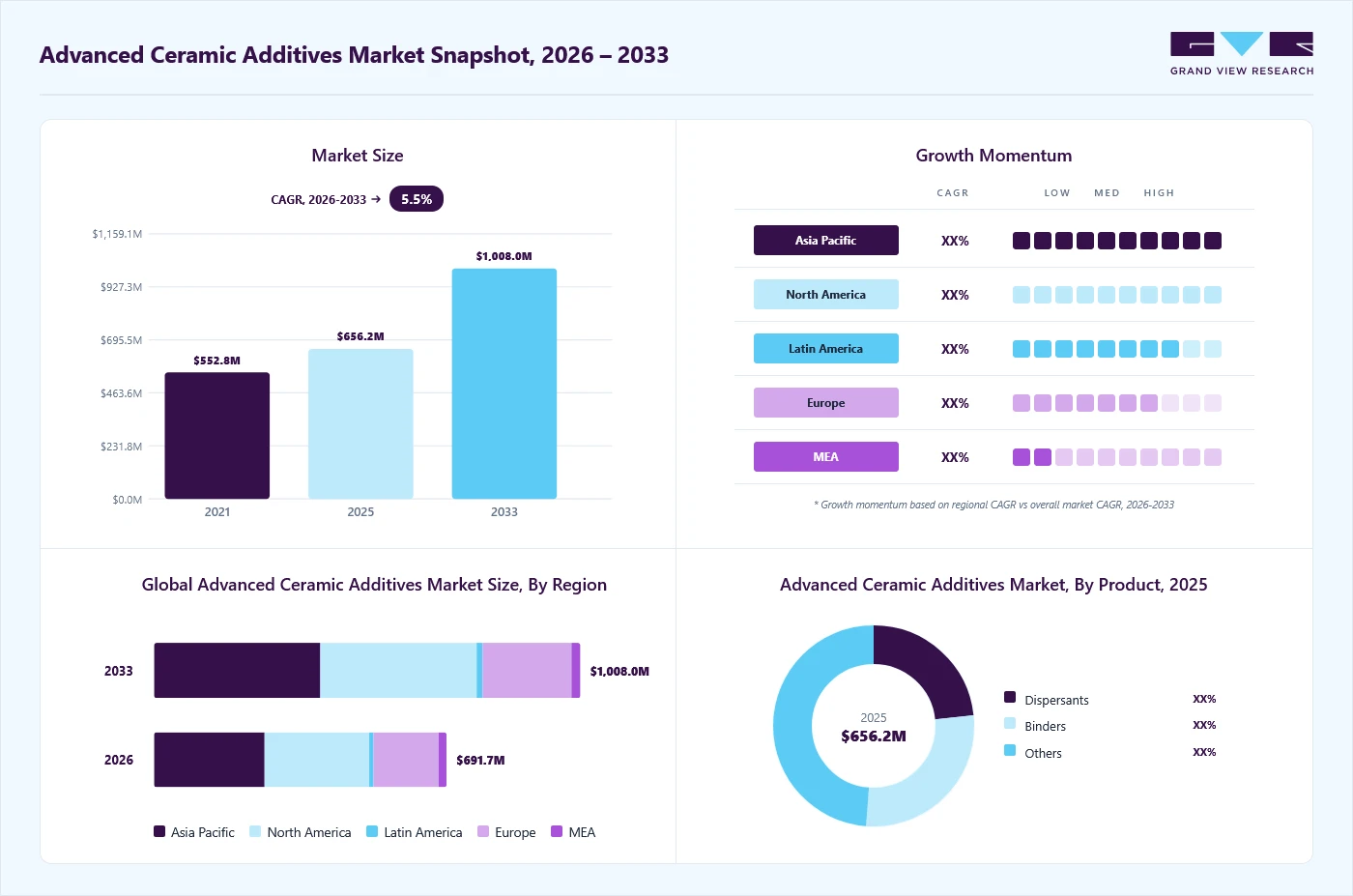
The global advanced ceramic additives market size was valued at USD 656.2 million in 2025 and is projected to grow from USD 691.7 million in 2026 to USD 1,008.0 million by 2033, at a CAGR of 5.5% from 2026 to 2033. The market in Asia Pacific dominated with a revenue share of 37.6% in 2025. The growth is primarily driven by the increasing demand for high-performance ceramics in electrical & electronics and automotive applications.
Key Market Trends & Insights
- By product: Binders segment held the largest market share of 28.0% in 2025.
- By application: Electrical & electronics segment held the largest market share in 2025.
Regional Highlights
- Largest regional market: Asia Pacific (37.6% revenue share, 2025)
- By country: China held the largest market share in 2025
Market Size & Forecast
- Market size in 2025: USD 656.2 Million
- Estimated market size in 2026: USD 691.7 Million
- Projected market size by 2033: USD 1,008.0 Million
- CAGR (2026-2033): 5.5%
It is further supported by advancements in ceramic processing technologies and the rising need for energy-efficient and durable materials across industrial sectors. Sustainability is emerging as a key driver in the advanced ceramic additives industry, with manufacturers increasingly focusing on eco-friendly formulations and energy-efficient processing techniques. Additives such as advanced dispersants and sintering aids enable reduced water consumption, lower emissions, and decreased sintering temperatures, thereby minimizing the overall environmental footprint of ceramic production. Additionally, growing regulatory pressure and the shift toward green manufacturing practices are encouraging the adoption of sustainable raw materials and low-VOC additive systems across end-use industries.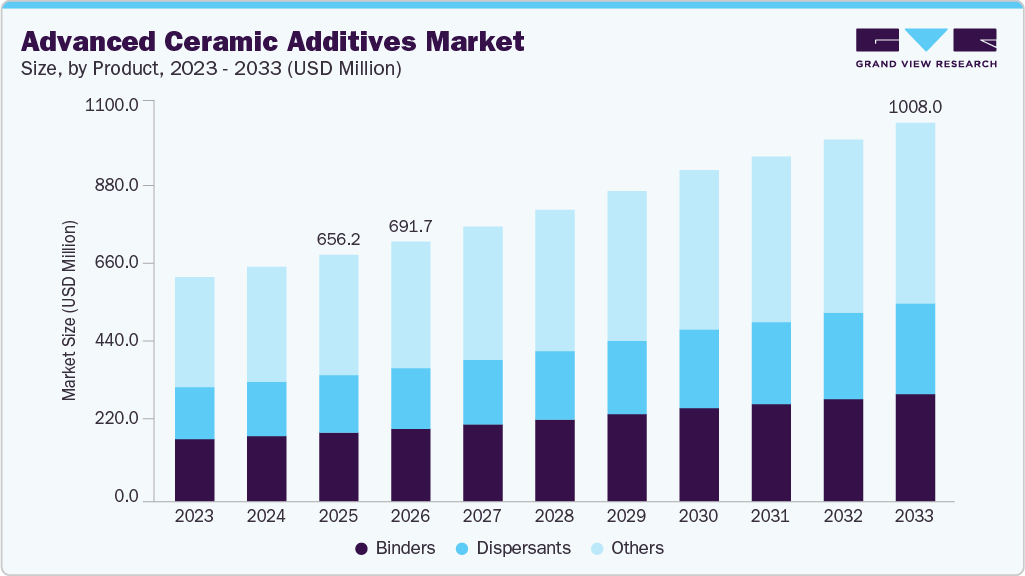
Technological advancements are significantly shaping the market, particularly through innovations in material science and precision engineering. The development of high-performance additives tailored for advanced applications such as semiconductors, electric vehicles, and medical devices is enhancing the functional properties of ceramics, including strength, thermal resistance, and electrical conductivity. Furthermore, emerging technologies such as additive manufacturing (3D printing of ceramics) and low-temperature sintering processes are expanding application possibilities, driving demand for specialized and customized additive solutions.
Drivers, Opportunities & Restraints
The industry is driven by the increasing demand for high-performance ceramics across industries such as electronics, automotive, and healthcare, where enhanced strength, thermal stability, and reliability are critical. In recent years, manufacturers have been focusing on improving production efficiency using advanced additives that enable better material uniformity and reduced processing temperatures, supporting large-scale and cost-effective manufacturing. This trend is further reinforced by the growing shift toward electrification and miniaturization in end-use industries.
The industry presents strong growth opportunities with the ongoing advancements in ceramic processing technologies and the emergence of next-generation applications. Innovations in areas such as additive manufacturing, miniaturized electronic components, and energy storage systems are creating demand for specialized additives that can deliver improved precision, functionality, and performance characteristics in advanced ceramic materials. Additionally, increasing investments in research and development are accelerating the commercialization of advanced ceramic solutions.
The industry faces challenges due to the complexity of ceramic manufacturing processes and fluctuations in the cost of raw materials used in additive formulations. High processing requirements, including controlled environments and energy-intensive operations, can increase production costs and limit adoption, particularly among smaller manufacturers and in price-sensitive markets. Moreover, the need for technical expertise and stringent quality control further adds to operational constraints.
Product Insights
The dispersants segment is expected to register the fastest growth during the forecast period from 2026 to 2033, driven by their critical role in improving slurry stability, particle dispersion, and overall processing efficiency in advanced ceramics. Increasing demand for high-precision ceramic components in electronics and energy applications is accelerating the adoption of advanced dispersant formulations that enable uniform microstructures and reduced defect rates.
Binders accounted for a revenue share of 28% in 2025, primarily due to their essential function in providing mechanical strength and structural integrity during the shaping and forming stages of ceramic manufacturing. Their widespread use across multiple applications, including electronics, automotive, and industrial components, continues to sustain strong demand, supported by ongoing advancements in polymer-based binder systems for improved performance and processability.
Application Insights
The environmental segment is anticipated to witness the highest CAGR from 2026 to 2033, supported by the growing use of advanced ceramics in filtration systems, emission control technologies, and catalytic applications. Increasing regulatory focus on pollution control and sustainability is driving demand for high-performance ceramic materials, thereby boosting the need for specialized additives that enhance durability and efficiency in environmental applications.
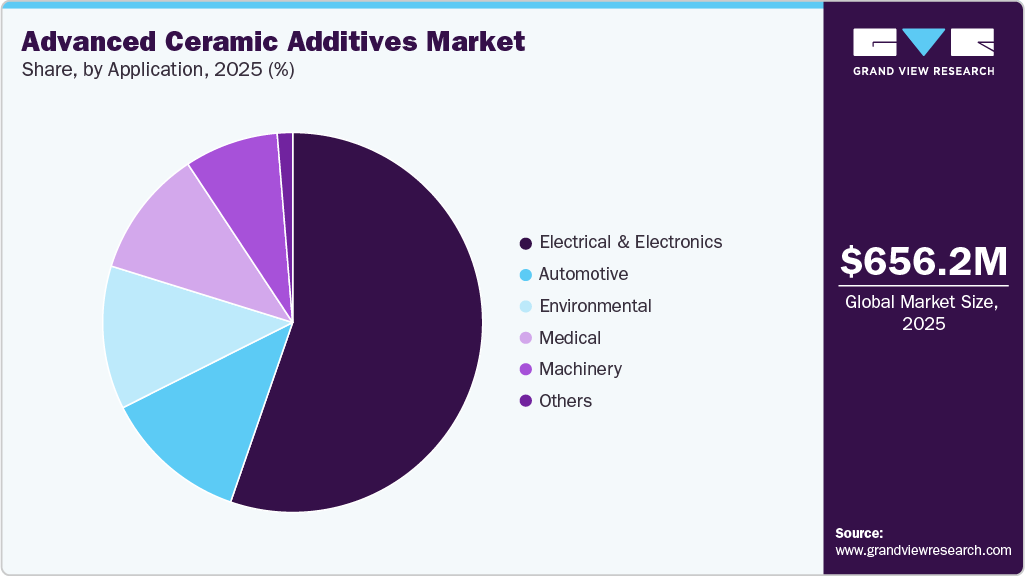
The electrical & electronics segment held the largest market share in 2025, driven by extensive use of advanced ceramics in semiconductors, capacitors, substrates, and insulating components. The continuous trend toward miniaturization, high-frequency performance, and enhanced reliability in electronic devices is sustaining strong demand for ceramic additives that enable precision manufacturing and superior electrical properties.
Regional Insights
North America advanced ceramic additives market represents a technologically advanced market, driven by strong demand from electronics, aerospace, and healthcare industries. The region benefits from a well-established manufacturing base and continuous investments in advanced materials research, particularly in high-performance ceramics for semiconductors and defense applications. Additionally, the presence of leading chemical companies and a growing focus on sustainable manufacturing practices are supporting steady market growth.
U.S. Advanced Ceramic Additives Market Trends
The advanced ceramic additives industry in the U.S. dominates the North American market, supported by its robust semiconductor industry, advanced healthcare infrastructure, and strong R&D ecosystem. Increasing adoption of advanced ceramics in electric vehicles, medical implants, and high-frequency electronic components is driving the demand for specialized additives. Furthermore, ongoing innovation in material science and government support for domestic manufacturing are strengthening market expansion.
Europe Advanced Ceramic Additives Market Trends
The advanced ceramic additives market in Europe is driven by the presence of a well-established automotive and industrial base, particularly in countries such as Germany and France. The region is witnessing increased demand for advanced ceramics in automotive electrification, renewable energy systems, and industrial machinery. Strict environmental regulations and sustainability goals are also encouraging the development of eco-friendly ceramic additives and energy-efficient processing technologies.
Asia Pacific Advanced Ceramic Additives Market Trends
Asia Pacific dominated the advanced ceramic additives industry with the largest revenue share of 37.6% in 2025 and is also the fastest-growing market, supported by its strong electronics manufacturing hub, particularly in China, Japan, and South Korea. Rapid industrialization, expanding semiconductor production, and growing demand for consumer electronics are significantly driving the need for advanced ceramic additives. Additionally, the region benefits from cost-effective manufacturing capabilities and increasing investments in advanced materials and EV supply chains.

Latin America Advanced Ceramic Additives Market Trends
The advanced ceramic additives market in Latin America is experiencing moderate growth, supported by industrial development and increasing demand from the automotive and electronics sectors. Countries such as Brazil and Mexico are witnessing the gradual adoption of advanced materials in manufacturing processes. However, market growth is somewhat constrained by limited technological infrastructure and dependency on imports for high-performance materials.
Middle East & Africa Advanced Ceramic Additives Market Trends
The advanced ceramic additives industry in the Middle East & Africa is gradually expanding, driven by infrastructure development, industrial diversification, and growing investments in manufacturing sectors. Demand for advanced ceramics is increasing in applications such as energy, construction, and industrial equipment, which in turn supports the use of ceramic additives. Although the market is still at a developing stage, ongoing economic diversification initiatives are expected to create growth opportunities.
Key Advanced Ceramic Additives Company Insights
Some of the key players operating in the market include BASF SE, Evonik Industries AG, and others.
-
BASF SE, founded in 1865, is one of the world’s largest chemical companies and a key supplier of advanced ceramic additives, with a strong global footprint across Europe, North America, and the Asia Pacific. The company offers a comprehensive range of performance chemicals, including dispersants, binders, and rheology modifiers, used in ceramic processing for electronics, automotive, and industrial applications. BASF is known for its strong R&D capabilities and focus on sustainable and high-performance material solutions, supporting advanced manufacturing and energy-efficient technologies.
-
Evonik Industries AG, established in 2007, is a leading global specialty chemicals company with a significant presence in advanced ceramic additives, operating across Europe, North America, and Asia. The company provides high-performance additives such as dispersants, surfactants, and silica-based solutions that enhance ceramic processing and end-product performance in electronics, medical, and industrial sectors. Evonik is recognized for its innovation-driven approach and strong expertise in material science, enabling customized solutions for high-tech ceramic applications.
-
Dow Inc., incorporated in 2019, is a major global materials science company with a strong presence in advanced additives for ceramics and related applications, serving markets across North America, Europe, and the Asia Pacific. The company’s portfolio includes specialty polymers, binders, and functional additives that improve processing efficiency and performance of advanced ceramics used in electronics, automotive, and infrastructure sectors. Dow leverages its broad materials science expertise and global manufacturing network to deliver scalable and innovative solutions aligned with evolving industry demands.
Key Advanced Ceramic Additives Companies:
The following key companies have been profiled for this study on the advanced ceramic additives market
- Ashland Inc.
- BASF SE
- Bentonite Performance Minerals LLC
- BOZZETTO Group
- Dow Inc.
- Evonik Industries AG
- Lamberti Group
- Sanyo Chemical Industries Ltd.
- Solvay S.A.
- Wacker Chemie AG
Recent Development
-
In February 2025, Evonik Industries AG announced the expansion of its silica and specialty additives production capacity in Asia, as disclosed through publicly available company communications. The initiative is aimed at strengthening supply capabilities for high-performance dispersants and functional additives used in advanced ceramics, particularly for electronics and semiconductor applications.
-
In June 2024, BASF SE introduced new sustainable dispersant technologies under its performance chemicals portfolio, as disclosed through publicly available company communications. These innovations are designed to improve ceramic processing efficiency while reducing environmental impact, supporting applications in electrical & electronics and industrial ceramics.
-
In September 2024, Dow Inc. announced advancements in its specialty binder solutions for high-performance ceramics, as disclosed through publicly available company communications. The development focuses on enhancing mechanical strength and processing stability in ceramic components used across automotive, electronics, and energy applications.
Advanced Ceramic Additives Market Report Scope
Report Attribute
Details
Market definition
The study estimates the apparent demand for additives incorporated during the manufacturing process of advanced ceramics.
Market size in 2025
USD 656.2 million
Estimated Market size in 2026
USD 691.7 million
Projected Market size by 2033
USD 1,008.0 million
Growth rate
CAGR of 5.5% from 2026 to 2033
Base year for estimation
2025
Historical data
2021 - 2024
Forecast period
2026 - 2033
Quantitative units
Volume in kilotons; revenue in USD million/billion, and CAGR from 2026 to 2033
Report coverage
Volume & revenue forecast, competitive landscape, growth factors, and trends
Segments covered
Product, application, region
Regional scope
North America; Europe; Asia Pacific; Latin America; Middle East & Africa
Country scope
U.S.; Canada; Mexico; Germany; UK; France; China; India; Japan; Brazil; Saudi Arabia
Key companies profiled
Ashland Inc.; BASF SE; Bentonite Performance Minerals LLC; BOZZETTO Group; Dow Inc.; Evonik Industries AG; Lamberti Group; Sanyo Chemical Industries Ltd.; Solvay S.A.; Wacker Chemie AG
Customization scope
Free report customization (equivalent up to 8 analysts working days) with purchase. Addition or alteration to country, regional & segment scope.
Pricing and purchase options
Avail customized purchase options to meet your exact research needs. Explore purchase options
Global Advanced Ceramic Additives Market Report Segmentation
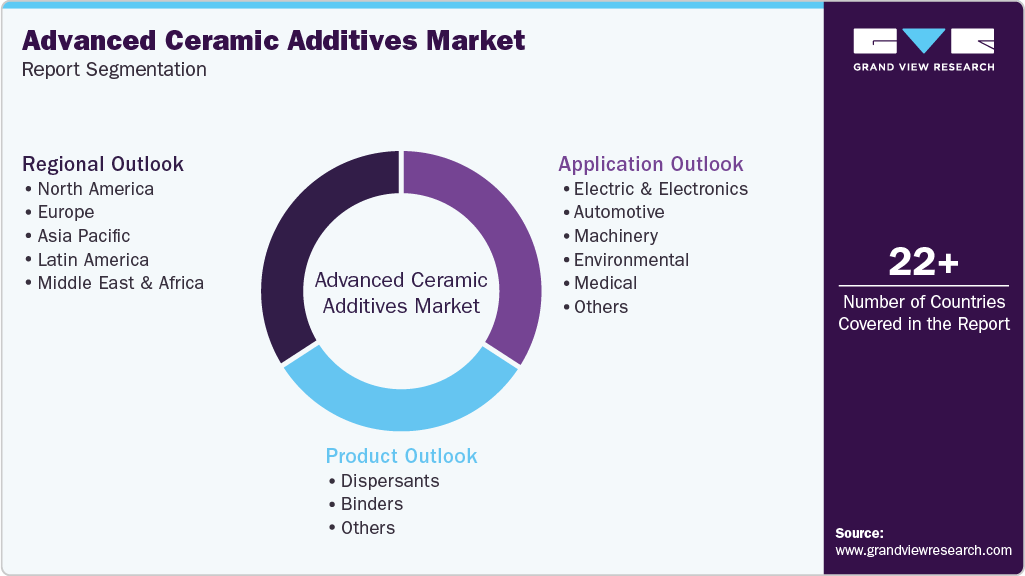
This report forecasts volume & revenue growth at the global, regional and country levels and provides an analysis of the industry trends in each of the sub-segments from 2021 to 2033. For this study, Grand View Research has segmented the global advanced ceramic additives market report on the basis of product, application, and region.
-
Product Outlook (Volume, Kilotons; Revenue, USD Million, 2021 - 2033)
-
Dispersants
-
Binders
-
Others
-
-
Application Outlook (Volume, Kilotons; Revenue, USD Million, 2021 - 2033)
-
Electric & Electronics
-
Automotive
-
Machinery
-
Environmental
-
Medical
-
Others
-
-
Regional Outlook (Volume, Kilotons; Revenue, USD Million, 2021 - 2033)
-
North America
-
U.S.
-
Canada
-
Mexico
-
-
Europe
-
Germany
-
UK
-
France
-
-
Asia Pacific
-
China
-
India
-
Japan
-
-
Latin America
-
Brazil
-
-
Middle East & Africa
-
Saudi Arabia
-
-
Frequently Asked Questions About This Report
The binders segment led with a 28.0% revenue share in 2025, while dispersants is the fastest-growing segment.
Asia Pacific dominated with a 37.6% revenue share in 2025.
The global advanced ceramic additives market size was estimated at USD 656.2 million in 2025 and is expected to reach USD 691.7 million in 2026.
The global advanced ceramic additives market is expected to grow at a compound annual growth rate of 5.5% from 2026 to 2033 to reach USD 1,008.0 million by 2033.
The electrical & electronics segment dominated the market in 2025, contributing 55.3% of the total revenue share.
Some of the key players operating in the advanced ceramic additives market are Ashland Inc., BASF SE, Bentonite Performance Minerals LLC, BOZZETTO Group, Dow Inc., Evonik Industries AG, Lamberti Group, Sanyo Chemical Industries Ltd., Solvay S.A., and Wacker Chemie AG, among others.
The global advanced ceramic additives market is driven by the rising demand for high-performance ceramics in electrical & electronics, automotive, and medical applications. Growth is further supported by advancements in ceramic processing technologies and the increasing need for energy-efficient and durable materials across industries.
About the Author(s)
Advanced Interior Materials Research Team
Advanced Materials · Advanced Interior MaterialsThis report was authored by the advanced interior materials research team at Grand View Research - comprising two research analysts, one senior research analyst, and one industry expert - with specialized expertise in the advanced interior materials segment of the advanced materials industry. All findings are based on proprietary advanced materials databases, executive interviews, and regulatory analysis, subject to internal peer review prior to publication.
Last Updated:
Speak to Analyst


Customize this report to your needs — add regions, segments, or data points, with 20% free customization.
Or view our licence options:


ISO 9001:2015 & 27001:2022 Certified
We are GDPR and CCPA compliant! Your transaction & personal information is safe and secure. For more details, please read our privacy policy.


