
- Home
- »
- Distribution & Utilities
- »
-
Advanced Energy Materials Market Size Report, 2026-2033GVR Report cover

Advanced Energy Materials Market (2026 - 2033)
Size, Share & Trends Analysis Report By Material Type (Battery Materials, Hydrogen & Fuel-Cell Materials, Nuclear Materials, Solar Materials, Semiconductor Materials), By Technology, By Application, By Region, And Segment Forecasts
Market Size, 2025
$166.8BMarket Estimate, 2026
$177.6BMarket Forecast, 2033
$322.4BCAGR, 2026–2033
8.9%Advanced Energy Materials Market Summary
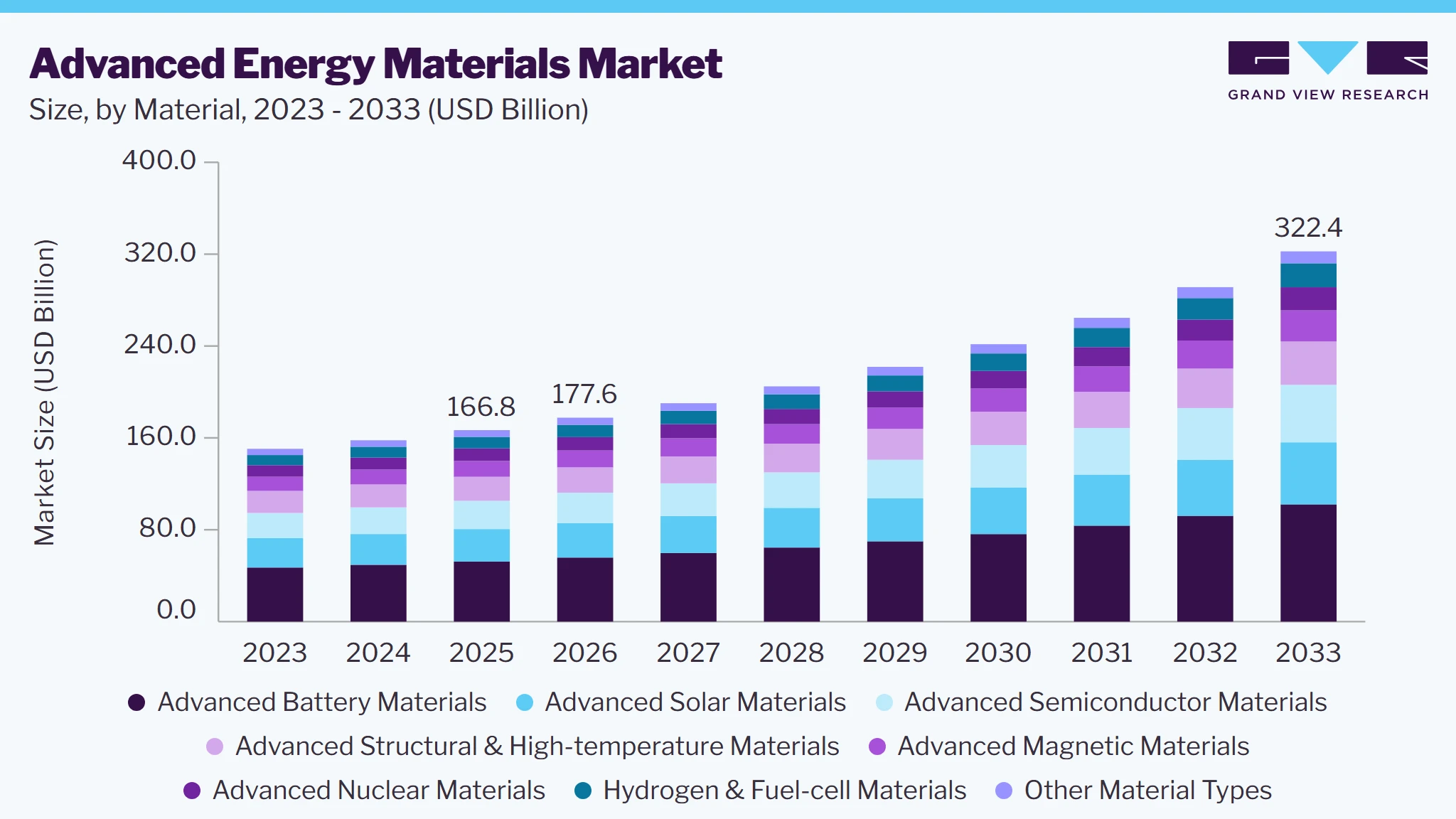
The global advanced energy materials market size was valued USD 166.8 billion in 2025 and is projected to grow from USD 177.6 billion in 2026 to USD 322.4 billion by 2033, at a CAGR of 8.9% from 2026 to 2033. Asia Pacific dominated the market, accounting for a revenue share of 56.4% in 2025. The market is driven by increasing demand for next-generation battery technologies, growing deployment of clean energy infrastructure, advancements in material science, and the need for improved performance, reliability, and sustainability across energy generation, storage, and transmission applications.
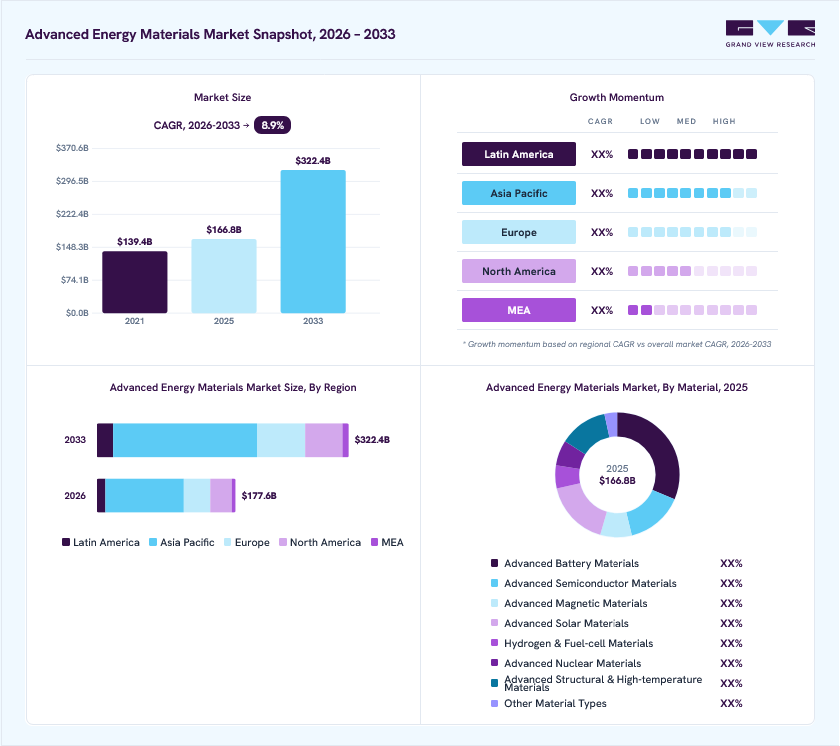 Source: Grand View Research, IR Documents, Primary Interviews, Paid DatabasesTo learn more about this report,
 Download Free Sample Report
 Key Market Trends & Insights
- By material type: Battery materials held the largest revenue share of 31.4% in 2025.
- By application: Energy storage held the largest revenue share of 29.0% in 2025.
- By technology: Battery technologies led the market with a revenue share of 29.1% in 2025.
Regional Highlights
- Largest regional market: Asia Pacific (56.4% revenue share, 2025)
- Fastest-growing regional market: Latin America (highest CAGR, 2026-2033)
- By country: India held the largest market share in 2025.
Market Size & Forecast
- Market size in 2025: USD 166.8 Billion
- Estimated market size in 2026: USD 177.6 Billion
- Projected market size by 2033: USD 322.4 Billion
- CAGR (2026-2033): 8.9%
Three ways to get this report
Buy it, customize it, or ask a question.Ask an Analyst
A direct answer, usually in 1 working day
- AccessReport author, directly
- Reply timeWithin 1 working day
- No sales callDirect answer only
- FormatEmail reply
- CostFree, no cost
Get the Full Report
What the study covers
- FormatsPDF · Excel · Dashboard
- Timeline2026–2033 annual, 2025 base
- Coverage20+ countries, 5 regions
- Companies10+ key players profiled
Customize the Report
20% free customization
- IncludeCountries, segments, points
- TailorTo your product definition
- ExtendDeeper competitor detail
- OrA fully bespoke study
- Turnaround5–10 working days
 To learn more about this report, Download Free Sample Report
 Market Dynamics
The advanced energy materials market is shaped by rapid innovation in material composition and manufacturing processes, which is enabling improved thermal, electrical, and mechanical properties. Increasing performance requirements across batteries, fuel cells, solar cells, and hydrogen technologies are encouraging the development of specialized materials. Supply availability and price fluctuations of critical minerals influence material selection and production economics. At the same time, research into recyclable, lightweight, and low-carbon materials is creating new opportunities for market participants.
The rapid electrification of transportation and expansion of energy storage are increasing demand for advanced materials that can improve energy density, charging performance, safety, and operating life. This is supporting wider use of high-performance cathode and anode materials, solid-state electrolytes, silicon-based materials, advanced separators, and other specialized components across EV and grid-storage applications. The shift toward next-generation battery chemistries is also encouraging material innovation aimed at reducing dependence on constrained or costly raw materials.
In January 2025, the U.S. Department of Energy announced a Notice of Intent for up to USD 725 million to strengthen domestic production of battery-critical materials, components, and advanced batteries. The proposed funding includes cathode and anode materials, electrolytes and electrolyte salts, separators, conductive additives, catalysts, binders, and other battery materials and processing technologies, highlighting continued investment in material supply chains supporting clean vehicles and grid energy storage.
High production and development costs remain a key restraint for the advanced energy materials market, particularly for materials requiring specialized processing, high-purity inputs, and stringent quality controls. Advanced synthesis, testing, and scale-up processes can require substantial capital investment before technologies reach commercial production. Volatility in the prices of critical minerals and specialty chemicals can further increase manufacturing costs and create uncertainty for producers. These cost pressures can slow commercialization and limit the adoption of advanced materials in price-sensitive applications.
The development of next-generation battery chemistries is creating new business opportunities for advanced energy material suppliers. Silicon-carbon composites can improve the energy-storage potential of lithium-ion anodes, while hard carbon is being developed for sodium-ion batteries as an alternative to conventional graphite. Solid-state batteries are also increasing demand for ceramic and polymer electrolytes with improved safety and ionic conductivity. These developments are creating opportunities across material development, specialized processing, component manufacturing, and battery recycling. In January 2025, the U.S. Department of Energy advanced projects focused on domestic hard-carbon anodes for sodium-ion batteries, highlighting the development of next-generation energy materials and associated domestic manufacturing capabilities.
Analyst Perspective
The advanced energy materials market is shifting from conventional material solutions toward specialized materials designed to improve energy density, efficiency, durability, and operating performance. Battery technologies are emerging as a major demand center, while hydrogen, fuel cells, solar, and grid applications are expanding the addressable opportunity. Supply-chain diversification is also becoming a strategic priority as critical-mineral availability and processing concentration influence material sourcing and technology selection. In the medium term, commercialization of next-generation materials and scalable manufacturing capabilities is expected to determine how quickly advanced materials move from R&D into broader energy applications.
Material Type Insights
The battery materials segment held the largest revenue share of 31.4% in 2025. This dominance is attributed to rising demand for lithium-ion batteries across electric vehicles, consumer electronics, and energy storage systems, alongside continued investments in battery manufacturing capacity and next-generation chemistries. Growing requirements for higher energy density, faster charging, safety, and longer cycle life are further supporting demand for advanced cathode, anode, electrolyte, and separator materials.
The hydrogen & fuel-cell materials segment is expected to register the fastest CAGR of 9.9% during the forecast period. This growth is driven by expanding hydrogen infrastructure, increasing deployment of fuel-cell systems, and continued material innovations aimed at improving catalyst activity, membrane durability, and overall system efficiency. Growing efforts to reduce reliance on conventional energy sources are further supporting the adoption of advanced materials across hydrogen production, storage, and fuel-cell applications.
Technology Insights
The battery technologies segment dominated the global market with a revenue share of 29.1% in 2025. This is supported by the rapid expansion of electric mobility, increasing deployment of stationary energy storage, and continued investment in high-performance battery chemistries. Growing demand for higher energy density, faster charging, longer cycle life, and improved safety is also encouraging the adoption of advanced materials across lithium-ion, sodium-ion, and next-generation battery technologies.
The hydrogen technologies segment is anticipated to register the fastest-growing CAGR of 9.9% from 2026 to 2033. This is due to increasing investment in green hydrogen production, expansion of electrolyzer capacity, and growing deployment of hydrogen-based energy systems. Advancements in catalysts, membranes, and other specialized materials are also improving the efficiency and durability of hydrogen technologies, supporting their broader commercialization across industrial and energy applications.
Application Insights
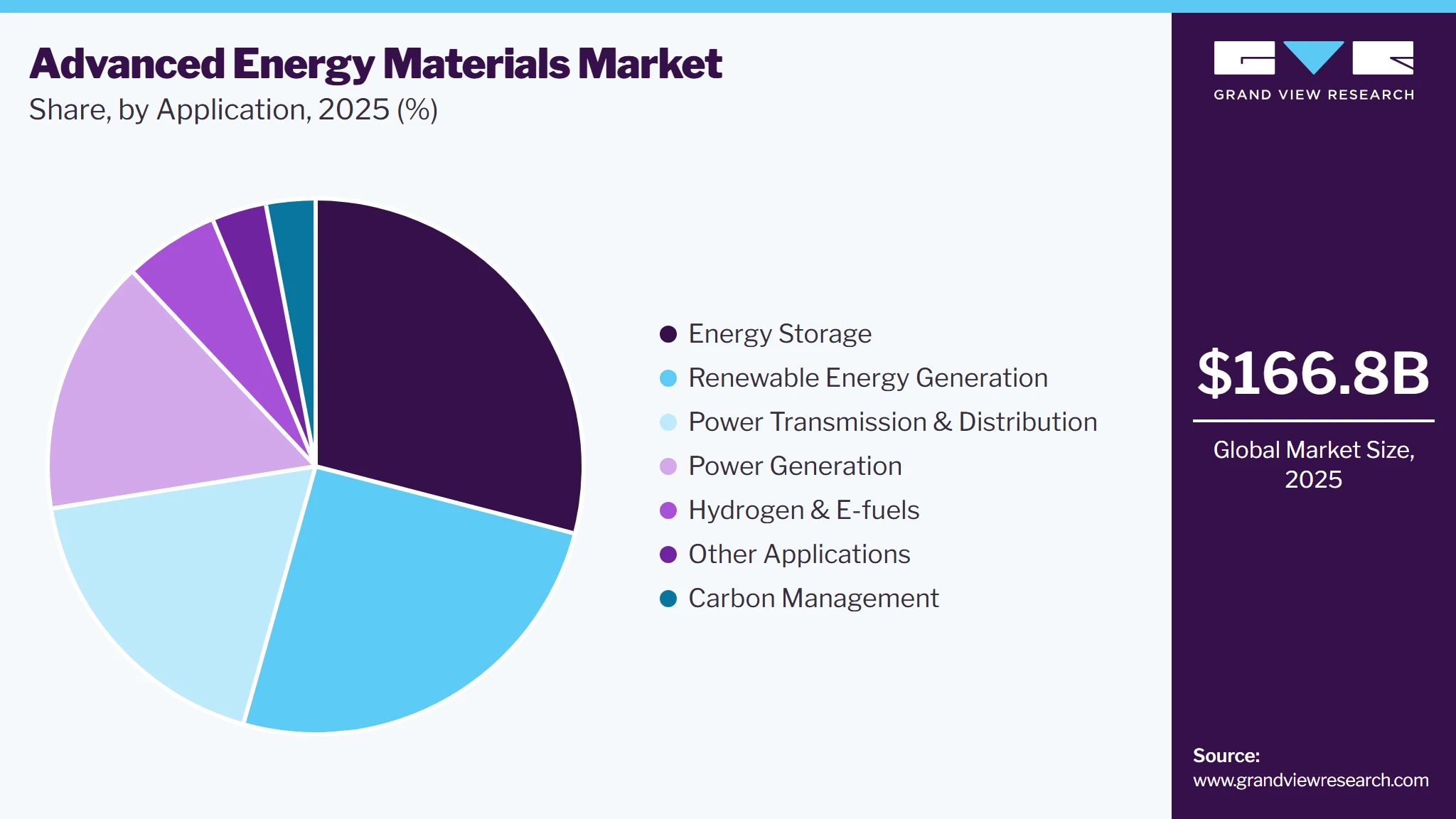
The energy storage segment held the largest revenue share of 29.0% in 2025, driven by increasing deployment of grid-scale battery systems, growing integration of intermittent renewable power, and rising demand for a reliable electricity supply. Investments in long-duration and next-generation storage technologies are also expanding the use of advanced materials that improve energy density, cycle life, thermal stability, and system performance. The expansion of distributed energy storage and behind-the-meter systems is further broadening demand for advanced storage materials across commercial, industrial, and residential applications.
 To learn more about this report, Download Free Sample Report
 The hydrogen & e-fuels segment is expected to register the fastest CAGR of 9.4% over the forecast period. This is supported by increasing investment in green hydrogen production, expanding electrolyzer deployment, and growing interest in low-carbon fuels for hard-to-abate sectors such as heavy transport, aviation, shipping, and industrial processes. Technological advancements in catalysts, membranes, and other specialized materials are further improving the efficiency and cost competitiveness of hydrogen-based systems.
Regional Insights
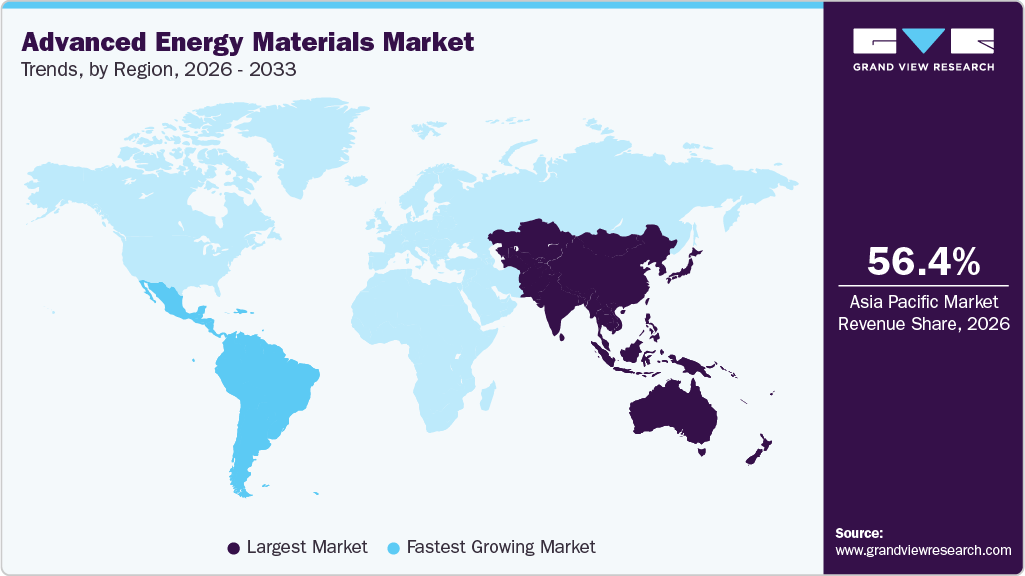
Asia Pacific advanced energy materials market dominated the global market with a revenue share of 56.4% in 2025. This is due to the region’s strong battery manufacturing base, expanding electric vehicle production, growing renewable energy deployment, and established supply chains for critical energy materials. China, Japan, South Korea, and emerging Southeast Asian markets continue to support regional demand through investments in battery components, energy storage, and clean energy technologies. In 2025, China accounted for more than 80% of global battery manufacturing capacity, highlighting the region’s strong position across the advanced energy materials value chain.
 To learn more about this report, Download Free Sample Report
 China Advanced Energy Materials Market Trends
China represents a major market for advanced energy materials, supported by its large-scale battery manufacturing ecosystem, rapid electric vehicle adoption, and continued expansion of renewable energy and energy storage capacity. The country’s integrated supply chain for cathode and anode materials, electrolytes, battery components, and critical minerals provides a strong manufacturing base for next-generation energy technologies. Increasing investment in sodium-ion batteries, solid-state batteries, hydrogen technologies, and other emerging applications is also broadening demand for specialized materials. Ongoing efforts to strengthen domestic supply chains and improve material processing capabilities are expected to support further market development.
Latin America Advanced Energy Materials Market Trends
The Latin America region is anticipated to register the fastest CAGR of 9.6% from 2026 to 2033. This is driven by increasing renewable energy deployment, rising investments in energy storage and electric mobility, and growing development of domestic supply chains for critical minerals. The region’s significant reserves of lithium and other strategic minerals are also creating opportunities for advanced material processing and supporting the expansion of battery and clean energy technologies. Growing efforts to attract foreign investment and strengthen local value chains are further supporting the development of advanced energy material manufacturing capabilities.
Europe Advanced Energy Materials Market Trends
Europe’s advanced energy materials market is supported by strong investment in batteries, hydrogen, renewable energy, and low-carbon industrial technologies. The region is also focusing on reducing dependence on imported critical raw materials by developing material substitution, recycling, and domestic processing capabilities. In 2025, the European Commission highlighted advanced materials as important for batteries, solar PV, fuel cells, electrolysers, wind turbines, and EV motors, creating opportunities for specialized material suppliers.
North America Advanced Energy Materials Market Trends
The North America advanced energy materials market is driven by expanding battery manufacturing, clean energy deployment, critical-mineral diversification, and investments in domestic technology supply chains. The region is seeing growing demand for battery materials, hydrogen components, advanced composites, and materials designed for high-efficiency energy systems. Canada is also developing capabilities in critical battery materials, cell prototyping, and recycling through its Advanced Clean Energy program, supporting regional supply-chain development.
U.S. Advanced Energy Materials Market Trends
The U.S. advanced energy materials market is supported by government efforts to strengthen domestic manufacturing and reduce reliance on overseas sources of critical materials. Demand is expanding across batteries, hydrogen, fuel cells, grid infrastructure, and advanced power-generation technologies, with emphasis on material performance and supply-chain security. In January 2025, the U.S. Department of Energy announced a Notice of Intent for up to USD 725 million to support domestic production of battery materials and components, including cathode and anode materials, electrolytes, separators, and conductive additives.
Middle East & Africa Advanced Energy Materials Market Trends
The Middle East & Africa advanced energy materials market is gaining momentum from investments in renewable power, hydrogen production, energy storage, and industrial decarbonization. Growing solar and wind capacity is creating demand for materials used in batteries, photovoltaics, electrolysers, and other clean-energy systems, while the region’s mineral resources provide opportunities for developing upstream material supply chains. Increasing focus on green hydrogen and low-carbon fuels is also creating new applications for catalysts, membranes, electrolytes, and other specialized materials.
Key Advanced Energy Materials Company Insights
Some of the key players operating in the global advanced energy materials market include 3M and Umicore, among others.
-
3M is a participant in the advanced energy materials market, supplying specialized materials and technologies for energy storage, fuel cells, power generation, and renewable energy applications. Its portfolio includes ceramics, fuel cell and battery components, glass bubbles, and materials used in wind energy applications. These engineered materials support applications requiring thermal resistance, electrical insulation, lightweight construction, and other performance characteristics across energy technologies. 3M’s broad material science capabilities and energy-focused product portfolio support its participation in the advanced energy materials market.
-
Umicore is a major participant in the advanced energy materials market, developing and manufacturing materials for batteries, energy storage, photovoltaics, and hydrogen technologies. Its portfolio includes battery-grade cobalt and nickel compounds, cathode active materials, silicon-based anode materials, and platinum- and iridium-based catalysts for green hydrogen applications. In March 2025, Umicore announced agreements with CNGR and Eco&Dream for the supply of precursor cathode active materials for EV batteries, complementing its own pCAM production in Finland and China. This combination of advanced material production, technology development, and recycling capabilities makes Umicore a significant participant in the advanced energy materials market.
Key Advanced Energy Materials Companies
The following key companies have been profiled for this study on the advanced energy materials market.
-
3M
-
Arkema
-
BASF
-
Cabot Corporation
-
Epsilon
-
Himadri Speciality Chemical Ltd.
-
James Cropper PLC
-
Johnson Matthey
-
Syensqo
-
Umicore
Competitive Benchmarking
Category
Operating Strategies
Competitive Edge
Weakness
Established Players (3M, Arkema, BASF, Cabot Corporation, Johnson Matthey, Syensqo, Umicore)
- Leverage established global manufacturing networks, advanced material science capabilities, and long-term customer relationships to serve large-scale demand across batteries, hydrogen, fuel cells, renewable energy, and other energy applications.
- Expand specialized material production capacities and develop application-specific solutions for emerging battery chemistries, energy storage, hydrogen, and electrification technologies.
- Invest in R&D, process optimization, and advanced manufacturing technologies to improve material performance, production efficiency, and cost competitiveness.
- Benefit from established global production infrastructure, extensive technical expertise, and diversified advanced-material portfolios.
- Maintain long-standing relationships with major customers across automotive, energy, electronics, and industrial markets.
- Utilize strong R&D capabilities and financial resources to develop and commercialize new material technologies at scale.
- Face higher capital and operating costs associated with large-scale manufacturing facilities and global production networks.
- Remain exposed to fluctuations in the prices and availability of critical minerals and other specialty raw materials.
- Manage complex portfolios across multiple industries, which can increase resource allocation and commercialization challenges.
Emerging Players (Epsilon, Himadri Speciality Chemical Ltd., James Cropper PLC)
- Focus on specialized advanced-material applications such as silicon-based anodes, conductive materials, battery separators, and next-generation energy-storage technologies.
- Develop proprietary material formulations and processing technologies to address specific performance and cost requirements of energy-technology customers.
- Establish strategic partnerships with battery manufacturers, automotive companies, and larger material suppliers to accelerate customer qualification and commercial adoption.
- Benefit from focused technology portfolios and specialized expertise in emerging energy-material applications.
- Maintain greater flexibility to customize materials according to customer and technology requirements.
- Utilize newer production technologies and focused operating structures to support innovation and product development.
- Operate with smaller production capacities and more limited global manufacturing networks than established competitors.
- Face higher commercialization risks as some technologies remain at pilot or early commercial stages.
- Have comparatively lower financial resources for large-scale capacity expansion and long-term R&D programs.
Recent Developments
- In June 2026, BASF introduced Oppanol N PLUS, a high-performance polyisobutene binder developed for next-generation EV batteries, including solid-state batteries. The material is designed to improve process consistency and battery stability by accommodating mechanical stresses during charging and discharging, while its narrow specifications reduce production variability and quality-control requirements. The development strengthens BASF’s portfolio of specialized battery materials and supports its focus on advanced materials for next-generation energy storage technologies.
Advanced Energy Materials Market Report Scope
Report Attribute
Details
Market Definition
The advanced energy materials market comprises the revenues generated from the sale of engineered materials specifically developed to enable or enhance energy generation, conversion, storage, transmission, distribution, and decarbonization technologies.
Market size in 2025
USD 166.8 billion
Estimated market size in 2026
USD 177.6 billion
Projected market size by 2033
USD 322.4 billion
Growth rate
CAGR of 8.9% from 2026 to 2033
Base year for estimation
2025
Historical data
2021 - 2024
Forecast period
2026 - 2033
Quantitative Units
Revenue in USD billion and CAGR from 2026 to 2033
Report coverage
Revenue forecast, competitive landscape, growth factors, and trends
Segments covered
Material type, technology, application, region
Regional scope
North America; Europe; Asia Pacific; Latin America; Middle East & Africa
Country scope
U.S.; Canada; Mexico; Germany; UK; France; Italy; Spain; China; India; Japan; South Korea; Australia; Brazil; Argentina; UAE; Saudi Arabia; South Africa
Key companies profiled
3M; Arkema; BASF; Cabot Corporation; Epsilon; Himadri Speciality Chemical Ltd.; James Cropper PLC; Johnson Matthey; Syensqo; Umicore
Customization scope
Free report customization (equivalent up to 8 analysts working days) with purchase. Addition or alteration to country, regional & segment scope.
Pricing and purchase options
Avail customized purchase options to meet your exact research needs. Explore purchase options
Global Advanced Energy Materials Market Report Segmentation
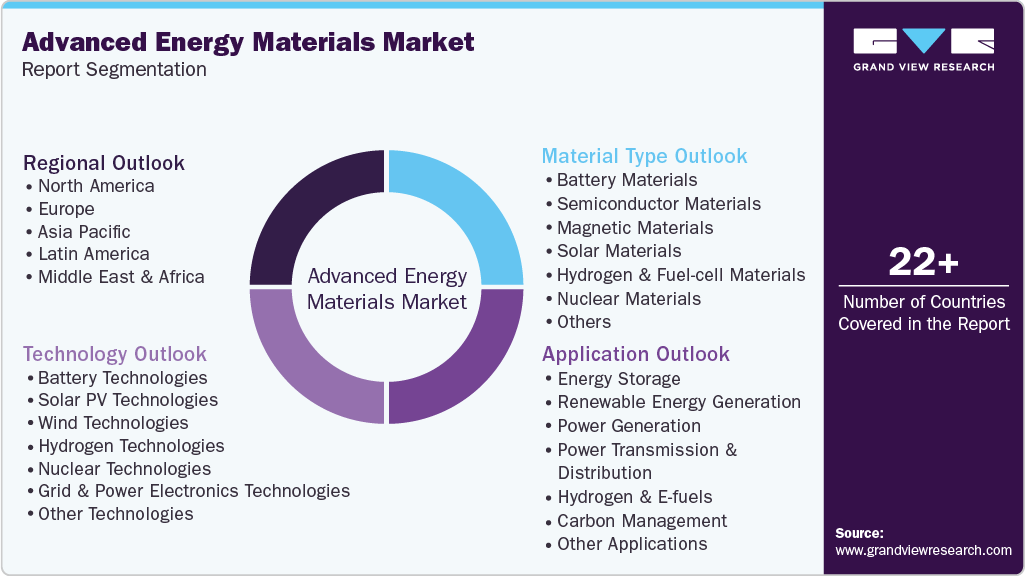
This report forecasts revenue growth at global, regional, and country levels and provides an analysis of the latest industry trends in each of the sub-segments from 2021 to 2033. For this study, Grand View Research has segmented the global advanced energy materials market report based on material type, technology, application, and region.
 To learn more about this report, Download Free Sample Report
 -
Material Type Outlook (Revenue, USD Billion, 2021 - 2033)
-
Battery Materials
-
Semiconductor Materials
-
Magnetic Materials
-
Solar Materials
-
Hydrogen & Fuel-cell Materials
-
Nuclear Materials
-
Structural & High-temperature Materials
-
Other Material Types
-
-
Technology Outlook (Revenue, USD Billion, 2021 - 2033)
-
Battery Technologies
-
Solar PV Technologies
-
Wind Technologies
-
Hydrogen Technologies
-
Nuclear Technologies
-
Grid & Power Electronics Technologies
-
Other Technologies
-
-
Application Outlook (Revenue, USD Billion, 2021 - 2033)
-
Energy Storage
-
Renewable Energy Generation
-
Power Generation
-
Power Transmission & Distribution
-
Hydrogen & E-fuels
-
Carbon Management
-
Other Applications
-
-
Regional Outlook (Revenue, USD Billion, 2021 - 2033)
-
North America
-
U.S.
-
Canada
-
Mexico
-
-
Europe
-
Germany
-
UK
-
France
-
Italy
-
Spain
-
-
Asia Pacific
-
China
-
India
-
Japan
-
South Korea
-
Australia
-
-
Latin America
-
Brazil
-
Argentina
-
-
Middle East & Africa
-
Saudi Arabia
-
UAE
-
South Africa
-
-
Research Methodology
The advanced energy materials market figures in this report are based on a proven research process that combines executive interviews with secondary research from proprietary databases, company filings, and recognized regulatory and institutional sources. Market size is built through value-chain sizing-reconciling supply-side and demand-side estimates-and triangulated with bottom-up and top-down approaches. Every estimate passes multiple levels of expert validation before publication, with each advanced energy materials segment quantified using the revenue-capture definitions in the table below.
Segment Definition
Material Type
Revenue capture definition
Battery Materials
Revenue from advanced materials used in battery electrodes, electrolytes, separators, current collectors, and related components.
Semiconductor Materials
Sales of engineered semiconductor materials, substrates, wafers, and compounds used in energy and power electronic devices.
Magnetic Materials
Revenue captures specialized magnetic materials supplied for motors, generators, transformers, inductors, and related energy equipment.
Solar Materials
Value of specialized materials used in solar cells, modules, and photovoltaic components.
Hydrogen & Fuel-cell Materials
Revenue includes catalysts, membranes, electrodes, electrolytes, coatings, and other engineered materials used in hydrogen and fuel-cell technologies.
Nuclear Materials
Income from materials used in nuclear fuel, reactor components, shielding, and other nuclear energy systems.
Structural & High-temperature Materials
Value derived from advanced ceramics, composites, alloys, coatings, and other materials designed for demanding structural and high-temperature applications.
Other Material Types
Revenue covers other engineered materials supporting energy, electrification, and decarbonization technologies.
Technology
Revenue capture definition
Battery Technologies
Revenue from advanced materials incorporated into lithium-ion, sodium-ion, solid-state, and other battery technologies.
Solar PV Technologies
Sales of materials supplied for photovoltaic cells, modules, and associated solar PV technologies.
Wind Technologies
Revenue captures specialized materials used in wind turbine blades, generators, structural components, and related systems.
Hydrogen Technologies
Value of materials incorporated into electrolyzers, hydrogen production, storage, distribution, and related technologies.
Nuclear Technologies
Revenue includes materials supplied for nuclear reactors, fuel systems, and associated nuclear energy technologies.
Grid & Power Electronics Technologies
Income from advanced materials used in power semiconductors, converters, inverters, transformers, switchgear, and grid equipment.
Other Technologies
Revenue covers material sales supporting energy and decarbonization technologies outside the specified technology categories.
Application
Revenue capture definition
Energy Storage
Revenue from advanced materials incorporated into grid-scale, stationary, distributed, and other energy storage systems.
Renewable Energy Generation
Sales of materials supplied for solar, wind, and other renewable power generation equipment.
Power Generation
Revenue captures engineered materials used across conventional, nuclear, and other power generation systems.
Power Transmission & Distribution
Value of specialized materials incorporated into transmission lines, transformers, cables, switchgear, and distribution equipment.
Hydrogen & E-fuels
Revenue includes materials used in hydrogen production and the synthesis, processing, storage, and utilization of e-fuels.
Carbon Management
Income from materials supplied for carbon capture, utilization, storage, and related emissions management technologies.
Other Applications
Revenue covers advanced materials serving other energy, electrification, and decarbonization applications.
Estimation Model
Layer Name
Key Question
Description
Demand Layer
Which factors drive demand for advanced energy materials?
Assess demand arising from the deployment, production, replacement, and capacity expansion of batteries, solar PV, wind turbines, hydrogen systems, nuclear technologies, grid infrastructure, power electronics, and other energy and decarbonization technologies.
Material Type Layer
Which material categories contribute to market revenue?
Evaluate revenue across Battery Materials, Semiconductor Materials, Magnetic Materials, Solar Materials, Hydrogen & Fuel-cell Materials, Nuclear Materials, Structural & High-temperature Materials, and Other Material Types based on material consumption, material intensity, and applicable selling prices.
Technology & Application Layer
Which technologies and applications generate demand for advanced energy materials?
Allocate material sales across Battery Technologies, Solar PV Technologies, Wind Technologies, Hydrogen Technologies, Nuclear Technologies, Grid & Power Electronics Technologies, and Other Technologies, with further allocation across Energy Storage, Renewable Energy Generation, Power Generation, Power Transmission & Distribution, Hydrogen & E-fuels, Carbon Management, and Other Applications.
Revenue Layer
How is market revenue generated and estimated?
Market revenue is quantified through the sale of engineered materials used in energy and decarbonization technologies. Revenue is estimated using material volumes sold, material intensity, technology deployment, and average selling prices, with revenue allocated by material type, technology, and application.
Delivered Customizations
We have successfully delivered the following deep-dive customizations
Client Request
Customization Delivered
Value Adds
Material Opportunity Assessment
Market analysis was conducted across battery materials, semiconductor materials, magnetic materials, solar materials, hydrogen & fuel-cell materials, nuclear materials, structural & high-temperature materials, and other material types by evaluating material demand, technology deployment, material intensity, production capacity, and adoption of advanced energy technologies.
Identified high-potential material categories based on demand growth, technology adoption, material intensity, supply requirements, and future advanced energy materials revenue opportunities.
Cross-Segmental Assessment
Market analysis was conducted by mapping advanced energy materials across energy storage, renewable energy generation, power generation, power transmission & distribution, hydrogen & e-fuels, carbon management, and other applications to assess material utilization, application-specific demand, technology requirements, and revenue contribution.
Identified high-potential material-application combinations based on material intensity, application growth, technology adoption, deployment activity, and future revenue opportunities across energy and decarbonization applications.
Regional Opportunity Assessment
Country-level analysis was conducted to assess advanced energy materials demand based on battery manufacturing capacity, renewable energy deployment, hydrogen projects, nuclear capacity, grid infrastructure investments, semiconductor production, and clean-energy technology manufacturing across key regions.
Identified high-potential countries and regions with expanding clean-energy manufacturing, increasing technology deployment, established industrial ecosystems, and growing demand for advanced materials, creating opportunities for material producers and suppliers.
Frequently Asked Questions About This Report
The advanced energy materials market is primarily driven by accelerating clean energy deployment, rapid growth in battery energy storage and electric vehicles, grid modernization investments, and increasing demand for high-performance materials that improve energy efficiency and decarbonization.
The Asia Pacific region dominated the advanced energy materials market with a revenue share of 56.4% in 2025.
The advanced energy materials market size was valued at USD 166.8 billion in 2025 and is estimated at USD 177.6 billion in 2026.
The advanced energy materials market is expected to grow at a CAGR of 8.9% from 2026 to 2033, reaching USD 322.4 billion by 2033.
Latin America is anticipated to register the fastest CAGR of 9.6% over the forecast period.
The battery materials segment accounted for largest revenue share of 31.4% in 2025 while hydrogen & fuel-cell materials segment is expected to be the fastest-growing market.
The energy storage segment held the largest revenue share of 29.0% in 2025, driven by increasing deployment of grid-scale battery systems, growing integration of intermittent renewable power, and rising demand for a reliable electricity supply.
The key players operating in the advanced energy materials market are 3M, Arkema, BASF, Cabot Corporation, Epsilon, Himadri Speciality Chemical Ltd., James Cropper PLC, Johnson Matthey, Syensqo, Umicore, and others.
The battery technologies segment dominated the global market with a revenue share of 29.1% in 2025.
About the Author(s)
Distribution & Utilities Research Team
Energy & Power · Distribution & UtilitiesThis report was authored by the distribution & utilities research team at Grand View Research - comprising two research analysts, one senior research analyst, and one industry expert - with specialized expertise in the distribution & utilities segment of the energy & power industry. All findings are based on proprietary energy & power databases, executive interviews, and regulatory analysis, subject to internal peer review prior to publication.
Last Updated:
Speak to Analyst

Customize this report to your needs - add regions, segments, or data points, with 20% free customization.
Or view our licence options:


ISO 9001:2015 & 27001:2022 Certified
We are GDPR and CCPA compliant! Your transaction & personal information is safe and secure. For more details, please read our privacy policy.


