
- Home
- »
- Next Generation Technologies
- »
-
AI Deception Tools Market Size & Share Report, 2025-2033GVR Report cover

AI Deception Tools Market (2025 - 2033)
Size, Share & Trends Analysis Report By Technology (Machine Learning, Natural Language Processing (NLP)), By Application (Fraud Detection, Cyber Security), By End-use, By Region, And Segment Forecasts
Market Size, 2024
$640.4MMarket Estimate, 2026
$1,039.5MMarket Forecast, 2033
$6,415.5MCAGR, 2025–2033
29.4%AI Deception Tools Market Summary
The global AI deception tools market size was valued at USD 640.4 million in 2024 and is projected to grow from USD 1,039.5 million in 2026 to USD 6,415.5 million by 2033, at a CAGR of 29.4% from 2025 to 2033. North America dominated the market, accounting for a revenue share of 35.9% in 2024. The market growth is anticipated by the growing use of AI- technologies in the security sector due to the growing complexity of cyber threats that bypass conventional security measures, demanding the need for more advanced and proactive defenses.
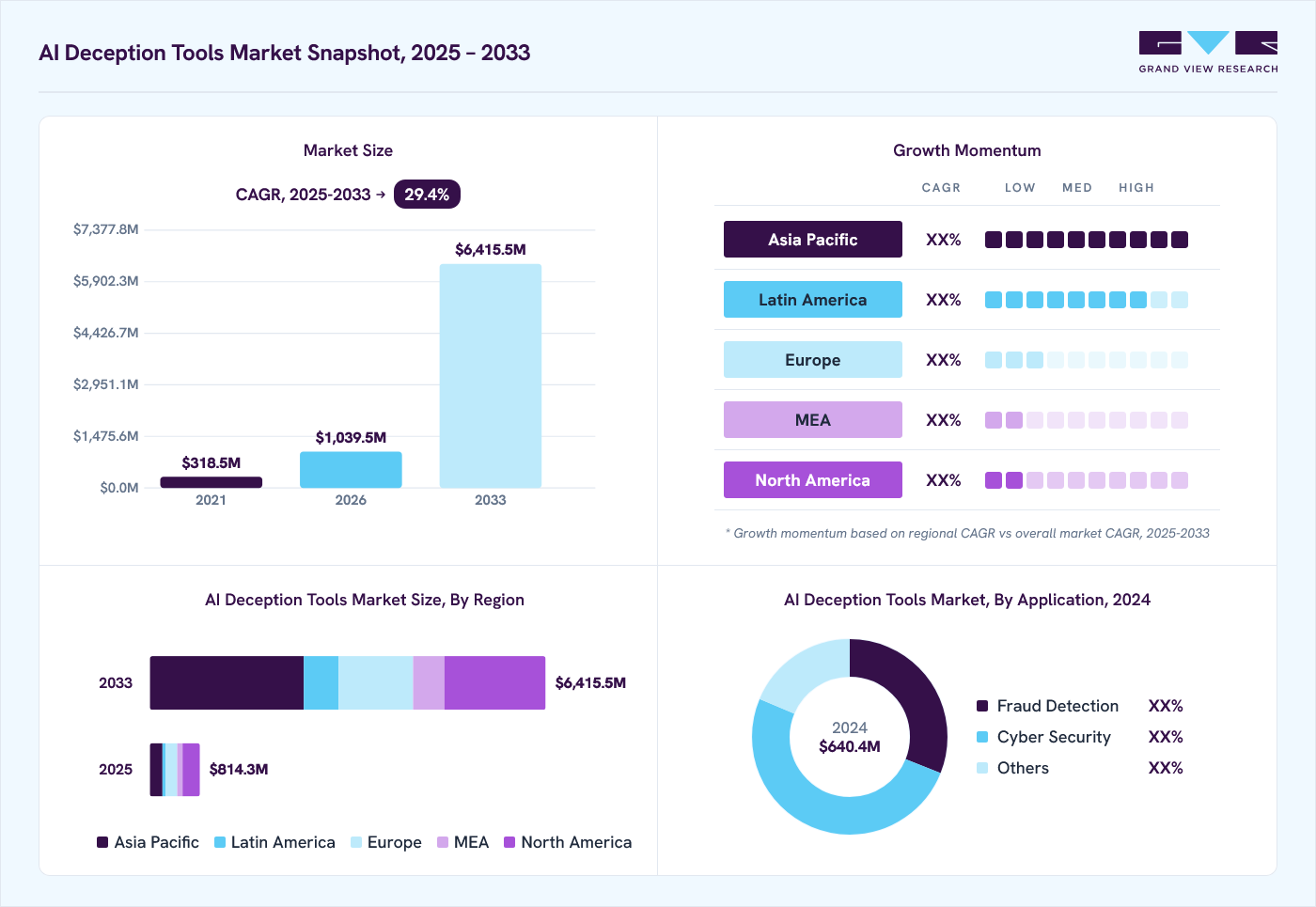 Source: Grand View Research, IR Documents, Primary Interviews, Paid DatabasesTo learn more about this report,
 Download Free Sample Report
 Key Market Trends & Insights
- The U.S. AI deception tools industry is expected to grow significantly in 2024.
- By technology, the machine learning segment led the market, holding the largest revenue share of 33.9% in 2024.
- By application, the cybersecurity segment held the dominant position in the market and accounted for the leading revenue share of 50.3% in 2024.
- By end use, the government segment is expected to grow at the fastest CAGR of 34.9% from 2025 to 2033.
Market Size & Forecast
- 2024 Market Size: USD 640.4 Million
- 2033 Projected Market Size: USD 6,415.5 Million
- CAGR (2025-2033): 29.4%
- North America: Largest market in 2024
- Asia Pacific: Fastest growing market
Three ways to get this report
Buy it, customize it, or ask a question.Ask an Analyst
Analyst response in 1 business day
- AccessReport author, directly
- Reply timeWithin 1 working day
- No sales callDirect answer only
- FormatEmail reply
- CostFree, no cost
Get the Full Report
What the study covers
- FormatsPDF · Excel · Dashboard
- Timeline2025–2033 annual, 2024 base
- Coverage20+ countries, 5 regions
- Companies10+ key players profiled
Customize the Report
20% free customization
- IncludeCountries, segments, points
- TailorTo your product definition
- ExtendDeeper competitor detail
- OrA fully bespoke study
- Turnaround5–10 working days
These AI-driven platforms boost early threat identification and response by strategically placing intelligent, adaptable decoys throughout networks to mislead attackers and expose malicious actions before they cause harm. The expansion of the market is driven by the continuously evolving nature of cyberattacks, where attackers increasingly depend on stealthy, long-term strategies to infiltrate and navigate networks without detection. Conventional perimeter defenses are often ineffective against these advanced persistent threats (APTs), leading organizations to adopt deception technologies that provide real-time insights into attacker activity and support quicker response times. AI enhances these capabilities by autonomously placing decoys in vulnerable areas and learning from attacker behavior to continuously adapt and strengthen security in line with emerging threats.Another major driver is the rise of AI-driven social engineering and misinformation attacks, such as deepfakes and AI-crafted phishing schemes. Cybercriminals are using generative AI to create highly realistic, personalized fraudulent content that often bypasses traditional security measures. AI deception tools prevent these threats by applying behavioral analytics and generating synthetic digital identities to detect and divert malicious activity, thereby qualifying risks such as credential theft, identity fraud, and synthetic attacks. As these AI-enhanced threats grow, industries including finance, healthcare, and defense are increasingly adopting advanced deception technologies designed to proactively neutralize such evolving cyber risks.
 To learn more about this report, Download Free Sample Report
 Furthermore, AI integration allows the systems to operate effectively at scale within complex environments, easing the burden on security teams and positioning deception as a vital technology of modern cybersecurity frameworks. Moreover, the advancements in multimodal large language models (LLMs) and multimodal AI technologies are enhancing the precision of AI deception tools. For instance, in September 2024, the Federal Trade Commission (FTC) launched Operation AI Comply, a suppression on companies using AI in deceptive or unfair ways that harm consumers. The initiative includes enforcement actions against businesses promoting AI tools that produce fake reviews, falsely advertise AI-based legal services, or attract people into fraudulent schemes promising income through AI-powered online shops. This effort is designed to safeguard consumers and promote fair competition in the growing AI industry.
Technology Insights
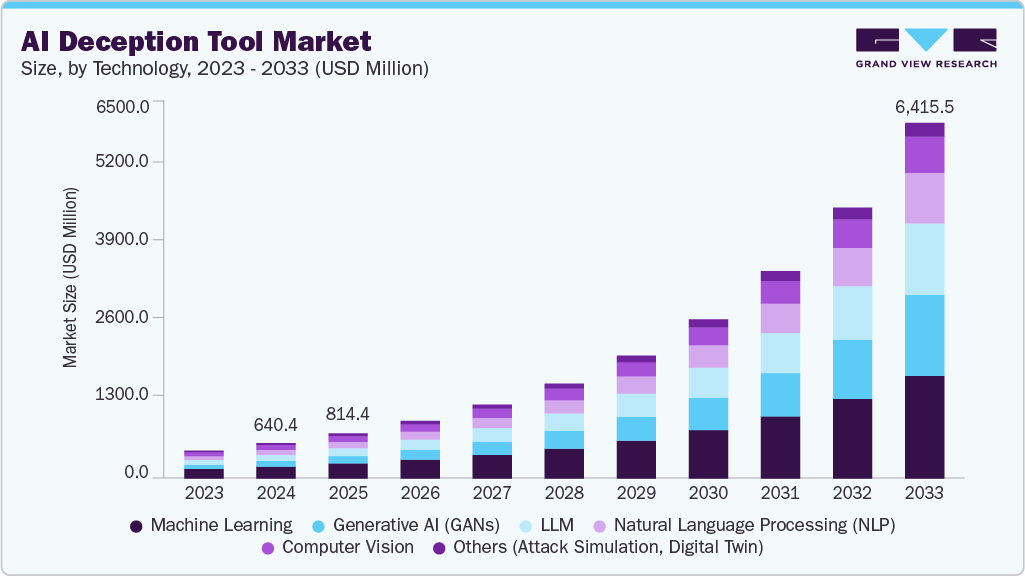
The machine learning segment led the market in 2024, accounting for 33.9% of global revenue, driven by the growing complexity and speed of modern digital scams, which pose serious risks to business credibility and customer relationships. Traditional fraud prevention methods are proving inadequate, bringing the requirement for the adoption of adaptive ML algorithms and systems that are capable of analyzing a wide range of data, such as IP addresses, request patterns, and geographic locations, to detect and block fraudulent actions in real time and faster. By utilizing historical data, this technology can expose and disrupt broader fraud networks instead of targeting isolated events. This proactive, intelligence-led strategy helps organizations protect both their financial resources and customer trust from increasingly AI-powered scams. For instance, in February 2024, Bumble launched Deception Detector, which uses ML to automatically detect and prevent fake, spam, and scam profiles before they reach users and showcase the feature of AI in fostering trust and creating a secure environment centered on genuine connections. It has led to a 45% drop in reports of deceptive accounts within just two months and has successfully blocked 95% of such profiles, and it operates with human moderators to enhance user safety and maintain authenticity on the platform.
The Gen AI segment is expected to grow at the fastest CAGR during the forecast period, driven by the development of highly convincing decoys such as fake chatbots, LLM APIs, and adaptive agents that closely imitate genuine AI systems, effectively drawing in and exposing malicious actors. This advanced method helps counter the growing wave of AI-driven attacks on sensitive systems by deploying interactive traps that can detect tactics such as prompt injection or attempts to extract training data. By incorporating generative AI decoys, organizations can improve threat detection across cloud and hybrid infrastructures, identify lateral movement early, and reinforce zero trust frameworks by turning attacker’s tools against them. As cybercriminals increasingly use AI for social engineering, credential theft, and scalable attacks, generative AI-powered deception is becoming essential for dynamic, real-time defense. For instance, in March 2025, GetReal Security introduced an automated forensic analysis platform designed to detect and fight against threats from malicious generative AI, such as deepfakes and impersonation attempts. The platform offers authentication for images, audio, and video across both stored content and live streams, understanding the needs of enterprises, government agencies, and media outlets. By combining AI, statistical analysis, and digital forensics, it delivers real-time verification and alerts to help prevent identity fraud and deception.
Application Insights
The cyber security segment held the largest market revenue share in 2024, driven by the main factors for integrating AI into cyber deception tools that focus on improving threat detection and response in a constantly shifting cyber threat environment. AI supports the development of adaptive and realistic deceptive elements such as fake files, login credentials, and simulated network structures that can actively engage and mislead attackers in real time. It also enables the creation of detailed attacker profiles by examining behaviors, tactics, and intent, allowing security teams to anticipate and neutralize threats more accurately. Moreover, AI’s ability to process large datasets helps minimize false alerts and reduce analyst fatigue, enhancing overall security operations. Lastly, 24/7 availability and cost-efficiency of AI-powered deception tools make them a valuable asset in cybersecurity strategies. For instance, in April 2025, Fortinet launched its FortiDeceptor platform, which identifies and tackles cyber threats using lifelike decoys and fake digital assets. The system attracts attackers to interact with these false endpoints, and allowing swift incident response. The platform delivers highly accurate alerts with no false positives and enables automated threat detection and containment.
The fraud detection segment is expected to grow at a significant CAGR over the forecast period, driven by the advanced tactics (deepfake videos, AI-generated phishing emails, and chatbot scams) taking advantage of vulnerabilities such as unpatched systems, outdated antivirus software, and social engineering for attacks such as credential theft, ransomware, and unauthorized access. AI-powered deception approach helps reduce response times, minimize false positives, optimize security resources, and enhance threat intelligence, strengthening overall security systems and enhancing an organization's defense against deceptive cyberattacks. For instance, in March 2025, GetReal Security introduced platform, automated forensic analysis to tackle AI deception, such as deepfake fraud and identity manipulation. It integrates multiple tools to authenticate images, audio, and video in real time, enabling organizations to detect and counter AI-generated misinformation effectively. By combining advanced AI, statistical techniques, and digital forensics, it verifies digital content across various formats, equipping enterprises, government agencies, and media outlets with reliable insights for critical decision-making. This solution addresses the rising threat of AI-enabled attacks by streamlining forensic analysis and offering expert support to help prevent fraud and protect sensitive data.
End Use Insights
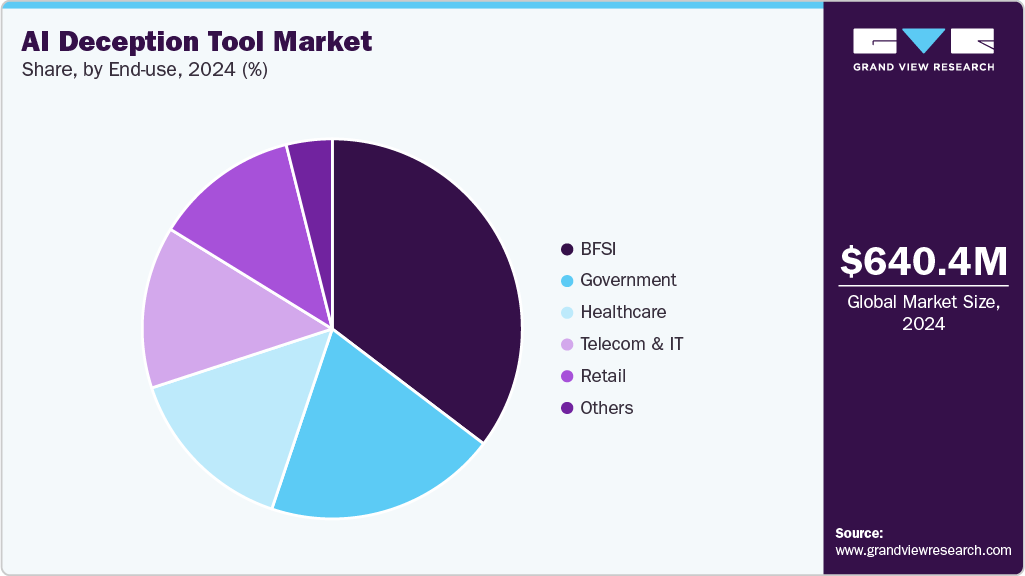
The BFSI sector accounted for the largest market revenue share in 2024, due to the rising demand for the ability to detect threats early by attracting attackers before they access real banking systems, thereby lowering the risk of data breaches. It also helps prevent financial fraud by identifying phishing attempts and insider threats in real time using decoy credentials with minimal false positives, security teams can concentrate on real threats, as any interaction with decoys is treated as suspicious, which results in time saving and putting focus on the genuine threat. In addition, deception tools provide valuable insights into attacker behavior, enabling continuous improvement of security measures by misleading attackers with false data, these technologies also safeguard sensitive customer information, making them a proactive and strategic solution for tackling advanced cyber threats in the BFSI sector. For instance, in October 2024, Swift introduced an AI-powered anomaly detection service to help banks identify and prevent financial fraud in cross-border transactions. It analyzes masked data from billions of messages across the Swift network to identify suspicious behavior in real time and was developed following a successful international pilot with financial institutions. By using federated learning and privacy-enhancing technologies, the service enables secure, collaborative fraud detection without compromising sensitive information.
 To learn more about this report, Download Free Sample Report
 The government sector is expected to grow at the fastest CAGR over the forecast period, driven by the AI that is being used to tackle voter fraud through digital identity verification and to identify AI-generated disinformation, such as deepfakes that could change public opinion and erode confidence in democratic systems. Simultaneously, governments are using AI to track and disrupt coordinated disinformation efforts in real time. For instance, in June 2024, Congresswoman Shontel Brown introduced the Securing Elections by AI Deception Act, which bans the use of AI to mislead or deny individuals their right to vote, while also requiring clear disclaimers on AI-generated election content. It addresses the threat of deceptive AI content, including deepfakes and misinformation, that could compromise voting rights and election integrity of the government.
Regional Insights
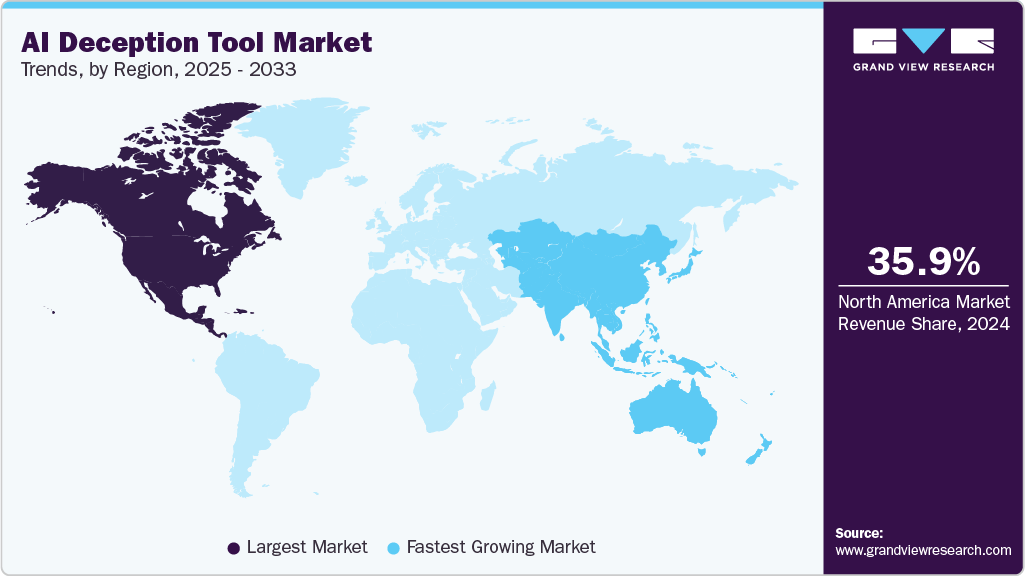
North America AI deception tool industry dominated globally with a revenue share of 35.9% in 2024, driven by a technological advancement that supports the adoption of cybersecurity solutions in targeted IoT systems. Government support, including substantial grant funding, is fueling innovation and expanding adoption of these tools. Rapid digital transformation across key industries is also increasing the demand for advanced AI solutions to counter cyberattacks. In addition, the integration of real-time threat monitoring, automation, and AI-powered deception is helping reduce the burden on security teams while strengthening the region’s overall cyber defense. According to a Technavio report, in February 2025, the U.S. government cybersecurity market is growing significantly, due to the adoption of AI and firewall-based deception tactics that identify and neutralize cyber threats. This growing demand for intelligent, adaptive cybersecurity solutions particularly for hybrid and cloud environments is driving the market’s expansion.
 To learn more about this report, Download Free Sample Report
 U.S. AI Deception Tools Market Trends
The U.S. AI deception tool industry is expected to grow significantly in 2024, driven by increased attention on ransomware and AI-driven threats such as deepfakes, broad adoption of autonomous deception technologies across enterprise IT environments; growing dependency on cloud-based AI threat intelligence and self-managing cyber deception systems to safeguard critical data and infrastructure. For instance, in October 2024, OpenAI revealed in the report that bad actors are increasingly misusing its AI tools to conduct deceptive campaigns for spreading misinformation and influencing elections, including those in the U.S. and by this year the company has disrupted more than 20 such networks attempting to exploit its AI models for harmful activities on social media and other online platforms. These campaigns mainly focused on producing misleading election-related content, but OpenAI effectively blocked them before they could gain widespread traction or build lasting audiences.
Europe AI Deception Tools Market Trends
The Europe AI deception tool industry is witnessing steady growth over the forecast period,due to the regulatory requirements from GDPR and the NIS Directive are pushing for stricter cybersecurity and privacy measures, raising fears surrounding AI-generated misinformation, deepfakes, and financial fraud are accelerating the adoption of deception technologies, and substantial investments are being made in AI-based fraud prevention within the banking and financial industries, there is also a growing focus on maintaining ethical standards in the use of deception tools, alongside the development of advanced defenses against adversarial AI threats.
Asia Pacific AI Deception Tools Market Trends
The AI deception tool industry in the Asia Pacific region is anticipated to register the fastest CAGR over the forecast period led by the increasing digital infrastructure and rising complexity of cyber threats in the region are driving greater demand for AI-powered deception tools. Enterprises are increasingly adopting these solutions to prevent advanced phishing, malware, and social engineering attacks facilitated by AI. In addition, there is a strong regional focus on aligning technological innovation with the development of emerging AI cybersecurity governance frameworks. For instance, in June 2025, Kaspersky researchers identified a malicious spreading Trojan through a fake version of the DeepSeek-R1 Large Language Model (LLM) app, targeting users in countries such as India and Nepal within the Asia Pacific region. The attackers used Google Ads to promote a phishing website designed to closely resemble DeepSeek’s official homepage, deceiving users into downloading a malware named BrowserVenom. Once installed, the malware redirects browser traffic through servers controlled by the attackers, allowing them to steal credentials and sensitive information. This incident underscores the growing cyber risks linked to popular AI tools and reinforces the need to download software only from trusted sources and uphold strong cybersecurity measures.
Key AI Deception Tools Company Insights
Some key companies in the AI deception tool industry include Acalvio Technologies, Inc., Proofpoint, Inc., Cynet, and Fortinet, Inc.
-
Acalvio Technologies specializes in autonomous cyber deception solutions designed to help enterprises proactively combat advanced threats, including insider attacks and advanced persistent threats (APTs). Its patented ShadowPlex Cyber Deception platform enables precise and rapid detection, engagement, and response to malicious activity across hybrid cloud and operational technology (OT) environments. Utilizing AI and data science, the platform minimizes attacker dwell time and enhances the effectiveness of security operations. Acalvio’s scalable offerings are easily deployable across cloud, on-premise, and managed service environments. Supported by experienced leadership and prominent investors, the company advocates for a proactive, AI-driven approach to cybersecurity.
-
Fortinet, Inc.is dedicated to protecting users, devices, and data through enterprise-grade solutions. Its core offering, the Fortinet Security Fabric, delivers an AI-powered, unified framework that seamlessly combines networking and security to provide automated threat protection, detection, and response. Its product portfolio spans firewalls, endpoint security, cloud protection, and AI-driven threat intelligence, designed to simplify and strengthen complex security infrastructures. Fortinet’s ongoing investment in R&D and strong global support network ensures scalable, real-time defense against cyber threats, including those using AI deception.
Key AI Deception Tools Companies:
The following are the leading companies in the AI deception tools market. These companies collectively hold the largest market share and dictate industry trends.
- SentinelOne
- Acalvio Technologies, Inc.
- Proofpoint, Inc.
- Cynet
- Commvault
- Smokescreen
- Fidelis Security
- NeroTeam Security Labs
- CyberTrap Machine Learning GmbH
- Fortinet, Inc.
Recent Developments
-
In January 2024, Acalvio Technologies announced its partnership with Velaspan to introduce the Active Cyber Engagement (ACE) managed cyber deception service. Powered by Acalvio’s AI-driven ShadowPlex platform, ACE delivers proactive protection against insider threats, zero-day vulnerabilities, and ransomware while minimizing the burden on security teams and enables threat detection, attack disruption, and intelligence collection through deception technology, integrated with Velaspan’s 24/7 security operations center. The collaboration seeks to broaden the availability of AI-based cyber deception tools and enhance cybersecurity resilience across various industries.
-
In November 2023, Acalvio Technologies joined the MITRE Engenuity Center for threat-informed defense as a benefactor, supporting the MITRE Engage framework to strengthen cyber defenses worldwide. Recognized for its expertise in cyber deception, Acalvio aims to help enterprise security teams better detect, engage, and deter threats by advancing adversary engagement techniques. MITRE Engage, built upon the MITRE ATT&CK knowledge base, promotes a collaborative global effort centered on cyber denial, deception, and defense. Acalvio will play an active role in shaping strategies and technologies designed to support governments, industries, and security vendors in countering advanced cyber threats.
-
In July 2023, Fidelis Cybersecurity launched the innovative Active Directory Intercept feature for its Fidelis Elevate users, aimed at strengthening defenses against advanced Active Directory (AD) attacks. This integrates AD-aware network detection, deception technology, and real-time event monitoring to quickly identify, block, and respond to threats within AD environments. It delivers deep visibility and enhanced threat hunting capabilities, enabling organizations to better protect their vital assets from evolving and cyber threats.
AI Deception Tools Market Report Scope
Report Attribute
Details
Market size in 2024
USD 640.4 million
Estimated market size in 2026
USD 1,039.5 million
Projected market size by 2033
USD 6,415.5 million
Growth rate
CAGR of 29.4% from 2025 to 2033
Base year for estimation
2024
Actual data
2021 - 2024
Forecast period
2025 - 2033
Quantitative units
Revenue in USD million & CAGR from 2025 to 2033
Report coverage
Revenue forecast, company ranking, competitive landscape, growth factors, and trends
Segments covered
Technology, application, end use, region
Regional scope
North America; Europe; Asia Pacific; Latin America; MEA
Country scope
U.S.; Canada; UK; Germany; France; China; India; Japan; South Korea; Australia; Brazil; Mexico; KSA; UAE; South Africa
Key companies profiled
SentinelOne; Acalvio Technologies, Inc.; Proofpoint, Inc.; Cynet; Commvault; Smokescreen; Fidelis Security; NeroTeam; Security Labs; CyberTrap Machine Learning GmbH; Fortinet, Inc.
Customization scope
Free report customization (equivalent up to 8 analysts working days) with purchase. Addition or alteration to country, regional, and segment scope.
Pricing and purchase options
Avail customized purchase options to meet your exact research needs. Explore purchase options
Global AI Deception Tools Market Report Segmentation
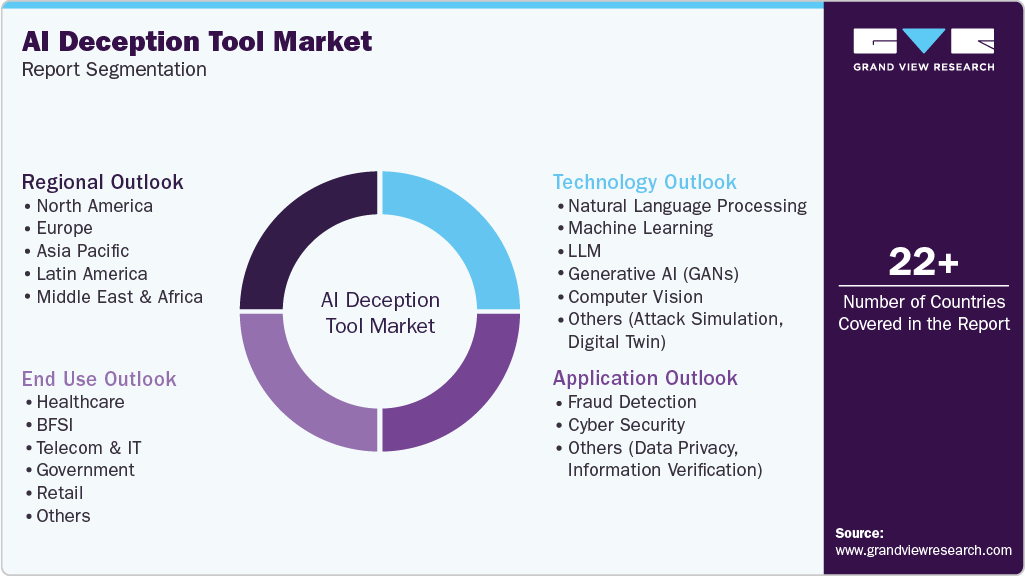
This report forecasts revenue growth on global, regional, and country levels and provides an analysis of the industry trends in each of the sub-segments from 2021 to 2033. For this study, Grand View Research has segmented the global AI deception tools market report based on technology, application, end use, and region:
 To learn more about this report, Download Free Sample Report
 -
Technology Outlook (Revenue, USD Million, 2021 - 2033)
-
Natural Language Processing (NLP)
-
Machine Learning
-
LLM
-
Generative AI (GANs)
-
Computer Vision
-
Others (Attack Simulation, Digital Twin)
-
-
Application Outlook (Revenue, USD Million, 2021 - 2033)
-
Fraud Detection
-
Cyber Security
-
Others (Data Privacy, Information Verification)
-
-
End Use Outlook (Revenue, USD Million, 2021 - 2033)
-
Healthcare
-
BFSI
-
Telecom & IT
-
Government
-
Retail
-
Others
-
-
Regional Outlook (Revenue, USD Million, 2021 - 2033)
-
North America
-
U.S.
-
Canada
-
Mexico
-
-
Europe
-
UK
-
Germany
-
France
-
-
Asia Pacific
-
China
-
India
-
Japan
-
South Korea
-
Australia
-
-
Latin America
-
Brazil
-
-
Middle East and Africa
-
KSA
-
UAE
-
South Africa
-
-
Frequently Asked Questions About This Report
The global AI deception tools market size was valued at USD 640.4 million in 2024 and is estimated at USD 1,039.5 million for 2026.
Some key players operating in the AI deception tools market include SentinelOne; Acalvio Technologies, Inc.; Proofpoint, Inc.; Cynet; Commvault; Smokescreen; Fidelis Security; NeroTeam; Security Labs; CyberTrap Machine Learning GmbH; Fortinet, Inc.
Key factors that are driving the market growth include the expansion of AI deception tool is driven by the continuously evolving nature of cyberattacks, where attackers increasingly depend on stealthy, long-term strategies to infiltrate and navigate networks without detection
The global AI deception tools market is expected to grow at a CAGR of 29.4% from 2025 to 2033, reaching USD 6,415.5 million by 2033.
North America dominated with a 35.9% revenue share in 2024.
About the Author(s)
Next Generation Technologies Research Team
Technology · Next Generation TechnologiesThis report was authored by the next generation technologies research team at Grand View Research - comprising two research analysts, one senior research analyst, and one industry expert - with specialized expertise in the next generation technologies segment of the technology industry. All findings are based on proprietary technology databases, executive interviews, and regulatory analysis, subject to internal peer review prior to publication.
Last Updated:
Speak to Analyst

Customize this report to your needs - add regions, segments, or data points, with 20% free customization.
Or view our licence options:


ISO 9001:2015 & 27001:2022 Certified
We are GDPR and CCPA compliant! Your transaction & personal information is safe and secure. For more details, please read our privacy policy.


