
- Home
- »
- Next Generation Technologies
- »
-
Digital Forensics Market Size And Share Report, 2026-2033GVR Report cover
![Digital Forensics Market (2026 - 2033)Report]()
Digital Forensics Market (2026 - 2033)
Size, Share & Trends Analysis Report By Component (Hardware, Software, Service), By Type (Computer Forensics, Cloud Forensics), By Tool, By End-use, By Region, And Segment Forecasts
Market Size, 2025
$12.4BMarket Estimate, 2026
$13.8BMarket Forecast, 2033
$35.3BCAGR, 2026–2033
14.3%Digital Forensics Market Summary
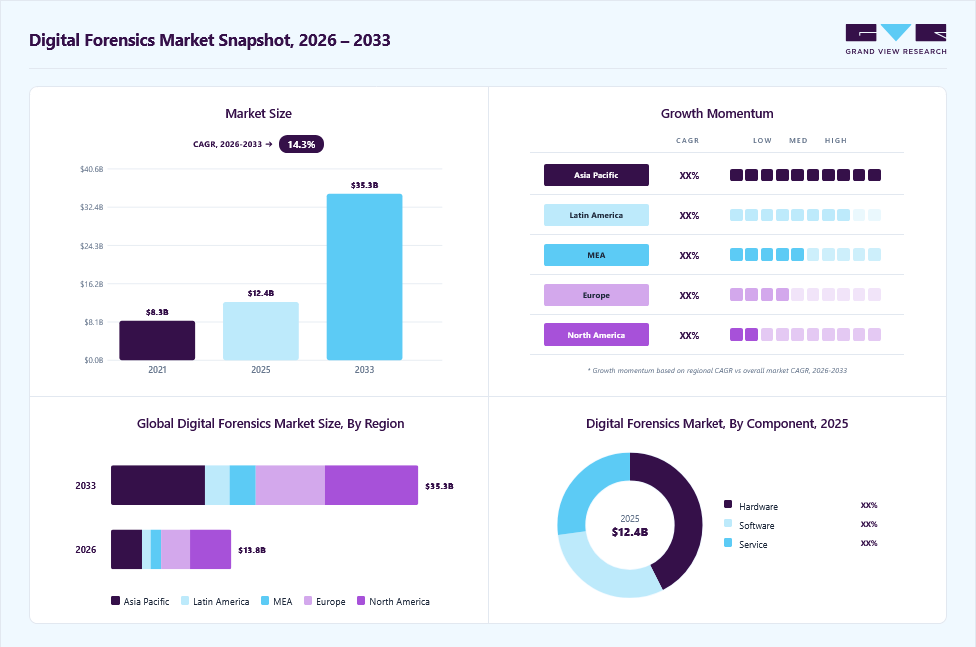
The global digital forensics market size was valued at USD 12.4 billion in 2025 and is projected to grow from USD 13.8 billion in 2026 to USD 35.3 billion by 2033, at a CAGR of 14.3% from 2026 to 2033. The market in North America dominated with a revenue share of 34.9% in 2025. This growth is driven by rising cyberattacks, stricter cybersecurity regulations, and growing adoption of AI-powered digital forensic solutions.
Key Market Trends & Insights
- By component: Hardware segment dominated the market, with a revenue share of 42.5% in 2025.
- By type: Computer forensics segment dominated the market, with a revenue share of 40.1% in 2025.
- By tool: Forensic data analysis segment dominated the market, with a revenue share of 27.8% in 2025.
- By end use: Government and defense segment held the largest revenue share of 22.6% in 2025
Regional Highlights
- Largest regional market: North America (34.9% revenue share, 2025)
- Fastest-growing regional market: Asia Pacific (highest CAGR, 2026-2033)
- By country: The U.S. held the largest market share in 2025.
Market Size & Forecast
- Market size in 2025: USD 12.4 Billion
- Estimated market size in 2026: USD 13.8 Billion
- Projected market size by 2033: USD 35.3 Billion
- CAGR (2026-2033): 14.3%
The increasing prevalence of cybercrime and data breaches globally is a primary driver for market growth, as organizations and law enforcement agencies urgently seek to investigate and prosecute such activities. For instance, the Internet Crime Complaint Center (IC3) under the Federal Bureau of Investigation (FBI) released its Annual Internet Crime Report 2023, which revealed that American citizens made 880,418 complaints regarding cyber fraud, which led to potential losses of over USD 12.5 billion in 2023. These numbers represent an increase of around 10% and 22% for complaints received and losses suffered in 2022, indicating a growing threat of such activities.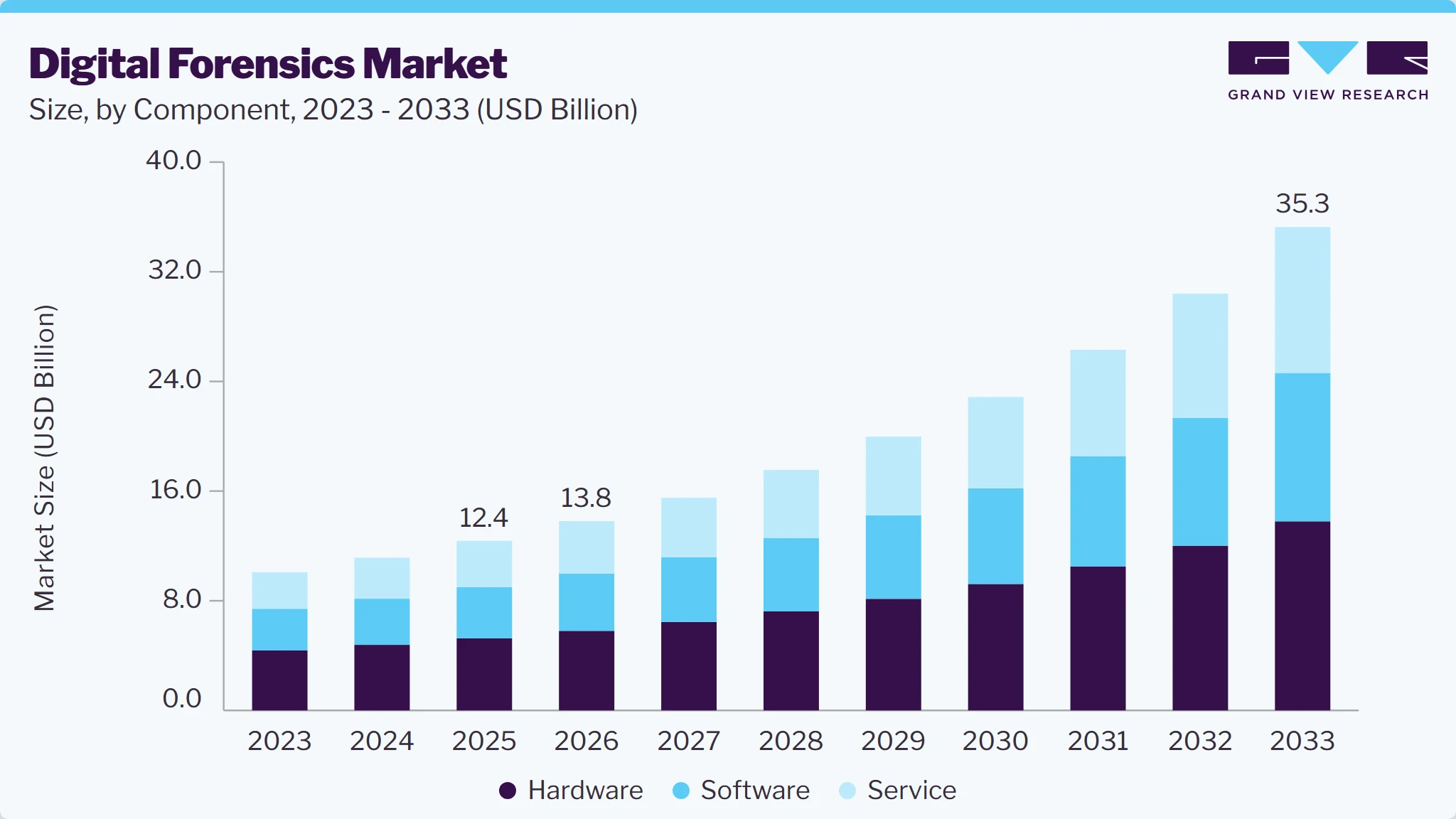
Increasing reliance on digital technologies and the Internet of Things (IoT) has also led to a sharp growth in the volume of digital data generated, creating a need for specialized tools and expertise to collect, analyze, and preserve this data. Moreover, the rising demand for cloud computing, artificial intelligence (AI), and machine learning (ML) technologies among industries worldwide and the continuous advancements in these technologies have created new challenges and opportunities for digital forensics. Rising incidences of data breaches have led to significant losses for enterprises. For instance, IBM’s Cost of a Data Breach Report 2024 estimated that globally, organizations lost, on average, USD 4.88 million due to data breach incidences, making it necessary to recover and investigate such data at the earliest. The International Organization for Standardization (ISO) and the International Electrotechnical Commission (IEC) introduced the ISO/IEC 27037 Guidelines for Identification, Collection, Acquisition, and Preservation of Digital Evidence in 2012. Such developments have helped shape market growth in the subsequent years.
The increasing use of digital evidence in legal proceedings has compelled digital forensics experts to authenticate and analyze digital data. Globally, government departments are increasingly collaborating with digital forensics experts to address digital fraud activities. For instance, Cellebrite, in July 2024, announced the establishment of Cellebrite Federal Solutions to address the requirements of the U.S. federal government in cases of cyber fraud. This was made possible through the company’s acquisition of Cyber Technology Services, Inc., which specializes in digital forensics, cybersecurity, and incident response solutions and services. Such factors collectively drive the global digital forensics industry by making this technology an increasingly important tool for organizations and law enforcement agencies to investigate and mitigate cyber threats.
Market Dynamics
The global digital forensics market is experiencing strong growth as cyberattacks, ransomware incidents, insider threats, financial fraud, and data breaches continue to increase across government, defense, banking, financial services, insurance (BFSI), healthcare, telecommunications, retail, manufacturing, and critical infrastructure sectors. Digital forensics solutions enable organizations and law enforcement agencies to identify, preserve, collect, analyze, and present digital evidence from computers, mobile devices, cloud environments, networks, endpoints, IoT devices, and enterprise applications while ensuring legal admissibility and regulatory compliance. Modern digital forensics platforms leverage artificial intelligence (AI), machine learning (ML), automation, cloud forensics, memory forensics, endpoint detection technologies, advanced analytics, and threat intelligence to accelerate investigations, reconstruct cyber incidents, identify attack vectors, and support faster incident response and digital evidence management.
The rising frequency and sophistication of cybercrime, ransomware attacks, data breaches, business email compromise (BEC), insider threats, and advanced persistent threats (APTs) are major drivers of the global digital forensics market. Organizations are increasingly investing in digital forensic solutions to rapidly investigate cyber incidents, identify compromised systems, recover digital evidence, determine root causes, and strengthen cybersecurity resilience. The growing adoption of cloud computing, remote work environments, mobile devices, IoT ecosystems, and digital business operations has significantly expanded the digital attack surface, creating greater demand for comprehensive forensic investigation capabilities across multiple digital environments. AI-powered forensic tools that automate evidence collection, malware analysis, log correlation, timeline reconstruction, and threat attribution are improving investigation speed while reducing manual workloads. For instance, in February 2025, OpenText launched its next-generation Cybersecurity Cloud with AI-powered threat detection and response capabilities, strengthening its portfolio across security operations, digital forensics, investigation, and compliance to accelerate cyber incident investigations and improve enterprise cyber resilience.
The growing complexity of modern digital ecosystems and the increasing use of encryption technologies remain significant restraints for the global digital forensics market. Investigators frequently encounter encrypted communications, decentralized cloud workloads, virtualized infrastructure, mobile applications, IoT devices, and cross-border data storage environments that complicate evidence acquisition and forensic analysis. Differences in operating systems, proprietary file formats, cloud service architectures, and rapidly evolving cyberattack techniques require continuous tool upgrades and specialized expertise. Additionally, strict privacy regulations, jurisdictional limitations, chain-of-custody requirements, and legal constraints surrounding digital evidence collection increase investigation complexity. High implementation costs, shortages of skilled digital forensic professionals, and the need for ongoing training further limit adoption, particularly among small and medium-sized enterprises (SMEs) and resource-constrained public agencies.
The rapid advancement of AI-powered forensic automation, cloud forensics, and integrated digital investigation platforms presents significant growth opportunities for the global digital forensics market. Organizations are increasingly adopting artificial intelligence, machine learning, natural language processing (NLP), behavioral analytics, and automation technologies to accelerate evidence collection, malware reverse engineering, digital evidence classification, log analysis, and forensic reporting. Growing migration toward cloud-native infrastructure is driving demand for cloud forensic solutions capable of investigating multi-cloud and hybrid environments while maintaining regulatory compliance and evidentiary integrity. Furthermore, increasing investments in digital evidence management, cybercrime investigation, fraud detection, e-discovery, incident response, threat hunting, and forensic readiness across government, law enforcement, defense, BFSI, healthcare, and critical infrastructure sectors are expanding market opportunities. As cyber threats continue to evolve and regulatory requirements for cybersecurity investigations become more stringent, next-generation AI-enabled digital forensic platforms are expected to witness substantial global adoption.
Analyst Perspective
The digital forensics market is positioned at the intersection of cybersecurity, digital transformation, and AI-driven threat investigation. Organizations across industries are increasingly deploying digital forensics solutions to investigate cyberattacks, ransomware incidents, insider threats, financial fraud, and data breaches while ensuring regulatory compliance and preserving the integrity of digital evidence. Unlike traditional forensic tools focused solely on post-incident analysis, modern digital forensics platforms integrate artificial intelligence (AI), machine learning (ML), automation, cloud forensics, endpoint telemetry, and threat intelligence to accelerate evidence collection, streamline investigations, reconstruct attack timelines, and enhance incident response capabilities.
Component Insights
Based on component, the hardware segment led the market with the largest revenue share of 42.5% in 2025. It is attributed to the critical role that specialized hardware plays in collecting, analyzing, and preserving digital evidence. Digital forensics investigators rely heavily on hardware tools such as forensic workstations, write blockers, and disk imagers to extract and analyze data from various digital devices such as computers, mobile devices, and servers. The need for high-performance and specialized hardware to keep pace with the increasing complexity and volume of digital data generated in the present day has driven the demand for advanced hardware components, leading to segment dominance in this market.
The service component is expected to register the fastest CAGR during the forecast period. It is owing to the increasing demand for specialized digital forensics services such as incident response, threat intelligence, and expert testimony. The growing complexity of digital forensics cases has also driven the need for specialized services, such as data recovery, mobile device analysis, and cloud forensics. In addition, the requirement for ongoing training and support to ensure that digital forensics professionals stay up-to-date with the latest technologies and techniques has fueled the demand for related services. As a result, major service providers have expanded their offerings to include managed services, consulting, and training, which is anticipated to drive segment expansion.
Type Insights
Based on type, the computer forensics segment led the market with the largest revenue share of 40.1% in 2025. The widespread use of computers and laptops in various critical industries has made them a primary source of gathering and analyzing digital evidence. Computer forensics, which involves collecting, analyzing, and preserving data from computer systems, has become a crucial aspect of digital investigations. The increasing reliance on computers for storing sensitive information, coupled with the growing threat of cybercrimes such as hacking and data breaches, has driven the demand for computer forensics solutions. For instance, governments in developing countries are increasingly adopting digitization initiatives, leading to a sharp rise in computer usage and creating more opportunities for cybercriminals. It has solidified the segment's position as the largest share of the global digital forensics market.
Meanwhile, the cloud forensics segment is expected to register the fastest growth from 2026 to 2033. The rapid adoption of cloud computing technologies has increased demand for specialized cloud forensics solutions. As organizations migrate their data and applications to cloud environments, investigating and analyzing cloud-based data has become critical. End-users of cloud forensics solutions include DevSecOps and cybersecurity professionals, law enforcement agencies, and IT investigators. Cloud forensics provides the necessary tools and expertise to collect, analyze, and preserve cloud-based data, making it a crucial component of digital forensics investigations. The growing prevalence of cloud-based cybercrimes, such as data breaches and unauthorized access, has driven the demand for cloud forensics solutions. Moreover, the complexity of cloud environments and the need to navigate multiple cloud service providers have created a need for specialized cloud forensics expertise, fueling this segment's high growth pace.
Tool Insights
Based on tool, the forensic data analysis segment led the market with the largest revenue share of 27.8% in 2025. These tools enable investigators to collect, process, and analyze vast amounts of digital data, including files, emails, and network logs, to reconstruct events and identify potential security threats. The increasing complexity and volume of digital data and the need for swift and accurate analysis have driven the demand for advanced forensic data analysis tools. These tools offer a range of features, including data carving, file recovery, and metadata analysis, which are essential for uncovering digital evidence and building a strong case for the concerned stakeholders. Furthermore, organizations are collaborating to address the transmission of abusive media content across various platforms, contributing to segment growth. For instance, in August 2023, Magnet Forensics announced the acquisition of Griffeye, a leading company in digital media forensics for child sexual abuse investigations. The Griffeye Analyze platform is used by more than a thousand police agencies globally to process, sort, and analyze large volumes of videos and images related to child sexual abuse material (CSAM).
On the other hand, forensic decryption tools are expected to register the fastest CAGR over the forecast period. The increasing demand for these solutions is attributed to the difficulties digital forensic investigators encounter during data decryption. As encryption adoption rises, the need for specialized tools to decrypt and analyze encrypted data has become critical. Forensic decryption tools enable investigators to access and analyze encrypted data, including files, emails, and communication records. Additionally, the growing complexity of encryption algorithms and the emergence of new encryption technologies have driven the demand for advanced forensic decryption tools.
End-use Insights
Based on end use, government and defense segment led the market with the largest revenue share of 22.6% in 2025. It is owing to the critical need for advanced digital forensics capabilities in this segment to investigate and mitigate cyber threats and analyze digital evidence in criminal investigations and intelligence gathering. The sector's reliance on sensitive information and critical infrastructure has created a pressing requirement for robust digital forensics solutions to protect against cyberattacks, data breaches, and other malicious activities. Furthermore, stringent regulatory requirements and compliance standards have driven the adoption of digital forensics solutions to ensure the integrity and security of digital evidence. The high segment share is also due to significant investments in digital forensics technologies, training, and expertise and its role in driving innovation and setting standards for digital forensics practices. For instance, in March 2024, Cellebrite initiated the process to obtain Federal Risk and Authorization Management Program (FedRAMP) authorization for its software-as-a-service offerings. It is expected to allow the company to provide its cloud-based solutions to federal government clients more efficiently.
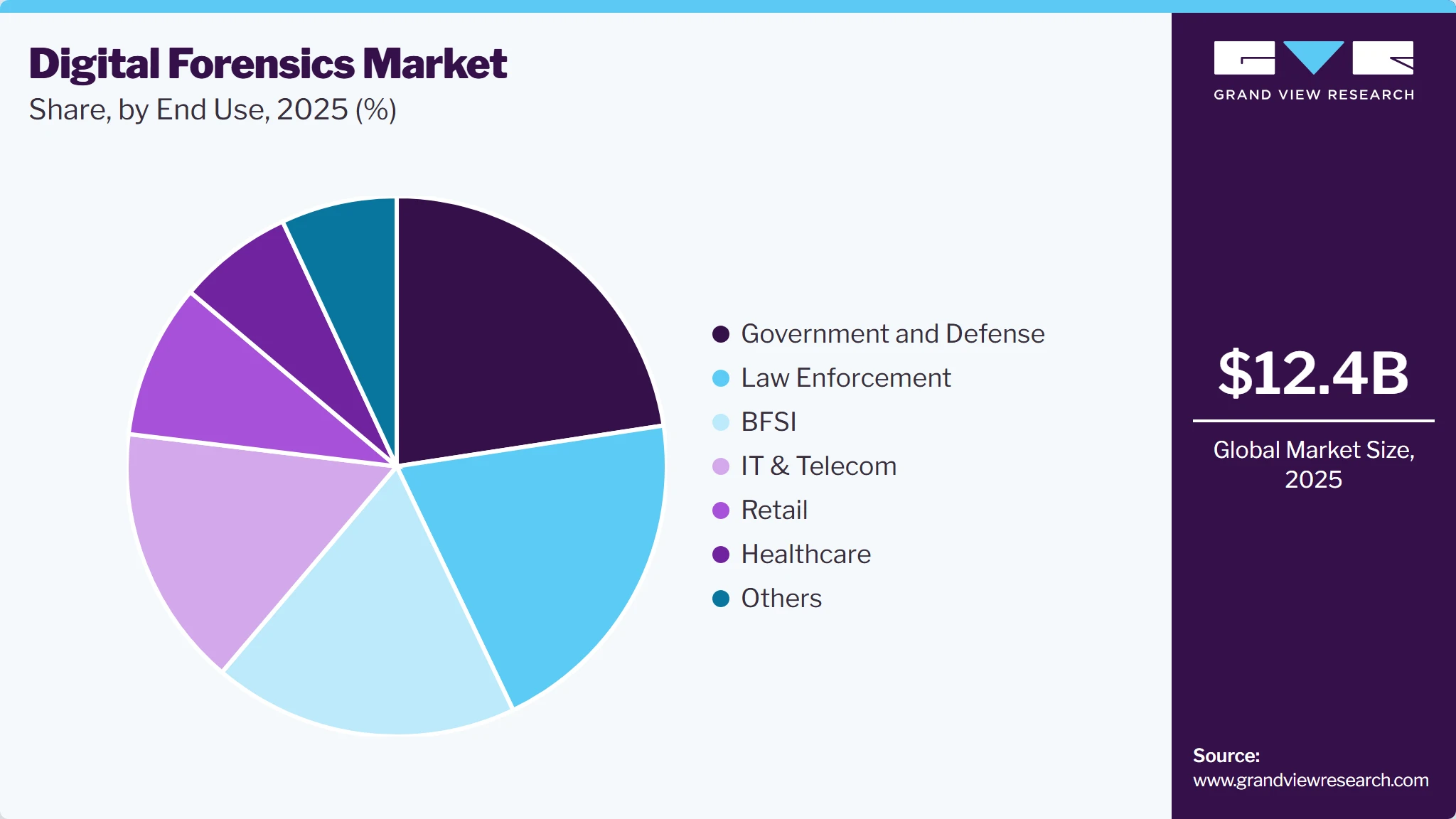
The healthcare sector is expected to register the fastest CAGR from 2026 to 2033. It is attributed to the increasing adoption of digital technologies in this industry, resulting in a surge in cyberattacks and data breaches targeting sensitive patient information. For instance, the Annual Data Breach Report by the Identity Theft Resource Center highlighted that the healthcare vertical was the most compromised in the U.S., reporting 809 data breaches in 2023. The growing reliance on electronic health records, medical devices, and connected healthcare systems presents a high risk of cyberattacks. This drives the need for digital forensics solutions to investigate and mitigate such incidents. Moreover, stringent regulatory requirements such as HIPAA have necessitated the implementation of robust digital forensics capabilities to ensure compliance and protect patient data.
Regional Insights
North America dominated the global digital forensics market with the largest revenue share of 34.9% in 2025. It is owing to the region's early adoption of digital technologies, resulting in a high volume of data generated and a corresponding need for digital forensics solutions. The presence of a large number of major technology companies, financial institutions, and government agencies in the region has created a hub for digital forensics innovation and investment. Furthermore, the increasing frequency and severity of cyberattacks and data breaches in North America have driven the demand for advanced digital forensics capabilities to investigate and mitigate these incidents.

U.S. Digital Forensics Market Trends
The digital forensics market in the U.S. held the largest share in the North America region in 2025. The country is well-known for its robust IT landscape. It has also made it vulnerable to sophisticated state-sponsored and private cyberattacks. The U.S. government has implemented stringent regulations and agencies to deal with this scenario, driving the demand for digital forensic tools. Additionally, collaborations with private players have ensured enhanced protection from cyber threats. For instance, in February 2024, OpenText Corporation was selected as a member of the Joint Cyber Defense Collaborative (JCDC), a public-private cybersecurity project established by the Cybersecurity and Infrastructure Security Agency (CISA). The JCDC aims to strengthen the cybersecurity capabilities of the U.S. government and its global allies.
Europe Digital Forensics Market Trends
Europe held a significant share of the global market in 2025. It is attributed to the region's stringent regulatory landscape, including the General Data Protection Regulation (GDPR), which has necessitated the adoption of advanced digital forensics capabilities to ensure compliance and protect sensitive information. The Internet Organized Crime Threat Assessment (IOCTA) Report 2024, published by Europol, revealed increased frequency and sophistication of cyberattacks in 2023. A substantial portion of the regional population became victim to various forms of cyberattacks, such as online payment fraud, child sexual abuse, and ransomware. This outlook in Europe has driven the need for specialized digital forensics solutions to investigate and mitigate such incidents. As Europe continues prioritizing cybersecurity and data protection, the demand for digital forensics solutions is expected to remain strong, sustaining regional industry growth.
The UK accounted for a notable share of the European market in 2025. The country's growing focus on cybersecurity measures and significant investments in digital forensics technologies and training contribute to the high growth rate. For instance, the Cyber Security Breaches Survey 2024 published by the Department for Science, Innovation & Technology (DSIT) of the Home Office in the UK revealed that about 50% of businesses experienced cyber threats, and around 33% of businesses in the country adopted cyber security monitoring tools, which was a significant hike from the previous year. Additionally, the presence of a large number of financial institutions, government agencies, and multinational corporations in the UK has created a significant scope for innovations and investments in digital forensics.
Asia Pacific Digital Forensics Market Trends
The Asia Pacific digital forensics market is expected to register the fastest CAGR over the forecast period. It is attributed to the rapid digital transformation and increasing adoption of cloud computing, IoT, and other digital technologies across various regional industries. As a result, regional economies have become a prime target for cyberattacks and data breaches, driving the demand for digital forensics solutions to address these incidents effectively. In addition, the region's growing focus on cybersecurity, data privacy, and regulatory compliance has necessitated the implementation of digital solid forensics capabilities. Countries like China, India, and Japan are leading through significant investments in digital forensics technologies, training, and expertise.
Rapid economic developments and increased adoption of digital technologies such as smart city initiatives, e-governance programs, and Digital India schemes over the past few years have made India susceptible to attacks by cybercriminals. The Indian government has addressed these issues by establishing the Indian Cybercrime Coordination Centre (I4C) and the Indian Computer Emergency Response Team (CERT-In). Moreover, prominent multinational organizations are expanding their operations in the economy. For instance, LogRhythm, in November 2023, announced the expansion of its research and development efforts in India. This strategic move aims to address the country's increasing incidences of advanced cybercrimes.
Key Digital Forensics Company Insights
Some key companies involved in the digital forensics market include Paraben Corporation, LogRhythm, Inc., and Magnet Forensics, among others.
-
Paraben Corporation is a U.S.-based digital forensics and security software company. The company's flagship product, Paraben's E3 Platform, is a cutting-edge digital forensics solution that enables investigators to collect, analyze, and preserve digital evidence from various sources, including computers, mobile devices, and cloud storage. In June 2024, Paraben announced major upgrades to its E3 platform by introducing its 4.0 version. This version, called the 'Dilithium Edition,' has a new graphical user interface (GUI). Paraben provides complimentary access to training courses to transition existing consumers to the new platform seamlessly.
-
LogRhythm, Inc., is a U.S.-based cyber threat defense and security intelligence company. The company offers advanced solutions in security information and event management (SIEM) and innovative products that enable organizations to detect, respond to, and neutralize cyber threats. LogRhythm's regular strategic partnerships and collaborations with industry stakeholders have led to its prominence as a well-known digital forensics services provider in the market. LogRhythm NetMon is a prominent tool offered by the company that can be used to detect, identify, and capture forensic evidence.
Key Digital Forensics Companies:
The following key companies have been profiled for this study on the digital forensics market.
-
Paraben Corporation
-
LogRhythm, Inc.
-
Magnet Forensics
-
MSAB
-
Exterro
-
NUIX
-
Open Text Corporation
-
Cellebrite
-
Cisco Systems, Inc.
-
IBM
Competitive Benchmarking
Category
Operating Strategies
Competitive Edge
Weakness
Established Players (Cellebrite, OpenText Corporation, IBM Corporation, Cisco Systems, Inc., LogRhythm, Inc.)
- Established players focus on delivering comprehensive digital forensics, incident response, cybersecurity, and digital evidence management solutions that integrate computer, mobile, network, cloud, and endpoint forensics with SIEM, SOAR, XDR, and threat intelligence platforms.
- Their strategies emphasize continuous product innovation, AI-powered forensic analytics, cloud-native deployments, strategic acquisitions, ecosystem partnerships, and integration with enterprise security infrastructure to strengthen cyber resilience and accelerate investigations.
- Established players benefit from extensive global customer bases, mature product portfolios, significant R&D investments, strong cybersecurity expertise, and well-established partner ecosystems.
- Their advanced AI capabilities, scalable cloud platforms, regulatory compliance features, broad service portfolios, and seamless integration with enterprise security tools enable them to support large-scale government, law enforcement, defense, and enterprise investigations.
- These companies face challenges related to complex product portfolios, high implementation and operational costs, lengthy deployment cycles, and integration across diverse IT environments.
- Enterprise-focused solutions may be expensive for SMEs, while rapid evolution of cyber threats, increasing demand for cloud-native forensic platforms, AI-driven automation, and growing competition from specialized digital forensic vendors may pressure market share and profitability.
Emerging Players (Magnet Forensics, Exterro, MSAB, Nuix, Paraben Corporation)
- Emerging players focus on delivering specialized, AI-enabled digital forensics and investigation platforms for computer, mobile, cloud, memory, and digital evidence analysis.
- Their strategies emphasize rapid product innovation, cloud-based deployment, automation of evidence collection and analysis, API-driven integrations, strategic partnerships, and expansion into high-growth markets including cyber incident response, eDiscovery, fraud investigations, and digital evidence management.
- Emerging players offer specialized forensic expertise, agile product development, intuitive investigation workflows, faster deployment, flexible licensing models, and advanced capabilities in mobile, cloud, and digital evidence analysis.
- Their focused innovation, automation features, and strong domain expertise enable organizations to accelerate investigations, reduce analyst workloads, and improve forensic accuracy while addressing evolving cybersecurity challenges.
- Limited global market presence, smaller partner ecosystems, lower brand recognition, and comparatively fewer financial resources may restrict expansion into large multinational enterprises and government contracts.
- They also face challenges in scaling globally, maintaining continuous investment in AI innovation, addressing evolving cyber threats, obtaining regulatory certifications, and competing against larger cybersecurity vendors offering integrated security and investigation platforms.
Recent Developments
-
In July 2024, LogRhythm and Exabeam announced their strategic merger to form a new cyber security solutions company. This merger aims to enable both companies to deliver an advanced AI-driven security operations platform to their customers.
-
In April 2024, Magnet Forensics announced the launch of its new comprehensive digital investigation platform, Magnet One. The solution aims to effectively address the steadily rising volume of digital evidence, enabling faster case resolution. Magnet One integrates the company’s range of solutions, including Magnet Axiom, Magnet Automate, Magnet Graykey, and Magnet Review. It has also introduced the Magnet One Hub to ensure efficient collaboration between investigators, examiners, and prosecutors.
-
In March 2024, LogRhythm and SOC Prime announced their partnership to provide enhanced threat detection and management solutions to security professionals. This collaboration combines LogRhythm Axon's threat management and advanced analytics capabilities with SOC Prime's technology offerings to aid customers in detecting and responding to threats faster and more effectively.
Digital Forensics Market Report Scope
Report Attribute
Details
Market size in 2025
USD 12.4 billion
Estimated market size in 2026
USD 13.8 billion
Projected market size by 2033
USD 35.3 billion
Growth rate
CAGR of 14.3% from 2026 to 2033
Base year for estimation
2025
Historical data
2021 - 2024
Forecast period
2026 - 2033
Quantitative units
Revenue in USD million/billion and CAGR from 2026 to 2033
Report coverage
Revenue forecast, company market share analysis, competitive landscape, growth factors, and trends
Segments covered
Component, type, tool, end use, and region
Regional scope
North America; Europe; Asia Pacific; Latin America; MEA
Country scope
U.S.; Canada; Mexico; Germany; UK; France; China; Japan; India; South Korea; Australia; Brazil; Saudi Arabia; South Africa; UAE
Key companies profiled
Paraben Corporation; LogRhythm, Inc.; Magnet Forensics; MSAB; Exterro; NUIX; Open Text Corporation; Cellebrite; Cisco Systems, Inc.; IBM
Customization scope
Free report customization (equivalent up to 8 analysts' working days) with purchase. Addition or alteration to country, regional & segment scope.
Pricing and purchase options
Avail customized purchase options to meet your exact research needs. Explore purchase options
Global Digital Forensics Market Report Segmentation
This report forecasts revenue growth at the global, regional, and country levels and provides an analysis of the latest industry trends in each of the sub-segments from 2021 to 2033. For this study, Grand View Research has segmented the global digital forensics market report based on component, type, tool, end-use, and region.
-
Component Outlook (Revenue, USD Billion, 2021 - 2033)
-
Hardware
-
Software
-
Service
-
-
Type Outlook (Revenue, USD Billion, 2021 - 2033)
-
Computer Forensics
-
Network Forensics
-
Mobile Device Forensics
-
Cloud Forensics
-
-
Tool Outlook (Revenue, USD Billion, 2021 - 2033)
-
Data Acquisition & Preservation
-
Forensic Data Analysis
-
Data Recovery
-
Review & Reporting
-
Forensic Decryption
-
Others
-
-
End Use Outlook (Revenue, USD Billion, 2021 - 2033)
-
Government and Defense
-
Law Enforcement
-
Banking, Financial Services, and Insurance (BFSI)
-
IT & Telecom
-
Retail
-
Healthcare
-
Others
-
-
Regional Outlook (Revenue, USD Billion, 2021 - 2033)
-
North America
-
U.S.
-
Canada
-
Mexico
-
-
Europe
-
UK
-
Germany
-
France
-
Italy
-
Spain
-
-
Asia Pacific
-
Japan
-
India
-
China
-
Australia
-
South Korea
-
-
Latin America
-
Brazil
-
-
Middle East & Africa
-
South Africa
-
Saudi Arabia
-
UAE
-
-
Research Methodology
The digital forensics market figures in this report are based on a proven research process that combines executive interviews with secondary research from proprietary databases, company filings, and recognized regulatory and institutional sources. Market size is built through value-chain sizing - reconciling supply-side and demand-side estimates - and triangulated with bottom-up and top-down approaches. Every estimate passes multiple levels of expert validation before publication, with each digital forensics segment quantified using the revenue-capture definitions in the table below.
Segment Definition
Segment - Component
Revenue capture definition
Hardware
Revenue is generated from the sale of digital forensic hardware used for evidence acquisition, preservation, extraction, storage, and analysis. This includes forensic workstations, write blockers, forensic imaging devices, data acquisition hardware, portable forensic kits, evidence storage systems, and other specialized hardware deployed by law enforcement agencies, government organizations, enterprises, and forensic laboratories.
Software
Revenue is generated from the licensing, subscription, and sale of digital forensic software used to collect, preserve, analyze, recover, decrypt, and report digital evidence across computers, mobile devices, networks, cloud environments, databases, and IoT devices. This includes computer forensics, mobile forensics, network forensics, cloud forensics, forensic analytics, digital evidence management, incident response, and investigation platforms.
Service
Revenue is generated from professional and managed services supporting digital forensic investigations, including forensic consulting, incident response, evidence collection, forensic analysis, expert witness services, litigation support, training, implementation, maintenance, and managed digital forensic services.
Segment - Type
Revenue capture definition
Computer Forensics
Revenue is generated from solutions and services used to acquire, preserve, analyze, and recover digital evidence from desktops, laptops, servers, storage media, and operating systems for cybercrime investigations, incident response, and legal proceedings.
Network Forensics
Revenue is generated from solutions and services that capture, monitor, and analyze network traffic, logs, and communications to investigate cyberattacks, unauthorized access, malware propagation, and other network security incidents.
Mobile Device Forensics
Revenue is generated from solutions and services used to extract, recover, analyze, and preserve digital evidence from smartphones, tablets, SIM cards, wearable devices, and other mobile endpoints.
Cloud Forensics
Revenue is generated from solutions and services designed to collect, preserve, and analyze digital evidence across public, private, hybrid, and multi-cloud environments, including virtual machines, cloud storage, SaaS applications, and cloud-native workloads.
Segment - Tool
Revenue capture definition
Data Acquisition & Preservation
Revenue is generated from tools that securely collect, image, preserve, and maintain the integrity of digital evidence while ensuring chain of custody and forensic soundness.
Forensic Data Analysis
Revenue is generated from tools that analyze digital evidence using file system analysis, timeline reconstruction, malware analysis, log analysis, artifact examination, AI-powered analytics, and correlation techniques.
Data Recovery
Revenue is generated from tools used to recover deleted, damaged, encrypted, or inaccessible data from digital devices and storage media for forensic investigations.
Review & Reporting
Revenue is generated from tools that facilitate evidence review, case management, documentation, visualization, reporting, and preparation of legally admissible forensic reports for investigations and court proceedings.
Forensic Decryption
Revenue is generated from tools designed to decrypt protected or encrypted digital evidence, recover passwords, and facilitate lawful access to secured data during forensic investigations.
Others
Revenue is generated from specialized digital forensic tools, including memory forensics, email forensics, database forensics, IoT forensics, multimedia forensics, blockchain forensics, and digital evidence management solutions not covered under the above categories.
Segment - End Use
Revenue capture definition
Government and Defense
Revenue is generated from digital forensic solutions and services used by government agencies, military organizations, intelligence agencies, and national security institutions to investigate cyber incidents, cyber espionage, terrorism, and national security threats.
Law Enforcement
Revenue is generated from digital forensic solutions and services used by police departments, cybercrime units, investigative agencies, and judicial authorities for criminal investigations, digital evidence collection, and prosecution.
Banking, Financial Services, and Insurance (BFSI)
Revenue is generated from digital forensic deployments used to investigate financial fraud, insider threats, cyberattacks, payment fraud, data breaches, regulatory compliance violations, and cyber risk incidents.
IT & Telecom
Revenue is generated from digital forensic solutions deployed by IT service providers, cloud service providers, software companies, and telecommunications operators to investigate cybersecurity incidents, insider threats, network attacks, and data breaches.
Retail
Revenue is generated from digital forensic solutions used by retailers and e-commerce organizations to investigate payment fraud, POS malware, customer data breaches, insider threats, and cybercrime incidents.
Healthcare
Revenue is generated from digital forensic solutions used by hospitals, healthcare providers, pharmaceutical companies, and life sciences organizations to investigate cyberattacks, ransomware incidents, patient data breaches, and regulatory compliance violations.
Others
Revenue is generated from digital forensic solutions and services deployed across manufacturing, energy & utilities, education, legal services, transportation & logistics, media & entertainment, and other industry verticals for cyber investigations and digital evidence management.
Estimation Model
Layer
Question
Analysis
Cybersecurity & Digital Investigation Demand Layer
Who can benefit from digital forensics solutions?
Identify organizations responsible for investigating cyber incidents, digital fraud, insider threats, data breaches, cyber espionage, and electronic evidence. These include government agencies, law enforcement, defense organizations, BFSI, healthcare, IT & telecommunications, retail, manufacturing, energy & utilities, and other sectors requiring digital evidence collection, cybercrime investigation, incident response, and regulatory compliance.
Cybersecurity Readiness & Investigation Capability Layer
Who can adopt digital forensics solutions?
Evaluate organizations based on their cybersecurity maturity, digital infrastructure, cloud adoption, remote workforce, regulatory compliance requirements, incident response capabilities, digital evidence management needs, and investments in security operations centers (SOCs), threat intelligence, endpoint security, and cyber resilience. Organizations with increasing cyber risk exposure and compliance obligations possess the operational readiness to adopt digital forensic platforms.
Adoption & Investigation Deployment Layer
Who actively deploys digital forensics solutions?
Analyze deployment across government agencies, law enforcement, enterprises, managed security service providers (MSSPs), cybersecurity firms, and forensic laboratories implementing computer, mobile, network, cloud, memory, and IoT forensics. Active users leverage digital forensic solutions for cyber incident investigations, ransomware response, fraud detection, insider threat investigations, digital evidence preservation, litigation support, and regulatory compliance.
Monetization Layer
How much revenue is generated?
Assess revenue generated through software licensing, SaaS subscriptions, forensic hardware, cloud-based digital forensic platforms, on-premise deployments, professional and managed forensic services, incident response engagements, forensic consulting, implementation, training, maintenance and support contracts, digital evidence management solutions, AI-powered forensic analytics, and value-added investigation and compliance services.
Delivered Customizations
This report has been delivered with the following In-depth customizations
Client Request
Customization Delivered
Value Adds
Digital Forensics Vendor Competitive Benchmarking
Assessed leading digital forensics vendors based on AI capabilities, computer, mobile, network and cloud forensics, evidence acquisition, forensic analytics, incident response integration, pricing strategies, product roadmaps, partnerships, and market presence.
Enables stakeholders to benchmark competitors, identify technology gaps, evaluate product differentiation, and formulate competitive product development and go-to-market strategies.
Regional Cybersecurity & Digital Forensics Adoption Forecast
Evaluated regional cybercrime trends, ransomware incidents, cybersecurity investments, digital transformation initiatives, cloud adoption, regulatory frameworks, law enforcement modernization, and digital forensics demand across Latin America and the Middle East & Africa.
Provides actionable insights into regional demand hotspots, cybersecurity maturity, investment priorities, competitive landscapes, and long-term growth opportunities across emerging digital forensics markets.
Cloud Forensics & AI-powered Investigation Opportunity Assessment
Assessed adoption of cloud forensics, AI-powered forensic analytics, digital evidence management, incident response automation, threat intelligence integration, forensic readiness initiatives, and competitive positioning of leading digital forensics solution providers.
Helps identify high-growth opportunities in cloud-based digital forensics, optimize product strategies, evaluate customer adoption trends, and capitalize on emerging AI-driven cyber investigation and incident response opportunities.
Frequently Asked Questions About This Report
The global digital forensics market size was estimated at USD 12.4 billion in 2025 and is expected to reach USD 13.8 billion in 2026.
The global digital forensics market is expected to grow at a compound annual growth rate of 14.3% from 2026 to 2033 to reach USD 35.3 billion by 2033.
North America dominated with 34.9% revenue share in 2025.
Asia Pacific is the fastest-growing region over the forecast period.
The computer forensics segment led with a 40.1% revenue share in 2025, while the cloud forensics segment is the fastest-growing segment.
The forensic data analysis segment led with a 27.8% revenue share in 2025, while the forensic decryption segment is the fastest-growing segment.
Hardware segment dominated the market, with a revenue share of 42.5% in 2025.
Key players operating in the digital forensics market include Paraben Corporation; LogRhythm, Inc.; Magnet Forensics; MSAB; Exterro; NUIX; Open Text Corporation; Cellebrite; Cisco Systems, Inc.; IBM
Key factors include rising frequency and sophistication of cybercrime, ransomware attacks, data breaches, business email compromise (BEC), insider threats, and advanced persistent threats (APTs)
About the Author(s)
Next Generation Technologies Research Team
Technology · Next Generation TechnologiesThis report was authored by the next generation technologies research team at Grand View Research - comprising two research analysts, one senior research analyst, and one industry expert - with specialized expertise in the next generation technologies segment of the technology industry. All findings are based on proprietary technology databases, executive interviews, and regulatory analysis, subject to internal peer review prior to publication.
Last Updated:
Speak to Analyst

Need a Tailored Report?
Customize this report to your needs — add regions, segments, or data points, with 20% free customization.
Or view our licence options:


ISO 9001:2015 & 27001:2022 Certified
We are GDPR and CCPA compliant! Your transaction & personal information is safe and secure. For more details, please read our privacy policy.












