
- Home
- »
- Next Generation Technologies
- »
-
AI In Environmental Sustainability Market Report, 2026-2033GVR Report cover

AI In Environmental Sustainability Market (2026 - 2033)
Size, Share & Trends Analysis Report By Application (Climate Change Mitigation, Renewable Energy Optimization), By Technology, By End Use, By Region, And Segment Forecasts
Market Size, 2025
$19.7BMarket Estimate, 2026
$23.6BMarket Forecast, 2033
$84.0BCAGR, 2026–2033
19.9%AI In Environmental Sustainability Market Summary
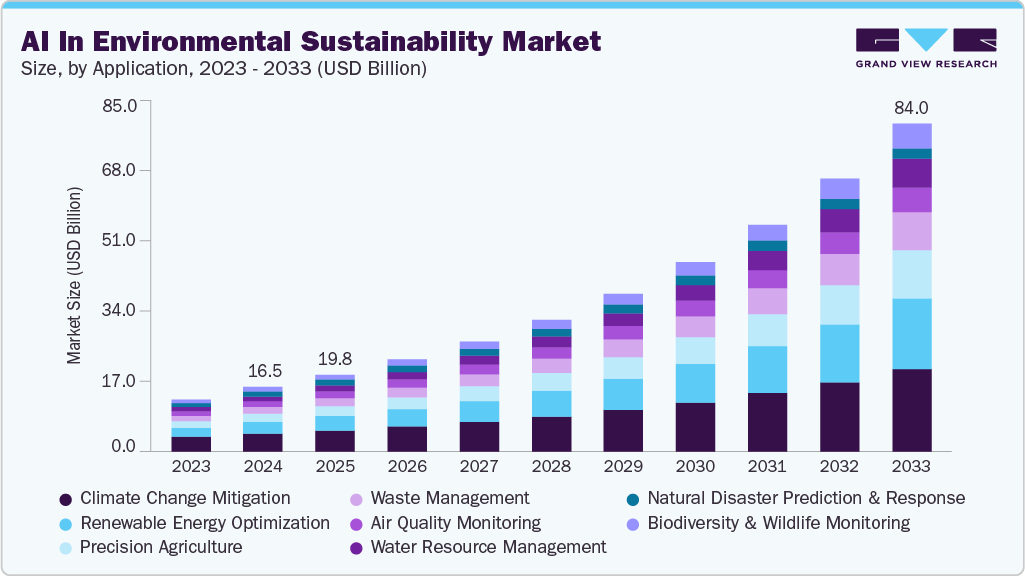
The global AI in environmental sustainability market size was valued at USD 19.7 billion in 2025 and is projected to grow from USD 23.6 billion in 2026 to USD 84.0 billion by 2033, at a CAGR of 19.9% from 2026 to 2033. North America dominated the market, accounting for a revenue share of 34.0% in 2025. The industry is expanding as governments and industries prioritize data-driven approaches to tackle environmental challenges.
 Source: Grand View Research, IR Documents, Primary Interviews, Paid DatabasesTo learn more about this report,
 Download Free Sample Report
 Key Market Trends & Insights
- By application: Climate change mitigation segment held the largest share of around 25.0% in 2025.
- By technology: Machine learning segment held the largest market share of around 38.0% in 2025
- By end use: Government and public sector led the market, with a share of around 34.0% in 2025
Regional Highlights
- Largest regional market: North America (34.0% revenue share, 2025)
- Fastest-growing regional market: Asia Pacific (highest CAGR, 2026-2033)
Market Size & Forecast
- Market size in 2025: USD 19.7 Billion
- Estimated market size in 2026: USD 23.6 Billion
- Projected market size by 2033: USD 84.0 Billion
- CAGR (2026-2033): 19.9%
Three ways to get this report
Buy it, customize it, or ask a question.Ask an Analyst
Analyst response in 1 business day
- AccessReport author, directly
- Reply timeWithin 1 working day
- No sales callDirect answer only
- FormatEmail reply
- CostFree, no cost
Get the Full Report
What the study covers
- FormatsPDF · Excel · Dashboard
- Timeline2026–2033 annual, 2025 base
- Coverage20+ countries, 5 regions
- Companies10+ key players profiled
Customize the Report
20% free customization
- IncludeCountries, segments, points
- TailorTo your product definition
- ExtendDeeper competitor detail
- OrA fully bespoke study
- Turnaround5–10 working days
Increasing availability of real-time environmental data is driving the adoption of AI tools for monitoring and response. Organizations are deploying machine learning models to optimize energy consumption, reduce emissions, and manage natural resources more efficiently. Advancements in AI algorithms are enabling faster, more accurate environmental decision-making across multiple sectors.The industry is seeing increased focus on reducing energy consumption across digital infrastructure. Rapid expansion of AI workloads is prompting the need for data centers that are both high-performance and energy-efficient. Rising environmental concerns are encouraging organizations to adopt greener technologies. Liquid cooling and AI-driven optimization tools are becoming more common in data center design. Companies are seeking ways to balance computational demand with carbon footprint reduction. This shift supports long-term sustainability goals while improving operational efficiency. Companies are actively launching new solutions associated with sustainability and reduced environmental impact. For instance, in August 2026, ClimeCo LLC launched Inset Engine, its newly designed AI-enabled digital tool for insetting, developed to enable companies enables to secure the verified emission reductions that assist them their science-based target (SBT) or related climate goals
Personal care product formulation is being transformed through AI-driven sustainable development. Companies are using AI to analyze large datasets of ingredients and formulations. This enables faster innovation while maintaining high performance and safety. AI helps identify bio-based and circular economy-compatible materials. It supports goals for reducing energy use and material waste. These efforts align with rising consumer demand for eco-conscious and environment friendly products. Several companies are building custom AI models to reformulate cosmetics using sustainable raw materials.
AI-enhanced environmental monitoring and early warning systems are improving the way environmental risks are detected and managed. These systems use machine learning algorithms to process data from satellites, IoT sensors, and weather stations in real time. By identifying patterns and anomalies, AI predict events such as floods, wildfires, droughts, and pollution spikes. This improves the timeliness and accuracy of warnings issued to communities and authorities. AI models also assist in identifying sources of deforestation, illegal mining, and water contamination. Such insights enable faster policy responses and enforcement actions. Predictive tools support better planning for disaster mitigation and emergency response. Governments and environmental agencies are integrating these tools to enhance resilience against climate-related disruptions. These systems reduce human effort and error while improving operational efficiency.
Analyst Perspective
The global environmental sustainability market is expected to grow steadily, driven by rising demand for automated carbon accounting and predictive ecological analytics. Corporations and environmental agencies are increasingly incorporating AI-based platforms into resource management, emission tracking, supply chain optimization, and biodiversity monitoring to support data accuracy, risk management, and overall strategic decision-making. The expanding popularity of cloud-based ESG software, real-time edge computing processing, and intelligent robotic process automation (RPA) is further supporting market growth. As demand for secure, compliance-ready environmental intelligence continues to rise, technology developers and platform vendors that focus on software integration, machine learning accuracy, and cyber-security enhancement are likely to capitalize on long-term growth opportunities.
Application Insights
The climate change mitigation segment dominated the market in 2025, accounting for around 25.0% share. Organizations are increasingly relying on AI to monitor and manage greenhouse gas emissions across various operational levels. Predictive AI models are being used to assess climate-related risks and support long-term mitigation strategies. These tools enhance the precision of carbon accounting and help verify emissions offset programs. Both government agencies and private companies are integrating AI into their low-carbon transition plans. This growing use of AI supports global climate targets and helps meet stricter environmental regulations.
Renewable energy optimization is emerging as a rapidly expanding application during the forecast period. AI is being adopted to forecast energy demand and improve the output of solar, wind, and other renewable sources. Smart grid systems powered by AI are enabling better control over energy flow and system stability. Machine learning tools are guiding decisions around energy storage management and dynamic load balancing. AI is also identifying ideal locations for deploying new renewable energy infrastructure. These advancements are encouraging organizations to increase AI investments to maximize efficiency, scalability, and sustainability in renewable energy operations.
Technology Insights
Machine learning dominated the market in 2025, due to its wide applicability in modeling, forecasting, and decision-making. It is used extensively for predicting air quality, optimizing resource use, and detecting environmental anomalies. Algorithms learn from historical and real-time data to improve accuracy in managing sustainability efforts. Machine learning enables automation in large-scale monitoring systems and enhances the speed of environmental analysis. It supports dynamic energy management, climate modeling, and biodiversity tracking. This has made it the most widely adopted technique across both public and private environmental initiatives. For instance, in August 2025, researchers introduced a machine learning-based real-time air quality assessment and health risk prediction framework that combines IoT sensor, meteorological, and satellite data with Random Forest, XGBoost, Gradient Boosting, and LSTM models to deliver highly accurate pollution forecasting and support proactive environmental management.
Natural language processing (NLP) is steadily gaining traction as a growing area in this space. It enables the extraction of insights from policy documents, climate reports, and public communications. NLP helps in interpreting unstructured environmental data and tracking sentiment around sustainability practices. It allows stakeholders to interact with environmental databases through conversational AI and intelligent assistants. As regulatory and policy data become increasingly relevant, NLP supports real-time compliance monitoring and reporting. This expansion is driving interest in NLP-based tools to enhance communication and transparency in environmental management.
End Use Insights
The government and public sector dominated the market in 2025 due to early adoption and regulatory responsibility. Governments are deploying AI to monitor pollution levels, manage climate risks, and enforce environmental compliance. Public sector agencies use AI tools for forecasting natural disasters and optimizing waste management systems. These initiatives often receive dedicated funding and support through national sustainability programs. Centralized access to large datasets further strengthens their AI capabilities. This has made government organizations the primary users of AI-driven environmental solutions.
Energy and utilities segment is a growing area in this market as companies seek to optimize operations and reduce emissions. AI is being applied to forecast energy demand, manage grid stability, and integrate renewable sources more efficiently. Utilities are also using AI to detect faults in infrastructure and monitor environmental impact. With the shift toward clean energy, AI helps in managing complex energy flows and resource allocation. Investment in smart grids and real-time data analysis is accelerating adoption. The sector is steadily increasing its share in AI-led environmental applications.
Regional Insights
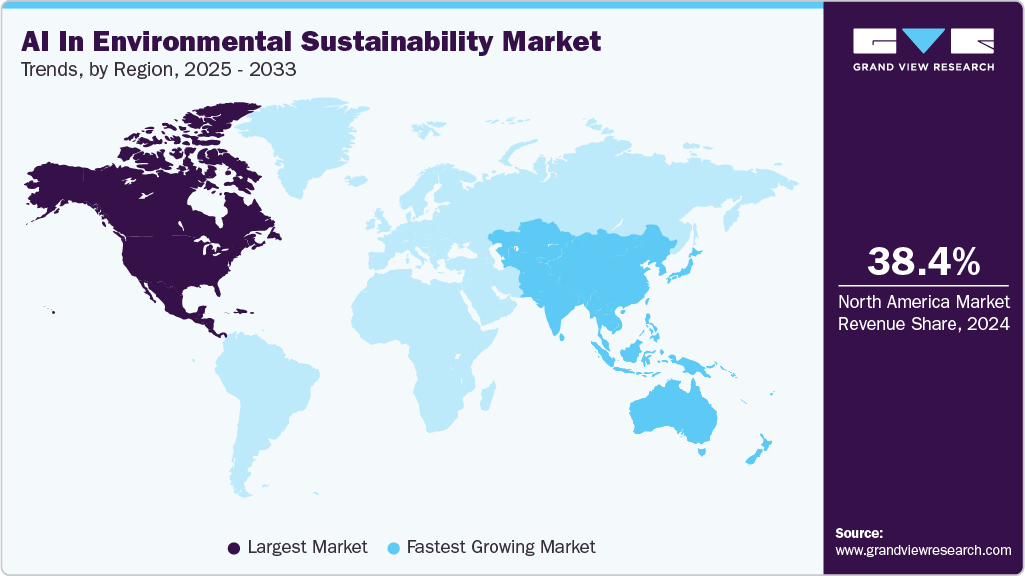
North America AI in environmental sustainability market held the largest share of over 34.0% in 2025, due to advanced digital infrastructure and strong investment in green technologies. Governments and private firms are adopting AI for climate modeling, emission monitoring, and energy efficiency. Presence of major AI companies also supports innovation and deployment. These factors continue to drive regional dominance in this market.
 To learn more about this report, Download Free Sample Report
 U.S. AI In Environmental Sustainability Market Trends
The AI in environmental sustainability market in the U.S. dominates the regional industry due to high adoption of advanced technologies. Strong federal and state-level sustainability initiatives are encouraging AI deployment. Companies are using AI for emissions monitoring, water management, and wildfire prediction. Investment in clean tech startups and AI research is further accelerating market growth.
Europe AI In Environmental Sustainability Market Trends
The AI in environmental sustainability market in Europe is rapidly expanding its use of AI for environmental goals, supported by policies such as the European Green Deal. Countries are applying AI for climate modeling, circular economy planning, and sustainable agriculture. The EU is funding cross-border AI projects to address ecological challenges. Public-private partnerships are driving innovation in green AI applications.
Asia Pacific AI In Environmental Sustainability Market Trends
The AI in environmental sustainability market in Asia Pacific is emerging as the fastest-growing region. Rapid urbanization and industrial activity are increasing the need for effective environmental management. Governments in the region are prioritizing AI-based solutions for climate risk monitoring and pollution control. Investments in AI for energy efficiency, water conservation, and waste reduction are gaining traction. Regional startups and tech firms are partnering with public agencies to deploy scalable AI tools.
Key AI In Environmental Sustainability Market Company Insights
Key players operating in the AI in environmental sustainability market are undertaking various initiatives to strengthen their presence and increase the reach of their products and services. Strategies such as expansion activities and partnerships are key in propelling the market growth.
Key AI In Environmental Sustainability Companies
The following key companies have been profiled for this study on the AI in environmental sustainability market.
-
Amazon Web Services, Inc.
-
Cisco Systems, Inc.
-
Google LLC
-
Hitachi, Ltd.
-
IBM Corporation
-
Microsoft
-
NVIDIA Corporation
-
Oracle Corporation
-
Schneider Electric
-
Siemens
Recent Developments
-
In July 2026, CuspAI launched the AI Materials Foundry, a global network that brought together more than 45 organizations, including NVIDIA, Meta, Samsung, Hyundai Motor Group, Applied Materials, and Oxford PV, to accelerate AI-driven materials discovery. The platform combined AI, computing, materials data, laboratories, and scientific expertise to design, simulate, synthesize, and validate new materials.
-
In June 2026, AI-enabled clean energy software and services provider, Stem Inc. launched AIONA. Its newly designed AI services features PowerTrack platform capabilities, practical AI, structured value discovery & road mapping, and more.
-
In July 2025, Accenture and Google Cloud collaborated with Air France-KLM to launch a generative AI factory that supports agentic AI capabilities, streamlining AI use case development across operations. The initiative accelerates digital transformation by enabling rapid design, testing, and deployment of gen AI solutions with measurable business impact.
-
In January 2025, Accenture launched the AI Refinery for Industry, featuring 12 industry-specific agentic AI solutions to streamline business processes using multi-agent networks. Built on NVIDIA AI software, these solutions aim to reduce deployment time and accelerate value creation across sectors such as clinical trials, industrial maintenance, and marketing.
-
In January 2025, NVIDIA Corporation launched AI foundation models as NIM micro services for RTX AI PCs, enabling users to build digital humans, creative workflows, and agentic AI locally. These models, supported by GeForce RTX 50 Series GPUs, power Technologies such as Project R2X, AI Blueprints, and various developer tools to accelerate AI deployment and performance on PCs.
AI In Environmental Sustainability Market Report Scope
Report Attribute
Details
Market size in 2025
USD 19.7 billion
Estimated market size in 2026
USD 23.6 billion
Projected market size by 2033
USD 84.0 billion
Growth rate
CAGR of 19.9% from 2026 to 2033
Base year for estimation
2025
Historical data
2021 - 2024
Forecast period
2026 - 2033
Quantitative units
Revenue in USD billion, and CAGR from 2026 to 2033
Report coverage
Revenue forecast, company ranking, competitive landscape, growth factors, and trends
Segments covered
Application, technology, end use, region
Regional Scope
North America; Europe; Asia Pacific; Latin America; Middle East & Africa
Country Scope
U.S.; Canada; Mexico; Germany; UK; France; China; Japan; India; Australia; South Korea; Brazil; KSA; UAE; South Africa
Key companies profiled
Amazon Web Services, Inc.; Cisco Systems, Inc.; Google LLC; Hitachi, Ltd.; IBM Corporation; Microsoft; NVIDIA Corporation; Oracle Corporation; Schneider Electric; Siemens
Customization scope
Free report customization (equivalent to 8 analyst working days) with purchase. Addition or alteration to country, regional & segment scope.
Pricing and purchase options
Avail of customized purchase options to meet your exact research needs. Explore purchase options
Global AI In Environmental Sustainability Market Report Segmentation
This report forecasts revenue growth at the global, regional, and country levels and provides an analysis of the latest industry trends and opportunities in each of the sub-segments from 2021 to 2033. For this study, Grand View Research has segmented the global AI in environmental sustainability market report based on application, technology, end use, and region.
- Application Outlook (Revenue, USD Billion, 2021 - 2033)
- Climate Change Mitigation
- Renewable Energy Optimization
- Waste Management
- Water Resource Management
- Biodiversity & Wildlife Monitoring
- Precision Agriculture
- Air Quality Monitoring
- Natural Disaster Prediction & Response
- Technology Outlook (Revenue, USD Billion, 2021 - 2033)
- Machine Learning
- Computer Vision
- Natural Language Processing
- Predictive Analytics
- Reinforcement Learning
- End Use Outlook (Revenue, USD Billion, 2021 - 2033)
- Government & Public Sector
- Energy & Utilities
- Agriculture
- Transportation & Logistics
- Manufacturing
- Regional Outlook (Revenue, USD Billion, 2021 - 2033)
- North America
- U.S.
- Canada
- Mexico
- Europe
- UK
- Germany
- France
- Asia Pacific
- China
- Japan
- India
- Australia
- South Korea
- Latin America
- Brazil
- Middle East & Africa (MEA)
- KSA
- UAE
- South Africa
- North America
Frequently Asked Questions About This Report
The global AI in environmental sustainability market is expected to grow at a CAGR of 19.9% from 2026 to 2033, reaching USD 84.0 billion.
North America dominated with an over 34.0% revenue share in 2025.
The global AI in environmental sustainability market size was valued at USD 19.7 billion in 2025 and is estimated at USD 23.6 billion for 2026.
Key players in the market include Amazon Web Services, Inc., Cisco Systems, Inc., Google LLC, Hitachi, Ltd., IBM Corporation, Microsoft, NVIDIA Corporation, Oracle Corporation, Schneider Electric, Siemens
The climate change mitigation segment accounted for the largest revenue share of around 25.0% in 2025.
About the Author(s)
Next Generation Technologies Research Team
Technology · Next Generation TechnologiesThis report was authored by the next generation technologies research team at Grand View Research - comprising two research analysts, one senior research analyst, and one industry expert - with specialized expertise in the next generation technologies segment of the technology industry. All findings are based on proprietary technology databases, executive interviews, and regulatory analysis, subject to internal peer review prior to publication.
Last Updated:
Speak to Analyst

Customize this report to your needs - add regions, segments, or data points, with 20% free customization.
Or view our licence options:


ISO 9001:2015 & 27001:2022 Certified
We are GDPR and CCPA compliant! Your transaction & personal information is safe and secure. For more details, please read our privacy policy.


