
- Home
- »
- Next Generation Technologies
- »
-
AI In Industrial Automation Market Size Report, 2026-2033GVR Report cover

AI In Industrial Automation Market (2026 - 2033)
Size, Share & Trends Analysis Report By Type (Deep Learning, Machine Learning, Natural Language Processing (NLP)), By Application , By End Use, By Region, And Segment Forecasts
Market Size, 2025
$23.1BMarket Estimate, 2026
$26.8BMarket Forecast, 2033
$90.3BCAGR, 2026–2033
19.0%AI In Industrial Automation Market Summary
The global AI in industrial automation market size was valued at USD 23.1 billion in 2025 and is projected to grow from USD 26.8 billion in 2026 to USD 90.3 billion by 2033, at a CAGR of 19.0% from 2026 to 2033. North America dominated the market, accounting for a revenue share of 35.0% in 2025. The market growth is primarily driven by the increasing adoption of predictive maintenance to enhance operational efficiency and reduce downtime, the integration of AI-enabled robotics to streamline production workflows, the deployment of machine vision systems for precise quality control, and the growing utilization of digital twin technology to optimize manufacturing processes and resource management.
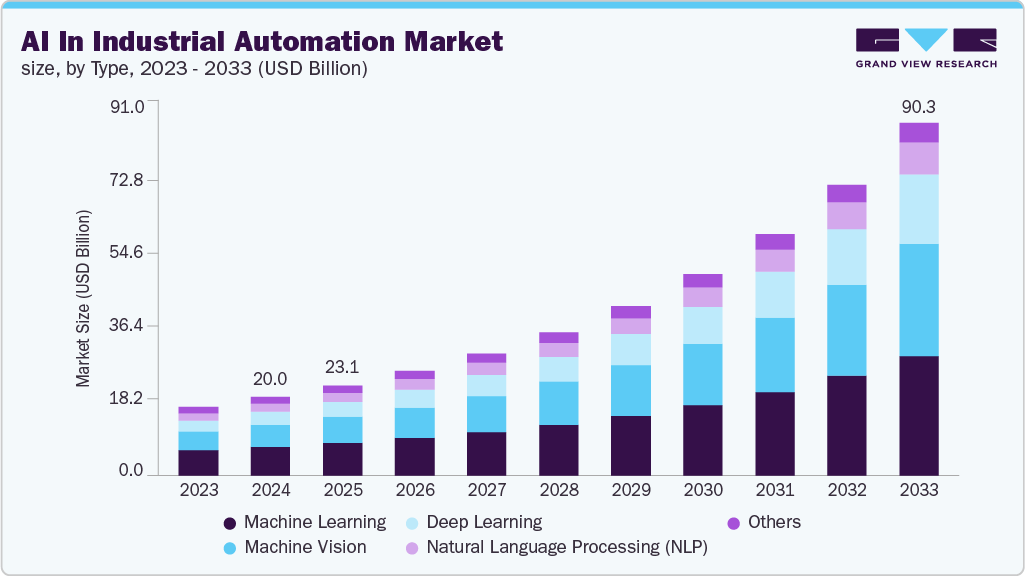 Source: Grand View Research, IR Documents, Primary Interviews, Paid DatabasesTo learn more about this report,
 Download Free Sample Report
Key Market Trends & Insights
- By type: The machine learning segment led the market, with the largest revenue share of over 35.0% in 2025.
- By application: The predictive maintenance & machinery inspection segment led the market, with the largest revenue share of around 29.0% in 2025.
- By end use: The manufacturing segment accounted for the largest revenue share of over 30.0% in 2025.
Regional Highlights
- Largest regional market: North America (35.0% revenue share, 2025)
- Fastest-growing regional market: Asia Pacific (highest CAGR, 2026-2033)
Market Size & Forecast
- Market size in 2025: USD 23.1 Billion
- Estimated market size in 2026: USD 26.8 Billion
- Projected market size by 2033: USD 90.3 Billion
- CAGR (2026-2033): 19.0%
Three ways to get this report
Buy it, customize it, or ask a question.Ask an Analyst
Analyst response in 1 business day
- AccessReport author, directly
- Reply timeWithin 1 working day
- No sales callDirect answer only
- FormatEmail reply
- CostFree, no cost
Get the Full Report
What the study covers
- FormatsPDF · Excel · Dashboard
- Timeline2026–2033 annual, 2025 base
- Coverage20+ countries, 5 regions
- Companies10+ key players profiled
Customize the Report
20% free customization
- IncludeCountries, segments, points
- TailorTo your product definition
- ExtendDeeper competitor detail
- OrA fully bespoke study
- Turnaround5–10 working days
The growing demand for AI-driven automation solutions is emerging as a key driver of industrial transformation worldwide. Organizations are increasingly adopting predictive maintenance technologies to enhance asset reliability and minimize unplanned downtime. The integration of AI-powered robotics is driving significant improvements in production efficiency, precision, and scalability. Furthermore, the deployment of advanced machine vision systems is enabling real-time quality control and reducing human error in manufacturing processes. In addition, the rising adoption of digital twin technology is fostering data-driven operations, optimizing resource utilization, and strengthening overall operational agility.New investments directed at strengthening the capabilities and enabling intelligent automation highlight the growth trends in this industry. For instance, in April 2026, Zebra Technologies Corp., one of the global providers of connected frontline, asset visibility, and automation solutions, announced a strategic investment through its venture capital arm, Zebra Ventures, in Apera AI, a 4D Vision technology company. The investment is expected to provide factory robots with real-time visual intelligence using Apera AI’s light-resilient stereo vision and AI models. Such developments are likely to influence the further course of this industry.
The growing demand for predictive maintenance is transforming the industrial automation landscape by enabling companies to anticipate equipment failures before they occur. AI-driven analytics are helping organizations monitor real-time machine data and optimize maintenance schedules, significantly reducing operational downtime. This proactive approach enhances equipment lifespan while improving resource allocation and cost efficiency. Manufacturers are increasingly integrating AI algorithms into their maintenance systems to achieve greater operational reliability. As a result, predictive maintenance is becoming a critical driver of competitiveness and sustainability in modern industrial operations.
AI in industrial automation industry is experiencing rapid growth due to the growing demand for machine vision systems in quality inspection processes. AI-based vision technologies enable real-time detection of defects, deviations, and irregularities with high precision and speed. These systems improve production quality while reducing dependency on manual inspection and minimizing human error. Manufacturers are leveraging deep learning-based vision solutions to comply with stringent quality and safety standards. As industries prioritize consistency and accuracy, machine vision is becoming a key enabler of smarter, data-driven manufacturing.
Analyst Perspective
The AI in the industrial automation market has been experiencing a significant growth driven by increasing adoption of automation across industries, innovation and delivery of novel solutions and technologies to improve compatibility of existing automation systems and robots with complex part geometry. The increasing significance of energy efficiency environmental impact of industrial operations also contribute to market growth. Innovation, partnerships among key technology companies, investments in system advancements and AI applications in robotics, and collaborations among technology providers and enablers are key to shaping the future course of this industry. Key players embrace strategies such as the use of software-defined layer architectures, massive data acquisition consolidations, relying on "shadow-mode" deployment paths, and natural language copilots.
Type Insights
The machine learning segment dominated the market in 2025, accounting for an over 35.0% share, driven by its critical role in predictive maintenance and process optimization across industries. The growing need to minimize equipment downtime and enhance operational efficiency is accelerating the adoption of machine learning solutions in manufacturing and energy sectors. Increasing integration of machine learning with industrial IoT and robotics is enabling real-time data-driven decision-making, further boosting market demand. Rapid investments in smart factory initiatives and Industry 4.0 adoption are serving as key catalysts for the segment’s growth. Continuous advancements in algorithms, cloud computing, and analytics platforms are expected to sustain robust expansion of the machine learning segment throughout the forecast period.
The growing demand for deep learning in industrial automation is fueled by its capability to enable advanced predictive analytics and autonomous decision-making in complex manufacturing environments. Companies are adopting deep learning to improve visual inspection, detect subtle defects, and enhance precision in robotic operations. The surge in high-resolution sensor data and industrial cameras is creating opportunities for deep learning to deliver actionable insights in real time. Collaboration between AI software providers and automation equipment manufacturers is accelerating the deployment of deep learning solutions across multiple sectors. Continuous innovations in algorithm efficiency and hardware acceleration are further driving the expansion of the deep learning segment in smart factories globally.
Application Insights
The predictive maintenance & machinery inspection segment held the largest share of the market in 2025, owing to its ability to significantly reduce unplanned downtime and optimize equipment performance. The growing focus on minimizing operational costs and improving overall equipment effectiveness (OEE) is driving widespread adoption of AI-powered predictive maintenance solutions. Integration of AI with IoT sensors, machine learning, and real-time analytics enables early detection of equipment faults and timely maintenance interventions. Industrial enterprises are increasingly investing in smart factory initiatives and automated inspection systems to enhance productivity and safety. Continuous advancements in sensor technologies, AI algorithms, and digital twin models are expected to sustain strong growth of this segment throughout the forecast period.
The increasing demand for material movement solutions is driven by the need to streamline logistics and automate repetitive handling tasks in industrial environments. AI-enabled robotic systems and autonomous guided vehicles (AGVs) are being deployed to improve throughput and minimize human intervention. Manufacturers are leveraging AI to dynamically plan routes, prioritize tasks, and manage real-time inventory movements across multiple production lines. The growth of smart warehouses and connected factory floors is encouraging broader adoption of AI-based material handling solutions. Enhanced coordination between AI software, robotics, and industrial equipment is expected to further expand the material movement segment in the coming years.
End Use Insights
The manufacturing segment accounted for the largest share of the market in 2025, primarily driven by the need for flexible and scalable production processes. AI adoption is enabling manufacturers to quickly adjust operations in response to changing demand, supply chain disruptions, and customized product requirements. Advanced analytics and AI-based process simulations are being used to optimize resource utilization and reduce material waste. The push toward energy-efficient manufacturing and regulatory compliance is encouraging integration of AI for monitoring and process control. Expansion of collaborative robotics and AI-enabled production planning is further enhancing operational agility and driving market growth in this segment.
The growing demand for AI in the energy & utilities segment is driven by the need to enhance grid reliability, optimize energy distribution, and reduce operational costs. Utilities are increasingly adopting AI for real-time monitoring of equipment, predictive maintenance of critical assets, and automated fault detection. Integration of AI with smart meters, sensors, and IoT platforms is enabling more efficient load management and energy forecasting. Rising focus on renewable energy integration and decarbonization initiatives is accelerating the deployment of AI-powered solutions in power generation and distribution. Continuous advancements in AI algorithms, analytics platforms, and edge computing are expected to further strengthen the growth of this segment throughout the forecast period.
Regional Insights
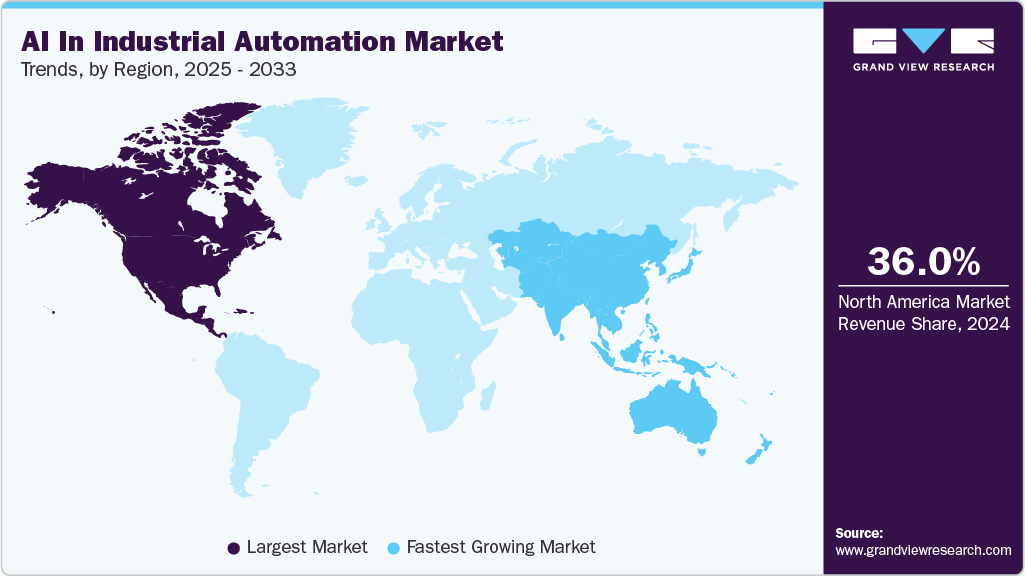
The AI in industrial automation industry in North America held the dominant global revenue share of over 35.0% in 2025, primarily driven by the strong presence of advanced manufacturing infrastructure and early adoption of AI technologies. Industries across automotive, aerospace, and electronics are integrating AI-driven robotics and machine vision systems to enhance production accuracy and reduce operational costs. The region’s strong emphasis on digital transformation and smart factory initiatives continues to support market expansion. Moreover, ongoing investments in R&D and the availability of skilled AI talent further strengthen North America’s leadership in industrial automation innovation.
 To learn more about this report, Download Free Sample Report
U.S. AI In Industrial Automation Market Trends
The AI in industrial automation industry in the U.S. accounted for a regional revenue share of over 20.0% in 2025, driven by the country’s robust industrial base and high adoption of intelligent manufacturing systems. American manufacturers are leveraging AI-powered predictive maintenance, process optimization, and quality inspection solutions to increase efficiency and reliability. The presence of major technology providers and AI startups is accelerating innovation and deployment across various industrial sectors. In addition, government initiatives promoting Industry 4.0 and smart manufacturing are fueling sustained market growth in the U.S.
Europe AI In Industrial Automation Market Trends
The AI in industrial automation industry in Europe is expected to grow at a CAGR of over 17.2% from 2026 to 2033, owing to the region’s increasing focus on sustainable and energy-efficient manufacturing practices. European industries are rapidly integrating AI-driven automation solutions to optimize production efficiency and reduce carbon emissions. The strong regulatory framework supporting digital transformation and industrial modernization is creating new opportunities for AI technology providers. Furthermore, collaborations between technology firms and manufacturing companies are accelerating the adoption of AI across automotive, electronics, and heavy machinery sectors. In February 2026, Deutsche Telekom launched its industrial AI factory in Munich, boosting Europe's digital sovereignty. Developed over six months in partnership with NVIDIA, the facility operates with nearly 10,000 Blackwell GPUs. Such development highlights efforts associated with improving computing technologies to support advanced automation system operations.
Asia Pacific AI In Industrial Automation Market Trends
The AI in industrial automation industry in Asia Pacific is expected to grow at the fastest CAGR of 23.7% from 2026 to 2033. The demand for AI-based automation solutions is being driven by rapid industrialization, rising labor costs, and growing investments in smart manufacturing across countries such as China, Japan, South Korea, and India. Manufacturers in the region are increasingly adopting AI-enabled robotics, predictive maintenance, and digital twin technologies to improve operational agility and cost efficiency. With supportive government initiatives and expanding industrial output, Asia Pacific is emerging as the most dynamic and high-growth region in the global AI in industrial automation landscape.
Key AI In Industrial Automation Company Insights
Some of the key companies in the AI in industrial automation industry include Siemens AG, ABB Ltd., General Electric Company, Mitsubishi Electric Corporation, Schneider Electric SE, and others. Organizations are focusing on increasing customer base to gain a competitive edge in the industry. Therefore, key players are taking several strategic initiatives, such as mergers and acquisitions, and partnerships with other major companies.
-
Siemens AG is a global leader in industrial automation and digitalization, integrating AI technologies into its solutions for smart factories and process optimization. The company specializes in predictive maintenance, digital twins, and machine vision applications across multiple industrial sectors. Siemens’ AI platforms help manufacturers reduce downtime, improve quality, and optimize energy consumption. Its MindSphere IoT platform and AI-driven analytics are widely adopted for industrial data insights and operational efficiency.
-
Mitsubishi Electric Corporation develops automation and AI solutions for industrial production and robotics applications. The company specializes in AI-powered industrial robots, factory automation systems, and process optimization tools. Mitsubishi Electric uses AI to enhance operational efficiency, ensure quality control, and reduce production downtime. Its solutions are widely adopted in manufacturing, automotive, and energy sectors, integrating AI with PLCs, vision systems, and industrial IoT networks.
Key AI In Industrial Automation Companies
The following key companies have been profiled for this study on the AI in industrial automation market.
-
Siemens AG
-
ABB Ltd.
-
General Electric Company (GE)
-
Mitsubishi Electric Corporation
-
Schneider Electric SE
-
Rockwell Automation, Inc.
-
IBM Corporation
-
Honeywell International Inc.
-
Fanuc Corporation
-
Bosch Rexroth AG
-
Cognex Corporation
-
KUKA AG
Recent Developments
-
In July 2026, ABB Robotics and NVIDIA published a joint white paper highlighting the role of physical AI in precision manufacturing, with a focus on moving industrial robots beyond predefined tasks toward more autonomous and adaptable systems. The companies identified robotic vision as an important entry point for deploying physical AI.
-
In June 2026, Siemens expanded the capabilities of its Eigen Engineering Agent, an AI system designed specifically for industrial automation engineering, by adding ECAD integration and standards-compliant project generation. The new capabilities allow electrical designs to be connected with software development and enable plain-language machine descriptions to be converted into ready-to-use automation projects.
-
In June 2026, Rockwell Automation introduced FactoryTalk ResilientEdge to support autonomous and scalable manufacturing operations, combining edge execution with cloud capabilities for analytics, AI training, and enterprise-level orchestration. The platform is designed to maintain continuous industrial operations even when connectivity is interrupted.
-
In August 2025, Sequoia Applied Technologies partnered with VIA Automation to introduce Industrial AI copilots designed to bring intelligence and automation to the factory floor. This collaboration focuses on embedding AI-driven insights into manufacturing workflows, enabling real-time monitoring, predictive analytics, and autonomous decision-making to optimize efficiency. By leveraging these intelligent systems, factories can minimize downtime, enhance operational productivity, and achieve smarter, data-centric manufacturing outcomes.
-
In May 2025, Siemens AG introduced AI agents for industrial automation, expanding its industrial AI portfolio to enable autonomous decision-making and workflow execution across the industrial value chain. The announcement at Automate 2025 in Detroit highlighted Siemens’ new agent orchestration architecture, allowing users to manage specialized AI agents that learn continuously, collaborate seamlessly, and integrate with industrial tools. At its Bad Neustadt facility, Siemens has already deployed the Insights Hub Production Copilot, which leverages these AI agents to transform fragmented production data into actionable insights, driving measurable productivity improvements.
-
In May 2025, NTT DATA launched its Smart AI Agent Ecosystem, offering industry-specific AI solutions to enhance enterprise operations through intelligent automation. The ecosystem upgrades legacy RPA bots into autonomous agents, improving decision-making and efficiency across sectors such as healthcare, automotive, and finance. In addition, a strategic collaboration with OpenAI will establish a Center of Excellence to accelerate the development and deployment of generative AI services tailored to specific business functions.
Global AI In Industrial Automation Market Report Scope
Report Attribute
Details
Market size in 2025
USD 23.1 billion
Estimated market size in 2026
USD 26.8 billion
Projected market size by 2033
USD 90.3 billion
Growth rate
CAGR of 19.0% from 2026 to 2033
Base year for estimation
2025
Historical data
2021 - 2025
Forecast period
2026 - 2033
Quantitative units
Revenue in USD billion and CAGR from 2026 to 2033
Report coverage
Revenue forecast, company ranking, competitive landscape, growth factors, and trends
Segment scope
Type, application, end use, region
Region scope
North America; Europe; Asia Pacific; Latin America; Middle East & Africa
Country scope
U.S.; Canada; Mexico; Germany; UK; France; China; Japan; India; Australia; South Korea; Brazil; KSA; UAE; South Africa
Key companies profiled
Siemens AG; ABB Ltd.; General Electric Company; Mitsubishi Electric Corporation; Schneider Electric SE; Rockwell Automation, Inc.; IBM Corporation; Honeywell International Inc.; Fanuc Corporation; Bosch Rexroth AG; Cognex Corporation; KUKA AG
Customization scope
Free report customization (equivalent up to 8 analysts working days) with purchase. Addition or alteration to country, regional & segment scope.
Pricing and purchase options
Avail of customized purchase options to meet your exact research needs. Explore purchase options
Global AI In Industrial Automation Market Report Segmentation
This report forecasts revenue growth at global, regional, and country levels and provides an analysis of the latest industry trends in each of the sub-segments from 2021 to 2033. For this study, Grand View Research has segmented the global AI in industrial automation market report based on type, application, end use, and region:
- Type Outlook (Revenue, USD Billion, 2021 - 2033)
- Deep Learning
- Machine Learning
- Natural Language Processing (NLP)
- Machine Vision
- Others
- Application Outlook (Revenue, USD Billion, 2021 - 2033)
- Material Movement
- Predictive Maintenance & Machinery Inspection
- Production Planning
- Field Services
- Quality Control & Reclamation
- Others
- End Use Outlook (Revenue, USD Billion, 2021 - 2033)
- Manufacturing
- Automotive
- Energy & Utilities
- Healthcare
- Retail
- Aerospace & Defense
- Other
- Regional Outlook (Revenue, USD Billion, 2021 - 2033)
- North America
- U.S.
- Canada
- Mexico
- Europe
- UK
- Germany
- France
- Asia Pacific
- China
- Japan
- India
- Australia
- South Korea
- Latin America
- Brazil
- Middle East & Africa (MEA)
- KSA
- UAE
- South Africa
- North America
Frequently Asked Questions About This Report
The global AI in industrial automation market size was valued at USD 23.1 billion in 2025 and is estimated at USD 26.8 billion for 2026.
Key players in the market include Siemens AG, ABB Ltd., General Electric Company, Mitsubishi Electric Corporation, Schneider Electric SE, Rockwell Automation, Inc., IBM Corporation, Honeywell International Inc., Fanuc Corporation, Bosch Rexroth AG, Cognex Corporation, KUKA AG., and others.
The global AI in industrial automation market is expected to grow at a CAGR of 19.0% from 2026 to 2033, reaching USD 90.3 billion.
North America dominated with over 35.0% revenue share in 2025.
The global AI in industrial automation market is expected to grow at a CAGR of 19.0% from 2026 to 2033, reaching USD 90.3 billion.
About the Author(s)
Next Generation Technologies Research Team
Technology · Next Generation TechnologiesThis report was authored by the next generation technologies research team at Grand View Research - comprising two research analysts, one senior research analyst, and one industry expert - with specialized expertise in the next generation technologies segment of the technology industry. All findings are based on proprietary technology databases, executive interviews, and regulatory analysis, subject to internal peer review prior to publication.
Last Updated:
Speak to Analyst

Customize this report to your needs - add regions, segments, or data points, with 20% free customization.
Or view our licence options:


ISO 9001:2015 & 27001:2022 Certified
We are GDPR and CCPA compliant! Your transaction & personal information is safe and secure. For more details, please read our privacy policy.


