
- Home
- »
- Advanced Interior Materials
- »
-
Algae-based Building Materials Market Report, 2026-2033GVR Report cover

Algae-based Building Materials Market (2026 - 2033)
Size, Share & Trends Analysis Report By Product (Algae-based Concrete Additives, Algae-based Bioplastics & Composites, Algae-based Insulation Materials), By End-use, By Region, And Segment Forecasts
Market Size, 2025
$880.1BMarket Estimate, 2026
$1,017.8BMarket Forecast, 2033
$2,816.3BCAGR, 2026–2033
15.7%Algae-based Building Materials Market Summary
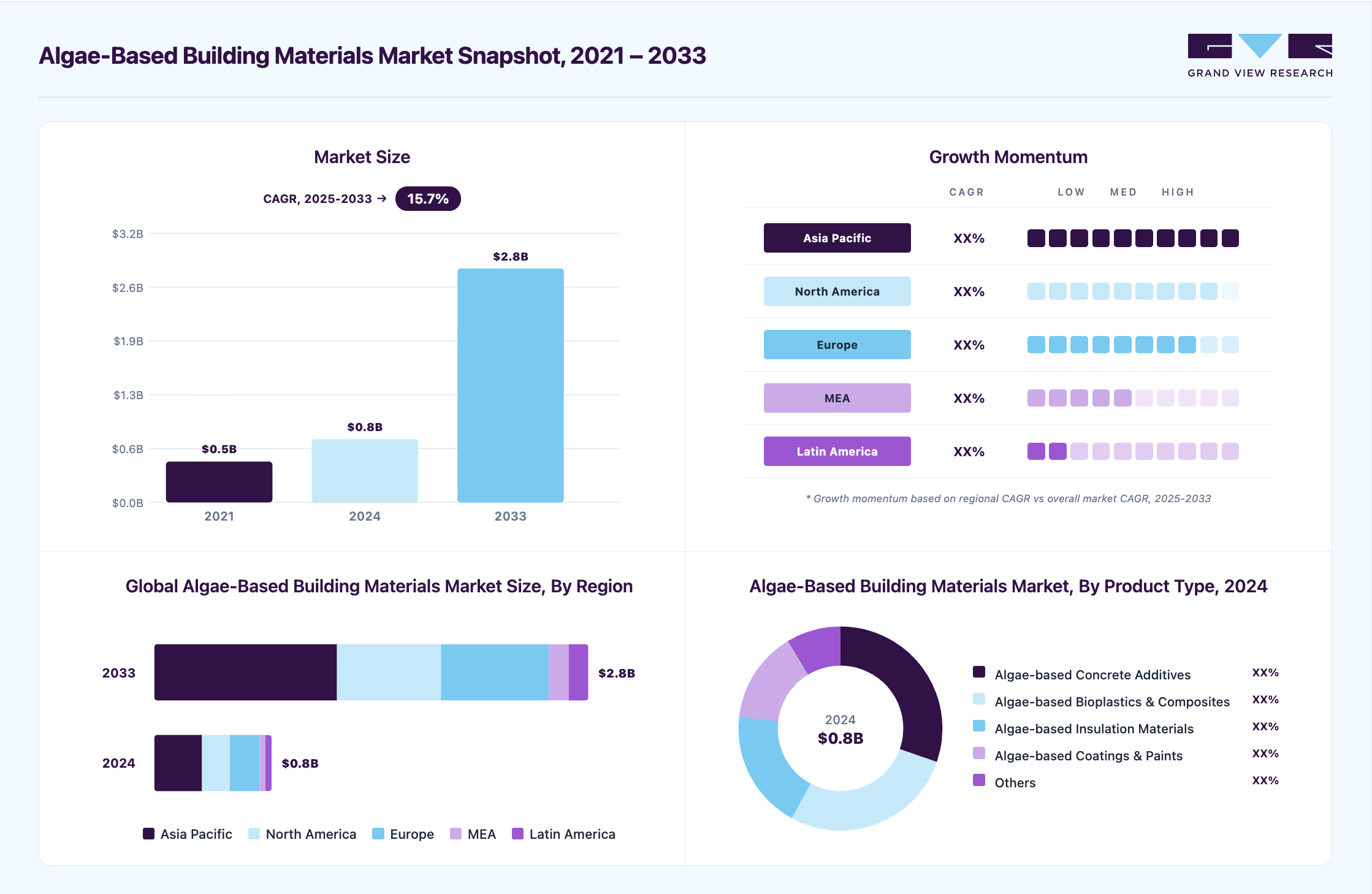
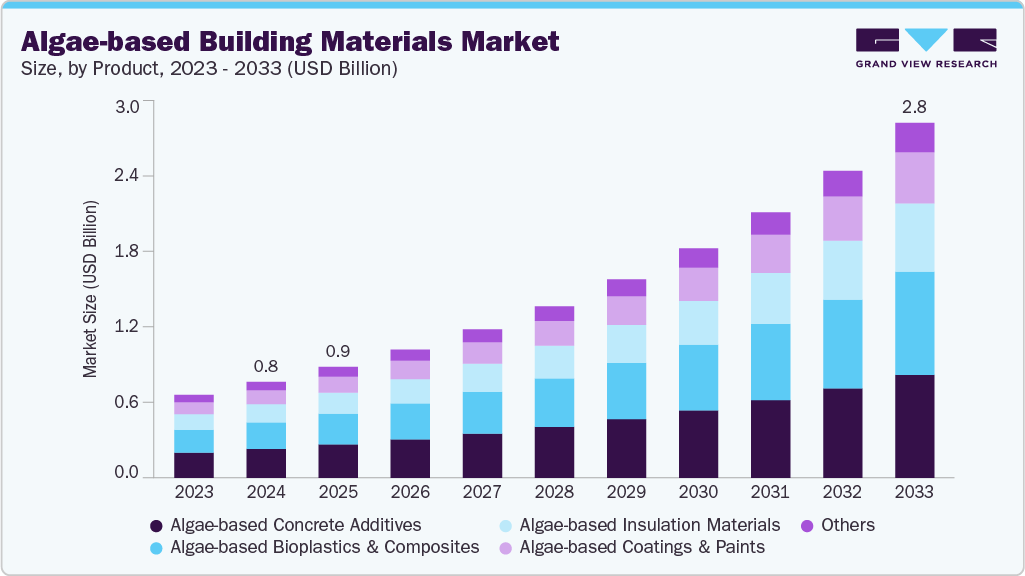
The global algae-based building materials market size was estimated at USD 880.1 million in 2025 and is projected to grow from USD 1,017.8 million in 2026 to USD 2,816.3 million by 2033, growing at a CAGR of 15.7% from 2026 to 2033. The market in Asia Pacific dominated with a revenue share of 40.8% in 2025. Algae can capture and store carbon dioxide during growth, offering a natural means to offset emissions from traditional materials like cement and steel.
 Source: Grand View Research, IR Documents, Primary Interviews, Paid DatabasesTo learn more about this report,
 Download Free Sample Report
 Key Market Trends & Insights
- By product: Algae-based concrete additives segment led the market with the largest revenue share of 30.2% in 2025
- By end use: Residential construction segment led the market with the largest revenue share of 60.5% in 2025
Regional Highlights
- Largest regional market: Asia Pacific (40.8% revenue share, 2025)
- By country: The China held the largest market share in 2025.
Market Size & Forecast
- Market size in 2025: USD 880.1 Million
- Estimated market size in 2026: USD 1,017.8 Million
- Projected market size by 2033: USD 2,816.3 Million
- CAGR (2026-2033): 15.7%
Three ways to get this report
Buy it, customize it, or ask a question.Ask an Analyst
A direct answer, usually in 1 working day
- AccessReport author, directly
- Reply timeWithin 1 working day
- No sales callDirect answer only
- FormatEmail reply
- CostFree, no cost
Get the Full Report
What the study covers
- FormatsPDF · Excel · Dashboard
- Timeline2026–2033 annual, 2025 base
- Coverage20+ countries, 5 regions
- Companies10+ key players profiled
Customize the Report
20% free customization
- IncludeCountries, segments, points
- TailorTo your product definition
- ExtendDeeper competitor detail
- OrA fully bespoke study
- Turnaround5–10 working days
As global climate goals tighten, industries are compelled to reduce their carbon footprints, creating a strong incentive for bio-based innovations. Algae-derived materials help builders achieve lower embodied carbon levels in projects. Their renewable nature also reduces dependence on finite resources. Consequently, the shift toward carbon-neutral architecture strongly favors algae-based alternatives.The growing popularity of eco-certifications such as LEED and BREEAM is driving the adoption of environmentally responsible materials. Construction firms and developers are increasingly prioritizing products that align with green building standards, which recognize renewable and biodegradable inputs. Algae-based materials meet these criteria through their minimal environmental impact and renewable sourcing. As public and private sectors embrace sustainability commitments, the demand for green materials is projected to rise steadily. This trend encourages investments in algae-based composites, bioplastics, and insulation products. The linkage between green architecture and algae innovation thus forms a major growth catalyst.
 To learn more about this report, Download Free Sample Report
 Advancements in algae cultivation and bioprocessing technologies are making large-scale production increasingly feasible. Innovations such as closed-loop photobioreactors and nutrient recycling systems are reducing costs and improving efficiency. These developments enhance the mechanical strength, thermal performance, and durability of algae-derived construction products. Moreover, new composite formulations allow algae to be blended with other sustainable materials for broader applications. As technology matures, the reliability and performance of these materials are expected to rival conventional alternatives. Hence, technological progress acts as a crucial enabler for market expansion.
Market Dynamics
The algae-based building materials market is experiencing significant growth due to increasing demand for sustainable construction solutions, rising focus on carbon-neutral and carbon-negative building practices, growing adoption of green building certifications, and continuous advancements in bio-based material technologies. Algae-based building materials are gaining attention for their ability to sequester carbon dioxide, reduce reliance on conventional cement-intensive products, and support circular economy objectives within the construction industry. The expansion of sustainable infrastructure projects, increasing investments in eco-friendly urban development, and growing emphasis on reducing the environmental footprint of buildings are further supporting market growth. Additionally, advancements in algae cultivation systems, bio-composite manufacturing, carbon-capturing concrete technologies, and algae-derived insulation materials are enabling improved material performance, durability, and scalability for commercial construction applications.
The growing demand for environmentally sustainable and low-carbon construction materials is a major driver of the algae-based building materials market. Governments, developers, architects, and construction companies are increasingly seeking alternatives to conventional building materials that contribute significantly to greenhouse gas emissions. Algae-based materials offer unique advantages through carbon sequestration capabilities, renewable feedstock utilization, and reduced environmental impact, making them attractive for sustainable building projects. The increasing adoption of green building standards, net-zero building initiatives, and carbon-reduction commitments is driving strong demand for innovative algae-derived construction solutions.
Furthermore, rising awareness regarding climate change, stricter environmental regulations, and increasing investments in sustainable infrastructure development are encouraging the adoption of bio-based construction materials. Growing implementation of green construction practices, expansion of energy-efficient building projects, and increasing demand for environmentally responsible materials are further accelerating the commercialization and deployment of algae-based building products globally.
The algae-based building materials market faces challenges, including high production costs, limited large-scale manufacturing capabilities, and technological complexities in material development. Producing construction-grade algae-based materials often requires controlled cultivation systems, biomass processing technologies, specialized manufacturing infrastructure, and extensive research to achieve desired mechanical and durability properties. Compared to traditional construction materials, algae-based alternatives may involve higher initial production expenses and longer commercialization timelines.
The growing investment in green buildings, carbon-negative construction technologies, and sustainable infrastructure development is creating substantial growth opportunities for the algae-based building materials market. Increasing demand for environmentally responsible building solutions across residential, commercial, and public infrastructure projects is driving significant interest in materials that reduce lifecycle carbon emissions while supporting circular economy goals. Algae-based materials offer opportunities to integrate carbon capture, renewable resource utilization, and enhanced sustainability into modern construction practices.
Market Concentration & Characteristics
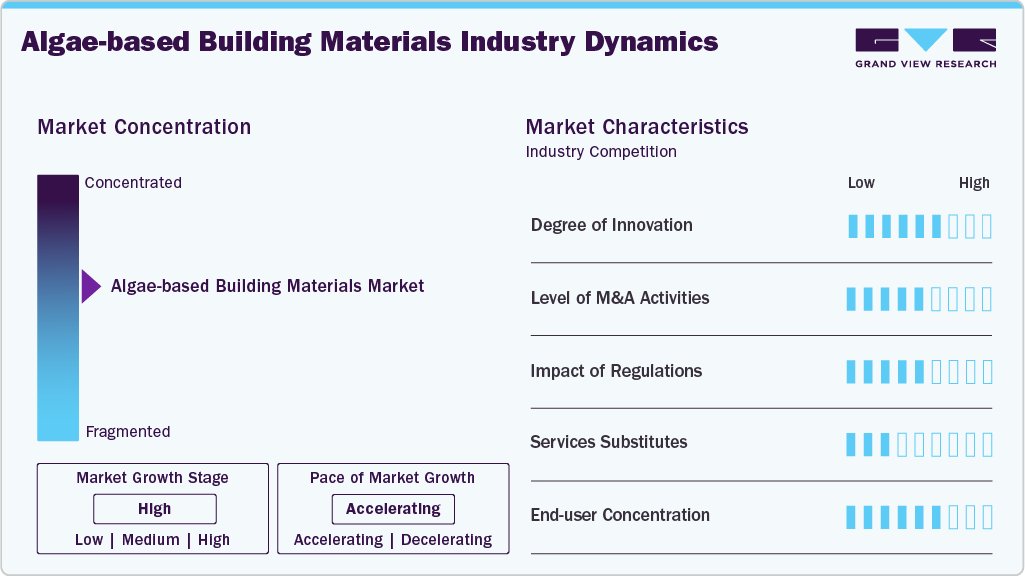
The industry demonstrates a moderate level of concentration, characterized by a small but growing number of innovative firms specializing in bio-based construction solutions. The degree of innovation is notably high, as companies invest heavily in developing new composite formulations, improving algae cultivation systems, and enhancing product durability and scalability. Collaborative research between biotechnology enterprises, material scientists, and architectural firms is a defining feature of this market, fostering continuous technological progress. While mergers and partnerships are increasing as firms seek to integrate expertise and expand production capacity, overall consolidation remains limited due to the industry’s emerging nature. This dynamic environment encourages experimentation and specialization, allowing new entrants with strong research capabilities to influence market direction.
 To learn more about this report, Download Free Sample Report
 Regulatory frameworks and sustainability policies exert a strong influence on market performance, reinforcing algae-based materials as viable eco-friendly alternatives to traditional construction resources. Governments’ emphasis on reducing carbon emissions, promoting circular economies, and implementing green building codes continues to accelerate adoption. However, competition from other renewable substitutes-such as mycelium bricks, hemp-based composites, and recycled polymers-poses a moderate challenge to market penetration.
End-user concentration remains centered around environmentally conscious developers, academic institutions, and public-sector projects prioritizing low-impact construction. As awareness and policy incentives expand, adoption is expected to broaden, with algae-based materials gradually transitioning from niche applications to mainstream sustainable building solutions.
Product Insights
Based on product, the algae-based concrete additives segment led the market with the largest revenue share of 30.2% in 2025 and is expected to grow at a CAGR of 15.1% over the forecast period, driven by growing demand for low-carbon construction solutions as developers and governments move toward climate-aligned materials. These additives enhance concrete durability, reduce reliance on traditional cement, and support improved binding performance, which strengthens adoption across green projects. Increasing R&D investments focused on bio-mineralization processes are accelerating commercialization and performance validation. The segment further benefits from expanding regulatory pressure to reduce embodied carbon and support bio-based admixture alternatives.
The algae-based bioplastics & composites segment is expected to grow at the fastest CAGR of 16.3% over the forecast period, driven by rising preference for renewable, biodegradable materials in structural and non-structural building components. Demand accelerates as manufacturers seek alternatives to petroleum-based plastics for panels, insulation, interior features, and façade systems. The segment also benefits from increasing concerns over plastic waste and microplastics, encouraging the adoption of algae-derived polymers that degrade more favorably. Technological advancements in biomass processing, polymer extraction, and algae cultivation efficiency are improving cost profiles and commercial viability.
End Use Insights
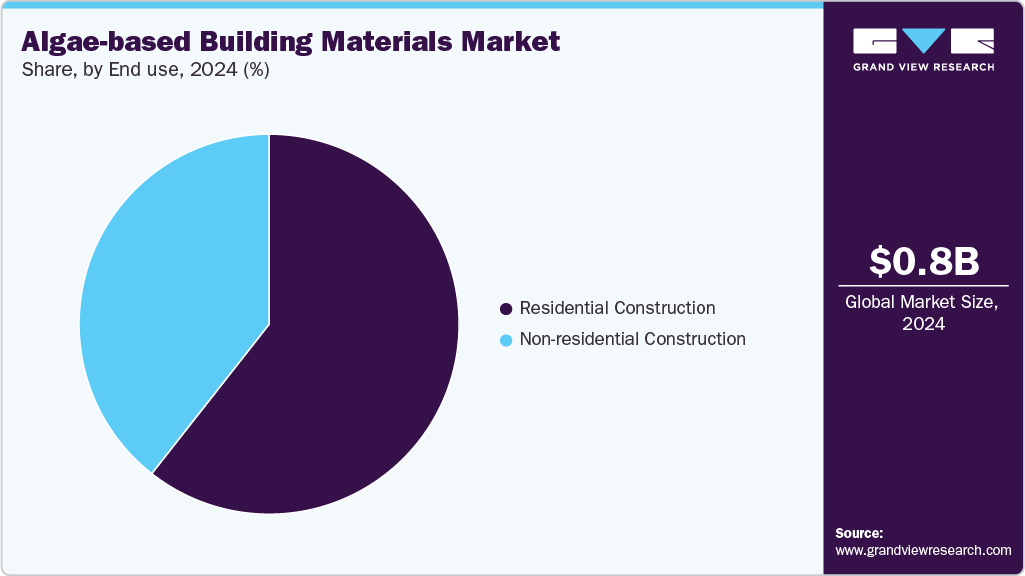
Based on end use, the residential construction segment led the market with the largest revenue share of 60.5% in 2025 and is expected to grow at a CAGR of 8.9% over the forecast period, driven by heightened consumer preference for environmentally responsible materials that lower household carbon footprints. Developers are integrating algae-based building materials into homes to meet rising expectations for energy-efficient, non-toxic, and sustainable living environments. Increasing urbanization has amplified demand for innovative lightweight materials that offer functional performance while reducing overall resource consumption. The segment is further supported by expanding green building certification programs that reward bio-based material usage, encouraging adoption among builders.
 To learn more about this report, Download Free Sample Report
 The non-residential construction segment is expected to grow at the fastest CAGR of 16.0% over the forecast period, driven by large-scale projects seeking to comply with stringent sustainability benchmarks and carbon-neutrality commitments. Commercial developers, public infrastructure authorities, and industrial operators are increasingly adopting algae-based materials to improve ESG performance. The need to reduce embodied emissions in offices, institutional buildings, retail complexes, and industrial facilities is accelerating demand for bio-derived alternatives. Advances in algae-based composites, concrete additives, and insulation materials are enabling technical performance that meets commercial construction standards.
Regional Insights
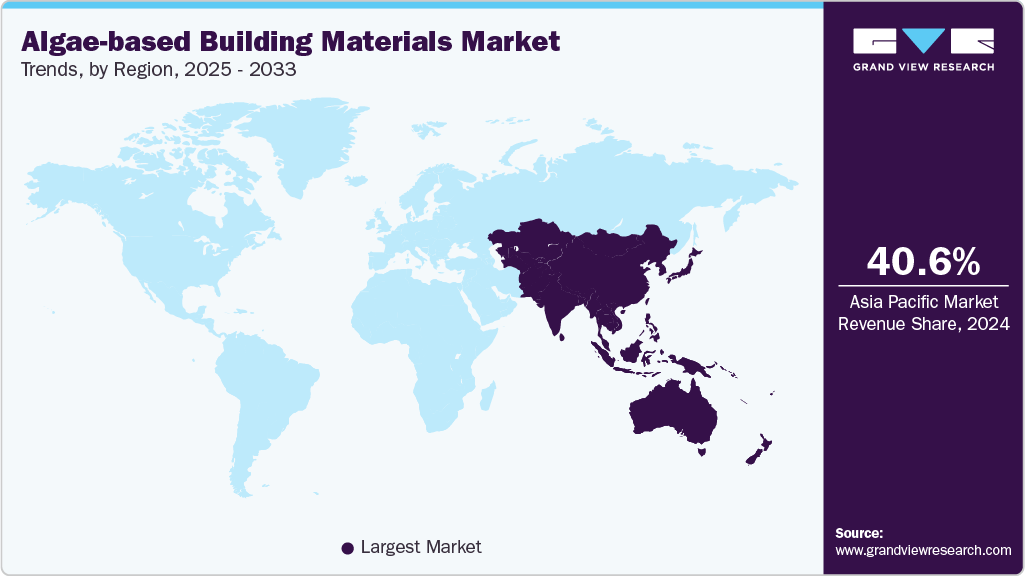
Asia Pacific dominated the algae-based building materials market with the largest revenue share of 40.8% in 2025, driven by rapid urbanization and an urgent need for sustainable infrastructure. Population growth and increasing environmental degradation have compelled governments to adopt eco-friendly construction policies. Countries like Japan, South Korea, and India are investing in bio-based technologies to reduce dependence on resource-intensive materials. Rising awareness of energy-efficient construction and green certification programs supports market expansion. Moreover, advancements in algae cultivation and local production capabilities help lower costs. This combination of economic growth and sustainability focus drives strong regional demand.
 To learn more about this report, Download Free Sample Report
 China’s market growth is mainly influenced by government mandates for green construction and carbon reduction. The nation’s “dual carbon” goals-peaking emissions before 2030 and achieving neutrality by 2060-create opportunities for algae-based materials. Research partnerships between universities and construction firms are fostering innovations in algae biocomposites and architectural panels. Urban expansion and the push for eco-cities further encourage large-scale adoption. Public investments in renewable technology development strengthen supply chains and production capacity. As sustainability becomes integral to national policy, algae-based materials are gaining traction in China’s construction ecosystem.
China Algae-based Building Materials Market Trends
The algae-based building materials market in China held the largest share in the Asia Pacific region in 2025.
North America Algae-based Building Materials Market Trends
The algae-based building materials market in North America is primarily driven by strong sustainability initiatives and robust green building standards. The United States and Canada have seen significant growth in eco-construction due to policies promoting carbon-neutral infrastructure. Advanced research institutions and startups are investing heavily in bio-based materials, including algae composites, insulation, and façade systems. Demand is further strengthened by LEED-certified projects and corporate commitments to net-zero emissions. Additionally, financial incentives for renewable materials encourage the adoption of innovative building solutions. This policy-backed ecosystem positions North America as a leading hub for sustainable material innovation.
U.S. Algae-based Building Materials Market Trends
The algae-based building materials market in the U.S. benefits from high technological capability, supportive environmental regulations, and strong private-sector investment. Federal and state-level programs incentivize green materials through tax credits and research funding. The growing number of sustainable urban development projects is expanding the use of algae-derived products in both residential and commercial sectors. Universities and startups collaborate to enhance algae cultivation efficiency and product performance. Rising public awareness of climate change and carbon emissions further boosts market interest. Together, these factors make the U.S. a pioneer in commercializing algae-based construction solutions.
Europe Algae-based Building Materials Market Trends
Europe leads globally in environmental policy and circular economy initiatives, which directly support algae-based material adoption. The European Green Deal and carbon-neutrality goals promote investment in renewable construction technologies. Strong R&D funding and cross-border collaborations enhance innovation and scalability. Countries across the region prioritize sustainable architecture and low-emission building design. Consumer preference for environmentally responsible materials further boosts market momentum. As sustainability becomes a competitive advantage, Europe remains a vital growth center for algae-based construction solutions.
Germany’s algae-based building materials market is driven by advanced engineering expertise and stringent environmental standards. The country’s strong research infrastructure facilitates the development of high-performance bio-composites and insulation materials. Government programs encouraging renewable innovation align well with the EU’s carbon reduction directives. Architects and developers increasingly integrate algae-based panels in energy-efficient buildings and green façades. Growing emphasis on life-cycle sustainability enhances demand across residential and commercial sectors. With robust industry-academia collaboration, Germany continues to shape the technical standards for this emerging market.
Central & South America Algae-based Building Materials Market Trends
In Central & South America, the key market driver is the region’s growing focus on sustainable urban development and climate adaptation. Countries such as Brazil, Chile, and Mexico are adopting green infrastructure strategies to combat deforestation and urban pollution. The abundance of natural resources supports cost-effective algae cultivation for bio-based construction materials. Rising investment in renewable industries and public-sector sustainability programs is fostering local production capabilities. Additionally, tourism-driven economies are encouraging eco-friendly architecture to align with global environmental standards. This convergence of ecological awareness and innovation underpins market growth in Central & South America.
Middle East & Africa Algae-based Building Materials Market Trends
The algae-based building materials market in the Middle East and Africa is motivated by sustainability initiatives aimed at reducing carbon footprints in arid environments. Governments are investing in renewable technologies to diversify economies and meet energy efficiency targets. The harsh climatic conditions drive demand for materials offering superior insulation and environmental performance. Pilot projects in sustainable urban planning, especially in the Gulf region, demonstrate growing interest in bio-based construction. Partnerships with global research institutions are helping develop scalable algae cultivation systems. These efforts collectively position the region for the gradual adoption of algae-based materials in modern construction.
Key Algae-based Building Materials Companies Insights
Key players operating in the algae-based building materials market are undertaking various initiatives to strengthen their presence and increase the reach of their products and services. Strategies such as expansion activities and partnerships are key in propelling the market growth. Some of the key players operating in market include Corbion N.V. and BASF SE.
-
Corbion N.V. is a Netherlands‑based company and has a strong focus on bioplastics and renewable polymers and is exploring algae‑derived feedstocks to enhance sustainability in its product lines.
-
BASF SE, a major global chemical company headquartered in Germany, is advancing research into bio‑based materials including algae‑derived polymers and composites for construction and other industrial uses.
Algix LLC, Ocean Grows Limited are some of the emerging market participants in Algae-based Building Materials market.
-
Algix LLC based in the United States is known for its proprietary algae foam and bio‑material technologies; while often associated with consumer goods, its capabilities extend toward construction‑adjacent sustainable materials.
-
Ocean Grows Limited is a Hong Kong/Asia‑Pacific based enterprise developing algae‑infused construction blocks (Ocean Brick) and modular building materials that incorporate algae extract for improved insulation/strength and lower carbon footprint.
Key Algae-based Building Materials Companies:
The following are the leading companies in the algae-based building materials market. These companies collectively hold the largest market share and dictate industry trends.
- Corbion N.V.
- BASF SE
- Evonik Industries AG
- Algix LLC
- Prometheus Materials
- Flora Materials
- Ocean Grows Limited
- Algenesis Materials
- AlgaEnergy S.A.
Competitive Benchmarking
Category
Operating Strategies
Competitive Edge
Weakness
Established Players (Corbion N.V., BASF SE, Evonik Industries AG, AlgaEnergy S.A.)
- Invest heavily in R&D to develop scalable algae-based construction materials with improved mechanical strength, durability, and carbon sequestration capabilities.
- Establish strategic partnerships with construction companies, research institutions, and green building developers to accelerate commercialization and market adoption.
- Leverage existing biotechnology, specialty chemicals, and biomaterials manufacturing infrastructure to achieve production efficiencies and global market reach.
- Strong financial resources and advanced research capabilities enable continuous innovation and product portfolio expansion.
- Established global distribution networks and industry relationships facilitate faster penetration into residential and commercial construction markets.
- Extensive regulatory expertise and product certification capabilities support compliance with evolving green building and sustainability standards.
- Large-scale organizational structures can slow innovation cycles and delay commercialization of emerging algae-based technologies.
- Significant investments may still be required to adapt existing production facilities for specialized algae-based construction material manufacturing.
- Dependence on broader corporate sustainability priorities may limit dedicated focus on niche algae-based building material segments.
Emerging Players (Algix LLC, Prometheus Materials, Flora Materials, Ocean Grows Limited)
- Focus on developing breakthrough algae-derived building materials that offer carbon-negative properties and superior environmental performance.
- Collaborate with universities, climate-tech investors, and sustainable construction startups to accelerate technology development and pilot projects.
- Target high-growth green building and sustainable infrastructure segments where innovative materials can command premium pricing and early adoption.
- Strong specialization in algae cultivation, biomineralization, and bio-based material technologies enables rapid innovation.
- Agile business models allow faster product development, testing, and commercialization compared to larger industry participants.
- Ability to position products around carbon reduction, circular economy principles, and net-zero construction objectives attracts environmentally focused customers and investors.
- Limited production capacity and manufacturing scale may restrict the ability to serve large commercial construction projects.
- Higher operating costs and dependence on external funding can create commercialization and scalability challenges.
- Lower brand recognition and limited distribution networks may slow market acceptance compared to established construction material suppliers.
Recent Developments
-
In November 2024, Flora Materials advanced its algae-based flooring tiles under the U.S. Army SBIR Program, securing a Phase II award of approximately USD 1.9 million. The initiative focuses on replacing petroleum-derived flooring with low-carbon algae-based composites. This development highlights the growing role of algae-based materials in sustainable construction.
Global Algae-based Building Materials Market Report Scope
Report Attribute
Details
Market size in 2025
USD 880.1 million
Estimated market size in 2026
USD 1,017.8 million
Projected market size by 2033
USD 2,816.3 million
Growth rate
CAGR of 15.7% from 2026 to 2033
Base year for estimation
2025
Historical data
2021 - 2024
Forecast period
2026 - 2033
Quantitative units
Revenue in USD million/billion and CAGR from 2026 to 2033
Report coverage
Revenue forecast, company ranking, competitive landscape, growth factors, and trends
Segments covered
Product, end use, region
Regional scope
North America; Europe; Asia Pacific; Central & South America; Middle East & Africa
Country scope
U.S.; Canada; Mexico; UK; Germany; France; Italy; Spain; China; India; Japan
Key companies profiled
Corbion N.V.; BASF SE; Evonik Industries AG; Algix LLC; Prometheus Materials; Flora Materials; Ocean Grows Limited; Algenesis Materials; AlgaEnergy S.A.
Customization scope
Free report customization (equivalent up to 8 analysts' working days) with purchase. Addition or alteration to country, regional & segment scope.
Pricing and purchase options
Avail customized purchase options to meet your exact research needs. Explore purchase options
Global Algae-based Building Materials Market Report Segmentation
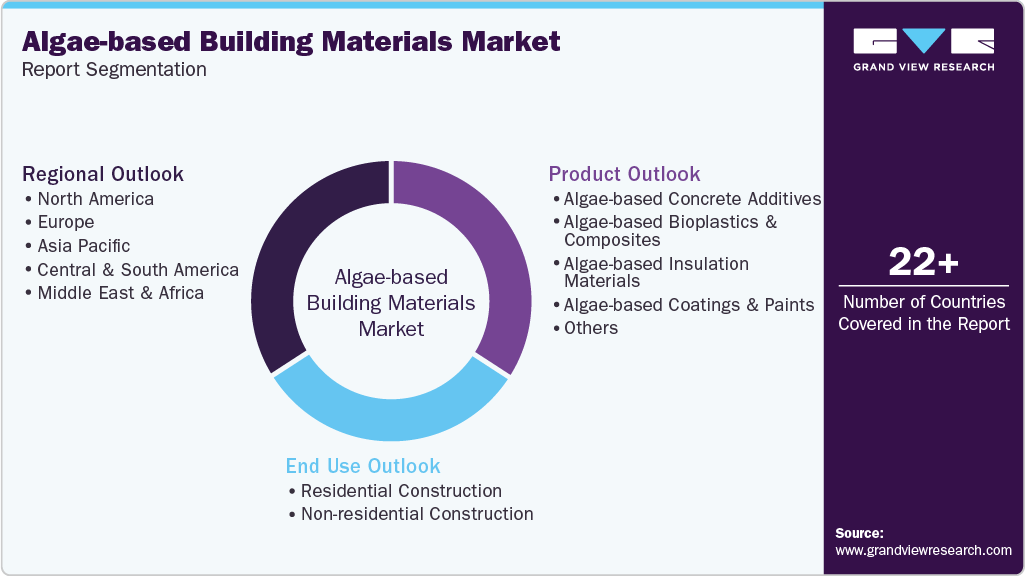
This report forecasts revenue growth at global, regional, and country levels and provides an analysis of the latest industry trends in each of the sub-segments from 2021 to 2033. For this study, Grand View Research has segmented the global algae-based building materials market report based on product, end use, and region:
 To learn more about this report, Download Free Sample Report
 -
Product Outlook (Revenue, USD Million, 2021 - 2033)
-
Algae-based Concrete Additives
-
Algae-based Bioplastics & Composites
-
Algae-based Insulation Materials
-
Algae-based Coatings & Paints
-
Others
-
-
End Use Outlook (Revenue, USD Million, 2021 - 2033)
-
Residential Construction
-
Non-residential Construction
-
-
Regional Outlook (Revenue, USD Million, 2021 - 2033)
-
North America
-
U.S.
-
Canada
-
Mexico
-
-
Europe
-
Germany
-
UK
-
France
-
Italy
-
Spain
-
-
Asia Pacific
-
China
-
Japan
-
India
-
-
Central & South America
-
Middle East & Africa
-
Research Methodology
The algae-based building materials market figures in this report are based on a proven research process that combines executive interviews with secondary research from proprietary databases, company filings, and recognized regulatory and institutional sources. Market size is built through value-chain sizing - reconciling supply-side and demand-side estimates - and triangulated with bottom-up and top-down approaches. Every estimate passes multiple levels of expert validation before publication, with each algae-based building materials segment quantified using the revenue-capture definitions in the table below.
Segment Definition
Segment - Product
Revenue capture definition
Algae-based Concrete Additives
Revenue generated from algae-based concrete additives incorporated into cement, concrete, and construction material formulations. This segment captures revenues from manufacturers and suppliers utilizing algae-derived additives, bio-mineralization agents, and carbon-sequestering compounds to enhance concrete performance, reduce carbon emissions, improve durability, and support sustainable construction practices across residential, commercial, and infrastructure projects.
Algae-based Bioplastics & Composites
Revenue generated from algae-based bioplastics and composite materials used in construction applications. This segment captures revenues from manufacturers and suppliers producing algae-derived polymers, bio-composites, structural panels, façade components, interior building products, and lightweight construction materials where sustainability, reduced environmental impact, durability, and circular economy benefits are essential.
Algae-based Insulation Materials
Revenue generated from algae-based insulation materials utilized in building envelopes and energy-efficient construction systems. This segment captures revenues from manufacturers and suppliers offering algae-derived thermal and acoustic insulation products used in walls, roofs, floors, and building assemblies where energy efficiency, indoor comfort, moisture management, environmental sustainability, and reduced carbon footprints are critical.
Algae-based Coatings & Paints
Revenue generated from algae-based coatings and paints applied across residential, commercial, and industrial building structures. This segment captures revenues from manufacturers and suppliers developing algae-derived coating formulations that provide protective, decorative, antimicrobial, and environmentally friendly properties while reducing dependence on petroleum-based ingredients and supporting sustainable building standards.
Others
Revenue generated from other algae-based building material applications not included in the above categories. This segment captures revenues from manufacturers and suppliers offering innovative algae-derived construction products such as bio-bricks, façade systems, carbon-capturing building components, bio-cement materials, decorative architectural elements, and emerging sustainable construction solutions.
Segment - End Use
Revenue capture definition
Residential Construction
Revenue generated from algae-based building materials utilized in residential construction projects. This segment captures revenues from manufacturers and suppliers providing algae-based concrete additives, insulation materials, coatings, composites, and other sustainable construction products used in single-family homes, multi-family housing developments, apartments, condominiums, and residential renovation projects where energy efficiency, environmental sustainability, and reduced lifecycle emissions are key priorities.
Non-residential Construction
Revenue generated from algae-based building materials utilized in non-residential construction projects. This segment captures revenues from manufacturers and suppliers serving commercial buildings, offices, educational institutions, healthcare facilities, hospitality establishments, industrial facilities, government infrastructure, and public buildings where sustainable construction practices, green building certifications, carbon reduction targets, and long-term operational efficiency are essential.
Estimation Model
Layer Name
Key Question
Description
Global Green Building Materials Market
What is the total market size for sustainable and environmentally friendly construction materials globally?
This layer represents the broader market for green building materials used across residential, commercial, and infrastructure projects. It includes low-carbon concrete, recycled materials, bio-based materials, sustainable insulation, green coatings, and other environmentally responsible construction products that support energy efficiency and carbon reduction objectives.
Bio-based Construction Materials Market
What portion of green building materials consists of bio-based and renewable construction products?
This layer narrows the focus to construction materials derived from renewable biological resources, including wood composites, hempcrete, mycelium-based materials, natural fiber composites, bio-based insulation products, algae-derived materials, and other sustainable alternatives designed to reduce dependence on fossil fuel-based construction inputs.
Algae-based Construction Materials Market
What share of bio-based construction materials is represented by algae-derived building products?
This layer focuses specifically on construction materials manufactured using algae biomass, algae-derived polymers, bio-mineralization technologies, and carbon-sequestering algae formulations. It includes algae-based concrete additives, insulation materials, bioplastics, composites, coatings, paints, and other innovative building solutions designed to enhance sustainability and reduce lifecycle carbon emissions.
Algae-based Building Materials Market
What is the market value of algae-based materials specifically commercialized for building and construction applications?
This final layer represents revenues generated from algae-based building materials sold for residential, non-residential, and infrastructure construction projects. The market includes commercial applications of algae-based concrete additives, bioplastics & composites, insulation materials, coatings & paints, and other emerging algae-derived construction products that contribute to green building and carbon-negative construction initiatives.
Delivered Customizations
This report has been delivered with the following In-depth customizations
CLIENT REQUEST
CUSTOMIZATION DELIVERED
VALUE ADDS
Product Opportunity Assessment
Detailed analysis of algae-based concrete additives, bioplastics & composites, insulation materials, coatings & paints, and other emerging product categories
Identified the highest-growth and most commercially viable product segments for strategic investment and expansion
Competitive Landscape & Innovation Mapping
Benchmarking of established material suppliers and emerging algae-based technology developers based on innovation, commercialization, and strategic positioning
Provided actionable competitive intelligence to support strategic planning, partnership evaluation, acquisition screening, and differentiation initiatives.
Regulatory & Green Building Compliance Assessment
In-depth analysis of green building certification frameworks such as LEED, BREEAM, IGBC, Living Building Challenge, and net-zero building standards. The study also evaluated carbon reduction regulations, sustainable procurement policies, environmental product declaration (EPD) requirements, embodied carbon guidelines, and government incentives supporting low-carbon construction materials across key regions.
Helped clients align product development and commercialization strategies with evolving sustainability regulations, improve certification readiness, identify compliance-driven growth opportunities, and enhance market acceptance among architects, developers, and construction firms seeking environmentally responsible building solutions.
Frequently Asked Questions About This Report
The global algae-based building materials market size was valued at USD 880.1 million in 2025 and is estimated at USD 1,017.8 million for 2026.
The global algae-based building materials market is expected to grow at a CAGR of 15.7% from 2026 to 2033, reaching USD 2,816.3 million by 2033.
Some of key players in the algae-based building materials market are Corbion N.V., BASF SE, Evonik Industries AG, Algix LLC, Prometheus Materials, Flora Materials, Ocean Grows Limited, Algenesis Materials, AlgaEnergy S.A.
The key factors driving the algae-based building materials market include rising demand for low-carbon construction solutions, advancements in algae cultivation and bio-processing technologies, increasing regulatory support for sustainable materials, growing emphasis on circular and renewable resources, and expanding adoption of bio-based alternatives across residential and commercial projects.
China held the largest revenue share of 38.7% in 2025 in the algae-based building materials market.
Algae-based concrete additives segment led the algae-based building materials market with a 30.2% revenue share in 2025.
Asia Pacific dominated the algae-based building materials market with a 40.76% revenue share in 2025.
Asia Pacific is the fastest-growing region in the algae-based building materials market with a CAGR of 16.1% over the forecast period.
Residential construction segment dominated the market and accounted for the largest revenue share of 60.5% in 2025, driven by heightened consumer preference for environmentally responsible materials that lower household carbon footprints.
About the Author(s)
Advanced Interior Materials Research Team
Advanced Materials · Advanced Interior MaterialsThis report was authored by the advanced interior materials research team at Grand View Research - comprising two research analysts, one senior research analyst, and one industry expert - with specialized expertise in the advanced interior materials segment of the advanced materials industry. All findings are based on proprietary advanced materials databases, executive interviews, and regulatory analysis, subject to internal peer review prior to publication.
Last Updated:
Speak to Analyst

Customize this report to your needs - add regions, segments, or data points, with 20% free customization.
Or view our licence options:


ISO 9001:2015 & 27001:2022 Certified
We are GDPR and CCPA compliant! Your transaction & personal information is safe and secure. For more details, please read our privacy policy.


