
- Home
- »
- Plastics, Polymers & Resins
- »
-
Aluminum Beverage Cans Market Size Report, 2026-2033GVR Report cover

Aluminum Beverage Cans Market (2026 - 2033)
Size, Share & Trends Analysis Report By Can Capacity (Below 330 mL, 330-500 mL, Above 500 mL), By Beverage (Carbonated Soft Drinks (CSDs), Water & Functional Water, Juices & Fruit-Based Beverages), By Region, And Segment Forecasts
Market Size, 2025
$43.8BMarket Estimate, 2026
$46.2BMarket Forecast, 2033
$65.7BCAGR, 2026–2033
5.2%Aluminum Beverage Cans Market Summary
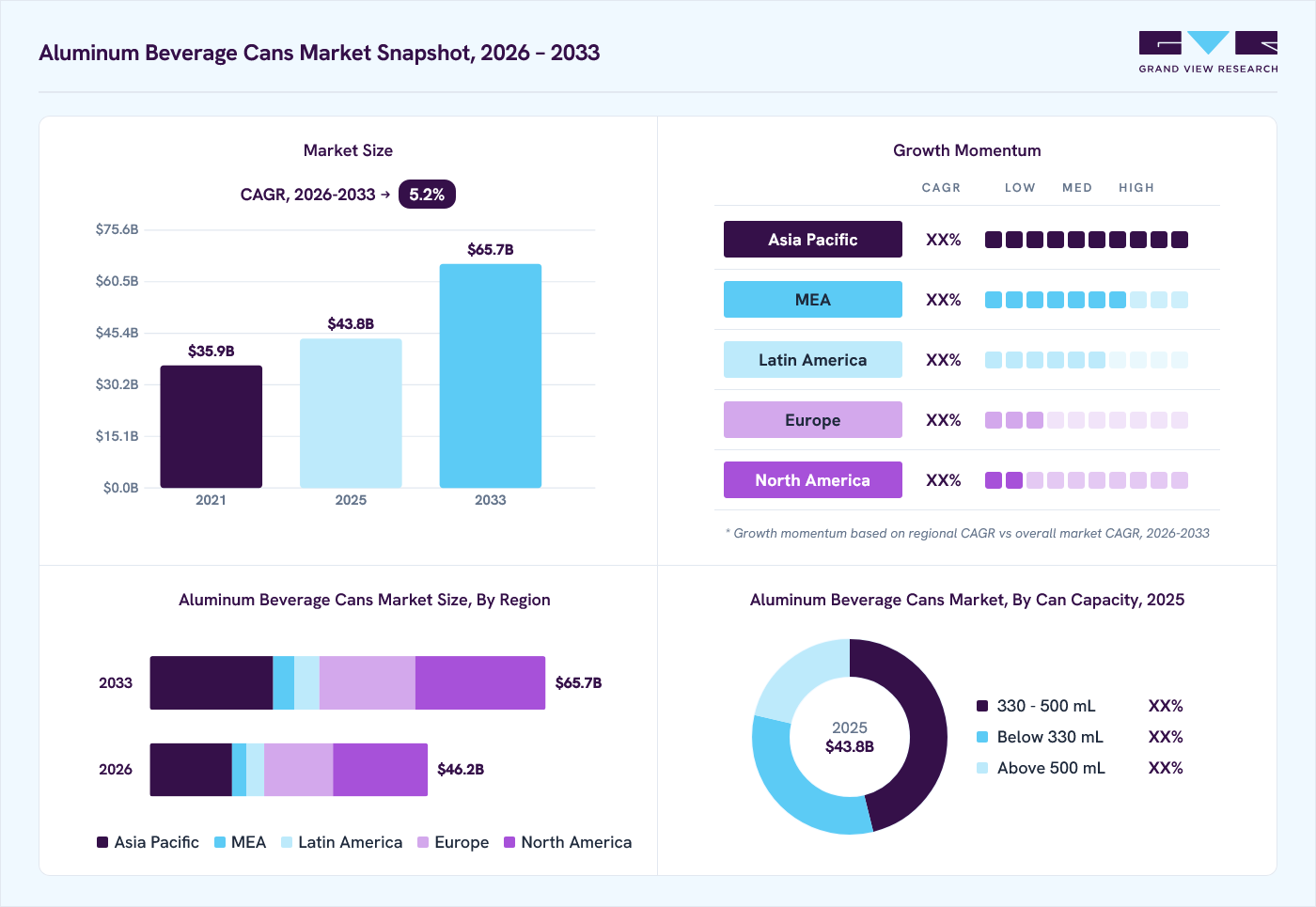
The global aluminum beverage cans market size was valued at USD 43.8 billion in 2025 and is projected to grow from USD 46.2 billion in 2026 to USD 65.7 billion by 2033, at a CAGR of 5.2% from 2026 to 2033. North America dominated the market, accounting for a revenue share of 34.3% in 2025. Market growth is driven by rising demand for carbonated drinks, beer, energy drinks, and ready-to-drink beverages, along with lightweight, durable, recyclable, and convenient nature of the aluminum cans.
 Source: Grand View Research, IR Documents, Primary Interviews, Paid DatabasesTo learn more about this report,
 Download Free Sample Report
Key Market Trends & Insights
- By can capacity: 330-500 mL segment accounted for the largest revenue share of 46.1% in 2025.
- By beverage: Carbonated Soft Drinks (CSDs) segment dominated the market with a 50.0% revenue share in 2025.
Regional Highlights:
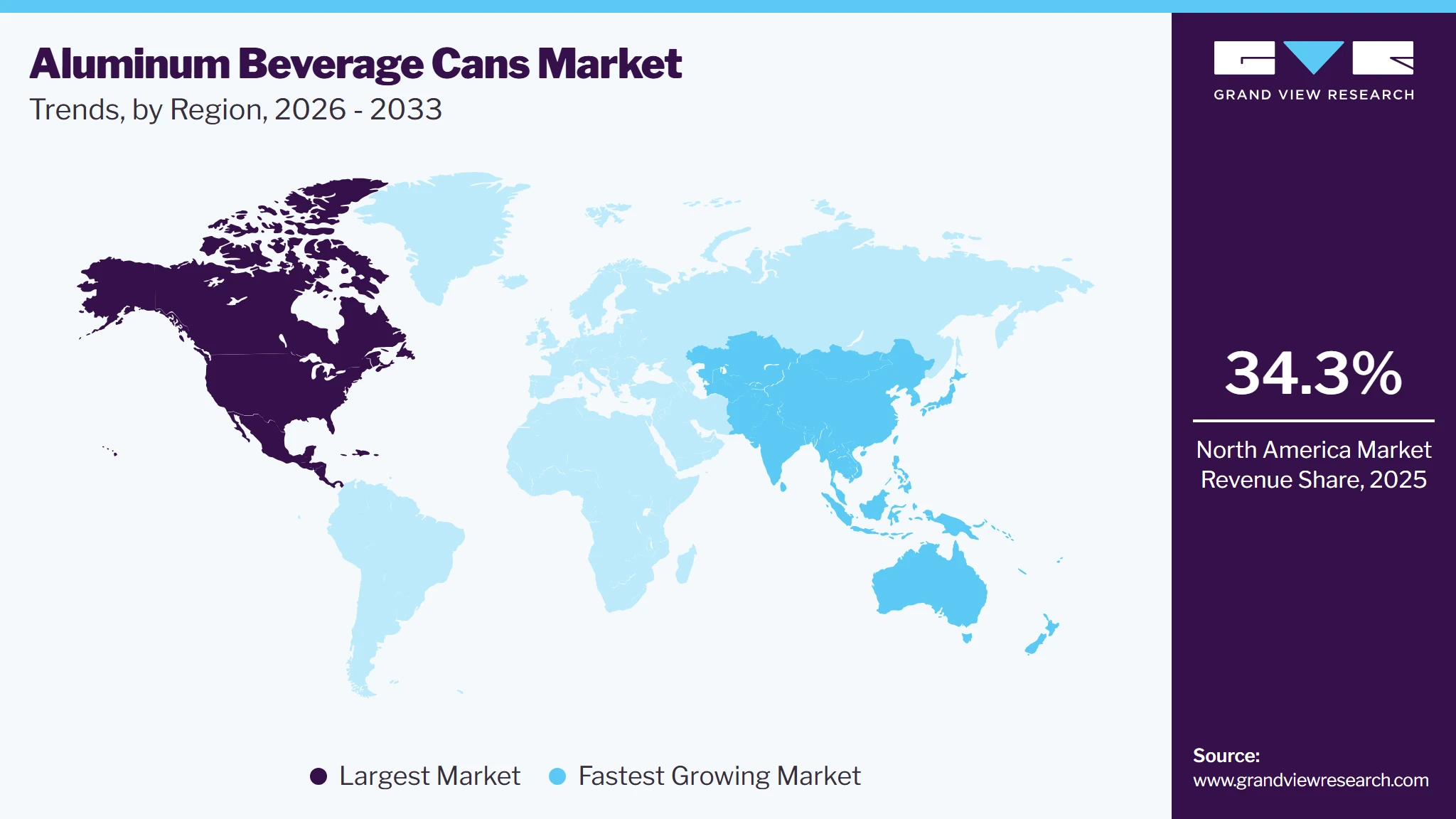
- Largest regional market: North America (34.3% revenue share, 2025)
- Fastest-growing regional market: Asia Pacific (highest CAGR, 2026-2033)
- By country: The U.S. held the largest market share in 2025.
Market Size & Forecast
- Market size in 2025: USD 43.8 Billion
- Estimated market size in 2026: USD 46.2 Billion
- Projected Market Size by 2033: USD 65.7 Billion
- CAGR (2026-2033): 5.2%
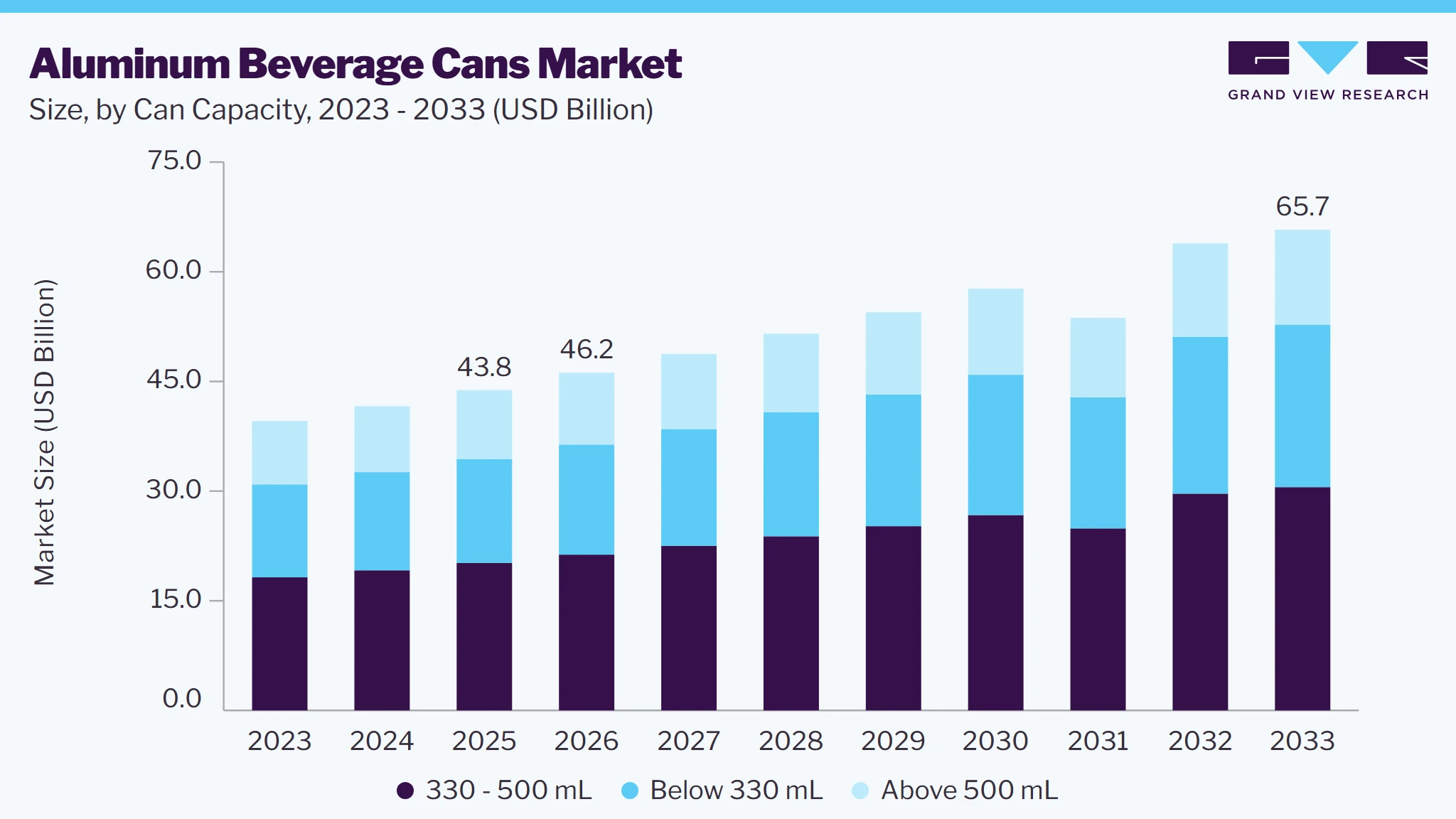
Prism AI by Grand View Research Free to tryAsk a question about the aluminum beverage cans market✓Every figure cited from GVR research Prefer the report? Download free sample →Growing sustainability initiatives, urbanization, and expansion of beverage production and organized retail are further supporting market adoption. Asia Pacific is expected to be the fastest-growing region, with a 6.0% CAGR during the forecast period. The aluminum beverage cans industry is driven by the growing consumption of packaged beverages, including carbonated soft drinks, beer, energy drinks, and ready-to-drink beverages. As beverage manufacturers increasingly focus on convenient, portable, and cost-efficient packaging formats, there is growing demand for aluminum cans across different capacity ranges. The 330-500 mL cans represent the largest capacity segment, supported by their suitability for single-serving beverages and widespread adoption across retail, convenience stores, foodservice, and vending channels. The expansion of organized retail, urbanization, and on-the-go consumption is further accelerating demand for standardized aluminum beverage cans.
 To learn more about this report, Download Free Sample Report
An increasing focus on consumer convenience, portion control, and product portability is expected to support market growth in the coming years. Smaller aluminum cans, particularly those below 300 mL, are gaining adoption as beverage companies respond to changing consumer preferences for controlled serving sizes and premium product formats. At the same time, cans above 500 mL continue to serve consumers seeking larger-volume beverage options, particularly in beer, soft drinks, and functional beverage categories. Improvements in can design, lightweighting, printing, and filling technologies are further enabling manufacturers to offer diverse can capacities while maintaining packaging efficiency.
Sustainability initiatives and the transition toward circular packaging systems are also significantly contributing to the growth of the aluminum beverage cans industry. Aluminum's high recyclability and ability to be repeatedly recycled without significant loss of material quality make it an attractive packaging material as beverage manufacturers seek to reduce packaging waste and improve environmental performance. Increasing investments in aluminum recycling infrastructure, recycled-content cans, and lightweight can technologies are encouraging the adoption of aluminum beverage packaging across capacity formats. These developments are expected to strengthen the availability of recycled aluminum and support the long-term expansion of sustainable beverage can production.
Market Dynamics
The aluminum beverage cans industry is witnessing steady growth, driven by rising consumption of packaged beverages, increasing demand for convenient and portable packaging, and the growing preference for recyclable beverage containers. Manufacturers are focusing on lightweight can designs, improved recyclability, and efficient production technologies to meet evolving consumer preferences and sustainability requirements. In addition, expanding beverage production, urbanization, organized retail, and the rising popularity of ready-to-drink beverages are supporting market expansion, while fluctuating aluminum prices and competition from alternative packaging formats remain key challenges.
The increasing consumption of carbonated soft drinks, beer, energy drinks, sports drinks, and ready-to-drink beverages is a key driver of the market. Changing lifestyles, urbanization, on-the-go consumption, and the growing availability of packaged beverages through supermarkets, convenience stores, foodservice outlets, and vending channels are increasing demand for convenient single-serve and multi-serve packaging formats.
Aluminum cans offer lightweight construction, durability, portability, and effective protection against light and oxygen, making them suitable for a wide range of beverages. The strong adoption of 330-500 mL cans, which accounted for the largest market share in 2025, further reflects demand for convenient serving sizes. Beverage manufacturers are also investing in innovative can designs, lightweighting technologies, and high-quality printing to improve brand visibility and optimize packaging and transportation costs.
A significant restraint for the market is the volatility in aluminum prices and the associated impact on manufacturing costs. Aluminum production is influenced by energy costs, raw material availability, trade policies, and fluctuations in global commodity markets. Rising input costs can increase the cost of can manufacturing and place pressure on profit margins for both can producers and beverage companies.
In addition, aluminum cans face competition from PET bottles, glass bottles, and cartons, particularly in beverage categories where manufacturers prioritize low packaging costs or specific product characteristics. These factors may limit the adoption of aluminum cans in price-sensitive markets and encourage manufacturers to focus on lightweighting and production efficiency.
A major opportunity for the market lies in the increasing adoption of recyclable and lightweight packaging solutions. Aluminum can be recycled repeatedly while retaining its material properties, making it an attractive packaging format as beverage companies and consumers place greater emphasis on circular economy initiatives and packaging sustainability.
Manufacturers are increasingly developing lightweight cans, increasing recycled aluminum content, and improving recycling processes to reduce material consumption and environmental impact. Growing demand for sustainable packaging, combined with the expansion of energy drinks, RTD beverages, functional beverages, and premium packaged drinks, is expected to create significant opportunities for aluminum can manufacturers across global markets.
Market Concentration & Characteristics
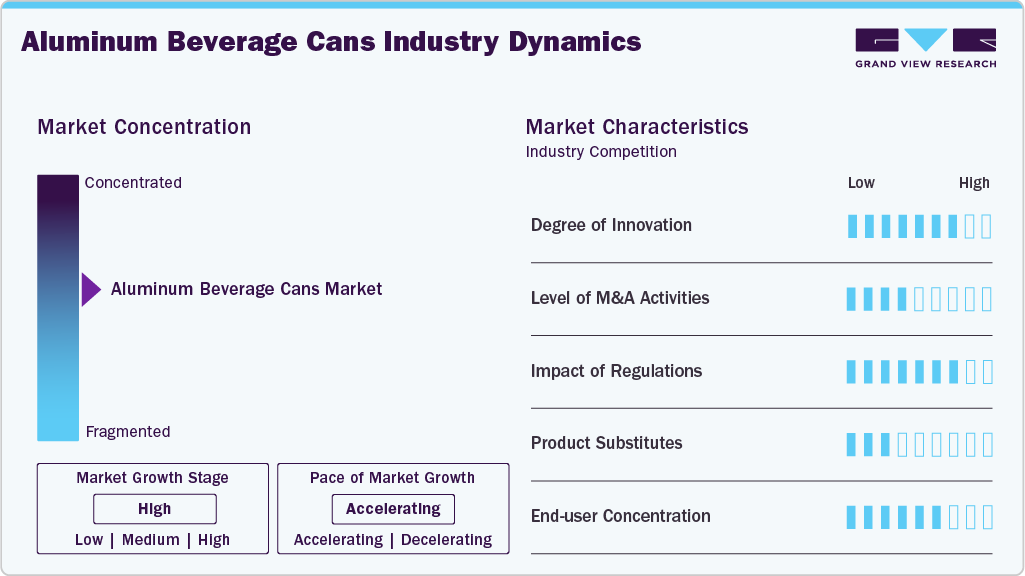
The aluminum beverage cans industry is characterized by high-volume production, standardized manufacturing processes, and strong dependence on economies of scale. The industry relies heavily on automated can forming, printing, coating, and filling technologies to achieve cost efficiency and consistent product quality. Manufacturers prioritize lightweighting, production efficiency, and bulk procurement of aluminum sheets and other raw materials to control operating costs. As aluminum cans are widely used for high-volume beverages such as carbonated soft drinks, beer, and energy drinks, packaging designs emphasize durability, portability, stackability, and efficient transportation. Leading players such as Ball Corporation, Crown Holdings, Ardagh Group, and Silgan Holdings have optimized their operations around large-scale production capabilities, advanced manufacturing technologies, and extensive geographic distribution networks.
 To learn more about this report, Download Free Sample Report
A defining feature of the industry is its reliance on aluminum as a lightweight, durable, and highly recyclable packaging material. Increasing sustainability concerns and circular economy initiatives are encouraging manufacturers to increase recycled aluminum content, develop lightweight can designs, and improve collection and recycling systems. Advancements in can printing, shaping, coatings, and digital decoration are also enabling beverage companies to differentiate products and strengthen brand visibility. Regulatory initiatives promoting recyclable packaging and reductions in packaging waste are further influencing material sourcing, production processes, and investment decisions across the aluminum beverage cans industry.
Analyst Perspective
The global market for aluminum beverage cans has evolved from traditional use in beer and carbonated soft drinks toward a versatile packaging solution for energy drinks, sports drinks, RTD beverages, functional water, and other emerging beverage categories. Adoption has expanded due to aluminum’s lightweight, durability, portability, recyclability, and strong product protection, changing consumer preferences and growing demand for convenient beverage formats. The market is expected to witness steady growth, driven by rising packaged beverage consumption, premiumization, increasing demand for single-serve formats, lightweight can innovations, and use of recycled aluminum. Sustainability, recycling infrastructure, and advanced manufacturing technologies are expected to shape future product development and market expansion.
Can Capacity Insights
Based on can capacity, the 330-500 mL segment led the market with the largest revenue share of 46.1% in 2025. This capacity range is widely preferred for carbonated soft drinks, beer, energy drinks, and ready-to-drink beverages due to its suitability for single-serving consumption, portability, and convenient storage and transportation. Its broad adoption across retail, convenience stores, foodservice, and vending channels supports its dominant position. The segment is also expected to expand at a CAGR of 5.3% during the forecast period.
The below 330 mL segment is expected to grow at the fastest CAGR of 5.7% during the forecast period. Smaller aluminum cans are gaining traction as beverage manufacturers increasingly respond to demand for portion-controlled servings, convenience, and premium beverage formats. Growing consumption of energy drinks, functional beverages, and other on-the-go products is supporting demand for compact can formats. The segment's share is also projected to increase from 32.4% in 2025 to 33.8% by 2033, reflecting its increasing adoption across beverage categories.
Beverage Insights
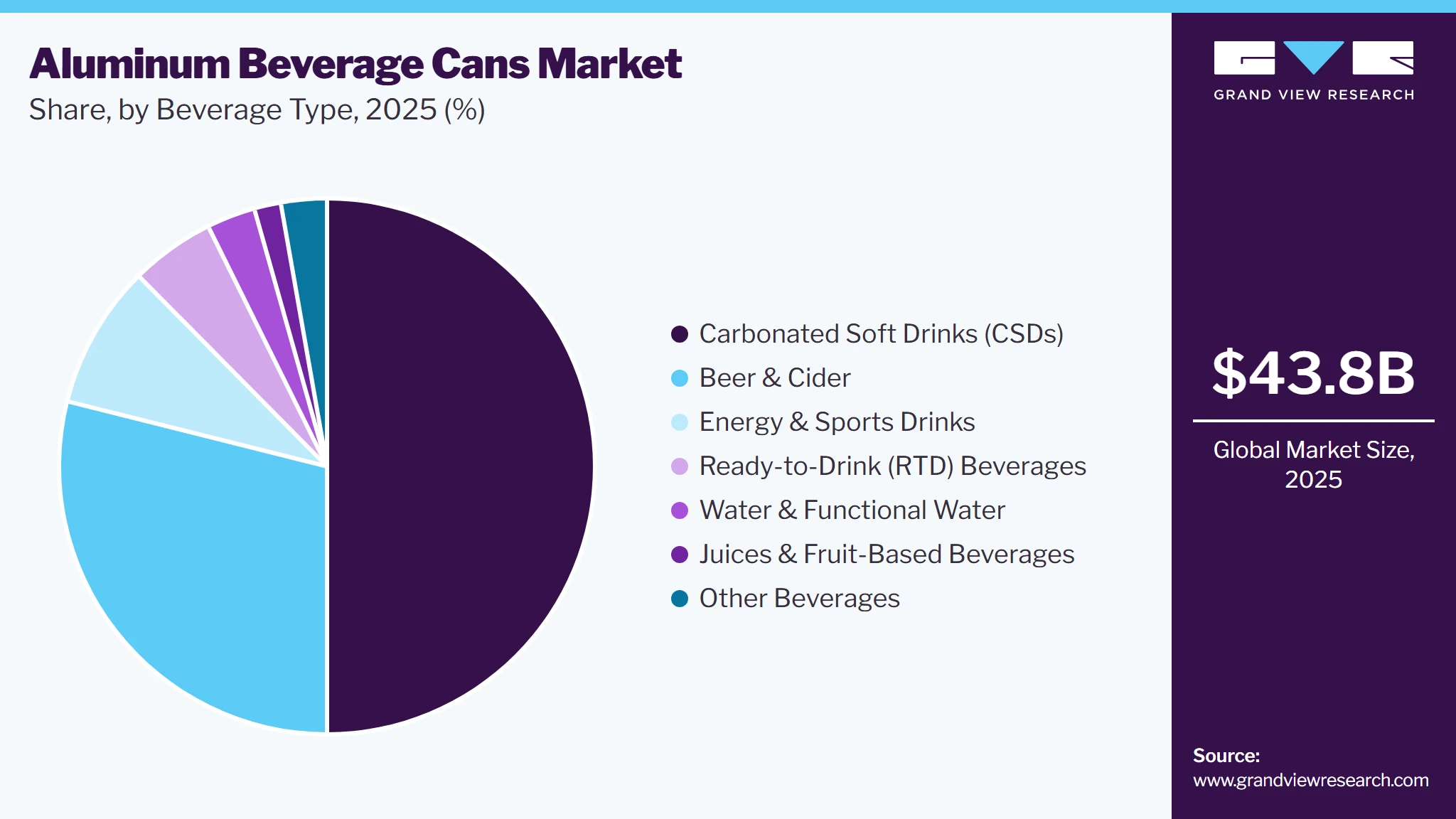
Based on beverage, the carbonated soft drinks (CSDs) segment led the market with the largest revenue share of 50.0% in 2025. CSDs represent the largest application for aluminum beverage cans due to their widespread consumption, portability, and strong compatibility with canned packaging formats. The segment is supported by continued demand for carbonated beverages across retail, convenience stores, foodservice, and vending channels, with its market share remaining relatively stable at 49.8% in 2033.
 To learn more about this report, Download Free Sample Report
The energy & sports drinks segment is expected to grow at the fastest CAGR of 6.0% during the forecast period. Rising consumer interest in energy, sports, and functional beverages, particularly among younger and active consumers, is increasing demand for convenient single-serve aluminum cans. The segment's share is projected to increase from 8.7% in 2025 to 9.2% by 2033, reflecting its growing contribution to the aluminum beverage cans market.
Regional Insights
North America Aluminum Beverage Cans Market Trends
The North America aluminum beverage cans industry accounted for the largest revenue share of 34.3% in 2025. The North America industry is expected to maintain steady growth during the forecast period, supported by strong consumption of carbonated soft drinks, beer, energy drinks, and ready-to-drink beverages. Established beverage manufacturing and distribution networks, high demand for convenient packaging, and increasing emphasis on recyclable packaging formats are supporting regional demand. The region accounted for the largest revenue share of 34.3% in 2025, although its share is projected to gradually decline to 33.0% by 2033 as other regions expand at a faster pace.
 To learn more about this report, Download Free Sample Report
U.S. Aluminum Beverage Cans Market Trends
The U.S. aluminum beverage cans industry represents the major contributor to regional demand, supported by its large packaged beverage industry and widespread adoption of canned soft drinks, beer, and energy beverages. Growing consumer preference for portable packaging and increasing focus on aluminum recycling are encouraging beverage manufacturers to expand the use of cans. Continued investments in lightweight can technologies and recycling infrastructure are expected to support market development.
Europe Aluminum Beverage Cans Market Trends
The Europe aluminum beverage cans industry is projected to grow moderately through 2033, driven by established beer and soft drink consumption and strong demand for recyclable packaging. Increasing emphasis on circular economy practices and packaging sustainability is encouraging beverage producers to improve the use of recycled aluminum and lightweight can format. Europe held a 24.8% revenue share in 2025, with its share expected to reach 24.2% by 2033.
Germany aluminum beverage cans industry represents an important market in Europe, supported by its mature beverage industry and strong beer consumption. The country's well-developed recycling infrastructure and emphasis on resource efficiency further support aluminum can adoption. Demand for lightweight and recyclable beverage packaging is expected to provide continued opportunities for manufacturers.
The UK aluminum beverage cans industry is expected to experience steady development, supported by demand for soft drinks, beer, energy drinks, and other packaged beverages. Growing consumer awareness of packaging sustainability and established recycling practices are encouraging greater use of recyclable aluminum formats. Product innovation and lightweight can designs are expected to strengthen market opportunities.
Latin America Aluminum Beverage Cans Market Trends
The Latin America aluminum beverage cans industry is projected to register healthy growth during the forecast period, supported by strong demand for beer, carbonated soft drinks, and other packaged beverages. The region is expected to grow at a 5.2% CAGR, faster than North America and Europe. Expansion of beverage distribution networks, urbanization, and increasing consumer preference for convenient packaging are creating additional opportunities for aluminum can producers.
Brazil aluminum beverage cans industry represents a significant market in Latin America, supported by its large beer and soft drink consumption base. Increasing demand for convenient packaged beverages and the country's established aluminum recycling ecosystem are supporting can adoption. Continued beverage industry expansion and investments in sustainable packaging are expected to contribute to future growth.
Argentina's aluminum beverage cans industry is expected to develop steadily, supported by demand for beer, carbonated beverages, and other packaged drinks. Growing preference for convenient beverage formats and increasing awareness of recyclable packaging are creating opportunities for aluminum cans. Market expansion is expected to remain closely linked to beverage production and consumer spending trends.
Middle East & Africa Aluminum Beverage Cans Market Trends
The Middle East & Africa aluminum beverage cans industry is expected to register a 5.4% CAGR from 2026 to 2033, making it the second-fastest-growing regional market after Asia Pacific. Increasing urbanization, expanding beverage consumption, rising retail activity, and growing demand for convenient packaged drinks are supporting regional growth. Investments in beverage manufacturing and distribution infrastructure are expected to further increase the use of aluminum cans.
South Africa aluminum beverage cans industry is an important market within the Middle East & Africa region, supported by established beverage manufacturing and consumption of carbonated drinks and beer. The growing focus on recyclable packaging and improvements in collection and recycling systems are creating favorable conditions for aluminum cans. Expansion of modern retail and beverage distribution is expected to support continued demand.
Key Aluminum Beverage Cans Company Insights
The aluminum beverage cans industry is characterized by large-scale manufacturing, lightweight can development, recycled aluminum adoption, production automation, and increasing emphasis on sustainable packaging. Key participants are focusing on expanding production capacities, improving can-manufacturing efficiency, developing lightweight and specialty can formats, and strengthening recycling capabilities to address growing beverage consumption and sustainability requirements.
-
Ball Corporation is a major global aluminum packaging manufacturer with a broad portfolio of beverage cans serving carbonated soft drinks, beer, energy drinks, and other beverage categories. The company focuses on lightweight can technologies, design innovation, recycled aluminum utilization, and circular packaging solutions to support beverage brands seeking efficient and sustainable packaging formats.
-
Crown Holdings, Inc. is a prominent metal packaging manufacturer offering aluminum beverage cans in multiple sizes and designs for beer, soft drinks, energy drinks, and other beverages. The company emphasizes advanced manufacturing, can decoration, lightweighting, and packaging innovation to meet changing beverage consumption patterns and brand requirements.
Key Aluminum Beverage Cans Companies
The following key companies have been profiled for this study on the aluminum beverage cans market.
-
Ball Corporation
-
Crown
-
Ardagh Metal Packaging
-
Toyo Seikan Co., Ltd
-
Nampak Ltd.
-
Orora Packaging
-
Envases Group3
-
Baosteel Co.,Ltd.
-
CANPACK
-
Can-One USA
-
Thai Beverage Can Ltd
-
Alucan Co., Ltd.
Competitive Benchmarking
Category
Operating Strategies
Competitive Edge
Weakness
Established Players (Ball Corporation; Crown Holdings; Ardagh Metal Packaging; Toyo Seikan Co., Ltd.; Nampak Ltd.; Orora Packaging)
Focus on expanding aluminum beverage can production capacity, strengthening relationships with major beverage manufacturers, developing lightweight and specialty can formats, and investing in manufacturing automation, recycling, and sustainable production technologies.
Strong manufacturing scale, established beverage-industry relationships, broad geographic presence, diversified can portfolios, advanced production capabilities, and strong financial resources support their competitive position.
High capital investment requirements, exposure to aluminum and energy price fluctuations, and rising costs associated with sustainability initiatives and production modernization can affect margins.
Emerging Players (Envases Group; Baosteel Co., Ltd.; CANPACK; Can-One USA; Thai Beverage Can Ltd.; Alucan Co., Ltd.)
Focus on expanding regional production capacity, developing customized aluminum beverage cans, strengthening local and international customer relationships, and improving manufacturing efficiency. Increasing emphasis is placed on lightweighting, recycled aluminum, product innovation, and penetration of high-growth beverage markets.
Strong regional expertise, flexible manufacturing capabilities, competitive pricing, localized customer relationships, and growing production footprints enable these companies to capture opportunities in developing and expanding beverage markets.
Smaller global footprint, relatively lower production scale, greater exposure to regional demand and raw material price fluctuations, and comparatively limited resources for large-scale R&D and international expansion may constrain growth.
Recent Developments
-
In April 2026, Crown Holdings, Inc. announced plans to establish a new two-line aluminum beverage can manufacturing facility in Northern India. The facility is expected to begin operations in the second half of 2027 and reach annual production capacity of approximately 2.2 billion cans. The investment is aimed at serving growing demand for aluminum cans across alcoholic and non-alcoholic beverages in India and is supported by long-term customer commitments, including United Breweries.
-
In May 2026, CANPACK Group reported a 9% increase in beverage can body volumes in the first quarter of 2026 compared with the same period in 2025. Growth was supported by higher volumes in Brazil, the U.S., Europe, and India. The company also increased capital expenditure to support ongoing capacity expansion projects, reflecting continued investment in aluminum beverage can manufacturing.
-
In March 2026, CANPACK reported that its 2025 beverage can body volumes increased by 3% year over year. The company also highlighted continued capacity expansion investments, particularly in the U.S. and India, while its European operations continued to operate at full capacity amid sustained customer demand.
Aluminum Beverage Cans Market Report Scope
Report Attribute
Details
Market size in 2025
USD 43.8 billion
Estimated market size in 2026
USD 46.2 billion
Projected market size by 2033
USD 65.7 billion
Growth rate
CAGR of 5.2%from 2026 to 2033
Base year for estimation
2025
Historical data
2021 - 2024
Forecast period
2026 - 2033
Quantitative units
Revenue in USD million/billion and CAGR from 2026 to 2033
Report coverage
Revenue forecast, company ranking, competitive landscape, growth factors, and trends
Segments covered
Can Capacity, beverage, region
Regional Scope
North America; Europe; Asia Pacific; Latin America; Middle East & Africa
Country scope
U.S.; Canada; Mexico; Germany; UK; France; Italy; Spain; China; South Korea; Japan; India; Australia; Brazil; Argentina; Saudi Arabia; UAE; South Africa
Key companies profiled
Ball Corporation; Crown; Ardagh Metal Packaging; Toyo Seikan Co., Ltd; Nampak Ltd.; Orora Packaging; Envases Group3; Baosteel Co., Ltd.; CANPACK; Can-One USA; Thai Beverage Can Ltd; Alucan Co., Ltd.
Customization scope
Free report customization (equivalent up to 8 analysts working days) with purchase. Addition or alteration to country, regional & segment scope.
Pricing and purchase options
Avail of customized purchase options to meet your exact research needs. Explore purchase options
Global Aluminum Beverage Cans Market Report Segmentation
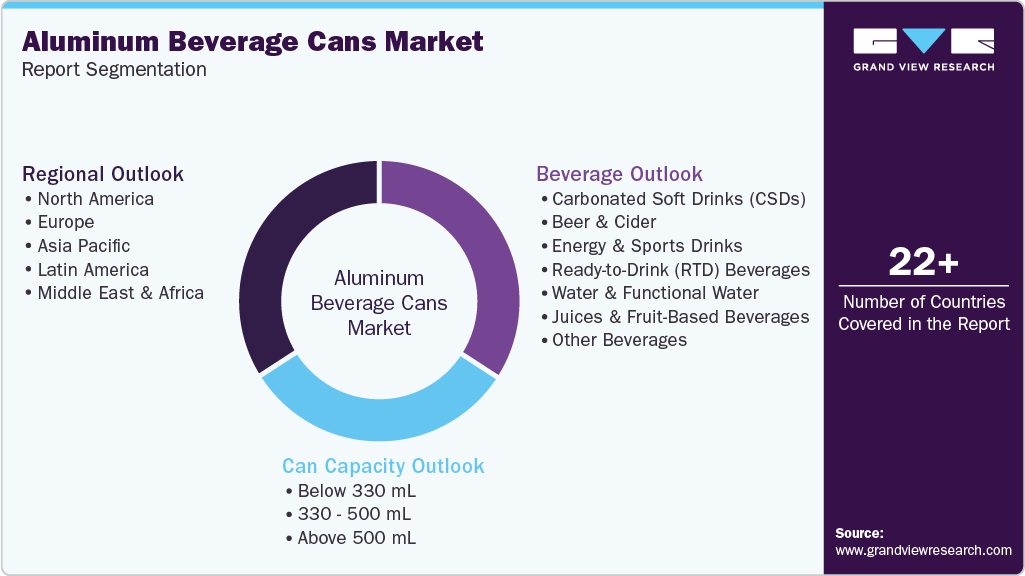
This report forecasts revenue growth at the regional and country levels and provides an analysis on the latest industry trends and opportunities in each of the sub-segments from 2021 to 2033. For this study, Grand View Research has segmented the aluminum beverage cans market report based on can capacity, end use, and region:
 To learn more about this report, Download Free Sample Report
-
Can Capacity Outlook (Revenue, USD Billion, 2021 - 2033)
-
Below 330 mL
-
330-500 mL
-
Above 500 mL
-
-
Beverage Outlook (Revenue, USD Billion, 2021 - 2033)
-
Carbonated Soft Drinks (CSDs)
-
Beer & Cider
-
Energy & Sports Drinks
-
Ready-to-Drink (RTD) Beverages
-
Water & Functional Water
-
Juices & Fruit-Based Beverages
-
Other Beverages
-
-
Regional Outlook (Revenue, USD Billion, 2021 - 2033)
-
North America
-
U.S.
-
Canada
-
Mexico
-
-
Europe
-
Germany
-
France
-
UK
-
Italy
-
Spain
-
-
Asia Pacific
-
China
-
India
-
Japan
-
South Korea
-
Australia
-
-
Latin America
-
Brazil
-
Argentina
-
-
Middle East & Africa
-
Saudi Arabia
-
UAE
-
South Africa
-
-
Research Methodology
The aluminum beverage cans market figures in this report are based on a proven research process that combines executive interviews with secondary research from proprietary databases, company filings, and recognized regulatory and institutional sources. Market size is built through value-chain sizing-reconciling supply-side and demand-side estimates-and triangulated with bottom-up and top-down approaches. Every estimate passes multiple levels of expert validation before publication, with each aluminum beverage cans segment quantified using the revenue-capture definitions in the table below.
Segment Definition
Can Capacity
Revenue capture definition
Below 330 mL
Revenue generated from the sale of aluminum beverage cans with a capacity below 330 mL, primarily used for single-serve portions of energy drinks, soft drinks, functional beverages, juices, and other ready-to-drink products. Includes standard and specialty small-format cans supplied to beverage manufacturers, retailers, foodservice operators, and other end users.
330-500 mL
Revenue generated from the sale of aluminum beverage cans with a capacity ranging from 330 mL to 500 mL, widely used for carbonated soft drinks, beer, energy and sports drinks, and ready-to-drink beverages. Includes standard, sleek, and specialty can formats supplied for single-serve and convenience-oriented beverage applications.
Above 500 mL
Revenue generated from the sale of aluminum beverage cans with a capacity above 500 mL, primarily used for larger serving formats of soft drinks, beer, functional beverages, and other packaged beverages. Includes large-format aluminum cans supplied to beverage producers and distribution channels serving retail, foodservice, and other high-volume consumption applications.
Beverage
Revenue capture definition
Carbonated Soft Drinks (CSDs)
Revenue generated from the sale of aluminum beverage cans used for carbonated soft drinks, including cola, lemon-lime, flavored sodas, and other carbonated beverages. Includes standard and specialty can formats supplied to beverage manufacturers and bottling companies.
Beer & Cider
Revenue generated from the sale of aluminum beverage cans used for beer and cider products. Includes cans supplied for lagers, ales, craft beer, flavored beer, hard cider, and other alcoholic malt beverages across retail and foodservice channels.
Energy & Sports Drinks
Revenue generated from the sale of aluminum beverage cans used for energy drinks, sports drinks, electrolyte beverages, and other performance-oriented beverages. Includes standard and slim can formats designed for convenient, single-serve consumption.
Ready-to-Drink (RTD) Beverages
Revenue generated from the sale of aluminum beverage cans used for ready-to-drink beverages, including RTD tea, coffee, cocktails, and other prepared beverages. Includes cans supplied for convenience-oriented and on-the-go consumption.
Water & Functional Water
Revenue generated from the sale of aluminum beverage cans used for packaged water and functional water products, including enhanced, vitamin, mineral, and electrolyte-infused waters. Includes cans marketed as recyclable and convenient alternatives to conventional beverage packaging.
Juices & Fruit-Based Beverages
Revenue generated from the sale of aluminum beverage cans used for juices, fruit drinks, flavored fruit beverages, and other fruit-based formulations. Includes cans supplied for single-serve and portion-controlled beverage formats.
Other Beverages
Revenue generated from the sale of aluminum beverage cans used for other beverage categories not classified above, including specialty beverages, flavored beverages, nutritional drinks, and emerging beverage formulations.
Estimation Model
Layer No.
Layer Name
Key Question
Description
01
Beverage Demand Layer
What drives demand for aluminum beverage cans?
Estimate demand from major beverage categories, including carbonated soft drinks, beer & cider, energy & sports drinks, RTD beverages, water, juices, and other beverages that utilize aluminum cans.
02
Can Capacity Adoption Layer
Which can sizes are preferred?
Assess adoption of aluminum beverage cans across below 330 mL, 330-500 mL, and above 500 mL capacity formats based on serving size, consumer preferences, beverage, and on-the-go consumption patterns.
03
Regional Consumption Layer
Where is demand concentrated?
Evaluate aluminum beverage can consumption across North America, Europe, Asia Pacific, Latin America, and Middle East & Africa, considering beverage production, packaging demand, urbanization, and regional consumption trends.
04
Revenue Layer
How is market revenue generated?
Revenue is estimated from the sale of aluminum beverage cans to beverage manufacturers, filling companies, and other packaging users across major beverage categories and can-capacity formats.
Delivered Customizations
This report has been delivered with the following In-depth customizations
Client Request
Customization Delivered
Value Adds
Competitive Benchmarking
Comparative benchmarking of leading aluminum beverage can manufacturers based on product portfolio, can capacity, beverage-type coverage, manufacturing capabilities, geographic presence, production capacity, sustainability initiatives, technological advancements, and strategic developments.
Enables clients to assess competitor positioning, identify capability gaps, benchmark manufacturing strengths, and develop effective market entry, expansion, and differentiation strategies.
Pricing Analysis
Detailed assessment of aluminum beverage can pricing based on aluminum sheet prices, recycled aluminum content, can size and capacity, manufacturing costs, energy prices, transportation expenses, regional supply-demand conditions, and customer order volumes.
Helps clients understand regional price variations, optimize pricing and procurement strategies, evaluate cost drivers, and manage margin and input-cost risks.
Trade Assessment
Comprehensive assessment of global aluminum beverage can trade flows, including major exporting and importing countries, regional trade patterns, production-consumption gaps, import dependency, export opportunities, and key trade dynamics across North America, Europe, Asia Pacific, Latin America, and Middle East & Africa.
Supports identification of attractive export markets, supply-chain opportunities, trade-dependent regions, sourcing strategies, and potential market expansion opportunities.
Frequently Asked Questions About This Report
The global aluminum beverage cans market size was valued at USD 43.8 billion in 2025 and is estimated to reach USD 46.2 billion in 2026.
The global aluminum beverage cans market is expected to grow at a CAGR of 5.2% from 2026 to 2033, reaching USD 65.7 billion by 2033.
The aluminum beverage cans market is primarily driven by increasing consumption of packaged beverages, rising demand for lightweight and recyclable packaging, growth in carbonated soft drinks and energy beverages, expanding ready-to-drink beverage consumption, and increasing emphasis on sustainable and circular packaging solutions.
North America dominated the aluminum beverage cans market with a 34.3% revenue share in 2025 while below 330 mL segment is second fastest growing market.
Asia Pacific is the fastest-growing region over the forecast period.
The 330–500 mL segment led the aluminum beverage cans market with a 46.1% revenue share in 2025.
The carbonated soft drinks (CSDs) segment led the aluminum beverage cans market with a 50.0% revenue share in 2025.
Key players in the aluminum beverage cans market include Ball Corporation, Crown Holdings, Ardagh Metal Packaging, Toyo Seikan Co., Ltd., Nampak Ltd., Orora Packaging, Envases Group, Baosteel Co., Ltd., CANPACK, Can-One USA, Thai Beverage Can Ltd., and Alucan Co., Ltd.
About the Author(s)
Plastics, Polymers & Resins Research Team
Bulk Chemicals · Plastics, Polymers & ResinsThis report was authored by the plastics, polymers & resins research team at Grand View Research - comprising two research analysts, one senior research analyst, and one industry expert - with specialized expertise in the plastics, polymers & resins segment of the bulk chemicals industry. All findings are based on proprietary bulk chemicals databases, executive interviews, and regulatory analysis, subject to internal peer review prior to publication.
Last Updated:
Speak to Analyst

Customize this report to your needs - add regions, segments, or data points, with 20% free customization.
Or view our licence options:


ISO 9001:2015 & 27001:2022 Certified
We are GDPR and CCPA compliant! Your transaction & personal information is safe and secure. For more details, please read our privacy policy.


