
- Home
- »
- Next Generation Technologies
- »
-
AR Cloud Market Size, Share And Trends Report, 2025-2033GVR Report cover

AR Cloud Market (2025 - 2033)
Size, Share & Trends Analysis Report By Component (Hardware, Software, Services), By Organization Size (Large Enterprises, Small & Medium Enterprises), By Type, By Deployment, By End Use, By Region, And Segment Forecasts
Market Size, 2024
$4.8BMarket Estimate, 2026
$8.7BMarket Forecast, 2033
$59.1BCAGR, 2025–2033
31.7%AR Cloud Market Summary
The global AR cloud market size was valued at USD 4.8 billion in 2024 and is projected to grow from USD 8.7 billion in 2026 to USD 59.1 billion by 2033, at a CAGR of 31.7% from 2025 to 2033. North America dominated the market, accounting for a revenue share of 39% in 2024. The growth is primarily driven by the increasing demand for immersive and location-based AR experiences, the rising adoption of 5G and edge computing technologies, the growing deployment of AR solutions across retail, real estate, and industrial sectors, and ongoing technological advancements in spatial mapping, 3D visualization, and cloud-based AR infrastructure.
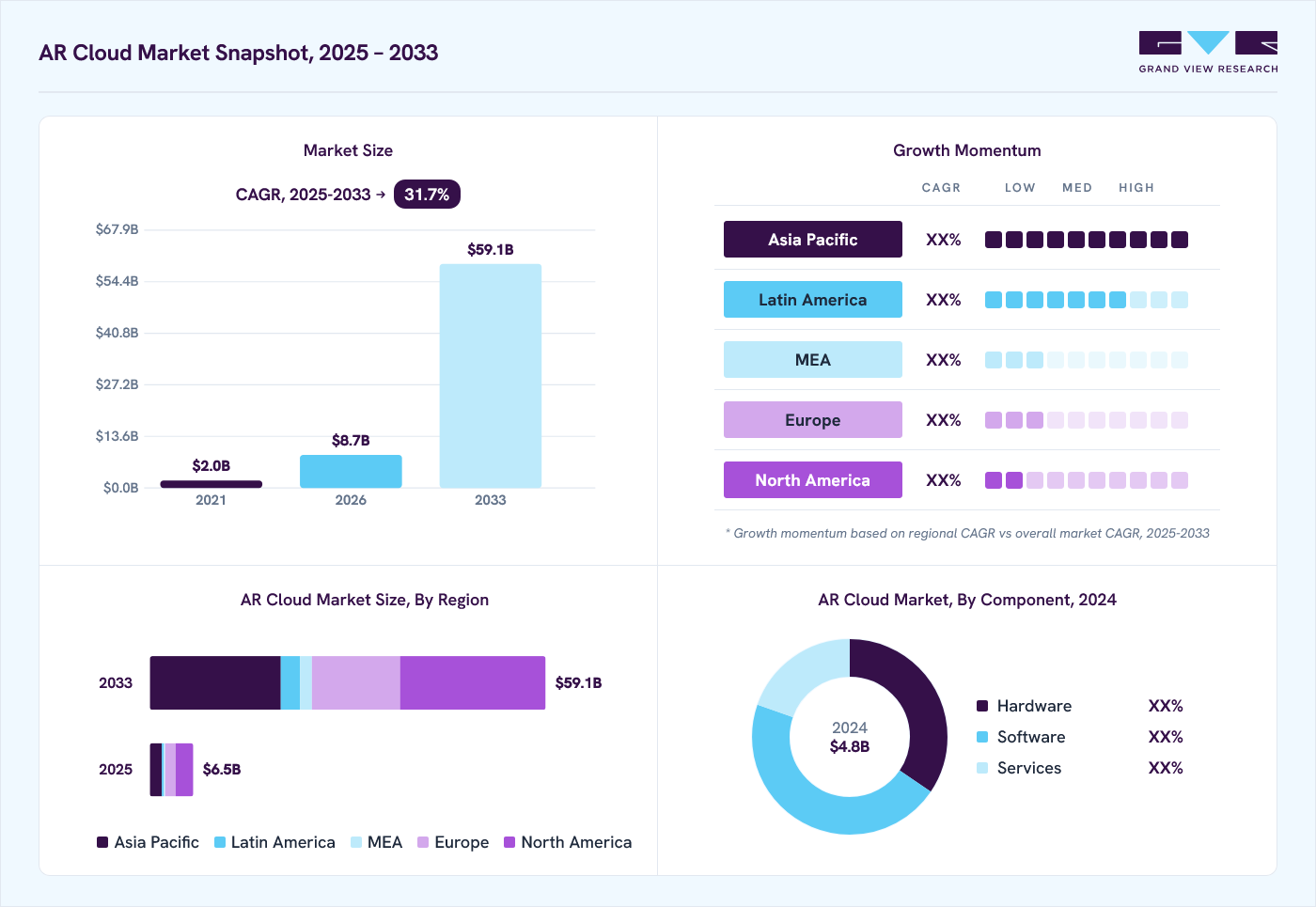 Source: Grand View Research, IR Documents, Primary Interviews, Paid DatabasesTo learn more about this report,
 Download Free Sample Report
 Key Market Trends & Insights
- By component, the software segment led the market and held the largest revenue share of over 45% in 2024.
- By organization size, the large enterprises segment led the market and held the largest revenue share of over 67% in 2024.
- By deployment, the public cloud segment led the market and held the largest revenue share of over 40% in 2024.
Market Size & Forecast
- 2024 Market Size: USD 4.8 Billion
- 2033 Projected Market Size: USD 59.1 Billion
- CAGR (2025-2033): 31.7%
- North America: Largest market in 2024
- Asia Pacific: Fastest growing market
Three ways to get this report
Buy it, customize it, or ask a question.Ask an Analyst
Analyst response in 1 business day
- AccessReport author, directly
- Reply timeWithin 1 working day
- No sales callDirect answer only
- FormatEmail reply
- CostFree, no cost
Get the Full Report
What the study covers
- FormatsPDF · Excel · Dashboard
- Timeline2025–2033 annual, 2024 base
- Coverage20+ countries, 5 regions
- Companies10+ key players profiled
Customize the Report
20% free customization
- IncludeCountries, segments, points
- TailorTo your product definition
- ExtendDeeper competitor detail
- OrA fully bespoke study
- Turnaround5–10 working days
The growth is driven by the increasing adoption of augmented reality (AR) applications across industries, which are creating sustained demand for spatially aware digital environments. The rising need for seamless integration of real-world and virtual content is fueling the adoption of advanced AR cloud platforms. The integration of next-generation technologies such as 5G, AI, and edge computing significantly enhances real-time data processing, spatial mapping accuracy, and content synchronization. The growing focus on developing large-scale, persistent, and collaborative AR experiences is accelerating investments in cloud infrastructure and spatial computing solutions, which is expected to propel the growth of the industry.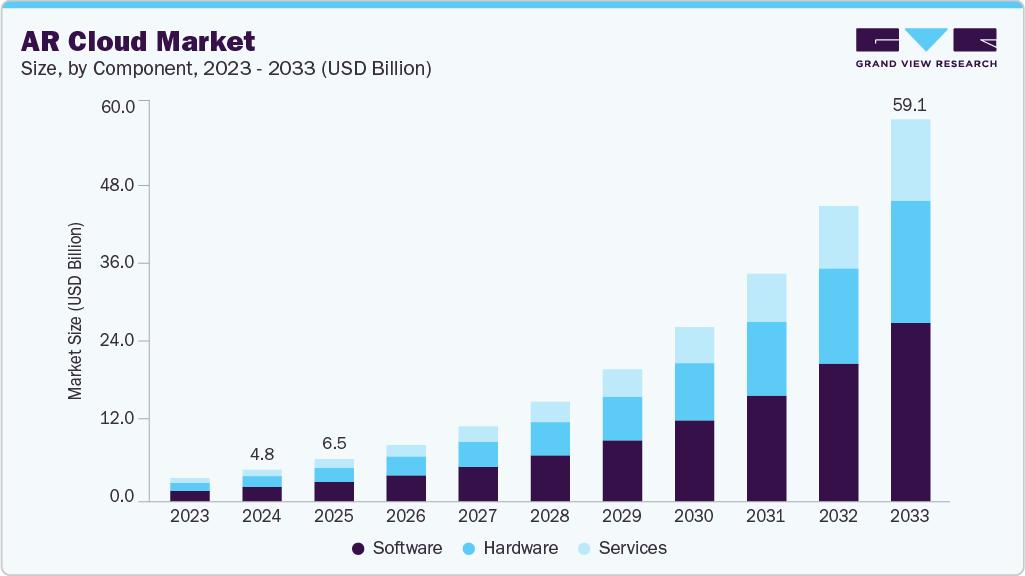 To learn more about this report, Download Free Sample Report
 The rising demand for immersive and spatially accurate augmented reality experiences, driven by the rapid proliferation of AR-enabled devices, advanced sensors, and 5G connectivity, is significantly fueling the growth of the AR cloud industry. This increasing need for real-time synchronization between virtual and physical environments is accelerating investments in AR infrastructure and spatial computing technologies, thereby driving investments in the industry.
Additionally, the growing emphasis on industrial and enterprise adoption of AR solutions is becoming a major growth driver for the AR cloud industry. Businesses are leveraging AR cloud platforms to enhance remote collaboration, maintenance, and training operations through real-time data visualization and the integration of digital twins. The demand for scalable, cloud-based AR ecosystems that support enterprise-level applications is driving innovation across manufacturing, logistics, and automotive sectors.
Furthermore, advancements in AI, computer vision, and edge computing are revolutionizing AR cloud performance and user experience. The integration of spatial mapping, real-time object recognition, and environmental understanding enables highly accurate and context-aware AR interactions. These technological improvements reduce latency, enhance rendering precision, and deliver seamless multi-user experiences. Increasingly intelligent and data-driven AR systems are driving greater reliance on next-generation cloud infrastructures and real-time processing capabilities.
Moreover, increasing collaboration between AR technology providers, telecom operators, and cloud service companies is accelerating ecosystem development within the AR cloud market. Strategic partnerships are leading to the creation of interoperable platforms that support large-scale, persistent AR experiences. Joint R&D initiatives are also focusing on standardizing spatial data formats, improving data privacy frameworks, and optimizing network bandwidth utilization. This collaborative approach is fostering innovation, strengthening interoperability, and accelerating the adoption of the industry.
Component Insights
The software segment dominated the market with a share of over 45% in 2024, owing to its pivotal role in enabling persistent spatial mapping, multi-user synchronization, and real-time 3D content anchoring across diverse AR ecosystems. The surge in demand for high-precision localization and cloud-based spatial data orchestration is propelling segment growth. Increasing investments in upgrading AR development toolkits, real-time mapping SDKs, and AI-driven spatial understanding models are further strengthening the dominance of the software segment in the industry.
The services segment is expected to witness the highest CAGR of over 32% from 2025 to 2033. The growing reliance on professional service providers for custom AR application development, spatial asset integration, and enterprise-grade cloud orchestration is fueling the segment’s rapid expansion. Advancements in remote edge-based rendering support and continuous AR infrastructure calibration are reinforcing the dominance of the services segment in the AR cloud industry.
Type Insights
The marker less AR segment accounted for the largest share in 2024, driven by increasing demand for marker-free computing experiences and cloud-connected environments. Growing integration of AI-powered object recognition, real-time mapping, and multi-user synchronization strengthens deployment in sectors such as manufacturing, retail, logistics, and smart cities. Continuous improvements in device sensors, wearable AR hardware, and cross-platform AR frameworks further accelerate the segment’s growth in the market.
The marker-based AR segment is expected to witness a significant CAGR from 2025 to 2033. This growth is driven by the rising need for affordable, easy-to-deploy AR solutions that ensure consistent tracking accuracy across applications. The growing preference among organizations for low-latency, low-cost AR Cloud integrations that utilize printed or digital markers to trigger cloud-based 3D content further reinforces the segment’s strong CAGR outlook in the industry.
Deployment Insights
The public cloud segment accounted for the largest market share in 2024, driven by rising demand for scalable AR cloud infrastructures that can handle dynamic spatial mapping workloads with minimal latency. Public cloud providers’ continuous investments in AI acceleration, edge nodes, and global redundancy enhance performance consistency, further supporting the segment’s dominance in the AR cloud industry.
The hybrid cloud segment is expected to witness a significant CAGR from 2025 to 2033. This growth is driven by the rising need of enterprises for flexible deployment models that combine the scalability of public clouds with the security of private environments. Increasing compliance obligations and data-residency regulations also push enterprises toward hybrid AR cloud deployments, reinforcing the segment’s dominance in the market.
End Use Insights
The manufacturing segment accounted for the largest market share in 2024, driven by its efficiency in enabling real-time spatial visualization, workflow optimization, and asset-interaction across factory environments. Continuous advancements in computer vision, 3D reconstruction, edge-enabled AR rendering, and cloud-synchronized spatial anchors are further enhancing performance and operational flexibility, supporting the segment’s growth in the AR cloud industry.
The automotive segment is expected to witness the highest CAGR from 2025 to 2033. This growth is driven by its ideal balance between real-time spatial awareness and high-accuracy data processing. AR cloud-enabled automotive platforms can support multiple continuous operational cycles. Growing demand for multi-functional AR applications, including immersive HUD displays, predictive maintenance alerts, and vehicle-to-everything (V2X) communication, is enhancing adoption and reinforcing the segment’s strong growth in the industry.
Organization Size Insights
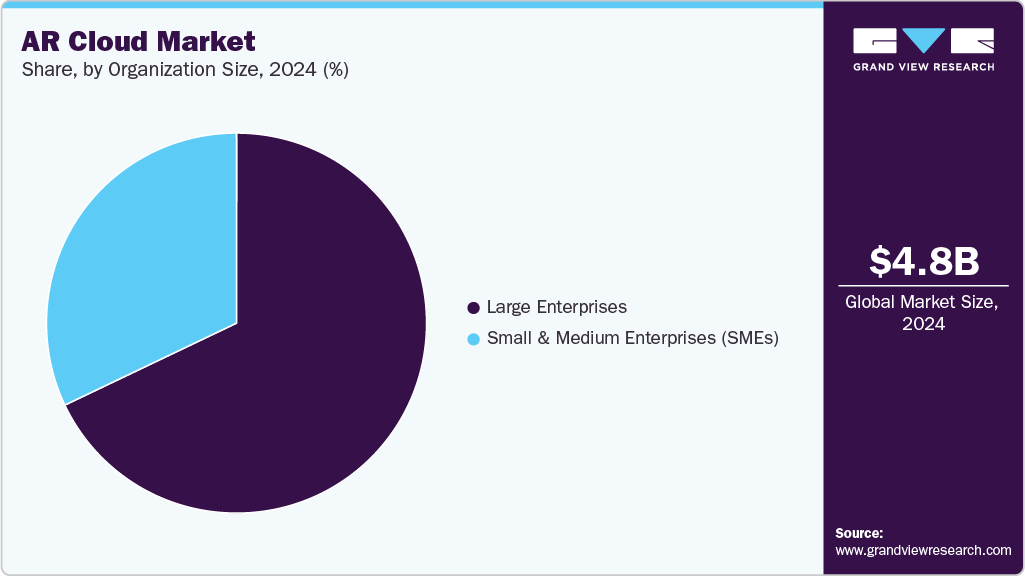
The large enterprises segment accounted for the largest market share in 2024, driven by mature cloud strategies, strong IT budgets, and immediate ROI from scale enterprises can integrate persistent spatial maps and digital twins across multiple sites, making AR cloud deployments cost-effective and highly impactful. Large organizations’ existing cloud/edge infrastructure and multi-cloud strategies simplify the heavy compute, storage, and security needs of AR cloud platforms, sustaining large-enterprise dominance in the AR cloud market.
 To learn more about this report, Download Free Sample Report
 The small & medium enterprises (SMEs) segment is expected to witness the highest CAGR from 2025 to 2033. This growth is driven by the rising need for affordable, easy-to-deploy AR cloud platforms that reduce upfront investment barriers for SMEs. Increasing demand for immersive customer experiences, remote support tools, and virtual product demonstrations fuels adoption. Expanding government digitalization programs and subsidies for small businesses adopting advanced technologies further reinforce SME adoption of the industry.
Regional Insights
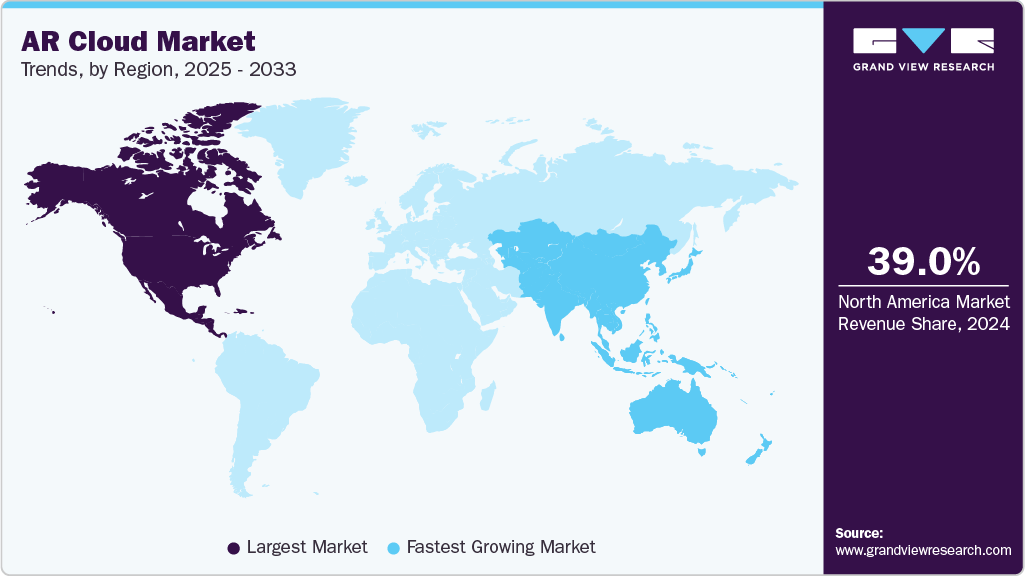
The AR cloud market in North America accounted for the largest market share of over 39% in 2024, primarily driven by the rapid adoption of augmented reality technologies across the enterprise, retail, and entertainment sectors in the region. Robust investments in 5G infrastructure, edge computing, and AI integration are supporting the development of large-scale, low-latency AR experiences. The growing use of AR cloud solutions in smart city initiatives, industrial automation, and immersive retail experiences is enhancing operational efficiency, strengthening North America’s position in the industry.
 To learn more about this report, Download Free Sample Report
 U.S. AR Cloud Market Trends
The AR cloud market in the U.S. is expected to grow at a CAGR of over 29% from 2025 to 2033, driven by the increasing adoption of spatial computing technologies across sectors such as retail, real estate, automotive, and manufacturing. Supportive government initiatives promoting the deployment of 5G infrastructure, digital transformation, and extended reality innovation are further driving market expansion. The integration of AI, edge computing, and IoT technologies to support real-time mapping and content synchronization is further strengthening the U.S. AR cloud market.
Europe AR Cloud Market Trends
The AR cloud market in Europe is expected to grow at a CAGR of over 30% from 2025 to 2033, driven by the expanding use of AR cloud technologies in public infrastructure projects, cultural heritage preservation, and tourism enhancement. The surge in investments toward autonomous vehicle development and smart mobility solutions is accelerating the integration of AR cloud for advanced navigation and situational awareness. Collaboration between European telecom operators and technology providers is strengthening regional competitiveness and driving widespread adoption of AR cloud technologies across Europe.
The UK AR cloud market is poised for significant expansion in the coming years. This growth is fueled by the government’s increasing focus on advancing digital infrastructure, innovative immersive technology, and smart city initiatives. The country’s strong support for AR and VR development through programs such as Innovate U.K. and the Digital Catapult Centre is accelerating adoption. The rising demand for immersive experiences in entertainment, tourism, and e-commerce is driving large-scale deployment of AR cloud solutions across the U.K.
The AR cloud market in Germany is driven by the country’s rapid digital transformation efforts under the Industrie 4.0 framework, emphasizing the integration of AR cloud technologies into manufacturing and automotive sectors. Germany’s strong industrial base and leadership in automation are encouraging enterprises to adopt AR cloud for real-time visualization, predictive maintenance, and collaborative design. The ongoing partnerships between technology firms, research institutions, and industrial associations are promoting innovation and strengthening Germany’s position in the AR cloud industry.
Asia Pacific AR Cloud Market Trends
The AR cloud market in Asia Pacific is expected to grow at the highest CAGR of over 34% from 2025 to 2033. The expanding use of AR in e-commerce, education, and manufacturing is prompting enterprises to adopt scalable AR cloud platforms for real-time spatial mapping and immersive experiences. Increasing government support for digital economy development is further fostering the integration of AR cloud solutions. The strong presence of major technology firms and startups focusing on AR innovation, combined with the rising adoption of AR-enabled devices by consumers, is accelerating market growth and strengthening the region’s position as a global hub for the market.
Japan AR cloud market is gaining traction, fueled by the nation’s rapid adoption of immersive technologies, which aim to integrate cyberspace and physical space for social and industrial advancement. Japan’s strong focus on robotics, autonomous systems, and digital twins is driving demand for AR cloud platforms that enable real-time spatial mapping and visualization. Japan’s emphasis on enhancing tourism through AR-powered navigation, cultural site reconstruction, and virtual heritage experiences is further propelling market growth.
The AR cloud market in China is experiencing robust growth, driven by the government’s strong emphasis on expanding digital infrastructure under initiatives such as the New Infrastructure Plan and Internet Plus. The widespread rollout of 5G networks, combined with the country’s leadership in AI, IoT, and edge computing, is fostering large-scale adoption of AR cloud technologies. The strategic investments by major domestic tech firms in developing AR cloud ecosystems and metaverse infrastructure are reinforcing China’s position as a global powerhouse in AR cloud innovation and deployment.
Key AR Cloud Companies Insights
Key players operating in the AR cloud market are undertaking various initiatives to strengthen their presence and increase the reach of their products and services. Strategies such as expansion activities and partnerships are key in propelling the market growth. Some of the key players operating in the market include Google LLC and Microsoft Corporation among others.
-
Google LLC offers ARCore and Google Cloud Anchor technologies that enable persistent and shared augmented reality experiences integrated with real-world environments. The company’s mapping ecosystem, supported by Google Maps and Street View, acts as a key base for spatial computing and location-based AR. With its cloud infrastructure and AI capabilities, Google continues to develop AR cloud solutions that support real-time spatial mapping, navigation, and immersive applications.
-
Microsoft Corporation is developing Azure Spatial Anchors and the Microsoft Mesh platform to support persistent, cross-device mixed reality experiences anchored to physical spaces. Its integration of AR cloud technologies within HoloLens and Azure services strengthens enterprise collaboration, remote training, and industrial maintenance. Microsoft’s established role in enterprise software, cloud computing, and AI supports its ability to scale AR cloud deployments across various industries.
Niantic, Inc. and Blippar Group Limited are some of the emerging market participants in the AR cloud market.
-
Niantic, Inc. is known for pioneering location-based AR experiences such as Pokémon GO. Through its Lightship ARDK and Visual Positioning System (VPS), Niantic is building a global AR cloud infrastructure that allows developers to create shared, persistent digital experiences mapped to real-world locations. Niantic’s focus on real-time spatial awareness and multiplayer AR capabilities is shaping the future of the AR cloud by connecting users through interactive, immersive environments.
-
Blippar Group Limited is recognized for its pioneering work in WebAR and AR content creation platforms. The company enables users and enterprises to develop, publish, and experience augmented reality directly through web browsers, eliminating the need for dedicated apps. By combining AI-driven object recognition with cloud integration, Blippar continues to expand the reach of interactive digital environments within the AR cloud industry.
Key AR Cloud Companies:
The following are the leading companies in the AR cloud market. These companies collectively hold the largest market share and dictate industry trends.
- Google LLC
- Microsoft Corporation
- Apple Inc.
- Amazon Web Services, Inc.
- PTC Inc.
- Meta Platforms, Inc.
- Oracle Corporation
- Niantic, Inc.
- Magic Leap, Inc.
- Blippar Group Limited
Recent Developments
-
In October 2025, Amazon Web Services, Inc. (AWS) signed a strategic collaboration agreement with Esri to integrate Esri’s geospatial AI platform (ArcGIS) with AWS’s cloud infrastructure, enabling enterprise-scale geospatial/AR/VR and AR cloud applications across industry verticals. This indicates AWS’s ramp-up into the AR cloud / spatial computing domain beyond pure gaming. The partnership reinforces AWS’s growing influence in the AR cloud market by empowering developers to create scalable, location-intelligent immersive experiences across sectors.
-
In July 2025, Niantic, Inc. announced a technology partnership with KOJIMA PRODUCTIONS to bring immersive geospatial-AI-powered AR experiences into the real world, highlighting Niantic’s ongoing shift toward a persistent AR cloud layer over physical locations. This collaboration underscores Niantic’s strategic intent to advance large-scale, real-world AR ecosystems that bridge digital and physical environments through the AR cloud market.
-
In May 2025, Google LLC announced updates to its AR development platform via ARCore, which includes new capabilities such as enhanced Cloud Anchors for shared cross-device AR experiences, vertical-plane detection, and augmented image recognition. These advances strengthen Google’s AR cloud positioning by enhancing real-time spatial mapping and enabling persistent, shared AR content.
AR Cloud Market Report Scope
Report Attribute
Details
Market size in 2024
USD 4.8 billion
Estimated market size in 2026
USD 8.7 billion
Projected market size by 2033
USD 59.1 billion
Growth rate
CAGR of 31.7% from 2025 to 2033
Base year for estimation
2024
Historical data
2021 - 2023
Forecast period
2025 - 2033
Quantitative units
Revenue in USD million/billion and CAGR from 2025 to 2033
Report Product
Revenue forecast, company ranking, competitive landscape, growth factors, and trends
Segments covered
Component, organization size, type, deployment, end use, region
Region scope
North America; Europe; Asia Pacific; Latin America; Middle East & Africa
Country scope
U.S.; Canada; Mexico; UK; Germany; France; China; Japan; India; South Korea; Australia; Brazil; UAE; Saudi Arabia; South Africa
Key companies profiled
Google LLC; Microsoft Corporation; Apple Inc.; Amazon Web Services, Inc.; PTC Inc.; Meta Platforms, Inc.; Oracle Corporation; Niantic, Inc.; Magic Leap, Inc.; Blippar Group Limited
Customization scope
Free report customization (equivalent to up to 8 analyst’s working days) with purchase. Addition or alteration to country, regional & segment scope.
Pricing and purchase options
Avail customized purchase options to meet you exact research needs. Explore purchase options
Global AR Cloud Market Report Segmentation
This report forecasts revenue growth at global, regional, and country levels and provides an analysis of the latest technological trends in each of the sub-segments from 2021 to 2033. For this study, Grand View Research has segmented the global AR cloud market report based on component, organization size, type, deployment, end use, and region:
-
Component Outlook (Revenue, USD Million, 2021 - 2033)
-
Hardware
-
Software
-
Services
-
-
Organization Size Outlook (Revenue, USD Million, 2021 - 2033)
-
Large Enterprises
-
Small & Medium Enterprises (SMEs)
-
-
Type Outlook (Revenue, USD Million, 2021 - 2033)
-
Marker Based AR
-
Marker Less AR
-
-
Deployment Outlook (Revenue, USD Million, 2021 - 2033)
-
Public Cloud
-
Private Cloud
-
Hybrid Cloud
-
-
End Use Outlook (Revenue, USD Million, 2021 - 2033)
-
Automotive
-
Aerospace & Defense
-
Healthcare
-
Manufacturing
-
Retail
-
Media & Entertainment
-
Real Estate & Construction
-
IT & Telecommunications
-
Others
-
-
Regional Outlook (Revenue, USD Million, 2021 - 2033)
-
North America
-
U.S.
-
Canada
-
Mexico
-
-
Europe
-
UK
-
Germany
-
France
-
-
Asia Pacific
-
China
-
Japan
-
India
-
South Korea
-
Australia
-
-
Latin America
-
Brazil
-
-
Middle East & Africa
-
UAE
-
Saudi Arabia
-
South Africa
-
-
Frequently Asked Questions About This Report
The global AR cloud market size was valued at USD 4.8 billion in 2024 and is estimated at USD 8.7 billion for 2026.
The global AR cloud market is expected to grow at a CAGR of 31.7% from 2025 to 2033, reaching USD 59.1 billion by 2033.
The North America AR cloud market accounted for the largest market share of over 41% in 2024, primarily driven by the rapid adoption of augmented reality technologies across the enterprise, retail, and entertainment sectors in the region. Robust investments in 5G infrastructure, edge computing, and AI integration are supporting the development of large-scale, low-latency AR experiences. The growing use of AR cloud solutions in smart city initiatives, industrial automation, and immersive retail experiences is enhancing operational efficiency, strengthening North America’s position in the AR cloud industry.
The key players in the AR cloud market are Google LLC, Microsoft Corporation, Apple Inc., Amazon Web Services, Inc., PTC Inc., Meta Platforms, Inc., Oracle Corporation, Niantic, Inc., Magic Leap, Inc., Blippar Group Limited.
Key drivers of the AR cloud market include the increasing demand for immersive and location-based AR experiences, rising adoption of 5G and edge computing technologies, growing deployment of AR solutions across retail, real estate, and industrial sectors, and ongoing technological advancements in spatial mapping, 3D visualization, and cloud-based AR infrastructure.
About the Author(s)
Next Generation Technologies Research Team
Technology · Next Generation TechnologiesThis report was authored by the next generation technologies research team at Grand View Research - comprising two research analysts, one senior research analyst, and one industry expert - with specialized expertise in the next generation technologies segment of the technology industry. All findings are based on proprietary technology databases, executive interviews, and regulatory analysis, subject to internal peer review prior to publication.
Last Updated:
Speak to Analyst

Customize this report to your needs - add regions, segments, or data points, with 20% free customization.
Or view our licence options:


ISO 9001:2015 & 27001:2022 Certified
We are GDPR and CCPA compliant! Your transaction & personal information is safe and secure. For more details, please read our privacy policy.


