
- Home
- »
- Next Generation Technologies
- »
-
AR Glasses Market Size And Share, Industry Report, 2033GVR Report cover

AR Glasses Market (2026 - 2033) Size, Share & Trends Analysis Report By Device Type (Standalone AR Glasses, Tethered AR Glasses), By Technology (Marker-based, Marker-less), By Component, By Application, By Region, And Segment Forecasts
Market Size, 2025
$1.8BMarket Estimate, 2026
$2.4BMarket Forecast, 2033
$35.2BCAGR, 2026–2033
46.0%AR Glasses Market Summary
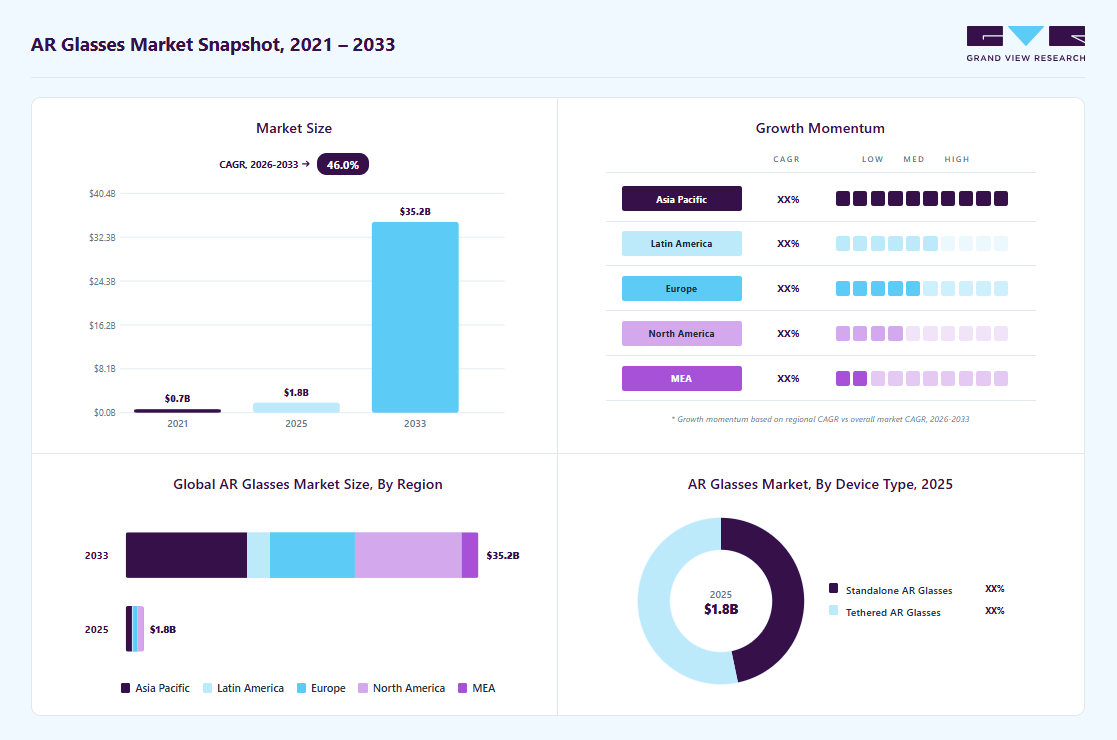
The global AR glasses market size was valued at USD 1.8 billion in 2025 and is projected to grow from USD 2.4 billion in 2026 to USD 35.2 billion by 2033, at a CAGR of 46.0% from 2026 to 2033. The North America AR glasses market held the largest share of 34.0% of the global market in 2025. This market expansion is driven by the growing integration of lightweight optics, AI-powered spatial computing, and real-time data visualization capabilities into wearable devices, and the rising demand for hands-free digital interfaces to enhance productivity, remote collaboration, and immersive user experiences.
 Source: Grand View Research, IR Documents, Primary Interviews, Paid DatabasesTo learn more about this report,
 Download Free Sample Report
 Key Market Trends & Insights
- By device type: The tethered AR glasses segment held the dominant position and accounted for the highest revenue share of over 53% in 2025.
- By technology: The marker-less segment accounted for the largest market share in 2025.
- By component: The display segment accounted for the largest revenue share of over 29% in 2025.
Regional Highlights
- Largest regional market: North America (34.0% revenue share, 2025)
- Fastest-growing regional market: Asia Pacific (highest CAGR, 2026-2033)
- The AR glasses industry in the U.S. held the largest revenue share in 2025.
Market Size & Forecast
- Market size in 2025: USD 1.8 Billion
- Estimated market size in 2026: USD 2.4 Billion
- Projected market size by 2033: USD 35.2 Billion
- CAGR (2026-2033): 46.0%
Three ways to get this report
Buy it, customize it, or ask a question.Ask an Analyst
Analyst response in 1 business day
- AccessReport author, directly
- Reply timeWithin 1 working day
- No sales callDirect answer only
- FormatEmail reply
- CostFree, no cost
Get the Full Report
What the study covers
- FormatsPDF · Excel · Dashboard
- Timeline2026–2033 annual, 2025 base
- Coverage20+ countries, 5 regions
- Companies10+ key players profiled
Customize the Report
20% free customization
- IncludeCountries, segments, points
- TailorTo your product definition
- ExtendDeeper competitor detail
- OrA fully bespoke study
- Turnaround5–10 working days
The growth of the AR glasses industry is driven by the rapid evolution of lightweight optical waveguide technologies, energy-efficient display components, and high-density battery systems that enable longer usage durations and improved wearer comfort. The adoption of ergonomically designed AR glasses is accelerating as enterprises, healthcare providers, and logistics companies seek hands-free visualization tools to streamline workflows, reduce human error, and enhance operational efficiency in dynamic working environments. The increasing integration of advanced spatial computing, computer vision, and sensor fusion technologies enhances environmental awareness and interactive capabilities in the AR glasses industry.
 To learn more about this report, Download Free Sample Report
 The rapid advancement of lightweight optical waveguide displays, micro LED and OLED-on-silicon technologies, and power-efficient processing units is significantly transforming visualization capabilities by enabling slimmer, more comfortable, and high-performance AR glasses designs. These innovations improved brightness, wider field of view, and enhanced color accuracy to deliver immersive augmented experiences in compact wearable form factors, supporting deployment across enterprise training, healthcare visualization, and consumer navigation applications. The integration of advanced semiconductor fabrication and precision optics manufacturing processes further supports scalable production and cost optimization in the market.
Additionally, the market is witnessing growing momentum toward the integration of AR glasses into enterprise digital transformation and remote workforce enablement platforms designed to enhance operational productivity and knowledge transfer in the AR smart glasses market. Organizations are increasingly incorporating AR-enabled workflows into maintenance, logistics, and field service operations to provide real-time instructions, digital overlays, and remote expert collaboration. This shift toward connected workforce technologies and immersive training environments is enabling companies to reduce operational errors, improve task completion speed, and strengthen workforce efficiency while meeting evolving demands for operational agility and workforce safety in the AR glasses industry.
Moreover, the expansion of smart manufacturing, warehouse automation, and Industry 4.0 initiatives is driving demand for real-time visualization and hands-free data access solutions. Industrial operators are increasingly investing in AR glass market to support pick-by-vision systems, equipment diagnostics, and quality assurance inspections, enabling faster decision-making and reduced operational downtime. This growing emphasis on process optimization, supply chain visibility, and asset performance management is strengthening the role of AR-enabled wearable technologies in the market.
Furthermore, the rising deployment of augmented reality technologies in healthcare, education, and defense training environments is reshaping application opportunities across the AR glasses industry. Medical professionals, educators, and defense organizations are increasingly adopting immersive visualization tools for surgical planning, anatomy simulation, mission rehearsal, and situational awareness enhancement. This transition toward interactive learning and simulation-based training solutions positions AR glass market to meet the evolving demands of precision training, safety preparedness, and advanced decision-support systems across critical sectors.
Device Type Insights
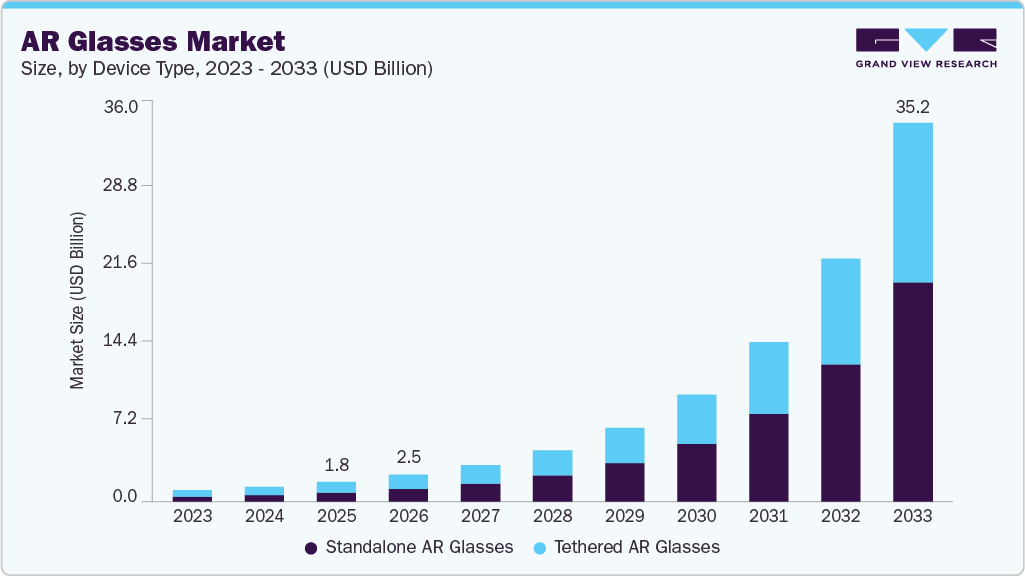
The tethered AR glasses segment accounted for the largest market share of over 53% in 2025, driven by its ability to leverage external computing devices and industrial workstations to deliver high-performance augmented reality experiences. Enterprises across manufacturing, logistics, and field service operations are prioritizing investments in tethered AR glasses that provide reliable visualization, extended battery life, and seamless integration. The continued expansion of digital workflow management, remote assistance solutions, and warehouse automation programs in industrial facilities and distribution centers reinforces the segment’s leading position in the market.
The standalone AR glasses segment is expected to witness the fastest CAGR of over 49% from 2026 to 2033. The segment growth is driven by rapid advancements in onboard processing power, edge computing capabilities, and integrated connectivity technologies. The rising demand for fully autonomous wearable devices across sectors such as healthcare, defense, construction, and smart manufacturing is accelerating the adoption of standalone AR glasses that operate independently. The growing focus on hands-free mobility, secure data processing, and field-ready deployment is expected to support strong expansion in the standalone AR glasses segment of the industry.
Technology Insights
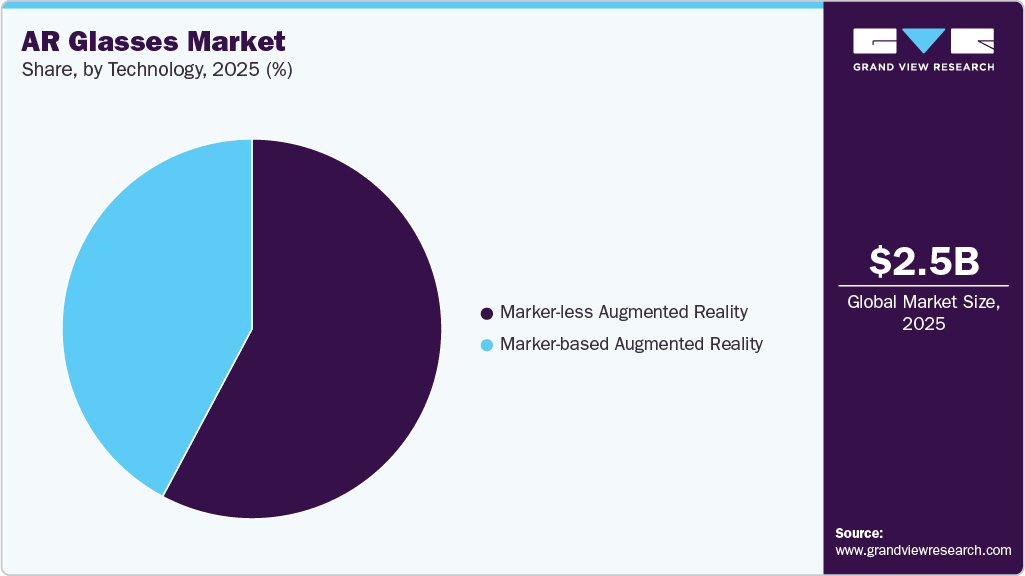
The marker-less segment accounted for the largest market share in 2025, driven by its ability to deliver flexible, real-time visualization without requiring predefined physical markers or codes. The continued expansion of smart factories, digital twin platforms, and mobile workforce solutions further reinforces the segment’s leading position, as organizations increasingly deploy intelligent AR systems that support remote collaboration, equipment diagnostics, and on-site decision-making in complex operational settings across the market.
 To learn more about this report, Download Free Sample Report
 The marker-based augmented reality segment is expected to witness a significant CAGR from 2026 to 2033, owing to its high accuracy, reliability, and ease of implementation in controlled environments. The rising demand for standardized workflow guidance, product visualization, and quality assurance processes is encouraging organizations to adopt marker-based AR glasses that utilize QR codes, visual tags, and predefined reference points. The growing focus on structured task execution, repeatable inspection processes, and low-cost deployment models is expected to support expansion in the marker-based segment of the industry.
Component Insights
The display segment accounted for the largest market share in 2025, owing to the increasing demand for high-brightness, lightweight, and energy-efficient micro display technologies. Enterprises and technology developers are prioritizing investments in advanced display systems to enhance image clarity, field of view, and user comfort in prolonged usage scenarios. The expansion of enterprise digitalization initiatives, remote assistance platforms, and immersive training programs is encouraging organizations to integrate high-performance display components into AR glasses to improve task accuracy and workforce productivity, thereby driving the segmental growth.
The processor & memory controllers segment is expected to witness the highest CAGR from 2026 to 2033. This growth is driven by the rapid advancement of edge computing architectures, increasing integration of AI acceleration capabilities, and rising demand for high-speed data processing. The growing emphasis on low-latency performance and real-time rendering capabilities is encouraging manufacturers to adopt advanced chip design technologies. The continuous evolution of secure processing frameworks and seamless connectivity with cloud-based ecosystems is accelerating the deployment of the processor & memory controllers.
Application Insights
The manufacturing & industrial segment accounted for the largest market share in 2025, owing to the increasing deployment of augmented reality solutions to enhance operational efficiency, workforce productivity, and real-time equipment visualization. The growing demand for hands-free digital guidance systems, remote expert assistance, and workflow automation tools is accelerating the adoption of smart wearable technologies. The rising emphasis on industrial digitalization, predictive maintenance strategies, and integration of connected factory platforms is strengthening the long-term growth potential of the manufacturing & industrial segment.
The healthcare segment is expected to witness the highest CAGR from 2026 to 2033. This growth is attributed to the rising demand for advanced visualization tools, precision-guided clinical workflows, and real-time access to critical patient data. The increasing focus on improving procedural accuracy, enhancing operational efficiency, and reducing human error is encouraging the adoption of hands-free digital interfaces capable of supporting complex medical tasks. The advancements in medical imaging integration and secure data transmission frameworks are accelerating the deployment of AR solutions, thereby supporting expansion in the healthcare segment.
Regional Insights
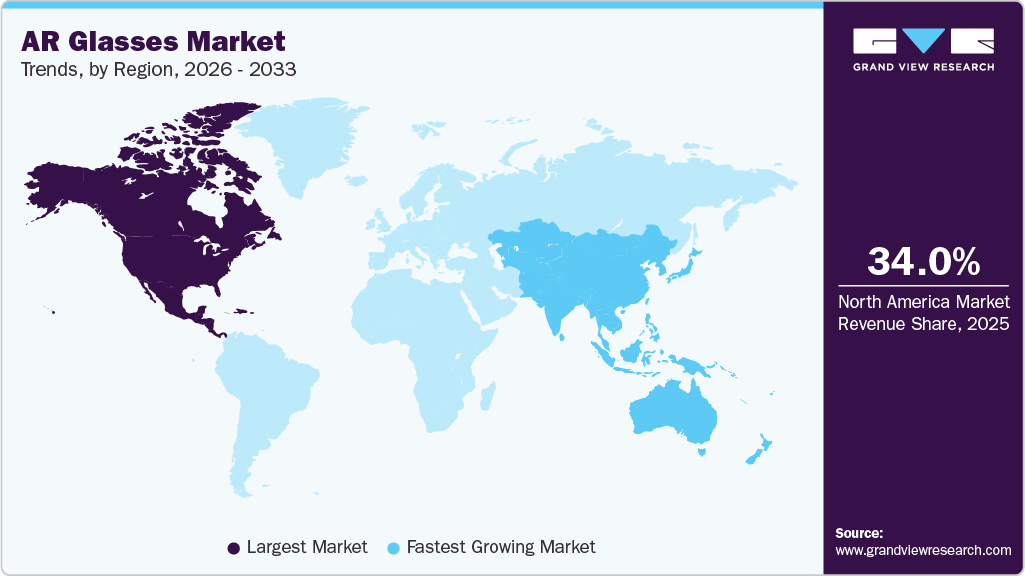
North America AR glasses market dominated with a share of over 34.0% in 2025, driven by the strong presence of leading technology innovators, established enterprise digital ecosystems, and early adoption of wearable computing solutions across industrial and healthcare sectors. The region is witnessing robust deployment of augmented reality solutions for workforce training, remote collaboration, and field service optimization across manufacturing, logistics, and defense organizations. The expansion of smart factories, advanced healthcare visualization systems, and enterprise mobility strategies is further strengthening market growth across North America.
 To learn more about this report, Download Free Sample Report
 U.S. AR Glasses Market Trends
The AR glasses market in the U.S. dominated the region with a share of over 81% in 2025, fueled by increasing investments in spatial computing platforms, immersive training simulations, and next-generation wearable productivity tools. The rising focus on improving operational efficiency in sectors such as aviation, healthcare, and construction is encouraging the deployment of the AR smart glasses market for real-time guidance, digital workflow management, and safety compliance monitoring. The presence of strong venture capital funding, rapid innovation in software development kits (SDKs), and the growing ecosystem of enterprise AR application developers are contributing to sustained market growth in the country.
Europe AR Glasses Market Trends
The AR glasses market in Europe is expected to grow at a CAGR of over 44% from 2026 to 2033. The market growth is driven by the increasing adoption of digital transformation initiatives and workforce modernization programs. The region is experiencing rising demand for wearable visualization technologies that support precision assembly, quality inspection, and maintenance operations in complex industrial environments. The integration of advanced human-machine interface technologies and regulatory emphasis on workplace safety standards is supporting improved operational efficiency and technology adoption across the industry.
The UK AR glasses market is expected to grow significantly in the coming years, driven by the expanding implementation of immersive education and simulation-based training platforms across universities, defense institutions, and professional training centers. Increasing collaboration between research organizations and technology startups is fostering innovation in lightweight wearable displays and cloud-connected augmented reality services. The growing focus on digital learning infrastructure and workforce reskilling programs is boosting demand for the AR glass market..
The AR glasses market in Germany is fueled by the increasing focus on smart manufacturing, modernization, and advanced engineering design processes. The country is witnessing rising adoption of AR-assisted design visualization, production planning, and maintenance support systems that improve operational accuracy and reduce production downtime. Strong emphasis on precision engineering, automation leadership, and industrial software integration is encouraging the development and deployment of highly reliable and performance-driven AR glasses technologies.
Asia Pacific AR Glasses Market Trends
The AR glasses market in Asia-Pacific is expected to grow at the highest CAGR of over 50% in 2025, driven by the rapid expansion of consumer electronics production, rising smartphone ecosystem integration, and increasing demand for immersive entertainment and gaming experiences. The region is experiencing strong adoption of cost-efficient wearable technologies that support navigation, live translation, and digital content interaction across urban populations. The growing penetration of 5G connectivity, e-commerce logistics networks, and smart retail infrastructure is enhancing demand for advanced AR visualization solutions across the market.
The Japan AR glasses market is gaining traction owing to the increasing adoption of robotics-assisted maintenance, precision manufacturing visualization, and advanced human-machine collaboration technologies in industrial environments. The country is focusing on integrating augmented reality into assembly line operations, equipment diagnostics, and quality control workflows to improve manufacturing precision and workforce productivity. The growing emphasis on automation, leadership, and high-tech industrial efficiency is encouraging investments in compact, durable, and high-performance AR glasses systems.
China's AR glasses market is rapidly expanding, driven by the strong growth of domestic consumer technology brands, large-scale deployment of smart retail and digital commerce platforms, and government-backed initiatives supporting extended reality (XR) innovation. The country is witnessing increasing adoption of AR glasses in logistics, warehousing, live-stream commerce, and urban infrastructure management applications. The expansion of local hardware manufacturing capabilities and the rising demand for affordable wearable devices are accelerating large-volume production and widespread adoption of AR glasses technologies across the country.
Key AR Glasses Companies Insights
Some of the key players operating in the market are Apple Inc. and Microsoft Corporation, among others.
-
Apple Inc. is a technology leader in consumer electronics and spatial computing solutions, offering advanced augmented reality hardware and software platforms designed to support immersive digital experiences across productivity, entertainment, and enterprise applications. The company’s strong ecosystem integration, proprietary chip design capabilities, and continuous investment in mixed reality and wearable computing technologies have strengthened its position as one of the most dominant players in the global industry.
-
Microsoft Corporation is a provider of enterprise-grade augmented reality and mixed reality solutions, delivering advanced AR glasses platforms such as industrial and defense-focused head-mounted devices designed for remote collaboration, training, and field service operations. The company’s strong presence in enterprise software, cloud computing infrastructure, and defense technology programs has reinforced its leadership in the global AR glasses industry, enabling widespread deployment of secure, high-reliability augmented visualization systems.
XReal, Inc. and Rokid are some of the emerging market participants in the AR glasses market.
-
XReal, Inc. is an emerging developer of lightweight consumer-oriented augmented reality glasses designed to deliver immersive media streaming, gaming, and productivity experiences through compact wearable displays. The company focuses on affordable, stylish AR hardware integrated with smartphone ecosystems and advanced display technologies, positioning itself as a fast-growing innovator in the AR glasses market. Its expanding global partnerships with telecom operators and consumer electronics distributors are accelerating the adoption of next-generation wearable display solutions across entertainment and computing applications.
-
Rokid is a rapidly growing augmented reality company specializing in smart glasses designed for industrial assistance, warehouse logistics, and remote maintenance operations. The company leverages advanced voice interaction, computer vision, and cloud-based data integration technologies to enhance operational efficiency and workforce productivity in enterprise environments. Its focus on practical industrial applications and scalable enterprise deployment models is strengthening its emergence as a key growth player in the industry.
Key AR Glasses Companies:
The following key companies have been profiled for this study on the AR glasses market.
- XReal, Inc.
- Rokid
- Microsoft Corporation
- Seiko Epson Corporation
- Vuzix Corporation
- RealWear, Inc.
- RayNeo (TCL)
- Viture
- Lenovo Group Limited
- Apple Inc.
- Meta Platforms, Inc.
- Google LLC
- Xiaomi Corporation
- Sony Group Corporation
Recent Developments
-
In March 2026, Meta Platforms, Inc. unveiled two new Ray-Ban Meta prescription smart glasses models, Blayzer Optics and Scriber Optics, developed in collaboration with eyewear manufacturer EssilorLuxottica. The launch focused on improved comfort, personalization, and AI-enabled wearable functionality designed to expand adoption among users requiring vision correction. This product expansion highlighted Meta’s strategy to accelerate mainstream adoption of AI-powered AR glasses and strengthen its dominant position in the global smart glasses ecosystem.
-
In January 2026, RayNeo introduced the world’s first eSIM-enabled standalone augmented reality glasses at the Consumer Electronics Show (CES) 2026, enabling direct network connectivity without reliance on smartphones. The product launch demonstrated advancements in independent wearable computing capabilities and highlighted the company’s ambition to deliver fully autonomous AR devices for enterprise and consumer applications, strengthening its technological competitiveness in next-generation wearable platforms.
-
In January 2026, XReal, Inc. collaborated with ASUS to introduce the ROG XREAL R1 augmented reality gaming glasses. The new product featured high-refresh-rate micro-OLED displays and compatibility with gaming consoles and PCs, enabling immersive visual performance for gaming and entertainment applications. This collaboration demonstrated the growing convergence of AR technology with gaming ecosystems and strengthened the company’s presence in the consumer AR glasses segment.
AR Glasses Market Report Scope
Report Attribute
Details
Market size in 2025
USD 1.8 billion
Estimated market size in 2026
USD 2.4 billion
Projected market size by 2033
USD 35.2 billion
Growth rate
CAGR of 46.0% from 2026 to 2033
Base year for estimation
2025
Historical data
2021 - 2024
Forecast period
2026 - 2033
Quantitative units
Revenue in USD million/billion and CAGR from 2026 to 2033
Report product
Revenue forecast, company ranking, competitive landscape, growth factors, and trends
Segments covered
Device type, technology, component, application, region
Regional scope
North America; Europe; Asia Pacific; Latin America; Middle East & Africa
Country scope
U.S.; Canada; Mexico; UK; Germany; France; China; Japan; India; South Korea; Australia; Brazil; UAE; Saudi Arabia; South Africa
Key companies profiled
XReal, Inc.; Rokid; Microsoft Corporation; Seiko Epson Corporation; Vuzix Corporation; RealWear, Inc.; RayNeo (TCL); Viture; Lenovo Group Limited; Apple Inc.; Meta Platforms, Inc.; Google LLC; Xiaomi Corporation; Sony Group Corporation
Customization scope
Free report customization (equivalent to up to 8 analyst’s working days) with purchase. Addition or alteration to country, regional & segment scope.
Pricing and purchase options
Avail customized purchase options to meet you exact research needs. Explore purchase options
Global AR Glasses Market Report Segmentation
This report forecasts revenue growth at global, regional, and country levels and provides an analysis of the latest technological trends in each of the sub-segments from 2021 to 2033. For this study, Grand View Research has segmented the global AR glasses market report based on device type, technology, component, application, and region:
-
Device Type Outlook (Revenue, USD Billion, 2021 - 2033)
-
Standalone AR Glasses
-
Tethered AR Glasses
-
-
Technology Outlook (Revenue, USD Billion, 2021 - 2033)
-
Marker-based Augmented Reality
-
Marker-less Augmented Reality
-
-
Component Outlook (Revenue, USD Billion, 2021 - 2033)
-
Display
-
Sensors
-
Lenses
-
Processor & Memory Controllers
-
Camera
-
Case & Connectors
-
Others
-
-
Application Outlook (Revenue, USD Billion, 2021 - 2033)
-
Consumer
-
Manufacturing & Industrial
-
Healthcare
-
Automotive
-
Aerospace & Defense
-
Energy & Utilities
-
Logistics & Warehousing
-
Retail & Field Services
-
Others
-
-
Regional Outlook (Revenue, USD Billion, 2021 - 2033)
-
North America
-
U.S.
-
Canada
-
Mexico
-
- Europe
-
UK
-
Germany
-
France
-
-
Asia Pacific
-
China
-
Japan
-
India
-
South Korea
-
Australia
-
-
Latin America
-
Brazil
-
-
Middle East and Africa (MEA)
-
UAE
-
Saudi Arabia
-
South Africa
-
-
Frequently Asked Questions About This Report
North America dominated with a 34.0% revenue share in 2025.
The tethered AR glasses segment accounted for the largest market share of over 53% in 2025, driven by its ability to leverage external computing devices and industrial workstations to deliver high-performance augmented reality experiences. Enterprises across manufacturing, logistics, and field service operations are prioritizing investments in tethered AR glasses that provide reliable visualization, extended battery life, and seamless integration. The continued expansion of digital workflow management, remote assistance solutions, and warehouse automation programs in industrial facilities and distribution centers reinforces the segment’s leading position in the market.
Some key players operating in the AR glasses market include XReal, Inc.; Rokid; Microsoft Corporation; Seiko Epson Corporation; Vuzix Corporation; RealWear, Inc.; RayNeo (TCL); Viture; Lenovo Group Limited; Apple Inc.; Meta Platforms, Inc.; Google LLC; Xiaomi Corporation; Sony Group Corporation
This market growth is driven by the growing integration of lightweight optics, AI-powered spatial computing, and real-time data visualization capabilities into wearable devices, and the rising demand for hands-free digital interfaces to enhance productivity, remote collaboration, and immersive user experiences.
The display segment accounted for the largest market share in 2025, while processor & memory controllers is the fastest-growing segment.
The marker-less segment accounted for the largest market share in 2025.
The global AR glasses market size was valued at USD 1.9 billion in 2025 and is expected to reach USD 2.4 billion in 2026.
The global AR glasses market is expected to grow at a compound annual growth rate (CAGR) of 46.0% from 2026 to 2033 to reach USD 35.1 billion by 2033.
About the Author(s)
Next Generation Technologies Research Team
Technology · Next Generation TechnologiesThis report was authored by the next generation technologies research team at Grand View Research - comprising two research analysts, one senior research analyst, and one industry expert - with specialized expertise in the next generation technologies segment of the technology industry. All findings are based on proprietary technology databases, executive interviews, and regulatory analysis, subject to internal peer review prior to publication.
Last Updated:
Speak to Analyst

Customize this report to your needs - add regions, segments, or data points, with 20% free customization.
Or view our licence options:


ISO 9001:2015 & 27001:2022 Certified
We are GDPR and CCPA compliant! Your transaction & personal information is safe and secure. For more details, please read our privacy policy.


