
- Home
- »
- Advanced Interior Materials
- »
-
Aseptic Filling Machine Market Size Report, 2026-2033GVR Report cover
![Aseptic Filling Machine Market (2026 - 2033)Report]()
Aseptic Filling Machine Market (2026 - 2033)
Size, Share & Trends Analysis Report By Packaging (Bottles & Cans, Vials & Ampoules, Pre-Filled Syringes (PFS) & Cartridges), By Mode Of Operation (Fully Automatic, Semi-Automatic), By End Use, By Region And Segment Forecasts
Market Size, 2025
$1.4BMarket Estimate, 2026
$1.5BMarket Forecast, 2033
$2.1BCAGR, 2026–2033
4.9%Aseptic Filling Machine Market Summary
The global aseptic filling machine market size was valued at USD 1.4 billion in 2025 and is projected to grow from USD 1.5 billion in 2026 to USD 2.1 billion by 2033, at a CAGR of 4.9% from 2026 to 2033. The market in Asia Pacific dominated with a revenue share of 37.1% in 2025. The growth of the industry is primarily driven by the increasing demand for sterile pharmaceutical and biologic products.

Key Market Trends & Insights
- By Packaging: Bottles and cans segment held the largest market share of 34.3% in 2025.
- By Mode of Operation: Fully automatic segment held the largest market share of 77.0% in 2025.
- By End Use: Food & beverage segment held the largest market share in 2025.
Regional Highlights
- Largest regional market: Asia Pacific (37.1% revenue share, 2025)
- By country: China held the largest market share in 2025
Market Size & Forecast
- Market size in 2025: USD 1.4 Billion
- Estimated market size in 2026: USD 1.5 Billion
- Projected market size by 2033: USD 2.1 Billion
- CAGR (2026-2033): 4.9%
As the production of vaccines, injectable drugs, and biologics continues to expand, manufacturers require advanced aseptic filling systems to ensure contamination-free packaging and compliance with strict regulatory standards. The growing popularity of ready-to-use packaging formats, such as prefilled syringes and vials, is driving the need for automated aseptic filling technologies. Furthermore, pharmaceutical manufacturers are investing in high-efficiency and automated production lines to improve operational productivity and reduce human intervention in sterile processes. The expansion of pharmaceutical manufacturing capacity in emerging markets is also contributing to higher equipment demand.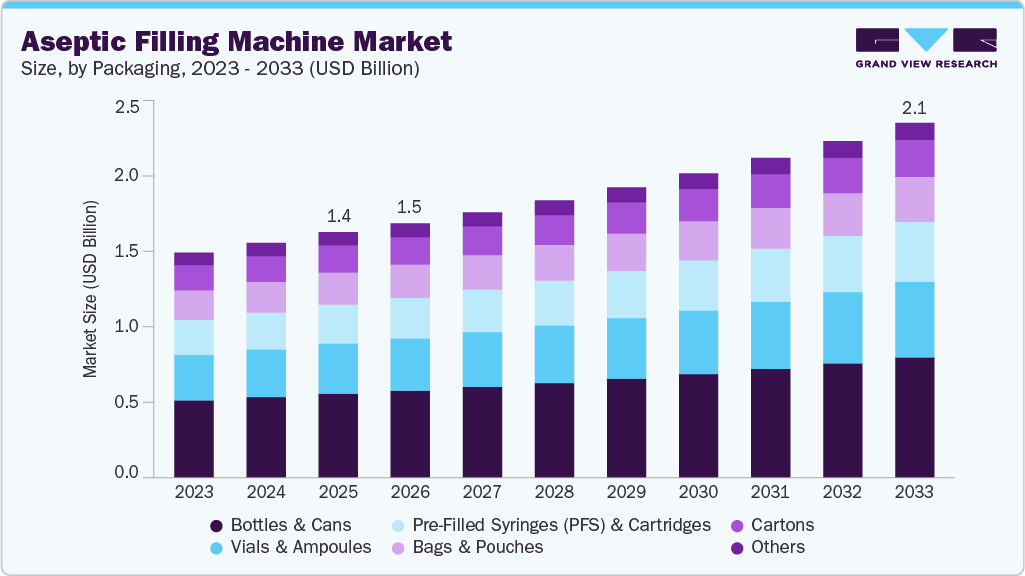
Market Dynamics
The pharmaceutical and biotechnology sectors are witnessing substantial growth driven by the rising prevalence of chronic diseases, increasing approvals of biologic drugs, and expanding global vaccination programs. These trends are creating strong demand for sterile filling environments capable of handling sensitive liquid formulations with high accuracy and minimal contamination risk. Aseptic filling machines play a critical role in ensuring product integrity, dosage precision, and compliance with stringent pharmaceutical manufacturing regulations.
The growing popularity of prefilled syringes, cartridges, and self-administered injectable therapies is prompting pharmaceutical companies to modernize their production facilities with automated aseptic filling lines. Contract manufacturing organizations (CMOs) and biopharmaceutical firms are also increasing investments in high-speed sterile processing technologies to improve operational efficiency and production scalability. Continuous advancements in robotics, isolator technology, and digital monitoring systems are further enhancing the reliability and adoption of aseptic filling equipment across pharmaceutical applications.
A major restraint affecting the aseptic filling machine market is the high capital investment required for installation, validation, and maintenance of advanced sterile filling systems. Fully automated aseptic equipment involves significant expenditure on specialized machinery, cleanroom infrastructure, isolator systems, sterilization technologies, and quality monitoring systems. Small and medium-sized manufacturers, particularly in developing economies, often face financial limitations that restrict the adoption of sophisticated aseptic filling solutions.
Market Concentration & Characteristics
The aseptic filling machine market is moderately concentrated, with a limited number of established equipment manufacturers supplying advanced sterile filling systems to pharmaceutical and biotechnology companies. Leading players compete through technological expertise, global service networks, and long-term partnerships with pharmaceutical manufacturers. As aseptic processing is critical for injectable drug production, buyers typically prefer experienced suppliers that can provide reliable systems, validation support, and regulatory compliance capabilities.
Regulatory requirements play a significant role in shaping the market. Pharmaceutical manufacturers must comply with strict guidelines related to sterile drug production issued by authorities such as the U.S. Food and Drug Administration and the European Medicines Agency. These regulations require validated aseptic processes, controlled environments, and high levels of automation to minimize contamination risks. Compliance with evolving good manufacturing practice (GMP) standards encourages continuous investment in advanced aseptic filling technologies and equipment upgrades.
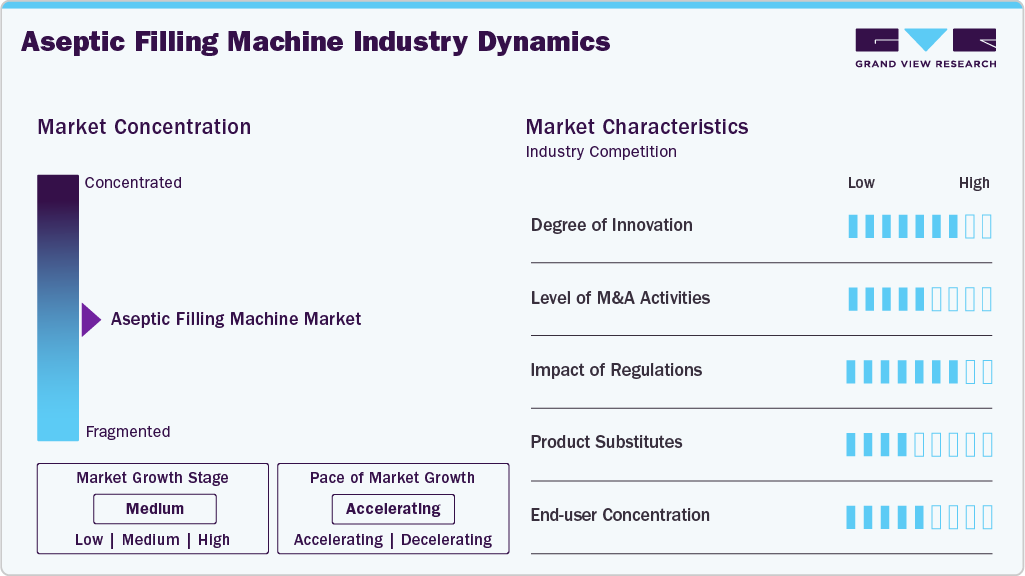
Technological advancements are also influencing market development, with increasing adoption of robotics, isolator-based systems, and automated filling lines designed to reduce human intervention and improve sterility assurance. Digital monitoring systems, real-time quality control, and flexible filling platforms capable of handling multiple container formats are becoming more common. In response, leading companies are focusing on product innovation, strategic collaborations with pharmaceutical manufacturers, and expansion of service and support capabilities to strengthen their competitive position in the market.
Packaging Insights
The bottles and cans segment represents a key packaging of the aseptic filling machine market, particularly in the food and beverage industry. These containers are widely used for packaging products such as dairy beverages, juices, functional drinks, and ready-to-drink products that require extended shelf life without preservatives. Aseptic filling machines for bottles and cans enable high-speed, contamination-free filling while maintaining product quality and safety. The increasing demand for packaged beverages and shelf-stable liquid products continues to support the adoption of aseptic filling technologies for this container format.
The pre-filled syringes (PFS) and cartridges segment is estimated to be the fastest-growing segment with a projected CAGR of 5.7%. The segment is experiencing strong growth driven by rising demand for injectable pharmaceuticals, biologics, and self-administered drug-delivery systems. These packaging formats improve dosing accuracy, reduce drug wastage, and enhance patient convenience compared to traditional vial-based delivery.
Mode of Operation Insights
The fully automatic segment represents a critical segment due to its ability to support high-volume production and maintain consistent sterility standards. These systems integrate automated container handling, filling, sealing, and inspection processes, minimizing human intervention and reducing contamination risks. Pharmaceutical and large-scale beverage manufacturers increasingly prefer fully automated systems to improve operational efficiency, maintain regulatory compliance, and support continuous production lines. The growing focus on automation in manufacturing facilities is further driving the adoption of fully automatic aseptic filling equipment.
The semi-automatic segment is projected to expand at a CAGR of 4.2% over the forecast period. These are commonly used by small and medium-scale manufacturers, research facilities, and pilot production lines. They offer flexibility and a lower initial investment than fully automated systems, while still enabling sterile filling processes. Semi-automatic machines are often used for smaller batch production, product development, and specialized pharmaceutical applications where production volumes are limited. Their cost-effectiveness and operational simplicity make them suitable for companies that require controlled aseptic processing without large-scale automation.
End Use Insights
The food & beverage segment dominated the global revenue share in 2025, accounting for 40.1% of the share, driven by increasing demand for shelf-stable packaged products. Aseptic filling technology enables the packaging of beverages such as dairy products, juices, plant-based drinks, and liquid foods without refrigeration, while maintaining product quality and safety. The growing consumption of ready-to-drink beverages and convenience foods is encouraging manufacturers to adopt aseptic packaging solutions. Additionally, expanding beverage production capacities in emerging economies is expected to foster demand for advanced aseptic filling equipment.
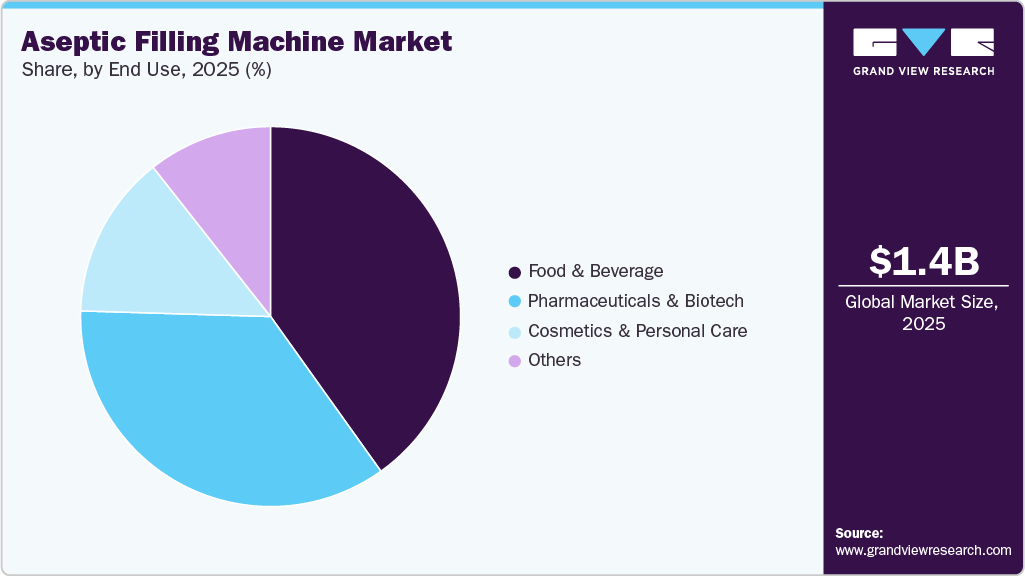
The pharmaceuticals and biotechnology segment is a key growth driver, due to the strict sterility requirements associated with injectable drugs and biologic therapies. Aseptic filling systems are essential for packaging products such as vaccines, monoclonal antibodies, insulin, and other injectable medicines. Pharmaceutical manufacturers rely on these machines to ensure contamination-free filling processes and compliance with regulatory standards for sterile drug production. The growing pipeline of biologics, biosimilars, and advanced injectable therapies is further increasing demand for highly specialized aseptic filling technologies in this sector.
Regional Insights
The aseptic filling machine industry in Asia Pacific is expanding rapidly due to the growth of pharmaceutical manufacturing sector and increasing investments in healthcare infrastructure. Countries such as China, India, South Korea, and Japan are witnessing rising production of generic drugs, vaccines, and biologics, which is driving demand for aseptic filling equipment. Moreover, the rapid growth of the food and beverage industry and rising consumption of packaged beverages are encouraging manufacturers to adopt aseptic packaging technologies. However, cost considerations and varying regulatory standards across countries may present challenges for some manufacturers.
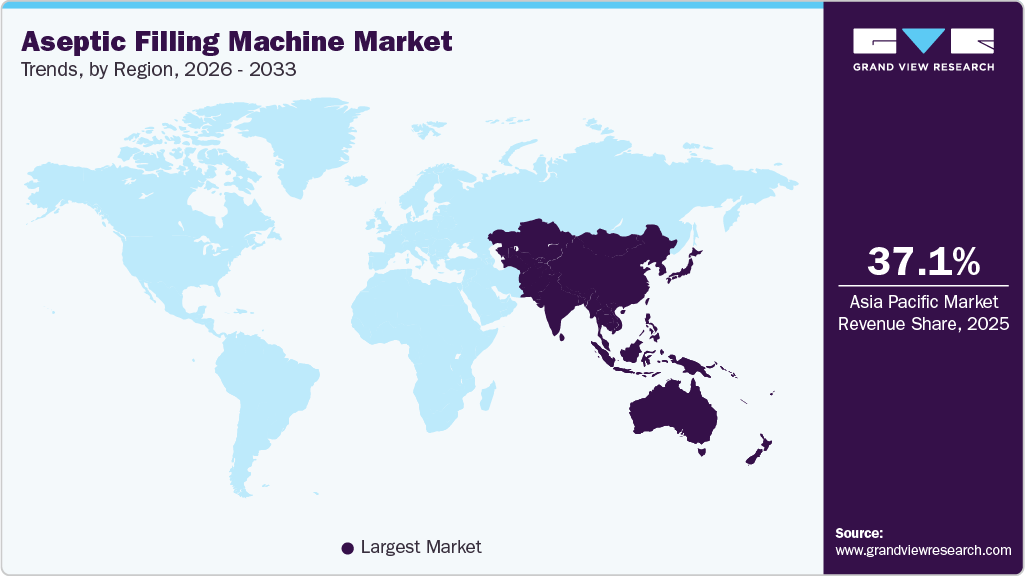
The China aseptic filling machine industry is growing as pharmaceutical manufacturers modernize production facilities to meet stricter drug quality and sterility standards. The country has been increasing investment in biologics, vaccines, and high-value injectable medicines, which require advanced sterile filling technologies. At the same time, China large beverage and dairy processing industry is adopting aseptic filling solutions to support high-volume production of shelf-stable drinks and liquid foods.
The aseptic filling machine industry in India is supported by the country’s strong pharmaceutical manufacturing ecosystem and its role as a major global supplier of generic medicines. Drug manufacturers are strengthening sterile production capabilities to expand injectable drug exports and vaccine manufacturing capacity. Alongside pharmaceutical demand, the expanding market for packaged dairy beverages, juices, and ready-to-drink products supported by a large population is encouraging food and beverage producers to invest in aseptic packaging and filling technologies.
North America Aseptic Filling Machine Market Trends
The aseptic filling machine industry in North America is driven by the presence of a well-established pharmaceutical and biotechnology industry, particularly in the U.S. and Canada. The increased production of biologics, vaccines, and injectable drugs is driving strong demand for advanced sterile filling technologies. Furthermore, stringent regulatory standards for sterile drug manufacturing are encouraging pharmaceutical companies to adopt highly automated aseptic filling systems to ensure compliance and product safety. Ongoing investments in pharmaceutical manufacturing facilities and the expansion of biologics production capacity continue to support market growth in the region.
The U.S. aseptic filling machine industry is driven by the country's large pharmaceutical and biotechnology industry and strong focus on biologics and advanced injectable therapies. Increasing production of vaccines, monoclonal antibodies, and specialty drugs is creating demand for highly automated aseptic filling systems. Moreover, strict regulatory standards for sterile drug manufacturing encourage pharmaceutical companies to invest in advanced filling technologies that ensure contamination control and operational efficiency.
Europe Aseptic Filling Machine Market Trends
The aseptic filling machine industry in Europe is supported by strong pharmaceutical manufacturing capabilities and strict regulatory frameworks governing sterile drug production. Countries such as Germany, Switzerland, and Italy host several pharmaceutical equipment manufacturers and contract manufacturing organizations that require advanced aseptic filling solutions. The increasing focus on biologics, biosimilars, and high-value injectable therapies is further driving demand for precision aseptic filling technologies. Additionally, the region’s well-developed food and beverage sector is contributing to the adoption of aseptic filling systems for packaging shelf-stable liquid products.
The Germany aseptic filling machine industry represents a key market in Europe due to its strong pharmaceutical manufacturing base and advanced industrial equipment sector. The presence of major pharmaceutical companies and contract manufacturing organizations is driving demand for high-precision aseptic filling machines. Additionally, Germany’s strong engineering capabilities and focus on automation are supporting the adoption of advanced filling systems designed to meet strict European regulatory requirements for sterile production.
The aseptic filling machine industry in the UK is supported by a well-developed pharmaceutical and biotechnology sector and increasing investment in biologics manufacturing. The country has several research and development centers and contract manufacturing facilities focused on sterile injectable drugs. The growing demand for high-quality injectable medicines and vaccines, along with strict regulatory oversight of pharmaceutical production, is driving the adoption of advanced aseptic filling technologies.
Latin America Aseptic Filling Machine Market Trends
The aseptic filling machine industry in Latin America is primarily supported by the gradual expansion of pharmaceutical manufacturing and increasing demand for packaged food and beverage products. Countries such as Brazil are strengthening their pharmaceutical production capabilities and investing in modern manufacturing technologies to meet domestic healthcare needs. The growing demand for safe and shelf-stable beverages is also encouraging the adoption of aseptic filling systems in the food and beverage industry. However, economic fluctuations and limited access to advanced manufacturing infrastructure in certain countries may affect the pace of market development.
The Brazil aseptic filling machine industry is influenced by the continued development of its pharmaceutical and food processing industries. Pharmaceutical producers are gradually adopting advanced sterile filling systems to improve manufacturing quality and comply with evolving regulatory requirements. Parallelly, increasing consumption of packaged beverages and dairy products is prompting food and beverage manufacturers to implement aseptic filling technologies that extend product shelf life and support large-scale production.
Middle East & Africa Aseptic Filling Machine Market Trends
The aseptic filling machine industry in the Middle East and Africa is developing steadily, supported by growing investments in healthcare infrastructure and pharmaceutical manufacturing capacity. Several countries in the Middle East are focusing on strengthening domestic drug production to reduce dependence on imports, which is increasing demand for sterile manufacturing technologies. In addition, the expanding packaged food and beverage sector is contributing to the adoption of aseptic filling systems for long shelf-life products.
The Saudi Arabia aseptic filling machine industry is growing as the country focuses on strengthening domestic pharmaceutical manufacturing and reducing reliance on imported medicines. Government initiatives to develop local pharmaceutical production and improve healthcare infrastructure are encouraging investment in sterile drug manufacturing technologies.
Key Aseptic Filling Machine Company Insights
Some of the key players operating in the market include SIG and Krones AG, among others.
-
SIG. is a multinational company engaged in the manufacture of aseptic carton packaging and filling machines, bag-in-box filling technology, carton packaging sleeves, spouts, and caps, as well as aftermarket services for food & beverage producers worldwide. The company’s operations are spread across the globe with equipment assembly facilities, production facilities, R&D facilities, sales network, test filling centers, and training centers established in the Americas, Europe, the Middle East, and the Asia Pacific with an overall presence in more than 100 nations. It has partnered with over 200 food & beverage producers across more than 60 countries.
-
Krones AG is company engaged in the manufacturing of processing, filling, and packaging lines as well as individual machinery for filling beverages in cans or glass and plastic bottles. It caters to a large set of customers, including breweries, juice & soft drink manufacturers, producers of spirits, wine, & sparkling wine, and companies in the liquid food industry. The company invests in R&D substantially and had 7,058 registered patents and utility models in 2023. The company has over 100 sites globally, which include its headquarters, production facilities, sales & service centers, and training centers.
Key Aseptic Filling Machine Companies:
The following key companies have been profiled for this study on the aseptic filling machine market.
- AST, LLC
- Bausch+Ströbel SE + Co. KG
- Maquinaria Industrial Dara, SL
- Groninger Holding GmbH & Co. KG
- I.M.A. Industria Macchine Automatiche S.p.A.
- Marchesini Group S.p.A.
- OPTIMA
- Syntegon Technology GmbH
- Tofflon Science and Technology Group Co., Ltd
- Romaco Group
- SIG
- Tetra Pak International S.A.
- Krones AG
- GEA Group Aktiengesellschaft
- FBR-ELPO S.p.A.
- Serac Group
Competitive Benchmarking
Operating Strategies
Competitive Edge
Weaknesses
Mature Players: Tetra Pak International S.A.; Krones AG; GEA Group Aktiengesellschaft; Syntegon Technology GmbH; I.M.A. Industria Macchine Automatiche S.p.A.; Marchesini Group S.p.A.; SIG
- Focus on large-scale automated aseptic filling systems for pharmaceutical, dairy, and beverage industries with high production throughput.
- Expand global manufacturing and service networks through strategic partnerships, acquisitions, and long-term contracts with multinational food and pharma companies.
- Invest heavily in smart manufacturing technologies, including robotics, AI-based monitoring, and integrated packaging solutions to enhance operational efficiency.
- Strong global brand recognition and extensive installed equipment base across developed and emerging markets.
- Broad product portfolios covering complete aseptic processing, sterilization, filling, and packaging solutions under a single platform.
- High R&D capabilities and compliance expertise enabling advanced sterile processing systems that meet strict international regulatory standards.
- High equipment and maintenance costs may limit adoption among small and medium-sized manufacturers.
- Large organizational structures can slow customization and response time for niche customer requirements.
- Significant dependence on mature food and beverage markets may limit rapid growth potential in certain regions.
Emerging Players: AST, LLC; Maquinaria Industrial Dara, SL; Tofflon Science and Technology Group Co., Ltd; FBR-ELPO S.p.A.; Serac Group; Romaco Group; OPTIMA
- Focus on cost-effective and flexible aseptic filling systems targeting mid-sized pharmaceutical, biotech, and regional food manufacturers.
- Expand presence through customized filling solutions, modular equipment designs, and regional distribution partnerships.
- Increase investments in sterile processing technologies and automation capabilities to strengthen competitiveness against established players.
- Greater flexibility in offering customized aseptic filling systems tailored to specific production requirements.
- Competitive pricing strategies help attract customers in developing and price-sensitive markets.
- Faster adoption of niche technologies and specialized applications, particularly in biologics, injectable drugs, and small-batch production.
- Limited global presence and smaller service networks compared to established multinational companies.
- Lower production scale and R&D budgets may restrict the development of highly advanced integrated aseptic systems.
Recent Developments
-
In November 2024, SIG launched the SIG Neo Slimline 15 Aseptic, expanding its Neo filling machine portfolio for aseptic carton packaging. The new system is designed to improve production efficiency for food and beverage manufacturers, offering higher output of up to 15,000 packs per hour along with a compact footprint that helps optimize factory space. It also supports multiple pack volumes and incorporates advanced features such as improved sterile airflow, digital monitoring, and semi-automated cleaning to enhance operational efficiency and reduce downtime.
-
In December 2025, Marchesini Group announced a strategic partnership with U.S.-based AST, a provider of aseptic fill-finish technologies. As part of the agreement, Marchesini acquired a 44.4% equity stake in AST, aiming to strengthen its portfolio of aseptic packaging and sterile filling solutions for pharmaceutical and biotechnology applications. The collaboration combines the companies’ technologies and global networks to develop more advanced fill-finish systems, expand production capacity, and enhance distribution and technical support across key regions such as North America, Europe, and Asia.
Aseptic Filling Machine Market Report Scope
Report Attribute
Details
Market size in 2025
USD 1.4 billion
Estimated Market size in 2026
USD 1.5 billion
Projected Market size by 2033
USD 2.1 billion
Growth rate
CAGR of 4.9% from 2026 to 2033
Base year for estimation
2025
Historical data
2021 - 2024
Forecast period
2026 - 2033
Quantitative units
Revenue in USD million/billion and CAGR from 2026 to 2033
Report coverage
Revenue forecast, company market position analysis, competitive landscape, growth factors, and trends
Segments covered
Packaging, mode of operation, end use, region
Regional scope
North America; Europe; Asia Pacific; Latin America; Middle East & Africa
Country Scope
U.S.; Canada; Mexico; UK; Germany; France; Italy; Spain; China; India; Japan; South Korea; Australia; Brazil;
Argentina; South Africa; Saudi Arabia; UAE
Key companies profiled
AST, LLC; Bausch+Ströbel SE + Co. KG; Maquinaria Industrial Dara, SL; Groninger Holding GmbH & Co. KG; I.M.A. Industria Macchine Automatiche S.p.A.; Marchesini Group S.p.A.; OPTIMA; Syntegon Technology GmbH; Tofflon Science and Technology Group Co., Ltd; Romaco Group; SIG; Tetra Pak International S.A.; Krones AG; GEA Group Aktiengesellschaft; FBR-ELPO S.p.A.; Serac Group.
Customization scope
Free report customization (equivalent up to 8 analysts working days) with purchase. Addition or alteration to country, regional & segment scope.
Pricing and purchase options
Avail customized purchase options to meet your exact research needs. Explore purchase options
Global Aseptic Filling Machine Market Report Segmentation
This report forecasts revenue growth at global, regional & country levels and provides an analysis on the industry trends in each of the sub-segments from 2021 to 2033. For this study, Grand View Research has segmented the global aseptic filling machine market report on the basis of packaging, mode of operation, end use, and region:
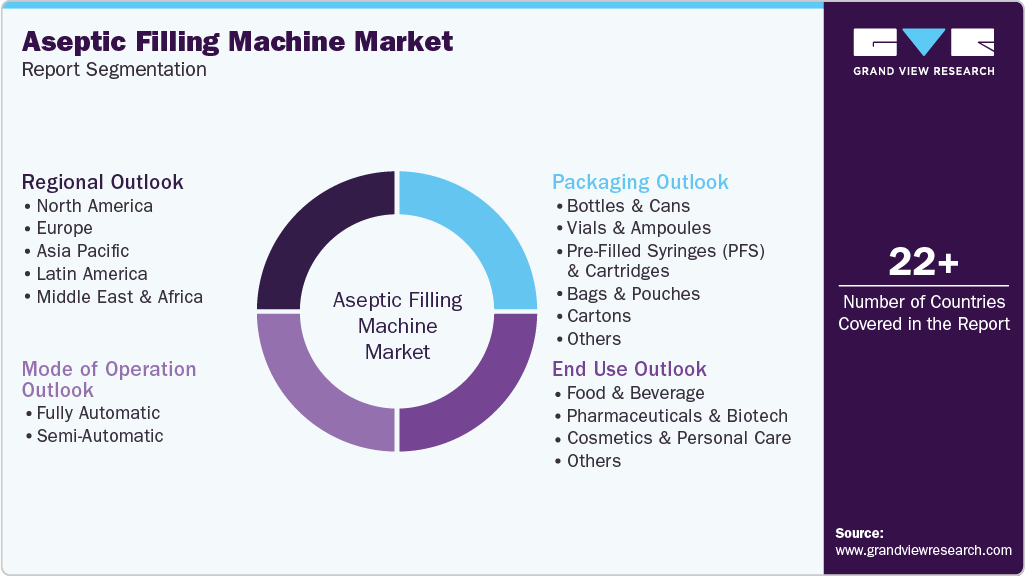
-
Packaging Outlook (Revenue, USD Million, 2021 - 2033)
-
Bottles & Cans
-
Vials & Ampoules
-
Pre-Filled Syringes (PFS) & Cartridges
-
Bags & Pouches
-
Cartons
-
Others
-
-
Mode of Operation Outlook (Revenue, USD Million, 2021 - 2033)
-
Fully Automatic
-
Semi-Automatic
-
-
End Use (Revenue, USD Million, 2021 - 2033)
-
Food & Beverage
-
Pharmaceuticals & Biotech
-
Cosmetics & Personal Care
-
Others
-
-
Regional Outlook (Revenue, USD Million, 2021 - 2033)
-
North America
-
U.S.
-
Canada
-
Mexico
-
-
Europe
-
UK
-
Germany
-
France
-
Italy
-
Spain
-
-
Asia Pacific
-
China
-
India
-
Japan
-
South Korea
-
Australia
-
-
Latin America
-
Brazil
-
Argentina
-
-
Middle East & Africa
-
South Africa
-
Saudi Arabia
-
UAE
-
-
Delivered Customizations
This report has been delivered with the following In-depth customizations
Client Request
Customization Delivered
Value Adds
Regional Segmentation
A detailed regional assessment was delivered covering North America, Europe, Asia Pacific, Latin America, and Middle East & Africa, along with country-level analysis for key markets such as the U.S., Germany, China, India, and Brazil. The study evaluated regional demand patterns, industrial growth trends, regulatory environment, and investment activities influencing the aseptic filling machine market.
Enabled the client to identify high-growth regional markets, optimize geographic expansion strategies, and understand region-specific demand drivers and competitive intensity for better market positioning.
Opportunity assessment
A comprehensive opportunity analysis was conducted across packaging formats, automation levels, and end-use industries, including pharmaceuticals, biotech, dairy, beverages, and cosmetics. The assessment highlighted emerging revenue pockets, technological adoption trends, and investment potential in high-growth applications such as biologics and pre-filled syringes.
Helped the client prioritize profitable business segments, identify untapped growth opportunities, and align future investments with rapidly expanding application areas and customer demand trends.
Competitive benchmarking
An in-depth competitive benchmarking study was provided comparing major market participants based on product portfolio, technological capabilities, geographic presence, strategic initiatives, automation expertise, and end-use specialization. The analysis also evaluated competitive positioning between mature multinational companies and emerging regional players.
Assisted the client in understanding competitor strengths and weaknesses, identifying market differentiation opportunities, and developing more effective pricing, partnership, and product development strategies.
Frequently Asked Questions About This Report
The global aseptic filling machine market size was valued at USD 1.4 billion in 2025 and is estimated at USD 1.5 billion for 2026.
The global aseptic filling machine market is expected to grow at a CAGR of 4.9% from 2026 to 2033, reaching USD 2.0 billion by 2033.
Asia Pacific dominated with a 37.1% revenue share in 2025.
Key players include AST, LLC; Bausch+Ströbel SE + Co. KG; Maquinaria Industrial Dara, SL; Groninger Holding GmbH & Co. KG; I.M.A. Industria Macchine Automatiche S.p.A.; Marchesini Group S.p.A.; OPTIMA; Syntegon Technology GmbH; Tofflon Science and Technology Group Co., Ltd; Romaco Group; SIG; Tetra Pak International S.A.; Krones AG; GEA Group Aktiengesellschaft; FBR-ELPO S.p.A.; Serac Group.
The aseptic filling machine market is driven by the increasing production of biologics, vaccines, and injectable drugs, growing demand for shelf-stable food and beverage products, and the need for advanced sterile processing technologies to meet strict regulatory and quality standards.
The bottles and cans segment led with a 34.3% revenue share in 2025, while the pre-filled syringes (pfs) and cartridges segment is the fastest-growing.
The fully automatic segment led with a 77.0% revenue share in 2025, while the semi-automatic segment is the fastest-growing.
The food & beverage segment held the largest revenue share in 2025, while the pharmaceuticals & biotech segment is the fastest-growing.
About the Author(s)
Advanced Interior Materials Research Team
Advanced Materials · Advanced Interior MaterialsThis report was authored by the advanced interior materials research team at Grand View Research - comprising two research analysts, one senior research analyst, and one industry expert - with specialized expertise in the advanced interior materials segment of the advanced materials industry. All findings are based on proprietary advanced materials databases, executive interviews, and regulatory analysis, subject to internal peer review prior to publication.
Last Updated:
Speak to Analyst


Customize this report to your needs — add regions, segments, or data points, with 20% free customization.
Or view our licence options:


ISO 9001:2015 & 27001:2022 Certified
We are GDPR and CCPA compliant! Your transaction & personal information is safe and secure. For more details, please read our privacy policy.


