
- Home
- »
- Animal Health
- »
-
Asia Pacific Animal Health Market, Industry Report, 2033GVR Report cover
![Asia Pacific Animal Health Market Size, Share & Trends Report]()
Asia Pacific Animal Health Market (2026 - 2033) Size, Share & Trends Analysis Report By Animal Type, By Product (Biologics, Pharmaceuticals, Diagnostics, Equipment & Disposables, Medicated Feed Additives), By Distribution Channel, By End Use, By Country, And Segment Forecasts
- Report ID: GVR-4-68040-280-8
- Number of Report Pages: 150
- Format: PDF
- Historical Range: 2021 - 2024
- Forecast Period: 2026 - 2033
- Industry: Healthcare
- Report Summary
- Table of Contents
- Segmentation
- Methodology
- Download FREE Sample
-
 Download Sample Report
Asia Pacific Animal Health Market Summary
The Asia Pacific animal health market size was estimated at USD 15.5 billion in 2025 and is projected to reach USD 37.8 billion by 2033, growing at a CAGR of 12.0% from 2026 to 2033. The market is experiencing growth driven by intensifying livestock and aquaculture production across Southeast Asia and China, surging companion animal ownership in urban APAC markets, government-driven One Health and epidemiological surveillance mandates, and the rapid emergence of AI-assisted diagnostics and the adoption of precision livestock farming.
Key Market Trends & Insights
- The China animal health market held the largest revenue share of 22.5% in 2025.
- By product, the pharmaceuticals segment held the largest share of 42.6% in 2025.
- By animal type, the production animal segment held the largest share in 2025.
- By distribution channel, the e-commerce segment is expected to grow at the fastest CAGR from 2026 to 2033.
- By end use, the point-of-care testing/in-house testing segment is expected to grow at the fastest CAGR from 2026 to 2033.
Market Size & Forecast
- 2025 Market Size: USD 15.5 Billion
- 2033 Projected Market Size: USD 37.8 Billion
- CAGR (2026-2033): 12.0%
One of the most dynamic drivers shaping the Asia Pacific animal health industry is the rapid emergence of AI-assisted diagnostics and precision livestock farming technologies. Across the region, mounting pressure from food security demands, disease outbreak frequency, and labor constraints is accelerating the transition from conventional veterinary practices toward data-driven animal health management systems.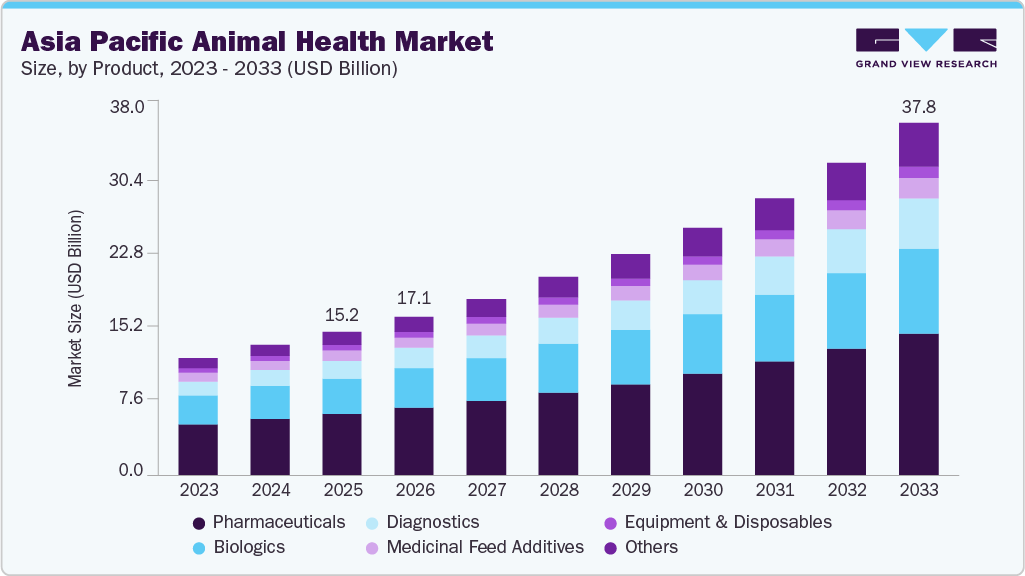
In China, large-scale pig and poultry operations are increasingly deploying AI-powered disease surveillance tools capable of real-time behavioral monitoring, early mortality detection, and automated feed optimization. The Chinese government's broader push toward agricultural modernization, reflected in its biotech- and innovation-friendly regulatory updates, has created a conducive environment for the integration of veterinary technology at the farm level. According to published research, AI applications are being actively validated for disease pattern recognition, vaccination scheduling, and herd productivity analytics, with China's veterinary biotech startup ecosystem developing localized diagnostic platforms tailored to domestic livestock breeds.
In Australia, precision livestock farming has moved beyond pilot stages. Wearable biosensors for cattle and sheep, drone-assisted herd monitoring, and satellite-linked health-tracking systems are operational across large pastoral holdings. The country's advanced veterinary infrastructure and high digital literacy among farm operators position it as the regional benchmark for technology adoption in animal health. Across Southeast Asia, adoption remains at varying stages, but the trajectory is upward. Indonesia and Thailand, both significant contributors to regional poultry and aquaculture output, are witnessing the growing integration of IoT-based water-quality monitoring and automated disease-alert systems into commercial aquaculture operations. The incubaFORUM ASIA 2026, backed by Phibro Animal Health as a Premium-Platinum Sponsor, reflects the region's structured effort to accelerate agri-animal health innovation through industry-startup collaboration.
In India, AI adoption within animal health is gaining traction through intersecting forces: government digital agriculture initiatives, a growing veterinary biotech sector, and increasing private investment in companion and livestock health platforms. Biotech industry participants have formally acknowledged AI's expanding role in bridging human and animal nutrition research, further validating cross-sector technology convergence. Moreover, multinational animal health companies operating across APAC, including Zoetis, Boehringer Ingelheim, and Elanco, are channeling investments into digital health divisions and forming regional partnerships to localize technology deployment. The convergence of farm-level data infrastructure, regulatory modernization, and rising producer awareness across key APAC markets positions AI-assisted diagnostics and precision farming as a structurally significant, long-duration growth driver for the regional animal health sector.
Market Concentration & Characteristics
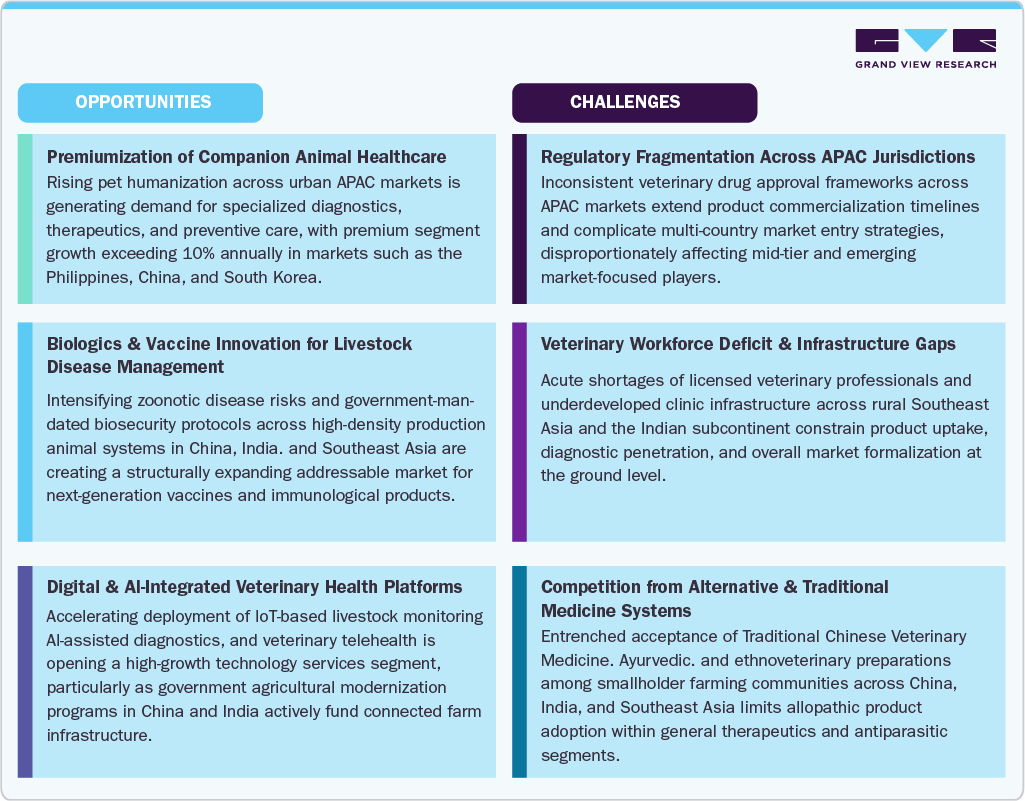
The Asia Pacific animal health market operates under a low to moderately concentrated structure, with a handful of multinational corporations, including Zoetis, Boehringer Ingelheim, Merck and Co., Elanco, and Virbac, collectively accounting for a significant share of regional revenues. These players maintain a competitive advantage through broad product portfolios spanning biologics, pharmaceuticals, and diagnostics. However, the presence of strong domestic players, particularly in China and India, such as Hester Biosciences and Indian Immunologicals, introduces meaningful competitive fragmentation at the national level, tempering overall market consolidation across the region.
Innovation intensity across the Asia Pacific animal health market is rising at an accelerating pace. China's regulatory updates, which actively encourage research and improve drug safety, are directly stimulating domestic veterinary pharmaceutical R&D pipelines. India's biotech sector is progressing toward integrated human-animal health innovation. AI-driven diagnostic platforms, IoT-based livestock monitoring, and next-generation vaccine formulations represent the current frontier of product development activity. Virbac's first local development partnership in China further signals a structural shift toward in-market innovation rather than import-dependent product commercialization, reflecting broader industry commitment to region-specific veterinary solutions.
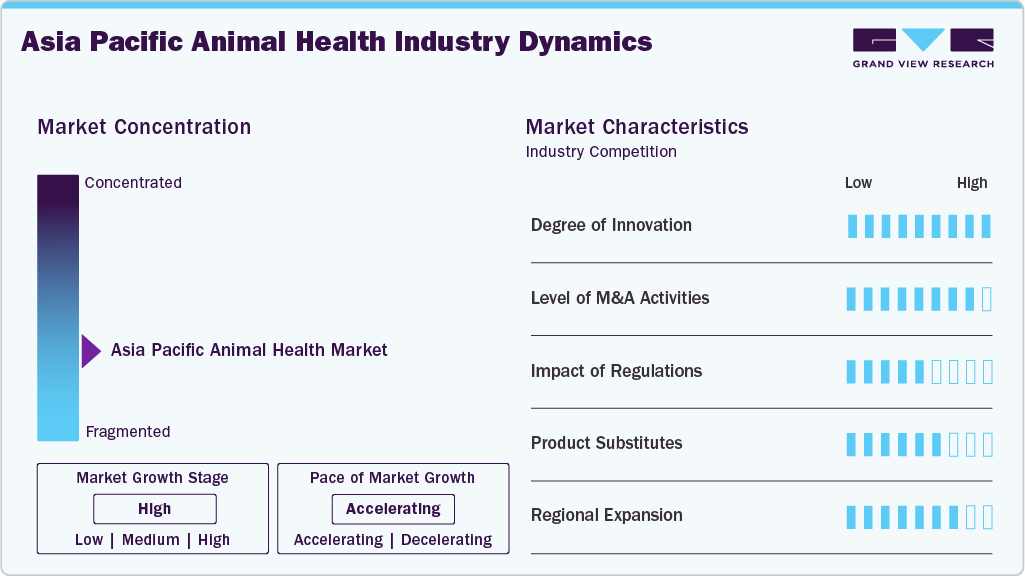
Merger and acquisition activity across the Asia Pacific animal health and adjacent sectors has remained notably active. Boehringer Ingelheim's partnership with Alivira Animal Health in India to expand the companion animal portfolio represents a prominent in-market collaboration with clear consolidation intent. Additionally, Zenex Animal Health's acquisition of VieVepharm signals cross-regional strategic positioning. In the feed segment, De Heus's acquisition of CJ Feed and Care and Royal Agrifirm's acquisition of Hamlet Protein indicate aggressive consolidation within the broader animal nutrition value chain, which directly interfaces with the animal health market's growth trajectory.
Regulatory frameworks across APAC present a dual-sided dynamic. On one hand, China's updated veterinary drug regulations, designed to encourage innovation and tighten drug safety standards, are creating a more structured and investable market environment. On the other hand, inconsistency across APAC jurisdictions, particularly in Southeast Asia, extends product approval timelines and complicates multi-market entry strategies for both multinational and regional players. According to a November 2025 FAO publication, Southeast Asia's Chief Veterinary Officers have committed to coordinated, epidemiology-driven regulatory action that, if operationalized effectively, could meaningfully reduce cross-border compliance fragmentation over the medium term.
Alternative and traditional medicine systems present a credible substitute dynamic within select segments. Traditional Chinese Veterinary Medicine, encompassing herbal formulations and acupuncture-based therapies, maintains established practitioner networks and producer acceptance across China and parts of Southeast Asia. In India, Ayurvedic and ethnoveterinary preparations are actively used in rural livestock management, particularly where access to allopathic veterinary products is limited or cost-prohibitive. While these substitutes do not directly compete with biologics or advanced diagnostics, they compete meaningfully within the general therapeutics and antiparasitic segments, particularly among smallholder farmers across the Indian subcontinent and Southeast Asian markets.
Regional expansion activity across the Asia Pacific animal health industry is intensifying across both multinational and domestic company tiers. Ceva Santé Animale's strategic leadership restructuring across Asia Pacific and China directly signals organizational prioritization of regional market penetration (Ceva). Australia's first veterinary mission to Papua New Guinea targets a critical infrastructure gap, extending the regional care frontier into underserved Pacific geographies. Furthermore, the Hanoi livestock summit consolidating Asia Pacific country commitments to address food demand, climate pressures, and disease risks signals coordinated regional expansion of veterinary health systems (ILRI).
Product Insights
Pharmaceuticals dominated the Asia Pacific animal health industry, accounting for the largest revenue share of 42.6% in 2025, driven by sustained demand for antiparasitic, anti-infective, and anti-inflammatory drugs across both production and companion animal segments. High disease burden in intensive livestock systems across China, India, and Southeast Asia sustains prescription volume at scale. Furthermore, expanding veterinary clinic networks and growing awareness of preventive pharmacological care among pet owners in urban APAC markets continue to support pharmaceutical product uptake across the region.
The others segment, including veterinary telehealth, veterinary software, and livestock monitoring, is emerging as the fastest-growing segment over the forecast period. Growth is driven by rapid digital infrastructure development across APAC, rising smartphone penetration in rural livestock-producing geographies, and increasing adoption of IoT-based farm management tools. Government-backed agricultural modernization programs in China and India are accelerating the deployment of connected livestock health platforms. Additionally, post-pandemic normalization of remote veterinary consultations has structurally broadened acceptance of telehealth among both companion animal owners and commercial farm operators.
Animal Type Insights
Production animals accounted for the largest revenue share of the Asia Pacific animal health market in 2025, driven by the sheer scale of livestock and aquaculture operations concentrated in China, India, Indonesia, Vietnam, and Thailand. Disease prevention and productivity management in high-density poultry, swine, and cattle operations generate consistent, high-volume demand for vaccines, antiparasitic treatments, and nutritional supplements. Moreover, food security imperatives across APAC governments are reinforcing biosecurity investment at the commercial farm level, sustaining production animal health expenditure as a foundational market segment.
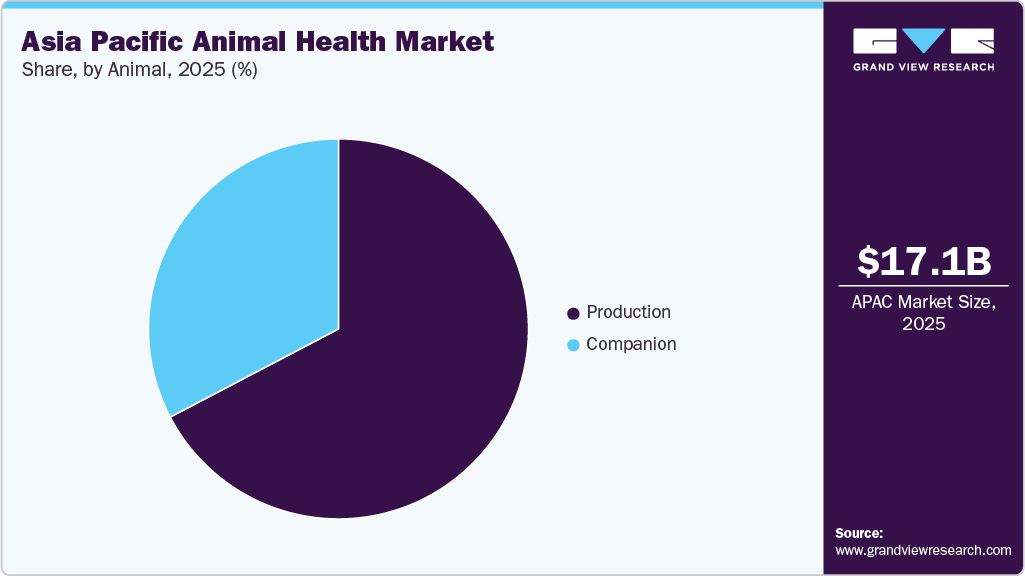
Companion animals is the fastest-growing segment in the APAC’s animal health market, fueled by accelerating pet humanization trends across urban centers in China, Japan, South Korea, India, and Australia. Rising disposable incomes, nuclear-family structures, and generational shifts in attitudes toward pet ownership are driving increased per-capita veterinary spending. Demand for premium diagnostics, preventive care, and specialized therapeutics for dogs and cats is expanding rapidly. Furthermore, the proliferation of organized veterinary clinic chains and pet insurance products across key APAC markets is structurally supporting sustained growth in companion animal health expenditure.
Distribution Channel Insights
The hospital/ clinic pharmacy segment held the largest revenue share of the Asia Pacific animal health market in 2025, driven by the centralized nature of veterinary prescription fulfillment and the strong preference among pet owners and livestock producers for professionally dispensed medications. Veterinary clinics across developed APAC markets, including China, India, Japan, Australia, and South Korea, operate with integrated in-house pharmacy capabilities. Additionally, regulatory requirements mandating prescription-based dispensing for several pharmaceutical categories continue to consolidate product flow through formal clinic and hospital pharmacy channels.
The e-commerce segment is emerging as the fastest-growing segment. Growth is driven by expanding internet penetration, rising consumer comfort with online pet product purchasing, and the growing availability of over-the-counter veterinary products on regional platforms such as JD.com, Flipkart, and Shopee. Competitive pricing, home delivery convenience, and subscription-based pet health product models are accelerating online channel adoption. Moreover, the COVID-19 period structurally normalized digital procurement of pet care essentials, generating a durable behavioral shift among urban companion animal owners across APAC.
End Use Insights
The veterinary hospitals & clinics segment held the largest revenue share of the Asia Pacific animal health industry in 2025, driven by the concentration of diagnostic equipment, specialist expertise, and pharmaceutical dispensing capabilities within organized veterinary facilities. Markets such as Japan, Australia, and South Korea maintain high clinic density relative to pet populations, sustaining elevated per-visit expenditure. In emerging APAC markets, the rapid expansion of organized veterinary clinic chains backed by private equity and corporate veterinary groups is progressively formalizing animal healthcare delivery and expanding this segment's revenue base.
The point-of-care testing/in-house testing segment is emerging as the fastest-growing segment. Growth is driven by rising demand for rapid, clinic-level diagnostic turnaround, the increasing availability of compact, cost-effective veterinary diagnostic analyzers, and growing clinician preference for immediate test-and-treat workflows. IDEXX Laboratories maintains a strong presence in this space across APAC. Additionally, heightened disease surveillance awareness following regional outbreak events and the expansion of veterinary clinic infrastructure across India and Southeast Asia are generating consistent demand for accessible, in-house diagnostic capabilities.
Country Insights
China Animal HealthMarket Trends
The China animal health industry dominated Asia Pacific in 2025 with a share of 22.5%. This dominance is owed to the country's massive livestock production base spanning swine, poultry, and aquaculture, which collectively generate sustained, high-volume demand for vaccines, antiparasitics, and feed additives. Government-mandated biosecurity protocols, accelerating veterinary drug regulatory reforms, encouraging domestic R&D investment, and a rapidly expanding companion animal population in urban centers collectively sustain China's market leadership. Furthermore, the growing presence of both multinational corporations and domestic veterinary biotech startups is deepening product availability and competitive intensity across all animal health categories.
India Animal HealthMarket Trends
The India animal health industry is expected to grow at a significant and the fastest CAGR of 13.8% during the forecast period. This rapid growth can be attributed to a convergence of structural demand drivers. India's position as one of the world's largest livestock producers, combined with government initiatives to boost dairy productivity, modernize poultry, and expand aquaculture, is driving broad-based veterinary product demand. Rising companion animal ownership in Tier-1 and Tier-2 cities is further diversifying market revenue streams. Strategic partnerships such as Boehringer Ingelheim's collaboration with Alivira Animal Health and Viyash Scientific's distribution agreement are actively expanding product reach and market formalization across both livestock and companion animal segments.
Key Asia Pacific Animal Health Company Insights
The Asia Pacific animal health market features a competitive landscape marked by the coexistence of global multinational corporations and regionally significant domestic players. Zoetis, Boehringer Ingelheim, Merck and Co., Elanco, and Virbac collectively command a substantial share of regional revenues across pharmaceuticals, biologics, and diagnostics. Domestic players, including Hester Biosciences and Indian Immunologicals, are introducing competitive fragmentation at the national level, particularly in price-sensitive biologics segments. Active partnership initiatives, local product development, and organizational restructuring across several key players indicate sustained competitive intensity across the region.
Key Asia Pacific Animal Health Companies:
- Zoetis
- Boehringer Ingelheim GmbH
- Merck & Co., Inc.
- Ceva Santé Animale
- Elanco
- Virbac
- Vetoquinol S.A.
- Dechra Pharmaceuticals Plc
- Idexx Laboratories, Inc.
- Hester Biosciences Ltd.
- India Immunologicals Ltd.
Recent Developments
-
In March 2026, ZymIQ Technology AB signed an exclusive distribution agreement with Broadchem Philippines BioPharma Corp. for its Kalzyme enzyme-based dental, dermatological, and otic pet care product line, targeting the expansion into the Philippines' rapidly expanding animal health sector.
-
In March 2026, Japan-based bitBiome and Kyoritsu Seiyaku Corporation announced a joint development agreement to co-develop biotechnology-based products for animal health and nutrition applications, combining bitBiome's AI-driven microbial genome platform with Kyoritsu Seiyaku's veterinary medicine expertise.
-
In March 2026, India's Multiples PE-backed Zenex Animal Health acquired a majority stake in Netherlands-based VievePharm, a specialist in phytogenic and natural animal nutrition formulations, gaining a Western European manufacturing base and distribution gateway across 25 countries.
-
In January 2026, Boehringer Ingelheim India announced a strategic partnership with Alivira Animal Health Limited to expand its companion animal product portfolio across India, leveraging Alivira's established domestic distribution infrastructure.
Asia Pacific Animal Health Market Report Scope
Report Attribute
Details
Market size value in 2026
USD 17.1 billion
Revenue forecast in 2033
USD 37.8 billion
Growth rate
CAGR of 12.0% from 2026 to 2033
Actual data
2021 - 2024
Forecast period
2026 - 2033
Quantitative units
Revenue in USD million/billion and CAGR from 2026 to 2033
Report coverage
Revenue forecast, company ranking, competitive landscape, growth factors, and trends
Segments covered
Product, animal type, distribution channel, end use, country
Country scope
Japan; China; India; Indonesia; Thailand; Australia; South Korea; Philippines; Malaysia; Singapore
Key companies profiled
Zoetis; Boehringer Ingelheim GmbH; Merck & Co., Inc.; Ceva Santé Animale; Elanco; Virbac; Vetoquinol S.A.; Dechra Pharmaceuticals Plc; IDEXX Laboratories, Inc.; Hester Biosciences Ltd.; Indian Immunologicals Ltd.
Customization scope
Free report customization (equivalent up to 8 analysts working days) with purchase. Addition or alteration to country, regional & segment scope.
Pricing and purchase options
Avail customized purchase options to meet your exact research needs. Explore purchase options
Asia Pacific Animal Health Market Report Segmentation
This report forecasts revenue growth at the regional and country levels and provides an analysis of the latest industry trends in each of the sub-segments from 2021 to 2033. For this study, Grand View Research has segmented the Asia Pacific animal health market report based on product, animal, distribution channel, and country:
-
Product Outlook (Revenue, USD Million, 2021- 2033)
-
Biologics
-
Vaccines
-
Modified/ Attenuated Live
-
Inactivated (Killed)
-
Other Vaccines
-
-
Other Biologics
-
-
Pharmaceuticals
-
Parasiticides
-
Anti-infectives
-
Anti-inflammatory
-
Analgesics
-
Others
-
-
Diagnostics
-
Consumables, reagents, and kits
-
Instruments and devices
-
-
Equipment & Disposables
-
Critical Care Consumables
-
Anesthesia Equipment
-
Fluid Management Equipment
-
Temperature Management Equipment
-
Rescue & Resuscitation Equipment
-
Research Equipment
-
Patient Monitoring Equipment
-
-
Medicinal Feed Additives
-
Others
-
Veterinary Telehealth
-
Veterinary Software
-
Livestock Monitoring
-
-
-
Animal Type Outlook (Revenue, USD Million, 2021 - 2033)
-
Production Animals
-
Poultry
-
Swine
-
Cattle
-
Sheep & Goats
-
Fish
-
-
Companion Animals
-
Dogs
-
Cats
-
Horses
-
Others
-
-
-
Distribution Channel Outlook (Revenue, USD Million, 2021 - 2033)
-
Retail
-
E-Commerce
-
Hospital/ Clinic Pharmacy
-
-
End Use Outlook (Revenue, USD Million, 2021 - 2033)
-
Veterinary Reference Laboratories
-
Point-of-care Testing/In-house Testing
-
Veterinary Hospitals & Clinics
-
Others
-
-
Country Outlook (Revenue, USD Million, 2021-2033)
-
Japan
-
China
-
India
-
Indonesia
-
Thailand
-
Australia
-
South Korea
-
Philippines
-
Malaysia
-
Singapore
-
Frequently Asked Questions About This Report
b. The Asia Pacific animal health market size was estimated at USD 15.5 billion in 2025 and is expected to reach USD 17.1 billion in 2026.
b. The Asia Pacific animal health market is expected to grow at a compound annual growth rate of 12.0% from 2026 to 2033 to reach USD 37.8 billion by 2033
b. By product, The others segment, including veterinary telehealth, veterinary software, and livestock monitoring, is emerging as the fastest-growing segment over the forecast period. Growth is driven by rapid digital infrastructure development across APAC, rising smartphone penetration in rural livestock-producing geographies, and increasing adoption of IoT-based farm management tools. Government-backed agricultural modernization programs in China and India are accelerating deployment of connected livestock health platforms.
b. Some key players operating in the Asia Pacific animal health market include Zoetis, Boehringer Ingelheim GmbH, Merck & Co., Inc., Ceva Santé Animale, Elanco, Virbac, Vetoquinol S.A., Dechra Pharmaceuticals Plc, IDEXX Laboratories, Inc., Hester Biosciences Ltd., and Indian Immunologicals Ltd.
b. Factors such as intensifying livestock and aquaculture production across Southeast Asia and China, surging companion animal ownership in urban APAC markets, government-driven One Health and epidemiological surveillance mandates, rapid emergence of AI-assisted diagnostics and precision livestock farming adoption. are driving the Asia Pacific animal health market growth


Share this report with your colleague or friend.
Need a Tailored Report?
Customize this report to your needs — add regions, segments, or data points, with 20% free customization.


ISO 9001:2015 & 27001:2022 Certified
We are GDPR and CCPA compliant! Your transaction & personal information is safe and secure. For more details, please read our privacy policy.
Trusted market insights - try a free sample
See how our reports are structured and why industry leaders rely on Grand View Research. Get a free sample or ask us to tailor this report to your needs.













