
- Home
- »
- Automotive & Transportation
- »
-
Automotive Chassis Market Size & Share Report, 2026-2033GVR Report cover

Automotive Chassis Market (2026 - 2033)
Size, Share & Trends Analysis Report By Chassis (Ladder Frame, Monocoque), By Vehicle (Passenger Cars, Commercial Vehicles, Heavy Electric Vehicles), By Sales Channel, By Material, By Region, And Segment Forecasts
Market Size, 2025
$170.9BMarket Estimate, 2026
$183.2BMarket Forecast, 2033
$361.7BCAGR, 2026–2033
10.2%Automotive Chassis Market Summary
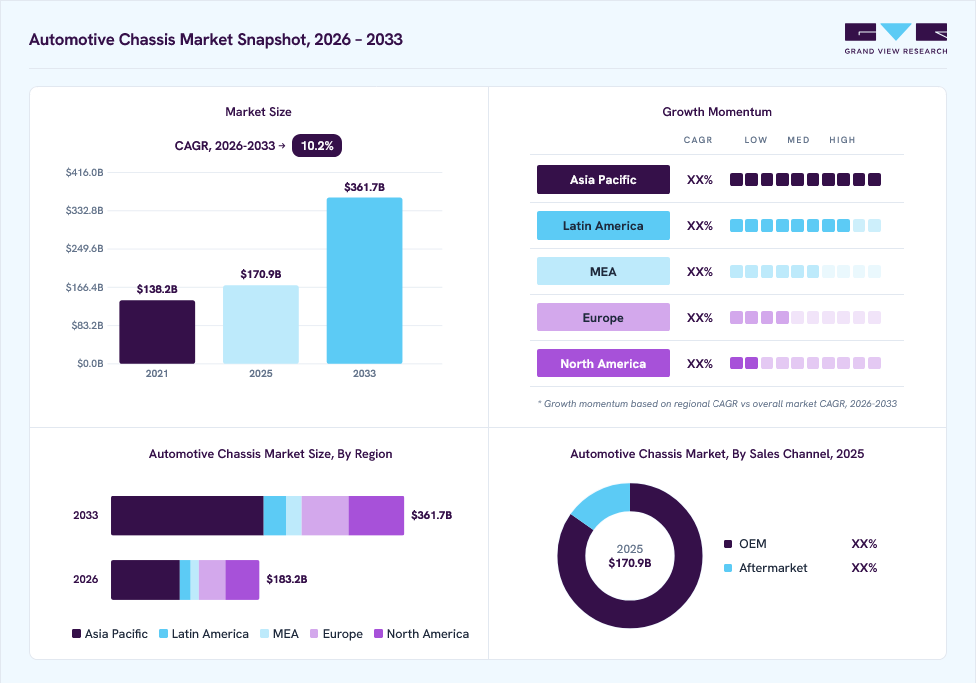
The global automotive chassis market size was valued at USD 170.9 billion in 2025 and is projected to grow from USD 183.2 billion in 2026 to USD 361.7 billion by 2033, at a CAGR of 10.2% from 2026 to 2033. Asia Pacific dominated the market, accounting for a revenue share of 45.5% in 2025. Increasing vehicle production and rising demand for lightweight and high-performance chassis systems are driving the industry.
 Source: Grand View Research, IR Documents, Primary Interviews, Paid DatabasesTo learn more about this report,
 Download Free Sample Report
 Key Market Trends & Insights
- By chassis: Monocoque segment led the market and accounted for 62.3% of the global revenue in 2025.
- By material: Steel segment led the market and accounted for 64.9% of the global revenue in 2025.
- By vehicle: Passenger cars led the market with a revenue share of 63.1% in 2025.
- By sales channel: OEM segment accounted for the largest share of 84.6% in 2025.
Regional Highlights
- Largest regional market: Asia Pacific (45.5% revenue share, 2025)
- By country: China held the largest market share in 2025
Market Size & Forecast
- Market Size in 2025: USD 170.9 Billion
- Estimated Market Size in 2026: USD 183.2 Billion
- Projected Market Size in 2033: USD 361.7 Billion
- CAGR (2026-2033): 10.2%
Three ways to get this report
Buy it, customize it, or ask a question.Ask an Analyst
A direct answer, usually in 1 working day
- AccessReport author, directly
- Reply timeWithin 1 working day
- No sales callDirect answer only
- FormatEmail reply
- CostFree, no cost
Get the Full Report
What the study covers
- FormatsPDF · Excel · Dashboard
- Timeline2026–2033 annual, 2025 base
- Coverage20+ countries, 5 regions
- Companies10+ key players profiled
Customize the Report
20% free customization
- IncludeCountries, segments, points
- TailorTo your product definition
- ExtendDeeper competitor detail
- OrA fully bespoke study
- Turnaround5–10 working days
The increasing adoption of electric and hybrid vehicles is driving demand for advanced automotive chassis systems that accommodate diverse powertrain layouts, battery packs, and vehicle architectures. Electrification is also increasing the importance of chassis designs that balance structural strength with lower vehicle weight, as reducing unnecessary mass can support vehicle efficiency and overall driving performance. In addition, automakers are developing flexible vehicle platforms that can support multiple vehicle models and powertrain configurations, creating opportunities for modular chassis systems. The continued transition toward cleaner mobility is encouraging investments in redesigned chassis architectures and lightweight structural solutions.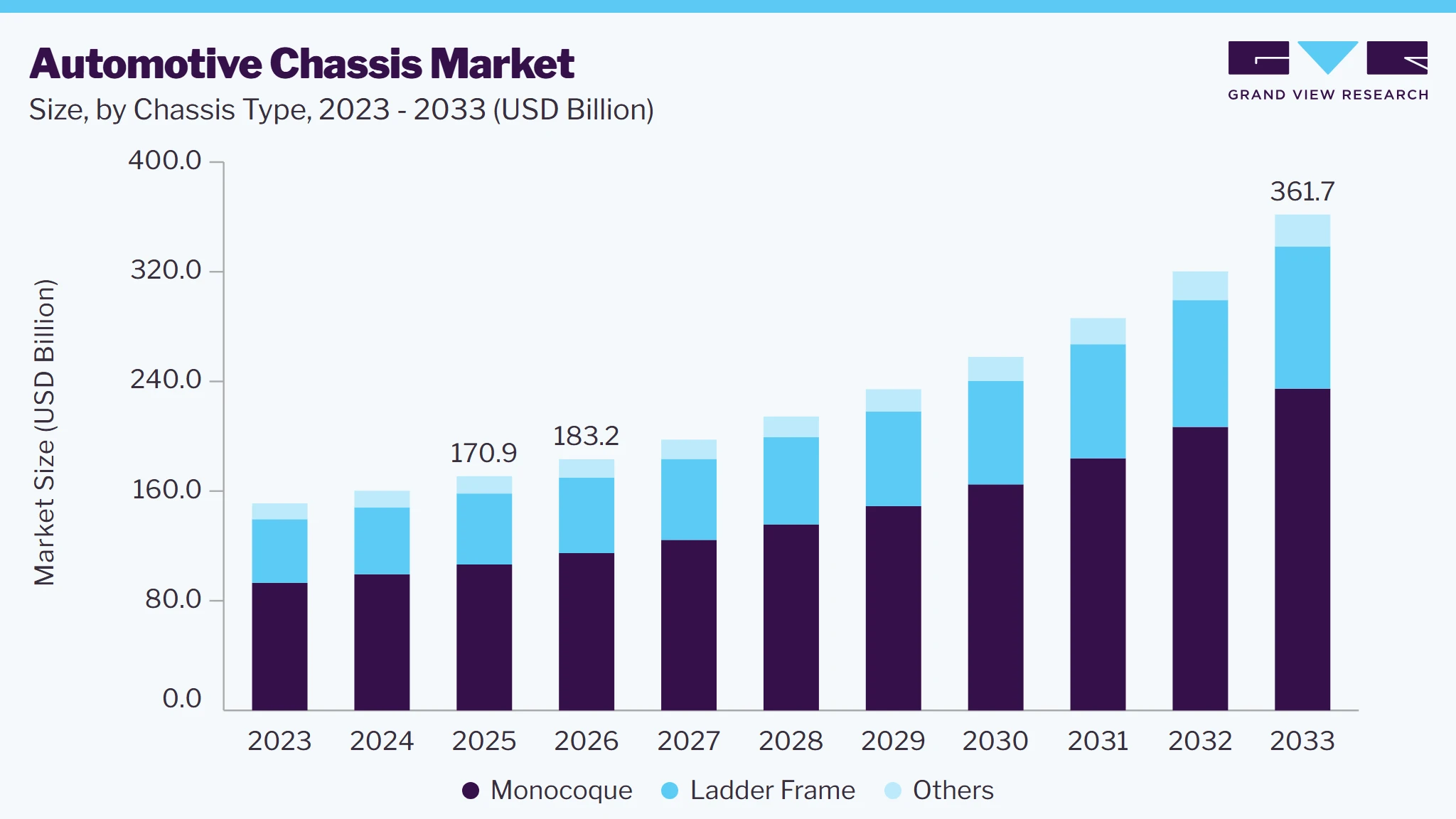 To learn more about this report, Download Free Sample Report
 The growing adoption of modular chassis platforms is emerging as a key trend, as automakers seek to reduce development complexity and use common vehicle architectures across multiple models. Manufacturers are increasingly integrating steering, braking, suspension, battery-supporting structures, and other vehicle systems into more optimized chassis designs to improve packaging efficiency and vehicle performance. The shift toward software-defined and electrified vehicles is also encouraging chassis architectures that can accommodate changing electronic and powertrain requirements. Consequently, chassis suppliers are focusing on flexible designs adaptable across passenger cars, commercial vehicles, hybrid vehicles, and battery-electric vehicles.
Increasing regulatory emphasis on vehicle safety is influencing the design and engineering requirements of automotive chassis systems. UNECE vehicle regulations cover critical chassis-related areas, including steering equipment under UN Regulation No. 79, heavy-vehicle braking under UN Regulation No. 13, and passenger-car braking under UN Regulation No. 13-H. Regulatory developments are also evolving alongside electrification, with UNECE introducing provisions for new-generation braking systems for electric vehicles, placing greater focus on braking performance and energy efficiency. These requirements increase the need for chassis components and systems to meet stringent safety, durability, and performance standards across different vehicle categories.
High development and manufacturing costs remain a key restraint for the automotive chassis market, particularly for lightweight, modular, and electrification-ready architectures. Advanced chassis systems often require new materials, manufacturing processes, tooling, testing, and validation, increasing investment requirements for both automakers and suppliers. The need to meet stringent structural, steering, braking, durability, and safety requirements further increases development time and engineering expenditure. These cost pressures can limit the adoption of advanced chassis technologies in price-sensitive vehicle segments and emerging automotive markets.
Market Dynamics
The market is being influenced by vehicle electrification, rising production, light weighting requirements, and the integration of advanced vehicle control technologies. Rising demand for improved vehicle safety, driving performance, structural durability, and energy efficiency is encouraging manufacturers to develop more advanced chassis architectures. At the same time, the increasing use of electronic content and the transition toward software-defined vehicles are expanding the functional scope of chassis systems. These developments are supporting a shift from conventional structural components toward lightweight, integrated, modular, and technology-enabled chassis solutions.
The increasing emphasis on vehicle weight reduction is driving demand for lightweight automotive chassis structures. Automakers are under growing pressure to improve fuel efficiency, reduce energy consumption, and enhance electric vehicle driving range while maintaining required levels of safety and structural strength. Conventional chassis structures can contribute significantly to overall vehicle weight, creating a need for materials and architectures that provide higher strength with lower mass. This requirement is increasing the adoption of optimized chassis designs and lightweight material solutions across different vehicle platforms.
Automotive chassis manufacturers are responding by increasing the use of high-strength steel, aluminum alloys, magnesium, composites, and multi-material structures. Advanced forming, joining, and structural optimization techniques enable manufacturers to reduce material usage while maintaining the required load-bearing performance. Lightweight chassis systems can also improve vehicle handling, acceleration, braking efficiency, and energy utilization. As lightweighting becomes increasingly important across both conventional and electric vehicles, demand for advanced chassis structures is expected to support market expansion.
The increasing complexity of automotive chassis structures can create manufacturing and assembly challenges for market participants. Advanced chassis architecture often requires specialized production equipment, precision manufacturing processes, additional joining technologies, and tighter dimensional controls. The use of multiple materials can further increase production complexity because different materials require different forming, welding, joining, and quality-control processes. These requirements can increase manufacturing costs and make production operations more difficult to standardize across vehicle platforms.
Higher manufacturing complexity can affect the scalability and cost competitiveness of advanced chassis solutions, particularly in programs requiring high production volumes and strict quality requirements. Additional process steps can increase cycle times, equipment investment, maintenance requirements, and quality-control expenditure. The impact can be more significant for lightweight and multi-material chassis structures because manufacturing processes must maintain structural consistency while controlling material and assembly costs. Consequently, complex production requirements can slow the transition from conventional chassis structures toward more advanced architecture.
The transition toward software-defined vehicles is creating an opportunity for greater integration of chassis functions with electronic controls and vehicle software. Traditional mechanical chassis functions are increasingly complemented by electronically controlled steering, braking, suspension, vehicle motion management, and other intelligent functions. This transition is increasing the technological content of chassis systems and creating demand for architectures that integrate hardware, sensors, actuators, electronic controls, and software. The broader shift toward centralized vehicle architecture further increases the importance of coordinated chassis functions.
The industry has the potential to increase the value generated from each chassis system by expanding the scope from individual mechanical components toward integrated vehicle-motion solutions. Demand is expected to increase for modular architectures that can accommodate different vehicle platforms, powertrain configurations, and levels of automation. Suppliers with capabilities in structural engineering, lightweight materials, electronics, controls, and system integration are likely to be better positioned to capture this opportunity. Increasing software content can also create additional opportunities for differentiated chassis functionality and longer-term technology development.
Market Concentration & Characteristics
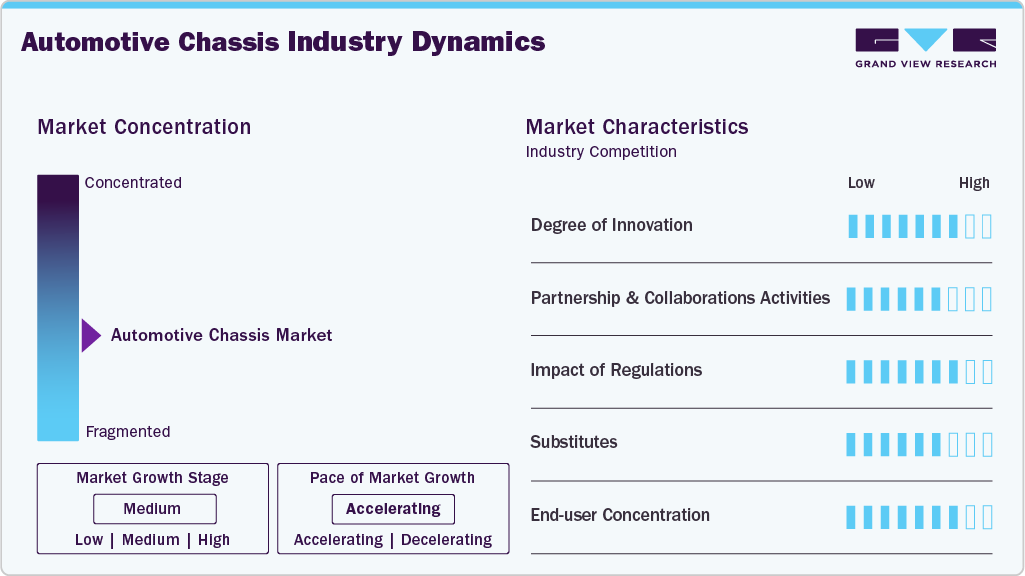
The industry is moderately consolidated, with a combination of major global automotive suppliers and specialized regional manufacturers. Leading companies have established capabilities in chassis modules, suspension systems, steering systems, braking systems, axles, subframes, and structural components, supported by strong relationships with vehicle manufacturers and extensive global production networks. At the same time, the presence of multiple suppliers across different chassis categories prevents the market from being fully concentrated. Competition is primarily influenced by product quality, engineering capabilities, manufacturing scale, cost efficiency, lightweight materials, and the ability to develop integrated chassis solutions for electric and software-defined vehicles.
 To learn more about this report, Download Free Sample Report
 The market demonstrates a high degree of innovation, while partnerships and collaborations remain relatively strong, with companies increasingly working with automakers and technology providers to develop advanced chassis systems. The impact of regulations is medium-to-high, particularly due to safety, emissions, vehicle efficiency, and electrification requirements, which encourage manufacturers to improve chassis performance and adopt lightweight and electronically controlled technologies.
Substitutes have a moderate impact, as chassis systems are essential vehicle structures, although alternative materials, architectures, and integrated technologies can replace conventional solutions. End-user adoption is relatively high, supported by increasing demand for vehicle safety, ride comfort, handling, electrification, and advanced vehicle dynamics. Moreover, the market is in an accelerating phase of exponential growth, driven by vehicle electrification and the increasing integration of advanced chassis technologies.
Analyst Perspective
The market is progressing toward higher-value, lightweight, and increasingly integrated structural systems, supported by vehicle electrification and evolving vehicle architectures. Demand for stronger yet lighter structures is encouraging greater use of advanced materials and optimized chassis designs. The integration of electronic controls and software into steering, braking, suspension, and vehicle-motion functions is expected to further expand the technology scope of chassis systems. Investment is likely to remain focused on lightweighting, modular architectures, electrified-vehicle platforms, and intelligent chassis technologies. Competitive positioning is expected to increasingly depend on engineering capabilities, system integration, manufacturing scale, and the ability to support multiple vehicle platforms.
Chassis Insights
The monocoque chassis segment accounted for the largest share of 62.3% in 2025, and is projected to grow at the fastest CAGR over the forecast period. Monocoque is widely used across passenger-oriented vehicle architectures because its integrated body and chassis structure enables efficient weight distribution and space utilization. The architecture provides opportunities to optimize structural rigidity, crash performance, vehicle handling, and manufacturing efficiency within a unified vehicle structure. Increasing demand for fuel-efficient and electric vehicles is encouraging further optimization of monocoque structures to reduce vehicle weight while accommodating changing powertrain and battery configurations. The segment is expected to maintain strong demand as manufacturers increasingly prioritize lightweight construction and efficient vehicle packaging.
The ladder frame chassis segment is projected to grow at a significant CAGR over the forecast period. The ladder frame segment represents a significant chassis architecture, particularly in vehicles requiring high structural strength, durability, and load-carrying capability. Its separate frame construction provides a strong foundation for mounting the powertrain, suspension, body, and other major vehicle systems. Demand remains supported by vehicle applications where towing capacity, off-road capability, payload performance, and structural durability are important purchasing considerations. Continued development of stronger and lighter frame structures is expected to support the segment as manufacturers seek to improve vehicle performance while controlling overall weight.
Material Insights
The steel segment accounted for the largest share of 64.9% in 2025 and projected to grow at the fastest CAGR over the forecast period, due to its structural strength, durability, availability, and established manufacturing infrastructure. Advanced grades of steel enable manufacturers to achieve higher strength while reducing material thickness and controlling overall vehicle weight. The material continues to be used extensively across frames, subframes, crossmembers, suspension structures, and other load-bearing components. Demand is expected to remain resilient as manufacturers balance structural performance, production efficiency, material costs, and vehicle safety requirements.
The aluminum alloy segment is projected to grow at a significant CAGR over the forecast period, due to its lower density compared with conventional steel and its potential to reduce vehicle weight. Lightweight chassis structures can contribute to improved energy efficiency, vehicle dynamics, and driving range in electrified vehicles. Increasing adoption of electric vehicles is creating additional opportunities for aluminum-based chassis components because reducing vehicle mass can help offset the weight associated with battery systems. Growth in the segment is also being supported by advances in forming, casting, joining, and material-processing technologies.
Vehicle Insights
The passenger cars segment accounted for the largest share of 63.1% in 2025 and is projected to grow at the fastest CAGR over the forecast, due to their large production base and diverse structural requirements. Demand is influenced by increasing expectations for safety, ride comfort, handling, durability, and weight efficiency. The transition toward electric and hybrid passenger vehicles is also creating demand for chassis structures that can accommodate battery systems and new powertrain layouts. Increasing integration of advanced suspension, steering, braking, and vehicle-control technologies is expected to further increase the value and complexity of chassis systems used in passenger cars.
The light commercial vehicles segment is projected to grow at a significant CAGR over the forecast period as they require a balance between payload capacity, durability, maneuverability, and operating efficiency. Chassis structures must withstand frequent loading, extended operating cycles, and varying road conditions while maintaining adequate vehicle performance. The increasing electrification of light commercial fleets is creating additional requirements for lightweight structures and chassis architectures capable of accommodating battery systems without significantly reducing payload capacity. Demand for modular and durable chassis solutions is therefore expected to increase as commercial operators seek greater efficiency and lower operating costs.
Sales Channel Insights
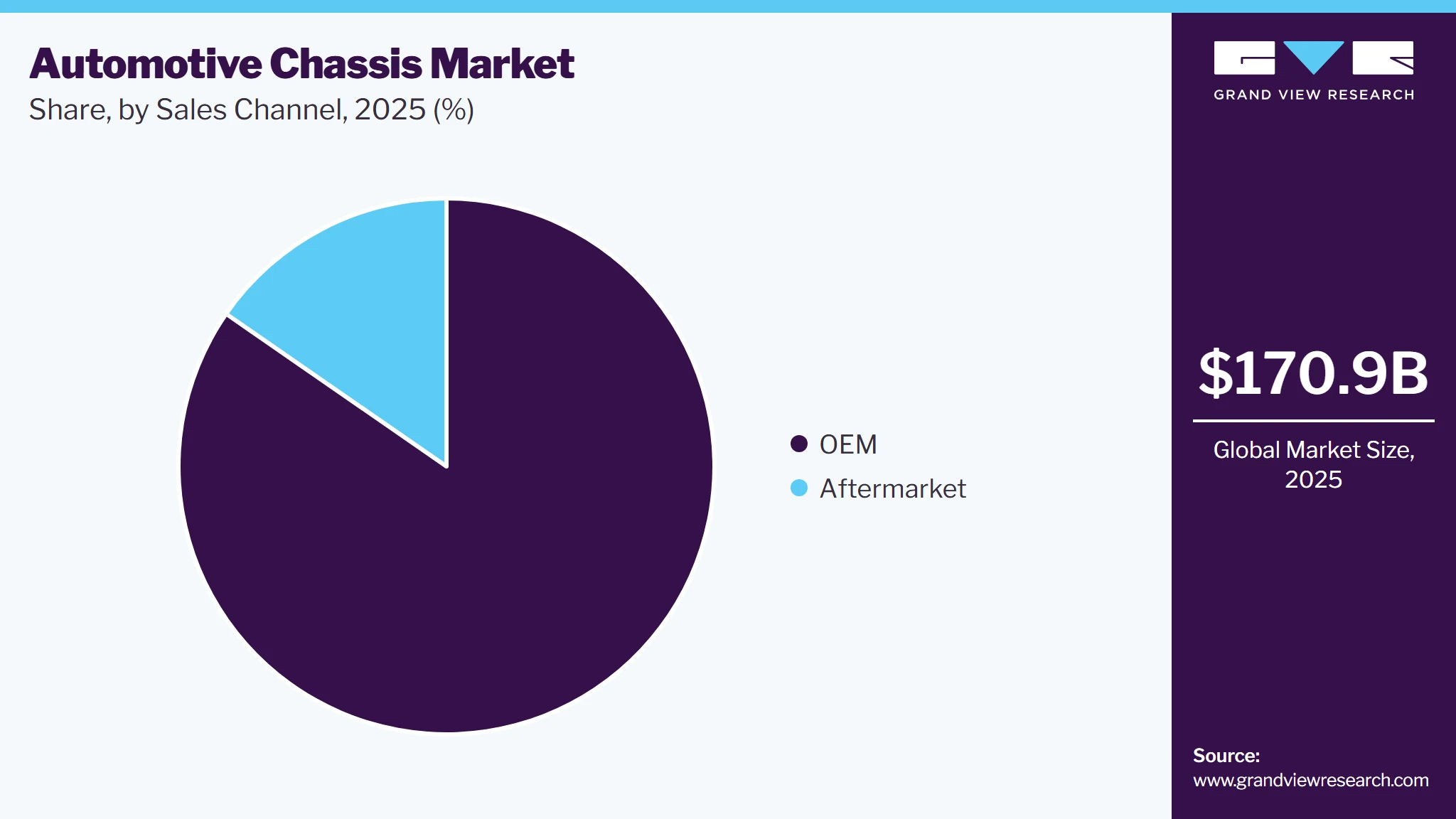
The OEM segment accounted for the largest share of 84.6% in 2025, supported by the direct supply of chassis structures, components, modules, and integrated systems for installation during vehicle manufacturing. Demand through this channel is closely linked to vehicle production volumes, new vehicle platform launches, model redesigns, and changes in powertrain architecture. Increasing vehicle electrification and the development of advanced vehicle platforms are creating opportunities for higher-value chassis systems with greater structural and technological content. Long-term supply arrangements and increasing integration of chassis components into vehicle platforms can further strengthen the importance of the OEM channel.
 To learn more about this report, Download Free Sample Report
 The aftermarket segment is projected to grow at the fastest CAGR over the forecast period. The aftermarket segment generates demand through the replacement, repair, and maintenance of chassis components after vehicles enter operation. Demand is influenced by vehicle age, mileage, road conditions, usage intensity, accident-related damage, and the overall size of the vehicle parc. Commercial vehicles and high-mileage vehicles can generate recurring replacement requirements for suspension, structural, and other chassis-related components. Growth in the vehicle parc and increasing demand for vehicle maintenance are expected to support aftermarket opportunities, although demand varies according to vehicle, component durability, and replacement cycles.
Regional Insights
The Asia Pacific automotive chassis market led and accounted for 45.5% of the global revenue in 2025 and is expected to register the fastest growth from 2026 to 2033. This is due to its extensive vehicle manufacturing base and growing demand for passenger and commercial vehicles. Increasing vehicle production, expanding electric vehicle adoption, and rising investments in automotive manufacturing are supporting demand for chassis structures across the region. The growing emphasis on cost-efficient manufacturing and lightweight vehicle architectures is also influencing chassis design and material selection.
 To learn more about this report, Download Free Sample Report
 China Automotive Chassis Market Trends
The China automotive chassis market held a dominant share in the Asia Pacific, supported by its large vehicle manufacturing base and rapidly expanding electric vehicle industry. Increasing production of electric and hybrid vehicles is creating demand for lightweight structures, reinforced underbody systems, and chassis architectures compatible with battery-based powertrains. Growing competition in the automotive industry is also encouraging manufacturers to improve chassis performance, manufacturing efficiency, and structural integration.
The automotive chassis market in Japan is expected to grow at a significant CAGR over the forecast period, due to its established vehicle manufacturing ecosystem and strong focus on manufacturing efficiency and vehicle quality. The development of electrified vehicle platforms is increasing the requirements for lightweight and structurally efficient chassis systems. Continued emphasis on vehicle safety, durability, weight reduction, and advanced mobility technologies is expected to support the development of next-generation chassis solutions.
Europe Automotive Chassis Market Trends
The automotive chassis market in Europe is poised for significant growth from 2026 to 2033, supported by a mature automotive manufacturing ecosystem and increasing focus on vehicle efficiency, safety, and electrification. Automakers are increasingly requiring lightweight and structurally optimized chassis systems to meet changing vehicle performance and energy-efficiency requirements. The transition toward electric and hybrid vehicles is also encouraging greater development of chassis structures compatible with new powertrain and battery configurations.
The UK automotive chassis market is supported by established vehicle manufacturing activities and a developed automotive component supply chain. Increasing demand for electric and hybrid vehicles is creating opportunities for lightweight chassis structures and components that support improved vehicle efficiency. The market is also influenced by increasing requirements for vehicle safety, structural performance, and advanced chassis technologies.
The automotive chassis market in Germany held a significant share in Europe, due to its advanced automotive engineering capabilities. Demand for chassis structures is supported by passenger vehicles, commercial vehicles, and electrified vehicle platforms. The shift toward lightweighting, improved vehicle dynamics, and integrated chassis technologies is expected to create additional demand for advanced chassis solutions.
North America Automotive Chassis Market Trends
The automotive chassis market in North America held a significant global share in 2025, supported by strong demand for passenger vehicles, SUVs, pickup trucks, and commercial vehicles. The region's preference for larger and heavier vehicle architecture supports demand for robust frames, suspension structures, and load-bearing chassis components. Increasing vehicle electrification requirements are also encouraging the adoption of structurally optimized chassis systems.
The automotive chassis market in the U.S. is anticipated to register significant growth from 2026 to 2033, due to its need for durable and high-strength chassis structures. The growing transition toward electric vehicles is further increasing demand for lightweight chassis architectures capable of accommodating battery systems while maintaining vehicle safety and performance.
Key Automotive Chassis Company Insights
Key players operating in the automotive chassis market are focusing on expanding lightweight chassis portfolios, developing integrated chassis systems, strengthening electric vehicle chassis capabilities, increasing production capacity, and securing long-term supply agreements with automotive manufacturers. Companies are also emphasizing modular chassis architectures, advanced materials, manufacturing automation, and system-level integration to improve product performance and strengthen their competitive positioning.
-
Magna International Inc. is the largest automotive supplier and provides a broad portfolio of chassis systems and assemblies. Its offerings include chassis subframes, suspension links and arms, twist axles, structural assemblies, and complete frame assemblies. The company manufactures chassis assemblies using processes such as hydroforming, rollforming, casting, stamping, bending, welding, and assembly, while working with materials including aluminum and advanced high-strength steel.
-
ZF Friedrichshafen AG is a global technology company providing mobility products and systems for passenger cars, commercial vehicles, and industrial applications. In the automotive chassis market, the company offers Vehicle Motion Control solutions, including damping, suspension, steering, braking, X-by-Wire technologies, and chassis components.
Key Automotive Chassis Companies
The following key companies have been profiled for this study on the automotive chassis market.
-
Magna International Inc.
-
ZF Friedrichshafen AG
-
BENTELER.
-
Gestamp
-
HYUNDAI MOBIS
-
AISIN CORPORATION
-
Martinrea International Inc.
-
Schaeffler AG
-
HL Mando Corp.
-
METALSA.
Company Categorization
Operating Strategies
Competitive Edge
Weaknesses
Mature Players: Magna International Inc., ZF Friedrichshafen AG, BENTELER, Gestamp
- Mature players in the automotive chassis market are focusing on broad chassis portfolios, global manufacturing networks, long-term OEM programs, platform-based product development, and increasing integration of lightweight and advanced chassis technologies.
- Mature players gain a competitive advantage through strong global presence, extensive engineering capabilities, diversified customer bases, large-scale manufacturing capacity, and broad chassis product portfolios.
- These companies often face challenges related to high operational complexity and capital requirements can increase development and manufacturing costs, while large global footprints can make business operations less flexible.
Emerging Players: HYUNDAI MOBIS, HL Mando Corp., METALSA
- Emerging players in the automotive chassis market are focused on expanding chassis technology capabilities, strengthening regional and global OEM relationships, developing integrated systems, and increasing participation in electrified vehicle platforms.
- Emerging players gain market traction through strong capabilities in selected chassis technologies, competitive manufacturing bases, established automotive relationships, and opportunities to expand into higher-value integrated chassis systems.
- Emerging players face limitations due to their comparatively narrower global chassis presence or portfolio breadth can limit scale and customer diversification against the largest established suppliers.
Recent Developments
-
In March 2026, HYUNDAI MOBIS launched a new chassis-module production plant in Hungary, expanding its European manufacturing capabilities to supply front and rear complete axle assemblies for electric and hybrid vehicles to a German premium automaker.
-
In February 2025, Magna International Inc. expanded its long-term partnership with Mercedes-Benz, covering body and chassis components, electrification, powertrain, ADAS, and vehicle assembly. The collaboration also includes an eDS Duo electric drive system for a new electric off-roader, strengthening capabilities in advanced electrified vehicle systems.
Automotive Chassis Market Report Scope
Report Attribute
Details
Market size value in 2025
USD 170.9 billion
Estimated market size in 2026
USD 183.2 billion
Projected market size by 2033
USD 361.7 billion
Growth rate
CAGR of 10.2% from 2026 to 2033
Base year for estimation
2025
Historical data
2021 - 2024
Forecast period
2026 - 2033
Quantitative units
Revenue in USD billion and CAGR from 2026 to 2033
Report coverage
Revenue forecast, company ranking, competitive landscape, growth factors, and trends
Segments covered
Chassis, material, vehicle, sales channel, region
Regional scope
North America; Europe; Asia Pacific; Latin America; MEA
Country scope
U.S.; Canada; Mexico; Germany; UK; France; China; Japan; India; South Korea; Australia; Brazil; KSA; UAE; South Africa
Key companies profiled
Magna International Inc.; ZF Friedrichshafen AG; BENTELER.; Gestamp; HYUNDAI MOBIS; AISIN CORPORATION; Martinrea International Inc.; Schaeffler AG; HL Mando Corp.; METALSA.
Customization scope
Free report customization (equivalent up to 8 analysts working days) with purchase. Addition or alteration to country, regional & segment scope.
Pricing and purchase options
Avail customized purchase options to meet your exact research needs. Explore purchase options
Global Automotive Chassis Market Report Segmentation
The report forecasts revenue growth at global, regional, and country levels and provides an analysis of the latest industry trends in each of the sub-segments from 2021 to 2033. For this study, Grand View Research has segmented the global automotive chassis market report based on chassis, material, vehicle, sales channel, and region.
-
Chassis Outlook (Revenue, USD Billion, 2021 - 2033)
-
Ladder Frame
-
Monocoque
-
Others
-
-
Material Outlook (Revenue, USD Billion, 2021 - 2033)
-
Steel
-
Aluminum Alloy
-
Carbon-Fibre Composites
-
Magnesium
-
Others
-
-
Vehicle Outlook (Revenue, USD Billion, 2021 - 2033)
-
Passenger Cars
-
Commercial Vehicles
-
Heavy Electric Vehicles
-
-
Sales Channel Outlook (Revenue, USD Billion, 2021 - 2033)
-
OEM
-
Aftermarket
-
-
Regional Outlook (Revenue, USD Billion, 2021 - 2033)
-
North America
-
U.S.
-
Canada
-
Mexico
-
-
Europe
-
Germany
-
U.K.
-
France
-
-
Asia Pacific
-
China
-
India
-
Japan
-
South Korea
-
Australia
-
-
Latin America
-
Brazil
-
-
Middle East & Africa (MEA)
-
UAE
-
Kingdom of Saudi Arabia (KSA)
-
South Africa
-
-
Research Methodology
The automotive chassis market figures in this report are based on a proven research process that combines executive interviews with secondary research from proprietary databases, company filings, and recognized regulatory and institutional sources. Market size is built through value-chain sizing-reconciling supply-side and demand-side estimates-and triangulated with bottom-up and top-down approaches. Every estimate passes multiple levels of expert validation before publication, with each automotive chassis segment quantified using the revenue-capture definitions in the table below.
Segment Definition
Chassis
Revenue capture definition
Ladder Frame
The segment revenue is generated from the sale of separate frame structures comprising longitudinal rails, cross members, frame assemblies, and associated structural components used in body-on-frame vehicle architectures. Revenue includes complete or partially assembled ladder-frame structures supplied for vehicle production.
Monocoque
The segment revenue is generated from integrated load-bearing vehicle structures in which the body and chassis functions are incorporated into a unified architecture. Revenue includes structural platforms, underbody structures, subframes, crossmembers, structural rails, and other integrated chassis assemblies.
Others
The segment revenue is generated from alternative chassis architectures that are not classified as ladder frame or monocoque. Revenue includes specialized structural architecture, modular chassis designs, space-frame structures, and other application-specific chassis systems.
Chassis
Revenue capture definition
Steel
The segment revenue is generated from steel-based chassis structures and components, including frames, subframes, crossmembers, suspension structures, axle components, and other load-bearing chassis parts.
Aluminum Alloy
The segment revenue is generated from aluminum-alloy chassis structures and components designed to provide lower weight while maintaining the required structural strength and durability.
Carbon-Fibre Composites
The segment revenue is generated from carbon-fibre composite chassis structures and components used in applications requiring high strength-to-weight performance and weight reduction.
Magnesium
The segment revenue is generated from magnesium-based chassis structures and components used where low material density and weight reduction are required.
Others
The segment revenue is generated from chassis structures manufactured using other metals, composites, alloys, or multi-material combinations not classified under the primary material categories.
Vehicle
Revenue capture definition
Passenger Cars
The segment revenue is generated from chassis structures, subframes, suspension structures, axle components, and integrated chassis systems supplied for passenger vehicles.
Commercial Vehicles
The segment revenue is generated from chassis frames, axle structures, suspension systems, subframes, and other structural chassis components supplied for light and heavy commercial vehicles.
Heavy Electric Vehicles
The segment revenue is generated from specialized chassis structures, reinforced frames, suspension systems, underbody structures, and supporting chassis components designed for heavy electric vehicle platforms.
Sales Channel
Revenue capture definition
OEM
The segment revenue is generated from the direct supply of chassis components, structures, modules, and integrated systems to vehicle manufacturers for installation during vehicle production.
Aftermarket
The segment revenue is generated from replacement and service sales of chassis components and systems supplied after the original vehicle manufacturing process through replacement-part distribution and service channels.
Estimation Model
Layer Name
Key Question
Description
Vehicle Production Base
How many vehicles require chassis systems?
The estimation begins with global vehicle production volumes across passenger cars, commercial vehicles, and heavy electric vehicles. Production data is assessed by major geographic markets and vehicle categories. The vehicle mix provides the fundamental volume base for estimating chassis demand. Changes in vehicle production directly influence the number of chassis systems required.
Chassis Content & Configuration
What and quantity of chassis content is required per vehicle?
The second layer evaluates chassis architecture, including ladder frame, monocoque, and other configurations. It also considers the material composition and structural complexity of chassis systems. Differences in vehicle architecture and powertrain configuration influence the quantity and value of chassis content per vehicle. This layer establishes the average chassis revenue attributable to different vehicle categories.
Pricing & Revenue Conversion
What revenue is generated from each chassis system?
The third layer converts estimated chassis volumes into monetary value using component, module, and integrated-system pricing. Pricing assumptions reflect differences in material composition, structural complexity, technology content, and vehicle application. Higher-value lightweight materials and advanced chassis technologies can increase revenue per vehicle. The resulting values are aggregated across vehicle categories and chassis configurations.
Regional & Market Validation
Does the estimated market size align with regional and industry conditions?
The final layer validates the estimated automotive chassis market against regional vehicle production, electrification rates, material adoption, and supplier-market conditions. Regional differences in vehicle architectures, manufacturing capacity, technology adoption, and replacement demand are incorporated into the assessment. Historical trends and industry developments are used to test the consistency of the estimates. The validated values form the final market size and forecast across regions, segments, and applications.
Delivered Customization
We have successfully delivered the following deep-dive customizations
Client Request
Customization Delivered
Value Adds
Regional Automotive Chassis Market Opportunity Assessment
Country/region-wise market sizing and forecasts
Analysis of demand, adoption trends, and regulatory landscape
Identification of high-growth regions and investment hotspots
- Identified region-specific growth opportunities
- Supported expansion and go-to-market strategy
- Enabled informed regional investment decisions
Cross-Segmentation Analysis for the Automotive Chassis Market
Criss-cross market analysis by chassis type, material type vehicle type, sales channel
Demand and adoption assessment across key segments
Segment attractiveness and growth potential passenger benchmarking
Identified high-potential market segments
Supported targeted Chassis type positioning and marketing strategy
Improved customer and segment prioritization
Competitive Benchmarking and Strategic Positioning in the Automotive Chassis Market
Benchmarking of key competitors across Chassis types, pricing, partnerships, and innovation
Comparative assessment of market share, capabilities, and strategies
Analysis of competitive strengths, gaps, and differentiation areas
Identified competitive white spaces and growth gaps
Supported strategic positioning and differentiation
Enabled data-driven competitive strategy development
Frequently Asked Questions About This Report
The global automotive chassis market size was estimated at USD 170.9 billion in 2025 and is estimated at USD 183.0 billion in 2026.
The Asia Pacific automotive chassis market led the global market and accounted for 45.5% of the global revenue in 2025.
Some key players operating in the automotive chassis market include Magna International Inc., ZF Friedrichshafen AG, BENTELER., Gestamp, HYUNDAI MOBIS, AISIN CORPORATION, Martinrea International Inc., Schaeffler AG, HL Mando Corp., and METALSA.
Steel segment dominated the market and accounted for 64.9% of the global revenue in 2025.
The global automotive chassis market is expected to grow at a compound annual growth rate of 10.2% from 2026 to 2033, reaching USD 361.7 billion by 2033.
Monocoque chassis type segment accounted for 62.3%, the largest share of global revenue in 2025 and projected to grow at the fastest CAGR over the forecast period. The monocoque segment is widely used across passenger-oriented vehicle architectures because its integrated body and chassis structure enables efficient weight distribution and space utilization
Key factors include increasing vehicle production and rising demand for lightweight and high-performance chassis systems are driving the automotive chassis market.
The passenger cars segment accounted for the largest share of 63.1% in 2025 and is projected to grow at the fastest CAGR over the forecast, due to their large production base and diverse structural requirements.
OEM segment accounted for the largest share of global revenue in 2025, while aftermarket segment is expected to be the fastest-growing market.
About the Author(s)
Automotive & Transportation Research Team
Technology · Automotive & TransportationThis report was authored by the automotive & transportation research team at Grand View Research - comprising two research analysts, one senior research analyst, and one industry expert - with specialized expertise in the automotive & transportation segment of the technology industry. All findings are based on proprietary technology databases, executive interviews, and regulatory analysis, subject to internal peer review prior to publication.
Last Updated:
Speak to Analyst

Customize this report to your needs - add regions, segments, or data points, with 20% free customization.
Or view our licence options:


ISO 9001:2015 & 27001:2022 Certified
We are GDPR and CCPA compliant! Your transaction & personal information is safe and secure. For more details, please read our privacy policy.


