
- Home
- »
- Automotive & Transportation
- »
-
Automotive Drive Shaft Market Size & Share Report, 2035GVR Report cover

Automotive Drive Shaft Market (2026 - 2035)
Size, Share & Trends Analysis Report By Product, By Position (Rear Axle Drive Shaft, Front Axle Drive Shaft), By Material (Steel, Aluminum), By Vehicle, By Region, And Segment Forecasts
Market Size, 2025
$17.5BMarket Estimate, 2026
$18.5BMarket Forecast, 2035
$31.5BCAGR, 2026–2035
6.1%Automotive Drive Shaft Market Summary
The global automotive drive shaft market was valued at USD 17.5 billion in 2025 and is projected to grow from USD 18.5 billion in 2026 to USD 31.5 billion in 2035, at a CAGR of 6.1% from 2026 to 2035. Asia Pacific dominated the market, accounting for a revenue share of 45.0% in 2025. The rising production of passenger vehicles, commercial vehicles, and electric vehicles is one of the key factors driving market growth.
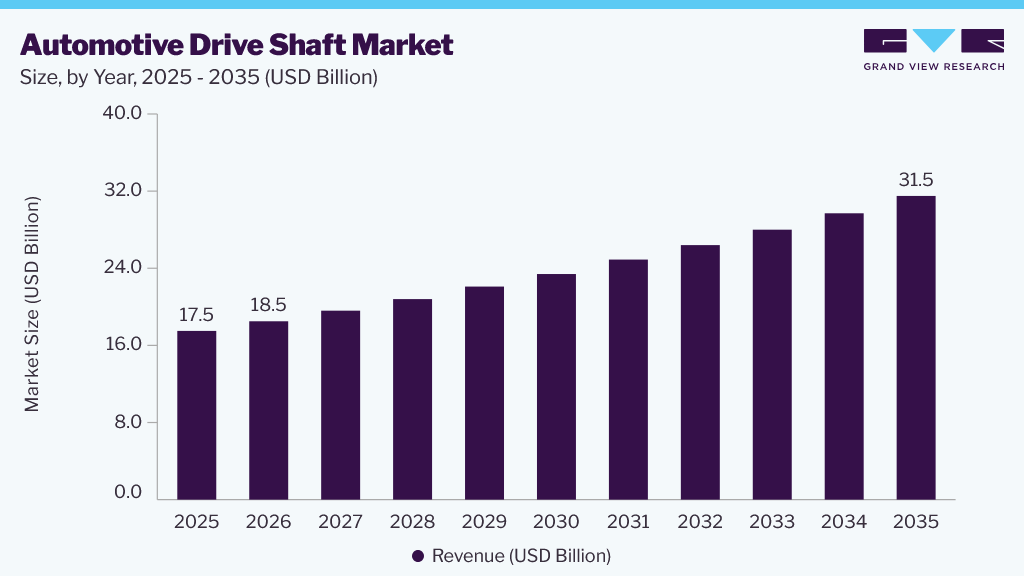 Source: Grand View Research, IR Documents, Primary Interviews, Paid DatabasesTo learn more about this report,
 Download Free Sample Report
Key Market Trends & Insights
- By product: The single-piece drive shaft segment held the largest revenue share of around 52.0% in 2025.
- By position: The rear axle segment held the largest revenue share in 2025.
- By material: The steel segment dominated the market and accounted for the largest revenue share of over 70.0% in 2025.
- By vehicle: The passenger cars segment dominated the market and accounted for the largest revenue share of around 60.0% in 2025.
Regional Highlights
- Largest regional market: Asia Pacific (45.0% revenue share, 2025)
Market Size & Forecast
- Market size in 2025: USD 17.5 Billion
- Estimated market size in 2026: USD 18.5 Billion
- Projected market size by 2035: USD 31.5 Billion
- CAGR (2026-2035): 6.1%
Prism AI by Grand View Research Free to tryAsk a question about the automotive drive shaft marketTry asking✓Every figure cited from GVR research Prefer the report? Download free sample →
As global vehicle production continues to expand, manufacturers require reliable drivetrain components that can efficiently transfer power while improving vehicle performance and durability. The increasing popularity of sport utility vehicles (SUVs), pickup trucks, and all-wheel-drive vehicles has further strengthened demand for advanced drive shaft systems capable of handling higher torque and providing smoother driving performance. At the same time, rising vehicle ownership in developing economies and the expansion of automotive manufacturing facilities are creating sustained demand for drive shafts across a wide range of vehicle categories.Another major trend shaping the market is the growing shift toward lightweight and high-performance drivetrain components. Automotive manufacturers are under constant pressure to improve fuel efficiency, extend electric vehicle driving range, and reduce vehicle emissions while maintaining safety and performance. As a result, there is increasing adoption of lightweight materials, such as aluminum and carbon fiber composites, in drive shaft manufacturing, particularly for premium and electric vehicles. Manufacturers are also introducing improved designs that reduce vibration, minimize energy loss, and enhance overall drivetrain efficiency, making modern drive shafts more durable and reliable than conventional systems.
In addition, the rapid growth of electric and hybrid vehicles is also transforming the market. Although electric vehicles have different powertrain architectures from conventional internal combustion engine vehicles, they still require highly efficient driveline components capable of handling instantaneous torque and ensuring smooth power delivery. This has encouraged manufacturers to develop compact, lightweight, and high-strength drive shaft solutions specifically designed for electrified vehicles. As governments continue to promote vehicle electrification through supportive policies and investments in charging infrastructure, demand for next-generation drivetrain technologies is expected to grow steadily.
Technological advancements in automotive manufacturing are further supporting market expansion. Manufacturers are increasingly adopting advanced forging, precision machining, automated assembly, and digital quality control technologies to improve product consistency and production efficiency. Improved manufacturing processes enable companies to produce stronger and lighter drive shafts with tighter tolerances, resulting in longer service life and lower maintenance requirements. In addition, closer collaboration between automotive manufacturers and component suppliers is accelerating the development of customized drive shaft solutions that meet the performance requirements of modern passenger cars, commercial vehicles, and electric mobility platforms.
Analyst Perspective
The automotive drive shaft market is witnessing steady growth due to rising global vehicle production, increasing demand for passenger and commercial vehicles, and the rapid expansion of electric and hybrid vehicle manufacturing. The market is also benefiting from the growing adoption of lightweight materials, advanced manufacturing technologies, and high-performance drivetrain components that improve vehicle efficiency, durability, and driving comfort. Although challenges such as fluctuating raw material prices, supply chain disruptions, and the need to meet increasingly stringent fuel-efficiency and emissions regulations remain, continuous innovation in lightweight materials, precision engineering, and electric-vehicle drivetrain technologies is creating significant growth opportunities. Companies that focus on developing durable, lightweight, and energy-efficient drive shaft solutions while strengthening partnerships with automotive manufacturers are expected to gain a competitive advantage and support long-term market growth.
Product Insights
The single-piece drive shaft segment accounted for the largest revenue share in 2025, at approximately 52.0%. The segment's dominance is primarily attributed to its widespread adoption in passenger cars, light commercial vehicles, and performance vehicles, owing to its lightweight design, lower manufacturing costs, and ability to efficiently transmit torque over shorter drivetrain lengths. The increasing production of front-engine, rear-wheel-drive passenger vehicles, compact SUVs, and pickup trucks continues to support demand for single-piece drive shafts. In addition, automakers are increasingly focusing on reducing vehicle weight and improving fuel efficiency, encouraging the use of lightweight single-piece shafts manufactured from high-strength steel, aluminum, and composite materials. For instance, in September 2025, Dana Incorporated announced the expansion of its Spicer driveline portfolio with lightweight single-piece aluminum driveshafts designed for light commercial vehicles and performance applications. The development reflects the growing industry focus on lightweight driveline components and reinforces demand for single-piece drive shafts across passenger and commercial vehicle applications.
The multi-piece drive shaft segment is anticipated to register the fastest CAGR during the forecast period. Rising demand for larger vehicles, including commercial vehicles, pickup trucks, long-wheelbase SUVs, and all-wheel-drive vehicles, is expected to drive the adoption of multi-piece drive shafts. These drive shafts are better suited to extended-wheelbase platforms, as they reduce vibration, improve driveline stability, and enhance torque transmission over longer distances. In addition, manufacturers are increasingly focusing on improving vehicle durability, ride comfort, payload capacity, and drivetrain efficiency, further supporting demand for multi-piece drive shafts across both conventional and electrified vehicle platforms.
Position Insights
The rear axle segment accounted for the largest revenue share in 2025, at approximately 58.0%. The segment's dominance is primarily attributed to the widespread use of rear drive shafts in rear-wheel-drive (RWD), all-wheel-drive (AWD), and four-wheel-drive (4WD) vehicles, including pickup trucks, SUVs, commercial vehicles, and buses. Growing production of larger vehicles with longer wheelbases has significantly increased demand for robust rear driveline systems capable of transmitting higher torque while maintaining drivetrain stability and durability. In addition, the rising adoption of premium SUVs, electric pickup trucks, and dual-motor electric vehicles has further strengthened demand for advanced rear-axle drive shafts. Manufacturers are increasingly developing lightweight rear drive shafts using aluminum and composite materials to improve fuel efficiency, reduce vehicle weight, and enhance overall vehicle performance without compromising strength or reliability.
The front axle segment is anticipated to register strong growth during the forecast period. Growth is primarily driven by increased production of front-wheel-drive passenger vehicles, expanding adoption of all-wheel-drive systems, and rising penetration of battery-electric vehicles with front- or dual-motor drivetrains. Modern crossover SUVs and electric vehicles increasingly require lightweight, high-strength front drive shafts that can transmit higher torque while improving efficiency and reducing vehicle weight. In addition, manufacturers continue to invest in advanced materials, precision manufacturing, and optimized driveline designs to enhance durability, reduce vibration, and improve overall vehicle performance. These trends are expected to accelerate demand for front axle drive shafts throughout the forecast period.
Material Insights
The steel segment dominated the market and accounted for the largest revenue share of over 70.0% in 2025. Steel remains the preferred material because it offers high strength, excellent durability, and reliable performance under demanding operating conditions. It is widely used in passenger and commercial vehicles for its cost-effectiveness and ability to withstand high torque and heavy loads. In addition, well-established manufacturing processes and the widespread availability of steel continue to make it the most practical choice for automotive manufacturers worldwide.
The carbon fiber composites segment is anticipated to register the fastest CAGR during the forecast period. The increasing focus on lightweight vehicle components and improved energy efficiency is driving demand for advanced composite materials. Carbon fiber drive shafts are significantly lighter than conventional steel alternatives while maintaining high strength and stiffness, helping reduce vehicle weight and improve overall performance. As electric vehicles and premium performance vehicles continue to expand globally, manufacturers are expected to increasingly adopt carbon fiber components to improve driving range, acceleration, and overall efficiency.
Vehicle Insights
The passenger cars segment dominated the market, accounting for the largest revenue share of around 60.0% in 2025. The large global production volume of passenger vehicles and the growing consumer preference for SUVs, crossovers, and compact cars continue to support the segment's leading position. Nearly every passenger vehicle requires reliable drive shaft systems to efficiently transfer power from the transmission to the wheels, making this segment a major contributor to market demand. In addition, the rapid shift toward hybrid and electric passenger vehicles is driving sustained demand for advanced, lightweight drivetrain technologies.
The light commercial vehicles (LCVs) segment, on the other hand, is anticipated to register the fastest CAGR during the forecast period. The rapid growth of e-commerce, urban logistics, and last-mile delivery services is increasing the demand for delivery vans and pickup trucks worldwide. Businesses are expanding their commercial vehicle fleets to support faster transportation and distribution, driving higher demand for durable, efficient drivetrain components. Furthermore, the increasing electrification of light commercial vehicles is encouraging manufacturers to develop advanced drive shaft solutions that offer improved efficiency, lower maintenance requirements, and better overall vehicle performance.
Regional Insights
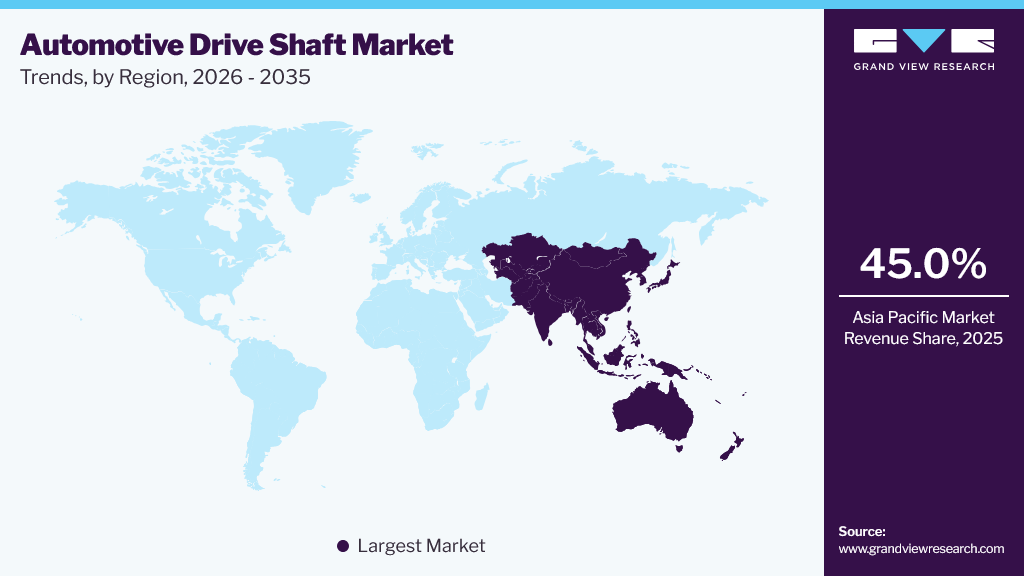
The automotive drive shaft industry in Asia Pacific region dominated the global market, accounting for the largest revenue share of 45.0% in 2025. The region's leadership is primarily driven by its position as the world's largest automotive manufacturing hub, supported by high vehicle production across China, Japan, India, and South Korea. The presence of leading automobile manufacturers, well-established automotive component suppliers, and extensive manufacturing infrastructure continues to generate strong demand for drive shafts across passenger cars, commercial vehicles, and electric vehicles. In addition, favorable government policies promoting domestic vehicle production, increasing investments in electric mobility, and the rapid expansion of automotive exports have further strengthened the regional market. China remains the largest contributor in the Asia Pacific region due to its massive vehicle production capacity, extensive automotive-component supply chain, and continued investment in new energy vehicles. Meanwhile, countries such as India and Southeast Asian nations are emerging as important manufacturing centers, with global automakers continuing to expand production facilities to meet growing domestic and international demand.
 To learn more about this report, Download Free Sample Report
North America Automotive Drive Shaft Market Trends
The automotive drive shaft industry in North America accounted for the second-largest share of the global market in 2025. The region's strong position is primarily driven by the high production and sales of pickup trucks, SUVs, and light commercial vehicles, all of which require durable and high-performance driveline components. Growing consumer preference for larger vehicles, combined with the increasing adoption of all-wheel-drive (AWD) and four-wheel-drive (4WD) systems, continues to support demand for advanced drive shafts across passenger and commercial vehicle segments. Furthermore, the presence of major automotive OEMs and Tier-1 driveline manufacturers, along with continuous investments in lightweight materials and electrified powertrain technologies, is accelerating product innovation and market growth.
U.S. Automotive Drive Shaft Market Trends
The U.S.automotive drive shaft industry is expected to grow steadily during the forecast period, supported by sustained demand for pickup trucks, SUVs, and electric vehicles. The growing production of battery-electric and hybrid vehicles, particularly dual-motor AWD models, is increasing demand for lightweight aluminum and composite drive shafts that improve vehicle efficiency and driving performance.
Key Automotive Drive Shaft Company Insights
The market is highly competitive, with the presence of established global manufacturers as well as regional suppliers focusing on innovation, product quality, and cost efficiency. Leading companies are investing in lightweight materials, advanced manufacturing technologies, and drive shaft solutions designed for electric, hybrid, and high-performance vehicles to meet changing industry requirements. Companies are also strengthening their market position through strategic partnerships with automotive OEMs, expansion of production facilities, and continuous product development to address the growing demand for efficient, durable, and high-performance drivetrain components.
Key Automotive Drive Shaft Companies
The following key companies have been profiled for this study on the automotive drive shaft market:
-
Dauch Corporation
-
Dana Incorporated
-
Hyundai Wia Corporation
-
IFA Rotorion Holding GmbH
-
JTEKT Corporation
-
Neapco Holdings LLC
-
Nexteer Automotive Group Limited
-
NTN Corporation
-
Wanxiang Qianchao Co., Ltd.
Recent Developments
-
In June 2026, Dana Incorporated announced an agreement to combine with Eaton's Mobility business to create a leading global powertrain systems provider. The combined portfolio expands capabilities across commercial and light-vehicle driveline technologies, including drive shafts, axles, differentials, transmissions, and electrified powertrain solutions, strengthening Dana's position across electric, hybrid, and internal-combustion vehicle platforms.
-
In April 2026, American Axle & Manufacturing (AAM) and GKN Automotive jointly issued their 2025 Sustainability Reports, highlighting the launch of seven major global product programs and continued investments in sustainable driveline technologies. The companies also expanded powertrain-agnostic solutions supporting electric, hybrid, and internal combustion vehicles, reinforcing ongoing innovation across the global automotive driveline and drive shaft market.
Global Automotive Drive Shaft Market Report Scope
Report Attribute
Details
Market size in 2025
USD 17.5 billion
Estimated market size in 2026
USD 18.5 billion
Projected market size by 2035
USD 31.5 billion
Growth rate
CAGR of 6.1% from 2026 to 2035
Base year for estimation
2025
Actual data
2021 - 2025
Forecast period
2026 - 2035
Quantitative units
Revenue in USD billion and CAGR from 2026 to 2035
Report coverage
Revenue forecast, company ranking, competitive landscape, growth factors, and trends
Segments covered
Product, material, vehicle, region
Regional Scope
North America; Europe; Asia Pacific; Latin America; Middle East & Africa
Country Scope
U.S.; Canada; Mexico; UK; Germany; France; Italy; Spain; China; Japan; India; Australia; South Korea; Brazil; Argentina; South Africa; Saudi Arabia; UAE
Key companies profiled
Dauch Corporation; Dana Incorporated; Hyundai Wia Corporation; IFA Rotorion Holding GmbH; JTEKT Corporation; Neapco Holdings LLC; Nexteer Automotive Group Limited; NTN Corporation; Wanxiang Qianchao Co., Ltd.
Customization scope
Free report customization (equivalent to 8 analyst working days) with purchase. Addition or alteration to country, regional & segment scope.
Pricing and purchase options
Avail of customized purchase options to meet your exact research needs. Explore purchase options
Global Automotive Drive Shaft Market Report Segmentation
This report forecasts revenue growth at the global, regional, and country levels and provides an analysis of the latest industry trends and opportunities across each sub-segment from 2021 to 2035. For this study, Grand View Research has segmented the global automotive drive shaft market report based on product, material, vehicle, and region:
-
Product Outlook (Revenue, USD Billion, 2021 - 2035)
-
Single Piece Drive Shaft
-
Multi Piece Drive Shaft
-
Slip-in-Tube Drive Shaft
-
Others
-
-
Position Outlook (Revenue, USD Billion, 2021 - 2035)
-
Rear Axle Drive Shaft
-
Front Axle Drive Shaft
-
-
Material Outlook (Revenue, USD Billion, 2021 - 2035)
-
Steel
-
Aluminum
-
Carbon Fiber Composites
-
Hybrid Composites
-
Others
-
-
Vehicle Outlook (Revenue, USD Billion, 2021 - 2035)
-
Passenger Cars
-
Hatchback
-
Sedan
-
SUV & Crossover
-
-
Light Commercial Vehicles (LCVs)
-
Pickup Trucks
-
Vans
-
-
Heavy Commercial Vehicles (HCVs)
-
Medium & Heavy Duty Trucks
-
Buses & Coaches
-
-
Others
-
-
Regional Outlook (Revenue, USD Billion, 2021 - 2035)
-
North America
-
U.S.
-
Canada
-
Mexico
-
-
Europe
-
UK
-
Germany
-
France
-
Italy
-
Spain
-
-
Asia Pacific
-
China
-
Japan
-
India
-
Australia
-
South Korea
-
-
Latin America
-
Brazil
-
Argentina
-
-
Middle East and Africa (MEA)
-
South Africa
-
Saudi Arabia
-
UAE
-
-
Frequently Asked Questions About This Report
The global automotive drive shaft market size was valued at USD 17.5 billion in 2025 and is estimated at USD 18.5 billion in 2026.
The global automotive drive shaft market is expected to grow at a CAGR of 6.1% from 2026 to 2035, reaching USD 31.5 billion by 2035.
Asia Pacific dominated with approximately 45.0% revenue share in 2025.
The single-piece drive shaft segment held the largest revenue share of around 52.0% in 2025.
Key players in the market include American Axle & Manufacturing Holdings, Inc., Dana Incorporated, GKN Automotive Limited, Hyundai Wia Corporation, IFA Rotorion Holding GmbH, JTEKT Corporation, Neapco Holdings LLC, Nexteer Automotive Group Limited, NTN Corporation, Wanxiang Qianchao Co., Ltd., and others.
About the Author(s)
Automotive & Transportation Research Team
Technology · Automotive & TransportationThis report was authored by the automotive & transportation research team at Grand View Research - comprising two research analysts, one senior research analyst, and one industry expert - with specialized expertise in the automotive & transportation segment of the technology industry. All findings are based on proprietary technology databases, executive interviews, and regulatory analysis, subject to internal peer review prior to publication.
Last Updated:
Speak to Analyst

Customize this report to your needs - add regions, segments, or data points, with 20% free customization.
Or view our licence options:


ISO 9001:2015 & 27001:2022 Certified
We are GDPR and CCPA compliant! Your transaction & personal information is safe and secure. For more details, please read our privacy policy.


