
- Home
- »
- Advanced Materials
- »
-
Automotive Flooring Market Size, Growth Report, 2026-2033GVR Report cover

Automotive Flooring Market (2026 - 2033)
Size, Share & Trends Analysis Report By Material (Polyurethane, Polypropylene, Nylon, Rubber, Others), By Product (Carpets, Mats), By Application, By Region, And Segment Forecasts
Market Size, 2025
$39.8BMarket Estimate, 2026
$41.2BMarket Forecast, 2033
$53.3BCAGR, 2026–2033
3.7%Automotive Flooring Market Summary
The global automotive flooring market size was valued at USD 39.8 billion in 2025 and is projected to grow from USD 41.2 billion in 2026 to USD 53.3 billion in 2033, at a CAGR of 3.7% from 2026 to 2033. The Asia Pacific market dominated, with a revenue share of over 50.0% in 2025. A significant rise in global demand for vehicles, driven by improving lifestyles and income levels, a growing focus on automotive interiors and aesthetics, advancements in flooring materials, and increased emphasis on vehicle safety, has contributed to market growth.
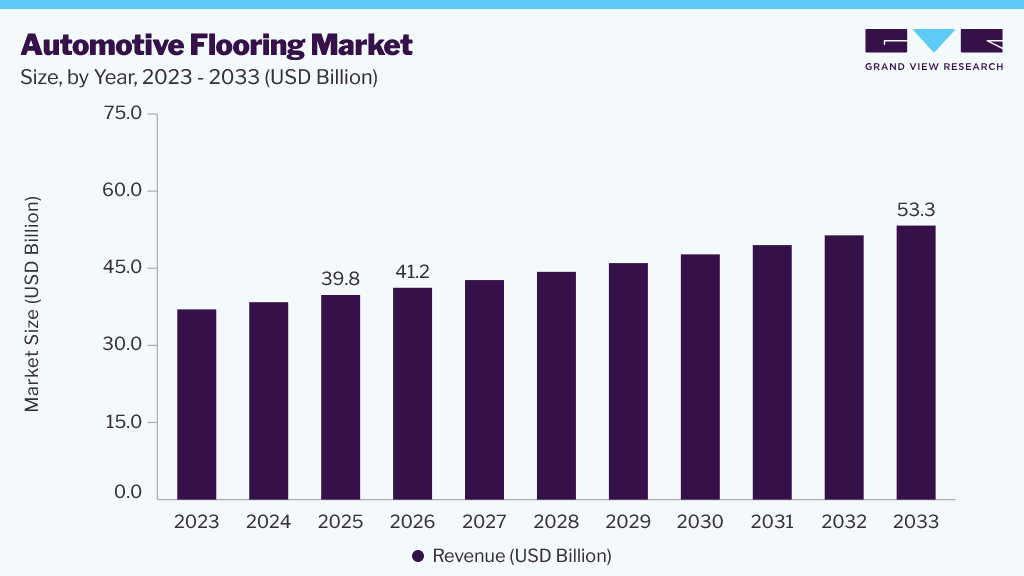 Source: Grand View Research, IR Documents, Primary Interviews, Paid DatabasesTo learn more about this report,
 Download Free Sample Report
Key Market Trends & Insights- By material: The nylon segment held the largest market share of around 25.0% in 2025.
- By product: The carpets segment held the largest market share in 2025.
- By application: The cars segment held the largest market share of over 70.0% in 2025.
Regional Highlights
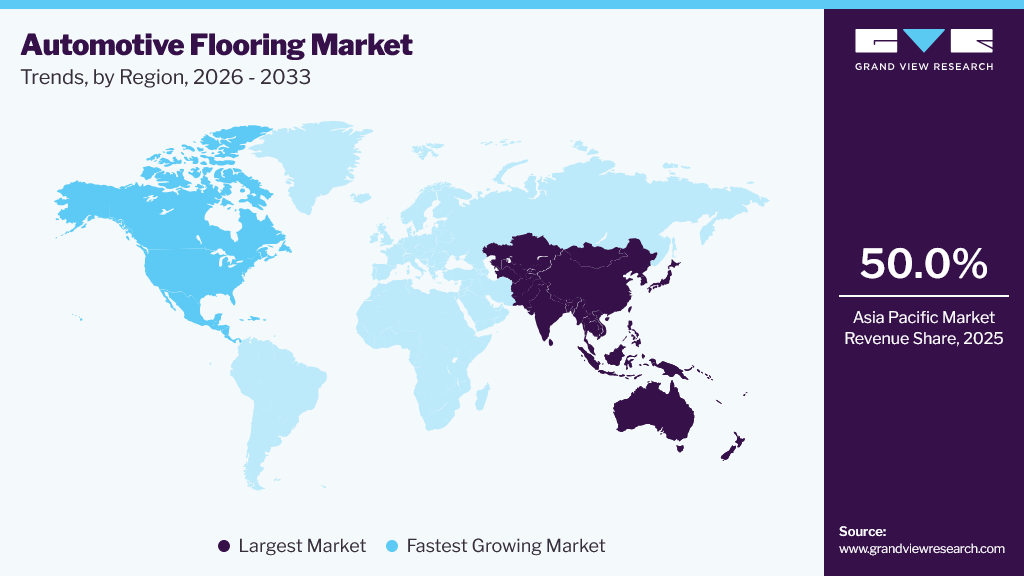
- Largest regional market: Asia Pacific (50.0% revenue share, 2025)
- Fastest-growing regional market: North America (highest CAGR, 2026-2033)
Market Size & Forecast
- Market size in 2025: USD 39.8 Billion
- Estimated market size in 2026: USD 41.2 Billion
- Projected market size by 2033: USD 53.3 Billion
- CAGR (2026-2033): 3.7%
Three ways to get this report
Buy it, customize it, or ask a question.Ask an Analyst
Analyst response in 1 business day
- AccessReport author, directly
- Reply timeWithin 1 working day
- No sales callDirect answer only
- FormatEmail reply
- CostFree, no cost
Get the Full Report
What the study covers
- FormatsPDF · Excel · Dashboard
- Timeline2026–2033 annual, 2025 base
- Coverage20+ countries, 5 regions
- Companies10+ key players profiled
Customize the Report
20% free customization
- IncludeCountries, segments, points
- TailorTo your product definition
- ExtendDeeper competitor detail
- OrA fully bespoke study
- Turnaround5–10 working days
The increasing global population and rapid urbanization are leading to a surge in demand for automobiles. For example, the International Organization of Motor Vehicle Manufacturers (OICA) reports that global vehicle sales reached approximately 99.8 million units in 2025, up from 95.3 million units in 2024, representing a growth rate of 4.7%. This significant rise in demand for both passenger cars and commercial vehicles is driving market growth.
The growing interest in vehicle customization and personalization is boosting the demand for premium flooring solutions such as carpets and 3D & 7D floor mats. These products are not only aesthetically pleasing but also help prevent metal floors from rusting and provide improved cushioning. In addition, high-quality flooring materials reduce road noise and chassis vibrations while enhancing sound dampening. The growing focus on safety standards and regulations is driving demand for flooring materials that meet strict safety requirements. For instance, in 2025, the U.S. Federal Motor Vehicle Safety Standard (FMVSS) No. 302 remained a crucial benchmark for determining the burn resistance of materials used inside vehicle occupant compartments. Administered by the National Highway Traffic Safety Administration (NHTSA), this standard specifies flammability requirements for interior materials, including carpeting, floor coverings, insulation, seat cushions, trim panels, and other components within the occupant compartment. Furthermore, the government has introduced a self-certification process that mandates automotive component manufacturers to comply with specific safety standards.
The rising popularity of electric and hybrid vehicles is creating new opportunities for innovative flooring solutions designed to meet their unique needs. For example, these vehicles have batteries installed at the bottom that require proper insulation and protection to prevent potential hazards for occupants. In addition, untapped vehicle segments, such as Light Commercial Vehicles (LCVs), are driving substantial demand for customized, durable floor mats and promoting market growth.
Technological advancements, including innovative features like ambient lighting, heating, and cooling systems integrated into flooring, are also facilitating the expansion of this industry. The automotive aftermarket, which encompasses the sale and installation of replacement parts and accessories, is experiencing steady growth. The demand for automotive flooring replacement products is a significant driver for this market. Moreover, the economic progress of emerging nations, particularly in the Asia-Pacific region, is further supporting the expansion of the automotive industry and related markets, including automotive flooring.
Analyst Perspective
The market is seeing steady evolution as vehicle manufacturers place greater focus on cabin comfort, durability, and interior aesthetics. Flooring materials are no longer viewed only as functional components but also as part of the overall driving experience and vehicle differentiation strategy. Automakers are increasingly seeking lightweight, easy-to-maintain, and noise-reducing materials that support both performance and design goals. This is creating opportunities for suppliers that can offer advanced material solutions while maintaining cost efficiency and production scalability. In addition, the growing shift toward electric vehicles is influencing demand for flooring systems that improve insulation and cabin acoustics. Market players that can balance material innovation, sustainability, and long-term durability are expected to strengthen their position as interior design and passenger experience become more important in vehicle purchasing decisions.
Material Insights
In terms of flooring material, nylon led the market with a revenue share of over 25.0% in 2025. Nylon's exceptional properties are responsible for its extensive use in automotive flooring applications. The material resists abrasion and chemicals, offers a high strength-to-weight ratio, and delivers excellent durability, making it well-suited to withstand the challenging conditions of the automotive sector. Moreover, nylon's flexibility enables it to be molded and formed easily to meet the design needs of contemporary vehicle interiors. In addition, its recyclability and reusability support the growing emphasis on sustainability in the automotive sector. The cost-effectiveness and ease of nylon production make it a favored option for manufacturers, leading to its widespread use in automotive flooring.
Polyurethane is expected to register the fastest CAGR over the forecast period. This is attributed to the unique combination of properties of this material, making it an appealing choice for automotive flooring applications. PU's superior flexibility, acoustic insulation, and vibration-damping capabilities enable it to provide enhanced comfort and noise reduction in vehicles. In addition, its lightweight and durable nature aligns with the industry's focus on weight reduction and sustainability. The growing adoption of PU in automotive flooring is also driven by its versatility, allowing it to be formulated to meet specific performance requirements. These factors have collectively contributed to this material’s strong demand among manufacturers.
Application Insights
Cars accounted for the largest share of market revenue in 2025. According to the International Organization of Motor Vehicle Manufacturers (OICA), approximately 71.3 million passenger cars were produced worldwide in 2025, accounting for nearly 74.0% of the total global motor vehicle production of 96.4 million units. This high proportion of sales has naturally driven a strong demand for vehicle flooring components such as carpets and mats. The cars segment encompasses a wide range of vehicles, such as sedans, hatchbacks, and SUVs, which represent a substantial market for automotive flooring. In addition, the growing focus on interior comfort, aesthetics, and noise reduction in passenger cars has led to greater adoption of advanced flooring materials and technologies. This segment also benefits from the high replacement rate of flooring components due to wear and tear, which generates significant aftermarket demand.
The LCV segment is expected to register the fastest CAGR from 2026 to 2033. This is owing to the increasing demand for LCVs, driven by the rapid expansion of e-commerce, logistics, and delivery sectors. As a result, there is a growing need for durable, practical flooring solutions that can withstand heavy use and cargo handling. The LCV segment, which includes vans, minivans, and pickup trucks, is benefiting from this trend, with manufacturers and fleet operators seeking high-quality flooring materials to enhance vehicle durability and reduce maintenance costs. In addition, the rising popularity of customized LCVs has driven demand for specialized flooring solutions tailored to specific customer requirements. This segment is also experiencing growth due to the increasing adoption of advanced flooring technologies, such as waterproof and slip-resistant materials, which provide improved functionality and safety.
Product Insights
Carpets accounted for the largest share of market revenue in 2025. Carpets provide a premium feel and look to vehicle interiors, making them a preferred choice for both original equipment manufacturers (OEMs) and consumers. In addition, these products offer excellent sound absorption and insulation features, contributing to a quieter and more comfortable driving experience. For instance, in 2025, Toyota Boshoku continued expanding the use of recycled and lightweight materials in its automotive interior components, including floor carpet systems, to support vehicle weight reduction and sustainability objectives. The initiative reflects the growing demand for environmentally friendly automotive carpet solutions across the global automotive industry. The versatile nature of carpets also allows them to be easily customized to fit various vehicle designs and models. Furthermore, advancements in carpet technology have enhanced durability, stain resistance, and ease of maintenance, solidifying carpets' position as the leading product segment in this industry.
The mats segment is expected to witness the fastest CAGR from 2026 to 2033. Floor mats offer superior protection against dirt, dust, and moisture, making them an essential accessory for vehicle owners. The growing popularity of sport utility vehicles (SUVs) and trucks has driven demand for 7D floor mats, as these vehicles require more durable, easy-to-clean flooring solutions. In addition, advancements in materials technology have enabled the development of high-quality, customized floor mats that offer a precise fit and superior performance. The rising trend in vehicle personalization and customization has driven growth in this market segment, as consumers seek to enhance their vehicles' interiors with premium, functional accessories.
Regional Insights
Asia Pacific dominated the global market with a revenue share of around 50.0% in 2025, a share that is growing. This is attributed to the region's large and steadily growing automotive industry, driven by leading automotive manufacturing hubs in countries such as China, Japan, India, and South Korea. In addition, the growing middle-income population and rising disposable incomes have led to increased vehicle ownership, further fueling demand for automotive flooring solutions. For instance, according to the Society of Indian Automobile Manufacturers (SIAM), passenger vehicle sales in India reached approximately 4.3 million units during FY 2024–25, marking the highest-ever annual sales volume in the country and significantly higher than the preceding year’s numbers. Similar observations were made in other regional economies, which have positively impacted the demand for automotive flooring in this region in recent years.
 To learn more about this report, Download Free Sample Report
China Automotive Flooring Market Trends
The automotive flooring market in China accounted for the largest share of the regional market in 2025. The economy benefits from a well-established supply chain and manufacturing infrastructure, which enable efficient production and distribution of automotive flooring products. Furthermore, government initiatives and investments in the automotive sector have created a favorable business environment, contributing to the country’s high market share. As a result, China has become home to numerous original equipment manufacturers (OEMs) and suppliers, thereby driving demand for automotive flooring solutions.
North America Automotive Flooring Market Trends
The automotive flooring market in North America held a notable share of the global market in 2025. The region's high vehicle production volume and a strong focus on comfort and aesthetics have contributed to the adoption of advanced flooring materials and technologies. The industry also benefits from a strong aftermarket segment, driven by consumer preference for vehicle customization and upgrading, which further fuels the demand for automotive flooring products. Moreover, the presence of key suppliers and manufacturers, such as Magna International Inc., has enabled the region to maintain a competitive edge in the global market.
The U.S. automotive flooring market accounted for the largest share in North America in 2025. The country is home to a significant number of major automotive manufacturers, including the Big Three automakers, Ford, General Motors, and Stellantis, which generate substantial demand for automotive flooring solutions. Moreover, according to the Alliance for Automotive Innovation, light trucks continued to dominate the U.S. automotive market in 2025, accounting for approximately 81% of total new vehicle sales. These factors have collectively fueled the demand for innovative, aesthetic, and durable automotive flooring solutions in the economy.
Key Automotive Flooring Company Insights
The automotive flooring industry features a range of global, regional, and local players, making it a competitive market. The world’s leading companies are using partnerships, collaborations, acquisitions, mergers, and agreements as strategies to withstand the intense competition and increase their market share. Automotive flooring product manufacturers are investing heavily in product enhancements and new product development.
Key Automotive Flooring Companies
The following key companies have been profiled for this study on the automotive flooring market:
-
HAYAKAWA EASTERN RUBBER CO., LTD.
-
IDEAL Automotive GmbH
-
Kotobukiya Fronte Co., Ltd.
-
SHANDONG EXCEEDING AUTO INTERIOR PARTS CO., LTD.
-
Suminoe Textile Co., Ltd.
-
HAYASHI TELEMPU CORPORATION
-
Magna International Inc.
-
Shanghai Shenda Co., Ltd.
-
TOYOTA BOSHOKU CORPORATION
-
Feltex
Recent Developments
-
In January 2026, Hurim Atec announced the completion of its proprietary “Stage Flooring” technology for autonomous and electric vehicles. The flooring system was developed as an alternative to conventional automotive flooring materials and supports the integration of premium surface finishes, lighting elements, and contamination-resistant features for next-generation vehicle interiors.
-
In July 2025, Autoneum launched N-Join1, a mono-material automotive carpet system designed without latex or adhesives. Manufactured from recycled materials, the flooring solution enhances recyclability and supports waste-free production while maintaining acoustic performance and passenger comfort, reflecting the increasing focus on sustainable automotive flooring technologies.
-
In June 2025, SK Chemicals signed an exclusive partnership agreement with Durmont to supply SKYPET CR recycled PET materials for automotive carpet applications used by global automotive manufacturers. The partnership expanded the use of recycled materials in vehicle flooring systems and supported sustainability initiatives across the automotive interior supply chain.
Automotive Flooring Market Report Scope
Report Attribute
Details
Market size in 2025
USD 39.8 billion
Estimated market size in 2026
USD 41.2 billion
Projected market size by 2033
USD 53.3 billion
Growth rate
CAGR of 3.7% from 2026 to 2033
Base year for estimation
2025
Historical data
2021 – 2024
Forecast period
2026 – 2033
Quantitative units
Revenue in USD billion, and CAGR from 2026 to 2033
Report coverage
Revenue forecast, company ranking, competitive landscape, growth factors, and trends
Segments covered
Material, product, application, region
Regional Scope
North America; Europe; Asia Pacific; Latin America; MEA
Country Scope
U.S.; Canada; Mexico; Germany; UK; France; Italy; Spain; China; Japan; India; Brazil; Argentina; South Africa; Saudi Arabia
Key companies profiled
HAYAKAWA EASTERN RUBBER CO., LTD; IDEAL Automotive GmbH; Kotobukiya Fronte Co., Ltd.; SHANDONG EXCEEDING AUTO INTERIOR PARTS CO., LTD; Suminoe Textile Co., Ltd.; HAYASHI TELEMPU CORPORATION; Magna International Inc.; Shanghai Shenda Co., Ltd.; TOYOTA BOSHOKU CORPORATION; Feltex
Customization scope
Free report customization (equivalent up to 8 analysts working days) with purchase. Addition or alteration to country, regional & segment scope.
Pricing and purchase options
Avail of customized purchase options to meet your exact research needs. Explore purchase options
Global Automotive Flooring Market Report Segmentation
This report forecasts revenue growth at global, regional, and country levels and provides an analysis of the latest industry trends and opportunities in each of the sub-segments from 2021 to 2033. For this study, Grand View Research has segmented the global automotive flooring market report based on material, product, application, and region:
-
Material Outlook (Revenue, USD Billion, 2021 - 2033)
-
Polyurethane
-
Polypropylene
-
Nylon
-
Rubber
-
Others
-
-
Product Outlook (Revenue, USD Billion, 2021 - 2033)
-
Carpets
-
Mats
-
-
Application Outlook (Revenue, USD Billion, 2021 - 2033)
-
Cars
-
LCV
-
HCV
-
-
Regional Outlook (Revenue, USD Billion, 2021 - 2033)
-
North America
-
U.S.
-
Canada
-
Mexico
-
-
Europe
-
UK
-
Germany
-
France
-
Italy
-
Spain
-
-
Asia Pacific
-
Japan
-
India
-
China
-
-
Latin America
-
Brazil
-
Argentina
-
-
Middle East & Africa
-
South Africa
-
Saudi Arabia
-
-
Frequently Asked Questions About This Report
The global automotive flooring market size was valued at USD 39.8 billion in 2025 and is estimated at USD 41.2 billion in 2026
The global automotive flooring market is expected to grow at a CAGR of 3.7% from 2026 to 2033, reaching USD 53.3 billion.
Asia Pacific dominated with an approximately 50.0% revenue share in 2025
The nylon automotive flooring segment accounted for the largest revenue share of over 25.0% in 2025.
Key players in the market include HAYAKAWA EASTERN RUBBER CO., LTD, IDEAL Automotive GmbH, Kotobukiya Fronte Co., Ltd., SHANDONG EXCEEDING AUTO INTERIOR PARTS CO., LTD, Suminoe Textile Co., Ltd., HAYASHI TELEMPU CORPORATION, Magna International Inc., Shanghai Shenda Co., Ltd., TOYOTA BOSHOKU CORPORATION, Feltex, and others.
About the Author(s)
Advanced Materials Research Team
Materials · Advanced MaterialsThis report was authored by the advanced materials research team at Grand View Research - comprising two research analysts, one senior research analyst, and one industry expert - with specialized expertise in the advanced materials segment of the materials industry. All findings are based on proprietary materials databases, executive interviews, and regulatory analysis, subject to internal peer review prior to publication.
Last Updated:
Speak to Analyst

Customize this report to your needs - add regions, segments, or data points, with 20% free customization.
Or view our licence options:


ISO 9001:2015 & 27001:2022 Certified
We are GDPR and CCPA compliant! Your transaction & personal information is safe and secure. For more details, please read our privacy policy.


