
- Home
- »
- Automotive & Transportation
- »
-
Automotive Fuse Market Size, Share & Trends Report, 2033GVR Report cover

Automotive Fuse Market (2026 - 2033)
Size, Share & Trends Analysis Report By Component (Blade Fuses, Glass Tube Fuses), By Vehicle (Passenger Cars, Commercial Vehicles), By Sales Channel (OEM, Aftermarket), By Application, By Region, And Segment Forecasts
Market Size, 2025
$13.5BMarket Estimate, 2026
$14.1BMarket Forecast, 2033
$21.8BCAGR, 2026–2033
6.4%Automotive Fuse Market Summary
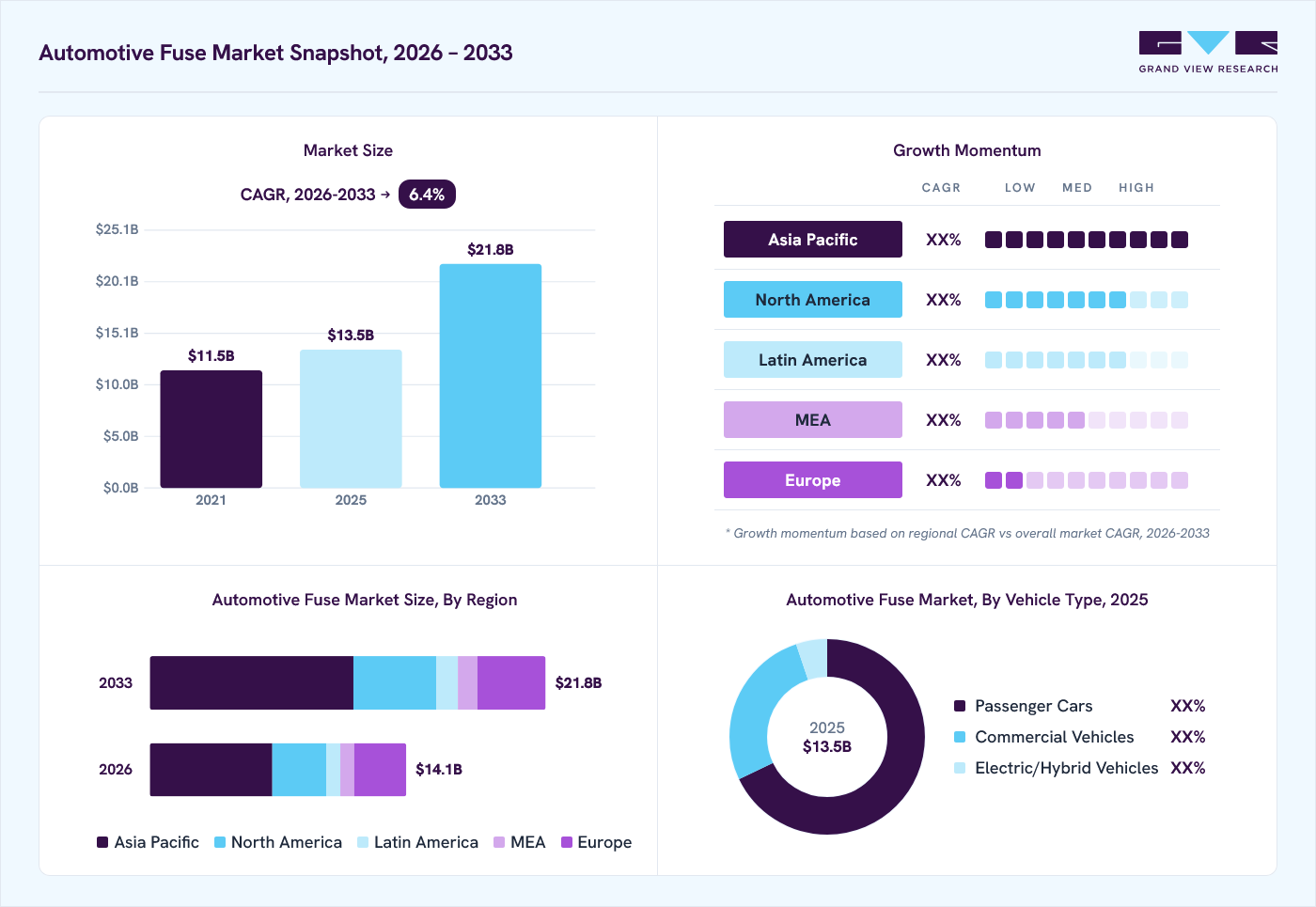
The global automotive fuse market size was valued at USD 13.5 billion in 2025 and is projected to grow from USD 14.1 billion in 2026 to USD 21.8 billion by 2033, at a CAGR of 6.4% from 2026 to 2033. Asia Pacific dominated the market, accounting for the largest revenue share of 47.3% in 2025. Rising demand for high-current protection in electric vehicle systems is supporting market growth.
 Source: Grand View Research, IR Documents, Primary Interviews, Paid DatabasesTo learn more about this report,
 Download Free Sample Report
Key Market Trends & Insights
- By component: The blade fuses segment led the market and accounted for 45.4% of the global revenue in 2025.
- By vehicle: The passenger cars segment led the market and accounted for 67.8% of the global revenue in 2025.
- By sales channel: The OEM segment led the market and accounted for 70.3% of the global revenue in 2025.
- By application: The body electronics segment accounted for the largest share of 34.6% of the global revenue in 2025.
Regional Highlights
- Largest regional market: Asia Pacific (47.3% revenue share, 2025)
- By country: China held the largest market share in 2025.
Market Size & Forecast
- Market size in 2025: USD 13.5 Billion
- Estimated market size in 2026: USD 14.1 Billion
- Projected market size by 2033: USD 21.8 Billion
- CAGR (2026-2033): 6.4%
Three ways to get this report
Buy it, customize it, or ask a question.Ask an Analyst
Analyst response in 1 business day
- AccessReport author, directly
- Reply timeWithin 1 working day
- No sales callDirect answer only
- FormatEmail reply
- CostFree, no cost
Get the Full Report
What the study covers
- FormatsPDF · Excel · Dashboard
- Timeline2026–2033 annual, 2025 base
- Coverage20+ countries, 5 regions
- Companies10+ key players profiled
Customize the Report
20% free customization
- IncludeCountries, segments, points
- TailorTo your product definition
- ExtendDeeper competitor detail
- OrA fully bespoke study
- Turnaround5–10 working days
The growing adoption of electric and hybrid vehicles is increasing the need for reliable electrical protection systems. These vehicles use more electrical circuits and higher-power components than conventional vehicles, creating greater demand for fuses to protect batteries, motors, inverters, charging systems, and other electronic components. The expansion of electrified powertrains is supporting demand for both conventional and high-current automotive fuses. As automakers continue to introduce more electric and hybrid models, the need for effective circuit protection is expected to increase.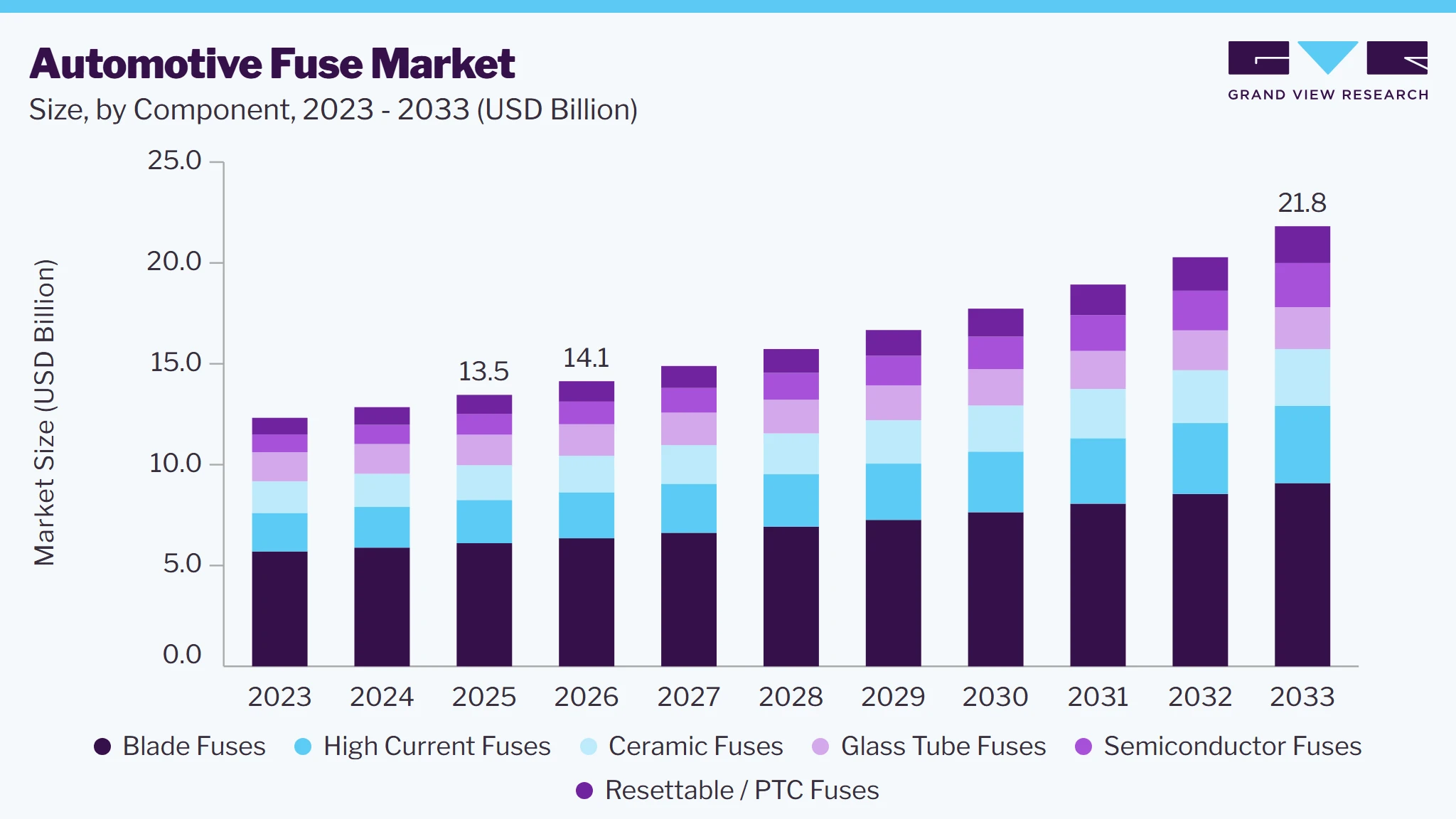 To learn more about this report, Download Free Sample Report
Automotive electrical systems are becoming more complex as vehicles increasingly incorporate ADAS, infotainment, connected features, and electrified powertrains. This is driving the development of smaller and faster fuses capable of protecting sensitive electronic components and handling higher electrical loads. High-current and high-voltage protection solutions are becoming particularly important for EV battery and powertrain systems. Moreover, the market is moving toward more compact and higher-performance fuse solutions that can support the growing electrical requirements of modern vehicles.
Stringent regulations governing high-voltage automotive systems are increasing the focus on electrical safety and protection in electric vehicles. These regulations provide a framework for ensuring the safe operation of high-voltage electrical systems and components. According to the UN Regulation No. 100, safety requirements for electric powertrains and high-voltage components used in electric vehicles. These requirements encourage manufacturers to adopt appropriate protection measures for batteries, electrical circuits, and other high-voltage systems. This supports demand for reliable high-voltage and high-current automotive fuse solutions.
The increasing adoption of resettable circuit protection technologies is restraining market growth, as these solutions can provide reusable protection without requiring fuse replacement after a fault. Their suitability for selected automotive electrical and electronic applications is encouraging manufacturers to consider alternatives to conventional fuses. This can reduce the use of replaceable fuse-based protection in certain vehicle systems. Moreover, the growing adoption of resettable protection technologies may limit demand for traditional automotive fuses.
Market Dynamics
The market for automotive fuses is being shaped by increasing vehicle electrification, rising electrical content, and growing demand for reliable circuit protection across powertrains, body electronics, safety, infotainment, and battery systems. Global vehicle production increased to 96.4 million units in 2025, while the continued adoption of electric and hybrid vehicles is increasing the number and complexity of electrical circuits requiring protection. At the same time, the market is shifting toward compact, high-current, high-voltage, and application-specific fuse solutions to support evolving vehicle electrical architectures.
Modern vehicles are incorporating an increasing number of electrical functions, including electronic control systems, safety features, infotainment, comfort features, battery systems, and electric powertrains. This increasing electrical content is raising the number of circuits that require protection against excessive current, short circuits, and electrical faults. The shift toward electric and hybrid vehicles further strengthens this requirement because these vehicles integrate high-power battery, charging, and power-conversion systems alongside conventional low-voltage electrical networks. As vehicle architecture becomes increasingly dependent on electrical and electronic systems, the need for effective circuit protection is expanding.
Automotive fuses protect individual electrical circuits and high-power components by interrupting current during overloads and short circuits. The market is therefore moving toward solutions that support both conventional low-voltage systems and higher-voltage electrical architecture used in electrified vehicles. High-current and high-voltage fuses are increasingly required across battery systems, charging systems, power converters, and vehicle power distribution networks. The expansion of these applications increases fuel content per vehicle and supports overall market growth.
The growing complexity of vehicle electrical systems is increasing the technical requirements for automotive fuses, including reliability, temperature resistance, vibration performance, current-interruption capability, and electrical safety. Fuse products must undergo extensive testing and qualification before being incorporated into vehicle electrical architectures. Compliance with automotive standards and customer-specific qualification requirements can increase product development timelines and associated engineering and testing expenditures. These requirements create a higher cost burden for manufacturers seeking to develop and introduce new automotive fuse technologies.
Higher development and qualification costs can particularly affect smaller suppliers with limited engineering, testing, and manufacturing resources. The challenge becomes more significant for high-voltage applications because these products require higher performance and greater reliability under demanding electrical conditions. As a result, manufacturers may face longer development cycles and higher investments before generating revenue from newly developed products. This can limit the pace of new supplier entry and slow the adoption of advanced fuse technologies, particularly in high-value electrified vehicle applications.
The increasing adoption of electric and hybrid vehicles is creating opportunities for advanced fuse products beyond conventional low-voltage applications. Battery packs, charging systems, power distribution units, power converters, and other high-power electrical systems require specialized circuit protection capable of managing higher voltage and current levels. The transition toward higher-voltage vehicle architecture is consequently increasing demand for fuses with improved interruption capability, thermal performance, compact designs, and higher electrical ratings. This shift is creating a growing addressable market for advanced automotive circuit-protection solutions.
The opportunity is particularly strong for high-voltage battery protection, charging-system protection, and power-distribution applications as vehicle electrification expands. Demand for compact and application-specific fuse solutions is also expected to increase as manufacturers seek to optimize vehicle packaging while maintaining electrical safety and reliability. Suppliers with capabilities in high-voltage, high-current, and customized fuse technologies are well positioned to benefit from this transition. Increasing fuse content and higher-value protection requirements in electrified vehicles can further increase per-vehicle revenue potential and support long-term market expansion.
Market Concentration & Characteristics
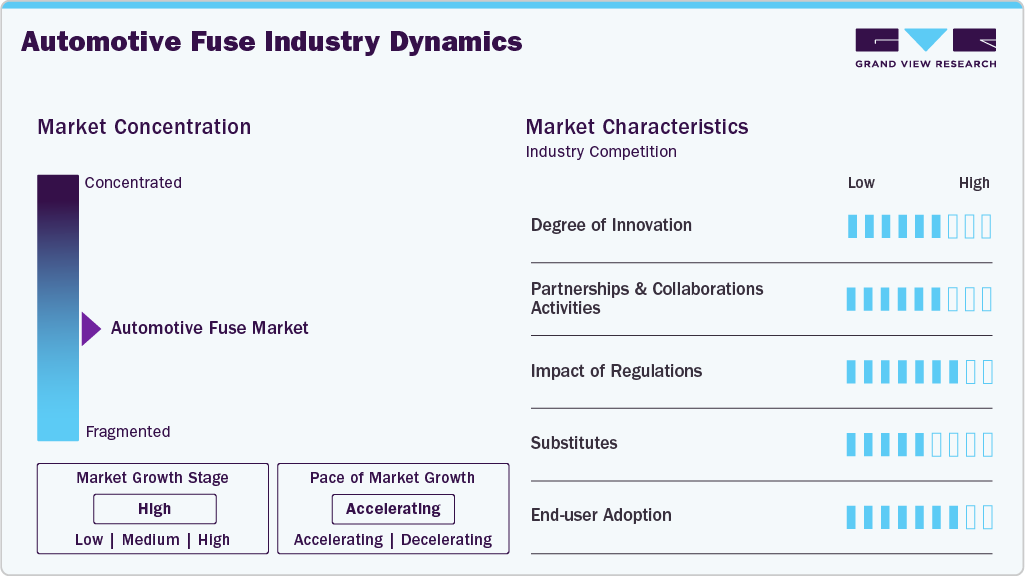
The automotive fuse industry is moderately consolidated, indicating that a limited number of established manufacturers hold a significant share of the market, while several regional and specialized players also compete. The market requires strong manufacturing capabilities, established relationships with automotive OEMs and Tier-1 suppliers, product reliability, and compliance with automotive safety and quality requirements, which creates barriers for new entrants. Leading manufacturers benefit from long-standing customer relationships and broad product portfolios covering standard, high-current, miniaturized, and high-voltage fuses. However, the presence of smaller, specialized suppliers prevents the market from becoming highly concentrated, particularly in aftermarket and niche applications. Moreover, competition is driven by product performance, reliability, cost-efficiency, customization capabilities, and the ability to meet the evolving electrical requirements of modern vehicles.
 To learn more about this report, Download Free Sample Report
The market characteristics indicate moderate-to-high innovation and partnership activity, supported by the increasing electrical and electronic content of vehicles and the growing adoption of electric and hybrid vehicles. Manufacturers are developing compact, high-current, and high-voltage fuse solutions to address the requirements of advanced electrical architecture and battery systems. Regulatory requirements have a relatively high impact because automotive fuses are closely associated with vehicle electrical safety and protection, while substitutes pose a relatively moderate threat, as circuit protection remains necessary even as alternative protection technologies develop. End-user adoption is relatively high, as fuses are widely used across powertrain, body electronics, safety, infotainment, comfort, and battery-related systems. These factors support accelerating market growth, while continued vehicle electrification and increasing electrical complexity are expected to sustain demand for advanced automotive fuse solutions.
Analyst Perspective
The market for automotive fuse is witnessing steady growth as vehicle production expands and electrical content increases across conventional, hybrid, and EVs. Electrification is particularly important because EV battery, charging, and power distribution systems require specialized high-current and high-voltage protection. Manufacturers are therefore shifting investment toward compact, higher-rated, and application-specific fuse technologies, including products designed for 800 V and 1,000 V vehicle systems. The competitive environment is also moving toward broader circuit-protection portfolios, customization, and closer collaboration with OEMs and Tier-1 suppliers. Moreover, investment is expected to increasingly favor EV-focused fuse technologies while conventional blade and low-voltage products continue to generate substantial replacement and OEM demand.
Component Insights
Based on component, the blade fuses component segment accounted for 45.4%, the largest share of global revenue in 2025, due to their widespread use across conventional vehicle electrical systems. Their compact design and easy replacement make them suitable for protecting lighting, body electronics, power accessories, and other low-voltage circuits. High availability across OEM and replacement channels further supports their large installed base. Continued vehicle production and increasing electrical content are expected to sustain demand for blade fuses, although higher-value fuse types are gaining importance in electrified vehicles.
The high current fuses component segment is projected to grow at the fastest CAGR over the forecast period, as vehicles increasingly require protection for higher-power electrical systems. Growing adoption of electric and hybrid vehicles is increasing demand for protection across batteries, charging systems, power distribution, and other high-power applications. Rising electrical loads in commercial vehicles are also creating additional opportunities for high current fuse products. The shift toward electrified and more electrically intensive vehicle architecture is increasing the value and application scope of this segment.
Vehicle Insights
Based on vehicle, the passenger cars segment accounted for 67.8%, the largest share of global revenue in 2025, driven by their significantly higher production and sales volumes compared with commercial vehicles. Increasing adoption of electronic features such as safety systems, infotainment, lighting, connectivity, and comfort functions is raising the requirement for circuit protection. Electric and hybrid passenger cars are further increasing demand for specialized fuse products as battery and charging systems become more common. The large global passenger vehicle base is expected to maintain the segment's leading position throughout the forecast period. Global electric car sales exceeded 20 million units in 2025, accounting for around one-quarter of new car sales, further increasing the importance of electrical protection in passenger vehicles.
The electric/hybrid vehicles segment is projected to grow at the fastest CAGR over the forecast period. Electric and hybrid vehicles are increasing demand for automotive fuses as their higher electrical requirements create a greater need for circuit protection. Fuses are used across battery systems, charging systems, power conversion equipment, and other electrical circuits. The move toward higher-voltage vehicle systems is further supporting demand for high-current and high-voltage fuse products. As adoption of electric and hybrid vehicles expands, the growing electrical content of these vehicles is expected to support continued demand for automotive fuses.
Sales Channel Insights
Based on sales channel, the OEM segment accounted for 70.3%, the largest share of global revenue in 2025, due to automotive fuses being primarily installed during vehicle manufacturing. Direct supply agreements provide fuse manufacturers with large-volume orders linked to vehicle production programs. OEM demand also benefits from the increasing number of electrical functions incorporated into newly produced vehicles. Growing electric vehicle production is creating additional opportunities for suppliers capable of meeting the requirements of battery, charging, and power distribution applications.
The aftermarket segment is projected to grow at the fastest CAGR over the forecast period. The aftermarket segment is expected to grow rapidly as the global vehicle population continues to expand and older vehicles require replacement fuses. Increasing electrical equipment in vehicles creates more potential replacement requirements over the operating life of a vehicle. Demand is supported by workshops, repair centers, retailers, distributors, and online automotive parts channels. The growing availability of replacement products across different fuse sizes also improves accessibility for vehicle owners. Expansion of the vehicle parc in emerging economies is expected to provide additional opportunities for aftermarket suppliers.
Application Insights
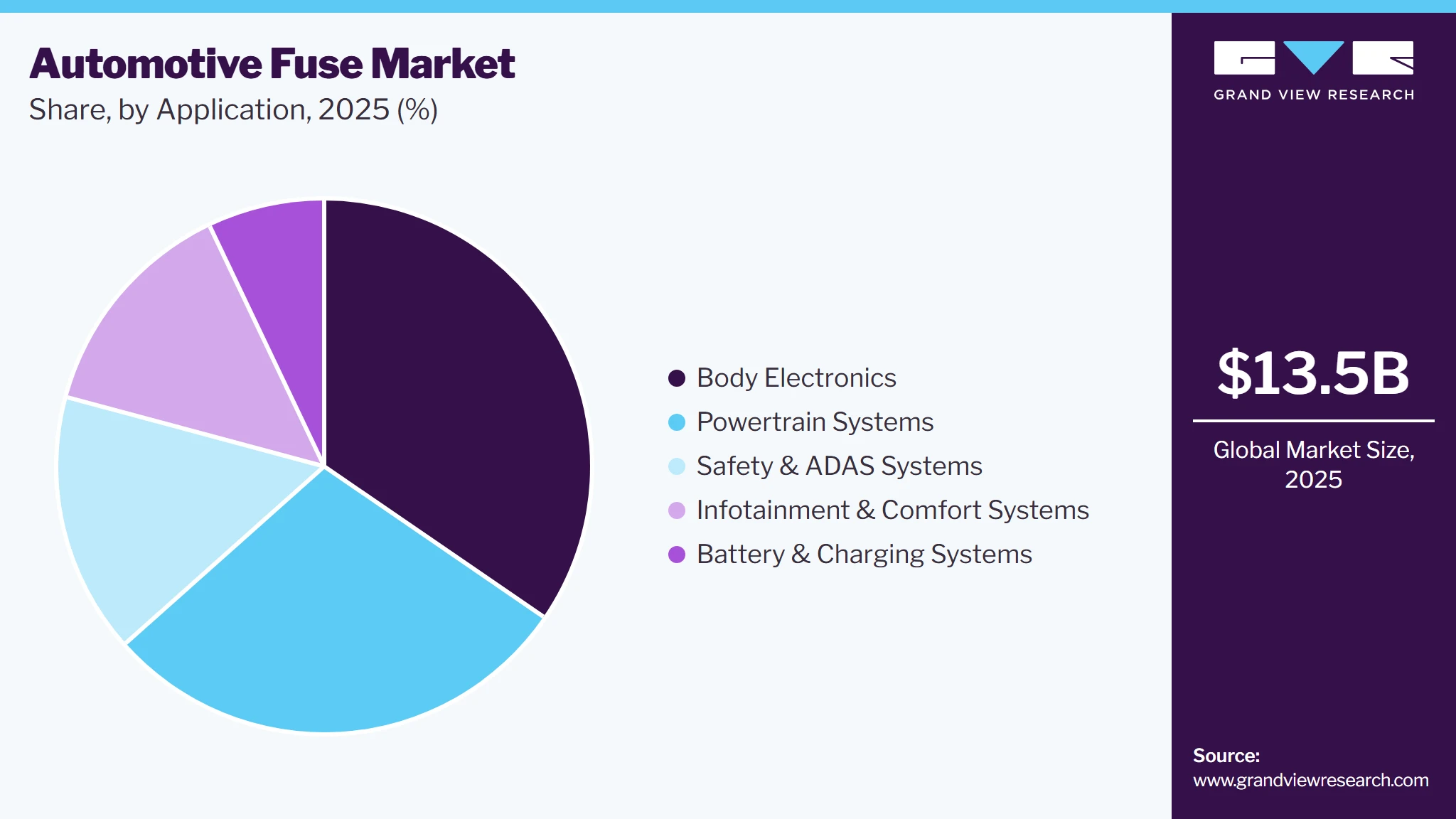
Based on application, the body electronics segment accounted for the largest market revenue share of 34.6% in 2025. Body electronics segments are widely used to protect everyday vehicle functions. Applications include lighting, windows, mirrors, doors, wipers, central locking, and other electrically operated body functions. The increasing use of electronic controls and electrically operated features is expanding the number of circuits requiring protection. Passenger vehicles with higher levels of comfort and convenience features are particularly supporting demand within this application. As vehicle electrical content continues to rise, body electronics are expected to remain a major source of automotive fuse demand.
 To learn more about this report, Download Free Sample Report
The infotainment & comfort systems segment is projected to grow at the fastest CAGR over the forecast period, as vehicles incorporate more displays, audio systems, connectivity features, climate controls, powered seats, and other passenger-oriented functions. Increasing consumer preference for connected and feature-rich vehicles is encouraging manufacturers to add more electrically operated functions. Each additional electrical function creates further requirements for reliable circuit protection. Electric and hybrid vehicles are also supporting this trend as vehicle architectures increasingly rely on electronic and electrically powered features. The growing emphasis on vehicle connectivity, convenience, and in-cabin experience is therefore expected to increase fuse demand in this application.
Regional Insights
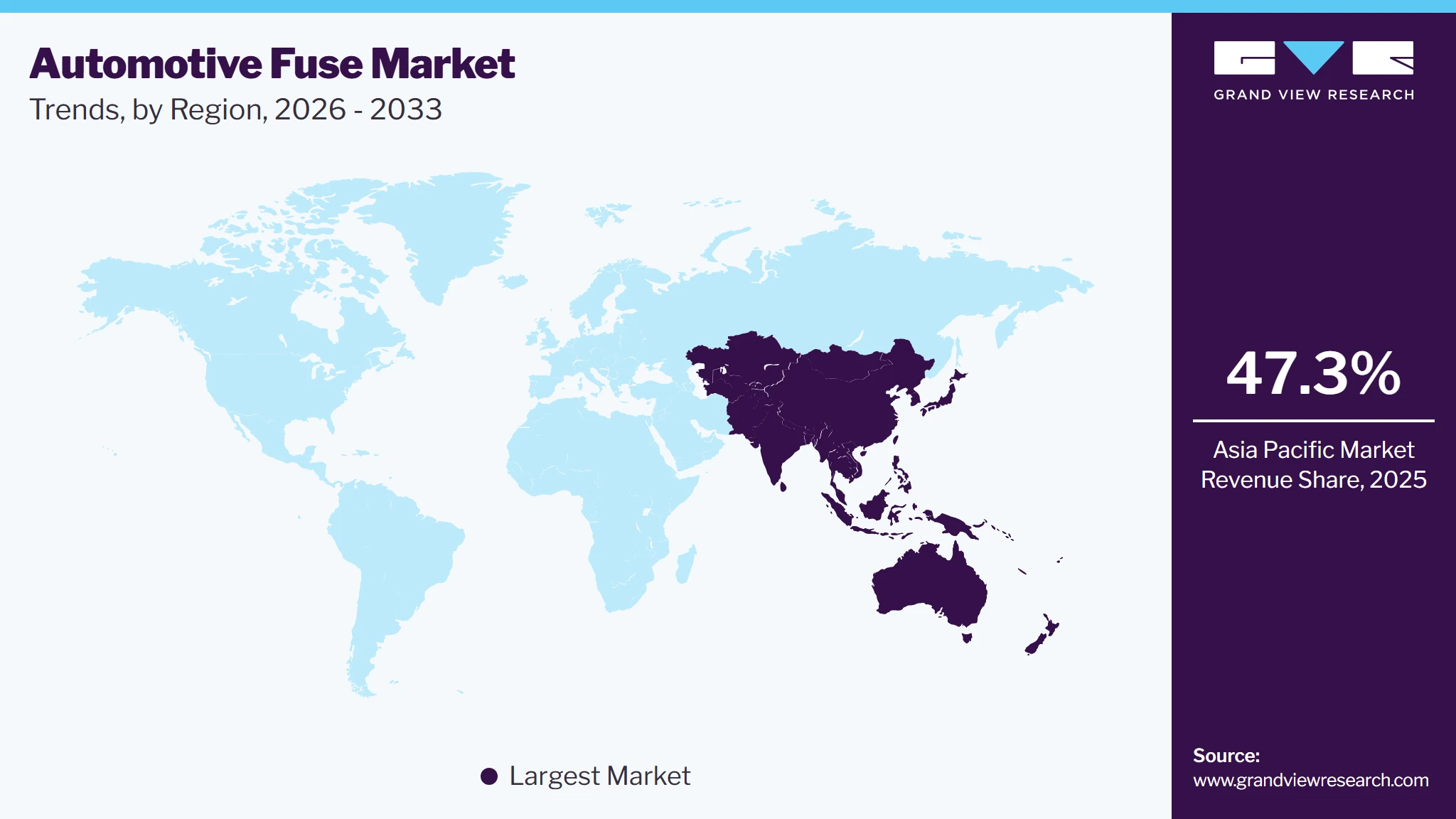
Asia Pacific automotive fuse market led the global market and accounted for 47.3% of the global revenue in 2025 and is expected to register the fastest growth from 2026 to 2033, due to its high vehicle production and rapidly expanding electric vehicle industry. China, Japan, South Korea, and India are major contributors to regional automotive manufacturing and component demand. Rising vehicle electrification is increasing requirements for high-current and high-voltage fuse products. Expanding vehicle production and growing electronic content are expected to support both OEM and aftermarket demand.
 To learn more about this report, Download Free Sample Report
China Automotive Fuse Market Trends
China automotive fuse market is the largest automotive producer globally and the leading market for electric vehicles, making it a major contributor to automotive fuse demand. High vehicle production volumes generate substantial requirements for conventional and advanced fuse products. Rapid electric vehicle adoption is increasing demand for high-current and high-voltage protection across battery and charging systems. The country's extensive automotive component ecosystem also supports localized production and supply of fuse products.
Japan automotive fuse market is expected to grow at a significant CAGR over the forecast period. Japan has a mature automotive industry with strong demand for reliable circuit-protection products. The widespread use of hybrid vehicles supports demand for fuses across both conventional and electrified vehicle systems. Increasing electronic content in vehicles is creating additional applications across safety, infotainment, comfort, and body electronics. Established OEM and component supplier networks provide a stable foundation for the automotive fuse industry.
North America Automotive Fuse Market Trends
North America automotive fuse market held a significant growth in the market, supported by its established vehicle manufacturing base and high adoption of electronic features. Increasing production of passenger vehicles, light trucks, and commercial vehicles continues to generate demand for circuit protection products. The growing shift toward electric and hybrid vehicles is also creating opportunities for high-current and high-voltage fuse applications. Strong OEM and aftermarket channels provide a balanced demand base across new vehicle production and replacement requirements.
The U.S. automotive fuse market is anticipated to register the fastest CAGR from 2026 to 2033, creating substantial demand for automotive fuse products. High vehicle production and the widespread use of electronic systems across passenger cars and commercial vehicles support consistent OEM demand. Growing electric vehicle adoption is increasing requirements for higher-capacity fuse solutions in batteries, charging systems, and power distribution. A large installed vehicle base further supports replacement demand through the aftermarket.
Europe Automotive Fuse Market Trends
Europe automotive fuse market is poised for significant growth from 2026 to 2033. Europe is characterized by strong vehicle manufacturing capabilities and increasing vehicle electrification. The growing share of electric and hybrid vehicles is creating demand for advanced fuse products used in batteries, charging systems, and power distribution. Increasing electronic content in vehicles is also supporting demand across safety, infotainment, comfort, and body applications. Established automotive supply chains and stringent vehicle safety requirements continue to support market development.
The UK automotive fuse market is supported by passenger vehicle production, commercial vehicle demand, and a large installed vehicle base. Increasing electrification of transportation is creating new requirements for high-current and high-voltage circuit protection. Greater use of electronic safety, connectivity, and comfort functions is also expanding the application base for automotive fuses. Aftermarket demand remains important due to ongoing vehicle servicing and replacement requirements.
The Germany automotive fuse market held the largest share in the European market, due to its large automotive manufacturing ecosystem and strong presence of vehicle and component manufacturers. Increasing production of electric and hybrid vehicles is driving demand for advanced circuit-protection solutions. Premium and technology-focused vehicles also contain a high number of electronic and electrically powered functions, supporting higher fuse content. Strong OEM and Tier-1 supplier networks provide opportunities for long-term automotive fuse contracts.
Key Automotive Fuse Company Insights
Key players operating in the automotive fuse industry include Littelfuse, Inc., Eaton Corporation plc, MERSEN., MTA S.p.A., Pacific Engineering Corporation, and among others. Key players in the market are focusing on expanding product portfolios, developing high-current and high-voltage solutions, and strengthening OEM relationships. Companies are also increasing their focus on electric and hybrid vehicle applications while expanding aftermarket and regional distribution networks to capture emerging growth opportunities.
-
Littelfuse, Inc. is a diversified industrial technology manufacturing company. The company provides products and solutions designed to support the safe and efficient management of electrical energy across industrial, transportation, and electronics markets. In the automotive sector, Littelfuse, Inc. offers circuit protection solutions, including automotive fuses, for various vehicle electrical and electronic applications.
-
Eaton Corporation plc is a global company focused on power management solutions. The company provides products that help customers use and manage power safely and efficiently across different industries. In the automotive sector, Eaton Corporation plc offers automotive fuse products that help protect vehicle electrical systems and support the growing electrical needs of modern and electrified vehicles.
Key Automotive Fuse Companies
The following key companies have been profiled for this study on the automotive fuse market.
-
Littelfuse, Inc.
-
Eaton Corporation plc
-
Mersen
-
MTA S.p.A.
-
Pacific Engineering Corporation.
-
SCHURTER Global
-
Optifuse
-
Blue Sea Systems
-
Halfords Group plc.
-
Ultra Wiring Connectivity System Ltd.
Competitive Benchmarking
Operating Strategies
Competitive Edge
Weaknesses
Mature Players: Littelfuse, Inc.; Eaton Corporation plc; MERSEN; MTA S.p.A.
- Mature players in the automotive fuse market are focus on broad portfolios address diverse vehicle circuit-protection needs, while OEM and Tier-1 relationships support integration into vehicle electrical systems.
- Their expansion into EV and high-voltage applications captures electrification demand, while continuous product development addresses changing voltage, current, size, and safety requirements.
- Mature players gain a competitive advantage through strong automotive experience helps meet vehicle requirements, while a broad product range serves different protection needs.
- Established customer relationships support repeat business, and product development capabilities help provide both conventional and newer fuse solutions.
- These companies often face challenges related to large product ranges and manufacturing operations can increase complexity and development costs.
- Strong competition can create pricing pressure, particularly for standardized, lower-value fuse products.
Emerging Players: SCHURTER Global; Optifuse; Ultra Wiring Connectivity System Ltd.
- Emerging players in the automotive fuse market are focused on product categories help address specific customer needs while keeping development and production more manageable.
- Expansion into aftermarket, regional, automotive, and EV applications helps reach new customers and capture growing demand.
- Emerging players gain market traction through product range allows quicker response to customer requirements, while customized solutions help serve specific vehicle applications.
- Their strong distributor and regional customer networks also support market reach.
- Emerging players face limitations due to their comparatively lower production scale can make it harder to compete on cost. Limited product coverage and fewer global customer relationships can reduce opportunities for large automotive contracts.
Recent Developments
-
In October 2025, Littelfuse, Inc. acquired Basler Electric Company, a manufacturer of electrical control and protection products, for grid and utility infrastructure, power generation, and data centers. The acquisition expanded the product range, manufacturing capabilities, and customer base across electrical protection applications, supporting broader growth strategies.
-
In September 2025, Eaton Corporation plc launched dozens of new electrified vehicle (EV) fuses to support internal combustion, electrified, plug-in hybrid, commercial, and off-highway vehicles. The launch expanded the fuse portfolio across different vehicles and voltage requirements, enabling broader coverage of customer applications. It also strengthened the ability to provide both standard and customized fuse solutions for electrified vehicles.
Automotive Fuse Market Report Scope
Report Attribute
Details
Market size value in 2025
USD 13.5 billion
Estimated market size in 2026
USD 14.1 billion
Projected market size by 2033
USD 21.8 billion
Growth rate
CAGR of 6.4% from 2026 to 2033
Base year for estimation
2025
Historical data
2021 - 2024
Forecast period
2026 - 2033
Quantitative units
Revenue in USD billion and CAGR from 2026 to 2033
Report coverage
Revenue forecast, company ranking, competitive landscape, growth factors, and trends
Segments covered
Component, vehicle, sales channel, application, region
Regional scope
North America; Europe; Asia Pacific; Latin America; MEA
Country scope
U.S.; Canada; Mexico; Germany; UK; France; China; Japan; India; South Korea; Australia; Brazil; KSA; UAE; South Africa
Key companies profiled
Littelfuse, Inc.; Eaton Corporation plc; Mersen; MTA S.p.A.; Pacific Engineering Corporation; SCHURTER Global; Optifuse; Blue Sea Systems; Halfords Group plc.; Ultra Wiring Connectivity System Ltd.
Customization scope
Free report customization (equivalent up to 8 analysts working days) with purchase. Addition or alteration to country, regional & segment scope.
Pricing and purchase options
Avail customized purchase options to meet your exact research needs. Explore purchase options
Global Automotive Fuse Market Report Segmentation
The report forecasts revenue growth at global, regional, and country levels and provides an analysis of the latest industry trends in each of the sub-segments from 2021 to 2033. For this study, Grand View Research has segmented the automotive fuse market report based on component, vehicle, sales channel, application, and region:
-
Component Outlook (Revenue, USD Billion, 2021 - 2033)
-
Blade Fuses
-
Glass Tube Fuses
-
Ceramic Fuses
-
High Current Fuses
-
Resettable / PTC Fuses
-
Semiconductor Fuses
-
-
Vehicle Outlook (Revenue, USD Billion, 2021 - 2033)
-
Passenger Cars
-
Commercial Vehicles
-
Electric/Hybrid Vehicles
-
-
Sales Channel Outlook (Revenue, USD Billion, 2021 - 2033)
-
OEM
-
Aftermarket
-
-
Application Outlook (Revenue, USD Billion, 2021 - 2033)
-
Powertrain Systems
-
Body Electronics
-
Safety & ADAS Systems
-
Infotainment & Comfort Systems
-
Battery & Charging Systems
-
-
Regional Outlook (Revenue, USD Billion, 2021 - 2033)
- North America
-
U.S.
-
Canada
-
Mexico
-
-
Europe
-
Germany
-
UK
-
France
-
-
Asia Pacific
-
China
-
India
-
Japan
-
South Korea
-
Australia
-
-
Latin America
-
Brazil
-
-
Middle East & Africa (MEA)
-
UAE
-
Kingdom of Saudi Arabia (KSA)
-
South Africa
-
- North America
Research Methodology
The automotive fuse market figures in this report are based on a proven research process that combines executive interviews with secondary research from proprietary databases, company filings, and recognized regulatory and institutional sources. Market size is built through value-chain sizing-reconciling supply-side and demand-side estimates-and triangulated with bottom-up and top-down approaches. Every estimate passes multiple levels of expert validation before publication, with each automotive fuse segment quantified using the revenue-capture definitions in the table below.
Segment Definition
Segment - Component
Revenue capture definition
Blade Fuses
The segment revenue is generated from the sale of plug-in automotive blade fuses used for circuit protection in low-voltage vehicle electrical systems, including standard, mini, micro, and high-current blade configurations.
Glass Tube Fuses
The segment revenue is generated from the sale of glass-bodied cartridge fuses and related automotive fuse products used for circuit protection, particularly in older vehicles, specialty vehicles, accessories, and replacement applications.
Ceramic Fuses
The segment revenue is generated from the sale of ceramic-bodied fuse products designed for applications requiring higher temperature resistance, stronger mechanical performance, or higher interruption capability compared with conventional glass designs.
High Current Fuses
The segment revenue is generated from the sale of high-amperage automotive fuses, including bolt-down, cartridge, link, and other high-current designs used to protect batteries, starters, power distribution systems, and other high-power circuits.
Resettable / PTC Fuses
The segment revenue is generated from the sale of resettable positive-temperature-coefficient protection devices that automatically return to a conductive state after the fault condition is removed, primarily for lower-power automotive electronic and accessory circuits.
Semiconductor Fuses
The segment revenue is generated from the sale of semiconductor-based or semiconductor-protection fuse solutions designed to protect sensitive electronic power components, power conversion systems, and high-performance electrical circuits from excessive current.
Segment - Vehicle
Revenue capture definition
Passenger Cars
The segment revenue is generated from automotive fuse sales installed in passenger cars, including conventional internal-combustion, hybrid, and battery-electric passenger vehicles across powertrain, body, safety, infotainment, and comfort systems.
Commercial Vehicles
The segment revenue is generated from fuse products installed in light and heavy commercial vehicles such as vans, trucks, and buses, including circuit protection for power distribution, lighting, control systems, and high-current electrical equipment.
Electric/Hybrid Vehicles
The segment revenue is generated from fuse products specifically supplied for battery-electric and hybrid vehicles, including protection for battery packs, battery management systems, onboard chargers, DC-DC converters, and high-voltage power distribution systems.
Segment - Sales Channel
Revenue capture definition
OEM
The segment revenue is generated from direct sales of automotive fuses to vehicle manufacturers and Tier-1 suppliers for installation during vehicle production, including supply contracts, vehicle-program orders, and customized fuse solutions.
Aftermarket
The segment revenue is generated from replacement and maintenance sales of automotive fuses through distributors, retailers, workshops, online channels, and automotive service providers after the vehicle has entered operation.
Segment - Application
Revenue capture definition
Powertrain Systems
The segment revenue is generated from fuses used to protect electrical circuits associated with engines, motors, transmission-related systems, power electronics, and other powertrain components.
Body Electronics
The segment revenue is generated from fuses used for lighting, windows, doors, wipers, mirrors, body control modules, central locking, and other vehicle body electrical functions.
Safety & ADAS Systems
The segment revenue is generated from fuses used to protect electrical circuits supporting airbags, brake systems, sensors, cameras, radar, driver-assistance systems, and other safety-related electronics.
Infotainment & Comfort Systems
The segment revenue is generated from fuses used in infotainment, audio, displays, climate control, seat functions, interior electronics, connectivity systems, and other passenger comfort applications.
Battery & Charging Systems
The segment revenue is generated from fuses used in batteries, battery management systems, onboard chargers, charging circuits, DC-DC converters, and high-voltage power distribution systems, particularly in electric and hybrid vehicles.
Estimation Model
Layer No.
Layer Name
Key Question
Description
01
Vehicle Production Base
How many vehicles require automotive fuse products?
The estimation begins with the number of vehicles produced across passenger cars, commercial vehicles, and electric/hybrid vehicles. Vehicle production provides the basic addressable unit base for estimating automotive fuse demand. Regional production levels and vehicle powertrain mix are considered because fuse requirements vary by vehicle architecture. The model also accounts for the increasing electrical content of newly produced vehicles.
02
Fuse Content per Vehicle
How many fuses are installed in each vehicle?
The second layer estimates the average number of automotive fuses installed per vehicle. Fuse content varies according to vehicle, electrical architecture, powertrain, and level of electronic functionality. Electric and hybrid vehicles can require additional high-current and high-voltage protection alongside conventional low-voltage fuses. The resulting fuse-per-vehicle assumption is applied to the relevant vehicle production base.
03
Average Revenue per Fuse
What revenue is generated from each fuse?
The third layer estimates the average selling value of fuse products across different component categories. Blade and conventional low-voltage fuses generally represent different revenue levels from high-current and high-voltage EV fuses. Product specifications, current and voltage ratings, customization, materials, and OEM qualification requirements influence pricing. Segment-specific average revenue assumptions are therefore applied rather than using a single market-wide price.
04
Market Revenue Validation
Does the calculated market value reflect actual industry conditions?
The final layer combines vehicle production, fuse content, and average revenue assumptions to estimate Automotive Fuse Market revenue. The calculation is cross-checked using supplier product portfolios, automotive fuse production capabilities, OEM supply relationships, and aftermarket activity. The model is further validated against the increasing adoption of electric and hybrid vehicles and the expansion of high-voltage fuse applications. This creates a bottom-up estimate that can be compared with company-level and regional market evidence.
Delivered Customizations
This report has been delivered with the following In-depth customizations
Client Request
Customization Delivered
Value Adds
Regional Automotive Fuse Market Opportunity Assessment
Country/region-wise market sizing and forecasts
Analysis of demand, adoption trends, and regulatory landscape
Identification of high-growth regions and investment hotspots
Identified region-specific growth opportunities
Supported expansion and go-to-market strategy
Enabled informed regional investment decisions
Cross-Segmentation Analysis for the Automotive Fuse Market
Criss-cross market analysis by component, vehicle, sales channel, application
Demand and adoption assessment across key segments
Segment attractiveness and growth potential passenger benchmarking
Identified high-potential market segments
Supported targeted component positioning and marketing strategy
Improved customer and segment prioritization
Competitive Benchmarking and Strategic Positioning in the Automotive Fuse Market
Benchmarking of key competitors across components, pricing, partnerships, and innovation
Comparative assessment of market share, capabilities, and strategies
Analysis of competitive strengths, gaps, and differentiation areas
Identified competitive white spaces and growth gaps
Supported strategic positioning and differentiation
Enabled data-driven competitive strategy development
Frequently Asked Questions About This Report
The global automotive fuse market size was valued at USD 13.5 billion in 2025 and is estimated at USD 14.1 billion in 2026.
The blade fuses component segment accounted for the largest revenue share of 45.4% in 2025, while high current fuses component segment is the fastest growing component.
Asia Pacific dominated the market, accounting for the largest revenue share of 47.3% in 2025.
Rising demand for high-current protection in electric vehicle systems is supporting market growth.
Some key players operating in the automotive fuse market include Littelfuse, Inc., Eaton Corporation plc, Mersen., MTA S.p.A., Pacific Engineering Corporation., SCHURTER Global, Optifuse, Blue Sea Systems, Halfords Group plc., Ultra Wiring Connectivity System Ltd.
Body electronics segment accounted for the largest market revenue share of 34.6% in 2025, while infotainment & comfort systems segment is the fastest growing application.
The global automotive fuse market is expected to grow at a CAGR of 6.4% from 2026 to 2033 to reach USD 21.8 billion by 2033.
The passenger cars segment accounted for 67.8%, the largest share of global revenue in 2025, while electric/hybrid vehicles segment is the fastest growing vehicle type.
The OEM segment accounted for 70.3%, the largest share of global revenue in 2025, while aftermarket segment is the fastest growing sales channel.
About the Author(s)
Automotive & Transportation Research Team
Technology · Automotive & TransportationThis report was authored by the automotive & transportation research team at Grand View Research - comprising two research analysts, one senior research analyst, and one industry expert - with specialized expertise in the automotive & transportation segment of the technology industry. All findings are based on proprietary technology databases, executive interviews, and regulatory analysis, subject to internal peer review prior to publication.
Last Updated:
Speak to Analyst

Customize this report to your needs - add regions, segments, or data points, with 20% free customization.
Or view our licence options:


ISO 9001:2015 & 27001:2022 Certified
We are GDPR and CCPA compliant! Your transaction & personal information is safe and secure. For more details, please read our privacy policy.


