
- Home
- »
- Advanced Interior Materials
- »
-
Automotive Headliners Market Size, Share Report 2026-2033GVR Report cover

Automotive Headliners Market (2026 - 2033)
Size, Share & Trends Analysis Report By Material (Fabric, Polyester, Plastic), By Vehicle Type (Passenger Vehicles, Commercial Vehicles), By Region (North America, Europe, APAC), And Segment Forecasts
Market Size, 2025
$15.9BMarket Estimate, 2026
$16.6BMarket Forecast, 2033
$22.5BCAGR, 2026–2033
4.4%Automotive Headliners Market Summary
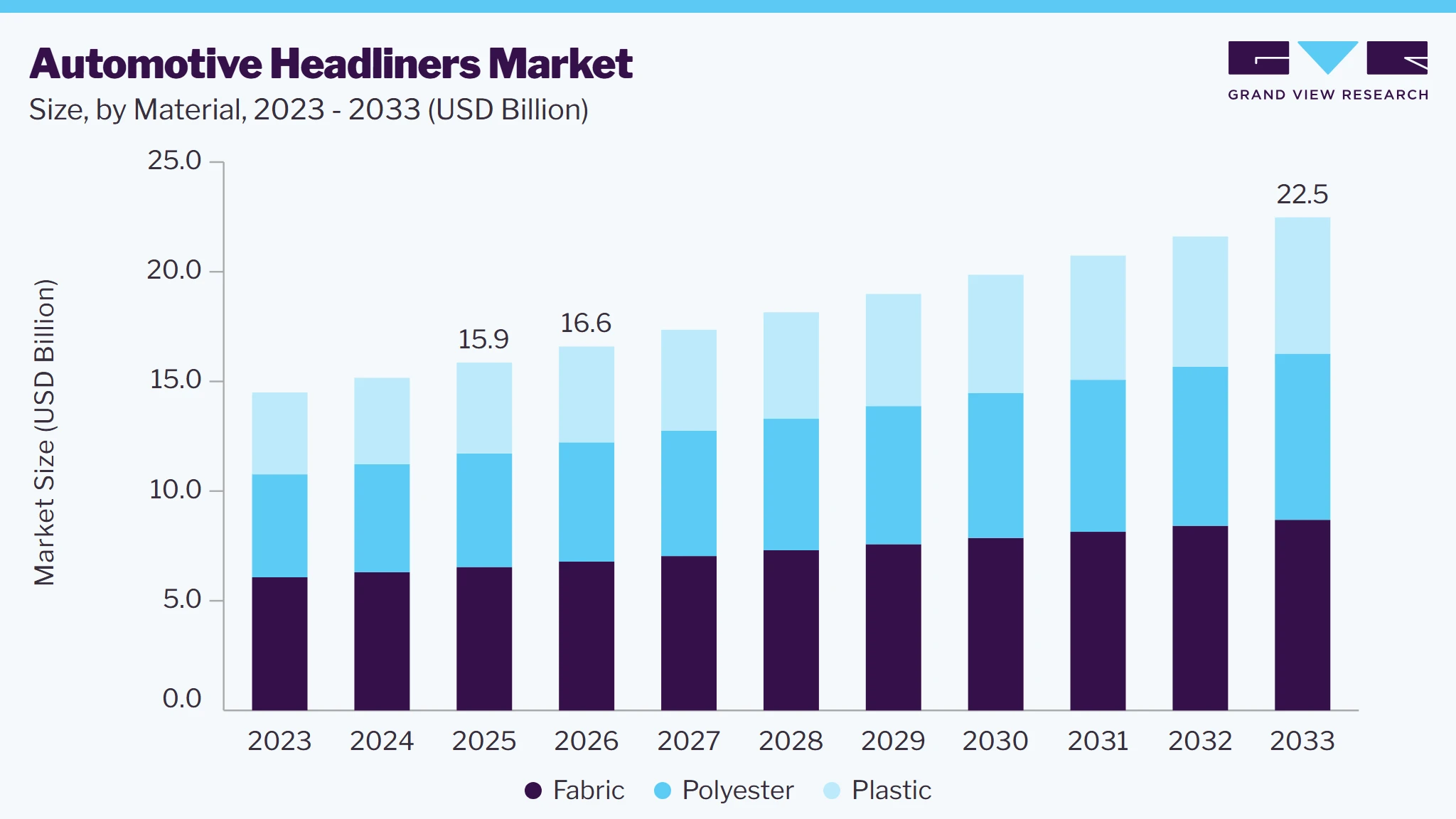
The global automotive headliners market size was valued at USD 15.9 billion in 2025 and is projected to grow from USD 16.6 billion in 2026 to USD 22.5 billion by 2033, at a CAGR of 4.4% from 2026 to 2033. Asia Pacific dominated the market, accounting for a revenue share of 46.6% in 2025. Demand for automotive headliners has notably increased in recent years, driven largely by the growing emphasis on vehicle aesthetics, comfort, and noise reduction.
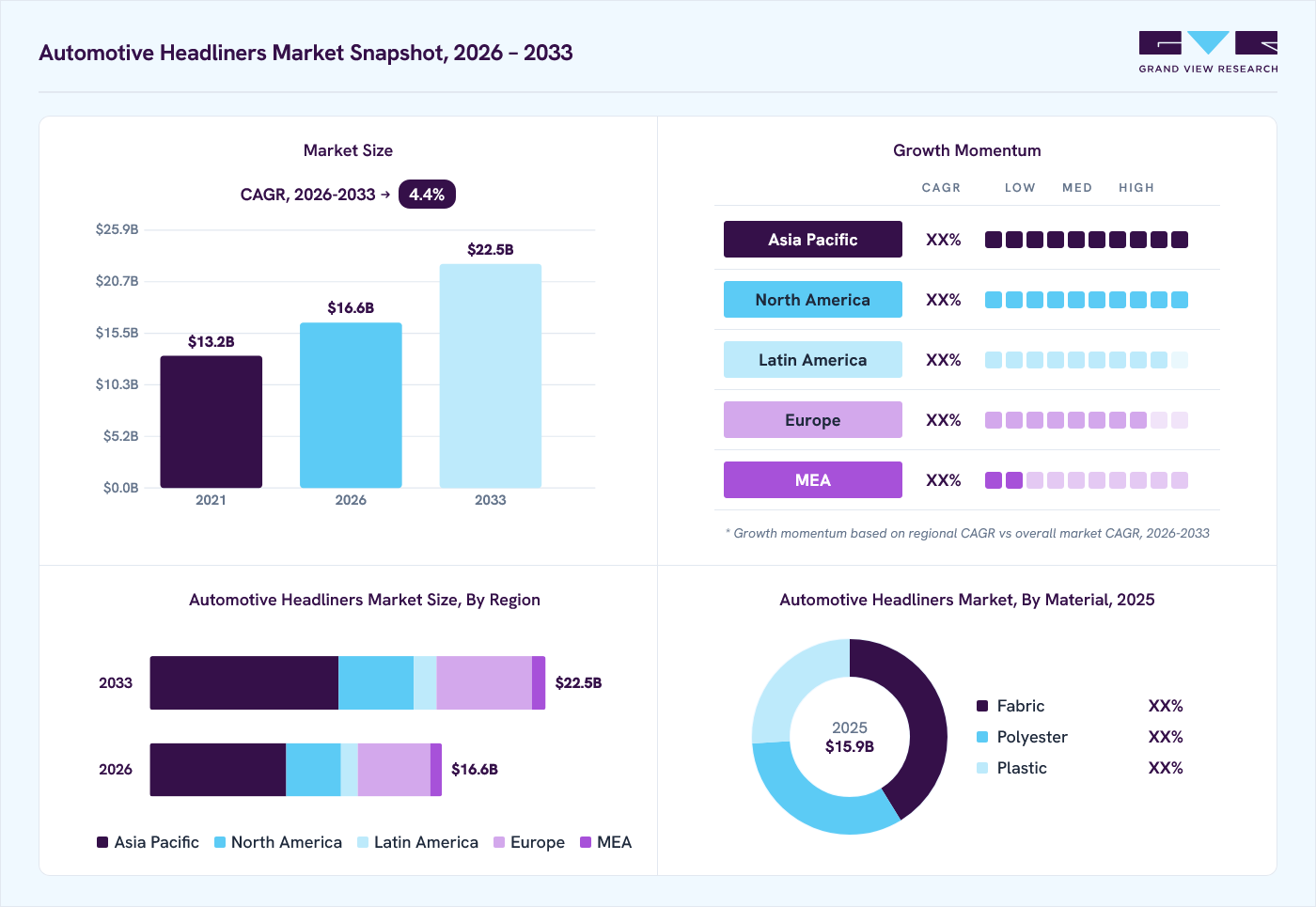 Source: Grand View Research, IR Documents, Primary Interviews, Paid DatabasesTo learn more about this report,
 Download Free Sample Report
Key Market Trends & Insights
- By material: Fabric segment dominated the market, with a revenue share of 41.2% in 2025.
- By vehicle type: Passenger vehicle segment held the largest market share of 83.8% in 2025.
Regional Highlights
- Largest regional market: Asia Pacific (46.6% revenue share, 2025)
- By country: China held the largest market share in 2025.
Market Size & Forecast
- Market size in 2025: USD 15.9 Billion
- Estimated market size in 2026: USD 16.6 Billion
- Projected market size by 2033: USD 22.5 Billion
- CAGR (2026-2033): 4.4%
Three ways to get this report
Buy it, customize it, or ask a question.Ask an Analyst
Analyst response in 1 business day
- AccessReport author, directly
- Reply timeWithin 1 working day
- No sales callDirect answer only
- FormatEmail reply
- CostFree, no cost
Get the Full Report
What the study covers
- FormatsPDF · Excel · Dashboard
- Timeline2026–2033 annual, 2025 base
- Coverage20+ countries, 5 regions
- Companies10+ key players profiled
Customize the Report
20% free customization
- IncludeCountries, segments, points
- TailorTo your product definition
- ExtendDeeper competitor detail
- OrA fully bespoke study
- Turnaround5–10 working days
Buyers prioritize premium interiors as consumer expectations evolve, even in mid-range and compact vehicles. In addition, the global rise in vehicle production, especially in emerging markets, has boosted the overall consumption of automotive interior components, including headliners. The trend toward electric and autonomous vehicles has also intensified the need for refined cabin environments, fueling demand for high-quality headliner materials.Several factors are driving market growth. These include increased vehicle production, growing demand for luxury and comfort features, lightweight and eco-friendly materials advancements, and regulatory pressures to improve fuel efficiency. Automakers are increasingly focused on enhancing the car experience through better soundproofing and thermal insulation, which headliners contribute to significantly. Moreover, technological integration, such as lighting systems and sensors embedded in headliners, adds to their functionality, making them a critical part of automotive design.
 To learn more about this report, Download Free Sample Report
One major driver is the push toward lightweight materials in automotive manufacturing. Headliners made from composite or thermoplastic materials help reduce the overall vehicle weight, enhancing fuel efficiency and reducing emissions. This aligns with regulatory requirements and consumer preference for environmentally responsible vehicles. Another key driver is the increasing consumer demand for enhanced in-cabin acoustics. Headliners now often incorporate acoustic foam and specialized textiles that significantly dampen road and engine noise, contributing to a quieter and more comfortable driving experience, especially in premium models.
The market is witnessing exciting innovations such as integrated ambient lighting, smart textiles, and even headliners with embedded climate or gesture control sensors. One cutting-edge development includes using sustainable materials like recycled PET and natural fibers (e.g., hemp or jute) to create eco-friendly headliners without compromising durability or aesthetics. In addition, companies are experimenting with 3D knitting and nanotechnology to enhance the functional capabilities of headliners while minimizing material waste during production. These innovations are setting new benchmarks for performance and sustainability in automotive interiors.
Market Dynamics
The automotive headliners market is witnessing steady growth, driven by rising vehicle production, increasing demand for enhanced interior comfort and aesthetics, and the adoption of lightweight materials to improve fuel efficiency. Growing integration of acoustic insulation, ambient lighting, and smart interior features is further supporting market expansion, particularly in electric and premium vehicles. Furthermore, the shift toward sustainable and recyclable materials is creating new opportunities for manufacturers. However, raw material price volatility and supply chain challenges may restrain market growth to some extent.
One of the primary drivers of the automotive headliners market is the increasing consumer preference for enhanced vehicle interior comfort and premium cabin experiences. Modern vehicle buyers are placing greater emphasis on interior aesthetics, noise reduction, thermal insulation, and overall passenger comfort, prompting automakers to invest in advanced headliner solutions. Headliners have evolved beyond their traditional functional role and are now integrated with features such as improved acoustic materials, ambient lighting, sunroof systems, and premium fabric finishes, contributing significantly to the overall in-cabin experience.
The growing demand for premium and luxury vehicles, along with the premiumization of mid-range passenger cars, is further accelerating the adoption of high-performance headliner materials and designs. Automakers are increasingly using lightweight, durable, and visually appealing headliner components to differentiate their vehicle offerings and enhance customer satisfaction. As consumers continue to seek greater comfort, convenience, and refined interiors, the demand for innovative automotive headliner solutions is expected to increase steadily across global markets.
A significant restraint for the automotive headliners market is the volatility in raw material prices and ongoing supply chain challenges. Headliner production relies on materials such as polyurethane foam, polyester fibers, adhesives, and fabric coverings, whose costs are influenced by fluctuations in petrochemical prices and global supply-demand dynamics. Additionally, disruptions in the supply chain, including transportation delays, material shortages, and geopolitical uncertainties, can increase manufacturing costs and affect production schedules. These factors create pricing pressures for manufacturers and may limit profit margins, particularly in cost-sensitive automotive segments.
A significant opportunity for the automotive headliners market lies in the rapid growth of electric vehicles (EVs) and the increasing focus on sustainable automotive interiors. EV manufacturers are emphasizing lightweight components to improve vehicle efficiency and driving range, creating demand for advanced headliner materials that reduce overall vehicle weight. At the same time, rising environmental concerns and regulatory requirements are encouraging the use of recyclable, bio-based, and low-emission materials in vehicle interiors. This trend is driving innovation in eco-friendly headliner solutions, enabling manufacturers to develop sustainable products that align with automakers' sustainability goals while enhancing interior comfort and aesthetics.
Market Concentration & Characteristics
The global automotive headliners industry exhibits a high degree of innovation, driven by technological advancements, sustainability mandates, and shifting consumer expectations. Innovation in this space can be classified into three main types: material innovation, functional integration, and aesthetic or design advancements. Material innovation uses lightweight composites, natural fibers like kenaf and jute, and recycled materials such as PET to meet environmental regulations and improve fuel efficiency. Functional innovations include embedding LED ambient lighting, microphones, speakers, and even gesture and climate control sensors directly into headliners, aligning with the trend toward smart and connected vehicles.
 To learn more about this report, Download Free Sample Report
The market is fragmented yet rapidly evolving, characterized by intense competition among global suppliers and regional players. It is OEM-driven, with automakers seeking supplier partnerships to offer innovation and cost-efficiency. The market shows moderate to high growth, fueled by trends like rising vehicle production, increased EV adoption, and demand for high-end interiors. A strong emphasis on customization, sustainability, and regulatory compliance forces players to innovate while maintaining cost control. Moreover, manufacturers face challenges such as raw material price volatility, complex global supply chains, and the need for advanced manufacturing capabilities, making adaptability and investment in R&D crucial for long-term success.
Analyst Perspective
The automotive headliners market is transitioning from a component-driven industry to a value-added interior solutions market, where material innovation, design flexibility, and sustainability are becoming key competitive differentiators. Manufacturers are increasingly investing in lightweight substrates, advanced nonwoven materials, and integrated functional features to meet evolving OEM requirements for improved vehicle efficiency and enhanced cabin experience. This shift is expected to support premiumization while creating opportunities for suppliers with strong material engineering and manufacturing capabilities.
Material Insights
Based on material, the fabric segment led the market with the largest revenue share of 41.2% in 2025. The demand for fabric headliners is increasing due to their cost-effectiveness, ease of manufacturing, and growing popularity in mid-range and economy vehicles. Fabric materials offer good flexibility, acoustic insulation, and a range of texture and color options, making them ideal for automakers aiming to enhance interior aesthetics without significantly raising production costs. As consumer demand rises for visually appealing yet budget-friendly vehicles, fabric headliners provide a practical solution that balances design with affordability.
Plastic is expected to experience the fastest market growth due to its lightweight nature, design flexibility, and cost-effectiveness. Advancements in thermoplastic materials, such as polypropylene and polyurethane, enable manufacturers to produce durable headliners that can be easily molded into complex shapes, facilitating the integration of features like lighting and air vents. Moreover, plastic headliners offer superior resistance to moisture, stains, and odors, enhancing their durability and appeal. As automakers strive to improve fuel efficiency and reduce vehicle weight, adopting plastic headliners is expected to accelerate, aligning with industry trends toward sustainability and performance optimization.
Vehicle Type Insights
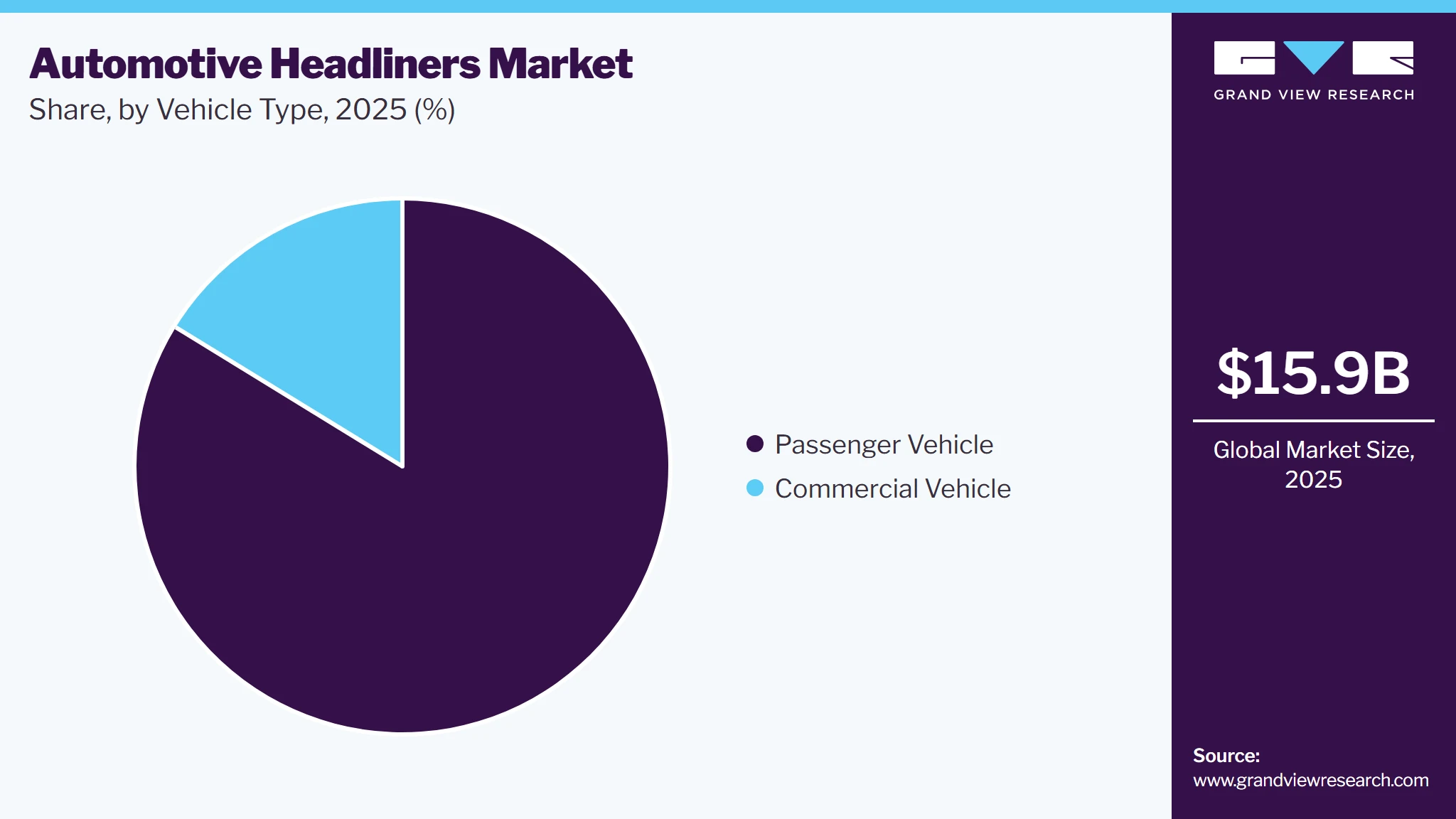
Based on vehicle type, the passenger vehicle segment led the market with the largest revenue share of 83.8% in 2025. The demand for headliners in passenger vehicles is rising due to increasing consumer expectations for enhanced interior comfort, noise insulation, and aesthetics. As more buyers prioritize the in-cabin experience, especially in compact and mid-sized cars, automakers upgrade interior components like headliners to include better materials, integrated lighting, and acoustic properties. Furthermore, the surge in electric and hybrid passenger vehicles requiring quieter cabins has intensified the need for advanced headliner solutions. The growing middle class in emerging economies and increased vehicle ownership drive higher production volumes, further boosting demand in this segment.
 To learn more about this report, Download Free Sample Report
In commercial vehicles, the rising demand for headliners is fueled by the growing focus on driver comfort, improved vehicle design, and soundproofing in long-haul and urban transport. With the expansion of logistics, e-commerce, and last-mile delivery services, there’s an increasing need for LCVs that offer better working environments for drivers. As fleet owners seek durable, low-maintenance, and cost-effective interior components, headliners made from lightweight and rugged materials have become essential. Furthermore, regulatory pressures for fuel efficiency and safety push manufacturers to use advanced headliner materials, contributing to overall vehicle performance and occupant protection.
Regional Insights
The automotive headliners market in North America is expanding steadily due to a strong preference for SUVs, pickup trucks, and premium models, which place a high value on interior comfort, noise dampening, and aesthetics. Consumers increasingly expect smart interiors, prompting OEMs to incorporate advanced materials and embedded features into headliners. Regulatory emphasis on fuel economy and lightweighting also pushes manufacturers to adopt new composites and foams. The growing electric vehicle market, especially in the U.S. and Canada, further contributes to the demand for innovative, sustainable, multifunctional headliners.
U.S. Automotive Headliners Market Trends
The U.S. automotive headliners market leads the North American market regarding vehicle sales and innovation. Demand for automotive headliners is rising as consumers seek quieter cabins, premium-feel materials, and enhanced interior lighting options. Electric vehicle leaders like Tesla and legacy OEMs like Ford and GM increasingly invest in lightweight headliner materials to optimize vehicle range and passenger comfort. The trend toward personalized interiors and higher trim packages in trucks and SUVs also drives demand for suede foam, acoustic foams, and integrated technologies in headliners.
Asia Pacific Automotive Headliners Market Trends
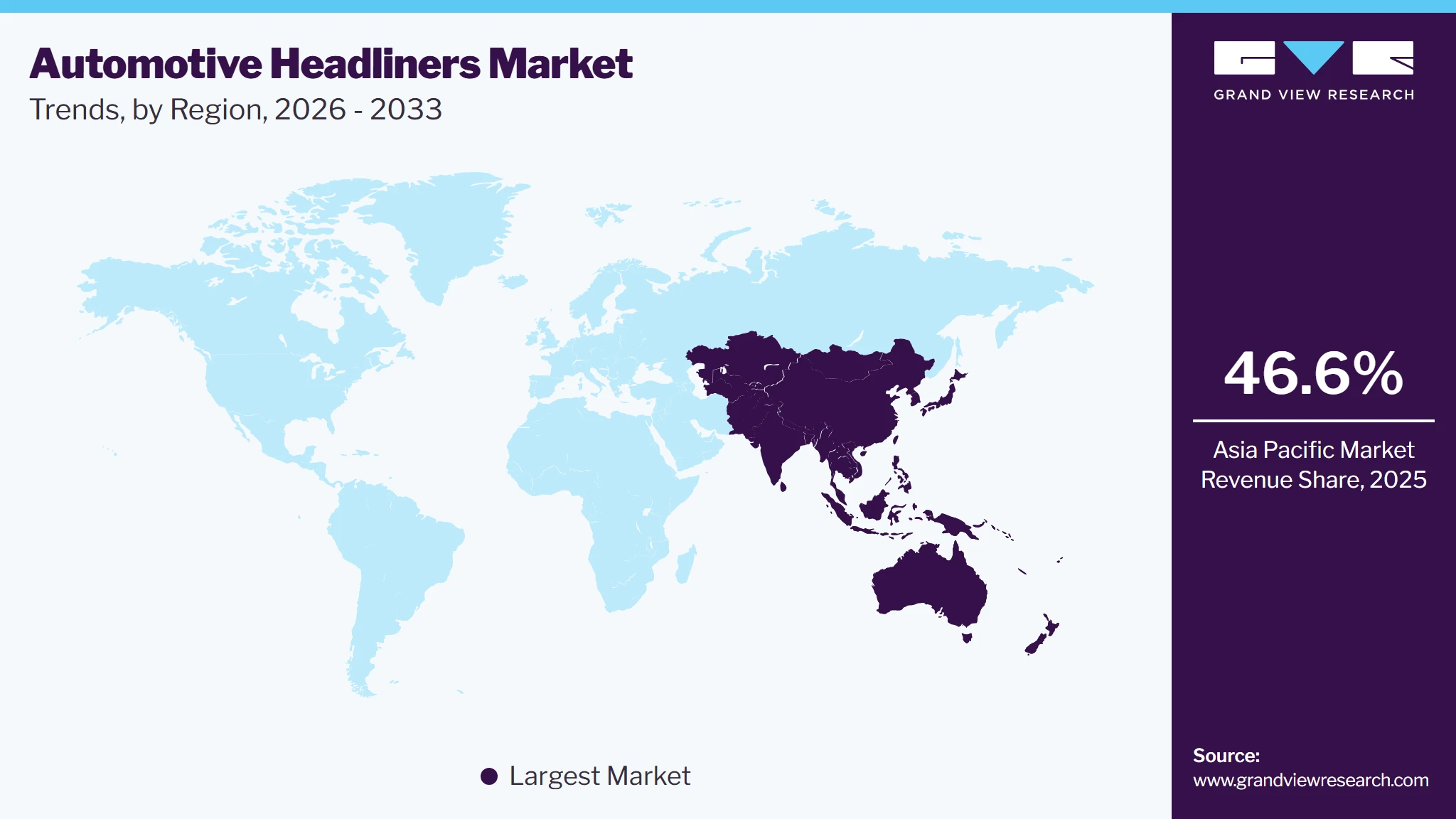
Asia Pacific dominated the automotive headliners market with the largest revenue share of 46.6% in 2025. The Asia Pacific region accounts for a significant global market share, driven by high vehicle production volumes and rising demand for passenger and electric vehicles. Economic growth, increasing urbanization, and a growing middle class fuel automotive sales across countries like India, China, Japan, and South Korea. Automakers increasingly focus on offering enhanced comfort, noise insulation, and better cabin aesthetics in response to consumer preferences. In addition, the strong presence of global and local Tier 1 suppliers and supportive government initiatives for EV production and localization are encouraging the adoption of advanced, lightweight, and sustainable headliner materials.
 To learn more about this report, Download Free Sample Report
The automotive headliners market in China held the largest share in the Asia Pacific region in 2025. China is the largest automotive market in the world, and the demand for automotive headliners is surging due to several factors. These include massive domestic vehicle production, rising EV adoption, and the expanding middle-class consumer base that demands enhanced interior comfort and technology features. Chinese OEMs invest in upgrading vehicle interiors to remain competitive, while global manufacturers partner with local suppliers for cost-effective yet high-quality components. Innovations like integrated lighting, noise reduction foams, and sustainable headliner fabrics are increasingly being adopted in domestic and export-focused vehicle lines.
Europe Automotive Headliners Market Trends
The automotive headliners market in Europe is expected to grow significantly over the forecast period. Europe remains a technology-driven and environmentally conscious market, with high demand for premium interiors and sustainable materials. Automakers in this region are focusing heavily on lightweight and recyclable materials for headliners to meet stringent EU emission and recycling regulations. The region also has a strong luxury and electric vehicle presence, especially in Western Europe, which necessitates advanced headliner designs with integrated lighting, climate controls, and acoustic insulation. High R&D investments and a strong culture of automotive innovation ensure Europe's continuous evolution of headliner technologies.
Germany automotive headliners market drives much of the continent’s demand for advanced headliners as the automotive innovation hub of Europe. Home to premium brands like Mercedes-Benz, Audi, Porsche, and BMW, Germany emphasizes superior in-cabin quality, acoustic performance, and integration of intelligent systems. These brands are pushing for headliners that support ambient lighting, connectivity features, and sustainable materials. Germany also plays a key role in setting global interior design trends and heavily invests in R&D partnerships with component manufacturers to stay at the forefront of automotive interior technologies.
Central & South America Automotive Headliners Market Trends
The automotive headliners market in Central & South America is gaining ground due to the growing need for versatile and low-cost construction methods that can adapt to a wide range of environments and community needs. The region’s emphasis on improving public infrastructure, housing, and tourism amenities creates a fertile ground for fabric-based solutions that are durable, quick to install, and require minimal upkeep. Whether for shading systems in urban parks or temporary shelters in remote or disaster-prone areas, fabric structures blend practicality and design potential. With increasing attention to resilience and resource efficiency, automotive headliners are becoming valuable in Central & South America's evolving architectural and infrastructural landscape.
Middle East & Africa Automotive Headliners Market Trends
The automotive headliners market in the Middle East & Africa is showing positive signs of growth, though it is still a smaller market compared to other regions. Gulf countries like the UAE and Saudi Arabia are witnessing rising demand for luxury and high-performance vehicles, which typically feature premium interior components, including suede or synthetic suede headliners. Infrastructure development, urbanization, and increased vehicle imports support regional automotive growth. In Africa, increased investment in local assembly plants and affordable vehicle production is gradually boosting the use of cost-efficient interior solutions, including basic headliner systems.
Key Automotive Headliners Company Insights
Some of the key players operating in the market include Antolin and TOYOTA BOSHOKU CORPORATION
-
Grupo Antolin is a global leader in automotive interior systems and one of the most prominent manufacturers of headliners worldwide. The company specializes in integrating smart technologies, sustainable materials, and lightweight solutions into headliners. Their innovations include ambient lighting, E Ink surfaces, and recyclable substrates, positioning Antolin as a pioneer in transforming headliners into multifunctional smart surfaces.
-
Toyota Boshoku, a member of the Toyota Group, plays a vital role in designing and manufacturing automotive interior components, including high-quality headliners. The company combines traditional Japanese craftsmanship with advanced technology to create lightweight, comfortable, and aesthetically pleasing headliner systems. Their approach emphasizes noise insulation, environmental performance, and modular design, aligning with Toyota’s goals for sustainability and innovation in vehicle interiors.
Lear Corp. and IAC Group are some of the emerging market participants in the market.
-
Lear Corporation, renowned for automotive seating and E-systems, also contributes to interior systems through its advanced headliner technologies. The company focuses on improving occupant experience by developing headliners that enhance acoustic insulation, thermal comfort, and premium design appeal. With a strategic emphasis on sustainable materials and intelligent surface integration, Lear is leveraging its technological capabilities to meet growing market demand for comfort and eco-consciousness in vehicle interiors.
-
IAC Group is a leading global supplier of automotive interior components, offering a broad range of headliner systems for various vehicle segments. Known for their strong focus on innovation and vertical integration, IAC develops headliners that balance acoustics, aesthetics, and environmental performance. Their use of natural fibers and recycled materials supports the industry's shift toward greener manufacturing, while their global manufacturing footprint allows them to serve major OEMs efficiently.
Key Automotive Headliners Companies:
The following key companies have been profiled for this study on the automotive headliners market.
-
Antolin
-
MOTUS INTEGRATED TECHNOLOGIES
-
TOYOTA BOSHOKU CORPORATION
-
IAC Group
-
Lear Corp.
-
Howa Co., Ltd
-
UGN, Inc.
-
SA Automotive
-
HAYASHI TELEMPU CORPORATION
-
Glen Raven, Inc.
-
Cindus Corporation
-
Johns Manville
Competitive Benchmarking
Category
Operating Strategies
Competitive Edge
Weakness
Established Players (Antolin, MOTUS Integrated Technologies, Toyota Boshoku Corporation, IAC Group, Lear Corporation, Howa Co., Ltd., UGN, Inc., Hayashi Telempu Corporation, Glen Raven, Inc., and Johns Manville)
- Focus on long-term supply agreements with global automotive OEMs while leveraging vertically integrated manufacturing and global production networks to ensure consistent quality, cost efficiency, and supply reliability.
- Invest heavily in lightweight materials, sustainable headliner solutions, acoustic technologies, and advanced interior systems to align with evolving vehicle design and regulatory requirements.
- Strong brand recognition, extensive OEM relationships, and diversified product portfolios enable mature players to secure high-volume contracts and maintain a competitive market position.
- Large-scale manufacturing capabilities, robust R&D resources, and global production footprints support innovation, economies of scale, and efficient market penetration across regions.
- High operational and fixed costs associated with maintaining global manufacturing facilities can reduce flexibility during market downturns or fluctuations in vehicle production.
- Complex organizational structures and dependence on major automotive OEM programs may slow decision-making processes and increase exposure to changes in customer sourcing strategies.
Emerging Players (SA Automotive and Cindus Corporation)
- Concentrate on niche applications, customized headliner solutions, and specialized material technologies to address specific customer requirements and differentiate from larger competitors.
- Expand market presence through strategic partnerships, targeted regional growth initiatives, and investments in specialized manufacturing capabilities.
- Greater operational flexibility and shorter decision-making cycles allow emerging players to respond quickly to changing customer demands and market opportunities.
- Specialized expertise in selected materials, components, or manufacturing processes enables the development of tailored solutions for specific vehicle programs.
- Limited financial resources and smaller production capacities can restrict investment in large-scale R&D initiatives, global expansion, and advanced manufacturing technologies.
- Lower brand visibility and a relatively narrow customer base may create challenges in securing long-term contracts with major automotive OEMs and competing against established suppliers.
Recent Developments
-
In April 2024, Grupo Antolin, a global leader in automotive interior components, unveiled a series of advanced headliner technologies at the Shanghai Auto Show. These innovations include E Ink-integrated surfaces, emotion-adaptive ambient lighting, and Sustainable materials. These advancements aim to enhance user experience, promote sustainability, and integrate seamlessly with modern vehicle designs.
Automotive Headliners Market Report Scope
Report Attribute
Details
Market size in 2025
USD 15.9 billion
Estimated market size in 2026
USD 16.6 billion
Projected market size by 2033
USD 22.5 billion
Growth rate
CAGR of 4.4% from 2026 to 2033
Base year for estimation
2025
Historical data
2021 - 2024
Forecast period
2026 - 2033
Quantitative units
Revenue in USD million/billion and CAGR from 2026 to 2033
Report coverage
Revenue forecast, company ranking, competitive landscape, growth factors, and trends
Segments covered
Material, vehicle type, region
Regional scope
North America; Europe; Asia Pacific; Latin America; MEA
Country scope
U.S.; Canada; Mexico; Germany; UK; France; Italy; Spain; China; Japan; India; South Korea
Key companies profiled
Antolin; MOTUS INTEGRATED TECHNOLOGIES; TOYOTA BOSHOKU CORPORATION; IAC Group; Lear Corp.; Howa Co., Ltd; UGN, Inc.; SA Automotive, HAYASHI TELEMPU CORPORATION; Glen Raven, Inc.; Cindus Corporation; Johns Manville
Customization scope
Free report customization (equivalent up to 8 analysts' working days) with purchase. Addition or alteration to country, regional & segment scope.
Pricing and purchase options
Avail customized purchase options to meet your exact research needs. Explore purchase options
Global Automotive Headliners Market Report Segmentation
This report forecasts revenue growth at the global, regional, and country levels and provides an analysis of the latest industry trends in each of the sub-segments from 2021 to 2033. For this study, Grand View Research has segmented the global automotive headliners market report based on material, vehicle type and region.
 To learn more about this report, Download Free Sample Report
-
Material Outlook (Revenue, USD Million, 2021 - 2033)
-
Fabric
-
Polyester
-
Plastic
-
-
Vehicle Type Outlook (Revenue, USD Million, 2021 - 2033)
-
Passenger Vehicles
-
Commercial Vehicles
-
-
Regional Outlook (Revenue, USD Million, 2021 - 2033)
-
North America
-
U.S.
-
Canada
-
Mexico
-
-
Europe
-
Germany
-
UK
-
France
-
Italy
-
Spain
-
-
Asia Pacific
-
China
-
India
-
Japan
-
South Korea
-
-
Central & South America
-
Middle East & Africa
-
Research Methodology
The automotive headliners market figures in this report are based on a proven research process that combines executive interviews with secondary research from proprietary databases, company filings, and recognized regulatory and institutional sources. Market size is built through value-chain sizing - reconciling supply-side and demand-side estimates - and triangulated with bottom-up and top-down approaches. Every estimate passes multiple levels of expert validation before publication, with each automotive headliners segment quantified using the revenue-capture definitions in the table below.
Segment Definition
Segment - Material
Revenue capture definition
Fabric
Revenue generated from the sale of fabric-based automotive headliners designed to enhance interior aesthetics, passenger comfort, and acoustic performance. This segment includes woven, non-woven, and composite fabric materials used in passenger and commercial vehicles for roof lining applications.
Polyester
Revenue generated from the sale of polyester-based automotive headliners valued for their lightweight properties, durability, recyclability, and sound insulation capabilities. This segment includes molded polyester fiber headliners used across a wide range of vehicle categories to improve cabin comfort and support vehicle lightweighting initiatives.
Plastic
Revenue generated from the sale of plastic-based automotive headliners manufactured using materials such as polypropylene, ABS, and other engineered polymers. This segment includes rigid and semi-rigid headliner systems used to provide structural stability, design flexibility, and cost-effective interior solutions in automotive applications.
Segment - Vehicle Type
Revenue capture definition
Passenger Vehicle
Revenue generated from the sale of automotive headliners installed in passenger vehicles, including hatchbacks, sedans, SUVs, crossovers, and luxury cars. This segment encompasses headliner solutions designed to enhance cabin aesthetics, noise reduction, thermal insulation, and overall passenger comfort.
Commercial Vehicle
Revenue generated from the sale of automotive headliners used in commercial vehicles, including light commercial vehicles, trucks, buses, and vans. This segment includes durable and functional headliner systems designed to improve driver comfort, cabin insulation, and vehicle interior durability under demanding operating conditions.
Estimation Model
Layer Name
Key Question
Description
Vehicle Production Base Layer
What forms the demand base?
Identify global vehicle production and sales volumes across passenger and commercial vehicle segments. This layer establishes the total addressable demand for automotive headliners by analyzing vehicle manufacturing output, fleet expansion, and automotive production trends across major regions.
Headliner Penetration Layer
Where are automotive headliners utilized?
Estimate the penetration of headliner systems across vehicle categories, including economy, mid-range, premium, luxury, and commercial vehicles. Assess adoption rates of advanced headliners featuring acoustic insulation, ambient lighting, lightweight materials, and integrated electronic components across developed and emerging automotive markets.
Material Consumption Layer
How much headliner material is consumed?
Analyze average headliner material consumption per vehicle, considering fabric, polyester, plastic, and composite materials. Material intensity is influenced by vehicle type, interior design complexity, lightweighting requirements, comfort features, and sustainability initiatives adopted by automotive manufacturers.
Revenue Layer
How is market revenue generated?
Market revenue is quantified through the sale of automotive headliner systems and related components supplied to OEMs and aftermarket channels. Revenue is generated from demand for interior comfort, noise reduction, thermal insulation, lightweight vehicle solutions, premium cabin aesthetics, and technologically advanced headliner applications across passenger and commercial vehicles.
Delivered Customizations
This report has been delivered with the following In-depth customizations
Client Request
Customization Delivered
Value Adds
Regional Segmentation Analysis
Delivered a detailed assessment of the Automotive Headliner Market across North America, Europe, Asia Pacific, Central & South America, and Middle East & Africa, covering regional demand trends, production capabilities, vehicle manufacturing outlook, regulatory landscape, and country-level market performance.
Enabled identification of high-growth regions, regional demand variations, investment hotspots, and expansion opportunities aligned with regional automotive production trends.
Cross-Segmentation Analysis
Provided an in-depth cross-segmentation analysis of Material (Fabric, Polyester, Plastic) and Vehicle Type (Passenger Vehicle, Commercial Vehicle) across all major regions. Evaluated demand distribution, adoption trends, and growth potential at each segment intersection.
Assisted in identifying the most profitable material-vehicle combinations, regional demand clusters, and untapped growth opportunities for targeted market strategies.
Opportunity Assessment
Evaluated growth opportunities across Fabric, Polyester, and Plastic headliners, as well as Passenger Vehicle and Commercial Vehicle applications, highlighting emerging demand areas, lightweight material adoption, sustainability trends, and expansion prospects in developing markets.
Enabled clients to prioritize high-growth segments, develop targeted investment strategies, identify future revenue opportunities, and strengthen long-term market positioning.
Frequently Asked Questions About This Report
Asia Pacific dominated the automotive headliner market with a 46.6% revenue share in 2025.
The passenger vehicle segment led the automotive headliner market with an 83.8% revenue share in 2025.
Key players in the automotive headliner market include Antolin; MOTUS INTEGRATED TECHNOLOGIES; TOYOTA BOSHOKU CORPORATION; IAC Group; Lear Corp.; Howa Co., Ltd; UGN, Inc.; SA Automotive, HAYASHI TELEMPU CORPORATION; Glen Raven, Inc.; Cindus Corporation; Johns Manville.
Key factors driving the automotive headliner market include increasing vehicle production, rising demand for enhanced cabin comfort and aesthetics, growing adoption of lightweight materials, and expanding electric and premium vehicle sales. The integration of acoustic insulation, ambient lighting, and sustainable materials is further supporting market growth.
The global automotive headliner market size was valued at USD 15.9 billion in 2025 and is estimated at USD 16.6 billion for 2026.
The global automotive headliner market is expected to grow at a CAGR of 4.4% from 2026 to 2033, reaching USD 22.5 billion by 2033.
The fabric segment led the automotive headliner market with a 41.2% revenue share in 2025.
About the Author(s)
Advanced Interior Materials Research Team
Advanced Materials · Advanced Interior MaterialsThis report was authored by the advanced interior materials research team at Grand View Research - comprising two research analysts, one senior research analyst, and one industry expert - with specialized expertise in the advanced interior materials segment of the advanced materials industry. All findings are based on proprietary advanced materials databases, executive interviews, and regulatory analysis, subject to internal peer review prior to publication.
Last Updated:
Speak to Analyst

Customize this report to your needs - add regions, segments, or data points, with 20% free customization.
Or view our licence options:


ISO 9001:2015 & 27001:2022 Certified
We are GDPR and CCPA compliant! Your transaction & personal information is safe and secure. For more details, please read our privacy policy.


