
- Home
- »
- Plastics, Polymers & Resins
- »
-
Automotive Labels Market Size & Share Report, 2026-2033GVR Report cover

Automotive Labels Market (2026 - 2033)
Size, Share & Trends Analysis Report By Vehicle Type (Passenger Vehicles, Light Commercial Vehicles, Heavy Commercial Vehicles, Two & Three Wheelers), By Function, By Material, By Label Type, By Region, And Segment Forecasts
Market Size, 2025
$8.1BMarket Estimate, 2026
$8.4BMarket Forecast, 2033
$11.7BCAGR, 2026–2033
4.8%Automotive Labels Market Summary
The global automotive labels market size was valued at USD 8.1 billion in 2025 and is projected to grow from USD 8.4 billion in 2026 to USD 11.7 billion by 2033, at a CAGR of 4.8% from 2026 to 2033. Asia Pacific dominated the market, accounting for the largest revenue share of 45.1% in 2025. Market growth is driven by increasing vehicle production, rising adoption of electric vehicles, and stringent labeling regulations for safety, traceability, and component identification.
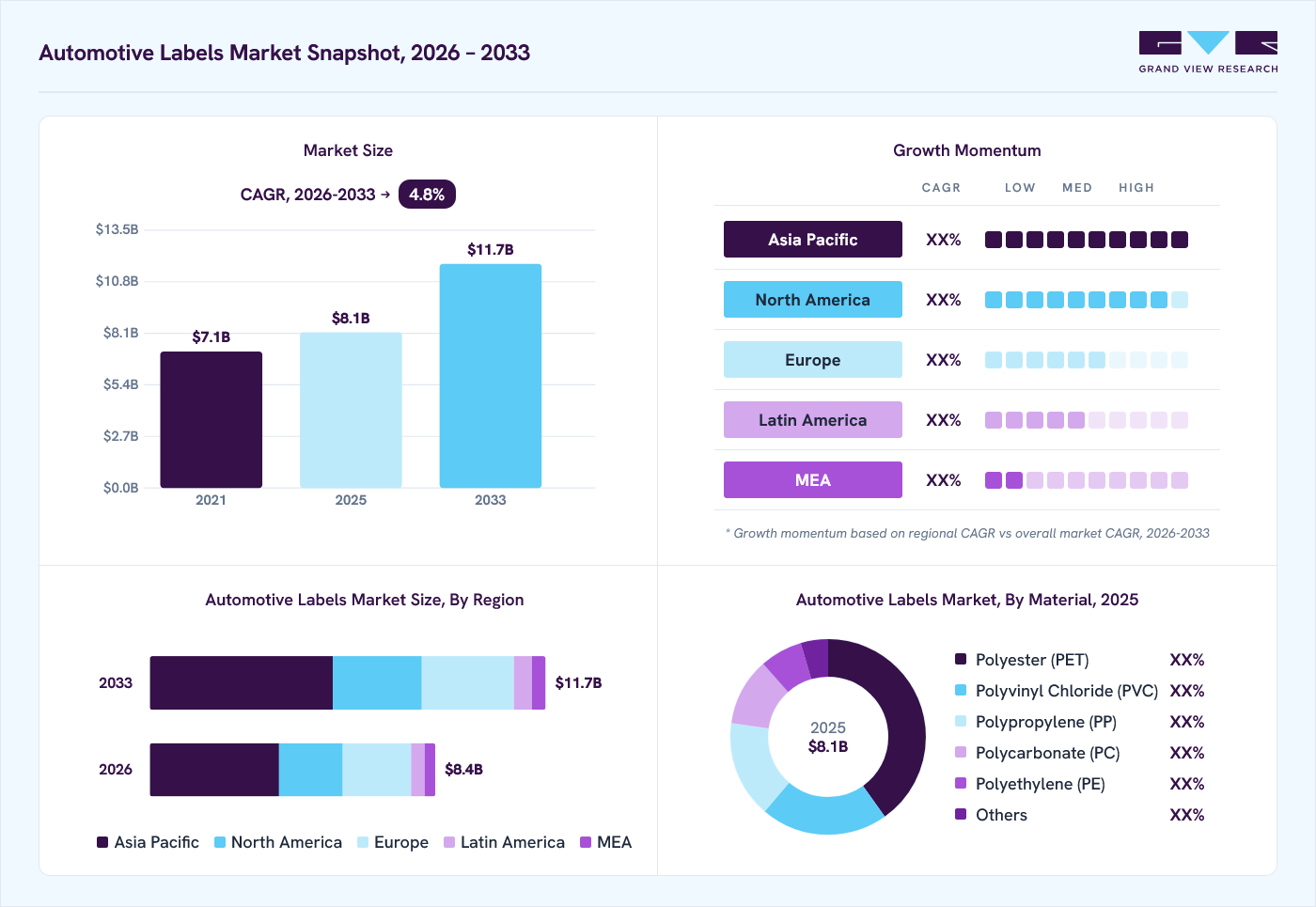 Source: Grand View Research, IR Documents, Primary Interviews, Paid DatabasesTo learn more about this report,
 Download Free Sample Report
Key Market Trends & Insights
- By vehicle type: Passenger vehicles segment led the market accounting for 68.8% revenue share in 2025
- By function: Warning & safety labels segment dominated the market, accounting for 33.9% revenue share in 2025
- By material: Polyester (PET) segment dominated the automotive labels market, accounting for 40.1% revenue share in 2025
- By label type: Pressure-sensitive labels segment dominated the automotive labels industry, accounting for 46.5% revenue share in 2025
Regional Highlights
- Largest regional market: Asia Pacific (45.1% revenue share, 2025)
- By country: China held the largest market share in 2025
Market Size & Forecast
- Market Size in 2025: USD 8.1 Billion
- Estimated Market Size in 2026: USD 8.4 Billion
- Projected Market Size by 2033: USD 11.7 Billion
- CAGR (2026-2033): 4.8%
Prism AI by Grand View Research Free to tryAsk a question about the automotive labels market✓Every figure cited from GVR research Prefer the report? Download free sample →
The growing use of durable, RFID-enabled labels in automotive manufacturing and aftermarket applications is further driving demand. The Automotive Labels market is driven by increasing global vehicle production, rising adoption of electric and connected vehicles, and stringent regulations for vehicle safety, identification, and component traceability. Automotive manufacturers are increasingly using durable pressure-sensitive, heat-transfer, and permanent labels that can withstand high temperatures, chemicals, abrasion, and harsh operating conditions. Growing automation in vehicle manufacturing and the need for efficient inventory and supply chain management are further supporting demand for advanced labeling solutions.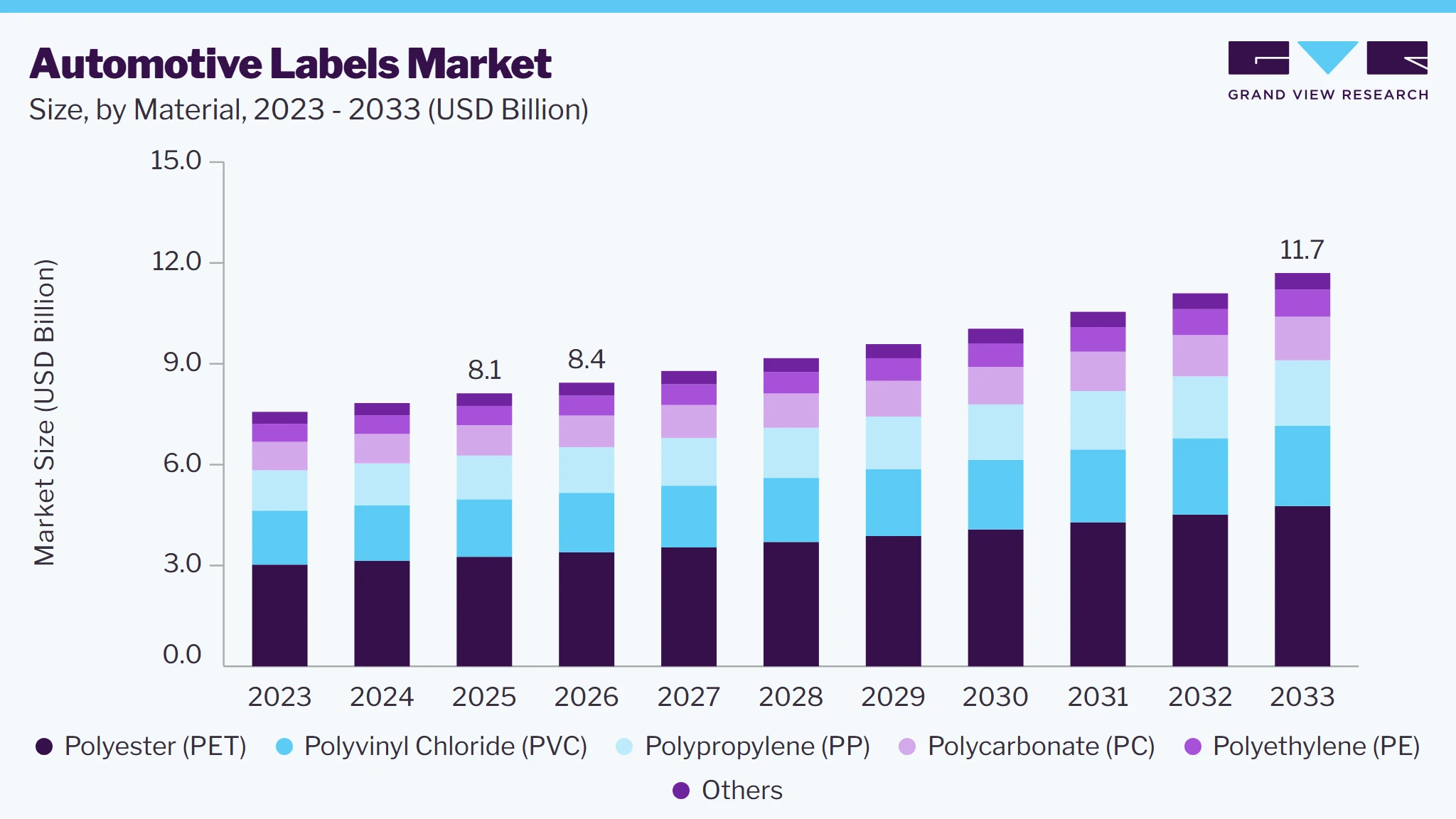 To learn more about this report, Download Free Sample Report
An increasing focus on product traceability, quality assurance, and regulatory compliance is expected to drive market growth in the coming years. Automotive OEMs and component suppliers are expanding the use of warning & safety labels, identification & traceability labels, and asset labels to improve production efficiency, anti-counterfeiting measures, and lifecycle tracking. The rapid growth of electric vehicles is also creating higher demand for specialized labels used in batteries, electronic components, and high-voltage systems.
Material innovation and sustainability initiatives are further contributing to market growth. Polyester (PET) remains the leading material due to its superior durability, chemical resistance, and thermal stability, while polypropylene (PP) is expected to witness the fastest growth owing to its lightweight, cost-effective, and recyclable properties. Manufacturers are also investing in sustainable label materials, advanced adhesives, and recyclable labeling solutions to meet environmental goals while maintaining high automotive performance standards.
Market Dynamics
The automotive labels market is experiencing steady growth, driven by rising vehicle production, increasing adoption of electric and connected vehicles, and stringent regulations on vehicle safety, identification, and traceability. Growing demand for durable, high-performance labels across automotive components, batteries, and electronic systems is supporting market expansion. At the same time, advancements in labeling materials, smart labeling technologies, and sustainable solutions are creating new opportunities, while fluctuating raw material prices and evolving environmental regulations remain key challenges for industry participants.
The growing demand for durable and high-performance labeling solutions is a key driver of the automotive labels market. Increasing vehicle production, stricter safety regulations, and the need for component traceability are encouraging OEMs and suppliers to adopt advanced labels with high resistance to heat, chemicals, moisture, and abrasion. The rapid adoption of electric vehicles and connected automotive technologies is further accelerating demand for specialized labels used in batteries, electronic components, and high-voltage systems.
Fluctuating prices of polymer materials such as polyester (PET), polypropylene (PP), and PVC, along with rising costs of specialty adhesives and printing materials, are limiting market growth. In addition, increasingly stringent environmental regulations that promote recyclable materials and restrict certain plastics require manufacturers to redesign products and invest in sustainable alternatives, thereby increasing production and compliance costs.
The rapid expansion of electric vehicles and smart automotive manufacturing is creating significant opportunities for the automotive labels market. Increasing demand for battery identification labels, RFID-enabled traceability solutions, and durable safety labels is supporting market growth. Furthermore, the development of recyclable label materials, liner-free labels, and eco-friendly adhesive technologies is enabling manufacturers to meet sustainability goals while addressing the evolving requirements of the global automotive industry.
Market Concentration & Characteristics
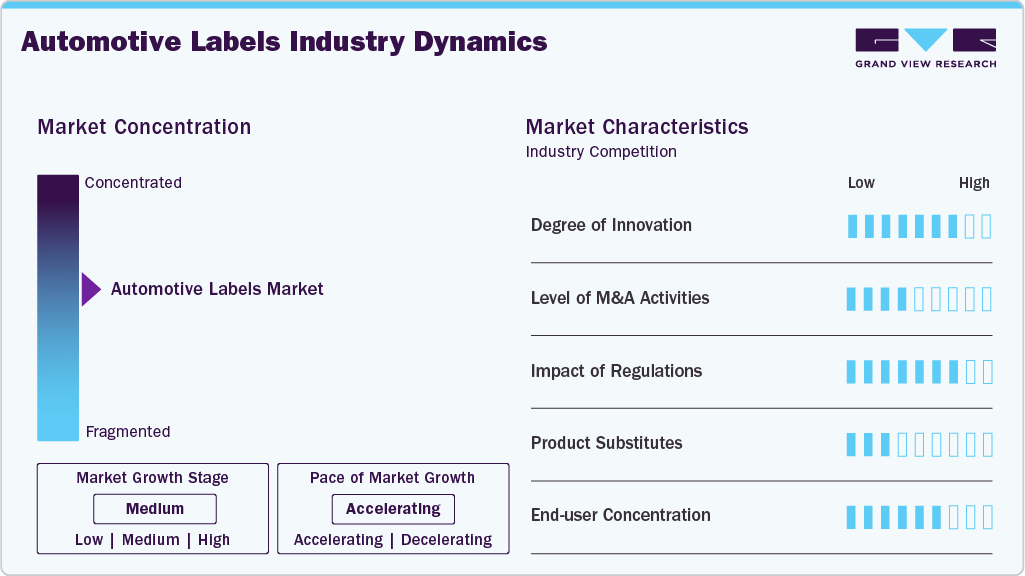
The automotive labels market is characterized by moderate capital intensity and continuous innovation in labeling materials, printing technologies, and adhesive systems. Manufacturers are investing in high-performance materials such as polyester (PET) and polypropylene (PP) to deliver labels with superior heat, chemical, and abrasion resistance for demanding automotive applications. The market is also witnessing increasing adoption of RFID, barcode, and QR code-enabled labels to improve component traceability, inventory management, and regulatory compliance across automotive supply chains.
 To learn more about this report, Download Free Sample Report
The automotive labels industry is moderately consolidated, with leading players competing through advanced material technologies, global manufacturing capabilities, and long-term partnerships with automotive OEMs and Tier-1 suppliers. Regulatory requirements related to vehicle safety, product identification, and environmental sustainability continue to influence product development, while the rapid growth of electric vehicles and smart manufacturing is driving demand for durable, recyclable, and high-performance automotive labeling solutions.
Analyst Perspective
The automotive labels market has evolved from supplying basic identification labels to becoming a mission-critical component of modern vehicle manufacturing, supporting safety compliance, product traceability, brand protection, and operational efficiency. Growth has been fueled by rising global vehicle production, accelerating electric vehicle (EV) adoption, stringent regulatory standards, and increasing demand for high-durability, high-performance labeling solutions. Looking ahead, the market is poised for steady and sustainable growth through 2033, driven by advancements in smart labeling technologies, RFID and QR code integration, digital printing, sustainable materials, and connected vehicle ecosystems. Manufacturers that prioritize innovation, regulatory compliance, and next-generation labeling solutions are expected to strengthen their competitive position and unlock long-term growth opportunities.
Vehicle Type Insights
The passenger vehicles segment dominated the automotive labels market, accounting for 68.8% revenue share in 2025, driven by high global passenger vehicle production and increasing demand for safety, identification, branding, and traceability labels. The growing integration of advanced electronics, connected vehicle technologies, and electric powertrains has further increased the use of durable labels for batteries, electronic modules, warning signs, and component identification. Rising regulatory compliance requirements and consumer demand for enhanced vehicle safety continue to support segment growth.
The Light Commercial Vehicles (LCVs) segment is expected to grow at the fastest CAGR of 5.3% during the forecast period. Growth is driven by the rapid expansion of e-commerce logistics, last-mile delivery fleets, and commercial transportation, which are increasing the production of LCVs worldwide. The rising adoption of electric commercial vehicles and the need for durable identification, safety, and asset-tracking labels are further accelerating demand for automotive labeling solutions in this segment.
Function Insights
The warning & safety labels segment dominated the automotive labels market, accounting for 33.9% revenue share in 2025, driven by stringent global vehicle safety regulations and the mandatory use of warning labels on batteries, airbags, engines, fuel systems, and high-voltage electric vehicle components. These labels provide critical safety instructions, hazard warnings, and regulatory information while maintaining durability under extreme temperatures, chemicals, moisture, and abrasion. The growing production of electric and connected vehicles is further strengthening demand for high-performance warning and safety labeling solutions.
The identification & traceability labels segment is expected to grow at the fastest CAGR of 5.3% during the forecast period. Growth is driven by the increasing adoption of barcode-, QR code-, and RFID-enabled labels for component identification, inventory management, anti-counterfeiting, and end-to-end supply chain traceability. Rising automation in automotive manufacturing, stricter quality control standards, and the need for lifecycle tracking of critical vehicle components are further accelerating the demand for identification and traceability labels across global automotive OEMs and Tier-1 suppliers.
Material Insights
The Polyester (PET) segment dominated the automotive labels market, accounting for 40.1% revenue share in 2025, owing to its excellent durability, thermal stability, chemical resistance, and strong adhesion properties. PET labels are widely used for warning, safety, identification, and under-the-hood applications where exposure to heat, moisture, oils, and harsh chemicals is common. The growing production of electric vehicles and advanced automotive electronics is further driving the adoption of PET-based labels due to their long-term performance and compliance with stringent automotive standards.
The Polypropylene (PP) segment is expected to grow at the fastest CAGR of 5.3% during the forecast period. Growth is driven by increasing demand for lightweight, cost-effective, and recyclable labeling materials that support automotive sustainability initiatives. PP labels offer good moisture resistance, flexibility, and printability, making them suitable for a wide range of automotive identification, branding, and traceability applications. Rising adoption of eco-friendly materials and recyclable labeling solutions by automotive OEMs is expected to further accelerate the segment growth.
Label Type Insights
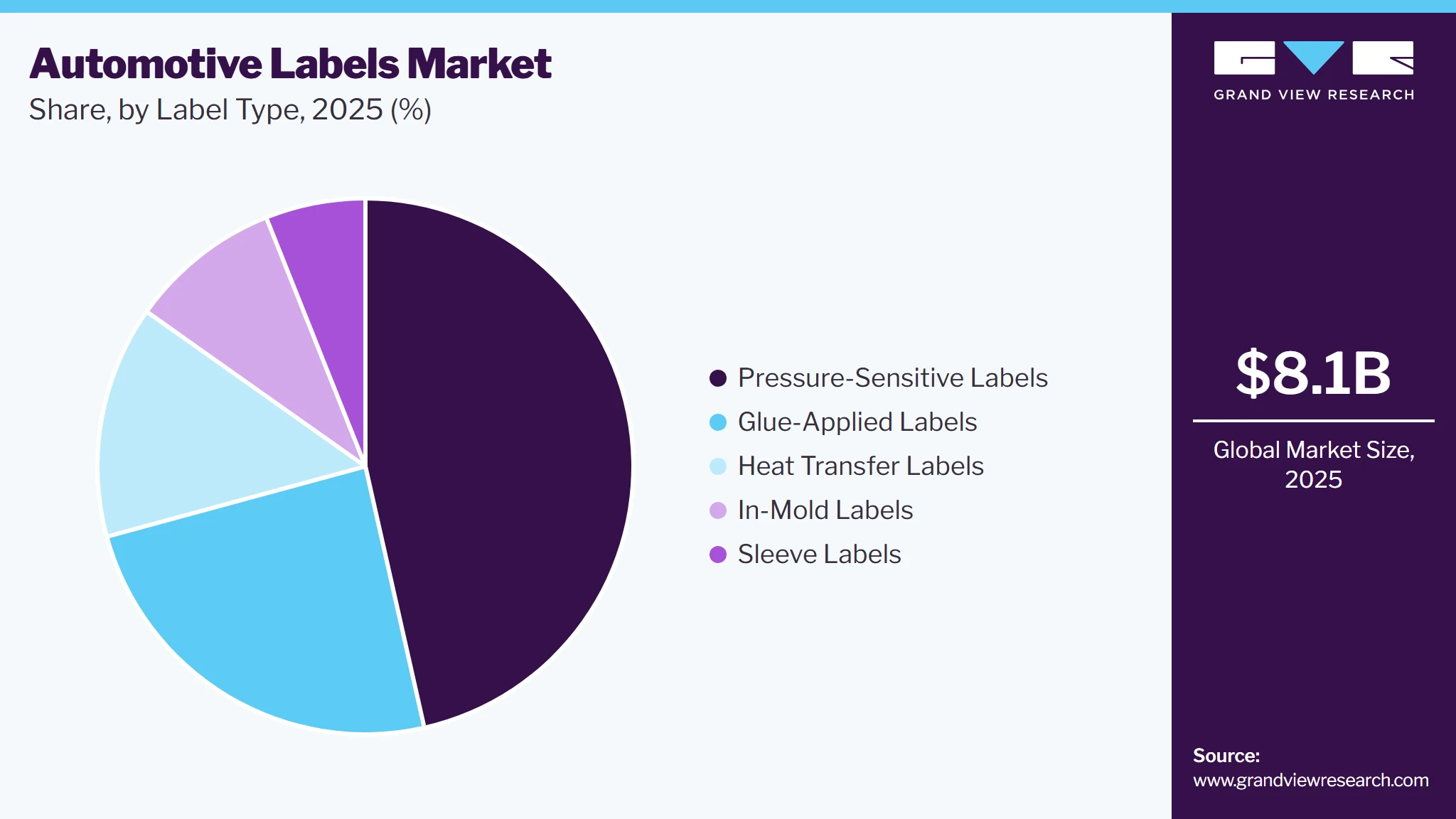
The pressure-sensitive labels segment dominated the automotive labels industry, accounting for 46.5% revenue share in 2025, owing to their ease of application, strong adhesive performance, and compatibility with a wide range of automotive surfaces. These labels are extensively used for warning, safety, branding, barcode, and component identification applications due to their durability and resistance to heat, chemicals, moisture, and abrasion. Their ability to support automated labeling processes and deliver long-lasting performance makes them the preferred choice across automotive OEMs and component manufacturers.
 To learn more about this report, Download Free Sample Report
The heat transfer labels segment is expected to grow at the fastest CAGR of 5.2% during the forecast period. Growth is driven by increasing demand for permanent, high-durability markings on automotive components exposed to harsh operating conditions. Heat transfer labels provide excellent resistance to wear, solvents, high temperatures, and mechanical stress, making them ideal for engine parts, electronic components, batteries, and under-the-hood applications. The rising production of electric vehicles and advanced automotive electronics is further accelerating the adoption of heat transfer labeling solutions.
Regional Insights
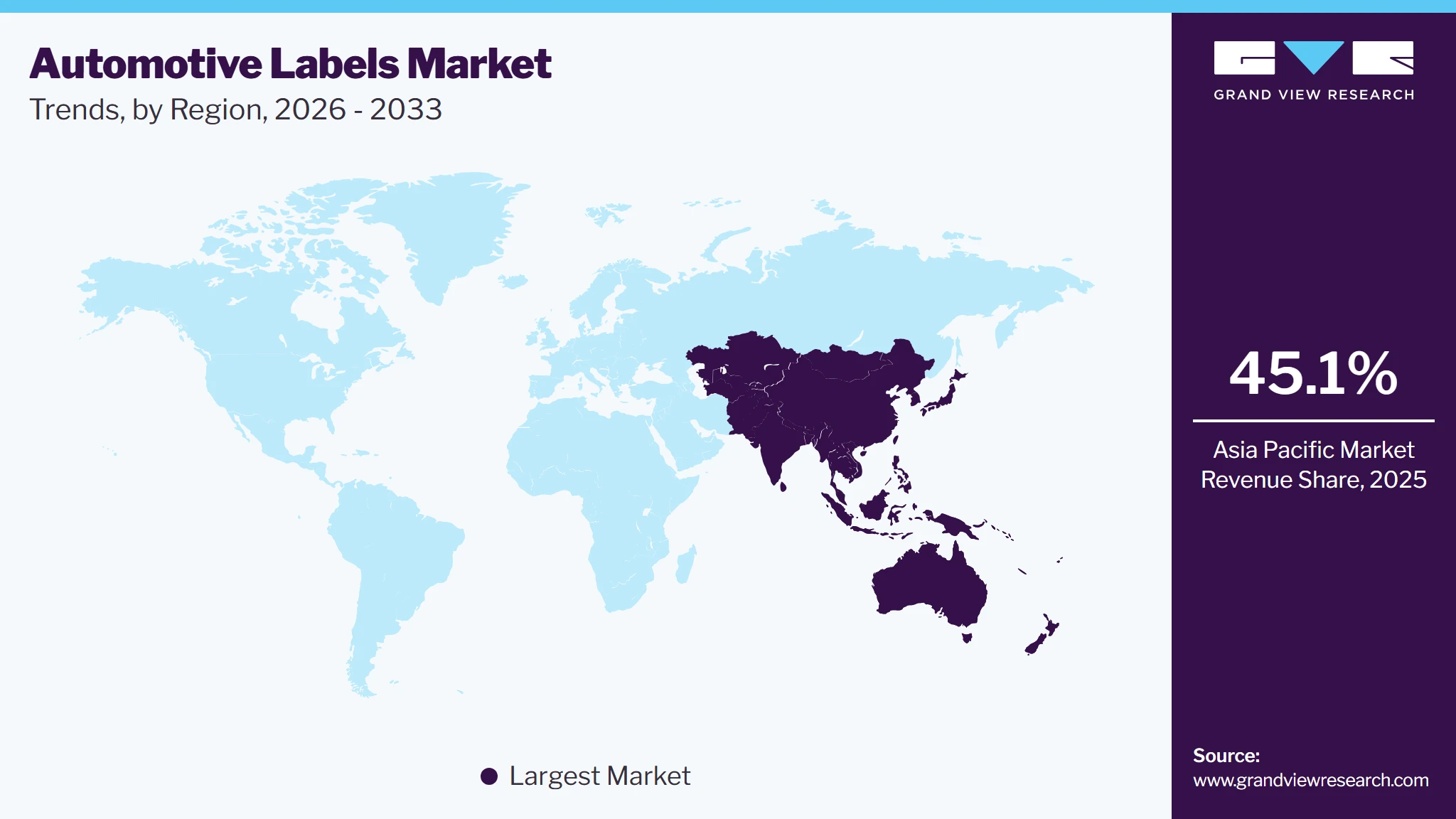
Asia Pacific dominated the global automotive labels market with a 45.1% revenue share in 2025 and is expected to grow at the fastest CAGR of 5.1% during the forecast period. The region's leadership is driven by its large automotive manufacturing base, rapid growth in electric vehicle production, expanding automotive component industry, and increasing adoption of advanced labeling solutions for safety, identification, and traceability. Rising investments in smart manufacturing and industrial automation are further supporting regional market growth.
 To learn more about this report, Download Free Sample Report
China Automotive Labels Market Trends
The China automotive labels market dominated Asia Pacific in 2025, owing to its position as the world's largest automotive manufacturing hub and its rapidly expanding electric vehicle industry. Increasing production of passenger vehicles, batteries, and automotive electronics is driving demand for high-performance warning, identification, and traceability labels.
The automotive labels market in India is expected to witness strong growth during the forecast period, supported by rising vehicle production, expanding automotive component manufacturing, increasing EV investments, and government initiatives such as Make in India. Growing localization of automotive supply chains is expected to further boost demand for automotive labeling solutions.
Europe Automotive Labels Market Trends
The Europe automotive labels industry is projected to experience steady growth over the forecast period. Demand is supported by the region's established automotive industry, stringent vehicle safety and environmental regulations, and increasing adoption of durable and sustainable labeling materials. The growing transition toward electric mobility is further contributing to market expansion.
The automotive labels market in Germanyaccounts for a significant share of Europe, due to its strong automotive manufacturing sector and the presence of leading global OEMs. Continuous investments in premium vehicles, electric mobility, and advanced manufacturing technologies are expected to support long-term market growth.
The UK automotive labels market is expected to grow steadily during the forecast period, driven by increasing adoption of electric vehicles, advanced automotive electronics, and growing demand for durable labeling solutions that support vehicle safety, compliance, and traceability requirements.
North America Automotive Labels Market Trends
The North America automotive labels industry is expected to witness steady growth during the forecast period, driven by increasing electric vehicle adoption, stringent safety regulations, and rising demand for high-performance identification and traceability labels. Growing investments in smart factories and connected vehicle technologies are also supporting market expansion.
The U.S. automotive labels industry is expected to grow steadily throughout the forecast period. Growth is supported by increasing production of electric and connected vehicles, strong demand for durable automotive labels, and rising adoption of RFID- and barcode-enabled labeling solutions for supply chain and inventory management.
Latin America Automotive Labels Market Trends
The Latin America automotive labels industry is projected to grow steadily during the forecast period, supported by increasing automotive manufacturing, expanding aftermarket activities, and rising demand for regulatory, branding, and traceability labels across passenger and commercial vehicles.
The automotive labels market in Brazil accounts for a significant share of Latin America, due to its large automotive manufacturing base and growing investments in domestic vehicle production. Rising demand for automotive components and replacement parts is expected to support market growth.
The Argentina automotive labels market is expected to experience stable growth throughout the forecast period, driven by a gradual recovery in automotive production, rising demand for replacement parts, and increasing adoption of durable labeling solutions in vehicle assembly and aftermarket applications.
Middle East & Africa Automotive Labels Market Trends
The Middle East & Africa automotive labels industry is expected to grow at a steady pace during the forecast period, supported by expanding automotive assembly operations, rising vehicle imports, and increasing demand for standardized safety, warning, and identification labels. Ongoing industrial development and investments in the automotive sector are expected to create additional growth opportunities across the region.
Key Automotive Labels Company Insights
The market is characterized by continuous innovation in durable labeling materials, high-performance adhesives, and traceability technologies. Leading manufacturers are focusing on product innovation, customized labeling solutions, RFID integration, and strategic partnerships with automotive OEMs and Tier-1 suppliers to strengthen their competitive position.
-
Avery Dennison Corporation is a global leader in pressure-sensitive materials and intelligent labeling solutions for the automotive industry. The company offers durable automotive labels, RFID-enabled labels, and high-performance adhesive materials designed for vehicle identification, component traceability, warning labels, and under-the-hood applications. Its strong focus on material innovation and sustainable labeling solutions supports its leadership in the global automotive labels market.
-
3M Company is a leading manufacturer of industrial labeling and identification solutions, offering durable automotive labels, graphic films, safety labels, and functional adhesive technologies. The company's automotive labeling portfolio is designed to withstand extreme temperatures, chemicals, UV exposure, and harsh operating environments. Through continuous innovation in specialty materials and adhesive technologies, 3M remains a key supplier to automotive manufacturers and component producers worldwide.
Key Automotive Labels Companies
The following key companies have been profiled for this study of the automotive labels market.
-
Avery Dennison Corporation
-
3M
-
CCL Industries
-
Brady Corporation
-
UPM
-
LINTEC Corporation
-
SATO Holdings Corporation
-
tesa SE
-
CILS International
-
Resource Label Group
-
Clarion Safety Systems
- Advantage Label & Packaging, Inc.
Competitive Benchmarking
Category
Operating Strategies
Competitive Edge
Weakness
Established Players (Avery Dennison Corporation; 3M Company; CCL Industries Inc.; UPM-Kymmene Corporation (UPM Raflatac); LINTEC Corporation; Brady Corporation; SATO Holdings Corporation; tesa SE)
Focus on expanding automotive labeling portfolios through continuous R&D, advanced adhesive technologies, RFID-enabled and durable labeling solutions, and strategic partnerships with automotive OEMs and Tier-1 suppliers. Invest in sustainable label materials, digital printing, and global manufacturing capabilities to strengthen market presence.
Strong global manufacturing and distribution networks, extensive expertise in pressure-sensitive materials and industrial labeling, broad product portfolios, advanced material technologies, and long-term relationships with automotive manufacturers enable these companies to maintain market leadership.
High investment requirements for material innovation and manufacturing, fluctuating raw material costs, increasing environmental compliance requirements, and pricing pressure from regional manufacturers may impact profitability and operational flexibility.
Emerging & Specialized Players (CILS International Ltd.; Resource Label Group, LLC; Clarion Safety Systems; Advantage Label & Packaging, Inc.)
Focus on customized automotive labels, safety and compliance labels, VIN and asset identification labels, and short-run production tailored to OEM and aftermarket requirements. Expand market presence through customer-specific solutions, fast turnaround times, and technical support for specialized automotive applications.
Strong expertise in customized and durable labeling solutions, flexibility in meeting customer-specific requirements, quick product development cycles, and specialization in regulatory and safety labeling support growth in niche automotive applications.
Limited global manufacturing footprint, smaller distribution networks, and lower R&D investments compared with multinational competitors may restrict international expansion. Greater dependence on regional markets and specialized customer segments can also limit large-scale growth opportunities.
Recent Developments
-
In April 2026, Avery Dennison Corporation announced a USD 75 million strategic investment in Wiliot to accelerate the adoption of Physical AI and intelligent supply chain solutions. The partnership expands RFID-enabled digital identification technologies and connected packaging capabilities, strengthening real-time product visibility and traceability across global logistics networks.
-
In August 2025, Brady Corporation acquired Mecco Partners, LLC, a manufacturer of industrial laser and pin marking systems. The acquisition expands Brady's direct part marking and specialty identification portfolio, strengthening its capabilities in automotive, aerospace, and industrial traceability solutions.
Automotive Labels Market Report Scope
Report Attribute
Details
Market size value in 2025
USD 8.1 billion
Market size value in 2026
USD 8.4 billion
Revenue forecast in 2033
USD 11.7 billion
Growth Rate
CAGR of 4.8% from 2026 to 2033
Base year for estimation
2025
Historical data
2021 - 2024
Forecast period
2026 - 2033
Quantitative units
Revenue in USD million/billion and CAGR from 2026 to 2033
Report coverage
Revenue forecast, company ranking, competitive landscape, growth factors, and trends
Segments covered
Vehicle type, function, material, label type, region
Regional Scope
North America; Europe; Asia Pacific; Latin America; Middle East & Africa
Key companies profiled
Avery Dennison Corporation; 3M Company; CCL Industries Inc.; Brady Corporation; UPM-Kymmene Corporation (UPM Raflatac); LINTEC Corporation; SATO Holdings Corporation; tesa SE; CILS International Ltd.; Resource Label Group; Clarion Safety Systems; Advantage Label & Packaging, Inc.
Customization scope
Free report customization (equivalent up to 8 analysts working days) with purchase. Addition or alteration to country, regional & segment scope.
Pricing and purchase options
Avail of customized purchase options to meet your exact research needs. Explore purchase options
Global Automotive Labels Market Report Segmentation
This report forecasts revenue growth at the global, regional & country levels and provides an analysis of the latest industry trends and opportunities in each of the sub-segments from 2021 to 2033. For this study, Grand View Research has segmented the global automotive labels market report based on vehicle type, function, material, label type, and region:
-
Vehicle Type Outlook (Revenue, USD Million/Billion, 2021 - 2033)
-
Passenger Vehicles
-
Light Commercial Vehicles
-
Heavy Commercial Vehicles
-
Two & Three Wheelers
-
-
Function Outlook (Revenue, USD Million/Billion, 2021 - 2033)
-
Warning & Safety Labels
-
Identification & Traceability Labels
-
Branding & Decorative Labels
-
Instruction & Information Labels
-
Asset & Inventory Labels
-
-
Material Outlook (Revenue, USD Million/Billion, 2021 - 2033)
-
Polyester (PET)
-
Polyvinyl Chloride (PVC)
-
Polypropylene (PP)
-
Polycarbonate (PC)
-
Polyethylene (PE)
-
Other Materials
-
-
Label Type Outlook (Revenue, USD Million/Billion, 2021 - 2033)
-
Pressure-Sensitive Labels
-
Glue-Applied Labels
-
Heat Transfer Labels
-
In-Mold Labels
-
Sleeve Labels
-
-
Regional Outlook (Revenue, USD Million/Billion, 2021 - 2033)
-
North America
-
U.S.
-
Canada
-
Mexico
-
-
Europe
-
Germany
-
France
-
UK
-
Italy
-
Spain
-
-
Asia Pacific
-
China
-
India
-
Japan
-
South Korea
-
Australia
-
-
Latin America
-
Brazil
-
Argentina
-
-
Middle East & Africa
-
Saudi Arabia
-
UAE
-
South Africa
-
-
Research Methodology
The automotive labels market figures in this report are based on a proven research process that combines executive interviews with secondary research from proprietary databases, company filings, and recognized regulatory and institutional sources. Market size is built through value-chain sizing-reconciling supply-side and demand-side estimates-and triangulated with bottom-up and top-down approaches. Every estimate passes multiple levels of expert validation before publication, with each automotive labels segment quantified using the revenue-capture definitions in the table below.
Segment Definition
Segment - Vehicle Type
Revenue capture definition
Passenger Vehicles
Revenue generated from automotive labels used in passenger cars, including warning & safety labels, identification & traceability labels, branding labels, instructional labels, VIN labels, barcode/RFID labels, and under-the-hood durable labels supplied to OEMs and the aftermarket.
Light Commercial Vehicles (LCVs)
Revenue generated from automotive labels used in light commercial vehicles such as vans, pickup trucks, and delivery vehicles. Includes durable identification labels, compliance labels, safety labels, logistics labels, and component traceability labels designed to withstand demanding operating conditions.
Heavy Commercial Vehicles (HCVs)
Revenue generated from automotive labels used in heavy-duty trucks, buses, trailers, and construction vehicles. Includes high-durability warning labels, equipment identification labels, asset tracking labels, engine compartment labels, and regulatory compliance labels for commercial fleet applications.
Two & Three Wheelers
Revenue generated from automotive labels used in motorcycles, scooters, mopeds, and three-wheelers. Includes branding labels, safety and caution labels, VIN labels, emission labels, instructional labels, and durable identification labels supplied to vehicle manufacturers and aftermarket service providers.
Segment - Function
Revenue capture definition
Warning & Safety Labels
Revenue generated from the sale of automotive warning and safety labels used to communicate critical safety information, hazard warnings, airbag notices, tire pressure details, battery warnings, and regulatory compliance markings. Includes durable labels designed to withstand heat, chemicals, moisture, and long-term vehicle operating conditions.
Identification & Traceability Labels
Revenue generated from the sale of automotive identification and traceability labels used for VIN identification, barcode and QR code tracking, RFID-enabled labeling, serial numbers, component identification, and supply chain traceability. Includes labels utilized by OEMs and automotive component manufacturers for production, logistics, warranty, and aftermarket tracking.
Branding & Decorative Labels
Revenue generated from the sale of branding and decorative automotive labels used for vehicle branding, logo applications, trim identification, model badges, promotional graphics, and aesthetic enhancement. Includes premium labels designed to provide long-term visual appeal, UV resistance, and durability for both interior and exterior vehicle applications.
Instruction & Information Labels
Revenue generated from the sale of automotive instruction and information labels displaying operating instructions, maintenance guidelines, fluid specifications, service information, wiring diagrams, and compliance details. Includes labels installed across engine compartments, vehicle interiors, doors, and other functional vehicle components.
Asset & Inventory Labels
Revenue generated from the sale of asset and inventory labels used for equipment identification, production asset management, warehouse tracking, inventory control, and logistics operations within automotive manufacturing facilities and supply chains. Includes durable barcode, RFID, and serialized labels used for efficient asset monitoring and inventory management.
Segment - Material
Revenue capture definition
Polyester (PET)
Revenue generated from the sale of polyester (PET)-based automotive labels used for warning, identification, traceability, branding, and information applications. Includes high-performance PET labels offering excellent durability, heat resistance, chemical resistance, abrasion resistance, and long-term adhesion for interior and exterior automotive components.
Polyvinyl Chloride (PVC)
Revenue generated from the sale of polyvinyl chloride (PVC)-based automotive labels used for branding, decorative, instructional, and identification purposes. Includes flexible and durable PVC labels designed to withstand moisture, chemicals, weather exposure, and mechanical wear in automotive environments.
Polypropylene (PP)
Revenue generated from the sale of polypropylene (PP)-based automotive labels used across vehicle components requiring lightweight, cost-effective, and chemically resistant labeling solutions. Includes labels applied for product identification, logistics, inventory management, and general automotive marking applications.
Polycarbonate (PC)
Revenue generated from the sale of polycarbonate (PC)-based automotive labels used in high-temperature and demanding automotive environments. Includes labels designed for instrument panels, electronic components, under-the-hood applications, and durable control interfaces requiring superior impact, heat, and abrasion resistance.
Polyethylene (PE)
Revenue generated from the sale of polyethylene (PE)-based automotive labels used for temporary, protective, informational, and packaging-related applications. Includes flexible labels offering moisture resistance, good printability, and reliable adhesion across automotive manufacturing and logistics operations.
Other Materials
Revenue generated from the sale of automotive labels manufactured using other materials, including polyimide, vinyl, acrylic films, specialty synthetic substrates, and composite materials. Includes customized labeling solutions developed for niche automotive applications requiring enhanced durability, chemical resistance, or specialized performance characteristics.
Segment - Label Type
Revenue capture definition
Pressure-Sensitive Labels
Revenue generated from the sale of pressure-sensitive automotive labels that adhere through pressure without requiring heat or water activation. Includes labels used for warning & safety, VIN and barcode identification, traceability, branding, instructional, and compliance applications across vehicle interiors, exteriors, engines, and electronic components.
Glue-Applied Labels
Revenue generated from the sale of glue-applied automotive labels that require adhesive application during installation. Includes durable labels used for component identification, product information, packaging, logistics, and branding applications where strong and long-lasting adhesion is required throughout the vehicle lifecycle.
Heat Transfer Labels
Revenue generated from the sale of heat transfer automotive labels applied using heat and pressure to create permanent markings on automotive components. Includes labels used for wire harnesses, engine parts, under-the-hood components, electronic modules, and high-temperature applications requiring excellent chemical, abrasion, and heat resistance.
In-Mold Labels
Revenue generated from the sale of in-mold automotive labels integrated into plastic components during the molding process. Includes decorative, branding, instructional, and identification labels used on dashboards, interior trims, control panels, and other molded automotive parts, offering superior durability and resistance to wear, moisture, and chemicals.
Sleeve Labels
Revenue generated from the sale of sleeve automotive labels designed to fit around cylindrical or irregular-shaped automotive components. Includes shrink and stretch sleeve labels used for branding, product identification, wiring systems, fluid containers, batteries, and specialty automotive components requiring full-surface coverage and high-quality graphics.
Estimation Model
Layer Name
Key Question
Description
Vehicle Production Layer
What drives demand?
Estimate demand based on global vehicle production across passenger vehicles, light commercial vehicles, heavy commercial vehicles, and two & three wheelers, as automotive labels are installed across all vehicle categories.
Function Adoption Layer
Where are automotive labels used?
Assess the adoption of automotive labels across key functions including warning & safety, identification & traceability, branding & decorative, instruction & information, and asset & inventory labeling based on OEM and aftermarket requirements.
Material & Label Type Layer
Which products generate demand?
Evaluate the consumption of automotive labels by material type (PET, PVC, PP, PC, PE, and others) and label type (pressure-sensitive, glue-applied, heat transfer, in-mold, and sleeve labels) across different automotive applications.
Revenue Layer
How is revenue generated?
Revenue is generated through the sale of automotive labels supplied to OEMs, Tier-1 suppliers, and aftermarket participants for vehicle identification, safety compliance, branding, traceability, and information labeling across interior, exterior, and under-the-hood applications.
Delivered Customizations
This report has been delivered with the following In-depth customizations
Client Request
Customization Delivered
Value Adds
Competitive Benchmarking
Detailed benchmarking of leading market participants based on product portfolio, security technologies, innovation capabilities, geographic presence, strategic developments, and end-use focus.
Enables clients to assess competitor positioning, identify market gaps, and develop effective expansion and partnership strategies.
Pricing Analysis
In-depth assessment of pricing trends by packaging type and security technology, including the impact of raw material costs, technology integration, manufacturing complexity, and regional pricing variations.
Supports pricing optimization, procurement planning, cost forecasting, and margin improvement strategies.
Opportunity Assessment
Detailed evaluation of emerging growth opportunities across smart packaging, RFID and NFC-enabled authentication, tamper-evident technologies, sustainable security materials, and high-growth e-commerce markets.
Helps clients prioritize investment areas, identify untapped revenue opportunities, formulate market entry strategies, and maximize long-term business growth potential.
Frequently Asked Questions About This Report
The automotive labels market is primarily driven by increasing vehicle production, growing demand for safety and regulatory compliance labels, rising adoption of traceability and RFID technologies, expanding electric vehicle manufacturing, and the need for durable, high-performance labeling solutions capable of withstanding harsh automotive operating conditions.
Asia Pacific dominated the automotive labels market with a 45.1% revenue share in 2025.
Asia Pacific is the fastest-growing region in the automotive labels market, registering a CAGR of 5.1% during the forecast period.
The Polypropylene (PP) segment is the fastest-growing material segment in the automotive labels market, with a CAGR of 5.3% during the forecast period.
The Passenger Vehicles segment led the automotive labels market with a 68.8% revenue share in 2025.
The Pressure-Sensitive Labels segment led the automotive labels market with a 46.5% revenue share in 2025.
Key players in the automotive labels market include Avery Dennison Corporation, 3M, CCL Industries, Brady Corporation, UPM, LINTEC Corporation, SATO Holdings Corporation, tesa SE, CILS International, Resource Label Group, Clarion Safety Systems, and Advantage Label & Packaging, Inc.
The global automotive labels market was valued at USD 8.1 billion in 2025 and is estimated to reach USD 8.4 billion in 2026
The global automotive labels market is expected to grow at a CAGR of 4.8% from 2026 to 2033, reaching USD 11.7 billion by 2033.
About the Author(s)
Plastics, Polymers & Resins Research Team
Bulk Chemicals · Plastics, Polymers & ResinsThis report was authored by the plastics, polymers & resins research team at Grand View Research - comprising two research analysts, one senior research analyst, and one industry expert - with specialized expertise in the plastics, polymers & resins segment of the bulk chemicals industry. All findings are based on proprietary bulk chemicals databases, executive interviews, and regulatory analysis, subject to internal peer review prior to publication.
Last Updated:
Speak to Analyst

Customize this report to your needs - add regions, segments, or data points, with 20% free customization.
Or view our licence options:


ISO 9001:2015 & 27001:2022 Certified
We are GDPR and CCPA compliant! Your transaction & personal information is safe and secure. For more details, please read our privacy policy.


