
- Home
- »
- Automotive & Transportation
- »
-
Automotive Over-The-Air Updates Market Report, 2026-2033GVR Report cover

Automotive Over-The-Air Updates Market (2026 - 2033)
Size, Share & Trends Analysis Report By Type (Software, Firmware), By Propulsion, By Vehicle Type (Passenger, Commercial), By Application, By Region, And Segment Forecasts
Market Size, 2025
$5.8BMarket Estimate, 2026
$7.0BMarket Forecast, 2033
$32.4BCAGR, 2026–2033
24.6%Automotive Over-The-Air Updates Market Summary
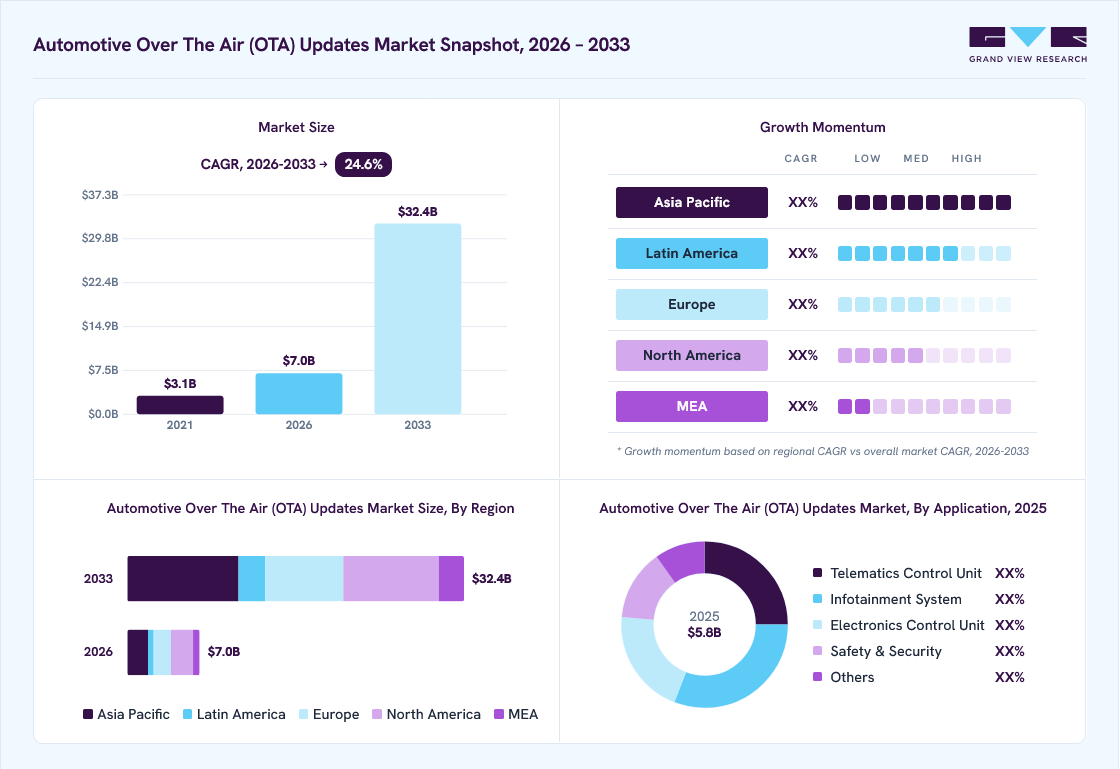
The global automotive over-the-air updates market size was valued at USD 5.8 billion in 2025 and is projected to grow from USD 7.0 billion in 2026 to USD 32.4 billion by 2033, at a CAGR of 24.6% from 2026 to 2033. North America dominated the global market, accounting for a revenue share of 30.9% in 2025. This market expansion is driven by the increased adoption of cloud-native OTA platforms and AI-driven update management systems to improve update efficiency, security, and fleet-wide deployment scalability.
 Source: Grand View Research, IR Documents, Primary Interviews, Paid DatabasesTo learn more about this report,
 Download Free Sample Report
Key Market Trends & Insights
- By type: Software segment dominated the market, with a revenue share of 76.4% in 2025.
- By propulsion: Internal combustion engine segment held the largest market share of 59.7% in 2025.
- By vehicle type: Passenger vehicle segment held the largest market share of 65.9% in 2025.
- By application: Infotainment system segment held the largest market share of 30.7% in 2025.
Regional Highlights
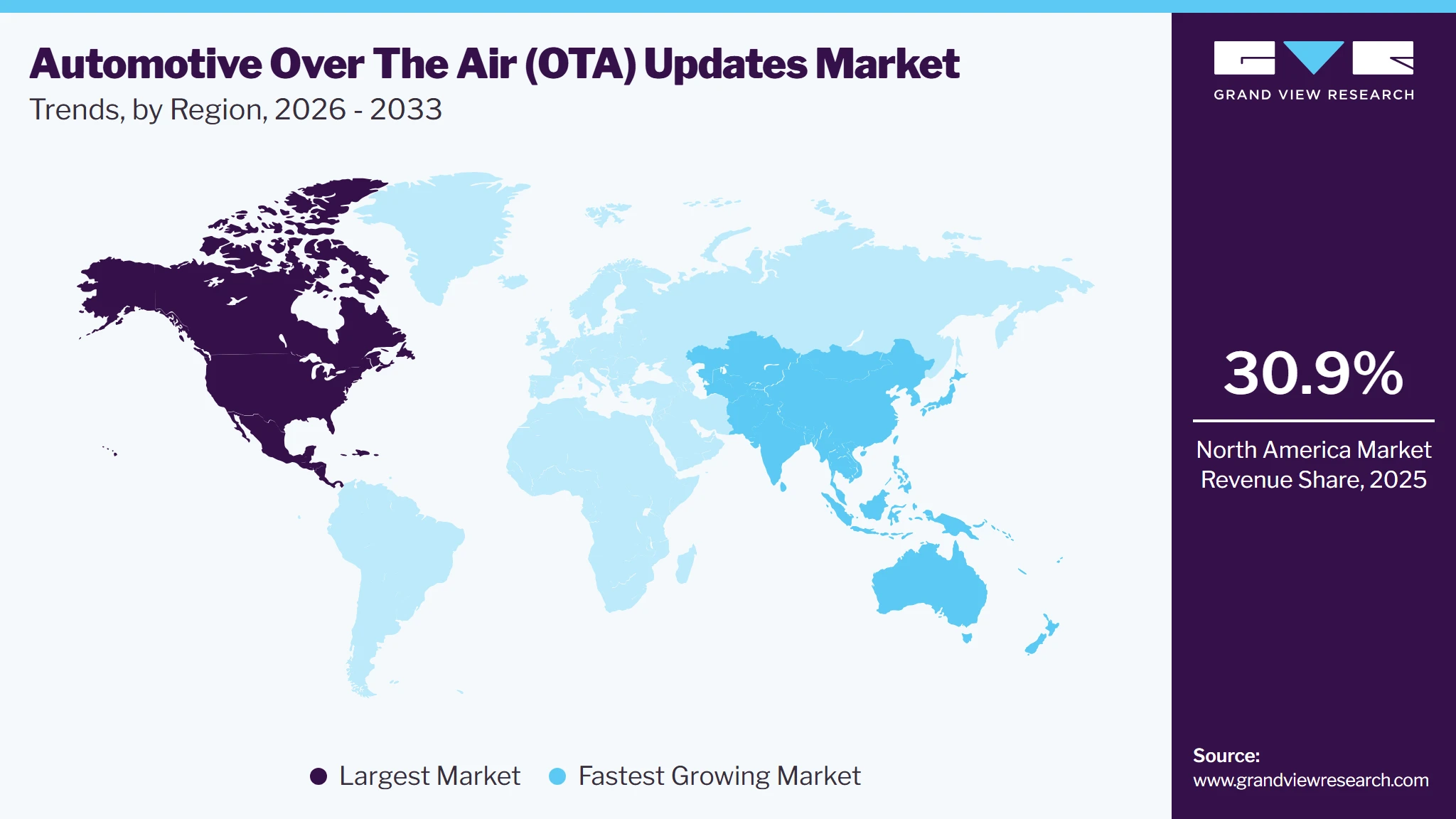
- Largest regional market: North America (30.9% revenue share, 2025)
- Fastest-growing regional market: Asia Pacific (highest CAGR, 2026-2033)
- By country: The automotive over the air (OTA) updates market in the U.S. held the largest share in the North America region in 2025.
Market Size & Forecast
- Market size in 2025: USD 5.8 Billion
- Estimated market size in 2026: USD 7.0 Billion
- Projected market size by 2033: USD 32.4 Billion
- CAGR (2026-2033): 24.6%
Three ways to get this report
Buy it, customize it, or ask a question.Ask an Analyst
Analyst response in 1 business day
- AccessReport author, directly
- Reply timeWithin 1 working day
- No sales callDirect answer only
- FormatEmail reply
- CostFree, no cost
Get the Full Report
What the study covers
- FormatsPDF · Excel · Dashboard
- Timeline2026–2033 annual, 2025 base
- Coverage20+ countries, 5 regions
- Companies10+ key players profiled
Customize the Report
20% free customization
- IncludeCountries, segments, points
- TailorTo your product definition
- ExtendDeeper competitor detail
- OrA fully bespoke study
- Turnaround5–10 working days
As the number of these software-dependent automobiles grows, the demand for over-the-air updates also increases. Consequently, OEMs are investing in wireless automotive software update technologies to ensure vehicles remain in optimal working condition.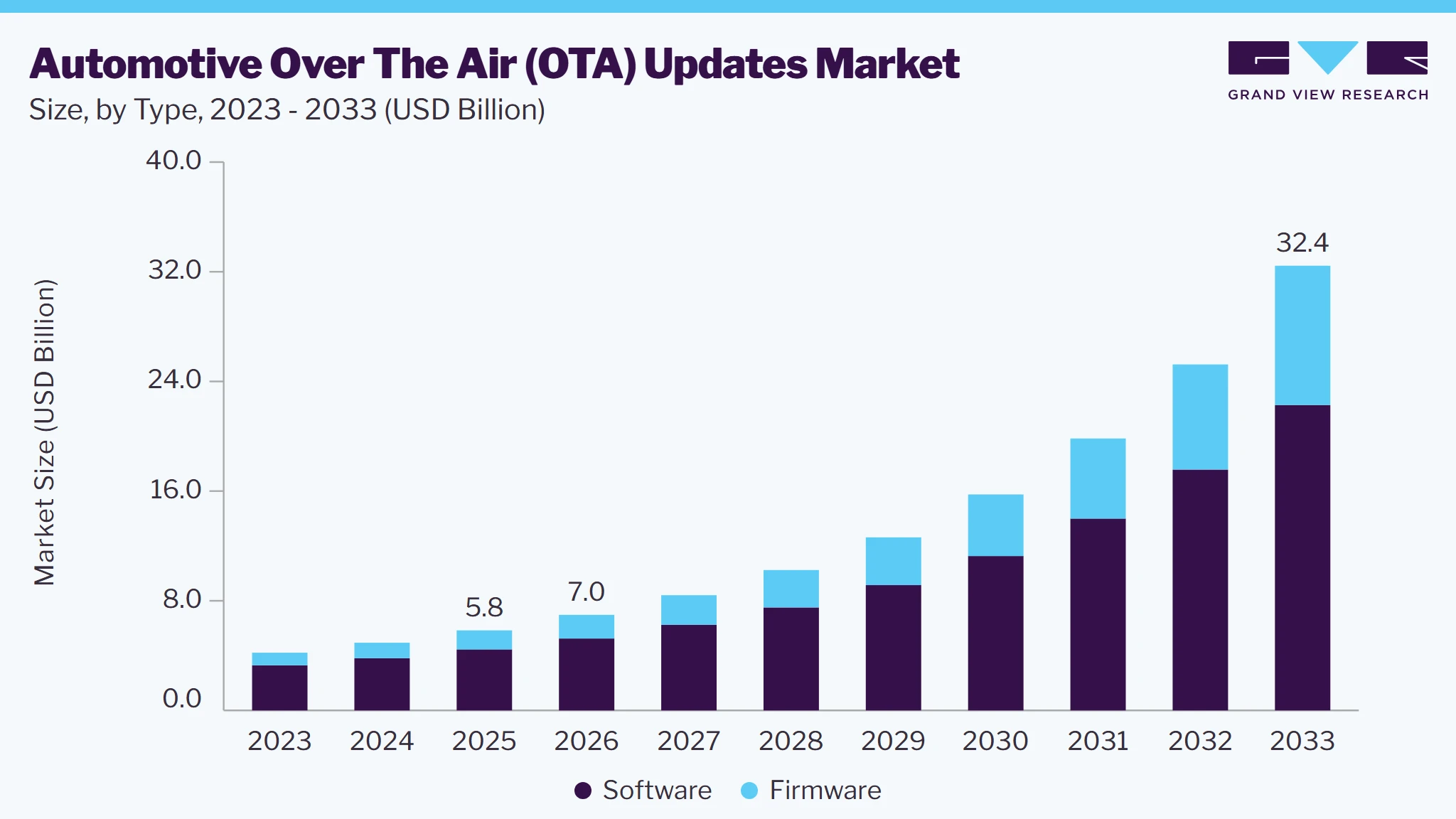 To learn more about this report, Download Free Sample Report
New technologies such as electrification, 5G, computer vision, and advanced AI and machine learning-based software solutions are converging. Consequently, automotive manufacturers are experiencing an increase in security and safety challenges. At the same time, they have the opportunity to transform business models by offering new aftermarket services and features on demand, delivered through over-the-air solutions. moreover, the increasing adoption of connected cars, improving customer experience, reducing costs and improving efficiency, enabling new business models, increasing regulatory requirements, and advancements in technology are all contributing to the growth of Automotive over-the-air updates. As more cars become connected, the demand for remote software updates increases, allowing automakers to enhance the driving experience by providing bug fixes, security patches, and new features without requiring customers to visit a dealership
Market Dynamics
The automotive over-the-air (OTA) updates market is gaining momentum as automakers increasingly rely on software-defined vehicle architectures that require continuous feature enhancements, bug fixes, cybersecurity patches, and performance optimization throughout a vehicle’s lifecycle. The growing integration of connected car technologies, advanced driver-assistance systems (ADAS), infotainment platforms, and vehicle diagnostics further amplifies the need for reliable OTA infrastructure. As vehicles become more software-centric, OTA updates have emerged as a critical tool for maintaining functionality, compliance, and customer satisfaction.
The rapid transition toward software-defined vehicles is transforming the automotive industry, with software increasingly controlling critical functions such as powertrain management, infotainment, advanced driver-assistance systems (ADAS), and vehicle diagnostics. As vehicles become more connected and feature-rich, manufacturers require a seamless mechanism to deploy performance enhancements, security patches, and functional upgrades throughout the vehicle lifecycle. Furthermore, growing connectivity enabled by embedded telematics, cloud platforms, and vehicle-to-everything (V2X) technologies is enabling continuous data exchange between vehicles and manufacturers. OTA updates enable automakers to respond quickly to software issues, introduce new features remotely, and maintain system reliability without requiring dealership visits. The ability to continuously improve vehicle functionality after purchase supports customer satisfaction while helping manufacturers reduce service costs and accelerate innovation cycles.
The effectiveness of automotive OTA updates depends heavily on reliable and high-speed internet connectivity, which remains inconsistent across many rural, remote, and developing regions. Vehicles operating in areas with weak cellular coverage often experience delayed, interrupted, or incomplete software downloads, reducing the efficiency of remote update deployment. Infrastructure limitations also affect the adoption of advanced OTA capabilities that require large data transfers, such as autonomous driving software, high-definition maps, and feature-rich infotainment updates. In regions where 4G and 5G networks are not widely available, manufacturers may need to rely on traditional service-center-based updates, diminishing the cost and convenience advantages of OTA technology. As a result, uneven telecommunications infrastructure continues to act as a constraint on the widespread and seamless implementation of automotive OTA update solutions.
The transition toward software-defined vehicles is creating a significant growth opportunity for the automotive over-the-air (OTA) updates market, as vehicle functionality is increasingly governed by software rather than hardware. Modern vehicles integrate numerous electronic control units, advanced driver-assistance systems, connectivity modules, and digital cockpit features that require regular updates to maintain optimal performance and security. OTA technology enables automakers to deliver these updates remotely, reducing service costs while improving vehicle functionality throughout its operational life.
As SDV adoption accelerates, manufacturers are using OTA platforms to introduce new features, enhance user experiences, and address software vulnerabilities without physical intervention. This capability supports faster innovation cycles and allows vehicles to continuously evolve after purchase, creating long-term value for both automakers and consumers. The growing focus on connected, intelligent, and upgradeable vehicles is therefore expanding the demand for scalable and secure OTA update ecosystems across global automotive markets.
Market Concentration & Characteristics
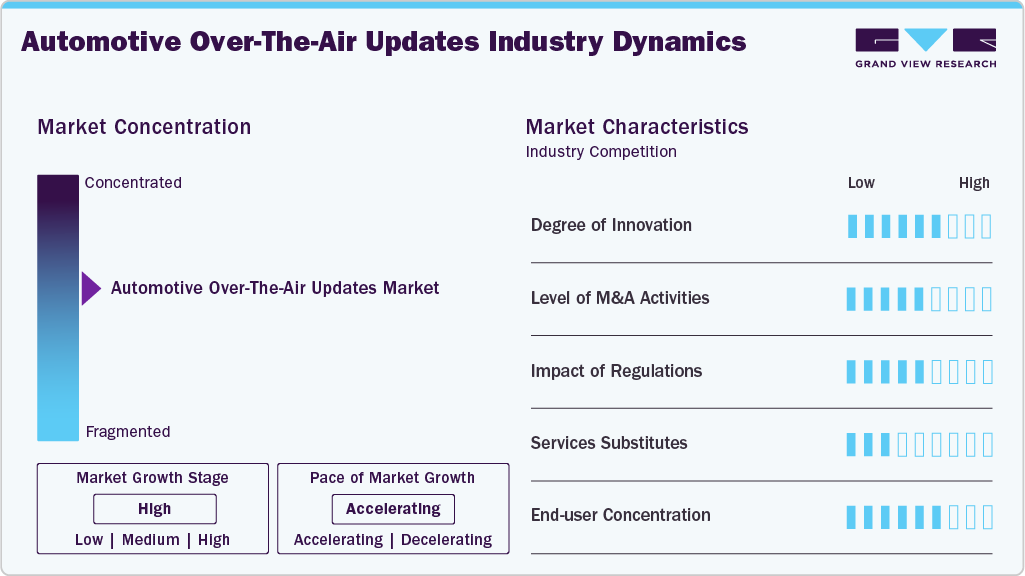
The market demonstrates a high degree of innovation as automakers increasingly adopt software-centric vehicle architectures that require continuous feature enhancements and remote management capabilities. Advancements in cloud computing, artificial intelligence, edge processing, cybersecurity frameworks, and vehicle connectivity are driving the evolution of OTA platforms. Companies are developing intelligent update orchestration systems that enable predictive deployments, real-time diagnostics, and seamless software rollouts. Continuous innovation remains essential as vehicle software complexity increases and consumer expectations for digital experiences continue to rise.
 To learn more about this report, Download Free Sample Report
End-user concentration is moderately high, as demand for OTA solutions is primarily driven by a limited number of global automotive OEMs that deploy these capabilities across large vehicle fleets. Major vehicle manufacturers account for a significant share of OTA platform adoption due to their extensive connected vehicle programs and software-defined vehicle initiatives. OTA providers often establish long-term partnerships with OEMs, creating substantial revenue concentration among leading automotive brands. However, expanding adoption among electric vehicle manufacturers and emerging mobility providers is gradually broadening the customer base.
Analyst Perspective
The automotive over-the-air (OTA) updates market is evolving from a vehicle maintenance tool into a core enabler of the software-defined vehicle ecosystem, where software functionality increasingly influences vehicle value and customer experience. Market growth is being driven by rising connected vehicle adoption, expanding electric vehicle deployments, and the need for continuous cybersecurity and performance updates throughout the vehicle lifecycle. The most durable competitive position belongs to providers capable of orchestrating secure, vehicle-wide updates across multiple software domains rather than supporting isolated applications. As automakers seek to repeat revenue through feature-on-demand services and digital upgrades, OTA platforms are becoming integral to long-term monetization strategies.
Type Insights
Based on type, the software segment led the market with the largest revenue share of 76.4% in 2025 and is expected to grow at the significant CAGR over the forecast period. The automotive industry is undergoing a significant transformation with the increasing adoption of over-the-air updates, which allow for wireless software updates to be delivered directly to vehicles, eliminating the need for physical visits to dealerships or service centers. There are two main types of over-the-air updates: Software over-the-air (SOTA) updates, which focus on the software applications running on the vehicle's infotainment system and other non-critical systems, and Firmware over-the-air (FOTA) updates, which target the firmware of electronic control units responsible for critical vehicle functions. As the automotive industry continues to evolve, the software aspect of over-the-air updates will play an increasingly critical role in enabling the seamless delivery of new features, security patches, and performance enhancements to vehicles, ultimately enhancing the driving experience and shaping the future of the industry.
The firmware segment is estimated to grow significantly over the forecast period. Firmware is a crucial aspect of Automotive over-the-air updates, enabling the wireless updating of firmware in electronic control units (ECUs) responsible for controlling various critical vehicle functions such as engine management, transmission, and braking systems. Firmware over-the-air updates can target ECUs as well as infotainment systems, offering significant benefits like improved safety through the rapid deployment of security patches and bug fixes, enhanced performance leading to better fuel efficiency and driving experience, reduced costs by eliminating the need for physical recalls and service visits, and increased efficiency by streamlining the update process.
Vehicle Type Insights
Based on vehicle type, the passenger vehicle segment led the market with the largest revenue share of 65.9% in 2025. Over-the-air updates help automakers ensure their passenger vehicles comply with the latest safety and environmental regulations, which is particularly important for EVs subject to strict emissions and efficiency standards. As OTA technology matures, there are opportunities for more personalized updates tailored to individual user preferences and driving patterns, which could be especially beneficial for EV owners with unique charging and usage requirements. TA updates are transforming the passenger vehicle industry, enabling continuous improvements, reducing costs, enhancing user experiences, and ensuring regulatory compliance, shaping the future of passenger vehicles.
The commercial segment is predicted to foresee significant growth in the forecast period. Over-the-air updates are becoming increasingly important for commercial vehicles, as they enable fleet operators and manufacturers to continuously improve the performance, efficiency, and safety of their vehicles remotely. Over-the-air updates allow fleet operators to quickly address software-related issues and implement performance enhancements without taking vehicles off the road for extended periods. This reduces downtime and maintenance costs, improving the overall efficiency of commercial vehicle operations. Moreover, over-the-air updates are transforming the commercial vehicle industry by enabling continuous improvements, reducing maintenance costs, enhancing safety and compliance, optimizing efficiency, and enabling predictive maintenance strategies. As the technology continues to evolve, over-the-air updates will play an increasingly crucial role in shaping the future of commercial vehicles.
Application Insights
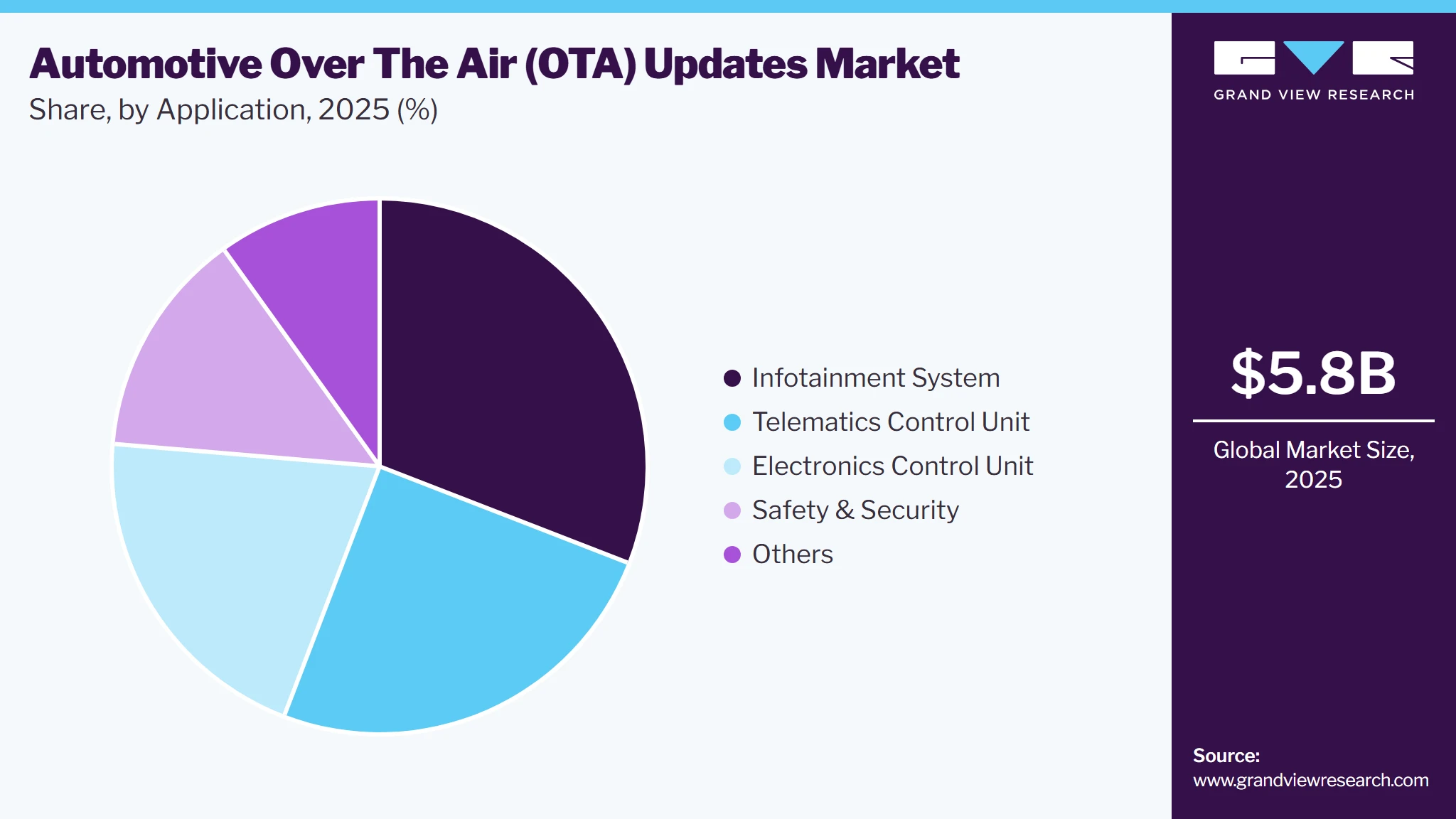
Based on application, the infotainment system segment led the market with the largest revenue share of 30.7% in 2025 and is expected to grow at the significant CAGR over the forecast period. The infotainment system segment is a major driver of growth in the automotive over-the-air updates market, particularly for software over-the-air updates, as automakers leverage this technology to deliver advanced features, improve user experience, and enhance customer satisfaction. The infotainment application is expected to continue growing at a rapid pace in the coming years, driven by the increasing adoption of connected vehicle technologies and the need for regular software updates to keep pace with evolving user demands and expectations.
 To learn more about this report, Download Free Sample Report
The Telematics Control Unit (TCU) segment is predicted to foresee significant growth in the forecast period. TCUs serve as the brain behind connected car technologies, enabling vehicle-to-vehicle (V2V), vehicle-to-infrastructure (V2I), and vehicle-to-everything (V2X) communications. Asia-Pacific emerges as a leading market for automotive TCUs, driven by automotive production growth, urbanization, and digitalization in countries such as China, Japan, South Korea, and India. TCUs support the integration of advanced technologies like autonomous driving systems and Vehicle-to-Everything (V2X) communication, which rely on seamless software updates to maintain optimal functionality. As the demand for connected cars grows, TCUs are expected to continue facilitating over-the-air updates as a standard practice, ensuring vehicles remain up-to-date with the latest advancements and improvements throughout their lifecycle.
Propulsion Outlook
Based on propulsion, the internal combustion engine segment led the market with the largest revenue share of 59.7% in 2026. Over-the-air updates have traditionally been associated with electric vehicles (EVs) and advanced driver-assistance systems (ADAS). However, their application in vehicles with internal combustion engines is equally transformative. Internal combustion engine vehicles are playing a crucial role in the growth of automotive over-the-air updates. By leveraging this technology, manufacturers can enhance vehicle performance, ensure regulatory compliance, improve safety and security, and provide new features and services to customers. As connectivity and software continue to advance, the role of over-the-air updates in internal combustion engine vehicles will only become more significant, driving further growth in this area.
The electric segment is projected to grow significantly over the forecast period. The growth of electric vehicles (EVs) is having a significant impact on the adoption and capabilities of automotive over-the-air updates. EV manufacturers are leading the way in implementing more extensive OTA update capabilities, as electric vehicles tend to have more software-intensive components and systems compared to traditional internal combustion engine vehicles. This has enabled EV makers, such as Tesla, Lucid, Polestar, Rivian, and Volvo, to leverage over-the-air updates more broadly, including Firmware over-the-air (FOTA) updates that can target critical vehicle systems like the powertrain, battery management, and advanced driver assistance systems (ADAS). The flexibility of over-the-air updates allows EV manufacturers to continuously improve the performance and efficiency of their vehicles, as demonstrated by Tesla's ability to increase the 0-60 mph acceleration times of its Model 3 through remote updates.
Regional Insights
North America dominated the automotive over the air (OTA) updates market with the largest revenue share of 30.9% in 2025. The North American market is witnessing robust growth fueled by several key factors. As vehicles become more technologically advanced and connected, over-the-air updates are becoming essential for automakers to deliver software updates and improvements seamlessly to their vehicles. This technology allows manufacturers to remotely update vehicle software, including infotainment systems, safety features, and engine performance, without requiring owners to visit a dealership. This not only enhances customer convenience but also ensures that vehicles stay current with the latest technological advancements and regulatory requirements.
 To learn more about this report, Download Free Sample Report
U.S. Automotive Over-the-air Updates Market Trends
The automotive over the air (OTA) updates market in the U.S. held the largest share in the North America region in 2025. The automotive over-the-air updates market in the U.S. is experiencing significant growth, driven by the growing adoption of electric and hybrid vehicles, fueled by the development of charging infrastructures, which is supporting the regional market growth. Additionally, the rising demand for safe and secure vehicle infotainment systems is another factor fueling the industry statistics in the U.S.
Europe Automotive Over-The-Air Updates Market Trends
The automotive over-the-air updates market in Europe is at the forefront of integrating advanced connectivity solutions into their vehicles. Over-the-air updates enable manufacturers to remotely update software and firmware, improving vehicle features such as infotainment systems, driver-assistance technologies, and battery management systems. This capability allows vehicles to stay updated with the latest functionalities and safety enhancements throughout their lifecycle.
Asia Pacific Automotive Over-The-Air Updates Market Trends
The automotive over-the-air updates market in Asia-Pacific (APAC) is experiencing significant growth in the Automotive over-the-air updates market, Countries like Japan, South Korea, and China are leaders in technology innovation and adoption. Automakers in these markets are increasingly integrating advanced connectivity features into their vehicles, making over-the-air updates essential for delivering software updates and improvements seamlessly to consumers. This includes updates for infotainment systems, navigation software, driver-assistance systems, and vehicle performance optimizations.
Key Automotive Over-The-Air Updates Company Insights
Prominent firms have used product launches and developments, followed by expansions, mergers and acquisitions, contracts, agreements, partnerships, and collaborations as their primary business strategy to increase their market share. The companies have used various techniques to enhance market penetration and boost their position in the competitive industry. For instance, in March 2023, Broadcom (US) unveiled BCM85812, a transceiver optimized for 800G DR8, 2x400G FR4, and 800G AOC module applications. It enables high-performance and efficient active optical cable solutions for hyper-scale data centers.
Key Automotive Over-The-Air Updates Companies:
The following key companies have been profiled for this study on the automotive over-the-air updates market.
-
Denso Corporation
-
Aptiv PLC
-
Continental AG
-
Garmin Ltd
-
Robert Bosch GmbH
-
HARMAN International
-
Infineon Technologies AG
-
BlackBerry Limited
-
Qualcomm Technologies, Inc.
-
Verizon Communications Inc.
-
NVIDIA Corporation
-
Airbiquity Inc.
Competitive Benchmarking
Category
Operating Strategies
Competitive Edge
Weakness
Established Players (Robert Bosch GmbH; Continental AG; Denso Corporation; NVIDIA Corporation; Aptiv PLC; Qualcomm Technologies, Inc.)
- Focus on end-to-end OTA ecosystems integrating connectivity, cloud platforms, cybersecurity, and vehicle software management.
- Leverage long-term OEM partnerships and global deployment capabilities to scale OTA services across vehicle programs.
- Extensive automotive expertise, established customer relationships, and access to large, connected vehicle fleets.
- Strong R&D investments support advanced OTA functionality, cybersecurity compliance, and software-defined vehicle initiatives.
- Large organizational structures can extend product development and deployment cycles.
- Dependence on OEM procurement processes may limit the ability to rapidly address niche market opportunities.
Emerging Players (Airbiquity Inc.; BlackBerry Limited; Garmin Ltd)
- Concentrate on specialized OTA software, cybersecurity, connectivity management, or cloud-native update platforms.
- Emphasize innovation-led partnerships and modular solutions focused on specific OEM or fleet requirements.
- Agile development environments enable faster feature releases and adaptation to evolve software-defined vehicle requirements.
- Specialized expertise allows differentiation in areas such as OTA orchestration, cybersecurity, and remote diagnostics.
- Limited global deployment scale and smaller customer bases compared with established automotive suppliers.
- Lower financial and operational resources can restrict expansion across multiple vehicle platforms and regions.
Recent Developments
-
In March 2024, NVIDIA announced that prominent companies in the transportation sector have adopted the NVIDIA DRIVE Thor centralized car computer. This technology powers their upcoming generations of consumer and commercial fleets, spanning from electric vehicles and trucks to robotaxis, robobuses, and autonomous last-mile delivery vehicles.
-
In February 2021, Ford Motor Company, a US-based automotive manufacturer, entered into a partnership with Google LLC, the details of which were not disclosed. This collaboration aims to profoundly impact the design and production of vehicles while expanding the implementation of OTA (over-the-air) updates.
Automotive Over-The-Air Updates Market Report Scope
Report Attribute
Details
Market size value in 2025
USD 5.8 billion
Market size value in 2026
USD 7.0 billion
Revenue forecast in 2033
USD 32.4 billion
Growth rate
CAGR of 24.6% from 2026 to 2033
Base year for estimation
2025
Historical data
2021 - 2024
Forecast period
2026 - 2033
Quantitative units
Revenue in USD million/billion and CAGR from 2026 to 2033
Report coverage
Revenue forecast, company ranking, competitive landscape, growth factors, and trends
Segments covered
Type, propulsion, vehicle type, application, region
Regional scope
North America; Europe; Asia Pacific; Latin America; MEA
Country scope
U.S.; Canada; Mexico; Germany; UK; France; China; Japan; India; South Korea; Australia; Brazil; Saudi Arabia; South Africa; UAE
Key companies profiled
Denso Corporation; Aptiv PLC; Continental AG; Garmin Ltd; Robert Bosch GmbH; HARMAN International; Infineon Technologies AG; BlackBerry Limited; Qualcomm Technologies, Inc.; Verizon Communications Inc.; NVIDIA Corporation; Airbiquity Inc.
Customization scope
Free report customization (equivalent up to 8 analysts' working days) with purchase. Addition or alteration to country, regional & segment scope.
Pricing and purchase options
Avail customized purchase options to meet your exact research needs. Explore purchase options
Automotive Over-The-Air Updates Market Report Segmentation
This report forecasts revenue growth at global, regional, and country levels and provides an analysis of the latest industry trends in each of the sub-segments from 2021 to 2033. For this study, Grand View Research has segmented the global automotive over-the-air updates market report based on type, propulsion, vehicle type, application, and region.
-
Type Outlook (Revenue, USD Million, 2018 - 2033)
-
Software
-
Firmware
-
-
Propulsion Outlook (Revenue, USD Million, 2018 - 2033)
-
Internal Combustion Engine
-
Electric
-
-
Vehicle Type Outlook (Revenue, USD Million, 2021 - 2033)
-
Passenger Vehicle
-
Commercial Vehicle
-
-
Application Outlook (Revenue, USD Million, 2021 - 2033)
-
Telematics Control Unit
-
Infotainment System
-
Electronics Control Unit
-
Safety & Security
-
Others
-
-
Regional Outlook (Revenue, USD Million, 2021 - 2033)
-
North America
-
U.S.
-
Canada
-
-
Europe
-
Germany
-
UK
-
France
-
-
Asia Pacific
-
China
-
Japan
-
India
-
South Korea
-
Australia
-
-
Latin America
-
Brazil
-
Mexico
-
-
Middle East and Africa (MEA)
-
Kingdom of Saudi Arabia
-
UAE
-
South Africa
-
-
Research Methodology
The automotive over-rhe-air updates market figures in this report are based on a proven research process that combines executive interviews with secondary research from proprietary databases, company filings, and recognized regulatory and institutional sources. Market size is built through value-chain sizing - reconciling supply-side and demand-side estimates - and triangulated with bottom-up and top-down approaches. Every estimate passes multiple levels of expert validation before publication, with each automotive over-rhe-air updates segment quantified using the revenue-capture definitions in the table below.
Segment Definition
Segment - Type
Revenue capture definition
Software
Revenue is captured from OTA platforms that deliver application updates, feature enhancements, infotainment upgrades, navigation improvements, and cybersecurity patches across connected vehicles. Demand is supported by the growing adoption of software-defined vehicles and subscription-based digital services.
Firmware
Revenue is generated through remote updates of embedded vehicle control systems, including electronic control units (ECUs), powertrain modules, battery management systems, and ADAS components. Increasing vehicle electrification and the need for continuous performance optimization support segment growth.
Segment - Propulsion
Revenue capture definition
Internal Combustion Engine
Revenue is captured from OTA software updates deployed across connected ICE vehicles for engine control systems, infotainment platforms, telematics, navigation, and cybersecurity maintenance. Demand is supported by large ICE vehicle fleets requiring continuous software management throughout the vehicle lifecycle.
Electric
Revenue is generated through OTA updates supporting battery management systems, powertrain optimization, charging performance, energy efficiency enhancements, and advanced vehicle software functions. Growing electric vehicle adoption is expanding the need for frequent remote updates that improve performance, safety, and user experience.
Segment - Vehicle Type
Revenue capture definition
Passenger Vehicle
Revenue is generated from OTA software updates deployed across connected cars, including infotainment enhancements, navigation updates, cybersecurity patches, and advanced driver-assistance system (ADAS) upgrades. Rising adoption of software-defined vehicles and premium digital features contribute significantly to OTA service revenues in this segment.
Commercial Vehicle
The commercial vehicle segment captures revenue from OTA updates supporting fleet management systems, vehicle diagnostics, powertrain optimization, compliance software, and telematics platforms. Demand is driven by logistics operators and fleet owners seeking improved vehicle uptime, operational efficiency, and remote maintenance capabilities.
Segment - Application
Revenue capture definition
Telematics Control Unit
Revenue for this segment captures OTA software and firmware updates delivered to telematics control units that manage vehicle connectivity, communication, and remote diagnostics. It includes update deployment platforms, connectivity management solutions, and associated software services.
Infotainment System
This segment includes revenue generated from OTA updates for in-vehicle infotainment platforms, covering navigation, multimedia, user interface enhancements, and connected services. Revenue is derived from software upgrades, content delivery, and feature additions executed remotely.
Electronics Control Unit
Revenue capture covers OTA updates applied to vehicle electronic control units responsible for powertrain, chassis, body control, and other operational functions. The segment includes software maintenance, performance optimization, and firmware management solutions.
Safety & Security
This segment accounts for revenue from OTA deployments related to vehicle cybersecurity, safety systems, driver assistance technologies, and compliance-driven software updates. It includes remote security patching, vulnerability management, and enhancements to safety features.
Others
Revenue in this category includes OTA updates for emerging automotive applications such as battery management systems, digital cockpits, vehicle personalization features, and cloud-connected services. It also encompasses software updates for specialized modules not classified under the primary application segments.
Estimation Model
Layer Name
Key Questions
Description
Vehicle Connectivity Layer
Who has OTA-capable vehicles?
Identify the installed base of connected vehicles equipped with telematics hardware, embedded connectivity modules, and OTA-enabled software architectures. This establishes the addressable vehicle population capable of receiving remote software and firmware updates.
Update Deployment Layer
How many vehicles receive OTA updates?
Apply OTA adoption and update activation rates across connected vehicle fleets to estimate the number of vehicles receiving software updates annually. This converts the connected vehicle base into active OTA-enabled endpoints generating platform and service demand.
Application Layer
Where are OTA updates applied?
Measure the distribution of OTA updates across telematics control units, infotainment systems, electronic control units, safety systems, battery management systems, and other vehicle software domains. This reflects the penetration and utilization of OTA technology across different automotive applications.
Monetization Layer
How much revenue is generated?
Apply average revenue per update, software subscription fees, platform licensing charges, cybersecurity services, and feature-on-demand revenues across the active OTA vehicle base. This sums up revenues generated from software deployment, update management, and connected vehicle services to estimate total market value.
Delivered Customizations
This report has been delivered with the following In-depth customizations
Client Request
Customization Delivered
Value Adds
Market Entry & Expansion Assessment
Regional demand sizing and forecasting
Customer segmentation and buying behavior analysis
Competitive landscape benchmarking
Regulatory and distribution channel assessment
Identified high-growth market opportunities
Supported go-to-market strategy development
Highlighted investment priorities and risks
Enabled data-driven expansion planning
Technology & Innovation Assessment
Emerging technology trend analysis
Innovation pipeline
Technology adoption readiness assessment
Ecosystem and partnership mapping
Identified future growth areas
Supported innovation roadmap planning
Evaluated commercialization potential
Strengthened strategic partnership decisions
Customer & End-User Insights Study
Consumer awareness and adoption analysis
Purchase decision journey mapping
Satisfaction and loyalty assessment
Usage pattern and pain-point evaluation
Revealed key adoption drivers and barriers
Supported customer-centric product development
Improved targeting and engagement strategy
Identified opportunities for retention and upselling
Frequently Asked Questions About This Report
Asia Pacific is the fastest-growing region over the forecast period.
The Software segment led with a 76.4% revenue share in 2025, while Firmware is the fastest growing segment.
Internal Combustion Engine held the largest revenue share of 59.7% in 2025, while Electric is the fastest growing segment.
The Infotainment System segment led with a 30.7% revenue share in 2025, while Telematics Control Unit is the fastest growing segment.
The global automotive over-the-air updates market size was estimated at USD 5.8 billion in 2025 and is expected to reach USD 7.0 billion in 2026.
The global automotive over-the-air updates market is expected to grow at a compound annual growth rate of 24.6% from 2026 to 2033 to reach USD 32.4 billion by 2033.
North America dominated the automotive over-the-air updates market, accounting for 30.9% in 2025. As vehicles become more technologically advanced and connected, over-the-air updates are becoming essential for automakers to deliver software updates and improvements seamlessly to their vehicles.
Some key players operating in the automotive over-the-air updates market include Denso Corporation; Aptiv PLC; Continental AG; Garmin Ltd; Robert Bosch GmbH; HARMAN International; Infineon Technologies AG; BlackBerry Limited; Qualcomm Technologies, Inc.; Verizon Communications Inc.; NVIDIA Corporation; Airbiquity Inc.
Key factors that are driving the market growth include the increasing rely on software-defined vehicle architectures that require continuous feature enhancements, bug fixes, cybersecurity patches, and performance optimization throughout a vehicle’s lifecycle.
About the Author(s)
Automotive & Transportation Research Team
Technology · Automotive & TransportationThis report was authored by the automotive & transportation research team at Grand View Research - comprising two research analysts, one senior research analyst, and one industry expert - with specialized expertise in the automotive & transportation segment of the technology industry. All findings are based on proprietary technology databases, executive interviews, and regulatory analysis, subject to internal peer review prior to publication.
Last Updated:
Speak to Analyst

Customize this report to your needs - add regions, segments, or data points, with 20% free customization.
Or view our licence options:


ISO 9001:2015 & 27001:2022 Certified
We are GDPR and CCPA compliant! Your transaction & personal information is safe and secure. For more details, please read our privacy policy.


