
- Home
- »
- Next Generation Technologies
- »
-
Autonomous ISR Systems Market Size & Share Report, 2033GVR Report cover

Autonomous ISR Systems Market (2026 - 2033)
Size, Share & Trends Analysis Report By Offering (Hardware, Software), By Platform (Airborne, Ground, Naval/Maritime), By Technology (AI & Machine Learning, Sensor Fusion), By Application, By End-use, By Region, and Segment Forecasts
Market Size, 2025
$5.9BMarket Estimate, 2026
$6.6BMarket Forecast, 2033
$14.5BCAGR, 2026–2033
11.9%Autonomous ISR Systems Market Summary
The global autonomous ISR systems market size was valued at USD 5.9 billion in 2025 and is projected to grow from USD 6.6 billion in 2026 to USD 14.5 billion by 2033, at a CAGR of 11.9% from 2026 to 2033. North America dominated the market, accounting for a share of 37.3% in 2025. The market is driven by rising demand for AI-enabled ISR platforms, growing deployment of unmanned aerial systems, increasing investments in autonomous sensing and multi-domain operations, and continued emphasis on enhancing real-time situational awareness, border security, and mission effectiveness.
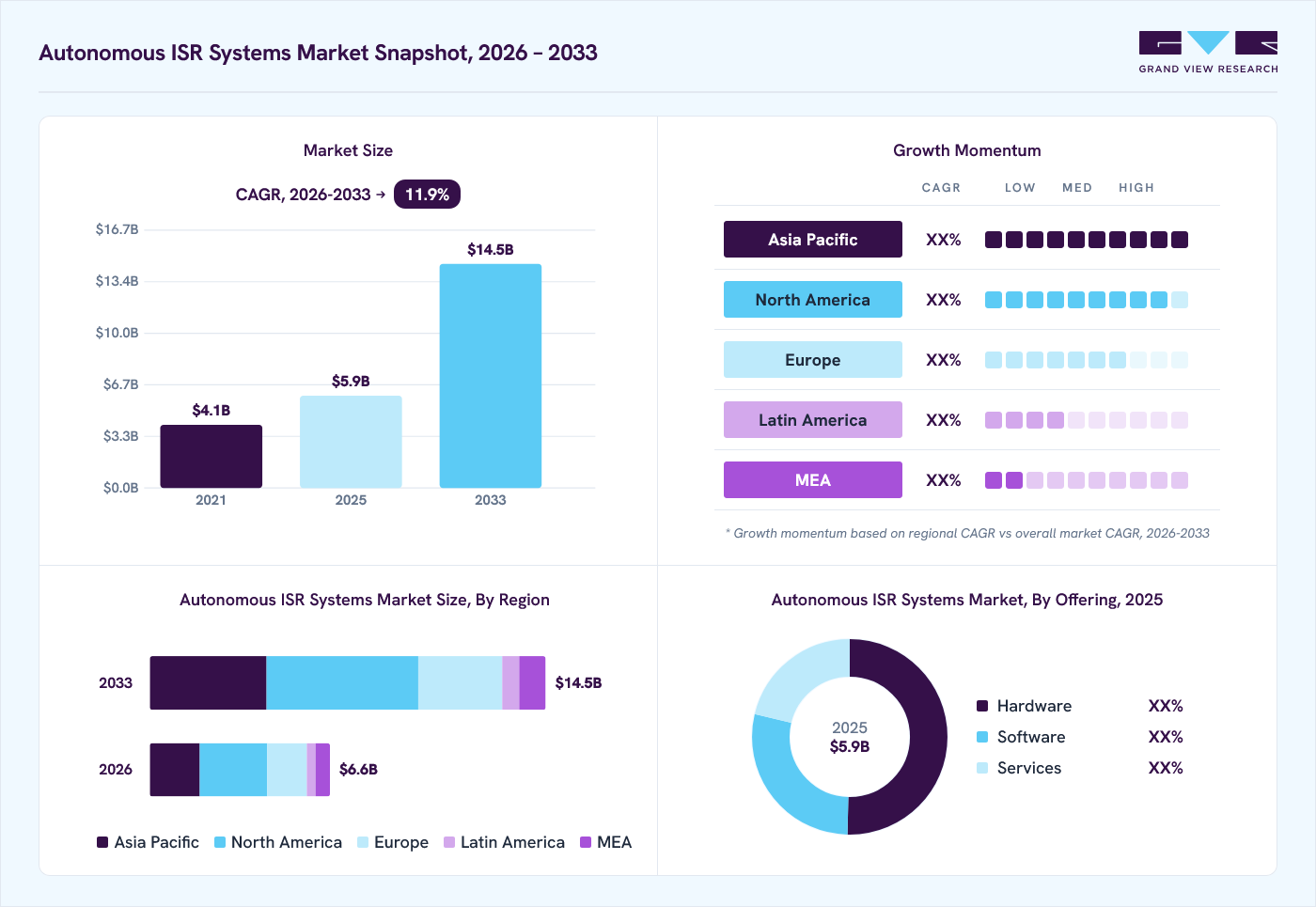 Source: Grand View Research, IR Documents, Primary Interviews, Paid DatabasesTo learn more about this report,
 Download Free Sample Report
Key Market Trends & Insights
- By offering: Hardware segment held the largest market share of around 50.3% in 2025.
- By platform: Airborne segment held the largest market revenue share of 44.6% in 2025.
- By technology: AI & Machine Learning segment led the market with the largest revenue share of 26.4% in 2025.
- By application: Intelligence gathering segment held the largest market revenue share of 31.4% in 2025.
- By end-use: Defense & Military segment led the market with the largest revenue share of 56.3% in 2025.
Regional Highlights
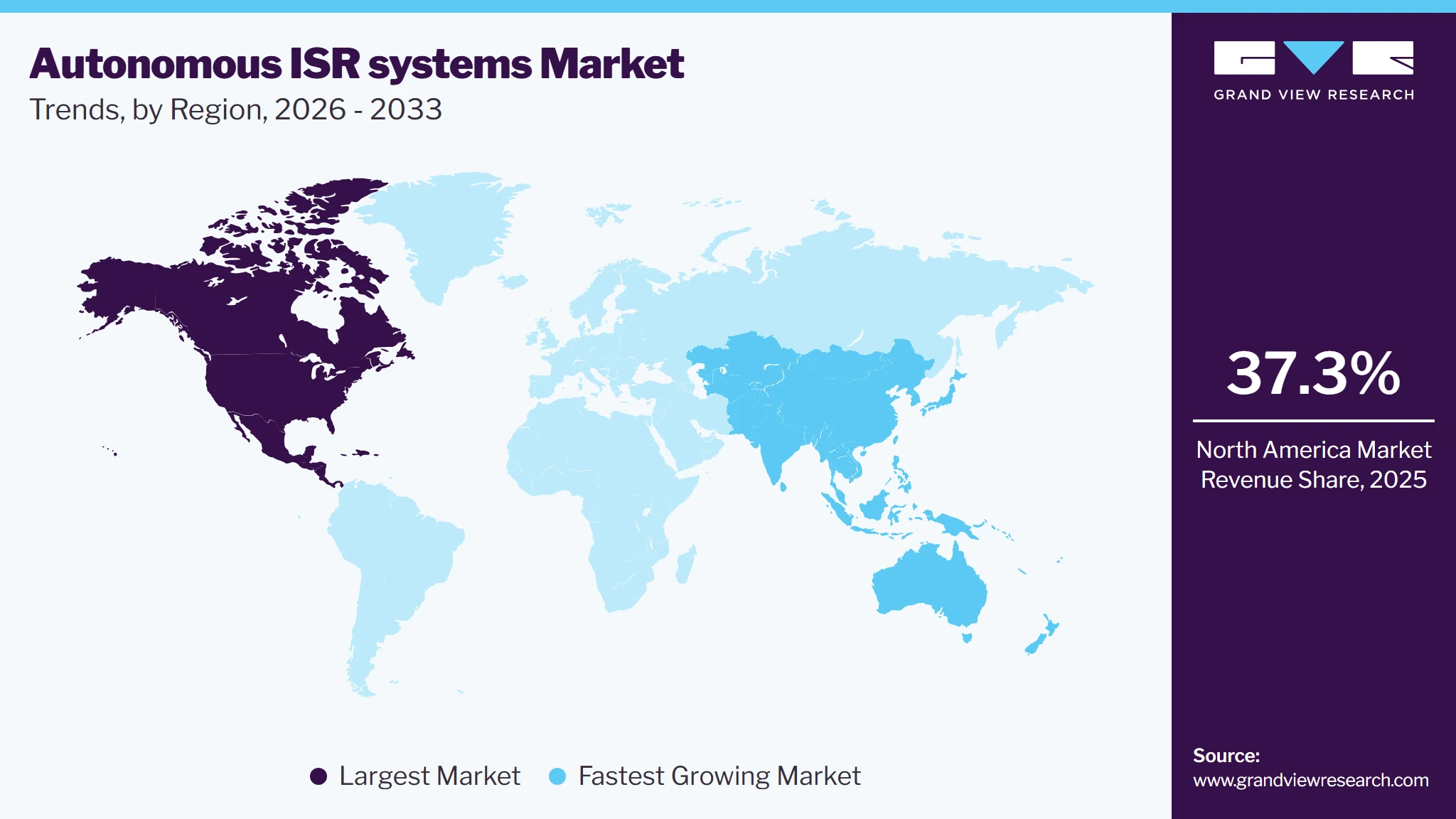
- Largest regional market: North America (37.3% revenue share, 2025)
- Fastest-growing regional market: Asia Pacific (highest CAGR, 2026-2033)
- Leading country: The U.S. held the largest market share in 2025.
Market Size & Forecasts
- Market size in 2025: USD 5.9 Billion
- Estimated market size in 2026: USD 6.6 Billion
- Projected market size by 2033: USD 14.5 Billion
- CAGR (2026-2033): 11.9%
Prism AI by Grand View Research Free to tryAsk a question about the autonomous ISR systems marketTry asking✓Every figure cited from GVR research Prefer the report? Download free sample →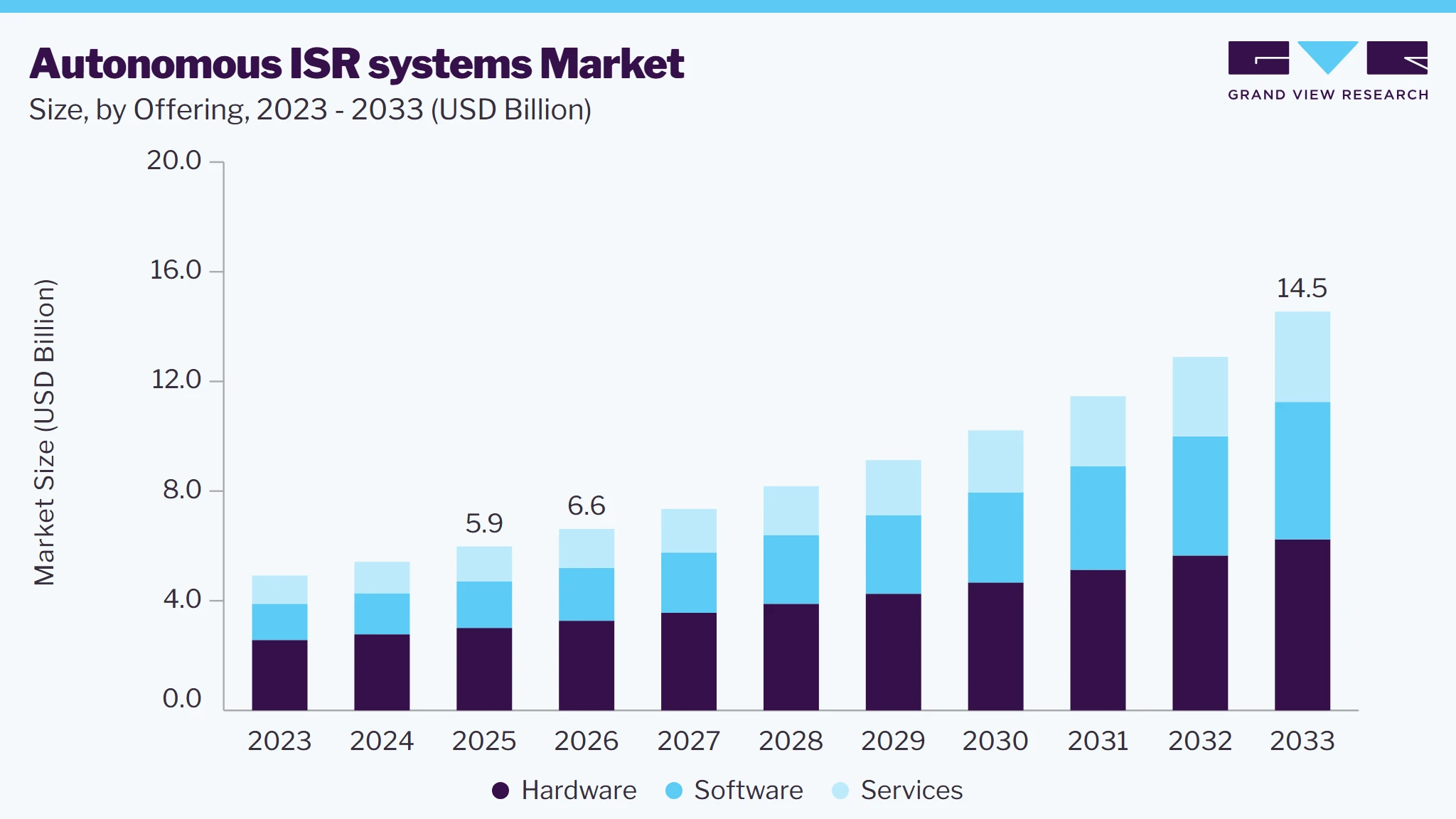 To learn more about this report, Download Free Sample Report
The demand for autonomous intelligence, surveillance, and reconnaissance (ISR) systems is increasing as defense and government organizations accelerate the adoption of autonomous capabilities for intelligence, surveillance, reconnaissance, border monitoring, threat detection, mission planning, and situational awareness. Military and intelligence agencies are increasingly investing in AI-enabled unmanned systems, autonomous UAVs, advanced sensors, real-time data processing, sensor fusion, and machine learning technologies to enhance airborne ISR capabilities, enable persistent surveillance, accelerate decision-making, and improve mission effectiveness across complex operational environments.Market Dynamics
The autonomous ISR systems Market is experiencing significant growth, driven by increasing demand for persistent intelligence, surveillance, and reconnaissance capabilities, AI-enabled autonomous systems, real-time situational awareness, and unmanned platforms across defense, intelligence, border security, and other government applications. Defense organizations are expanding the use of autonomous UAVs, unmanned ground and maritime systems, advanced electro-optical/infrared (EO/IR) sensors, radar, signals intelligence (SIGINT), and AI-based data-processing technologies to collect, process, and analyze information with reduced human intervention. The integration of artificial intelligence, machine learning, sensor fusion, edge computing, and autonomous decision-support capabilities is improving the speed, accuracy, persistence, and operational effectiveness of ISR missions.
The Autonomous ISR systems Market is primarily driven by increasing requirements for continuous, real-time intelligence and situational awareness across complex and contested operational environments. Military and intelligence organizations are increasingly deploying autonomous UAVs, unmanned ground vehicles, unmanned maritime systems, autonomous sensors, radar, EO/IR systems, and SIGINT payloads to conduct surveillance, reconnaissance, border monitoring, threat detection, and target identification. The growing need to monitor large geographic areas and maintain persistent ISR coverage is increasing demand for autonomous platforms capable of operating for extended periods with limited human intervention. In parallel, the integration of AI, machine learning, computer vision, sensor fusion, and edge computing enables autonomous systems to detect, classify, track, and prioritize objects and activities in real time. These capabilities are reducing operator workload, accelerating intelligence generation, and improving decision-making and mission effectiveness.
Despite strong growth prospects, the autonomous intelligence, surveillance, and reconnaissance (ISR) systems Market faces challenges associated with the high cost and technical complexity of developing, integrating, deploying, and maintaining autonomous ISR systems. Advanced UAVs, autonomous platforms, high-performance sensors, secure communications, AI computing infrastructure, and mission-management systems require significant investments in development and procurement. Integrating multiple sensors and autonomous systems can also create challenges related to interoperability, data synchronization, communications, sensor fusion, and system reliability. In addition, autonomous ISR platforms operating in contested environments require robust cybersecurity, electronic warfare resilience, secure communications, and protection against spoofing and jamming. Regulatory and operational constraints related to autonomous decision-making, airspace access, spectrum availability, data security, and human oversight can further complicate deployment. The requirement for specialized expertise in AI, robotics, autonomous navigation, sensor technologies, cybersecurity, and defense systems can also increase implementation costs and limit adoption among organizations with limited technical capabilities.
The increasing development of AI-enabled autonomous platforms, multi-domain ISR networks, edge-based intelligence processing, and collaborative unmanned systems is creating substantial opportunities for market participants. AI and machine learning can enable autonomous ISR platforms to detect objects, identify anomalies, track threats, classify targets, and generate actionable intelligence with limited human intervention. Edge computing allows ISR data to be processed closer to the point of collection, reducing latency and enabling faster responses in communications-constrained environments. The integration of UAVs, unmanned ground vehicles, unmanned surface and underwater systems, satellites, radar, EO/IR sensors, SIGINT, and other intelligence sources can provide more comprehensive situational awareness across air, land, maritime, space, and cyber domains.
Market Concentration & Characteristics
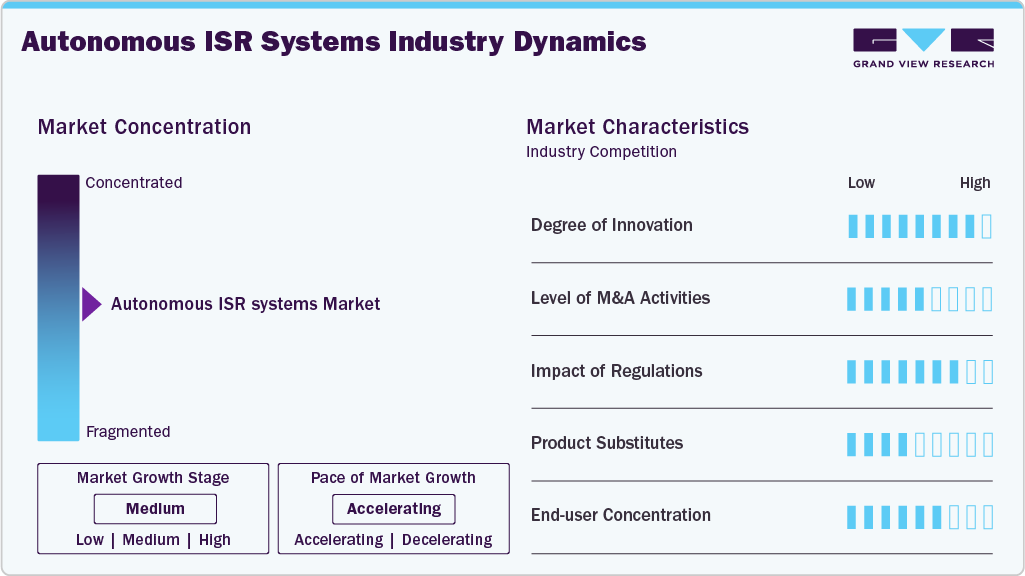
The autonomous ISR systems market is moderately concentrated, with competition led by established aerospace and defense, unmanned systems, sensor, artificial intelligence, and intelligence technology companies with strong capabilities in autonomous UAVs, unmanned ground and maritime systems, ISR sensors, AI-enabled analytics, secure communications, sensor fusion, and mission-management systems. The market is characterized by continuous advancements in autonomous navigation, AI and machine learning, computer vision, edge computing, multi-sensor fusion, real-time data processing, collaborative unmanned systems, and human-machine teaming. High costs associated with advanced autonomous platforms and sensor technologies, complex system integration requirements, stringent defense and security standards, cybersecurity risks, regulatory requirements, and the need for specialized expertise create significant barriers to entry. These factors enable established companies to maintain strong competitive positions through technological innovation, defense contracts, strategic partnerships, autonomous system development, platform integration, and long-term government programs.
 To learn more about this report, Download Free Sample Report
Major players such as AeroVironment, Inc.; Airbus SE; Anduril Industries, Inc.; BAE Systems plc; Elbit Systems Ltd.; General Atomics Aeronautical Systems, Inc.; Leonardo S.p.A.; Lockheed Martin Corporation; Northrop Grumman Corporation; Quantum Systems GmbH; Shield AI; and Teledyne Technologies Incorporated and Israel Aerospace Industries Ltd. compete across different segments of the Autonomous ISR systems Market through investments in autonomous UAVs, AI-enabled ISR platforms, advanced EO/IR and radar sensors, edge-based processing, secure communications, and multi-domain intelligence solutions. Companies are increasingly focused on improving autonomous navigation, sensor capabilities, target detection and classification, real-time data processing, mission endurance, communications resilience, and human-machine collaboration.
Analyst Perspective
The autonomous ISR systems market is expected to witness steady growth, supported by increasing defense spending, military modernization initiatives, and the growing need for persistent intelligence, surveillance, and reconnaissance capabilities. Defense forces are investing in advanced autonomous UAVs, unmanned ground and maritime platforms, AI-enabled ISR systems, high-performance sensors, secure communication systems, edge computing, and autonomous mission technologies to enhance real-time intelligence collection, threat detection, border surveillance, and battlefield situational awareness. The replacement of legacy ISR platforms and increasing requirements for persistent surveillance, reconnaissance, maritime monitoring, disaster response, and special operations are further supporting demand.
Offering Insights
The hardware segment holds a significant share of 50.3% of the autonomous ISR systems market in 2025, driven by increasing demand for autonomous ISR platforms, advanced sensors, mission computers, communication systems, navigation technologies, and specialized ISR payloads. These hardware components are extensively deployed across airborne, ground, naval/maritime, and space-based platforms to support intelligence gathering, persistent surveillance, reconnaissance, target detection and tracking, and real-time situational awareness across defense, military, homeland security, and intelligence applications.
The software segment is expected to grow significantly in the autonomous ISR systems market, driven by the increasing integration of AI and machine learning, autonomous mission-management systems, sensor fusion, computer vision, autonomous navigation, and edge-based data processing. The growing demand for real-time intelligence, automated target detection and tracking, predictive analytics, and autonomous decision support is accelerating the adoption of advanced software solutions across airborne, ground, naval/maritime, and space-based ISR platforms.
Platform Insights
The airborne segment holds the largest share of 44.6% of the autonomous ISR systems market in 2025, driven by increasing demand for autonomous and semi-autonomous UAVs and other airborne platforms for persistent surveillance, intelligence gathering, reconnaissance, and target detection and tracking. The segment is supported by the growing integration of AI-enabled mission systems, EO/IR sensors, radar, autonomous navigation, and advanced communication technologies, enabling long-endurance and real-time ISR operations across defense, military, and homeland security applications.
The Naval/Maritime segment is expected to grow significantly in the Autonomous ISR Systems Market, driven by increasing demand for unmanned surface and underwater vehicles, autonomous maritime surveillance, and persistent monitoring of coastal and offshore environments. The growing adoption of AI-enabled navigation, advanced radar and sonar, sensor fusion, and autonomous mission systems is further supporting maritime ISR capabilities for defense, border security, and maritime domain awareness.
Technology Insights
The AI & machine learning segment holds a significant share of 26.4% of the autonomous ISR systems market in 2025, driven by the increasing integration of AI-enabled intelligence processing, automated target recognition, computer vision, predictive analytics, and autonomous decision-making capabilities. These technologies enable faster analysis of large volumes of ISR data, improve threat detection and classification, enhance situational awareness, and reduce operator workload across airborne, ground, naval/maritime, and space-based autonomous ISR operations.
The autonomous navigation segment is expected to grow significantly in the autonomous ISR systems market, driven by increasing demand for unmanned platforms capable of independently navigating complex and contested environments with minimal human intervention. Advances in AI-based path planning, obstacle avoidance, GPS-denied navigation, localization, and real-time route optimization are enhancing mission autonomy and enabling longer-duration ISR operations across airborne, ground, and maritime platforms.
Application Insights
The intelligence gathering segment holds the largest share of 31.4% of the autonomous ISR systems market in 2025, driven by the growing demand for automated collection, processing, and analysis of intelligence from multiple sources. Autonomous ISR platforms equipped with AI, sensor fusion, EO/IR, radar, SIGINT, and advanced data-processing capabilities enable faster intelligence generation, improved situational awareness, and more efficient threat assessment across defense, military, homeland security, and intelligence applications.
The persistent surveillance segment is expected to grow significantly in the autonomous ISR systems Market, driven by increasing demand for continuous, long-duration monitoring of strategic areas, borders, maritime zones, assets, and operational environments. The integration of autonomous platforms, AI-enabled analytics, advanced sensors, and automated target tracking enabling persistent ISR capabilities with reduced operator intervention and improved real-time situational awareness.
End-use Insights
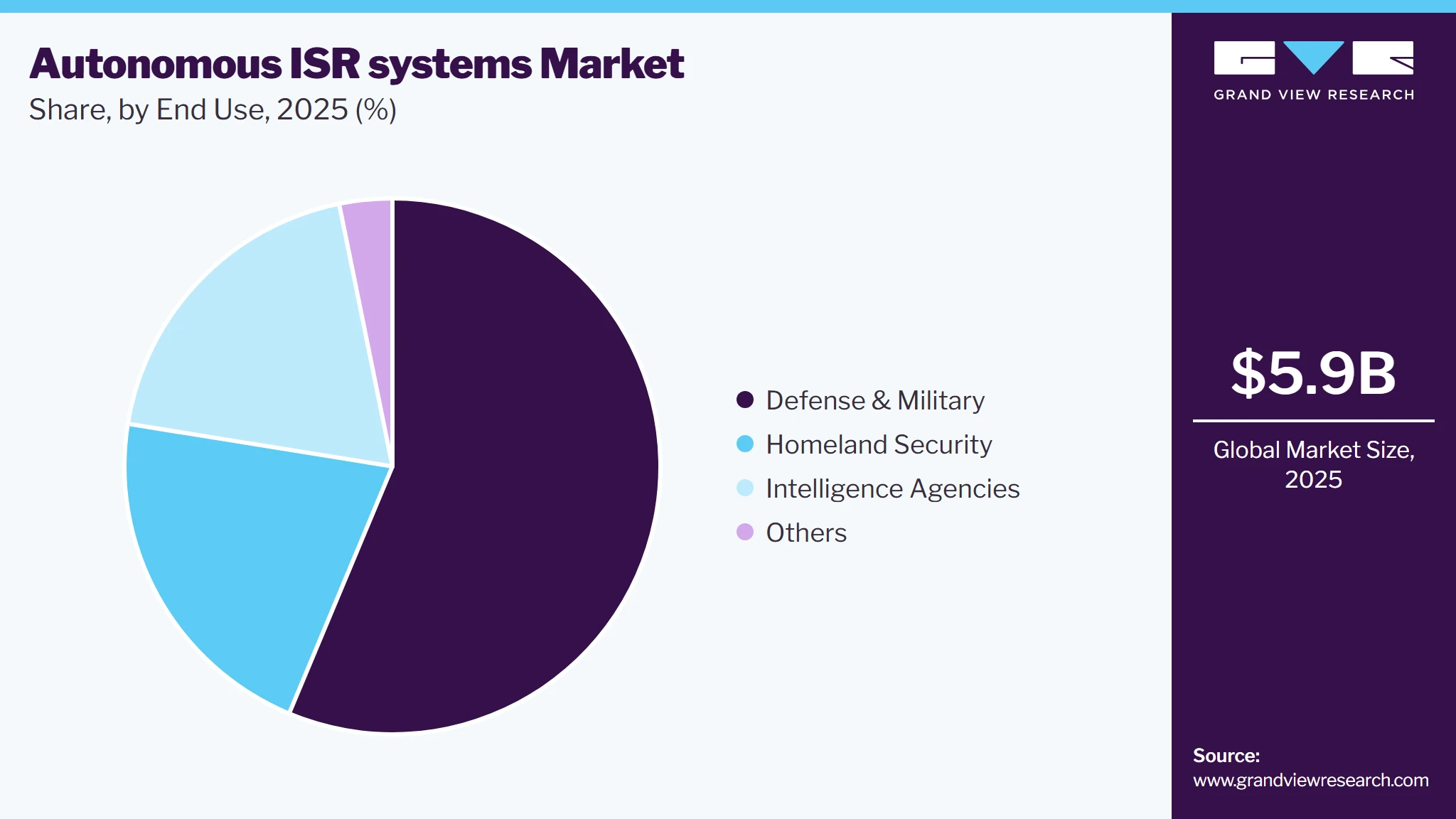
The defense & military segment holds a dominant share of 56.3% of the autonomous ISR systems market in 2025, driven by increasing defense modernization programs, rising demand for autonomous intelligence and surveillance capabilities, and growing deployment of unmanned platforms in contested environments. Autonomous ISR systems are increasingly used for battlefield surveillance, reconnaissance, persistent monitoring, target detection and tracking, threat assessment, and multi-domain situational awareness, supported by growing investments in AI, sensor fusion, autonomous navigation, and advanced mission systems.
 To learn more about this report, Download Free Sample Report
The intelligence agencies segment is expected to grow significantly in the autonomous ISR systems market, driven by increasing demand for persistent intelligence collection, automated data processing, and real-time threat assessment. The adoption of AI-enabled analytics, sensor fusion, autonomous platforms, and advanced surveillance technologies is enhancing intelligence agencies’ ability to monitor activities, identify potential threats, and generate actionable intelligence with reduced human intervention.
Regional Insights
North America autonomous ISR systems market dominated the market with largest share of 37.3% in 2025, supported by substantial investments in defense and national security, advanced unmanned systems, and widespread adoption of AI-enabled autonomous technologies. The region, led by the U.S., benefits from the presence of major aerospace and defense companies, autonomous technology providers, ISR system manufacturers, intelligence agencies, and established military infrastructure.
 To learn more about this report, Download Free Sample Report
U.S. Autonomous ISR Systems Market Trends
The autonomous ISR systems market in U.S. is witnessing steady growth, supported by increasing investments in national security, defense modernization, autonomous systems, and AI-enabled intelligence, surveillance, and reconnaissance capabilities. The country benefits from a well-established aerospace and defense ecosystem, advanced unmanned system infrastructure, leading autonomous technology providers, and strong government demand for persistent ISR capabilities.
Europe Autonomous ISR Systems Market Trends
The Europe autonomous ISR systems Market is witnessing steady growth, driven by increasing investments in unmanned systems, defense modernization, AI-enabled intelligence, and advanced surveillance and reconnaissance technologies. European countries are strengthening their autonomous ISR capabilities through the development and deployment of autonomous UAVs, unmanned ground and maritime systems, advanced EO/IR and radar sensors, secure communication systems, and AI-enabled data-processing platforms. Increasing requirements for defense and border security, intelligence, surveillance and reconnaissance, maritime domain awareness, threat detection, and battlefield situational awareness are further supporting demand for autonomous ISR systems across the region.
The autonomous ISR systems market in UK is strengthening its autonomous ISR capabilities through increasing adoption of autonomous UAVs, AI-enabled surveillance systems, advanced sensors, secure communications, and real-time intelligence technologies for defense, reconnaissance, border security, maritime surveillance, and threat detection. Growing investments in AI, autonomous navigation, unmanned systems, sensor fusion, and human-machine teaming are further supporting the deployment of autonomous ISR solutions across military and national security applications.
The Germany autonomous ISR systems market is experiencing significant growth, supported by increasing investments in defense modernization, digital transformation, national security, and advanced unmanned systems. Germany is strengthening its autonomous ISR capabilities through investments in autonomous UAVs, AI-enabled surveillance, advanced EO/IR and radar sensors, secure communications, real-time intelligence processing, and multi-source sensor fusion to support defense operations, border security, critical infrastructure monitoring, reconnaissance, and situational awareness.
Asia Pacific Autonomous ISR Systems Market Trends
The autonomous ISR systems market in Asia Pacific is witnessing strong growth, driven by increasing investments in defense modernization, unmanned systems, artificial intelligence, and advanced surveillance technologies across China, India, Japan, South Korea, and Australia. Governments across the region are strengthening their autonomous ISR capabilities through investments in autonomous UAVs, unmanned maritime systems, advanced EO/IR and radar sensors, AI-enabled analytics, secure communications, and real-time intelligence processing to support defense, border security, maritime surveillance, threat detection, disaster response, and battlefield situational awareness.
The growing integration of AI, machine learning, edge computing, autonomous navigation, advanced sensors, and multi-source intelligence data is improving the processing, analysis, and real-time interpretation of ISR information. At the same time, increasing defense modernization, border security requirements, maritime surveillance, autonomous warfare capabilities, and the deployment of unmanned systems are creating additional opportunities for Autonomous ISR adoption, supporting China’s position as a key growth market in the Asia-Pacific region.
Key Autonomous ISR Systems Company Insights
The autonomous ISR market is characterized by the presence of established aerospace and defense, unmanned systems, artificial intelligence, sensor, and intelligence technology companies with strong capabilities across autonomous UAVs, unmanned ground and maritime systems, advanced ISR sensors, AI-enabled analytics, autonomous navigation, secure communications, edge computing, and multi-sensor data fusion. Competition is driven by continuous innovation in autonomous mission execution, AI and machine learning, computer vision, sensor fusion, real-time data processing, swarm technologies, and human-machine teaming. Established players maintain strong market positions through extensive R&D capabilities, proprietary autonomous technologies, government and defense contracts, strategic partnerships, platform integration, technology demonstrations, and long-term military modernization programs.
-
AeroVironment, Inc. is a leading player in the Autonomous ISR systems Market, providing unmanned aircraft systems, autonomous platforms, loitering systems, and advanced sensing capabilities for defense and intelligence applications. Its portfolio supports persistent surveillance, reconnaissance, target detection, and real-time situational awareness across tactical operational environments.
-
Anduril Industries, Inc. is a major provider of AI-enabled autonomous defense and ISR solutions, offering autonomous aerial, ground, and maritime systems supported by advanced software and sensor technologies. Its capabilities in autonomous mission management, AI-based perception, sensor fusion, and real-time decision support position the company as a key participant in the development of next-generation autonomous ISR capabilities.
Key Autonomous ISR Systems Companies:
The following key companies have been profiled for this study on the autonomous ISR systems market.
-
AeroVironment, Inc.
-
Airbus SE
-
Anduril Industries, Inc.
-
BAE Systems plc
-
Elbit Systems Ltd.
-
General Atomics Aeronautical Systems, Inc.
-
Leonardo S.p.A.
-
Lockheed Martin Corporation
-
Northrop Grumman Corporation
-
Quantum Systems GmbH
-
Shield AI
-
Teledyne Technologies Incorporated
Competitive Benchmarking
Operating Strategies
Competitive Edge
Weaknesses
Mature Players: Mature Players: AeroVironment, Inc.; Airbus SE; BAE Systems plc; Elbit Systems Ltd.; General Atomics Aeronautical Systems, Inc.; Leonardo S.p.A.; Lockheed Martin Corporation; Northrop Grumman Corporation; Teledyne Technologies Incorporated
- Invest in autonomous UAVs, ISR payloads, AI-enabled mission systems, sensor fusion, electronic warfare, autonomous navigation, and advanced surveillance technologies.
- Expand capabilities through government and defense contracts, strategic partnerships, acquisitions, technology integration, and long-term procurement programs.
- Extensive defense and aerospace experience with established global customer relationships.
- Strong R&D capabilities across autonomous systems, sensors, avionics, AI, communications, and mission systems.
- High R&D, manufacturing, and system-integration costs.
- Dependence on government and defense procurement cycles.
- Complex integration of autonomous platforms, sensors, communications, and mission-management systems.
Emerging Players: Anduril Industries, Inc.; Quantum Systems GmbH; Shield AI
- Focus on AI-native autonomous platforms, autonomous mission execution, intelligent perception, edge computing, and collaborative unmanned operations.
- Invest in software-defined architectures, autonomous navigation, computer vision, sensor fusion, and AI-based decision support.
- Strong focus on AI-enabled autonomy and software-defined defense systems.
- Agile product development and comparatively rapid innovation cycles.
- Smaller installed base and global footprint compared with established defense primes.
- Dependence on successful scaling of newer autonomous technologies and defense programs.
Recent Developments
-
In April 2026, AeroVironment was selected by the U.S. Navy to provide persistent ISR services using its autonomous JUMP 20-X VTOL UAS with advanced multi-sensor payload integration. The system offers more than 13 hours of endurance and a 185-km operational range, enabling persistent ISR missions across land and maritime environments.
-
In June 2026, Shield AI received a U.S. Air Force production contract to implement its Hivemind mission-autonomy software for the collaborative combat aircraft program, supporting coordinated autonomous aircraft operations. The contract focuses on enabling multiple autonomous aircraft to operate collaboratively under human supervision, reducing operator workload and supporting operations at scale.
Autonomous ISR Systems Market Report Scope
Report Attribute
Details
Market size in 2025
USD 5.9 billion
Estimated market size in 2026
USD 6.6 billion
Projected market size by 2033
USD 14.5 billion
Growth rate
CAGR of 11.9% from 2026 to 2033
Actual data
2021 - 2025
Forecast period
2026 - 2033
Quantitative units
Revenue in USD million/billion and CAGR from 2026 to 2033
Report coverage
Revenue forecast, company share, competitive landscape, growth factors, and trends
Segments covered
Offering, platform, technology, application, end-use, region
Regional scope
North America; Europe; Asia Pacific; Latin America; Middle East & Africa
Country scope
U.S.; Canada; Mexico; UK; Germany; France; China; Japan; India; South Korea; Australia; Brazil; UAE; KSA; South Africa
Key companies profiled
AeroVironment, Inc.; Airbus SE; Anduril Industries, Inc.; BAE Systems plc; Elbit Systems Ltd.; General Atomics Aeronautical Systems, Inc.; Leonardo S.p.A.; Lockheed Martin Corporation; Northrop Grumman Corporation; Quantum Systems GmbH; Shield AI; Teledyne Technologies Incorporated
Customization scope
Free report customization (equivalent to up to 8 analyst working days) with purchase. Addition or alteration to country, regional & segment scope.
Pricing and purchase options
Avail customized purchase options to meet your exact research needs. Explore purchase options
Global Autonomous ISR Systems Market Report Segmentation
This report forecasts revenue growth at global, regional, and country levels and provides an analysis of the latest industry trends in each of the sub-segments from 2021 to 2033. For this study, Grand View Research has segmented the global autonomous ISR systems market report based on offering, platform, technology, application, end-use, and region.
-
Offering Outlook (Revenue, USD Million, 2021 - 2033)
-
Hardware
-
Software
-
Services
-
-
Platform Outlook (Revenue, USD Million, 2021 - 2033)
-
Airborne
-
Ground
-
Naval/Maritime
-
Space-Based
-
-
Technology Outlook (Revenue, USD Million, 2021 - 2033)
-
AI & Machine Learning
-
Sensor Fusion
-
Autonomous Navigation
-
Computer Vision
-
Edge Computing
-
Others
-
-
Application Outlook (Revenue, USD Million, 2021 - 2033)
-
Intelligence Gathering
-
Persistent Surveillance
-
Reconnaissance
-
Target Detection & Tracking
-
Others
-
-
End-use Outlook (Revenue, USD Million, 2021 - 2033)
-
Defense & Military
-
Homeland Security
-
Intelligence Agencies
-
Others
-
-
Regional Outlook (Revenue, USD Million, 2021 - 2033)
-
North America
-
U.S.
-
Canada
-
Mexico
-
-
Europe
-
UK
-
Germany
-
France
-
-
Asia Pacific
-
China
-
Japan
-
India
-
South Korea
-
Australia
-
-
Latin America
-
Brazil
-
-
Middle East and Africa
-
UAE
-
KSA
-
South Africa
-
-
Research Methodology
The autonomous ISR systems market figures in this report are based on a proven research process that combines executive interviews with secondary research from proprietary databases, company filings, and recognized regulatory and institutional sources. Market size is built through value-chain sizing-reconciling supply-side and demand-side estimates-and triangulated with bottom-up and top-down approaches. Every estimate passes multiple levels of expert validation before publication, with each autonomous ISR systems segment quantified using the revenue-capture definitions in the table below.
Segment Definition
Offering
Revenue Capture Definition
Hardware
Hardware revenue in the Autonomous ISR Systems Market is generated through the sale of autonomous ISR platforms, unmanned aerial, ground, and maritime systems, ISR sensors, EO/IR cameras, radar and SAR systems, SIGINT/ELINT equipment, mission computers, communication and data-link systems, navigation systems, and other physical components used for autonomous intelligence, surveillance, and reconnaissance
Software
Software revenue in the Autonomous ISR Systems Market is generated through the sale and licensing of autonomous mission-management software, AI and machine-learning platforms, sensor-fusion software, autonomous navigation and control systems, computer-vision applications, automated target detection and recognition tools, ISR data-processing and analytics platforms, and cloud- and edge-based software used to support autonomous intelligence, surveillance, and reconnaissance operations
Services
Services revenue in the Autonomous ISR Systems Market is generated through the provision of system integration, installation, training, maintenance, technical support, mission planning, data analysis, software updates, platform operation, and lifecycle management services supporting the deployment and operation of autonomous intelligence, surveillance, and reconnaissance systems.
Platform
Revenue Capture Definition
Airborne
Airborne revenue in the Autonomous ISR Systems Market is generated through the sale and deployment of autonomous and semi-autonomous airborne ISR platforms, including UAVs, UAS, VTOL systems, fixed-wing aircraft, and associated ISR payloads, sensors, mission systems, and autonomous technologies used for intelligence, surveillance, reconnaissance, target detection, and persistent aerial monitoring.
Ground
Ground revenue in the Autonomous ISR Systems Market is generated through the sale and deployment of autonomous and semi-autonomous ground-based ISR systems, including unmanned ground vehicles (UGVs), robotic reconnaissance platforms, autonomous surveillance systems, ground sensors, mission-control systems, and associated technologies used for intelligence gathering, reconnaissance, perimeter monitoring, and battlefield surveillance.
Naval/Maritime
Naval/Maritime revenue in the Autonomous ISR Systems Market is generated through the sale and deployment of autonomous and semi-autonomous maritime ISR systems, including unmanned surface vehicles (USVs), unmanned underwater vehicles (UUVs), autonomous maritime surveillance platforms, sonar and radar systems, maritime sensors, mission-control systems, and associated technologies used for intelligence gathering, surveillance, reconnaissance, and persistent monitoring of maritime environments.
Space-Based
Space-Based revenue in the Autonomous ISR Systems Market is generated through the sale and deployment of autonomous and semi-autonomous space-based ISR systems, including reconnaissance satellites, Earth-observation platforms, space-based sensors, satellite payloads, onboard AI and data-processing systems, and associated command-and-control technologies used for intelligence gathering, surveillance, reconnaissance, target monitoring, and persistent observation from space.
Technology
Revenue Capture Definition
AI & Machine Learning
AI & Machine Learning revenue in the Autonomous ISR Systems Market is generated through the sale and licensing of AI and machine-learning technologies, including autonomous decision-making systems, automated target recognition, computer vision, predictive analytics, intelligent mission planning, anomaly detection, and AI-enabled sensor-data processing used to enhance autonomous intelligence, surveillance, and reconnaissance operations.
Sensor Fusion
Sensor Fusion revenue in the Autonomous ISR Systems Market is generated through the sale and licensing of sensor-fusion technologies that integrate and process data from multiple ISR sensors, including EO/IR, radar, SAR, SIGINT, and other sources, to provide unified situational awareness, improve target detection and tracking, support autonomous decision-making, and enhance the accuracy and reliability of intelligence, surveillance, and reconnaissance operations.
Autonomous Navigation
Autonomous Navigation revenue in the Autonomous ISR Systems Market is generated through the sale and licensing of autonomous navigation technologies, including GPS-denied navigation, path planning, obstacle avoidance, guidance and control systems, localization, and real-time route optimization, enabling unmanned ISR platforms to navigate, maneuver, and execute missions with minimal human intervention
Computer Vision
Computer Vision revenue in the Autonomous ISR Systems Market is generated through the sale and licensing of computer-vision technologies, including image and video processing, object detection and classification, target recognition, visual tracking, scene understanding, and automated imagery analysis used to support autonomous intelligence, surveillance, reconnaissance, and threat-detection operations.
Edge Computing
Edge Computing revenue in the Autonomous ISR Systems Market is generated through the sale and deployment of edge-computing hardware and software, including onboard processors, edge AI systems, real-time data-processing platforms, and distributed computing technologies that enable ISR data to be processed and analyzed closer to the point of collection, supporting faster decision-making, reduced latency, and autonomous mission execution.
Others
Other Technologies revenue in the Autonomous ISR Systems Market is generated through the sale and deployment of complementary technologies such as cloud computing, digital twins, advanced communications, 5G/6G connectivity, blockchain, cybersecurity, and autonomous mission-management technologies that support data exchange, system interoperability, secure operations, and overall autonomous ISR mission effectiveness.
Application
Revenue Capture Definition
Intelligence Gathering
Intelligence Gathering revenue in the Autonomous ISR Systems Market is generated through the deployment and use of autonomous ISR systems for collecting, processing, and analyzing intelligence from multiple sources, including imagery, signals, electronic, radar, and other sensor data, to support situational awareness, threat assessment, mission planning, and informed decision-making.
Persistent Surveillance
Persistent Surveillance revenue in the Autonomous ISR Systems Market is generated through the deployment and operation of autonomous ISR systems that provide continuous, long-duration monitoring of designated areas, assets, borders, maritime zones, and operational environments using unmanned platforms, advanced sensors, AI-enabled analytics, and automated target tracking.
Reconnaissance
Reconnaissance revenue in the Autonomous ISR Systems Market is generated through the deployment and operation of autonomous ISR systems for collecting and analyzing information about terrain, infrastructure, forces, activities, and potential threats using unmanned platforms, advanced sensors, AI-enabled analytics, and automated data-processing technologies.
Target Detection & Tracking
Target Detection & Tracking revenue in the Autonomous ISR Systems Market is generated through the deployment and operation of autonomous ISR technologies that detect, identify, classify, locate, and continuously track targets using radar, EO/IR, computer vision, sensor fusion, AI, and automated tracking systems to support real-time situational awareness and mission decision-making.
Others
Other application revenue in the Autonomous ISR Systems Market is generated through the deployment of autonomous ISR systems for applications such as border and perimeter monitoring, search and rescue, disaster response, infrastructure monitoring, environmental surveillance, and other specialized missions requiring automated intelligence, surveillance, and reconnaissance capabilities.
End Use
Revenue Capture Definition
Defense & Military
Defense & Military revenue in the Autonomous ISR Systems Market is generated through the procurement and deployment of autonomous ISR platforms, sensors, software, mission systems, and related services by armed forces for battlefield intelligence, persistent surveillance, reconnaissance, target detection and tracking, threat assessment, and multi-domain situational awareness.
Homeland Security
Homeland Security revenue in the Autonomous ISR Systems Market is generated through the procurement and deployment of autonomous ISR platforms, sensors, software, and related services by homeland security agencies for border surveillance, critical infrastructure protection, threat detection, coastal monitoring, and public safety operations.
Intelligence Agencies
Intelligence Agencies revenue in the Autonomous ISR Systems Market is generated through the procurement and deployment of autonomous ISR platforms, sensors, software, and related services by intelligence organizations for intelligence collection, persistent surveillance, reconnaissance, signals monitoring, threat assessment, and real-time situational awareness.
Others
Other end-user revenue in the Autonomous ISR Systems Market is generated through the procurement and deployment of autonomous ISR platforms, sensors, software, and related services by law enforcement agencies, emergency response organizations, border protection units, maritime security authorities, and other organizations for surveillance, monitoring, reconnaissance, and situational awareness.
Estimation Model
Layer
Key Questions
Description
Addressable Autonomous ISR Base Layer
Which autonomous ISR platforms, systems, technologies, and capabilities are currently deployed or addressable?
Estimate the global addressable base of autonomous and semi-autonomous ISR platforms, including airborne, ground, naval/maritime, and space-based systems, along with ISR sensors, mission computers, communication systems, navigation systems, autonomous-control technologies, and associated infrastructure. The assessment considers installed platforms, replacement cycles, modernization programs, defense requirements, autonomy adoption, and regional deployment levels.
Autonomous ISR Adoption Layer
Which autonomous ISR platforms, technologies, and capabilities are currently deployed?
Apply adoption and deployment rates across autonomous platforms, hardware, software, and services, considering the use of AI and machine learning, sensor fusion, autonomous navigation, computer vision, edge computing, automated target detection and tracking, and other autonomy technologies across defense, military, homeland security, intelligence, and other applications.
Technology & Solution Configuration Layer
What autonomous technologies and capabilities are incorporated into each ISR solution?
Estimate solution value based on the integration of autonomous platforms, EO/IR and radar sensors, SIGINT/ELINT systems, AI/ML, sensor fusion, autonomous navigation, computer vision, edge computing, communications, mission-management systems, and automated data-processing capabilities.
Revenue Generation Layer
How is revenue generated from Autonomous ISR Systems?
Estimate market revenue from the sale and licensing of autonomous ISR hardware and software, platform procurement, ISR payloads and sensors, AI-enabled mission systems, system integration, deployment, training, maintenance, technical support, data processing, mission services, and lifecycle support contracts.
Delivered Customizations
This report has been delivered with the following in-depth customizations
Client Request
Customization Delivered
Value Adds
Autonomous ISR systems Market Entry & Growth Strategy
Assessment of demand for autonomous ISR systems across Defense & Military, Homeland Security, Intelligence Agencies, and other end users.
Analysis of opportunities across airborne, ground, naval/maritime, and space-based autonomous ISR platforms, as well as hardware, software, and services.Identified high-growth platform, technology, application, end-user, and regional segments.
Supported market entry, product positioning, customer targeting, partnership identification, and regional expansion strategies.Next-Generation Autonomous ISR & Capability Assessment
Evaluation of autonomous ISR capability requirements across battlefield surveillance, intelligence gathering, reconnaissance, persistent surveillance, target detection and tracking, border monitoring, and maritime surveillance.
Assessment of next-generation requirements related to AI/ML, autonomous navigation, sensor fusion, computer vision, edge computing, multi-platform operations, and autonomous mission management.
Identified technology gaps and high-potential innovation areas within the autonomous ISR ecosystem
Supported technology roadmap development, R&D prioritization, solution enhancement, and next-generation autonomous ISR platform strategies.
Frequently Asked Questions About This Report
The airborne segment dominated with a 44.6% revenue share in 2025, while naval/maritime segment is the fastest-growing segment.
The defense & military segment accounted for the largest share with 56.3% of revenue in 2025,while intelligence agencies the fastest-growing segment.
The global autonomous ISR systems market size was valued at USD 5.9 billion in 2025 and is estimated at USD 6.6 billion for 2026.
The global autonomous ISR systems market is expected to grow at a CAGR of 11.9% from 2026 to 2033, reaching USD 14.5 billion by 2033.
The hardware segment accounted for the largest share with 50.3% of revenue in 2025, while software is the fastest-growing segment.
North America dominated the market, accounting for a share of 37.3% in 2025.
Key factors that are driving the autonomous ISR systems market growth include the rising demand for AI-enabled ISR platforms, growing deployment of unmanned aerial systems, increasing investments in autonomous sensing and multi-domain operations, and continued emphasis on enhancing real-time situational awareness, border security, and mission effectiveness.
Some key players operating in the autonomous ISR systems market include AeroVironment, Inc.; Airbus SE; Anduril Industries, Inc.; BAE Systems plc; Elbit Systems Ltd.; General Atomics Aeronautical Systems, Inc.; Leonardo S.p.A.; Lockheed Martin Corporation; Northrop Grumman Corporation; Quantum Systems GmbH; Shield AI; Teledyne Technologies Incorporated
Asia Pacific is the fastest-growing region over the forecast period.
About the Author(s)
Next Generation Technologies Research Team
Technology · Next Generation TechnologiesThis report was authored by the next generation technologies research team at Grand View Research - comprising two research analysts, one senior research analyst, and one industry expert - with specialized expertise in the next generation technologies segment of the technology industry. All findings are based on proprietary technology databases, executive interviews, and regulatory analysis, subject to internal peer review prior to publication.
Last Updated:
Speak to Analyst

Customize this report to your needs - add regions, segments, or data points, with 20% free customization.
Or view our licence options:


ISO 9001:2015 & 27001:2022 Certified
We are GDPR and CCPA compliant! Your transaction & personal information is safe and secure. For more details, please read our privacy policy.


