
- Home
- »
- Next Generation Technologies
- »
-
Autonomous Mobile Delivery Robots Market Report, 2033GVR Report cover

Autonomous Mobile Delivery Robots Market (2026 - 2033)
Size, Share & Trends Analysis Report By Platform, By Payload Capacity (Light-Payload Robots (Up to 10 kg), Medium-Payload Robots (10 to 30 kg)), By End-use (Food Delivery, Grocery Delivery), By Region, And Segment Forecasts
Market Size, 2025
$1.7BMarket Estimate, 2026
$2.0BMarket Forecast, 2033
$8.4BCAGR, 2026–2033
22.6%Autonomous Mobile Delivery Robots Market Summary
The global autonomous mobile delivery robots market size was valued at USD 1.7 billion in 2025 and is projected to grow from USD 2.0 billion in 2026 to USD 8.4 billion in 2033, at a CAGR of 22.6% from 2026 to 2033. North America dominated the market, accounting for a revenue share of 38.0% in 2025. Growing labor shortages, increasing wages, and pressure to reduce last-mile delivery costs are pushing enterprises toward autonomous mobile delivery robots.
Key Market Trends & Insights
- By platform: The Ground Delivery Robots (GDR) and Sidewalk Delivery Robots (SDR) segment held the dominant position in the market in 2025.
- By payload capacity: The light-payload robots (Up to 10 kg) led the market, holding the largest revenue share of 48.0% in 2025.
- By end use: The food delivery segment held the dominant position in the market.
Regional Highlights
- Largest regional market: North America (38.0% revenue share, 2025)
- Fastest-growing regional market: Asia Pacific (highest CAGR, 2026-2033)
Market Size & Forecast
- Market size in 2025: USD 1.7 Billion
- Estimated market size in 2026: USD 2.0 Billion
- Projected market size by 2033: USD 8.4 Billion
- CAGR (2026-2033): 22.6%
Three ways to get this report
Buy it, customize it, or ask a question.Ask an Analyst
Analyst response in 1 business day
- AccessReport author, directly
- Reply timeWithin 1 working day
- No sales callDirect answer only
- FormatEmail reply
- CostFree, no cost
Get the Full Report
What the study covers
- FormatsPDF · Excel · Dashboard
- Timeline2026–2033 annual, 2025 base
- Coverage20+ countries, 5 regions
- Companies10+ key players profiled
Customize the Report
20% free customization
- IncludeCountries, segments, points
- TailorTo your product definition
- ExtendDeeper competitor detail
- OrA fully bespoke study
- Turnaround5–10 working days
These systems deliver predictable cost structures, higher delivery density, and faster turnaround, enabling businesses to maintain competitive margins while improving service efficiency. The exponential growth of e-commerce and the normalization of same-day or next-hour delivery have created strong demand for cost-efficient, high-frequency last-mile logistics. Autonomous mobile delivery robots address these pressures by enabling scalable, low-cost delivery operations in busy urban corridors, residential neighborhoods, and controlled premises. Retailers and marketplaces face strong consumer expectations for fast, accurate fulfillment, and human-based delivery models are increasingly unsustainable at peak volumes. AMDRs support continuous, 24/7 operations, predictable route optimization, and reduced operational bottlenecks. Their integration with micro-fulfillment centers, dark stores, and digital commerce platforms further accelerates adoption, positioning AMDRs as a structural solution to e-commerce-driven fulfillment challenges.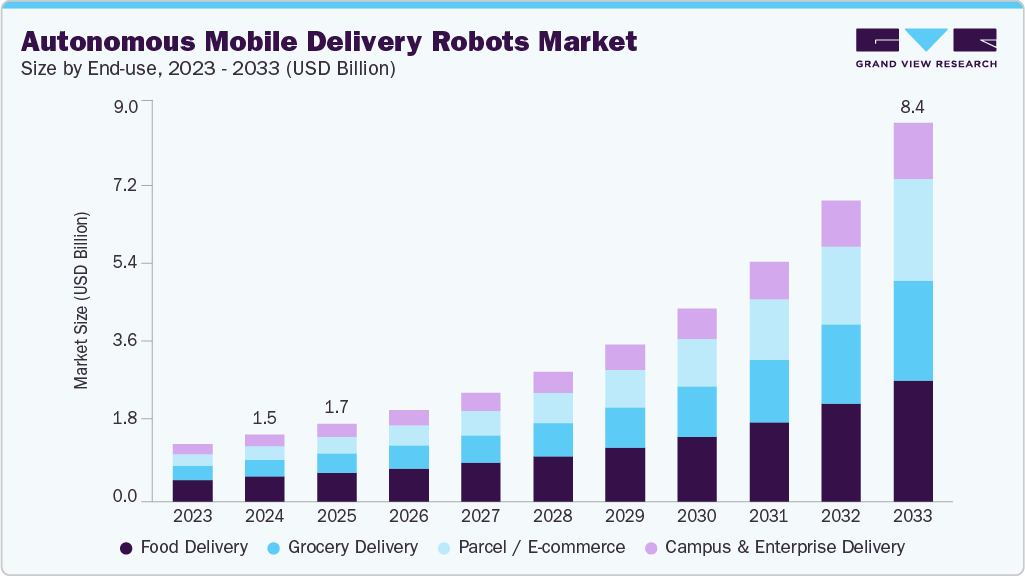 Source: Grand View Research, IR Documents, Primary Interviews, Paid DatabasesTo learn more about this report,
 Download Free Sample Report
 Advances in AI perception, sensor fusion, computer vision, SLAM, and edge-AI processing drastically improve the reliability, navigation accuracy, and safety of autonomous delivery robots. Enhanced localization and obstacle-avoidance capabilities enable robots to operate confidently in complex, mixed-traffic environments such as sidewalks, campuses, and retail hubs. Parallel improvements in battery density, charging efficiency, and thermal stability support longer duty cycles and lower operational downtime. These technology gains reduce the cost per delivery, improve throughput, and enhance regulatory compliance. As autonomous stacks mature, AMDRs become more commercially viable, reducing total cost of ownership and enabling broader deployment across retail, logistics, food service, and enterprise environments.
Governments and municipalities worldwide are establishing regulatory sandboxes and controlled deployment zones to test and validate robot delivery models. These supportive frameworks lower operational barriers and speed up commercial readiness. Logistics firms, food-delivery services, universities, and retailers are actively partnering with robot manufacturers to launch pilots, confirm economics, and improve delivery workflows. Such partnerships enhance ecosystem maturity, standardize operational protocols, and encourage investment in scalable deployment programs. Universities and enterprise campuses offer low-regulation environments where operational data, reliability metrics, and ROI benefits are quickly demonstrated. As policy clarity improves and industry alliances grow, AMDR adoption speeds up due to increased stakeholder confidence and proven commercial success.
Analyst Perspective
The autonomous mobile delivery robots market is witnessing steady growth owing to rising demand for faster and more cost-effective delivery services, increasing labor costs, and the growing need for contactless and flexible delivery solutions. The market is seeing growing adoption of AI powered navigation, sensors, cameras, and autonomous mobile robots as businesses use these technologies to deliver food, groceries, medicines, and other goods with less human involvement. Although challenges such as safety concerns, regulatory requirements, limited operating areas, high technology costs, and customer acceptance remain, improvements in AI, navigation, connectivity, and obstacle detection are creating new opportunities. Companies that invest in reliable, safe, and scalable delivery robots are expected to benefit from long-term market growth by reducing delivery costs, improving operational efficiency, and meeting the growing demand for convenient last mile services.
Platform Insights
The Ground Delivery Robots (GDR) and Sidewalk Delivery Robots (SDR) segment dominated the market in 2025. Ground Delivery Robots (GDRs) and Sidewalk Delivery Robots (SDRs) are gaining momentum as retailers, food-service operators, and logistics companies seek scalable, low-cost solutions for last-mile deliveries, particularly for short-distance, high-frequency routes. Their ability to operate safely on sidewalks and low-speed zones, combined with advancements in vision-based navigation, mapping, and obstacle avoidance, enables reliable autonomous operations in dense urban environments. Rising labor costs, demand for faster delivery windows, and the expansion of micro-fulfillment centers further accelerate adoption. Supportive municipal pilot programs and partnerships with QSR chains, e-commerce platforms, and grocery retailers are strengthening commercial viability and driving broader deployment of GDR and SDR fleets.
The aerial delivery drones and autonomous drone-ground hybrid systems segment is expected to register a significant CAGR over the forecast period. Advancements in long-range navigation, automated flight management systems, and lightweight payload technologies are accelerating the adoption of aerial delivery drones and hybrid drone-ground systems in the AMDR market. These platforms offer significant advantages in bypassing road congestion, reducing delivery times, and accessing remote or infrastructure-limited regions. Growing regulatory approvals for beyond-visual-line-of-sight (BVLOS) operations, along with increasing investments from the e-commerce, logistics, and healthcare sectors, further strengthen the commercial viability. The integration of drones with ground robots in coordinated hybrid models enhances route efficiency and reduces the cost per delivery, making aerial and hybrid systems a high-growth segment in autonomous last-mile logistics.
Payload Capacity Insights
The Light-Payload Robots (up to 10 kg) segment led the market with a share of over 48.0% in 2025. These robots are gaining significant traction in the AMDR market due to their suitability for high-frequency, short-distance deliveries in food, grocery, pharmacy, and campus environments. Their compact size, lower hardware costs, and ease of navigation on sidewalks or indoors make them ideal for dense urban areas and controlled settings. Retailers and delivery platforms favor these robots because they enable rapid turnaround, scalable fleet management, and lower operating costs compared to human couriers. The increasing demand for small-basket orders and instant delivery models further accelerates adoption, establishing light-payload robots as a cost-effective and flexible solution for last-mile logistics.
The Heavy-Payload Robots (above 30 kg) segment is expected to register the highest CAGR during the forecast period. Heavy-payload robots (above 30 kg) are gaining strong traction in the AMDR market as retailers, logistics operators, and hyperlocal delivery companies increasingly need robots that can carry bulk orders, multi-item grocery loads, and medium-sized parcels in a single trip. Rising demand for efficient micro-fulfillment workflows, growing adoption of warehouse-to-curbside automation, and the need to cut labor-intensive handling of heavier goods drive faster adoption. Improvements in high-torque drivetrains, stability control, rugged chassis designs, and long-capacity batteries boost operational safety and range, allowing deployment across mixed indoor and outdoor routes. As e-commerce order sizes expand and companies aim for higher delivery productivity per mission, heavy-payload AMDRs are becoming essential for scalable last-mile logistics.
End-use Insights
The food delivery segment dominated the market in 2025, driven by rising demand for fast, low-cost, and high-frequency meal deliveries, especially across urban centers, campuses, and hospitality environments. QSRs, cloud kitchens, and restaurant chains increasingly adopt autonomous delivery robots to reduce dependency on human couriers, stabilize delivery costs, and ensure consistent service quality during peak hours. Robots enable efficient short-distance routes, contactless delivery, and 24/7 operations, supporting higher order throughput and improved customer experience. Growing partnerships between food-delivery platforms, robotics vendors, and retail ecosystems further strengthen commercial viability and accelerate large-scale deployment.
The e-commerce segment is expected to register the highest CAGR over the forecast period, driven by the rapid surge in online shopping volumes, escalating pressure for same-day and next-day deliveries, and the growing need to streamline last-mile logistics costs. Autonomous mobile delivery robots enable high-frequency, short-distance parcel movements with lower operational expenses, predictable delivery windows, and reduced reliance on manual couriers. Their integration with micro-fulfillment centers, smart lockers, and urban consolidation hubs helps optimize routing and minimize congestion-related delays. As e-commerce platforms scale and labor constraints intensify, AMDRs offer a scalable, 24/7, and cost-efficient delivery alternative, strengthening their adoption across retail, logistics, and third-party delivery networks.
Regional Insights
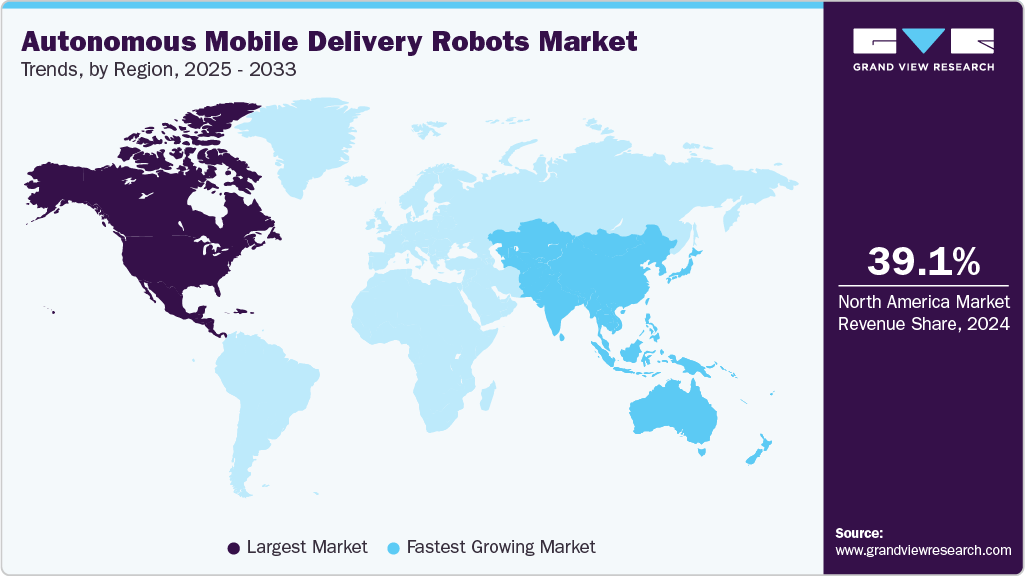
The North America autonomous mobile delivery robots market in dominated with a revenue share of over 38.0% in 2025, driven by high labor costs, rapid e-commerce expansion, and strong demand for efficient last-mile logistics across urban and suburban regions. Regulatory support through state-level pilots, campus delivery programs, and controlled testing zones accelerates the real-world validation and commercial adoption of innovative solutions. Major retailers, food delivery platforms, and logistics providers are investing in autonomous delivery partnerships to reduce delivery times and operational costs. Advancements in AI navigation, LiDAR-based perception, and fleet-management platforms further enhance reliability and safety, enabling broader deployments. Collectively, these factors position North America as among the dominant AMDR markets globally.
 To learn more about this report, Download Free Sample Report
 U.S. Autonomous Mobile Delivery Robots Market Trends
The autonomous mobile delivery robots industry in the U.S. is expected to grow significantly in 2025, primarily driven by escalating last-mile delivery costs, persistent labor shortages, and rising wage pressures that push logistics providers toward automation. Strong e-commerce penetration, rapid grocery and food-delivery demand, and the expansion of micro-fulfillment networks further accelerate adoption. Supportive regulatory initiatives, including state-level pilot approvals and controlled urban testing zones, enable safer and scalable deployments.
Europe Autonomous Mobile Delivery Robots Market Trends
The autonomous mobile delivery robots industry in Europe is expected to grow significantly over the forecast period driven by strong regulatory support for sustainable last-mile logistics, rising labor shortages in delivery-intensive economies, and the region’s aggressive decarbonization targets. European cities are promoting low-emission mobility zones, incentivizing retailers and logistics providers to adopt autonomous delivery robots for short-distance, zero-emission operations. Rapid e-commerce penetration, high urban density, and the maturity of 5G and smart-city infrastructure further accelerate deployment. Additionally, structured pilot programs across the UK, Germany, the Nordics, and the Netherlands provide favorable testing environments, strengthening technology validation.
Asia Pacific Autonomous Mobile Delivery Robots Market Trends
The autonomous mobile delivery robots industry in the Asia Pacific region is anticipated to witness the fastest CAGR over the forecast period driven by accelerating e-commerce expansion, rapid urbanization, and the region’s strong digital consumer base demanding faster and reliable delivery services. Governments in China, Japan, South Korea, Singapore, and Australia are actively supporting autonomous mobility pilots, smart-city programs, and last-mile automation frameworks, enabling quicker commercial deployment. High labor costs in developed APAC markets and acute delivery-workforce shortages in emerging economies further strengthen adoption. Increasing investments from retail, food-delivery, logistics, and technology companies, along with advancements in AI navigation and robotics hardware, are positioning APAC as the fastest-growing AMDR region.
Key Autonomous Mobile Delivery Robots Company Insights
Some key companies in the autonomous mobile delivery robots industry are Starship Technologies, Nuro, Inc., and others.
-
Starship Technologies is a key global provider of autonomous mobile delivery robots, operating large-scale fleets across campuses, residential zones, and retail districts. Its strong operational maturity, high delivery volume, and established commercial partnerships position it as a dominant player in the autonomous mobile delivery ecosystem.
-
Nuro, Inc. is a key player in autonomous mobile delivery robots, specializing in driverless road-going delivery vehicles designed for groceries, parcels, and consumer goods. Its regulatory breakthroughs, large-scale funding, and partnerships with major retailers position it among the most influential companies in automated last-mile delivery.
Key Autonomous Mobile Delivery Robots Companies
The following key companies have been profiled for this study on the autonomous mobile delivery robots market.
-
Starship Technologies
-
Nuro, Inc.
-
Serve Robotics Inc
-
Zipline
-
Ottonomy.IO
-
Kiwibot
-
JDLogistics
-
Cartken Inc.
-
Manna
-
Refraction AI
Recent Developments
-
In March 2026, Niantic Spatial partnered with Coco Robotics to improve autonomous robot navigation using spatial AI and Visual Positioning System technology. The partnership is designed to improve location accuracy and navigation in complex urban environments, particularly where GPS signals may be unreliable.
-
In February 2026, Coco Robotics launched Coco 2, its novel autonomous delivery robot. The new robot is designed to operate more independently, adapt to new cities faster, and navigate complex urban environments using data gathered from millions of real world delivery miles. Coco also positioned the platform for broader urban logistics applications across restaurants, grocery stores, pharmacies, and local retailers.
-
In February 2026, Starship Technologies and Just Eat announced a major partnership to expand autonomous robot delivery in the UK. The first joint service launched in Sunderland, allowing customers to select Starship autonomous robot delivery through the Just Eat app.
-
In November 2025, Starship Technologies and Uber Eats announced a global collaboration to expand autonomous sidewalk robot deliveries across Europe and the U.S. The first deployment began in the UK, with additional European markets planned for 2026 and U.S. expansion planned for 2027.
-
In October 2025, Serve Robotics, robotics and technology company, announced a multi-year strategic partnership with DoorDash, online food delivery company, to integrate its autonomous sidewalk delivery robots into the DoorDash platform, beginning in the U.S. This collaboration supports DoorDash’s multimodal logistics model such as robots, drones, and human couriers, enables Serve to scale its order volume and geographic footprint.
-
In October 2025, Waymo LLC, autonomous driving technology company, and DoorDash, online food delivery company, announced a pilot for fully autonomous vehicle delivery in Phoenix, using Waymo LLC’s driverless cars to deliver food and grocery orders from participating merchants. Through the DoorDash Autonomous Delivery Platform, customers will be matched with Waymo LLC vehicles, unlocking the trunk via the app to retrieve orders.
-
In April 2025, Serve Robotics Inc., autonomous robotics company, launched autonomous delivery service in the Dallas-Fort Worth metro, Texas, U.S. via Uber Eats. The rollout covers over 22,000 households in Uptown neighborhoods and leverages existing Uber Eats partner merchants, signaling Serve Robotics Inc’s rapid scaling toward its 2,000-robot deployment goal by end-2025.
Global Autonomous Mobile Delivery Robots Market Report Scope
Report Attribute
Details
Market size in 2025
USD 1.7 billion
Estimated market size in 2026
USD 2.0 billion
Projected market size by 2033
USD 8.4 billion
Growth rate
CAGR of 22.6% from 2026 to 2033
Base year for estimation
2025
Actual data
2021 - 2025
Forecast period
2026 - 2033
Quantitative units
Revenue in USD billion, and CAGR from 2026 to 2033
Report coverage
Revenue forecast, company ranking, competitive landscape, growth factors, and trends
Segments covered
Platform, payload capacity, end-use, region
Regional scope
North America; Europe; Asia Pacific; Latin America; Middle East & Africa
Country scope
U.S.; Canada; Mexico; Germany; UK; France; China; India; Japan; Australia; South Korea; Brazil; UAE; South Africa; KSA
Key companies profiled
Starship Technologies; Nuro, Inc.; Serve Robotics Inc; Zipline; Ottonomy.IO; Kiwibot; JDLogistics; Cartken Inc.; Manna; Refraction AI
Customization scope
Free report customization (equivalent to 8 analyst working days) with purchase. Addition or alteration to country, regional & segment scope.
Pricing and purchase options
Avail of customized purchase options to meet your exact research needs. Explore purchase options
Global Autonomous Mobile Delivery Robots Market Report Segmentation
This report forecasts revenue growth at the global, regional, and country levels and provides an analysis of the latest industry trends and opportunities across each sub-segment from 2021 to 2033. For this study, Grand View Research has segmented the global autonomous mobile delivery robots market report based on platform, payload capacity, end-use, and region:
- Platform Outlook (Revenue, USD Billion, 2021 - 2033)
- Ground Delivery Robots (GDR) and Sidewalk Delivery Robots (SDR)
- On-Campus Delivery Robots and Indoor-Outdoor Hybrid Robots
- Aerial Delivery Drones and Autonomous Drone-Ground Hybrid Systems
- Payload Capacity Outlook (Revenue, USD Billion, 2021 - 2033)
- Light-Payload Robots (Up to 10 kg)
- Medium-Payload Robots (10-30 kg)
- Heavy-Payload Robots (Above 30 kg)
- End-use Outlook (Revenue, USD Billion, 2021 - 2033)
- Food Delivery
- Grocery Delivery
- E-commerce
- Campus & Enterprise Delivery
- Regional Outlook (Revenue, USD Billion, 2021 - 2033)
- North America
- U.S.
- Canada
- Mexico
- Europe
- Germany
- UK
- France
- Asia Pacific
- China
- Japan
- India
- South Korea
- Australia
- Latin America
- Brazil
- Middle East and Africa (MEA)
- UAE
- KSA
- South Africa
- North America
Frequently Asked Questions About This Report
The global autonomous mobile delivery robots market is expected to grow at a CAGR of 22.6% from 2026 to 2033, reaching USD 8.4 billion.
North America dominated with over 38.0% revenue share in 2025. The region market is driven by high labor costs, rapid e-commerce expansion, and strong demand for efficient last-mile logistics across urban and suburban regions.
Key players in the market include Starship Technologies, Nuro, Inc., Serve Robotics Inc, Zipline, Ottonomy.IO, Kiwibot, JDLogistics, Cartken Inc., Manna, Refraction AI, and others.
The Ground Delivery Robots (GDR) and Sidewalk Delivery Robots (SDR) segment held the dominating share in the market.
The global autonomous mobile delivery robots market size was valued at USD 1.7 billion in 2025 and is estimated at USD 2.0 billion for 2026.
About the Author(s)
Next Generation Technologies Research Team
Technology · Next Generation TechnologiesThis report was authored by the next generation technologies research team at Grand View Research - comprising two research analysts, one senior research analyst, and one industry expert - with specialized expertise in the next generation technologies segment of the technology industry. All findings are based on proprietary technology databases, executive interviews, and regulatory analysis, subject to internal peer review prior to publication.
Last Updated:
Speak to Analyst

Customize this report to your needs - add regions, segments, or data points, with 20% free customization.
Or view our licence options:


ISO 9001:2015 & 27001:2022 Certified
We are GDPR and CCPA compliant! Your transaction & personal information is safe and secure. For more details, please read our privacy policy.


