
- Home
- »
- Advanced Interior Materials
- »
-
Baghouse Filters Market Size, Share & Trends Report, 2033GVR Report cover

Baghouse Filters Market (2026 - 2033)
Size, Share & Trends Analysis Report By Filter Media (Polyester, Aramid/Nomex), By Application (Industrial Dust Collection, Process Gas Filtration), By End-use (Food & Beverage, Chemical & Petrochemical), By Region, And Segment Forecasts
Market Size, 2025
$1.4BMarket Estimate, 2026
$1.5BMarket Forecast, 2033
$2.2BCAGR, 2026–2033
5.2%Baghouse Filters Market Summary
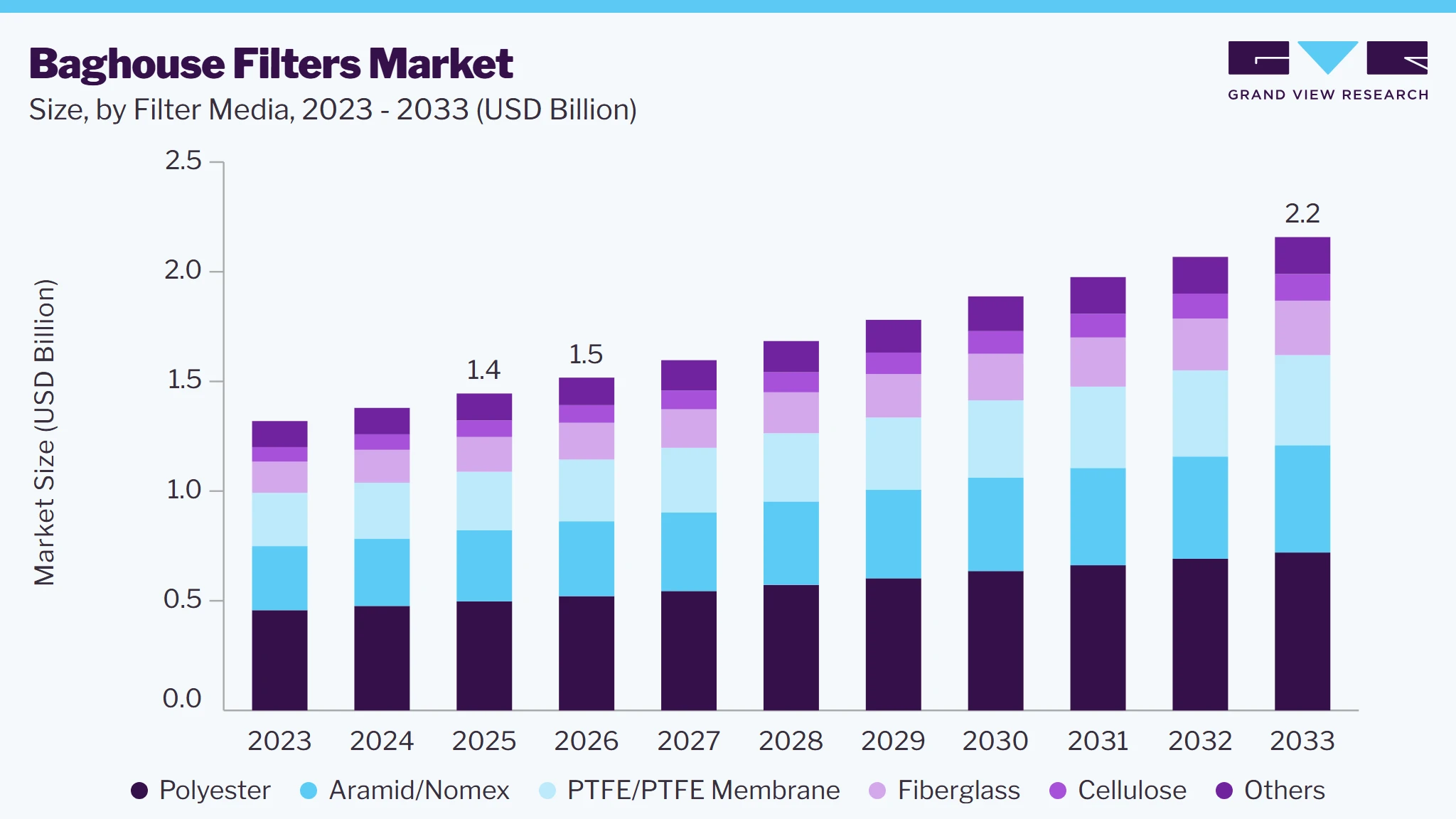
The global baghouse filters market size was valued at USD 1.4 billion in 2025 and is projected to grow from USD 1.5 billion in 2026 to USD 2.2 billion by 2033, at a CAGR of 5.2% from 2026 to 2033. North America dominated the market, accounting for a revenue share of 41.9% in 2025. The industry is driven by the increasing particulate loads generated across cement, steel, mining, power generation, chemicals, and other process industries.
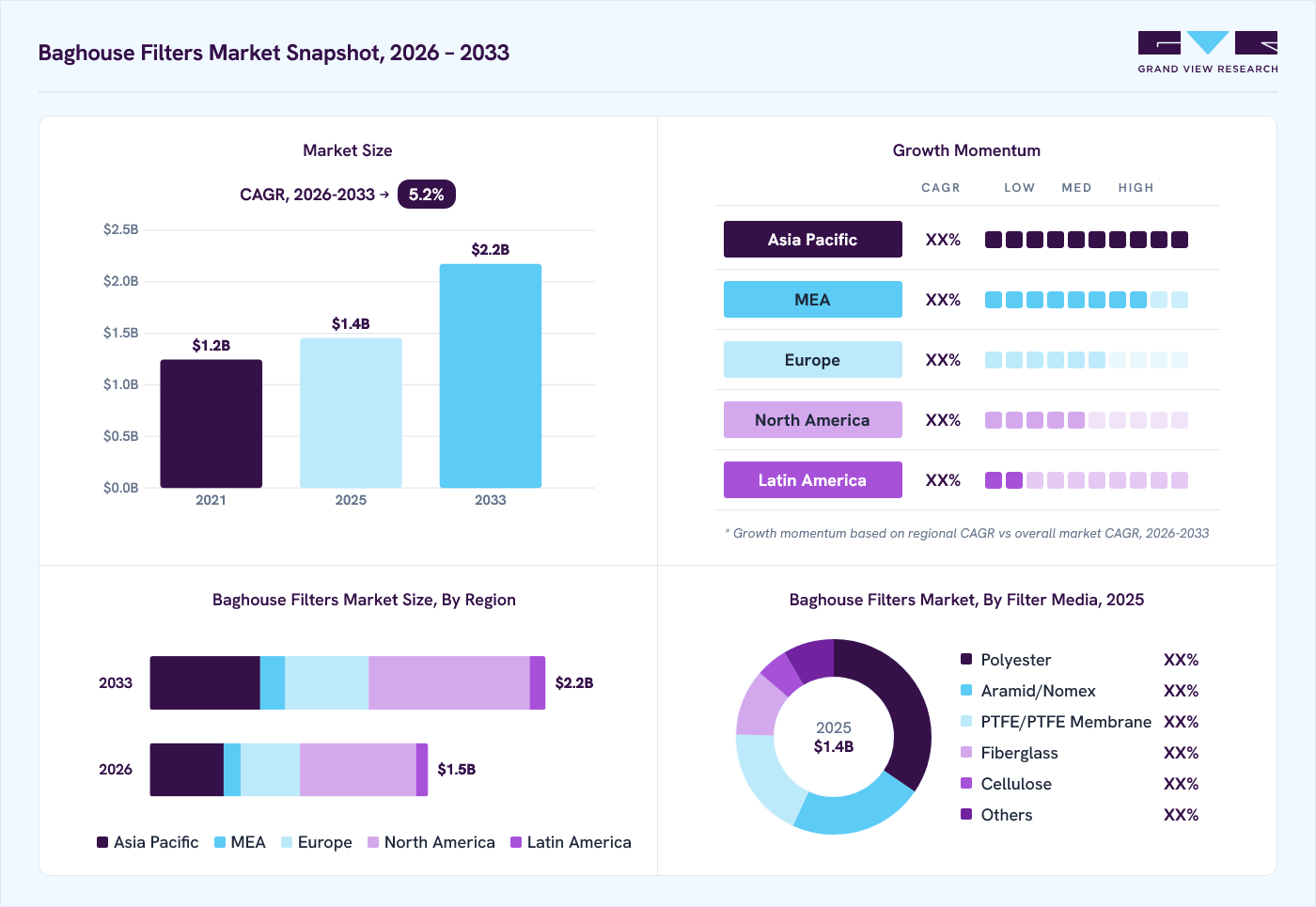 Source: Grand View Research, IR Documents, Primary Interviews, Paid DatabasesTo learn more about this report,
 Download Free Sample Report
Key Market Trends & Insights
- By filter media: Cellulose segment is projected to grow at 6.1% CAGR during the forecast period.
- By application: Industrial dust collection segment dominated the market in 2025, accounting for 42.3% market share.
- By end-use: Power generation segment held the largest revenue share of 22.9% in 2025.
Regional Highlights
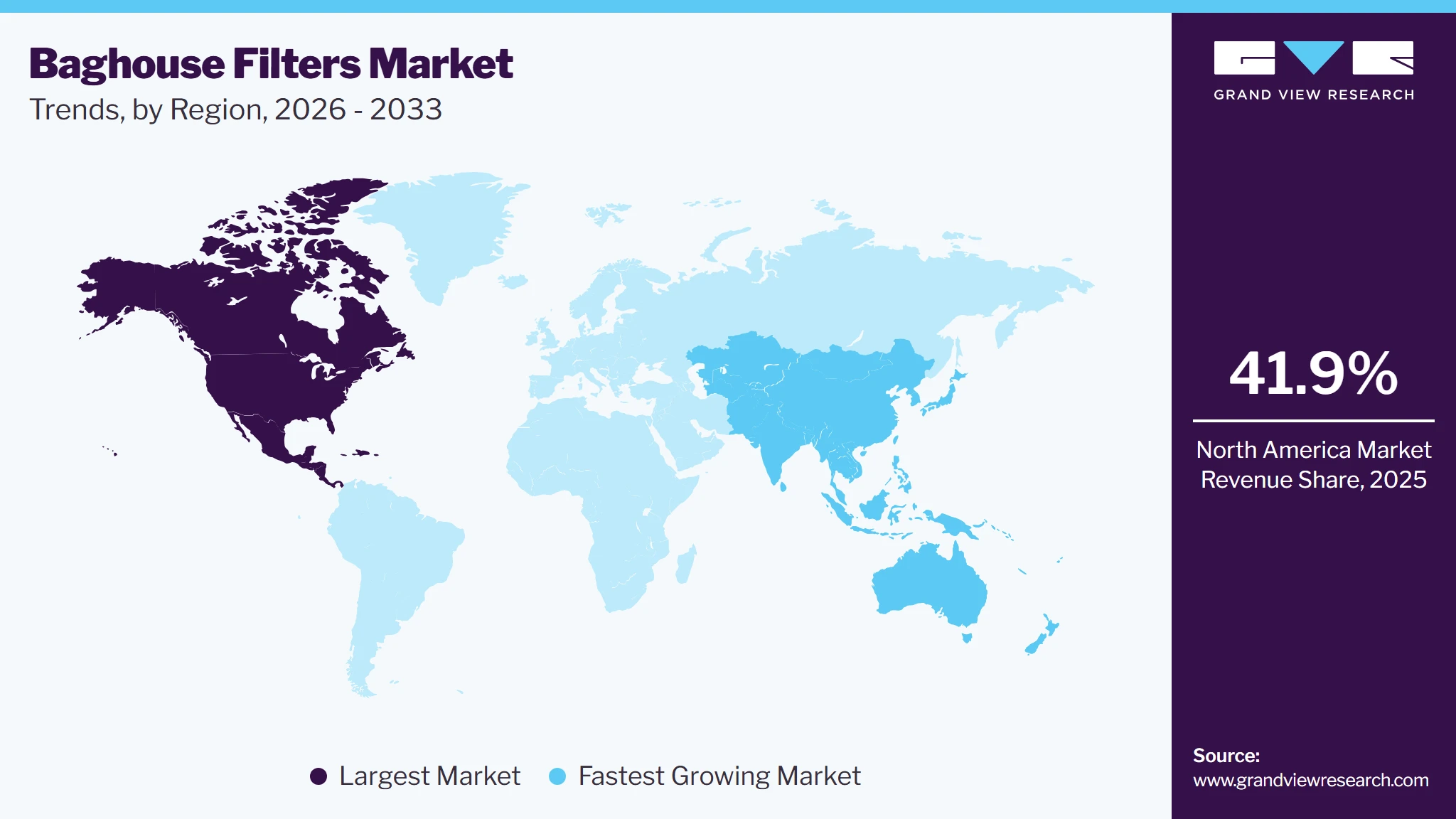
- Largest regional market: North America (41.9% revenue share, 2025)
- Fastest-growing regional market: Asia Pacific (highest CAGR, 2026-2033)
- By country: The U.S market held the largest share in 2025.
Market Size & Forecast
- Market size in 2025: USD 1.4 Billion
- Estimated market size in 2026: USD 1.5 Billion
- Projected market size by 2033: USD 2.2 Billion
- CAGR (2026-2033): 5.2%
GVR research-powered AIAsk Prism AI about the baghouse filters marketGet cited answers from GVR research on market growth, segments, regulations and forecasts.Start with✓ Source-linked answers ✓ Market-specific context ✓ Traceable figuresExplore Prism AI ↗Higher material throughput and expansion of production lines require dust collection systems capable of handling continuous volumes of fine and coarse particles while maintaining stable plant operations. Environmental compliance requirements further encourage industrial facilities to install or upgrade fabric filtration systems where conventional dust-control arrangements no longer meet required emission levels.
 To learn more about this report, Download Free Sample Report
Additionally, the replacement of aging filtration equipment is creating a steady aftermarket for filter bags, collector units, and related components. Advances in membrane-coated fabrics, high-temperature filter media, and pulse-jet cleaning systems are expanding baghouse applications across processes with demanding dust characteristics and operating conditions. Retrofit projects are also gaining relevance as plants modify existing collection systems to accommodate changes in production capacity, process configuration, or emission-control requirements.
Market Dynamics
The global baghouse filters market is shaped by the need for effective particulate removal, stringent emission-control requirements, filtration performance, and reliable dust collection across industrial processes. Market demand varies according to dust characteristics, filtration capacity, filter media selection, operating temperature, airflow requirements, pressure drop, and application conditions. Competitive activity is also influenced by manufacturers’ ability to provide durable filtration solutions, optimize collection efficiency, and meet the specific requirements of industries such as power generation, cement, steel, mining, chemicals, and food processing.
Expansion of cement production, metal processing, mining, mineral handling, and other material-intensive operations is increasing the amount of particulate matter generated during crushing, grinding, conveying, mixing, and processing activities. Baghouse filters are used to separate these particles from process air and exhaust streams, particularly in facilities operating under continuous production conditions. Increasing material throughput can therefore require filtration systems with higher airflow-handling capacity, appropriate dust-loading characteristics, and durable filter media. This relationship between production intensity and particulate generation directly drives equipment demand across multiple industrial applications.
Operating performance can be affected by pressure buildup across filter bags as collected dust accumulates on the filtration surface. Cleaning cycles are required to restore airflow, but frequent pulse-jet cleaning can increase compressed-air consumption and contribute to energy use across the collection system. Higher pressure drop can also place additional load on induced-draft or exhaust fans. Consequently, operators must balance filtration performance with airflow resistance and energy requirements, which can affect the economic attractiveness of baghouse systems in energy-intensive facilities.
Advances in filtration materials are creating opportunities to expand baghouse applications into processes involving fine particles, elevated temperatures, corrosive gases, and demanding chemical conditions. Membrane-treated fabrics, specialized synthetic fibers, and high-temperature media can improve particle capture while extending operating life under specific process conditions. Manufacturers can also differentiate through application-specific media selection and engineered bag designs rather than relying on standardized filtration products. This creates opportunities for suppliers to address specialized filtration requirements and capture higher-value replacement and retrofit demand.
Market Concentration & Characteristics
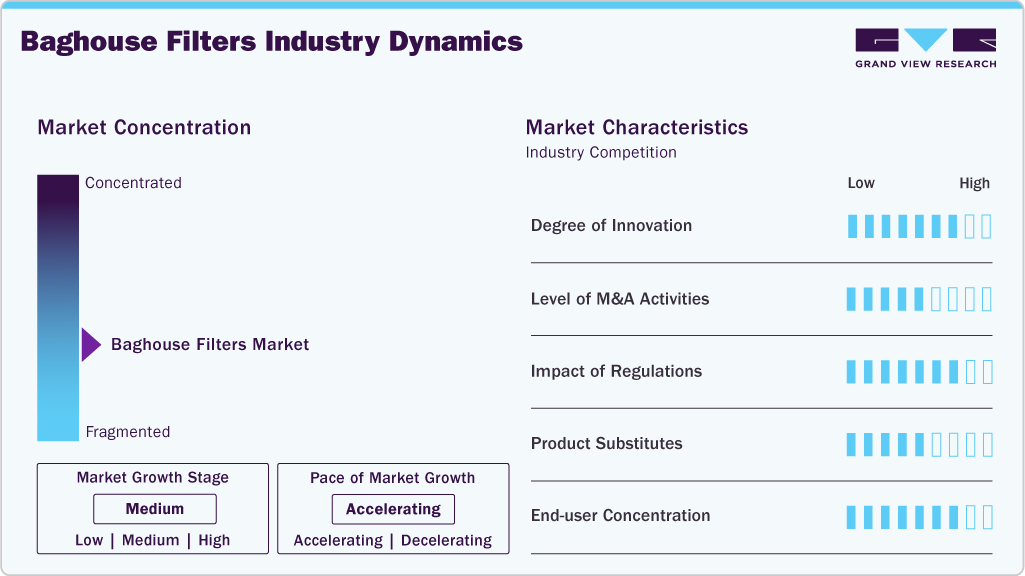
The baghouse filters market is highly fragmented, with multinational filtration companies competing alongside specialized dust-collection manufacturers and regional fabric filter suppliers. Large companies generally have broader product portfolios and engineering capabilities, allowing them to participate in complex industrial projects, while smaller manufacturers often focus on customized systems, replacement components, and applications within specific industries or geographic markets. Competitive presence, therefore, varies considerably across cement, metals, mining, power, chemical processing, and other dust-generating industries.
 To learn more about this report, Download Free Sample Report
Purchasing decisions are closely linked to the technical characteristics of the process rather than a single standardized product specification. Factors such as gas composition, particulate size, moisture content, operating temperature, airflow volume, pressure drop, and available installation space influence the selection of filter media and collector configuration. This creates a market for application-engineered systems, with suppliers differentiating through design expertise, material selection, system integration, commissioning, and aftermarket servicing.
Recurring demand is also an important characteristic of the industry, as filter bags and other consumable components require periodic replacement based on operating conditions and service life. Plant expansions, equipment modernization, regulatory upgrades, and changes in production processes generate opportunities for new installations and retrofit projects. Meanwhile, developments in membrane filtration, specialized fabrics, cleaning technologies, and monitoring capabilities are gradually changing equipment specifications and enabling baghouse systems to address more demanding filtration requirements.
Analyst Perspective
The baghouse filters market is shaped by industrial emission-control requirements, regulatory compliance, production capacity expansion, and recurring replacement demand across particulate-intensive industries. Procurement decisions are influenced by dust characteristics, gas composition, operating temperature and pressure, required filtration efficiency, and compatibility of filter media with specific process conditions. Polyester, aramid/Nomex, PTFE/PTFE membrane, fiberglass, and other media serve distinct operating requirements, while demand spans new system installations and replacement filter bags. From a market perspective, recurring replacement requirements provide an aftermarket revenue stream alongside capital expenditure on new filtration systems, with purchasing patterns varying by industry, process configuration, and regional emission-control standards.
Filter Media Insights
The polyester segment held the largest revenue share of 34.4% in 2025, reflecting its established position as a standard media for pulse-jet baghouse systems. Its combination of durability, abrasion resistance, chemical resistance, and relatively economical cost enables broad deployment across cement and quarrying, metal processing, grain, food, wood, and other dust-intensive operations. Different polyester treatments, including glazed and hydroentangled constructions, further extend its applicability by improving dust release and maintaining stable filtration performance during repeated cleaning cycles.
Cellulose is projected to register the fastest CAGR of 6.1% during the forecast period, indicating increasing demand for economical media in applications where conventional particulate filtration is adequate. Its growth is supported by its use in blended media constructions, where cellulose can be combined with synthetic fibers to achieve a balance between filtration characteristics and operating cost. This positions cellulose as a growing option in applications seeking practical filtration solutions without the higher material requirements associated with specialized high-temperature or chemically resistant media.
Application Insights
The industrial dust collection segment held the largest revenue share of 42.3% in 2025, reflecting its extensive use for controlling particulate generated during material handling, crushing, grinding, conveying, mixing, and other manufacturing activities. Baghouse systems are widely integrated into industrial ventilation and dust extraction infrastructure, particularly across cement, mining, metals, food processing, and chemical operations where continuous particulate capture is required.
Process gas filtration is projected to register the fastest CAGR of 5.9% during the forecast period, driven by the increasing integration of fabric filtration into process exhaust streams from kilns, furnaces, dryers, boilers, and other industrial equipment. Demand in this application is closely associated with tighter emission-control requirements and the need to manage fine particulate in high-temperature and chemically diverse gas streams, encouraging the adoption of application-specific baghouse configurations.
End-use Insights
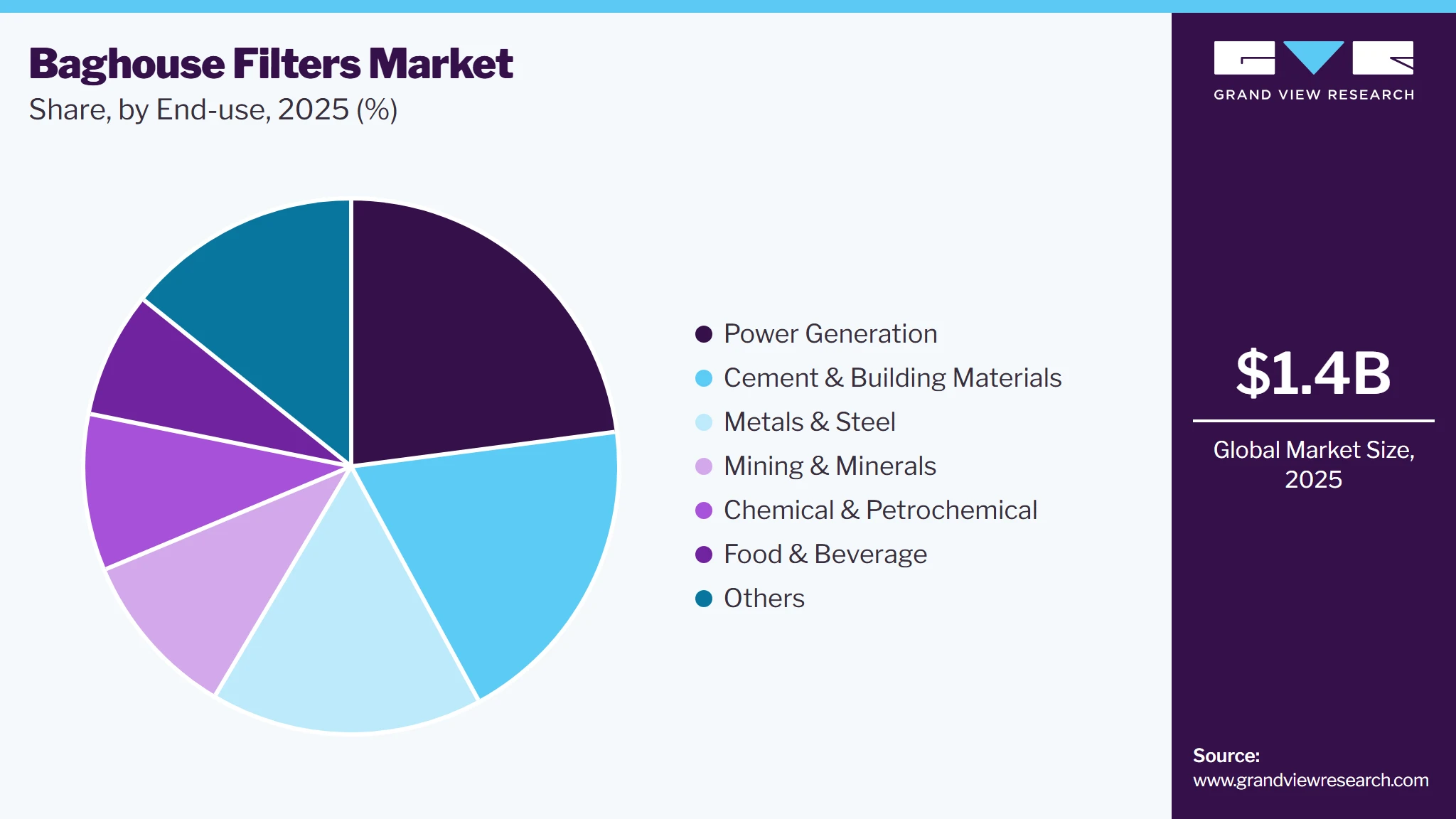
The power generation segment held the largest revenue share of 22.9% in 2025, reflecting the extensive use of baghouse filtration for particulate control in power plants and associated fuel-handling and combustion processes. Baghouse systems are applied across coal, biomass, and other thermal power operations, particularly for controlling dust from fuel handling and particulate-laden exhaust streams. The installed base of large-scale power facilities also creates recurring demand for replacement filter bags and filtration-system upgrades.
 To learn more about this report, Download Free Sample Report
Food & beverage is projected to register the fastest CAGR during the forecast period, supported by expanding processing volumes and the need for dedicated dust-control systems across grain handling, milling, flour processing, sugar, spices, and other powder-intensive operations. Baghouse adoption in this sector is also linked to requirements for hygienic production environments, product-loss prevention, and control of combustible and airborne dust, creating opportunities for application-specific filtration systems as processing capacity expands.
Regional Insights
North America dominated the baghouse filters market, accounting for a revenue share of 41.9% in 2025. The region represents a mature industry characterized by a substantial installed base of industrial dust-collection systems and established environmental-control practices. Demand is supported by particulate-emission requirements across process industries, together with ongoing maintenance and refurbishment of filtration infrastructure. The market also benefits from the replacement of conventional filter media, upgrades to cleaning mechanisms, and installation of higher-capacity systems at facilities undergoing production or process modifications.
 To learn more about this report, Download Free Sample Report
U.S. Baghouse Filters Market Trends
The baghouse filters market in the U.S. accounts for the broadest application base in the region, with baghouse filtration integrated into cement, power generation, metals, chemicals, and other dust-intensive operations. The scale of established industrial infrastructure creates recurring requirements for filter bags and associated components, while plant retrofits generate demand for systems capable of handling changing process conditions. Purchasing decisions increasingly consider filtration efficiency, operating life, maintenance requirements, and compatibility with existing emission-control equipment.
The Canada baghouse filters market is well-positioned as the country has a more resource-oriented demand structure, reflecting its mining, mineral processing, metals, cement, and pulp and paper activities. Baghouse systems are particularly relevant where large quantities of bulk materials are processed or transferred, necessitating reliable particulate capture under variable operating conditions. The geographic distribution of industrial facilities and demanding process environments also emphasizes equipment durability, maintenance accessibility, and reliable continuous operation.
Asia Pacific Baghouse Filters Market Trends
The baghouse filters market in the Asia Pacific is broad, with substantial demand across heavy process industries and rapidly developing manufacturing sectors. Cement, steel, power generation, mining, chemicals, food processing, and mineral processing account for diverse filtration requirements, ranging from high-dust material handling to continuous process-gas filtration. China, India, Japan, South Korea, and Australia have distinct industrial structures, leading to varying requirements for filtration capacity, media selection, cleaning mechanisms, and equipment configuration. Southeast Asian economies are also creating additional applications as manufacturing, infrastructure, cement production, and food-processing capacity expand.
The China baghouse filters market accounted for the largest revenue share of 41.9% of the Asia Pacific industry in 2025. The country's extensive cement, steel, thermal power, chemicals, nonferrous metals, and mineral-processing base supports widespread use of fabric filtration. Baghouse systems are deployed around kilns, mills, sintering and material-preparation operations, boilers, crushers, conveyors, and other particulate-intensive process stages.
Europe Baghouse Filters Market Trends
The baghouse filters market in Europe has a well-established industry shaped by stringent environmental requirements and the modernization of industrial emission-control infrastructure. Fabric filtration remains relevant across energy-intensive manufacturing and waste-processing operations where particulate emissions must be controlled consistently. Market demand is increasingly influenced by plant refurbishment, improvements in filtration performance, and the need to maintain established production assets while meeting evolving environmental requirements.
The Germany baghouse filters market has a strong industrial filtration base associated with its steel, cement, chemical, power, and manufacturing sectors. Baghouse systems are integrated into production lines where particulate capture is required from high-temperature exhaust streams and material-processing operations. The country's mature industrial infrastructure creates a sizeable aftermarket for filter media and system components, while plant upgrades support demand for more technically capable filtration configurations.
The baghouse filters market in the UK presents a comparatively specialized application profile, with demand linked to waste-to-energy, cement, chemicals, metals, and industrial processing. Waste combustion and energy-recovery facilities represent an important area for fabric filtration because of the need for continuous control of particulate matter in flue gases. Demand is also associated with refurbishment of established industrial assets and the integration of filtration equipment into new or upgraded process lines.
Middle East & Africa Baghouse Filters Market Trends
The baghouse filters market in the Middle East & Africa represents a developing sector, with demand concentrated in industries associated with construction materials, resource processing, energy, and emerging manufacturing capacity. The market is influenced by the development of large industrial facilities as well as the increasing incorporation of emission-control systems into production infrastructure. Compared with mature markets, project-driven demand has a greater role in shaping equipment requirements.
The Saudi Arabia baghouse filters market is developing a broader industrial application base through investments in cement, mining, metals, power, and downstream manufacturing. These activities create requirements for particulate filtration across material preparation and processing operations, particularly in facilities handling minerals and other bulk inputs. New industrial projects provide an important source of demand, while the expansion of operating plants is gradually increasing the need for filtration replacement and maintenance services.
Latin America Baghouse Filters Market Trends
The baghouse filters market in Latin America is diversified, with mining and mineral processing representing important sources of demand alongside cement, steel, power generation, chemicals, and food processing. The region's resource-intensive industrial structure creates filtration requirements at several stages of material processing, from primary handling through size reduction and beneficiation. Market development is consequently linked closely with mining output, industrial investment, and the expansion or refurbishment of processing facilities.
The Brazil baghouse filters market represents the region's most extensive application base, supported by large-scale mining, steel, cement, power generation, and manufacturing activities. Mining operations generate requirements for dust collection throughout ore handling and processing, while cement and metallurgical facilities require filtration for high-temperature and high-dust process streams. Continued investment in resource processing and industrial infrastructure provides opportunities for baghouse equipment, replacement filter media, and associated filtration components.
Key Baghouse Filters Company Insights
Some of the key players operating in the market include Donaldson Company, Inc., Nederman Holding AB, among others.
-
Donaldson Company, Inc., headquartered in Bloomington, Minnesota, U.S., is a manufacturer of filtration systems and dust-collection equipment, offering baghouse dust collectors, filter bags, filter media, and related components for industrial applications. Its solutions serve mining, cement, mineral processing, manufacturing, food processing, waste management, and other industries requiring particulate capture and emission control.
-
Nederman Holding AB, headquartered in Helsingborg, Sweden, is an environmental technology company specializing in industrial air filtration and dust-collection solutions, with a portfolio of baghouse systems, filter bags, and associated equipment. Its solutions serve metalworking, woodworking, recycling, manufacturing, and other process industries requiring particulate control and industrial air-quality management.
Key Baghouse Filters Companies
The following key companies have been profiled for this study on the baghouse filters market.
-
Donaldson Company, Inc.
-
Nederman Holding AB
-
Camfil AB
-
FLSmidth A/S
-
Babcock & Wilcox Enterprises, Inc.
-
CECO Environmental Corp.
-
Scheuch GmbH
-
Intensiv-Filter Himenviro GmbH
-
Ducon Technologies Inc.
-
KC Cottrell Co., Ltd.
-
Longking Environmental Protection Co., Ltd.
-
Baghouse America, Inc.
-
Aget Manufacturing Co.
-
Imperial Systems, Inc.
-
Griffin Filters LLC
Competitive Benchmarking
Category
Operating Strategies
Competitive Edge
Weakness
Established Players (e.g., Donaldson Company, Inc.; Nederman Holding AB; Camfil AB; FLSmidth A/S; Babcock & Wilcox Enterprises, Inc.; CECO Environmental Corp.; Scheuch GmbH)
Expand baghouse collectors, filter bags, media, and engineered filtration systems across cement, power, metals, mining, chemicals, and manufacturing.
Invest in high-performance filter media, automated cleaning systems, emission monitoring, system optimization, and aftermarket replacement services.
Large installed bases and established relationships with industrial customers and EPC contractors.
Broad engineering capabilities enable application-specific designs for varying dust characteristics, temperatures, and gas volumes.
Higher engineering, manufacturing, and service costs can limit competitiveness in price-sensitive projects.
Extensive product portfolios and global operating structures can make highly customized smaller projects less commercially attractive.
Emerging & Regional Players (e.g., Intensiv-Filter Himenviro GmbH; Ducon Technologies Inc.; KC Cottrell Co., Ltd.; Longking Environmental Protection Co., Ltd.; Baghouse America, Inc.; Aget Manufacturing Co.; Imperial Systems, Inc.; Griffin Filters LLC)
Concentrate on selected dust-intensive applications and customized baghouse configurations based on process conditions and emission requirements.
Strengthen regional distribution, fabrication capabilities, replacement-filter offerings, and technical support to compete in localized markets.
Greater flexibility in equipment configuration, customization, and project response.
Regional manufacturing and service networks can support shorter delivery cycles and closer customer engagement.
Smaller installed bases and limited geographic coverage can restrict participation in large multinational projects.
Lower scale may limit investment in advanced media development, testing infrastructure, automation, and global aftermarket networks.Recent Developments
-
In February 2026, Cleanova launched Sentinel Connect, an Industrial IoT monitoring system specifically designed for baghouse filters and dust-collection systems. The system monitors baghouse filter performance through real-time operating data, including differential pressure, and provides cloud-based dashboards, automated alerts, historical reporting, and remote access.
-
In July 2025, I.W. Tremont Co., Inc. acquired Filter Holdings, Inc., a U.S. manufacturer of sewn filtration products, including baghouse filters and filter bags for industrial applications. The acquisition expanded I.W. Tremont's manufacturing capabilities and product portfolio, strengthening its presence in industrial filtration applications requiring high-temperature, chemically resistant, and fine-particle filtration.
Baghouse Filters Market Report Scope
Report Attribute
Details
Market size in 2025
USD 1.4 billion
Estimated market size in 2026
USD 1.5 billion
Revenue forecast in 2033
USD 2.2 billion
Growth rate
CAGR of 5.2% from 2026 to 2033
Base year for estimation
2025
Historical data
2021-2024
Forecast period
2026 - 2033
Quantitative units
Revenue in USD billion and CAGR from 2026 to 2033
Report coverage
Revenue forecast, company market position analysis, competitive landscape, growth factors, and trends
Segments covered
Filter media, application, end-use, region
Regional scope
North America; Europe; Asia Pacific; Latin America; and Middle East & Africa
Country Scope
U.S.; Canada; Mexico; Germany; UK; Italy; Spain; France; China; Japan; India; Australia; South Korea; Brazil; Argentina; Saudi Arabia; UAE; South Africa
Key companies profiled
Donaldson Company, Inc.; Nederman Holding AB; Camfil AB; FLSmidth A/S; Babcock & Wilcox Enterprises, Inc.; CECO Environmental Corp.; Scheuch GmbH; Intensiv-Filter Himenviro GmbH; Ducon Technologies Inc.; KC Cottrell Co., Ltd.; Longking Environmental Protection Co., Ltd.; Baghouse America, Inc.; Aget Manufacturing Co.; Imperial Systems, Inc.; Griffin Filters LLC.
Customization scope
Free report customization (equivalent up to 8 analysts working days) with purchase. Addition or alteration to country, regional & segment scope.
Pricing and purchase options
Avail customized purchase options to meet your exact research needs. Explore purchase options
Global Baghouse Filters Market Report Segmentation
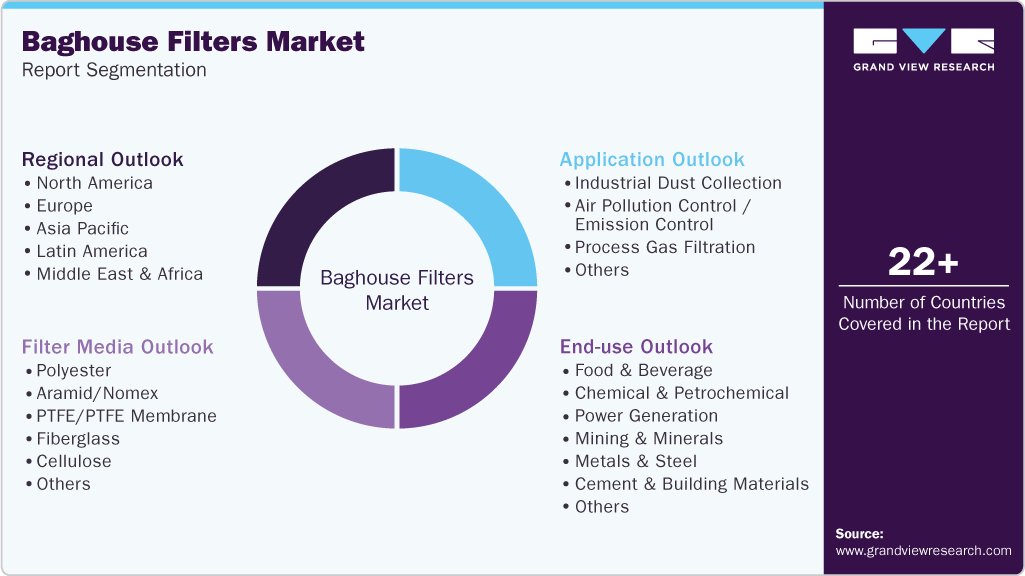
This report forecasts revenue growth at global, regional & country levels and provides an analysis on the industry trends in each of the sub-segments from 2021 to 2033. For this study, Grand View Research has segmented the global baghouse filters market report on the basis of filter media, application, end-use, and region:
 To learn more about this report, Download Free Sample Report
-
Filter Media Outlook (Revenue, USD Billion, 2021 - 2033)
-
Polyester
-
Aramid/Nomex
-
PTFE/PTFE Membrane
-
Fiberglass
-
Cellulose
-
Others
-
-
Application Outlook (Revenue, USD Billion, 2021 - 2033)
-
Industrial Dust Collection
-
Air Pollution Control / Emission Control
-
Process Gas Filtration
-
Others
-
-
End-use Outlook (Revenue, USD Billion, 2021 - 2033)
-
Food & Beverage
-
Chemical & Petrochemical
-
Power Generation
-
Mining & Minerals
-
Metals & Steel
-
Cement & Building Materials
-
Others
-
-
Regional Outlook (Revenue, USD Billion, 2021 - 2033)
-
North America
-
U.S.
-
Canada
-
Mexico
-
-
Europe
-
Germany
-
France
-
UK
-
Spain
-
Italy
-
-
Asia Pacific
-
China
-
India
-
Japan
-
South Korea
-
Australia
-
-
Latin America
-
Brazil
-
Argentina
-
-
Middle East & Africa
-
Saudi Arabia
-
UAE
-
South Africa
-
-
Research Methodology
The baghouse filters marketfigures in this report are based on a proven research process that combines executive interviews with secondary research from proprietary databases, company filings, and recognized regulatory and institutional sources. Market size is built through value-chain sizing-reconciling supply-side and demand-side estimates-and triangulated with bottom-up and top-down approaches. Every estimate passes multiple levels of expert validation before publication, with eachbaghouse filters segment quantified using the revenue-capture definitions in the table below.
Segment Definition
Filter Media
Revenue Capture Definition
Polyester
Revenue generated through polyester baghouse filter sales to customers requiring polyester-based filtration media, including purchases through manufacturers, distributors, contractors, or system integrators.
Aramid/Nomex
Revenue generated through aramid/Nomex baghouse filter sales to customers requiring heat- and chemical-resistant filtration media, including direct and channel-based purchases.
PTFE/PTFE Membrane
Revenue generated through PTFE and PTFE membrane baghouse filter sales to customers requiring high-efficiency filtration, including orders placed directly or through distributors and filtration-system suppliers.
Fiberglass
Revenue generated through fiberglass baghouse filter sales to customers requiring high-temperature filtration, including direct orders and purchases through distribution channels.
Cellulose
Revenue generated through cellulose baghouse filter sales to customers requiring cellulose-based filtration media, including direct and indirect sales channels.
Others
Revenue generated through sales of other baghouse filter media, including specialty and blended media, to industrial customers and channel partners.
Application
Revenue Capture Definition
Industrial Dust Collection
Revenue generated through baghouse filter sales for industrial dust collection requirements, including orders placed by end users, contractors, distributors, or system integrators.
Air Pollution Control / Emission Control
Revenue generated through baghouse filter sales for industrial air pollution and particulate emission control, including direct and channel-based customer purchases.
Process Gas Filtration
Revenue generated through baghouse filter sales for process gas filtration requirements, including purchases by industrial operators, contractors, distributors, or filtration-system providers.
Others
Revenue generated through baghouse filter sales for applications outside the defined categories, including direct and indirect customer purchases.
End Use
Revenue Capture Definition
Food & Beverage
Revenue generated through baghouse filter sales to food and beverage industry customers, including product orders placed directly by manufacturers, contractors, distributors, or engineering and procurement companies.
Chemical & Petrochemical
Revenue generated through baghouse filter sales to chemical and petrochemical industry customers, including orders placed directly by operators, contractors, distributors, or engineering and procurement companies.
Power Generation
Revenue generated through baghouse filter sales to power generation customers, including product orders placed directly by plant operators, contractors, distributors, or engineering and procurement companies.
Mining & Minerals
Revenue generated through baghouse filter sales to mining and mineral-processing customers, including direct orders and purchases through contractors, distributors, or system suppliers.
Metals & Steel
Revenue generated through baghouse filter sales to metals and steel industry customers, including product orders placed directly by producers, contractors, distributors, or engineering and procurement companies.
Cement & Building Materials
Revenue generated through baghouse filter sales to cement and building-material industry customers, including direct orders and purchases through contractors, distributors, or engineering and procurement companies.
Others
Revenue generated through baghouse filter sales to end-use industries outside the specified categories, including direct and channel-based customer purchases.
Estimation Model
Layer Name
Key Question
Description
Baghouse Filter Demand Layer
Where is demand for baghouse filters generated?
Quantify addressable demand for baghouse filters across food & beverage, chemical & petrochemical, power generation, mining & minerals, metals & steel, cement & building materials, and other end-use industries. Assess demand arising from new filtration installations, production capacity additions, process upgrades, emission-control requirements, and replacement cycles.
Baghouse Filter Procurement Layer
What factors influence baghouse filter procurement?
Evaluate purchasing requirements based on particulate characteristics, filtration efficiency, operating temperature and pressure, gas composition, filter media specifications, equipment configuration, regulatory requirements, and system performance criteria. Assess procurement through manufacturers, distributors, contractors, and system integrators.
Baghouse Filter Configuration & Media Adoption Layer
Which baghouse filter configurations and media are being purchased?
Analyze product adoption across polyester, aramid/Nomex, PTFE/PTFE membrane, fiberglass, cellulose, and other filter media, together with their application across dust collection, emission control, and process gas filtration. Assess selection according to operating conditions, particulate loading, temperature resistance, chemical compatibility, and required filtration performance.
Revenue Generation Layer
How much revenue is generated from baghouse filter sales?
Estimate annual market revenue from new and replacement baghouse filter products across filter media, application, end use, and region. Capture manufacturer sales through direct and indirect channels while excluding installation, maintenance, repair, inspection, and other aftermarket services.
Customization Table
Client Request
Customization Delivered
Value Adds
Competitive Benchmarking
A structured assessment of leading baghouse filter manufacturers was conducted across filter media, baghouse configurations, filtration capacity, cleaning mechanisms, application coverage, industry presence, geographic reach, distribution networks, and recent product developments. Company portfolios, market positioning, manufacturing capabilities, and areas of specialization were also reviewed.
Enables stakeholders to compare manufacturers based on product breadth, media capabilities, application coverage, technical offerings, commercial reach, and strategic focus. The analysis also highlights areas of differentiation and potential gaps across supplier portfolios.
Regional Segmentation
The market was evaluated across North America, Europe, Asia Pacific, Latin America, and the Middle East & Africa, with selected country-level analysis. Regional assessment covered emission regulations, industrial activity, manufacturing capacity, particulate-control requirements, installed filtration base, project investments, procurement channels, and replacement practices.
Provides a detailed view of regional market conditions and purchasing patterns. The analysis supports assessment of market accessibility, region-specific filtration requirements, distribution opportunities, and geographic expansion strategies.
Opportunity Assessment
Opportunities were evaluated across polyester, aramid/Nomex, PTFE/PTFE membrane, fiberglass, cellulose, and other filter media, as well as industrial dust collection, air pollution/emission control, and process gas filtration applications. The assessment also considered new system installations, capacity expansion, regulatory compliance, equipment modernization, and recurring filter replacement requirements across major end-use industries.
Supports identification of addressable opportunities across product, media, application, and end-use segments. The assessment helps stakeholders identify portfolio expansion areas, evaluate replacement-driven demand, target high-potential applications, and determine areas for future investment.
Frequently Asked Questions About This Report
The global baghouse filters market is projected to grow at a CAGR of 5.2% from 2026 to 2033, reaching USD 2.2 billion by 2033.
The global baghouse filters market size was valued at USD 1.4 billion in 2025 and is projected to reach USD 1.5 billion in 2026.
North America dominated the market, accounting for a revenue share of 41.9% in 2025.
The polyester segment held the largest revenue share of 34.4% in 2025, while cellulose is the fastest-growing segment.
The industrial dust collection segment held the largest revenue share of 42.3% in 2025, while process gas filtration is the fastest-growing segment.
The power generation segment held the largest revenue share of 22.9% in 2025, while food & beverage is the fastest-growing segment.
The baghouse filters market is influenced by rising dust-generating industrial activities, particulate-emission control requirements, replacement of aging filtration equipment, plant expansions, and modernization of existing systems.
Key players include Donaldson Company, Inc., Nederman Holding AB, Camfil AB, FLSmidth A/S, Babcock & Wilcox Enterprises, Inc., CECO Environmental Corp., Scheuch GmbH, Intensiv-Filter Himenviro GmbH, Ducon Technologies Inc., KC Cottrell Co., Ltd., Longking Environmental Protection Co., Ltd., Baghouse America, Inc., Aget Manufacturing Co., Imperial Systems, Inc., and Griffin Filters LLC.
Asia Pacific is the fastest-growing region over the forecast period.
About the Author(s)
Advanced Interior Materials Research Team
Advanced Materials · Advanced Interior MaterialsThis report was authored by the advanced interior materials research team at Grand View Research - comprising two research analysts, one senior research analyst, and one industry expert - with specialized expertise in the advanced interior materials segment of the advanced materials industry. All findings are based on proprietary advanced materials databases, executive interviews, and regulatory analysis, subject to internal peer review prior to publication.
Last Updated:
Speak to Analyst

Customize this report to your needs - add regions, segments, or data points, with 20% free customization.
Or view our licence options:


ISO 9001:2015 & 27001:2022 Certified
We are GDPR and CCPA compliant! Your transaction & personal information is safe and secure. For more details, please read our privacy policy.


