
- Home
- »
- Power Generation & Storage
- »
-
Battery Electrolyte Market Size & Share Report, 2026-2033GVR Report cover
![Battery Electrolyte Market (2026 - 2033)Report]()
Battery Electrolyte Market (2026 - 2033)
Size, Share & Trends Analysis Report By Electrolyte Type (Liquid, Solid, Gel), By Battery Type (Lithium-ion, Lead Acid, Flow Battery), By Application (Automotive, Others), By Region, And Segment Forecasts
Market Size, 2025
$13.7BMarket Estimate, 2026
$15.5BMarket Forecast, 2033
$41.2BCAGR, 2026–2033
13.1%Battery Electrolyte Market Summary
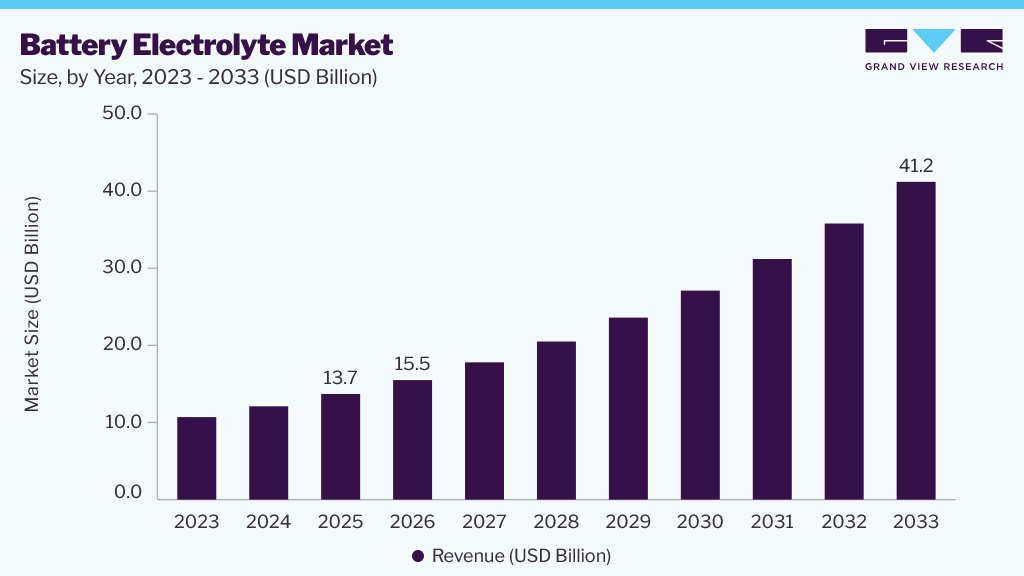
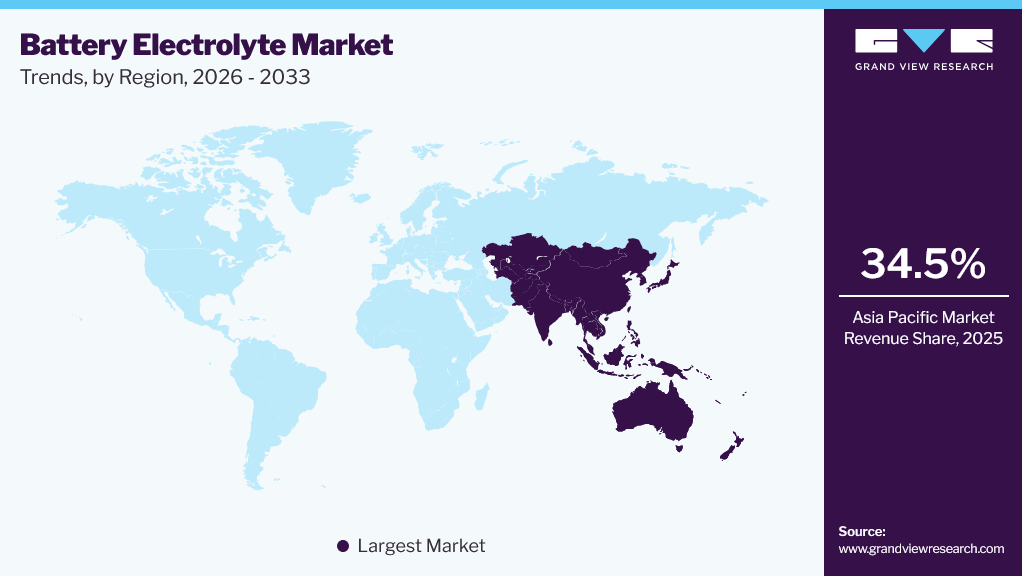
The global battery electrolyte market size was valued at USD 13.7 billion in 2025 and is projected to grow from USD 15.5 billion in 2026 to USD 41.2 billion in 2033, at a CAGR of 13.1% from 2026 to 2033.Asia Pacific dominated the market, accounting for a revenue share of 34.5% in 2025. The demand for batteries is expected to increase significantly due to the high adoption in the e-mobility industry.
Key Market Trends & Insights
- By electrolyte type: The gel segment held the largest market share of around 42.0% in 2025.
- By battery type: The lead acid segment held the largest market share of over 34.0% in 2025.
- By application: The automotive segment held the largest market share of over 30.5% in 2025.
Regional Highlights
- Largest regional market: Asia Pacific (34.5% revenue share, 2025)
- Fastest-growing regional market: Asia Pacific (highest CAGR, 2026-2033)
Market Size & Forecast
- Market size in 2025: USD 13.7 Billion
- Estimated market size in 2026: USD 15.5 Billion
- Projected market size by 2033: USD 41.2 Billion
- CAGR (2026-2033): 13.1%
Three ways to get this report
Buy it, customize it, or ask a question.Get the Full Report
What the study covers
- FormatsPDF · Excel · Dashboard
- Timeline2026–2033 annual, 2025 base
- Coverage20+ countries, 5 regions
- Companies10+ key players profiled
Customize the Report
20% free customization
- IncludeCountries, segments, points
- TailorTo your product definition
- ExtendDeeper competitor detail
- OrA fully bespoke study
- Turnaround5–10 working days
Ask an Analyst
A direct answer, usually in 1 working day
- AccessReport author, directly
- Reply timeWithin 1 working day
- No sales callDirect answer only
- FormatEmail reply
- CostFree, no cost
Many battery manufacturers strive to leave the smallest possible environmental footprint. This necessitates the careful sourcing of high-quality raw materials, the use of clean energy to power battery cell production, and the integration of circular systems into manufacturing processes. The market is expected to witness substantial growth over the forecast period, driven by the growing demand for high-power-range systems. The increasing trend towards adopting UPS systems as essential power backup devices is expected to positively impact market growth over the coming years.
Strong manufacturing capabilities and the continued expansion of the automotive industry in the U.S. are expected to support vehicle production, thereby driving battery manufacturing and increasing demand for battery electrolytes in the country over the forecast period. For instance, in January 2025, BMW expanded production capacity at its Spartanburg, South Carolina, plant, which is the company’s largest global manufacturing facility. The expansion of automotive manufacturing capacity is expected to increase battery demand across conventional and electrified vehicles, thereby supporting battery electrolyte consumption.
In addition, the growing adoption of electric vehicles in the U.S., supported by government initiatives aimed at reducing carbon emissions and promoting sustainable transportation, is expected to further drive demand for lithium-ion batteries and battery electrolytes in the coming years. For instance, in December, 2025, Orbia announced the completion of the expansion of its Custom Electrolyte facility in Madison, Wisconsin. This expansion increased the plant’s battery electrolyte production capacity by approximately 300%, which strengthens the domestic supply of electrolytes for lithium-ion batteries and emerging battery chemistries. The facility supplies electrolytes for electric vehicles, energy storage systems, industrial applications, defense, and aerospace.
Analyst Perspective
The global battery electrolyte market is expected to grow steadily, driven by rising demand for advanced energy storage solutions across electric vehicles, consumer electronics, industrial systems, and grid-scale storage applications. Battery manufacturers are increasingly emphasizing sustainable production practices, including responsible raw material sourcing, clean energy integration, and circular battery ecosystems. Growing demand for high-power backup systems, such as UPS solutions, along with increasing electric vehicle adoption, is driving the need for advanced battery technologies and a reliable supply of electrolytes. Demand across battery chemistries, including lithium-ion, lead-acid, sodium-ion, and solid-state batteries, is expected to support market expansion. However, market growth may be hindered by volatility in raw material prices, dependence on critical minerals, stringent environmental regulations, and challenges in developing safer, high-performance electrolyte formulations. Despite these challenges, growing investments in battery manufacturing, energy storage projects, and next-generation battery technologies are expected to create significant opportunities for electrolyte manufacturers globally.
Electrolyte Type Insights
Based on electrolyte type, the market is segmented into liquid, solid, and gel. The gel segment led the market with the largest revenue share of around 42.0% in 2025. The demand for gel electrolytes, particularly Gel Polymer Electrolytes (GPEs), is increasing due to their potential for advanced high-energy-density and safe rechargeable solid-state batteries. These GPEs offer advantages in enhancing battery performance, making them suitable for high-performance applications. In addition, gel electrolytes offer superior thermal stability, improved leakage resistance, and enhanced safety compared to conventional liquid electrolytes, making them increasingly suitable for electric vehicles, energy storage systems, and other applications requiring reliable battery performance under demanding operating conditions. The innovative applications and continuous improvements in gel electrolytes underscore a growing demand for these advanced materials in the energy storage sector.
The solid segment emerged as the fastest-growing segment in the market. Demand for solid electrolytes is expected to increase significantly over the forecast period, driven by their potential to transform battery technology. Their growing adoption in next-generation solid-state batteries is driven by advantages over conventional lithium-ion batteries, including improved safety through the elimination of flammable liquid electrolytes, faster charging capabilities, and longer battery lifespan. These advantages make solid electrolytes highly suitable for applications such as electric vehicles and consumer electronics. For instance, in June 2025, Formosa Smart Energy and the Battery Research Center of Ming Chi University of Technology launched a pilot production line for all-solid-state lithium batteries. This facility covers the complete manufacturing chain, including the synthesis of key materials such as solid-state battery components, thereby accelerating the commercialization of batteries that utilize solid electrolytes.
Battery Type Insights
By battery type, the market is segmented into lithium-ion, lead-acid, flow batteries, and others. The lead acid segment led the market with the largest revenue share of approximately 34.0% in 2025, owing to the flourishing telecom sector and increased automobile sales. The growing subscriber base and the impending rollout of 5G services are driving demand for backup lead-acid batteries worldwide. Lead-acid batteries comprise a positive electrode, or anode, manufactured from materials such as lead-antimony and lead-calcium alloys. For better shelf life and long-lasting battery performance, lead-calcium alloys are generally preferred. This battery consists of a pure lead-based negative electrode. Both electrodes are immersed in an electrolytic solution of sulfuric acid.
By battery type, lithium-ion batteries emerged as the fastest-growing segment, registering a significant CAGR over the forecast period. Demand for lithium-ion batteries is driven by multiple factors, including the rapid expansion of the electric vehicle (EV) market and the increasing need for energy storage solutions. The growing adoption of electric vehicles across developed and emerging economies is significantly driving demand for lithium-ion batteries due to their high energy density, lightweight design, and long cycle life. In addition, increasing investment in battery manufacturing facilities and advances in battery technology are supporting large-scale lithium-ion battery production, thereby accelerating demand for battery electrolytes. The rising preference for fast-charging and high-performance batteries across automotive, consumer electronics, and energy storage applications is further expected to support segment growth over the forecast period.
Application Insights
Based on application, the market is segmented into consumer electronics, automotive, energy storage, and others. The automotive segment led the market with the largest revenue share of around 30.5% in 2025, driven by rising environmental concerns about the harmful impact of carbon emissions from vehicles fueled by fossil fuels, which has increased research & development activities for electric vehicles equipped with lithium-ion batteries. Incentives and subsidies provided by governments in different countries to encourage consumers to opt for electric vehicles have considerably reduced prices. The easy availability of publicly accessible electric charging booths for these vehicles has also increased their popularity, particularly in Europe and North America. These factors are expected to contribute to market growth in the automotive end-use segment over the forecast period.
Energy storage emerged as the fastest-growing segment, with a significant CAGR over the forecast period, driven by rising demand for reliable, efficient energy storage systems to support renewable energy integration and grid stability. Increasing deployment of battery energy storage systems across utility-scale, commercial, and industrial applications is expected to drive demand for lithium-ion batteries in the energy storage segment. Lithium-ion batteries are increasingly preferred in energy storage systems due to their high energy density, long cycle life, and operational efficiency. Thus, growing adoption of energy storage systems across various industries worldwide, along with rising investments in renewable energy infrastructure and grid modernization, is expected to fuel demand for battery electrolytes over the forecast period.
Regional Insights
The battery electrolyte market in North America is anticipated to grow at a significant CAGR during the forecast period. The presence of major battery manufacturers and continued investments in battery production across the region are expected to drive market growth. Key market participants such as Tesla, Clarios, LG Energy Solution, and Panasonic Energy are contributing to the expansion of battery manufacturing capacity in North America. The growing demand for electric vehicles in the U.S. and Mexico, driven by rising government efforts to reduce carbon footprints through the adoption of eco-friendly transportation solutions, is expected to further support market growth over the forecast period.
U.S. Battery Electrolyte Market Trends
The battery electrolyte market in the U.S. accounted for the largest revenue share of around 63.0% in North America. Increasing sales of electric vehicles in the country, supported by favorable federal policies and the presence of major market players, are expected to drive battery demand over the forecast period. In January 2025, the U.S. Department of Energy announced funding initiatives of up to USD 725 million to expand domestic production of battery materials, components, and advanced batteries. This initiative is expected to reduce dependence on imported battery supply chains, strengthen domestic battery manufacturing capacity, and support demand for battery electrolytes.
The Canada battery electrolyte market is expected to grow at significant CAGR during the forecast period, owing to the growing demand for vehicle charging infrastructure and the installation of renewable energy systems are expected to stimulate market growth. The high demand for telecom towers coupled with ongoing innovations to reduce the cost of lithium-ion batteries is expected to spur market growth. Subsidies and a favorable regulatory framework are anticipated to drive market growth over the forecast period.
Asia Pacific Battery Electrolyte Market Trends
The Asia Pacific dominated the battery electrolyte market with a revenue share of 34.5% in 2025 and is expected to grow at the fastest CAGR over the forecast period. The robust battery manufacturing base in China, Japan, and India, along with governments' commitment to infrastructure development, is expected to drive market growth. Further, the growing FMCG companies in India, China, and Singapore are expected to increase demand for batteries, thereby driving market growth over the forecast period. In addition, rapid industrialization, rising government infrastructure spending, and rising FDI inflows are expected to promote market growth.
The China battery electrolyte market accounted for the largest revenue share of around 55.0% in the Asia Pacific in 2025. According to the China Association of Automobile Manufacturers (CAAM), electric vehicle adoption is steadily rising in the country. China continues to remain the world’s largest electric vehicle (EV) market. China sold almost 13 million electric cars in 2025, accounting for around six out of every ten electric cars sold globally. In addition, China’s strong domestic battery manufacturing base and well-established battery materials supply chain are expected to further support market growth. The presence of major battery manufacturers and continued investments in battery production capacity are driving demand for battery materials, including electrolytes, across the country. Such factors are expected to drive growth in China's battery electrolyte market over the forecast period.
The battery electrolyte market in Japan is also expected to grow at the fastest CAGR during the forecast period. In Japan, lithium-ion batteries are increasingly adopted due to their fast-charging capabilities, high energy density, and longer lifespan compared to other battery technologies. The presence of major battery manufacturers such as Panasonic Energy, GS Yuasa, Murata Manufacturing, and Toshiba is expected to support market growth. Continued investments in advanced battery technologies, energy storage systems, and electric mobility solutions are anticipated to further drive demand for battery electrolytes in the country over the forecast period.
Europe Battery Electrolyte Market Trends
The battery electrolyte market in Europe is experiencing significant demand driven by the region's increasing adoption of energy storage systems, electric vehicles, and consumer electronics. The market is witnessing substantial growth, particularly in the lithium-ion battery segment, which is expected to dominate due to its wide range of applications. Europe has seen a surge in battery usage, from energy storage systems to electric vehicles, with lithium-ion batteries projected to be the leading battery type in the region.
The Germany battery electrolyte market accounted for the largest revenue share of around 18.5% in Europe in 2025, owing to the increasing use of lithium-ion batteries in energy storage systems, electric vehicles, and consumer electronics. Germany is the world’s leading market for energy storage systems and for the development of renewable energy. Approximately 33% of the electricity consumed in Germany is derived from renewables, and this share is expected to reach 80% by 2050. This is expected to create growth opportunities for battery manufacturers in the country over the forecast period.
The battery electrolyte market in the UK is expected to grow at a significant CAGR over the forecast period. Factors such as policy measures that incentivize EV adoption, investments in national electric vehicle technology innovation, and the development of charging infrastructure are expected to fuel demand for electric vehicles. Thus, the policies aimed at promoting the growth of electric vehicles are expected to fuel the demand for lithium-ion batteries over the coming years.
Central & South America Battery Electrolyte Market Trends
The battery electrolyte market in Central & South America is anticipated to grow at a significant CAGR during the forecast period. The market's growth is driven by rising demand for consumer electronics and the emergence of dominant battery material suppliers in the region. Brazil is expected to dominate the market due to high demand for consumer electronics and the growing adoption of electric vehicles.
The Brazil battery electrolyte market accounted for the largest revenue share of around 27.5% in Central & South America in 2025. Brazil has witnessed a shift in preference toward ethanol, produced from sugar beet, as an alternative to diesel and gasoline. Currently, the electric vehicle market lags in the country due to a low number of potential buyers and a lack of charging infrastructure. However, the government of Brazil is taking various initiatives to support the electric vehicle market by exempting annual car ownership tax and import tax on electric vehicles. This is expected to fuel market growth in the country over the coming years.
Middle East & Africa Battery Electrolyte Market Trends
The battery electrolyte market in the Middle East and Africa is expected to grow at a significant CAGR during the forecast period, owing to the region's increasing need for energy storage solutions, the rise in renewable energy projects, the growing adoption of electric vehicles (EVs), and supportive government initiatives promoting sustainable energy practices.
The UAE battery electrolyte market accounted for the largest revenue share of around 37.5% in Middle East & Africa in 2025. Rapid industrialization and ongoing infrastructure development in the UAE are expected to positively impact market growth. Increasing investments in renewable energy projects, energy storage infrastructure, and power backup solutions are expected to drive demand for lithium-ion batteries across the country. This growing adoption of battery storage systems is expected to support demand for battery electrolytes over the forecast period. For instance, in 2025, Masdar and EWEC announced a landmark 5.2 GW solar project paired with a 19 GWh battery energy storage system in Abu Dhabi, which demonstrates the UAE’s increasing focus on large-scale energy storage solutions to ensure reliable power supply. The expansion of battery storage infrastructure is expected to support demand for lithium-ion batteries and associated components, which also includes battery electrolytes.
Key Battery Electrolyte Market Company Insights
Key companies are adopting several organic and inorganic growth strategies, such as new Electrolyte Type development, mergers & acquisitions, and joint ventures, to maintain and expand their market share.
Key Battery Electrolyte Companies
The following are the leading companies in the battery electrolyte market. These companies collectively hold the largest market share and dictate industry trends.
-
3M
-
UBE Corporation
-
Guangzhou Tinci Materials Technology Co., Ltd
-
Mitsubishi Chemical Group Corporation
-
Targray Technology International Inc.
-
Sionic Energy.
-
CAPCHEM
-
Mitsui Chemicals, Inc.
-
NEI Corporation
-
Central Glass Co., Ltd.
Recent Developments
-
In June 2026, Asahi Kasei announced that German battery manufacturer EAS Batteries commercialized its ultra-high-power lithium-ion battery cell using Acetolyte, Asahi Kasei’s acetonitrile-containing electrolyte technology. The electrolyte improves ionic conductivity, lowers internal resistance, and enhances battery performance under demanding operating conditions.
-
In December 2025, Mitsubishi Chemical Group announced an agreement to transfer its lithium-ion battery electrolyte manufacturing assets in the U.S. and UK to Green E Origin SARL (GEO). The transfer includes production facilities operated by Mitsubishi Chemical subsidiaries in Tennessee and the UK, supporting continued electrolyte manufacturing capacity and supply chain expansion.
Battery Electrolyte Market Report Scope
Report Attribute
Details
Market size in 2025
USD 13.7 billion
Estimated market size in 2026
USD 15.5 billion
Projected market size by 2033
USD 41.2 billion
Growth rate
CAGR of 13.1% from 2026 to 2033
Base year for estimation
2025
Actual data
2021 – 2024
Forecast period
2026 – 2033
Quantitative units
Revenue in USD billion, and CAGR from 2026 to 2033
Report coverage
Revenue forecast, company ranking, competitive landscape, growth factors, and trends
Segments covered
Electrolyte type, battery type, application, region
Regional scope
North America; Europe; Asia Pacific; Central & South America; Middle East & Africa
Country scope
U.S.; Canada; Mexico; Germany; France; Italy; UK; Spain; Hungary; China; Japan; South Korea; Australia; India; Brazil; Argentina; UAE; Saudi Arabia
Key companies profiled
3M; UBE Corporation; Guangzhou Tinci Materials Technology Co., Ltd; Mitsubishi Chemical Group Corporation; Targray Technology International Inc.; Sionic Energy.; CAPCHEM; Mitsui Chemicals, Inc.; NEI Corporation; Central Glass Co., Ltd.
Customization scope
Free report customization (equivalent up to 8 analysts working days) with purchase. Addition or alteration to country, regional & segment scope.
Pricing and purchase options
Avail of customized purchase options to meet your exact research needs. Explore purchase options
Global Battery Electrolyte Market Report Segmentation
This report forecasts revenue growth at global, regional, and country levels and provides an analysis of the latest industry trends and opportunities in each of the sub-segments from 2021 to 2033. For this study, Grand View Research has segmented the global battery electrolyte market report based on electrolyte type, battery type, application, and region:
-
Electrolyte Type Outlook (Volume, Kilo Tons; Revenue, USD Million, 2021 - 2033)
-
Liquid
-
Solid
-
Gel
-
-
Battery Type Outlook (Volume, Kilo Tons; Revenue, USD Million, 2021 - 2033)
-
Lithium-ion
-
Lead Acid
-
Flow Battery
-
Others
-
-
Application Outlook (Volume, Kilo Tons; Revenue, USD Million, 2021 - 2033)
-
Automotive
-
Consumer Electronics
-
Energy Storage
-
Others
-
-
Regional Outlook (Volume, Kilo Tons; Revenue, USD Million, 2021 - 2033)
-
North America
-
U.S.
-
Canada
-
Mexico
-
-
Europe
-
Germany
-
France
-
Italy
-
UK
-
Spain
-
Hungary
-
-
Asia Pacific
-
China
-
Japan
-
South Korea
-
Australia
-
India
-
-
Central & South America
-
Brazil
-
Argentina
-
-
Middle East & Africa
-
Saudi Arabia
-
UAE
-
-
Frequently Asked Questions About This Report
The global battery electrolyte market size was valued at USD 13.7 billion in 2025 and is estimated at USD 15.5 billion for 2026.
The conventional gel segment accounted for the largest revenue share of approximately 42.0% in 2025.
Some of the key players operating in this industry include Fuel Cell Energy, Inc., Ballard Battery Type Systems, SFC Energy AG, Nedstack Fuel Cell Electrolyte Type B.V., Bloom Energy, Doosan Fuel Cell America, Inc., Ceres Battery Type Holdings Plc, Plug Battery Type, Inc., Nuvera Fuel Cells, LLC.
The global battery electrolyte market is expected to grow at a CAGR of 13.1% from 2026 to 2033, reaching USD 41.2 billion by 2033.
Asia Pacific dominated with an approximately 34.5% revenue share in 2025.
About the Author(s)
Power Generation & Storage Research Team
Energy & Power · Power Generation & StorageThis report was authored by the power generation & storage research team at Grand View Research - comprising two research analysts, one senior research analyst, and one industry expert - with specialized expertise in the power generation & storage segment of the energy & power industry. All findings are based on proprietary energy & power databases, executive interviews, and regulatory analysis, subject to internal peer review prior to publication.
Last Updated:
Speak to Analyst


Customize this report to your needs - add regions, segments, or data points, with 20% free customization.
Or view our licence options:


ISO 9001:2015 & 27001:2022 Certified
We are GDPR and CCPA compliant! Your transaction & personal information is safe and secure. For more details, please read our privacy policy.


