
- Home
- »
- Advanced Interior Materials
- »
-
Beryllium Mining Market Size And Share Report, 2026-2033GVR Report cover

Beryllium Mining Market (2026 - 2033)
Size, Share & Trends Analysis Report By Application (Form), By End Use (Aerospace & Defense, Electronics & Telecom, Automotive, Medical & Dental), By Region (North America, Europe, Asia Pacific, MEA), And Segment Forecasts
Market Size, 2025
$11.0BMarket Estimate, 2026
$11.3BMarket Forecast, 2033
$13.9BCAGR, 2026–2033
3.1%Beryllium Mining Market Summary
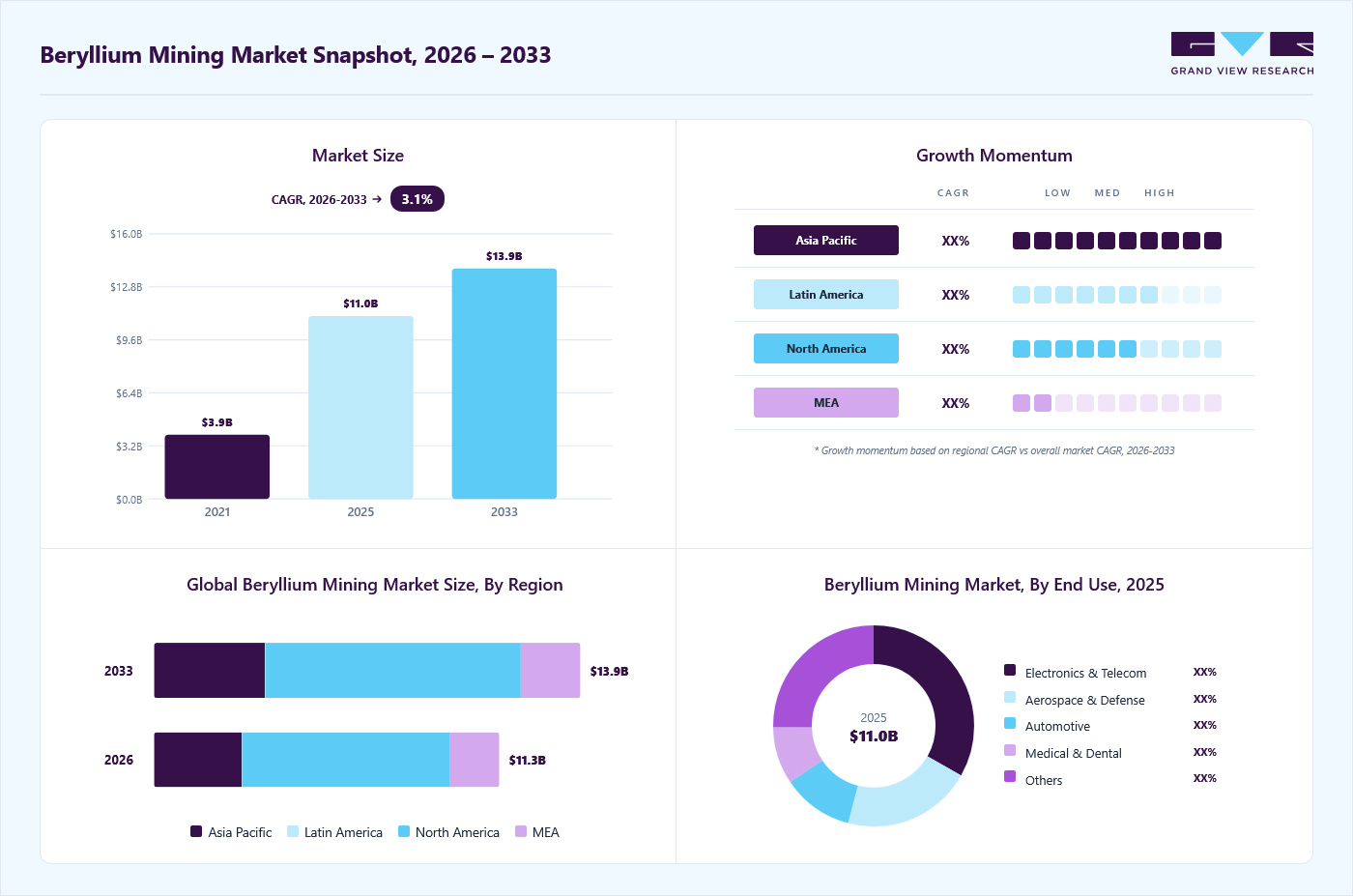
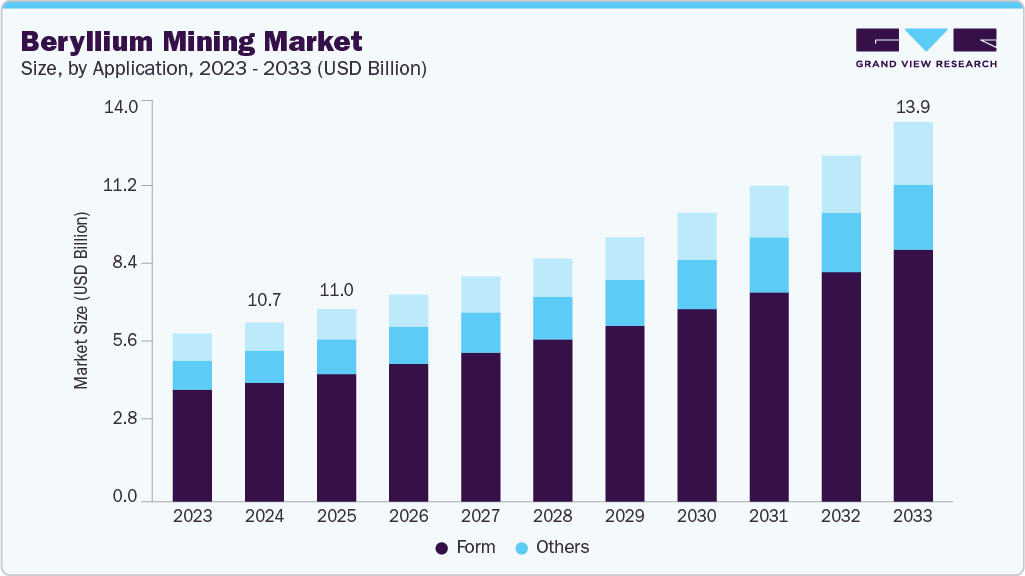
The global beryllium mining market size was valued at USD 11.0 billion in 2025 and is projected to grow from USD 11.3 billion in 2026 to USD 13.9 billion by 2033, at a CAGR of 3.1% from 2026 to 2033. The market in North America dominated with a revenue share of 60.0% in 2025. Beryllium is prized for its exceptional stiffness, light weight, and thermal stability, which keeps aerospace demand as the top growth driver for beryllium mining.
 Source: Grand View Research, IR Documents, Primary Interviews, Paid DatabasesTo learn more about this report,
 Download Free Sample Report
 Key Market Trends & Insights
- By application: Form segment held the largest market share of 66.5% in 2025.
- By end use: Electronics & telecom segment held the largest market share of 33.2% in 2025.
Regional Highlights
- Largest regional market: North America (60.0% revenue share, 2025)
- Fastest-growing regional market: Asia Pacific (highest CAGR, 2026-2033)
- By country: The U.S. held the largest market share in 2025.
Market Size & Forecast
- Market size in 2025: USD 11.0 Billion
- Estimated market size in 2026: USD 11.3 Billion
- Projected market size by 2033: USD 13.9 Billion
- CAGR (2026-2033): 3.1%
Three ways to get this report
Buy it, customize it, or ask a question.Ask an Analyst
A direct answer, usually in 1 working day
- AccessReport author, directly
- Reply timeWithin 1 working day
- No sales callDirect answer only
- FormatEmail reply
- CostFree, no cost
Get the Full Report
What the study covers
- FormatsPDF · Excel · Dashboard
- Timeline2026–2033 annual, 2025 base
- Coverage20+ countries, 5 regions
- Companies10+ key players profiled
Customize the Report
20% free customization
- IncludeCountries, segments, points
- TailorTo your product definition
- ExtendDeeper competitor detail
- OrA fully bespoke study
- Turnaround5–10 working days
As commercial and military aircraft continue to push for lighter, stronger materials to improve fuel efficiency and performance, the need for beryllium-containing alloys and components in structural parts, satellite systems, and high-performance electronics increases. Growth in space programs and satellite constellations further amplifies demand because beryllium’s combination of mechanical and thermal properties is hard to replace in precision instruments and optics.Defense and advanced electronics represent another major source of market expansion. Beryllium’s role in guided munitions, radars, and secure communication systems makes it strategically important, prompting defense procurement programs to secure reliable supplies. Meanwhile, the miniaturization of electronics and advances in high-frequency devices boost demand for beryllium-bearing components in connectors, switches, and thermal management solutions. As military modernization and high-tech manufacturing programs progress in multiple countries, these sectors continue to create steady, high-value demand.
 To learn more about this report, Download Free Sample Report
 Innovation in new industrial and scientific applications is widening the beryllium market. Growth in quantum computing, precision optics, and specialized medical devices has raised interest in beryllium for niche, high-performance uses. Research into additive manufacturing and advanced alloys also creates opportunities for beryllium to be used in specialized parts where its properties enable performance that alternative materials cannot match. Expanding these high-margin applications increases mining incentives because they justify investment in secure, high-quality feedstock.
Supply-side dynamics are a powerful growth driver because beryllium production is concentrated and capital-intensive. Limited global primary deposits and the complex, regulated processing chain make supply relatively inelastic, amplifying price signals when demand rises. Geopolitical concerns and export controls on strategic materials encourage downstream users to seek vertically integrated or diversified sources, prompting investment in economically viable exploration and processing capacity. Investors view constrained supply and strategic importance as reasons to support additional mining projects and beneficiation capacity.
Environmental regulations and recycling trends influence the market by shaping lifecycle economics and social license to operate. Strict health and environmental controls around beryllium dust and processing raise compliance costs and can limit expansion in some jurisdictions, which increases the value of responsibly sourced material. At the same time, improvements in recycling beryllium-containing alloys and components alleviate some feedstock pressure, enabling secondary supply for lower-grade applications while leaving primary mined material available for the highest-performance uses. Together, these regulatory and circular-economy factors steer investment toward safer, more efficient, and higher-quality production.
Market Dynamics
The growth of the beryllium mining market is primarily driven by rising demand from the aerospace and defense sectors. Beryllium is valued for its exceptional strength-to-weight ratio, thermal stability, and stiffness, making it a critical material for aircraft structures, satellites, missile systems, precision optics, and military communication equipment. Increasing investments in defense modernization programs, space exploration initiatives, and commercial aircraft production are boosting demand for beryllium-based materials, thereby supporting mining and exploration projects worldwide.
The aerospace and defense sector remains one of the most significant drivers of the beryllium mining market. Beryllium is widely used in aircraft structures, satellite systems, missile guidance components, optical systems, and defense electronics due to its exceptional stiffness, low density, corrosion resistance, and thermal stability. As governments continue to increase defense spending and aerospace manufacturers expand production to meet growing demand in commercial aviation, the consumption of beryllium-containing materials is rising steadily. The metal's ability to perform reliably in extreme environments makes it indispensable for advanced military and aerospace applications, supporting long-term demand for beryllium mining and processing activities worldwide.
Commercial aircraft production growth is further strengthening demand for beryllium. Airbus delivered 793 commercial aircraft in 2025, up 4% from 766 in 2024, while Boeing delivered 600 commercial aircraft in the same year, marking a strong recovery in production levels. The combined output of these leading aircraft manufacturers reflects the expanding global aerospace industry and the need for lightweight, high-performance materials across airframes, avionics, sensors, and space-related systems. As aircraft order backlogs remain elevated and defense modernization programs continue globally, the requirement for beryllium-based components is expected to increase, creating sustained growth opportunities for the beryllium mining market.
Stringent health and safety regulations surrounding beryllium exposure pose a significant restraint on the beryllium mining market. Beryllium dust, fumes, and airborne particles generated during mining, processing, and manufacturing activities can lead to serious health conditions, including chronic beryllium disease (CBD) and other respiratory disorders. As a result, regulatory authorities across major markets have established strict exposure limits, monitoring requirements, worker training programs, and protective equipment standards. Compliance with these regulations increases operational costs for mining companies through investments in ventilation systems, dust control technologies, medical surveillance programs, and workplace safety measures. These additional costs, coupled with potential legal liabilities and regulatory scrutiny, can limit production expansion and discourage new entrants from investing in beryllium mining projects.
The expansion of space exploration activities and satellite deployment programs presents a significant opportunity for the beryllium mining market. Beryllium is highly valued in the aerospace and space sectors due to its exceptional stiffness, lightweight nature, dimensional stability, and ability to withstand extreme temperature fluctuations. These properties make it an ideal material for satellite structures, optical systems, space telescopes, navigation instruments, and spacecraft components. The growing number of satellite launches for communication, Earth observation, navigation, and defense applications, along with increasing investments in lunar missions, deep space exploration, and commercial space programs, is driving demand for advanced materials that can perform reliably in harsh space environments.
Analyst Perspective
The beryllium mining market is characterized by stable long term demand driven by its critical role in aerospace, defense, electronics, telecommunications, and advanced industrial applications. Beryllium’s unique combination of lightweight properties, exceptional stiffness, high thermal conductivity, and dimensional stability makes it difficult to substitute in high performance environments where reliability is essential. Growing investments in defense modernization programs, commercial aviation, satellite deployment, semiconductor manufacturing, and next generation communication systems are expected to support sustained demand for beryllium based materials.
Application Insights
Based on application, form segment led the market with the largest revenue share of 66.5% in 2025. The growth of the form segment, which includes beryllium alloys and metal, is being fueled by rising demand in the aerospace, defense, and electronics industries. Beryllium alloys such as beryllium-copper are valued for their high strength-to-weight ratio, thermal stability, and corrosion resistance. These properties make them ideal for satellite structures, missile components, and precision instruments, where lightweight and durable materials are essential.
The others segment in the market is experiencing growth as industries seek advanced materials with unique thermal and electrical characteristics. Beryllium ceramics, such as semiconductor equipment, medical imaging devices, and precision optics, are particularly valuable in applications where heat dissipation, dimensional stability, and resistance to thermal shock are critical. With the ongoing expansion of semiconductor manufacturing and medical technology, demand for beryllium-based ceramics and composites is rising steadily.
End Use Insights
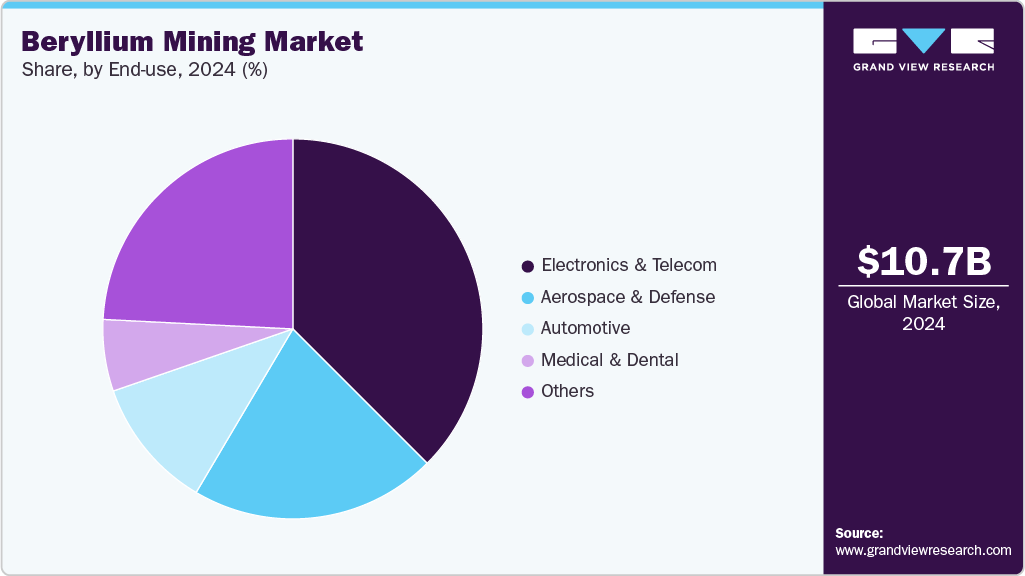
Based on end use, electronics & telecom segment led the market with the largest revenue share of 33.2% in 2025. The electronics and telecom segment in the market is expanding due to the increasing demand for high-performance and reliable electronic components. Beryllium copper alloys are widely used in connectors, switches, and relays because of their excellent electrical conductivity, mechanical strength, and fatigue resistance. Rapid growth in the semiconductor industry, rollout of 5G networks, and the miniaturization of electronic devices drive higher consumption of beryllium-based materials in producing precise and durable components for smartphones, computers, and telecom infrastructure.
 To learn more about this report, Download Free Sample Report
 The automotive segment is anticipated to register the fastest CAGR over the forecast period as manufacturers increasingly adopt lightweight and high-strength materials to improve fuel efficiency and meet stricter emission norms. Due to their excellent mechanical strength, electrical conductivity, and wear resistance, beryllium copper alloys are used in critical automotive components such as sensors, switches, connectors, and precision engine parts. The shift toward electric vehicles, hybrid drivetrains, and advanced electronics in modern vehicles further drives demand for beryllium-containing materials in battery connectors, braking systems, and electronic control units.
Regional Insights
North America dominated the beryllium mining market with the largest revenue share of 60.0% in 2025. The Asia-Pacific beryllium mining industry has become a pivotal player in the global market, primarily due to China's substantial production and consumption. In 2023, China extracted over 30,000 metric tons of beryl ore and refined approximately 28 metric tons of beryllium, solidifying its dominant force in the industry. The nation's extensive industrial base and strategic investments in electronics, aerospace, and defense have driven a steady increase in beryllium demand. This growth is further supported by China's expanding refining capabilities, which have enhanced its self-sufficiency in beryllium production.
 To learn more about this report, Download Free Sample Report
 The North America beryllium mining industry is pivotal in the global market, primarily because the U.S. produces most of the world’s refined beryllium. The U.S. operates the only commercial bertrandite mining operation in Utah, providing a consistent supply of beryllium to domestic and international markets. This mining operation forms the backbone of the region’s beryllium supply chain, supporting various industrial applications. While not as dominant in raw production, Canada contributes through refining and alloying, helping to meet specialized demands in electronics and high-tech manufacturing. The combination of U.S. production and Canadian processing ensures North America remains largely self-sufficient in meeting its critical beryllium needs.
U.S. Beryllium Mining Market Trends
The beryllium mining market in the U.S. held the largest share in the North America region in 2025, accounting for most of the region’s production. The country operates the only commercial bertrandite mine in the world, located in Utah, which serves as the primary beryllium source for domestic consumption and international supply. This mining operation underpins the U.S. beryllium supply chain, providing feedstock to industrial, aerospace, and defense manufacturers. The strategic importance of this resource has led to sustained investment in mining infrastructure and processing capabilities to ensure reliable and consistent production.
Europe Beryllium Mining Market Trends
The beryllium mining industry in Europe is growing, with Luxembourg being the only significant producer within the European Union. In 2024, Luxembourg's production reached 836 tons, accounting for most of the EU's total output of 876 tons. Despite limited local production, Europe represents a substantial consumer of beryllium, driven by aerospace, defense, electronics, and telecommunications sectors.
Asia Pacific Beryllium Mining Market Trends
The Asia Pacific beryllium mining market is anticipated to grow at the fastest CAGR over the forecast period.
Latin America Beryllium Mining Market Trends
The beryllium mining industry in Latin America is still in its early stages, with no active commercial beryllium mines currently operating. The region, particularly Brazil, possesses significant geological potential with rich mineral deposits containing beryllium-bearing minerals. These resources position Latin America as a promising area for future beryllium mining projects. The governments in the region have started recognizing the strategic importance of developing their mineral sectors, which may include beryllium as part of broader rare earth initiatives.
Middle East & Africa Beryllium Mining Market Trends
The beryllium mining industry in the Middle East and Africa is currently underdeveloped, with limited commercial production and processing facilities. However, the region holds significant geological potential, particularly in countries such as Mozambique, Nigeria, and South Africa, where new beryl deposits have been identified. In 2023, Mozambique and Nigeria reported discovering new beryl deposits totaling approximately 5,000 metric tons, indicating the region's untapped resources. Despite these discoveries, the lack of refining infrastructure and export logistics poses challenges to scaling up production to meet global demand.
Key Beryllium Mining Company Insights
Some of the key players operating in the market include Materion Corporation, Ulba Metallurgical Plant, and others
-
Materion Corporation is a leading global supplier of advanced materials, with a strong presence in beryllium mining and production. The company specializes in providing high-performance beryllium and beryllium-based products for applications requiring lightweight, strong, and thermally stable materials. Its beryllium offerings are widely used in aerospace, defense, electronics, and industrial sectors, where precision and reliability are critical. Materion operates integrated mining, refining, and alloying facilities that allow for control over product quality and supply chain efficiency, ensuring consistent performance for its customers worldwide.
-
Ulba Metallurgical Plant, based in Kazakhstan, is a major producer of beryllium and beryllium compounds. The company has developed a vertically integrated operation encompassing the extraction of beryllium ores, processing, and production of beryllium metals and alloys. Ulba, leveraging its advanced metallurgical expertise, serves various high-tech industries, including aerospace, nuclear energy, and electronics. Its focus on innovation and quality control has positioned it as a reliable supplier in the global beryllium market, supporting domestic and international industrial demands.
Key Beryllium Mining Companies
The following key companies have been profiled for this study on the beryllium mining market.
-
Materion Corporation
-
Ulba Metallurgical Plant
-
Xinjiang Xinxin Mining Industry Co Ltd
-
China Nonferrous Metal Mining Group Co Ltd (CNMC)
-
Hunan Shuikoushan Nonferrous Metals Group Co Ltd
-
IBC Advanced Alloys Corp
-
NGK Metals Corporation
-
American Beryllia Inc
-
Belmont Metals Inc
-
Texas Mineral Resources Corp
Competitive Benchmarking
Category
Operating Strategies
Competitive Edge
Weakness
Established Players (e.g. Materion Corporation, Ulba Metallurgical Plant, Xinjiang Xinxin Mining Industry Co Ltd)
- Mature participants in the beryllium mining market primarily focus on securing long term resource availability through ownership of strategic beryllium reserves and vertically integrated operations encompassing mining, concentration, refining, and alloy production.
- These companies emphasize supply chain control to ensure consistent availability of beryllium products for aerospace, defense, electronics, telecommunications, and nuclear applications.
- Established players possess significant competitive advantages through ownership of high quality beryllium resources, extensive refining infrastructure, and decades of metallurgical expertise.
- Their integrated operations enable greater control over product quality, supply reliability, and production costs.
- Despite their strong market positions, mature players face challenges related to high operating costs and stringent health, safety, and environmental regulations.
- Beryllium mining and processing require specialized handling procedures due to the potential health risks associated with beryllium exposure.
Emerging & Regional Players (e.g., IBC Advanced Alloys Corp, American Beryllia Inc.)
- Emerging participants in the beryllium mining market generally focus on resource exploration, development of new mining projects, and establishing alternative supply sources to support growing demand for critical minerals.
- Their strategies emphasize attracting strategic investments, securing government support, and positioning themselves as future suppliers for industries seeking diversified and resilient supply chains.
- Emerging companies benefit from operational flexibility and the ability to incorporate modern mining and processing technologies from the early stages of project development.
- Without extensive legacy infrastructure, they can design operations around current environmental standards, efficiency objectives, and sustainability expectations.
- Emerging participants face significant challenges related to financing requirements, lengthy project development timelines, and regulatory approvals.
- Developing a beryllium mining operation requires substantial capital investment in exploration, mine construction, processing facilities, and environmental management systems.
Recent Development
-
In September 2025, BGV Group Management received the first draft of a preliminary feasibility study (PFS) for its flagship Ukrainian Beryllium project, prepared by SGS Canada to NI 43-101 standards. The PFS results revealed robust economic fundamentals, projecting a payback period of up to five years, substantially faster than the industry average of 8-15 years, and confirming significant reserves of beryllium and zinc as key minerals. This enhances Ukraine’s global strategic role as a prospective beryllium supplier for the EU, US, and Asian markets, especially as the demand grows in aviation, defense, nuclear energy, and electronics.
Beryllium Mining Market Report Scope
Report Attribute
Details
Market definition
The beryllium mining market size represents the annual value of beryllium bearing ores (primarily bertrandite and beryl) extracted through mining activities worldwide.
Market size in 2025
USD 11.0 billion
Estimated market size in 2026
USD 11.3 billion
Projected market size by 2033
USD 13.9 billion
Growth rate
CAGR of 3.1% from 2026 to 2033
Base year for estimation
2025
Historical data
2021 - 2024
Forecast period
2026 - 2033
Quantitative units
Revenue in USD million and CAGR from 2026 to 2033
Report coverage
Revenue forecast, company ranking, competitive landscape, growth factors, and trends
Segments covered
Application, end use, region
Regional scope
North America, Asia Pacific; Latin America; Middle East & Africa
Country scope
U.S., China, Brazil, Madagascar, Mozambique
Key companies profiled
Materion Corporation; Ulba Metallurgical Plant; Xinjiang Xinxin Mining Industry Co Ltd; China Nonferrous Metal Mining Group Co Ltd (CNMC); Hunan Shuikoushan Nonferrous Metals Group Co Ltd; IBC Advanced Alloys Corp; NGK Metals Corporation; American Beryllia Inc; Belmont Metals Inc.; Texas Mineral Resources Corp
Customization scope
Free report customization (equivalent up to 8 analysts' working days) with purchase. Addition or alteration to country, regional & segment scope.
Pricing and purchase options
Avail customized purchase options to meet your exact research needs. Explore purchase options
Global Beryllium Mining Market Report Segmentation
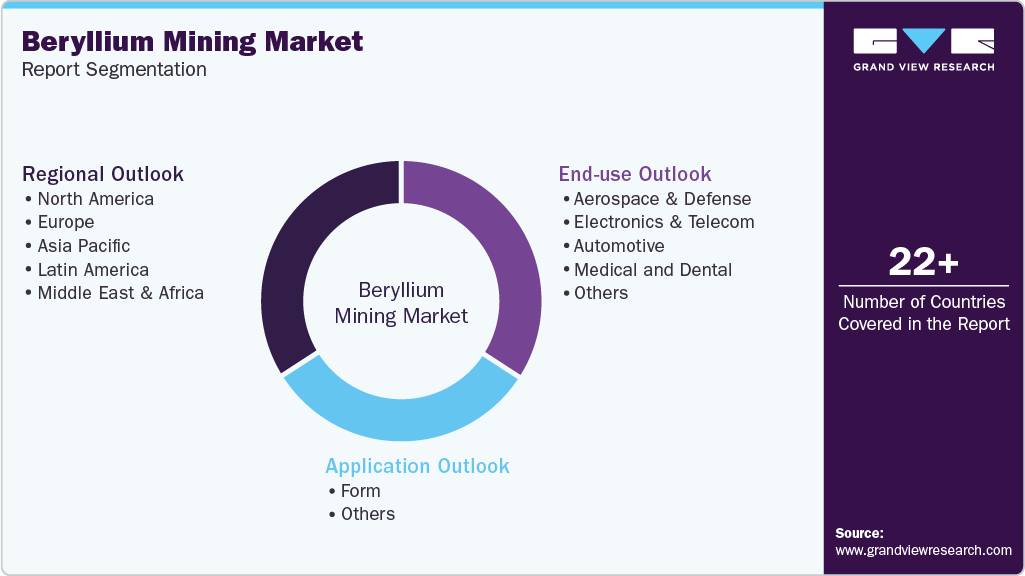
This report forecasts revenue and volume growth at global, regional, and country levels and provides an analysis of the latest industry trends in each of the sub-segments from 2021 to 2033. For this study, Grand View Research has segmented the global beryllium mining market report based on application, end use, and region.
 To learn more about this report, Download Free Sample Report
 -
Application Outlook (Revenue, USD Million, 2021 - 2033)
-
Form
-
Others
-
-
End Use Outlook (Revenue, USD Million, 2021 - 2033)
-
Aerospace & Defense
-
Electronics & Telecom
-
Automotive
-
Medical and Dental
-
Others
-
-
Regional Outlook (Revenue, USD Million, 2021 - 2033)
-
North America
-
U.S.
-
Canada
-
Mexico
-
-
Europe
-
Germany
-
UK
-
France
-
-
Asia Pacific
-
China
-
India
-
Japan
-
-
Latin America
-
Brazil
-
-
Middle East & Africa
-
Saudi Arabia
-
UAE
-
-
Research Methodology
The beryllium mining market figures in this report are based on a proven research process that combines executive interviews with secondary research from proprietary databases, company filings, and recognized regulatory and institutional sources. Market size is built through value-chain sizing - reconciling supply-side and demand-side estimates - and triangulated with bottom-up and top-down approaches. Every estimate passes multiple levels of expert validation before publication, with each beryllium mining segment quantified using the revenue-capture definitions in the table below.
Segment Definition
Application
Revenue Capture Definition
Form
This segment includes beryllium extracted and processed into commercially usable forms such as metal, alloys, oxides, and other intermediate products. These forms serve as the primary raw materials for manufacturing components used across aerospace, defense, electronics, and industrial applications.
Others
The others segment comprises niche and specialized beryllium products that do not fall under standard commercial forms. These include custom fabricated materials, specialty compounds, and application specific beryllium products developed for research, medical, and advanced technology applications.
End Use
Revenue Capture Definition
Aerospace & Defense
This segment includes the use of beryllium in aircraft structures, satellites, missile systems, spacecraft, defense electronics, and optical components. Its high strength to weight ratio, stiffness, and thermal stability make it critical for demanding aerospace and military applications.
Electronics & Telecom
Beryllium is utilized in connectors, switches, relays, semiconductors, telecommunications infrastructure, and electronic devices. Its excellent electrical conductivity, durability, and heat dissipation properties support high performance electronic systems.
Automotive
This segment covers the use of beryllium and beryllium alloys in automotive electronics, sensors, braking systems, and high performance vehicle components. The material helps improve reliability, reduce weight, and enhance overall vehicle efficiency.
Medical and Dental
Beryllium is used in medical imaging equipment, X ray windows, diagnostic instruments, and selected dental applications. Its transparency to X rays and mechanical strength make it suitable for precision healthcare technologies.
Others
The others segment includes industrial machinery, energy systems, research equipment, nuclear applications, and specialized manufacturing processes. These applications leverage beryllium's unique combination of lightweight characteristics, thermal conductivity, and structural stability.
Estimation Model
Layer Name
Key Question
Description
End Use Industry Demand Base Layer
What forms the demand base?
Identify global demand from major beryllium consuming industries including aerospace & defense, electronics & telecommunications, automotive, medical devices, energy, and industrial manufacturing. Assess production volumes and technological developments within these sectors to establish the total addressable demand for beryllium and beryllium containing materials.
Beryllium Application Penetration Layer
Where is beryllium utilized?
Estimate the penetration of beryllium across key applications including beryllium metal, beryllium alloys, beryllium oxide ceramics, X ray equipment, aerospace components, telecommunications infrastructure, electronic connectors, and defense systems. Analyze adoption trends across developed and emerging economies based on technological requirements and industry growth.
Beryllium Consumption Intensity Layer
How much beryllium is consumed?
Analyze beryllium consumption intensity based on aerospace manufacturing output, electronics production, defense procurement, medical equipment manufacturing, and industrial applications. Evaluate the utilization of beryllium concentrates, beryllium metal, and beryllium compounds across various end use sectors. Consumption intensity varies according to performance requirements, technological advancements, and material substitution trends.
Revenue Layer
How is market revenue generated?
The beryllium mining market size represents the annual value of beryllium-bearing ores and concentrates produced through mining activities. It excludes revenues associated with downstream processing, refining, beryllium metal, alloys, compounds, and end-use products. Market value is determined by mining output, ore grades, ore prices, reserve quality, and regional supply-demand conditions.
Delivered Customizations
This report has been delivered with the following In-depth customizations
Client Request
Customization Delivered
Value Adds
Regional Segmentation
Detailed regional analysis of the beryllium mining market across North America, Europe, Asia Pacific, Latin America, and Middle East & Africa. Included evaluation of beryllium reserves, mining activities, refining capacity, exploration projects, government policies, critical mineral strategies, and downstream demand from aerospace, defense, electronics, and medical industries.
Identified key resource rich regions, emerging mining projects, and high growth consumption markets. Enabled strategic expansion planning based on reserve availability, government support, and downstream industrial demand. Supported regional demand forecasting and resource development strategies.
Cross Segmentation
Comprehensive cross segmentation analysis by product type and end use industry, including beryllium metal, beryllium alloys, beryllium oxide, and other derivatives consumed across aerospace & defense, electronics & telecom, automotive, medical & dental, and industrial applications. Evaluated regional consumption patterns, technology adoption rates, material performance requirements, and demand growth opportunities across major industries.
Enabled identification of the most attractive product end use combinations and emerging demand opportunities. Supported product portfolio optimization, customer targeting, and investment prioritization strategies.
Opportunity Assessment
Identification of high growth opportunities across aerospace systems, defense technologies, satellite manufacturing, semiconductor equipment, telecommunications infrastructure, electric vehicles, medical imaging systems, nuclear applications, and advanced industrial technologies.
Enabled prioritization of high return growth segments and emerging regional opportunities. Supported long term investment planning, exploration activities, capacity expansion decisions, and strategic business development initiatives aligned with advanced technology and national security trends.
Frequently Asked Questions About This Report
The global beryllium mining market size was valued at USD 11.0 billion in 2025 and is estimated at USD 11.3 billion for 2026.
The global beryllium mining market is expected to grow at a CAGR of 3.1% from 2026 to 2033, reaching USD 13.9 billion by 2033.
The U.S. dominated the North American market in 2025.
Asia Pacific is anticipated to register the fastest CAGR over the forecast period.
Based on application, the form segment accounted for largest revenue share of 66.5% in 2025.
The electronics & telecom segment led with a 33.2% revenue share in 2025, while the automotive segment is the fastest-growing.
The key players operating in the beryllium mining market are Materion Corporation; Ulba Metallurgical Plant; Xinjiang Xinxin Mining Industry Co Ltd; China Nonferrous Metal Mining Group Co Ltd (CNMC); Hunan Shuikoushan Nonferrous Metals Group Co Ltd; IBC Advanced Alloys Corp; NGK Metals Corporation; American Beryllia Inc; Belmont Metals Inc.; Texas Mineral Resources Corp
The key factor driving the growth of the global beryllium mining market is the rising demand for lightweight and high-performance materials across aerospace, defense, telecommunications, and electronics industries.
North America dominated the market with revenue share of 60.0% in 2025.
About the Author(s)
Advanced Interior Materials Research Team
Advanced Materials · Advanced Interior MaterialsThis report was authored by the advanced interior materials research team at Grand View Research - comprising two research analysts, one senior research analyst, and one industry expert - with specialized expertise in the advanced interior materials segment of the advanced materials industry. All findings are based on proprietary advanced materials databases, executive interviews, and regulatory analysis, subject to internal peer review prior to publication.
Last Updated:
Speak to Analyst

Customize this report to your needs - add regions, segments, or data points, with 20% free customization.
Or view our licence options:


ISO 9001:2015 & 27001:2022 Certified
We are GDPR and CCPA compliant! Your transaction & personal information is safe and secure. For more details, please read our privacy policy.


