
- Home
- »
- Personal Care & Cosmetics
- »
-
Bio-based Surfactants Market Size & Share Report, 2033GVR Report cover
![Bio-based Surfactants Market (2026 - 2033)Report]()
Bio-based Surfactants Market (2026 - 2033)
Size, Share & Trends Analysis Report By Product Type (Rhamnolipids, Sophorolipids), By Source (Vegetable Oils & Natural Fats, Sugars & Carbohydrates), By Application (Household Detergents, Cosmetics & Personal Care), By Region, Forecasts
Market Size, 2025
$2.0BMarket Estimate, 2026
$2.1BMarket Forecast, 2033
$3.1BCAGR, 2026–2033
5.4%Bio-Based Surfactants Market Summary
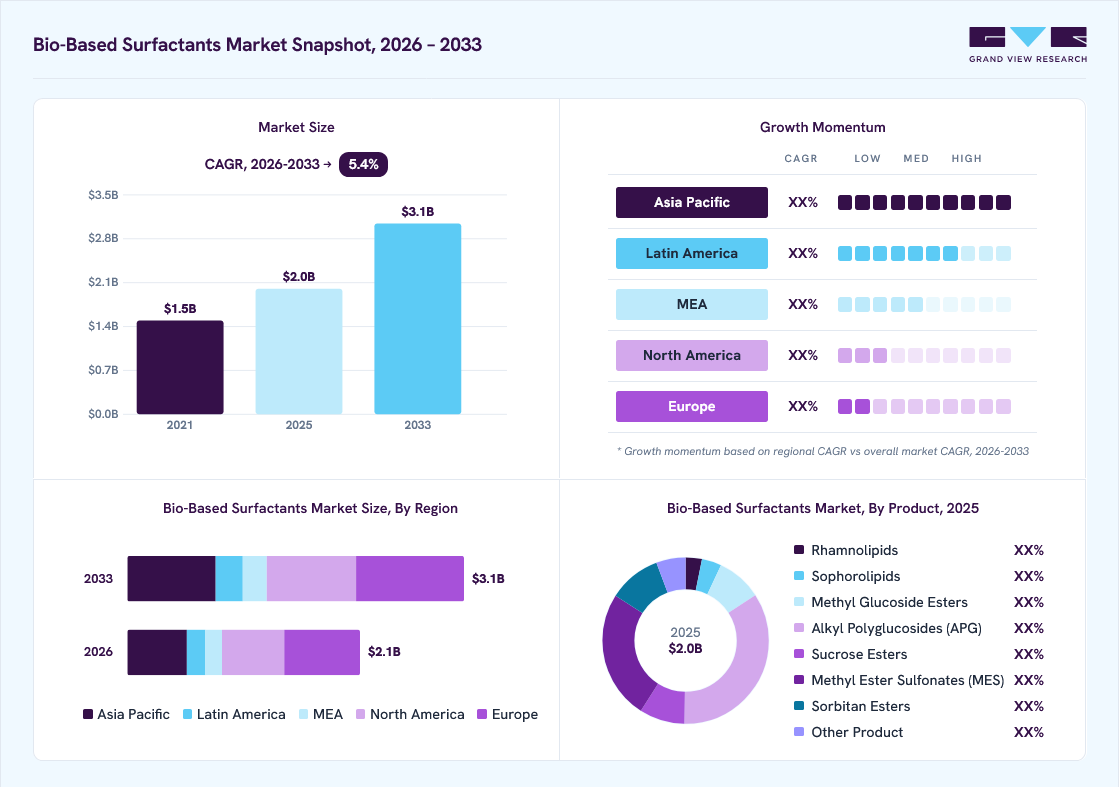
The global bio-based surfactants market size was valued USD 2.0 billion in 2025 and is projected to grow from USD 2.1 billion in 2026 to reach USD 3.1 billion by 2033, at a CAGR of 5.4% from 2026 to 2033. Europe dominated the market, accounting for the largest revenue share of 32.6% in 2025. The market growth is driven by increasing demand for biodegradable and renewable surfactants, stringent environmental regulations promoting sustainable chemical alternatives, and expanding adoption across household detergents, personal care, industrial cleaning, and agricultural applications.
Key Market Trends & Insights
- By product type: The alkyl polyglucosides held the largest revenue share of 34.4% in 2025.
- By source: The vegetable oils & natural fats dominated with a share of 49.7% in 2025.
- By application: The household detergents led the segment with a revenue share of 37.1% in 2025.
Regional Highlights
- Largest Region: Europe (32.6% revenue share, 2025)
- Fastest-growing region: Asia Pacific (highest CAGR, 2026-2033)
- By country: Germany held the largest market share in 2025.
Market Size & Forecast
- Market size in 2025: USD 2.0 Billion
- Estimated market size in 2026: USD 2.1 Billion
- Projected market size by 2033: USD 3.1 Billion
- CAGR (2026-2033): 5.4%
Consumers are increasingly prioritizing health, wellness, and transparency when selecting beverages, resulting in a strong preference for products formulated with naturally derived botanical ingredients.
Categories such as ready-to-drink teas, functional waters, kombucha, plant-based beverages, energy drinks, and wellness shots are witnessing higher adoption as consumers seek products that deliver benefits including immune support, digestive health, cognitive performance, hydration, relaxation, and stress management. Herbal extracts, floral infusions, spices, and fruit-derived extracts are increasingly being incorporated to provide both functional value and authentic natural flavors.
Market Dynamics
The bio-based surfactants market is growing as industries increasingly prioritize sustainable raw materials, regulatory compliance, and reduced environmental impact. Rising consumer preference for biodegradable ingredients in personal care, household cleaning, and industrial formulations is encouraging manufacturers to replace petroleum-derived surfactants with renewable alternatives. Advances in biotechnology and green chemistry are improving production efficiency, enabling the commercialization of high-performance products with enhanced functionality and broader application potential. At the same time, stringent environmental regulations and corporate sustainability commitments are accelerating investment in product portfolios across developed and emerging economies. However, expansion is constrained by higher production costs, limited availability of renewable feedstocks, and challenges associated with scaling fermentation and bio-based manufacturing processes. Despite these limitations, increasing research and development activities, strategic collaborations, and capacity expansions are expected to strengthen competitiveness. Growing demand from sectors such as personal care, agriculture, oilfield chemicals, and institutional cleaning, coupled with innovations is expected to create long-term growth opportunities.
The increasing emphasis on sustainability is a primary driver, as manufacturers across personal care, home care, industrial cleaning, and agricultural sectors seek environmentally responsible alternatives to conventional petrochemical surfactants. Growing consumer awareness regarding product safety, biodegradability, and renewable sourcing has encouraged brand owners to reform their product portfolios using natural ingredients. In parallel, multinational consumer goods companies are integrating sustainability targets into their procurement and product development strategies, creating sustained demand for products derived from plant oils, sugars, and other renewable feedstocks. This shift is strengthening the commercial adoption of premium products.
The increasingly stringent environmental regulations governing chemical emissions, aquatic toxicity, and biodegradability are reinforcing the transition toward renewable technologies. Regulatory frameworks promoting green chemistry and the circular economy are encouraging investments in bio-based production capabilities and sustainable innovation. Advancements in biotechnology and fermentation processes are also enhancing product performance and cost efficiency, enabling bio-based surfactants to meet the functional requirements of diverse industrial applications. These developments are collectively supporting long-term market expansion and increasing the competitiveness of bio-based formulations.
The relatively high production cost compared with conventional petroleum-based surfactants. The manufacturing of bio-based surfactants often depends on renewable feedstocks, specialized fermentation technologies, advanced downstream purification processes, and stringent quality control measures, all of which increase production expenses. Feedstock price volatility resulting from agricultural supply fluctuations and competition with food and biofuel industries further impacts cost stability. Many bio-based surfactants are still produced at comparatively lower commercial volumes, limiting economies of scale and reducing price competitiveness. These factors can discourage adoption in price-sensitive applications, particularly in emerging economies where purchasing decisions are heavily influenced by cost. Although continuous technological advancements and capacity expansions are gradually improving manufacturing efficiency, achieving cost parity with conventional surfactants remains a key challenge that may restrain broader market penetration in the near term.
The growing adoption of sustainable cleaning solutions across industrial and institutional sectors presents a growth opportunity for this industry. Manufacturing facilities, healthcare institutions, hospitality establishments, and food processing plants are increasingly replacing conventional cleaning chemicals with biodegradable formulations that comply with stricter environmental and occupational safety standards. They provide effective detergency, wetting, emulsification, and foaming properties while reducing environmental impact, making them suitable for next-generation industrial cleaning products. This trend is encouraging formulators to develop innovative products that balance performance with sustainability. corporate environmental, social, and governance (ESG) commitments are driving procurement decisions toward renewable and low-carbon chemical ingredients. Large organizations are actively seeking cleaning solutions that contribute to carbon reduction goals and improve supply chain sustainability. Emerging markets are also witnessing rising investments in green manufacturing practices, creating new commercial opportunities for suppliers of bio-based surfactants.
Market Concentration & Characteristics
The bio-based surfactants industry is moderately consolidated, with competition centered on the development of high-performance bio-based surfactants, renewable feedstock sourcing, biotechnology capabilities, production efficiency, and building long-term partnerships with consumer goods and industrial manufacturers. Leading companies are expanding their portfolios of bio-based anionic, nonionic, cationic, and amphoteric surfactants to address the rising demand for biodegradable, and low-carbon ingredients across personal care, home care, industrial cleaning, agriculture, and oilfield applications. Investments in advanced fermentation technologies, green chemistry processes, and sustainable raw material procurement have emerged as key competitive differentiators, enabling manufacturers to improve product performance while reducing environmental impact and supporting circular economy initiatives.
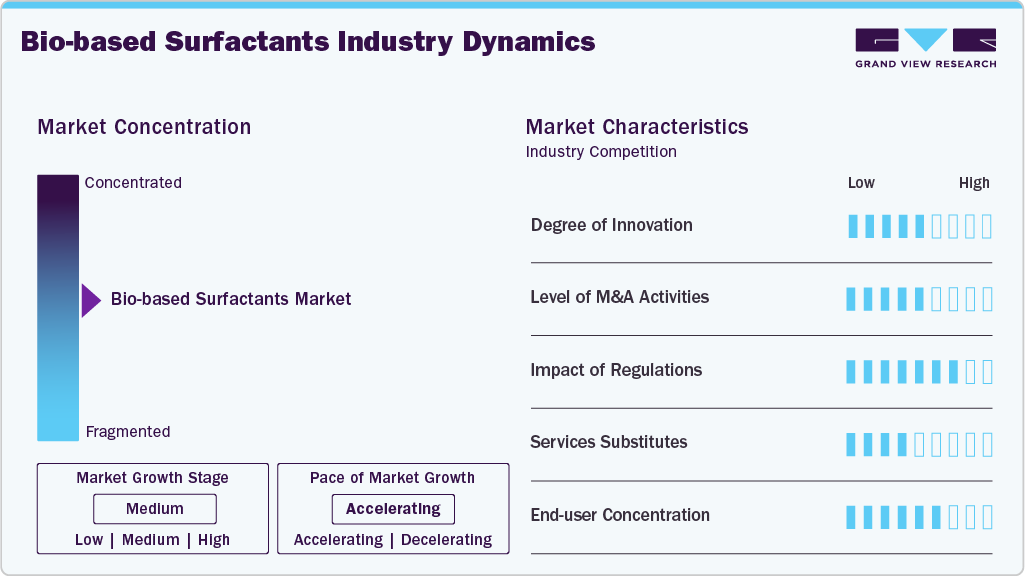
Participants are also strengthening their competitive position through strategic collaborations, production capacity expansions, technology licensing, and targeted acquisitions to enhance their bio-based product offerings and geographic presence. Companies are increasingly working with consumer goods manufacturers and industrial formulators to develop customized surfactant solutions that meet specific performance, regulatory, and sustainability requirements across diverse end-use industries. Investments in research and development, renewable feedstock integration, and environmentally responsible manufacturing processes are enabling suppliers to improve cost competitiveness, enhance product scalability, and comply with evolving environmental regulations. These strategic initiatives are supporting innovation while positioning manufacturers to capitalize on the growing global transition toward sustainable specialty chemicals.
Analyst Perspective
The bio-based surfactants industry is transitioning from a niche sustainable segment to a commercially viable alternative to conventional surfactants as environmental regulations and consumer preferences continue to evolve. Higher production costs remain a challenge, ongoing advances in biotechnology and process optimization are steadily improving commercial feasibility. Strong demand personal care, home care, and industrial cleaning, where sustainability has become a key purchasing criterion. Companies investing in renewable feedstocks, scalable production technologies, and strategic collaborations are likely to strengthen their competitive position. Over the long term, growth is supported by the global shift toward low-carbon, biodegradable, and circular economy-based chemical solutions.
Product Type Insights
The alkyl polyglucosides (APG) held the largest revenue share of 34.4% in 2025, due to their broad commercial adoption across household detergents, personal care products, industrial cleaners, and agricultural formulations. Produced from renewable feedstocks such as glucose and fatty alcohols, APGs combine excellent detergency, low toxicity, high biodegradability, and compatibility with other surfactants, making them one of the most versatile product categories. Their well-established manufacturing base, cost competitiveness, and compliance with increasingly stringent environmental regulations have accelerated adoption among global formulators seeking sustainable alternatives to petroleum-based surfactants.
The Rhamnolipids segment is the fastest-growing product type segment, with a CAGR of 11.3% from 2026 to 2033. driven by rapid advancements in industrial biotechnology and increasing commercialization of microbial biosurfactants. Their exceptional surface activity, biodegradability, low ecotoxicity, and effectiveness at low concentrations make them highly attractive for applications in personal care, industrial cleaning, agriculture, oilfield chemicals, and environmental remediation. Rising investments in fermentation technologies, expanding commercial-scale production facilities, and increasing regulatory support for bio-based chemicals are improving product availability and reducing manufacturing costs.
Source Insights
The vegetable oils & natural fats segment held the largest revenue share of 49.7% in 2025, owing to their widespread availability, well-established global supply chains, and compatibility with commercial surfactant manufacturing processes. Feedstocks such as coconut oil, palm kernel oil, sunflower oil, and rapeseed oil serve as primary raw materials for producing alkyl polyglucosides, methyl ester sulfonates, sucrose esters, and other renewable surfactants. Their cost competitiveness, scalable production, and favorable performance characteristics have supported extensive adoption across household detergents, personal care products, and industrial cleaning formulations.
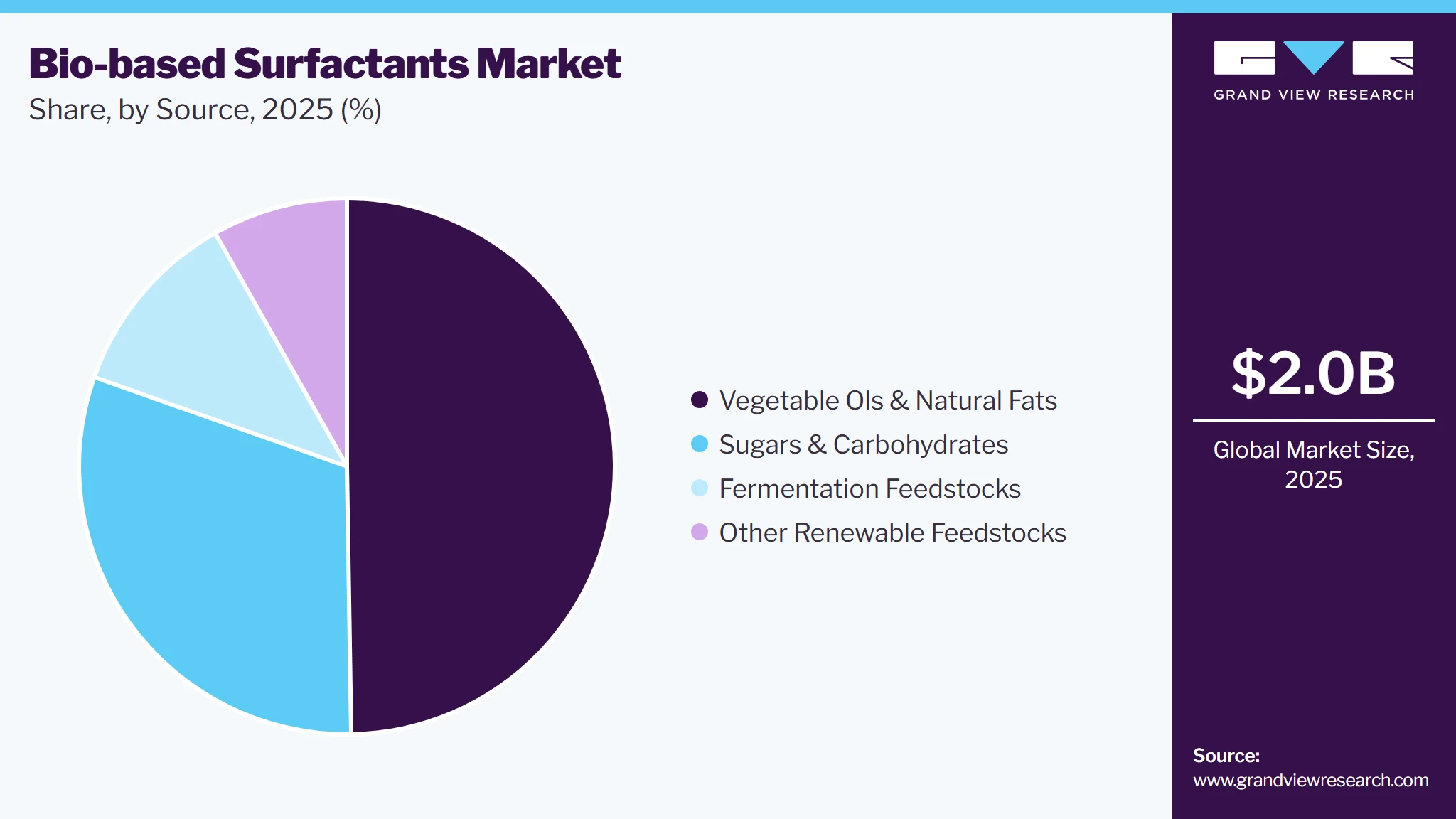
The fermentation feedstocks segment is the fastest-growing ingredient type segment, with a CAGR of 9.1% from 2026 to 2033, as biotechnology continues to transform the production of next-generation biosurfactants. Renewable substrates such as sugars, glycerol, and agricultural by-products are increasingly utilized in microbial fermentation to manufacture high-value surfactants including rhamnolipids and sophorolipids with superior biodegradability and low toxicity. Continuous advancements in fermentation efficiency, strain engineering, and downstream processing are improving commercial scalability while reducing production costs.
Application Insights
The household detergents segment held the largest revenue share of 37.1% in 2025. due to the widespread adoption of renewable surfactants in laundry detergents, dishwashing liquids, and multi-purpose cleaning products. Growing consumer preference for biodegradable cleaning ingredients, combined with stringent environmental regulations restricting the use of conventional petroleum-based surfactants, has accelerated the incorporation of bio-based alternatives into household formulations. Leading detergent manufacturers are also increasing the use of plant-derived and fermentation-based surfactants to meet corporate sustainability goals, reduce carbon footprints, and comply with eco-label certification requirements. Their superior cleaning efficiency, low toxicity, and favorable environmental profile continue to strengthen demand.
The cosmetics & personal care segment is the fastest-growing ingredient type segment, with a CAGR of 7.4% from 2026 to 2033. driven by increasing consumer demand for naturally derived, skin-friendly, and sustainable ingredients. Bio-based surfactants are gaining significant traction in shampoos, facial cleansers, body washes, and skincare formulations because they offer mild cleansing performance, improved skin compatibility, and excellent biodegradability. Premium beauty brands are reformulating their product portfolios with renewable ingredients to support clean-label positioning, meet evolving regulatory requirements, and achieve environmental, social, and governance (ESG) objectives.
Region Insights
Europe dominated the bio-based surfactants market with a share of 32.6% in 2025, owing to its stringent environmental regulations, well-established bioeconomy policies, and strong commitment to reducing dependence on petroleum-derived chemicals. The region has a mature specialty chemicals industry, significant investments in green chemistry, and widespread adoption of sustainable ingredients across household cleaning, personal care, and industrial applications. In addition, increasing corporate sustainability commitments and the presence of leading manufacturers continue to strengthen regional demand for renewable surfactant technologies.

Germany Bio-based Surfactants Market Trends
Germany bio-based surfactants market led European market due to its advanced chemical manufacturing infrastructure, strong biotechnology capabilities, and continuous investment in sustainable product innovation. The presence of globally recognized chemical producers, extensive research and development activities, and supportive environmental regulations has accelerated the commercialization of bio-based surfactants. Strong industrial demand from personal care, home care, and industrial cleaning sectors further reinforces the country's leadership position.
North America Bio-based Surfactants Market Trends
North America is expected to witness strong growth during the forecast period, supported by rising demand for sustainable consumer products, expanding investment in biotechnology, and increasing regulatory focus on environmentally safer chemical formulations. Growing adoption of renewable surfactants across household detergents, personal care, institutional cleaning, and agricultural applications is creating new opportunities for manufacturers. Strategic collaborations, product innovation, and increasing corporate ESG commitments are expected to sustain regional growth.
The U.S. dominates the regional landscape owing to its large consumer goods industry, strong biotechnology ecosystem, and continuous investment in sustainable specialty chemicals. Major manufacturers are increasingly incorporating renewable surfactants into premium personal care and cleaning products to meet evolving consumer preferences and corporate sustainability objectives. Continuous innovation, favorable research infrastructure, and expanding commercialization activities support long-term industry development.
Asia Pacific Bio-based Surfactants Market Trends
Asia Pacific is emerging as a high-potential region due to rapid industrialization, increasing environmental awareness, and expanding production of bio-based chemicals. Rising consumption of household cleaning products, cosmetics, and agricultural chemicals, coupled with growing investments in sustainable manufacturing, is accelerating adoption across the region. Government initiatives promoting green manufacturing and the availability of renewable agricultural feedstocks further support future expansion.
Bio-based surfactants market in China leads the Asia Pacific market through its large-scale chemical manufacturing capacity, abundant feedstock availability, and rapidly expanding consumer goods industry. Increasing environmental regulations encouraging greener production practices, combined with rising domestic demand for biodegradable cleaning and personal care products, are driving market growth. Continued investment in biotechnology, industrial modernization, and sustainable manufacturing technologies is further strengthening the country's competitive position.
Middle East & Africa Bio-based Surfactants Market Trends
The Middle East & Africa region is experiencing gradual growth as governments and industries increasingly adopt sustainable chemical solutions to diversify beyond traditional petrochemical production. Expanding investments in industrial cleaning, personal care manufacturing, and water treatment applications are creating demand for environmentally responsible surfactants. Growing awareness of sustainability and the gradual implementation of environmental standards are expected to support long-term market development.
Latin America Bio-based Surfactants Market Trends
Latin America presents attractive growth opportunities due to its abundant agricultural resources, expanding oleochemical industry, and increasing production of renewable feedstocks used in bio-based surfactant manufacturing. Rising demand for sustainable household cleaning products, personal care formulations, and agricultural chemicals is encouraging manufacturers to expand their regional presence. Supportive sustainability initiatives and growing investments in bio-based industries are expected to strengthen market prospects over the forecast period.
Key Bio-based Surfactants Company Insights
Companies are strengthening their competitive position by investing in biotechnology, green chemistry, and advanced production technologies to enhance performance, scalability, and cost efficiency. They are also expanding their product portfolios through strategic collaborations, capacity expansions, and targeted acquisitions while increasing the use of renewable feedstocks to support sustainability objectives. Manufacturers are partnering with end-use industries to develop application-specific formulations, enabling greater product differentiation and broader adoption across diverse industrial and consumer applications.
-
Arkema is a leading specialty chemicals company with a growing focus on sustainable materials and high-value surfactant solutions derived from renewable resources. Through its specialty surfactants portfolio, the company offers bio-based ingredients designed for applications such as personal care, home care, industrial cleaning, and agrochemicals. Its competitive advantage lies in continuous investment in green chemistry, process innovation, and sustainable manufacturing, enabling the development of high-performance formulations that align with evolving environmental standards. The company's global manufacturing footprint and strong research capabilities further strengthen its position in the industry.
-
Croda International is a prominent producer and supplier of specialty chemicals and bio-based ingredients, with a well-established portfolio of naturally derived surfactants for personal care, household, and industrial applications. The company emphasizes renewable feedstocks, biotechnology, and sustainable formulation technologies to deliver products that combine high performance with improved environmental profiles. Ongoing investments in innovation, customer-focused product development, and sustainable sourcing have enabled Croda to expand its offerings while addressing increasing demand for biodegradable and low-carbon solutions. Its extensive global presence and strong collaboration with consumer goods manufacturers reinforce its competitive position.
Key Bio-based Surfactants Companies:
The following key companies have been profiled for the study on the bio-based surfactants market.
-
BASF SE
-
Clariant
-
Evonik Industries
-
Croda International
-
Solvay
-
Arkema
-
Oleon
-
SurfactGreen
-
KLK Kolb
-
Lankem
-
EOC Group
-
ERASM
Competitive Benchmarking
Operating Strategies
Competitive Edge
Weaknesses
Mature Players: BASF SE, Clariant, Evonik Industries, Croda International, Solvay, Arkema, Oleon
- Invest heavily in R&D to develop high-performance bio-based surfactants.
- Expand production capacity and optimize global manufacturing networks.
- Secure renewable feedstocks through long-term supplier partnerships.
- Strengthen market presence through acquisitions, collaborations, and diversified product portfolios.
- Strong global distribution networks and established customer relationships.
- Broad product portfolios serving multiple end-use industries.
- Significant financial resources to support innovation and expansion.
- Well-established regulatory expertise and global manufacturing capabilities.
- Higher operational complexity due to large-scale global operations.
- Longer product development and commercialization cycles.
- Legacy petrochemical businesses may slow the transition to fully bio-based portfolios.
- Greater exposure to regulatory changes across multiple international markets.
Emerging Players: SurfactGreen, KLK Kolb, Lankem, EOC Group, ERASM
- Focus on niche bio-based surfactant technologies and specialized applications.
- Commercialize innovative formulations using biotechnology and green chemistry.
- Collaborate with research institutes and industry partners to accelerate product development.
- Target high-growth applications and regional markets with customized solutions.
- High flexibility in responding to evolving customer requirements.
- Strong innovation in sustainable and bio-based technologies.
- Faster development of customized and application-specific solutions.
- Agile business models focused on emerging sustainability trends.
- Limited production capacity compared with multinational competitors.
- Lower brand recognition and smaller global distribution footprint.
- Greater dependence on external funding or strategic partnerships for expansion.
- Higher unit production costs due to limited economies of scale.
Recent Developments
-
In May 2024, Evonik opened the first industrial-scale production facility for rhamnolipid biosurfactants in Slovakia. This significant investment of triple-digit millions of euros supports the increasing demand from personal care, cleaning, agriculture, and other industries.
-
In September 2024, BASF launched Plantapon Soy, a bio-based anionic surfactant made from European soy protein and coconut oil, designed for gentle rinse-off formulations, thereby enhancing its sustainable personal care portfolio.
Bio-Based Surfactants Market Report Scope
Report Attribute
Details
Market size value in 2025
USD 2.0 billion
Estimated Market size in 2026
USD 2.1 billion
Projected revenue size by 2033
USD 3.1 billion
Growth rate
CAGR of 5.4% from 2026 to 2033
Base year for estimation
2025
Historical data
2021 - 2024
Forecast period
2026 - 2033
Quantitative units
Revenue in USD billion, volume in kilotons, and CAGR from 2026 to 2033
Report coverage
Revenue forecast, volume forecast, company ranking, competitive landscape, growth factors, and trends
Segments covered
Product type, source, application, region
Regional scope
North America; Europe; Asia Pacific; Latin America; Middle East & Africa
Country scope
U.S.; Canada; Mexico; Germany; UK; France; Italy; Spain; China; India; Japan; South Korea; Brazil; Argentina; Saudi Arabia; South Africa.
Key companies profiled
BASF SE; Clariant; Evonik Industries; Croda International; Solvay; Arkema; Oleon; SurfactGreen; KLK Kolb; Lankem; EOC Group; ERASM
Customization scope
Free report customization (equivalent up to 8 analysts’ working days) with purchase. Addition or alteration to country, regional & segment scope.
Pricing and purchase options
Avail customized purchase options to meet your exact research needs. Explore purchase options
Global Bio-based Surfactants Market Report Segmentation
This report forecasts volume & revenue growth at regional, and country levels and provides an analysis of the latest industry trends in each of the sub-segments from 2021 to 2033. For this study, Grand View Research has segmented the bio-based surfactants market report based on product type, source, application and region:

-
Product Type Outlook (Revenue, USD Billion, Volume, Kilotons, 2021 - 2033)
-
Rhamnolipids
-
Sophorolipids
-
Methyl Glucoside Esters
-
Alkyl Polyglucosides (APG)
-
Sucrose Esters
-
Methyl Ester Sulfonates (MES)
-
Sorbitan Esters
-
Other Products (Anionic APG Derivatives)
-
-
Source Outlook (Revenue, USD Billion, Volume, Kilotons, 2021 - 2033)
-
Vegetable Ols & Natural Fats
-
Sugars & Carbohydrates
-
Fermentation Feedstocks
-
Other Renewable Feedstocks
-
-
Application Outlook (Revenue, USD Billion, Volume, Kilotons, 2021 - 2033)
-
Household Detergents
-
Industrial & Institutional Cleaners
-
Cosmetics & Personal Care
-
Agriculture Chemicals
-
Textile & Leather
-
Oilfield Chemicals
-
Paints & Coatings
-
Other Application
-
-
Regional Outlook (Revenue, USD Billion, Volume, Kilotons, 2021 - 2033)
-
North America
-
U.S.
-
Canada
-
Mexico
-
-
Europe
-
UK
-
Germany
-
France
-
Italy
-
Spain
-
-
Asia Pacific
-
China
-
Japan
-
India
-
South Korea
-
-
Latin America
-
Brazil
-
Argentina
-
-
Middle East and Africa (MEA)
-
South Africa
-
Saudi Arabia
-
-
Research Methodology
The bio-based surfactantsmarketfigures in this report are based on a proven research process that combines executive interviews with secondary research from proprietary databases, company filings, and recognized regulatory and institutional sources. Market size is built through value-chain sizing—reconciling supply-side and demand-side estimates—and triangulated with bottom-up and top-down approaches. Every estimate passes multiple levels of expert validation before publication, with eachbio-based surfactantssegment quantified using the revenue-capture definitions in the table below.
Segment Definition
Segment - Product Type
Revenue capture definition
Rhamnolipids
Commercial demand is driven by microbial biosurfactants that deliver excellent detergency, emulsification, and biodegradability for household, industrial, and personal care formulations.
Sophorolipids
Market expansion is supported by fermentation-derived surfactants offering effective foaming, cleansing, and conditioning properties across cosmetics and specialty cleaning applications.
Methyl Glucoside Esters
Value creation stems from the adoption of sugar-based nonionic surfactants that enhance emulsification, moisturization, and cleansing performance in personal care products.
Alkyl Polyglucosides (APG)
Strong commercial uptake is attributed to plant-derived surfactants that combine excellent cleaning efficiency with superior environmental compatibility across multiple industries.
Sucrose Esters
Business growth is fueled by naturally derived emulsifiers that improve formulation stability while supporting clean-label and sustainable product development.
Methyl Ester Sulfonates (MES)
Industry demand is strengthened by renewable oil-based surfactants that provide high detergency and cost-effective performance in household cleaning applications.
Sorbitan Esters
Product commercialization is supported by multifunctional emulsifiers that enhance consistency, dispersion, and stability across cosmetic, pharmaceutical, and industrial formulations.
Other Products (Anionic APG Derivatives)
Market opportunities arise from specialty bio-based surfactants designed to deliver advanced wetting, dispersing, and surface modification characteristics for niche applications.
Segment - Source
Revenue capture definition
Vegetable Ols & Natural Fats
Commercial activity is centered on renewable oils and natural fats that serve as primary raw materials for manufacturing sustainable surfactants with reliable performance characteristics.
Sugars & Carbohydrates
Market value is created through the conversion of glucose, sucrose, and other carbohydrate feedstocks into biodegradable surfactants for personal care and cleaning formulations.
Fermentation Feedstocks
Business potential is driven by microbial fermentation technologies that produce high-performance biosurfactants from renewable biological substrates.
Other Renewable Feedstocks
Growth is supported by the utilization of biomass-derived intermediates and alternative renewable resources that improve raw material diversification and long-term sustainability.
Segment - Application
Revenue capture definition
Household Detergents
Consumer demand supports widespread incorporation of bio-based surfactants into laundry detergents, dishwashing liquids, and multi-purpose cleaning products.
Industrial & Institutinal Cleaners
Commercial adoption continues to increase as sustainable cleaning formulations gain preference across manufacturing, healthcare, hospitality, and commercial facilities.
Cosmetics & Personal Care
Product utilization is expanding across shampoos, facial cleansers, body washes, and skincare formulations requiring mild and naturally derived cleansing ingredients.
Agriculture Chemicals
Industry adoption is driven by the use of renewable surfactants as wetting agents and adjuvants that enhance pesticide performance and crop protection efficiency.
Textile & Leather
Growing utilization in textile processing and leather treatment supports improved scouring, dye penetration, emulsification, and finishing performance.
Oilfield Chemicals
Application growth is supported by surfactants that improve emulsification, enhanced oil recovery, and drilling fluid performance under challenging operating conditions.
Paints & Coatings
Market penetration is encouraged by the use of renewable surfactants that enhance pigment dispersion, wetting behavior, and formulation stability in coating systems.
Other Application
Commercial prospects extend across pharmaceuticals, mining, pulp and paper, and water treatment where specialized surface-active performance is required.
Estimation Model
Layer Name
Key Question
Description
Raw Material & Production Layer
What forms the supply base?
Identify the sourcing and production of renewable raw materials used in bio-based surfactant manufacturing, including vegetable oils, natural fats, sugars, carbohydrates, and fermentation feedstocks. Evaluate feedstock availability, microbial fermentation processes, oleochemical conversion technologies, production capacities, raw material supply chains, sustainability certifications, and key manufacturing hubs supporting large-scale commercial production.
Application Adoption Layer
Where are bio-based surfactants utilized?
Assess the adoption of bio-based surfactants across major end-use industries, including household detergents, industrial and institutional cleaning, cosmetics and personal care, agricultural chemicals, textile and leather processing, oilfield chemicals, paints and coatings, and other specialty applications. Demand is supported by increasing regulatory emphasis on biodegradable ingredients, corporate sustainability commitments, and growing consumer preference for environmentally responsible formulations.
Consumption Intensity Layer
How extensively are bio-based surfactants consumed?
Analyze consumption patterns by evaluating the utilization of rhamnolipids, sophorolipids, alkyl polyglucosides, methyl ester sulfonates, sucrose esters, and other bio-based surfactants across diverse industrial applications. The assessment considers formulation concentrations, production output, product innovation, replacement of petroleum-derived surfactants, and manufacturing activity to estimate annual consumption across key end-use sectors.
Revenue Layer
How is market revenue generated?
Market value is created through the production, formulation, and commercial supply of renewable surfactants used in cleaning products, personal care formulations, industrial processing, agricultural chemicals, and specialty applications. Growth is supported by increasing adoption of biodegradable alternatives, technological advancements in biotechnology and green chemistry, expanding manufacturing capacity, and rising investments in sustainable specialty chemicals that improve environmental performance and regulatory compliance.
Delivered Customizations
This report has been delivered with the following In-depth customizations
Client Request
Customization Delivered
Value Adds
Regional segmentation
The assessment provides country-level market size and forecasts; demand analysis by product type, source, and application; consumption trends across household detergents, personal care, industrial cleaning, agriculture, oilfield chemicals, and other end-use sectors; regulatory developments; domestic production and trade dynamics; manufacturing capacity; competitive landscape; distribution channels; sustainability initiatives; and investment opportunities influencing industry growth across each country.
Supports market entry planning, manufacturing footprint optimization, and supplier selection by providing insights into regional demand, feedstock availability, production economics, and pricing dynamics. It also enables informed capacity planning, procurement optimization, and long-term investment decisions across high-growth markets.
Opportunity Assessment
Comprehensive evaluation of emerging opportunities across biodegradable cleaning products, sustainable personal care formulations, industrial and institutional cleaners, agricultural adjuvants, oilfield chemicals, and specialty industrial applications. The assessment examines advances in biotechnology, renewable feedstocks, green chemistry, evolving environmental regulations, and increasing demand for low-carbon, high-performance surfactant solutions across developed and emerging economies.
Enables identification of high-potential application areas and strategic investment opportunities by highlighting evolving sustainability trends, technological advancements, regulatory developments, and changing customer requirements. The insights support portfolio diversification, innovation strategies, and long-term business expansion.
Competitive Benchmarking
Comparative assessment of leading bio-based surfactant manufacturers based on product portfolio, renewable feedstock integration, production technologies, biotechnology capabilities, manufacturing footprint, sustainability initiatives, innovation pipeline, regional presence, strategic collaborations, and expansion strategies. The benchmarking also evaluates application expertise, research and development capabilities, operational scalability, and supply chain resilience across major end-use industries.
Facilitates competitive positioning by identifying strengths and improvement areas across product innovation, manufacturing efficiency, sustainability performance, and customer engagement. It supports strategic decision-making related to partnerships, technology investments, capacity expansion, portfolio optimization, and long-term market differentiation.
Frequently Asked Questions About This Report
The bio-based surfactants market size was valued at USD 2.0 billion in 2025 and is expected to reach USD 2.1 billion by 2026.
The bio-based surfactants market is expected to grow at a CAGR of 5.4% from 2026 to 2033, reaching USD 3.1 billion by 2033.
Europe dominated the market, accounting for the largest revenue share of 32.6% in 2025.
The industry is driven by rising demand for biodegradable and renewable surfactants, supported by stringent environmental regulations and increasing adoption of sustainable chemical solutions across end-use industries. Advancements in biotechnology, coupled with growing use in household cleaning, personal care, and industrial applications, are further accelerating growth.
Asia Pacific is the fastest-growing region over the forecast period.
The vegetable oils & natural fats dominated with a share of 49.7% in 2025, while the fermentation feedstocks segment is fastest growing source.
Key players include BASF SE; Clariant; Evonik Industries; Croda International; Solvay; Arkema; Oleon; SurfactGreen; KLK Kolb; Lankem; EOC Group; ERASM
The alkyl polyglucosides (APG) held the largest revenue share of 34.4% in 2025, while the rhamnolipids segment is the fastest growing product type.
The household detergents segment held the largest revenue share of 37.1% in 2025, while the cosmetics & personal care segment is the fastest growing application.
About the Author(s)
Personal Care & Cosmetics Research Team
Bulk Chemicals · Personal Care & CosmeticsThis report was authored by the personal care & cosmetics research team at Grand View Research - comprising two research analysts, one senior research analyst, and one industry expert - with specialized expertise in the personal care & cosmetics segment of the bulk chemicals industry. All findings are based on proprietary bulk chemicals databases, executive interviews, and regulatory analysis, subject to internal peer review prior to publication.
Last Updated:
Speak to Analyst


Customize this report to your needs — add regions, segments, or data points, with 20% free customization.
Or view our licence options:


ISO 9001:2015 & 27001:2022 Certified
We are GDPR and CCPA compliant! Your transaction & personal information is safe and secure. For more details, please read our privacy policy.












