
- Home
- »
- Plastics, Polymers & Resins
- »
-
Bio-based Waterproofing Materials Market Size Report, 2033GVR Report cover

Bio-based Waterproofing Materials Market (2026 - 2033)
Size, Share & Trends Analysis Report Market By Product Type (Liquid Membranes, Sheet Membranes, Waterproof Coatings), By Application (Roofing, Walls & Facades), By Region, And Segment Forecasts
Market Size, 2025
$1.1BMarket Estimate, 2026
$1.3BMarket Forecast, 2033
$2.5BCAGR, 2026–2033
10.6%Bio-based Waterproofing Materials Market Summary
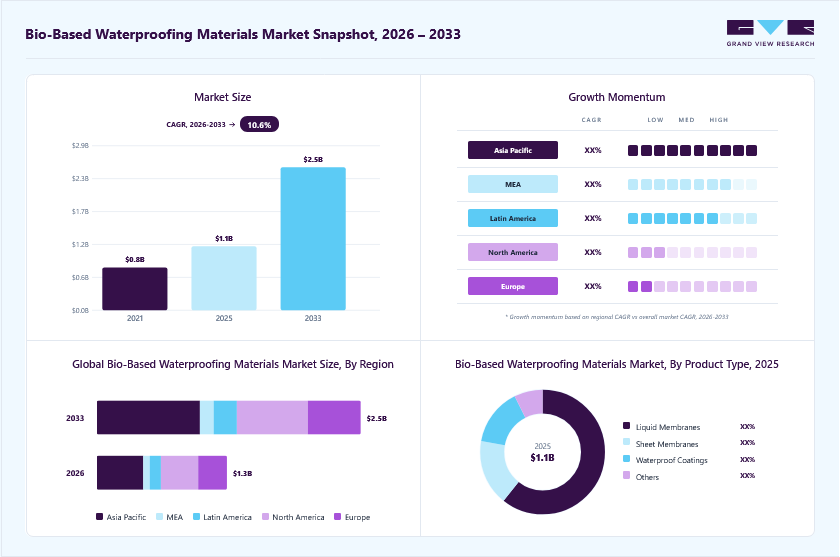
The global bio-based waterproofing materials market size was valued at USD 1.1 billion in 2025 and is projected to grow from USD 1.3 billion in 2026 to USD 2.5 billion by 2033, at a CAGR of 10.6% from 2026 to 2033. Asia Pacific dominated the market, accounting for the largest revenue share of 35.2% in 2025. Growing demand for bio-based waterproofing materials across construction, infrastructure, roofing, foundations, and industrial applications is supporting market growth.
 Source: Grand View Research, IR Documents, Primary Interviews, Paid DatabasesTo learn more about this report,
 Download Free Sample Report
 Key Market Trends & Insights
- By product type: The liquid membranes bio-based waterproofing materials segment dominated the market with revenue share of 60.7% in 2025.
- By application: The roofing segment led the market by application, accounting for 36.8% of revenue in 2025.
Regional Highlights
- Largest regional market: Asia Pacific (35.2% revenue share, 2025)
- By country: South Korea held the largest market share in 2025.
Market Size & Forecast
- Market size in 2025: USD 1.1 Billion
- Estimated market size in 2026: USD 1.3 Billion
- Projected Market Size by 2035: USD 2.5 Billion
- CAGR (2026-2033): 7.1%
Three ways to get this report
Buy it, customize it, or ask a question.Ask an Analyst
A direct answer, usually in 1 working day
- AccessReport author, directly
- Reply timeWithin 1 working day
- No sales callDirect answer only
- FormatEmail reply
- CostFree, no cost
Get the Full Report
What the study covers
- FormatsPDF · Excel · Dashboard
- Timeline2026–2033 annual, 2025 base
- Coverage20+ countries, 5 regions
- Companies10+ key players profiled
Customize the Report
20% free customization
- IncludeCountries, segments, points
- TailorTo your product definition
- ExtendDeeper competitor detail
- OrA fully bespoke study
- Turnaround5–10 working days
Bio-based waterproofing materials enable manufacturers to develop liquid membranes, sheet membranes, and waterproof coatings that provide moisture resistance, durability, flexibility, and environmental benefits. Their ability to protect building structures, underground systems, facades, and infrastructure assets from water penetration is expanding commercial adoption, particularly as green construction practices and sustainable material requirements gain momentum.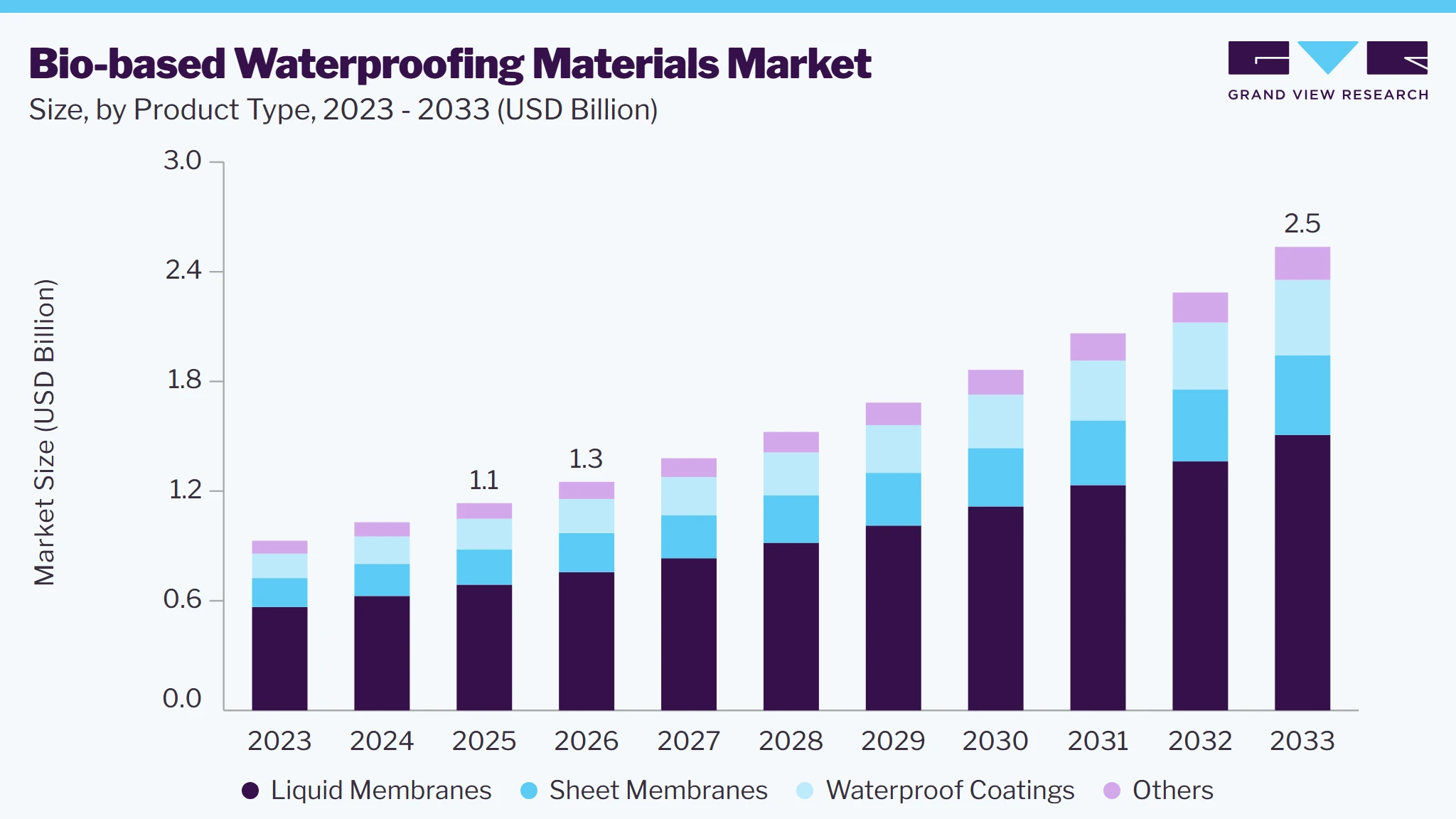 To learn more about this report, Download Free Sample Report
 Rapid adoption of sustainable material technologies is emerging as a key trend in the bio-based waterproofing materials market. Manufacturers are increasingly developing bio-derived polymer coatings, membranes, and sealants that provide effective moisture resistance while reducing reliance on fossil-based inputs. Demand is rising across green buildings, packaging, textiles, agriculture, and infrastructure applications, where enhanced durability, environmental compatibility, and lower carbon footprints are becoming important performance requirements.
Growing demand for sustainable construction and industrial materials is a major driver for the bio-based waterproofing materials market. These materials offer water resistance, biodegradability, renewable sourcing, and reduced environmental impact, making them suitable for roofs, walls, foundations, packaging, and protective coatings. Increasing environmental awareness, stringent sustainability regulations, and corporate commitments toward reducing carbon emissions are further accelerating the adoption of bio-based waterproofing solutions across diverse end-use industries.
Expansion of green construction and sustainable infrastructure presents a significant opportunity for the bio-based waterproofing materials market. Increasing investments in energy-efficient buildings, eco-friendly packaging, and resilient infrastructure are creating new demand for renewable waterproofing solutions with high functional performance. In addition, advancements in bio-based polymers, coatings, and composite technologies are enabling manufacturers to improve water resistance, durability, and application versatility while supporting the transition toward lower-impact material solutions.
Market Dynamics
Residential and commercial construction is emerging as a key end user for bio-based waterproofing materials, driven by the need for sustainable and high-performance moisture protection solutions. Bio-based roof waterproofing coatings, basement sealants, and fluid-applied membranes provide effective water resistance while supporting reduced environmental impact. These materials help protect building structures from moisture ingress, leakage, and deterioration, enhancing durability and long-term performance across diverse construction applications.
Growing emphasis on green building practices is further accelerating the adoption of bio-based waterproofing materials in construction. Manufacturers are developing renewable-content coatings, sealants, and membrane systems that combine waterproofing performance with lower reliance on petroleum-derived inputs. Increasing demand for energy-efficient and environmentally responsible buildings, supported by sustainability regulations and certification programs, is therefore creating favorable conditions for the broader use of bio-based waterproofing solutions across residential and commercial projects.
High initial costs are emerging as a key restraint for the bio-based waterproofing materials market, driven by the premium pricing of bio-derived formulations and specialized renewable inputs. These materials often require advanced processing technologies, customized formulations, and higher-cost feedstocks compared with conventional bitumen or petroleum-based waterproofing products. The resulting cost differential can limit adoption among price-sensitive end users, particularly in large-scale construction and infrastructure projects where material costs significantly influence purchasing decisions.
Multi-functional coatings present a significant opportunity for the bio-based waterproofing materials market, driven by demand for high-performance and sustainable protective solutions. Manufacturers are increasingly developing bio-based organic coatings that combine waterproofing with self-healing, thermal insulation, and surface protection capabilities. These multifunctional systems can improve durability, energy efficiency, and maintenance performance across buildings, infrastructure, packaging, and industrial applications, while reducing material consumption and supporting broader sustainability objectives.
Market Concentration & Characteristics
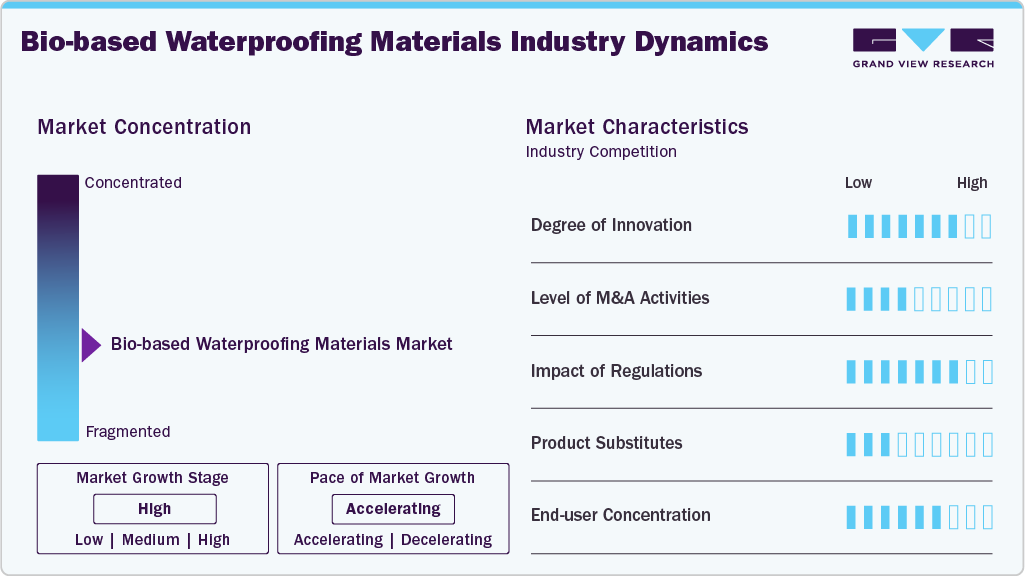
The market growth stage is High, and growth is accelerating. The market exhibits slight fragmentation, with key players dominating the industry landscape. Major companies such as eVent Fabrics, Polartec (Milliken & Company), Dimpora AG, Sympatex Technologies GmbH, Tiong Liong Industrial Co., Ltd. (TLC), Tremco Roofing / Tremco CPG, PPG Industries, SP Samhwa, and others play a significant role in shaping the market dynamics. These leading players often drive innovation in the market by introducing new products, technologies, and materials to meet the industry's evolving demands.
 To learn more about this report, Download Free Sample Report
 Innovation in the bio-based waterproofing materials market is driven by advances in bio-based polymer chemistry, interface adhesion, and process scalability. Recyclable formulations, flexible-rigid combinations, and improved barrier performance are expanding use across construction, packaging, healthcare, and industrial coatings. These developments enhance durability, application efficiency, and design versatility while supporting lower-impact material solutions.
Regulatory requirements and qualification standards also shape market development. Manufacturers must meet safety, emissions, traceability, and durability criteria before commercialization, which can increase testing and certification costs, especially for smaller firms. However, companies with strong R&D capabilities, compliance expertise, and validated material portfolios can accelerate approval, strengthen customer trust, and support wider adoption across end-use sectors.
Analyst Perspective
Over the next 5-10 years, bio-based waterproofing will transition from traditional performance solutions to sustainability-driven products. Demand across roofing, basements, facades, infrastructure, and renovations will be spurred by green standards and climate resilience. Membranes and multifunctional coatings will advance as renewable feedstocks match conventional durability and moisture protection. Stricter environmental and chemical regulations will speed up the shift away from petroleum-based alternatives. Top players will stand out through advanced formulations, reliable sourcing, integrated production, and strong industry partnerships. Though high raw material costs and cheap synthetic competition may squeeze profits, long-term growth hinges on scalable production and verified eco-credentials.
Product Type Insights
The liquid membranes bio-based waterproofing materials segment dominated the market across product type segmentation in terms of revenue, accounting for 60.7% market share in 2025, and is forecast to grow at a 10.3% CAGR from 2026 to 2033. The segment is being driven by continuous advances in bio-based polymer formulations, liquid membrane technology, and application processes, which enable precise control over adhesion, flexibility, curing, and water resistance. This allows manufacturers to develop liquid membranes with different durability, elasticity, and barrier characteristics for specific end-use requirements. Customized formulations improve waterproofing performance, surface compatibility, and application efficiency, supporting product differentiation and strengthening the role of liquid bio-based membranes across sustainable construction and industrial applications.
The waterproof coatings bio-based waterproofing materials segment is expected to expand at a 12.0% CAGR in the bio-based waterproofing materials market over the forecast period. Waterproof coatings represent a significant product segment within the bio-based waterproofing materials market, driven by their superior moisture resistance, adhesion, durability, and environmental compatibility. Demand is increasing as industries seek sustainable coating solutions capable of meeting demanding protection requirements across construction, packaging, textiles, and industrial applications. These coatings enable manufacturers to combine effective water barriers with renewable feedstocks, supporting enhanced surface protection, longer service life, and lower environmental impact across diverse end-use applications.
Application Insights
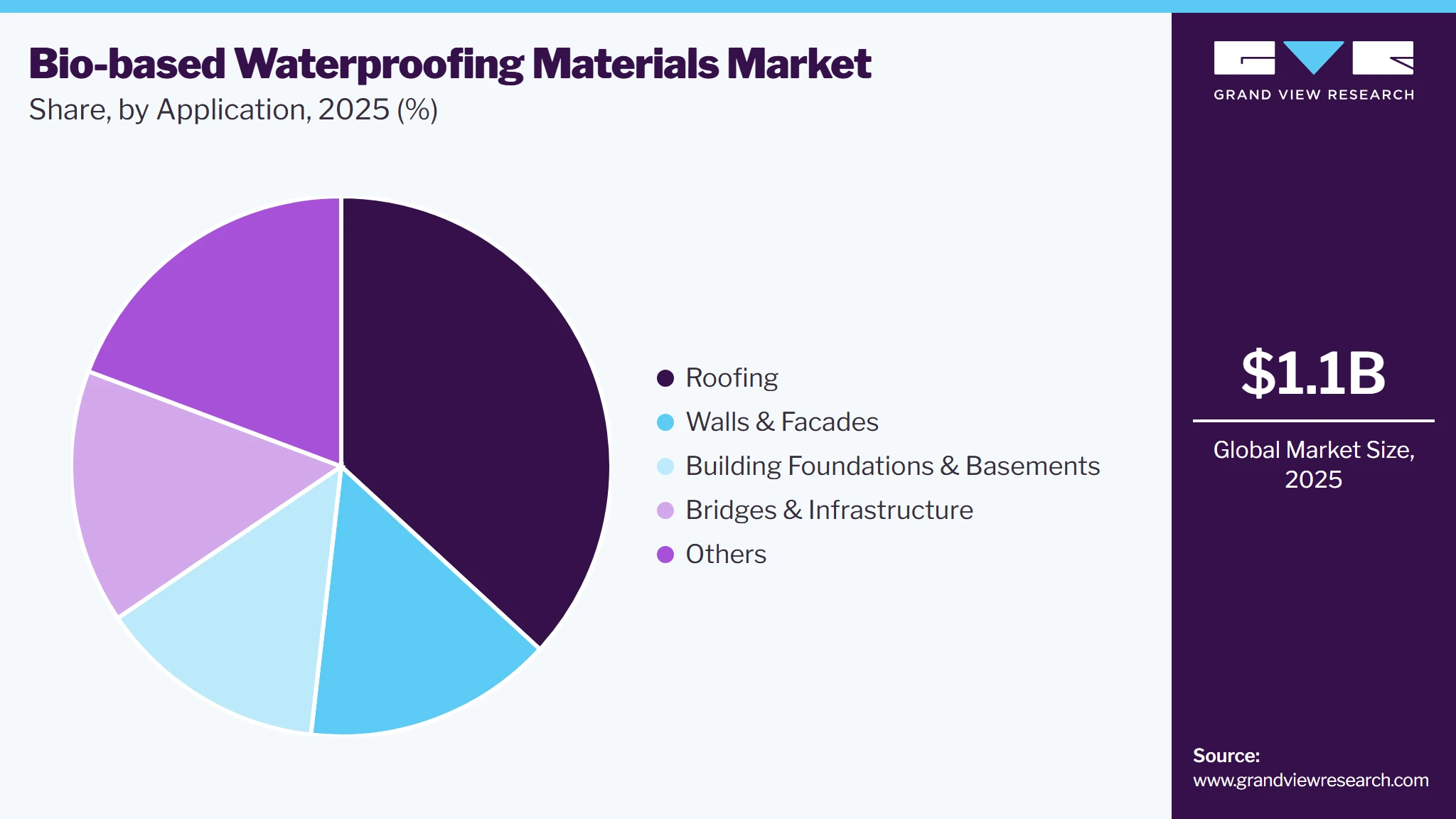
The roofing segment led the market by application, accounting for 36.8% of revenue in 2025, and is projected to grow at a 10.4% CAGR from 2026 to 2033. The roofing segment is gaining traction in the bio-based waterproofing materials market due to increasing demand for durable, sustainable, and cost-effective moisture protection solutions. Bio-based waterproofing materials enable manufacturers to develop flexible membranes, coatings, and sealants that provide effective resistance to water, weathering, and temperature variations. Their ability to support energy-efficient and environmentally responsible roofing systems enhances building durability, reduces maintenance requirements, and accelerates adoption across residential, commercial, and industrial construction applications.
 To learn more about this report, Download Free Sample Report
 The building foundations & basements segment is expected to grow at the fastest CAGR of 12.0% over the forecast period. The building foundations and basements segment represents a high-value application area for bio-based waterproofing materials, supported by increasing demand for durable and environmentally responsible moisture protection solutions. Bio-based membranes, coatings, and sealants provide effective resistance against groundwater, dampness, and moisture penetration, helping protect structural integrity and reduce maintenance requirements. Growing adoption of sustainable construction practices, green building standards, and resilient infrastructure is further accelerating demand for advanced bio-based waterproofing solutions in foundation and basement applications.
Regional Insights
The Asia Pacific bio-based waterproofing materials market held the largest revenue share of 35.2% in 2025. The region is expected to grow at a CAGR of 12.1% over the forecast period. Rapid industrialization and expanding construction activities are supporting the strong growth of the bio-based waterproofing materials market across the Asia Pacific. Increasing investments in residential, commercial, industrial, and infrastructure projects are driving demand for sustainable waterproofing solutions across roofs, foundations, basements, and protective coatings. Rising adoption of green building practices, growing environmental awareness, and government initiatives promoting sustainable materials are further accelerating regional market development. Expanding construction output and advancements in bio-based polymer technologies are also strengthening adoption.
 To learn more about this report, Download Free Sample Report
 India Bio-based Waterproofing Materials Market Trends
India’s market for bio-based waterproofing materials is expanding steadily, supported by increasing construction activity and growing adoption of sustainable building solutions. Rising investments in residential, commercial, industrial, and infrastructure development are strengthening demand for bio-based membranes, coatings, and sealants across roofing, foundations, basements, and protective applications. Government initiatives promoting sustainable construction, increasing environmental awareness, and growing demand for durable, low-impact materials are further encouraging the adoption of bio-based waterproofing solutions across the country.
North America Bio-based Waterproofing Materials Market Trends
North America is a key growth region for the bio-based waterproofing materials market, supported by strong demand from construction, infrastructure, packaging, and industrial applications. The region’s emphasis on sustainable building practices and advanced material technologies is driving the adoption of bio-based membranes, coatings, and sealants for roofing, foundations, and protective applications. Growing investments in green construction and environmentally responsible materials are further strengthening regional market development.
The U.S. bio-based waterproofing materials market represents a major contributor to regional growth, supported by established construction infrastructure, technological capabilities, and increasing adoption of sustainable materials. Rising utilization of bio-based waterproofing solutions across commercial buildings, residential construction, and industrial facilities is accelerating demand. Strong emphasis on energy efficiency, environmental compliance, and durable building systems is further encouraging manufacturers to develop high-performance bio-based waterproofing technologies.
Europe Bio-based Waterproofing Materials Market Trends
Europe’s bio-based waterproofing materials market is expanding due to the increasing adoption of sustainable construction materials across residential, commercial, infrastructure, and industrial applications. Demand is rising for bio-based membranes, coatings, and sealants that provide effective moisture protection while supporting lower environmental impact and improved building performance. Additionally, stringent sustainability regulations, circular economy initiatives, and growing preference for renewable and recyclable materials are encouraging broader adoption of bio-based waterproofing solutions across the region.
Central & South America Bio-based Waterproofing Materials Market Trends
Growing construction activities, expanding infrastructure development, and rising adoption of sustainable building technologies are driving demand for bio-based waterproofing materials across Central & South America. These materials are increasingly utilized in residential, commercial, industrial, and infrastructure applications due to their moisture resistance, durability, and environmental benefits. Increasing investments in green construction, energy-efficient buildings, and resilient infrastructure are further supporting market growth, while growing environmental awareness continues to encourage regional adoption of bio-based waterproofing solutions.
Middle East and Africa Bio-based Waterproofing Materials Market Trends
Increasing construction activity, expanding infrastructure development, and rising adoption of sustainable building technologies are driving demand in the Middle East & Africa bio-based waterproofing materials market. Growing utilization of eco-friendly waterproofing solutions across residential, commercial, industrial, and infrastructure applications is supporting demand for durable, moisture-resistant, and environmentally responsible materials. Additionally, investments in green buildings, sustainable infrastructure, and advanced construction technologies are encouraging the transition toward bio-based waterproofing solutions, while economic diversification initiatives are strengthening regional adoption.
Key Bio-based Waterproofing Materials Company Insights
Some of the key players operating in the market include eVent Fabrics and Polartec (Milliken & Company)
-
eVent Fabrics participates in the bio-based waterproofing materials market through its waterproof and breathable membrane technologies designed for outdoor, footwear, and performance apparel applications. Supported by material innovation and advanced membrane engineering, the company provides high-performance solutions offering water resistance, breathability, and durability, supporting growing demand for sustainable and functional waterproofing materials across performance-oriented applications.
-
Polartec (Milliken & Company) participates in the bio-based waterproofing materials market through its portfolio of advanced performance fabrics and textile technologies designed for outdoor, apparel, and industrial applications. Supported by strong material innovation capabilities and an established global presence, the company provides functional solutions offering water resistance, breathability, durability, and thermal performance, strengthening its position in sustainable and high-performance waterproofing applications.
Dimpora AG and SP Samhwa are some of the emerging participants in the bio-based waterproofing materials market.
-
Dimpora AG is a materials technology company focused on advanced waterproof and breathable membrane solutions for applications across outdoor apparel, footwear, and performance textiles. Leveraging innovative polymer membrane technology, the company develops high-performance materials that provide water resistance, breathability, and durability. Its focus on sustainable material development supports growing adoption of advanced waterproofing solutions across environmentally conscious applications.
-
SP Samhwa is a materials manufacturer focused on waterproofing, protective coatings, and construction chemical solutions for applications across buildings, infrastructure, and industrial facilities. Leveraging formulation expertise and advanced coating technologies, the company develops performance-oriented materials that provide water resistance, durability, and surface protection. Its product development capabilities support growing adoption of sustainable waterproofing solutions across construction and infrastructure applications.
Key Bio-based Waterproofing Materials Companies:
The following key companies have been profiled for this study on the bio-based waterproofing materials market.
-
eVent Fabrics
-
Polartec (Milliken & Company)
-
Dimpora AG
-
Sympatex Technologies GmbH
-
Tiong Liong Industrial Co., Ltd. (TLC)
-
Tremco Roofing / Tremco CPG
-
PPG Industries
-
SP Samhwa
Competitive Benchmarking
Operating Strategies
Competitive Edge
Weakness
Mature Players: eVent Fabrics, Polartec (Milliken & Company), Sympatex Technologies GmbH, Tremco Roofing / Tremco CPG, PPG Industries, Tiong Liong Industrial Co., Ltd. (TLC), SP Samhwa (Samhwa Paints)
- Extensive focus on waterproof-breathable membranes, performance textiles, waterproofing systems, coatings, and construction chemical solutions across apparel, footwear, construction, and industrial applications.
- Continuous investment in material innovation, sustainable formulations, recyclable technologies, advanced coatings, and high-performance waterproofing solutions.
- Expansion through global customer relationships, technical partnerships, customized solutions, and established manufacturing and distribution networks.
- Strong expertise in waterproofing, membrane technology, performance textiles, coatings, and construction chemical applications.
- Established brands, customer relationships, technical capabilities, and global commercial networks provide strong market access.
- Broad product portfolios and application expertise enable customized, high-performance, and environmentally responsible waterproofing solutions across diverse end-use sectors.
- Premium and advanced waterproofing solutions can involve higher material, manufacturing, and installation costs.
- Dependence on construction, apparel, footwear, and infrastructure markets exposes companies to cyclical demand and changing consumer trends.
- Increasing competition, regulatory requirements, and the development of bio-based formulations can raise R&D, testing, qualification, and compliance costs.
Emerging Players: Dimpora AG and SP Samhwa
- Focus on advanced waterproof-breathable membranes, waterproofing coatings, and construction chemical solutions for outdoor apparel, footwear, buildings, infrastructure, and industrial applications.
- Continuous investment in sustainable formulations, membrane technology, and coating performance to improve waterproofing, breathability, durability, and application efficiency.
- Expansion across diverse end-use applications through material innovation, formulation development, and industry collaborations.
- Strong expertise in waterproof-breathable membrane technology, protective coatings, and sustainable material development.
- Differentiated solutions combining water resistance, durability, breathability, and environmental performance provide access to premium and performance-oriented applications.
- Broad application capabilities across textiles, construction, infrastructure, and industrial sectors support market diversification and customer reach.
- Specialized product portfolios and application focus may limit exposure to broader waterproofing applications.
- Advanced bio-based formulations and membrane technologies can involve higher development, testing, and production costs.
- Competition from established waterproofing and construction chemical manufacturers may increase pricing and differentiation pressures, particularly in cost-sensitive markets.
Recent Developments
-
In July 2026, SP Samhwa obtained a patent for a bio-based waterproofing agent designed for polyurea waterproofing membranes. The technology incorporates a plant-derived glycerin plasticizer and a plant-oil-based defoamer as alternatives to conventional petroleum-derived additives, supporting the development of more sustainable construction waterproofing solutions while reducing reliance on fossil-based formulation components.
-
In June 2026, Paramelt launched Aquavate Bio, a water-based biodegradable coating platform designed for fiber-based packaging applications. The technology strengthens the company’s sustainable coating portfolio and supports applications requiring moisture resistance, biodegradability, and functional barrier performance, thereby expanding bio-based coating capabilities for environmentally responsible packaging and waterproofing applications.
Bio-based Waterproofing Materials Market Report Scope
Report Attribute
Details
Market size in 2025
USD 1.1 billion
Estimated market size in 2026
USD 1.3 billion
Projected market size by 2033
USD 2.5 billion
Growth rate
CAGR of 10.6% from 2026 to 2033
Historical data
2021 - 2025
Forecast period
2026 - 2033
Quantitative units
Revenue in USD million/billion, volume in tons, and CAGR from 2026 to 2033
Report coverage
Revenue & volume forecast, competitive landscape, growth factors, and trends
Segments covered
Product type, application, region
Regional scope
North America; Europe; Asia Pacific; Central & South America; Middle East & Africa
U.S.; Canada; Mexico; Europe; Germany; UK; France; Italy; Spain; China; India; Japan; South Korea; Australia; Brazil; Argentina; Saudi Arabia; UAE; South Africa
Key companies profiled
eVent Fabrics; Polartec (Milliken & Company); Dimpora AG; Sympatex Technologies GmbH; Tiong Liong Industrial Co., Ltd. (TLC); Tremco Roofing / Tremco CPG; PPG Industries; SP Samhwa
Customization scope
Free report customization (equivalent to up to 8 analyst working days) with purchase. Addition or alteration to country, regional & segment scope
Pricing and purchase options
Avail customized purchase options to meet your exact research needs. Explore purchase options
Global Bio-based Waterproofing Materials Market Report Segmentation
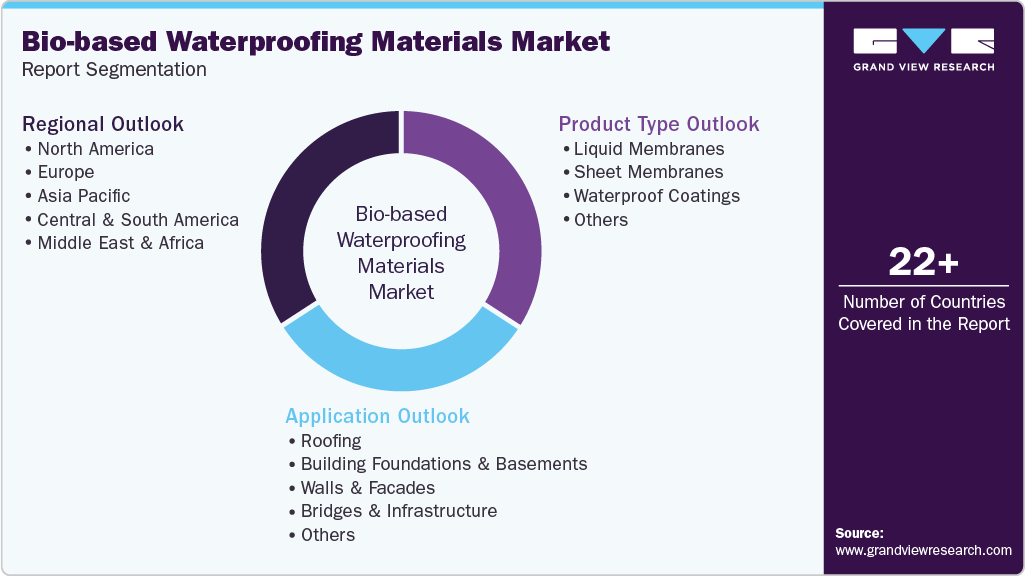
This report forecasts revenue growth at the global, regional, and country levels and provides an analysis of the latest industry trends across sub-segments from 2021 to 2033. For this study, Grand View Research has segmented the global bio-based waterproofing materials market report based on product type, application, and region:
 To learn more about this report, Download Free Sample Report
 -
Product Type Outlook (Volume, Kilotons; Revenue, USD Million, 2021 - 2033)
-
Liquid Membranes
-
Sheet Membranes
-
Waterproof Coatings
-
Others
-
-
Application Outlook (Volume, Kilotons; Revenue, USD Million, 2021 - 2033)
-
Roofing
-
Building Foundations & Basements
-
Walls & Facades
-
Bridges & Infrastructure
-
Others
-
-
Regional Outlook (Volume, Kilotons; Revenue, USD Million, 2021 - 2033)
-
North America
-
U.S.
-
Canada
-
Mexico
-
-
Europe
-
Germany
-
UK
-
France
-
Italy
-
Spain
-
-
Asia Pacific
-
China
-
India
-
Japan
-
South Korea
-
Australia
-
-
Central & South America
-
Brazil
-
Argentina
-
-
Middle East & Africa
-
Saudi Arabia
-
UAE
-
South Africa
-
-
Research Methodology
The bio-based waterproofing materials market figures in this report are based on a proven research process that combines executive interviews with secondary research from proprietary databases, company filings, and recognized regulatory and institutional sources. Market size is built through value-chain sizing—reconciling supply-side and demand-side estimates—and triangulated with bottom-up and top-down approaches. Every estimate passes multiple levels of expert validation before publication, with each bio-based waterproofing materials segment quantified using the revenue-capture definitions in the table below
Segment Definition
Segment - Product Type
Revenue capture definition
Liquid Membranes
Revenue is captured through the sale of bio-based liquid-applied membranes used for roofing, foundations, basements, walls, facades, and infrastructure applications. Value is driven by seamless coverage, strong adhesion, flexibility, crack-bridging capability, and ease of application on complex surfaces. Demand is supported by increasing adoption of sustainable construction materials, renovation activities, moisture protection requirements, and waterproofing systems requiring durable, environmentally responsible, and application-efficient solutions.
Sheet Membranes
Revenue is captured through bio-based sheet membranes used for waterproofing roofs, foundations, basements, walls, tunnels, and infrastructure structures. Value is influenced by tensile strength, dimensional stability, puncture resistance, flexibility, and installation efficiency. Demand is supported by growing use of prefabricated waterproofing systems, sustainable building practices, infrastructure development, and applications requiring consistent barrier performance, reliable moisture protection, and long-term durability.
Waterproof Coatings
Revenue is generated through bio-based waterproof coatings used to protect concrete, masonry, metal, wood, and other substrates from water penetration and moisture-related deterioration. Value is driven by adhesion, water resistance, durability, surface compatibility, and resistance to weathering and environmental exposure. Growth is supported by increasing demand for sustainable protective coatings, green construction, building renovation, and high-performance surface protection across residential, commercial, industrial, and infrastructure applications.
Others
Revenue comes from specialized bio-based waterproofing products including sealants, waterproofing additives, protective treatments, and hybrid waterproofing systems used across construction, infrastructure, industrial, and specialty applications. Value is supported by application flexibility, enhanced adhesion, crack sealing, moisture resistance, and compatibility with diverse substrates. Emerging applications create opportunities for premium formulations, multifunctional solutions, application-specific product development, and diversified revenue streams across sustainable construction and industrial waterproofing markets.
Segment - Application
Revenue capture definition
Roofing
Revenue is captured through bio-based waterproofing materials used in roofs, roof decks, terraces, and other roofing structures to prevent water penetration and moisture-related deterioration. Value is driven by weather resistance, flexibility, durability, adhesion, and resistance to temperature variations. Demand is supported by increasing construction and renovation activities, growing adoption of green buildings, and rising requirements for sustainable roofing systems that provide long-term protection and reduced environmental impact.
Building Foundations & Basements
Revenue is generated through bio-based waterproofing materials used to protect foundations, basement walls, underground structures, and substructures from groundwater and moisture penetration. Value is driven by hydrostatic pressure resistance, adhesion, crack-bridging performance, durability, and long-term barrier protection. Growth is supported by increasing residential and commercial construction, infrastructure development, basement utilization, and growing demand for environmentally responsible waterproofing systems that protect structural integrity and reduce maintenance requirements.
Walls & Facades
Revenue is captured through bio-based waterproofing materials used on exterior walls, facades, masonry, concrete, and building envelopes to prevent moisture infiltration while maintaining surface performance. Value is driven by water repellency, breathability, adhesion, weather resistance, and compatibility with different substrates. Demand is supported by increasing building renovation, energy-efficient construction, facade protection, and green building initiatives requiring sustainable materials that improve building durability and reduce moisture-related damage.
Bridges & Infrastructure
Revenue is generated through bio-based waterproofing materials used in bridges, tunnels, highways, parking structures, rail infrastructure, and other civil engineering assets. Value is driven by durability, chemical resistance, crack-bridging capability, adhesion, and protection against water and environmental exposure. Demand is supported by increasing infrastructure investments, asset rehabilitation, climate-resilient construction, and growing emphasis on sustainable infrastructure materials that extend service life and reduce maintenance requirements.
Others
Revenue comes from specialized applications including industrial facilities, water management structures, agricultural buildings, marine structures, balconies, terraces, and specialty construction projects. Value is supported by moisture resistance, substrate compatibility, durability, flexible application methods, and environmental performance. These emerging applications create opportunities for multifunctional waterproofing systems, application-specific formulations, premium bio-based materials, and diversified revenue streams across sustainable construction, industrial protection, and specialty infrastructure applications.
Estimation Model
Layer Name
Key Question
Description
Top-Down Bio-based Waterproofing Materials Demand Assessment Layer
What defines market boundaries?
This layer establishes global demand for bio-based waterproofing materials across roofing, building foundations & basements, walls & facades, bridges & infrastructure, and other construction and industrial applications. Demand is filtered through macro drivers such as sustainable construction, green building adoption, infrastructure development, climate-resilient construction, environmental regulations, and increasing preference for renewable and low-impact materials. This defines the total addressable market based on consumption and revenue generated from bio-based waterproofing solutions.
End-Use Demand Validation Layer
Where is demand generated?
This layer maps demand across residential, commercial, industrial, and infrastructure construction, including roofing systems, foundations, basements, building envelopes, bridges, tunnels, and specialty structures. Market sizing is aligned with performance requirements such as water resistance, adhesion, flexibility, crack-bridging capability, durability, weather resistance, chemical stability, substrate compatibility, and environmental performance across different waterproofing applications.
Consumption-to-Revenue Conversion Layer
Who captures market revenue?
This layer translates waterproofing material consumption and application volumes into revenue potential using product utilization rates, formulation requirements, coverage area, application methods, product performance specifications, and project-specific material requirements. Pricing differentials across liquid membranes, sheet membranes, waterproof coatings, sealants, and other bio-based solutions are incorporated to estimate value realization across material manufacturers, formulation suppliers, construction chemical companies, distributors, contractors, and downstream users.
Regional Demand Verification Layer
How are assumptions validated?
This layer validates demand distribution across North America, Europe, Asia Pacific, Central & South America, and the Middle East & Africa by assessing construction activity, infrastructure investments, green building adoption, renovation expenditure, environmental regulations, and availability of sustainable materials. Regional construction trends, regulatory frameworks, technology maturity, raw material availability, supply chain dynamics, and sustainability initiatives are used to verify market penetration assumptions and strengthen forecast reliability.
Delivered Customizations
This report has been delivered with the following In-depth customizations
Client Request
Customization Delivered
Value Adds
Regional segmentation
Detailed assessment of North America, Europe, Asia Pacific, Central & South America, and Middle East & Africa, including country-level analysis for key markets such as the U.S. and India.
Identifies regional demand patterns, construction activity, sustainability adoption, regulatory influences, and growth opportunities.
Cross-segmentation
Cross-analysis of product types, including liquid membranes and waterproof coatings, against key applications such as roofing, building foundations & basements, construction, infrastructure, and industrial applications.
Highlights high-growth combinations of product and application segments and identifies areas with stronger commercial potential.
Competitive benchmarking
Comparative evaluation of key market participants, including eVent Fabrics, Polartec (Milliken & Company), Dimpora AG, SP Samhwa, and other relevant manufacturers, based on product portfolios, technology capabilities, application coverage, and strategic positioning.
Provides a clear understanding of competitive strengths, market positioning, differentiation strategies, and potential gaps.
Frequently Asked Questions About This Report
The bio-based waterproofing materials market was estimated at around USD 1.1 billion in the year 2025 and is expected to reach around USD 1.3 billion in 2026.
The bio-based waterproofing materials market is expected to grow at a compound annual growth rate of 10.6% from 2026 to 2033 to reach around USD 2.5 billion by 2033.
The key players in the bio-based waterproofing materials market are eVent Fabrics, Polartec (Milliken & Company), Dimpora AG, Sympatex Technologies GmbH, Tiong Liong Industrial Co., Ltd. (TLC), Tremco Roofing / Tremco CPG, PPG Industries, and SP Samhwa.
Asia Pacific dominated the market, accounting for the largest revenue share of 35.2% in 2025.
The liquid membranes bio-based waterproofing materials industry led the bio-based waterproofing materials product type market in 2025 with a 60.7% share. Growing demand for sustainable waterproofing systems, coupled with advances in bio-based polymer processing and formulation technologies, is accelerating liquid membrane adoption for roofing, foundations, basements, facades, and infrastructure protection applications.
Rising demand for bio-based waterproofing materials across construction, infrastructure, roofing, foundations, and industrial applications is driving market growth. Their moisture resistance, durability, flexibility, and environmental benefits support liquid membranes, sheet membranes, and waterproof coatings, expanding adoption as sustainable construction practices and green material requirements gain momentum.
The roofing segment led the market by application, accounting for 36.8% of revenue in 2025, while building foundations & basements segment is fastest growing application.
About the Author(s)
Plastics, Polymers & Resins Research Team
Bulk Chemicals · Plastics, Polymers & ResinsThis report was authored by the plastics, polymers & resins research team at Grand View Research - comprising two research analysts, one senior research analyst, and one industry expert - with specialized expertise in the plastics, polymers & resins segment of the bulk chemicals industry. All findings are based on proprietary bulk chemicals databases, executive interviews, and regulatory analysis, subject to internal peer review prior to publication.
Last Updated:
Speak to Analyst

Customize this report to your needs - add regions, segments, or data points, with 20% free customization.
Or view our licence options:


ISO 9001:2015 & 27001:2022 Certified
We are GDPR and CCPA compliant! Your transaction & personal information is safe and secure. For more details, please read our privacy policy.


