
- Home
- »
- Advanced Interior Materials
- »
-
Board Insulation Market Size & Share Report, 2026-2033GVR Report cover

Board Insulation Market (2026 - 2033)
Size, Share & Trends Analysis Report By Application (Building & Construction, Transportation, Industrial), By Region (North America, Europe), And Segment Forecasts
Market Size, 2025
$13.9BMarket Estimate, 2026
$14.4BMarket Forecast, 2033
$19.4BCAGR, 2026–2033
4.3%Board Insulation Market Size & Trends
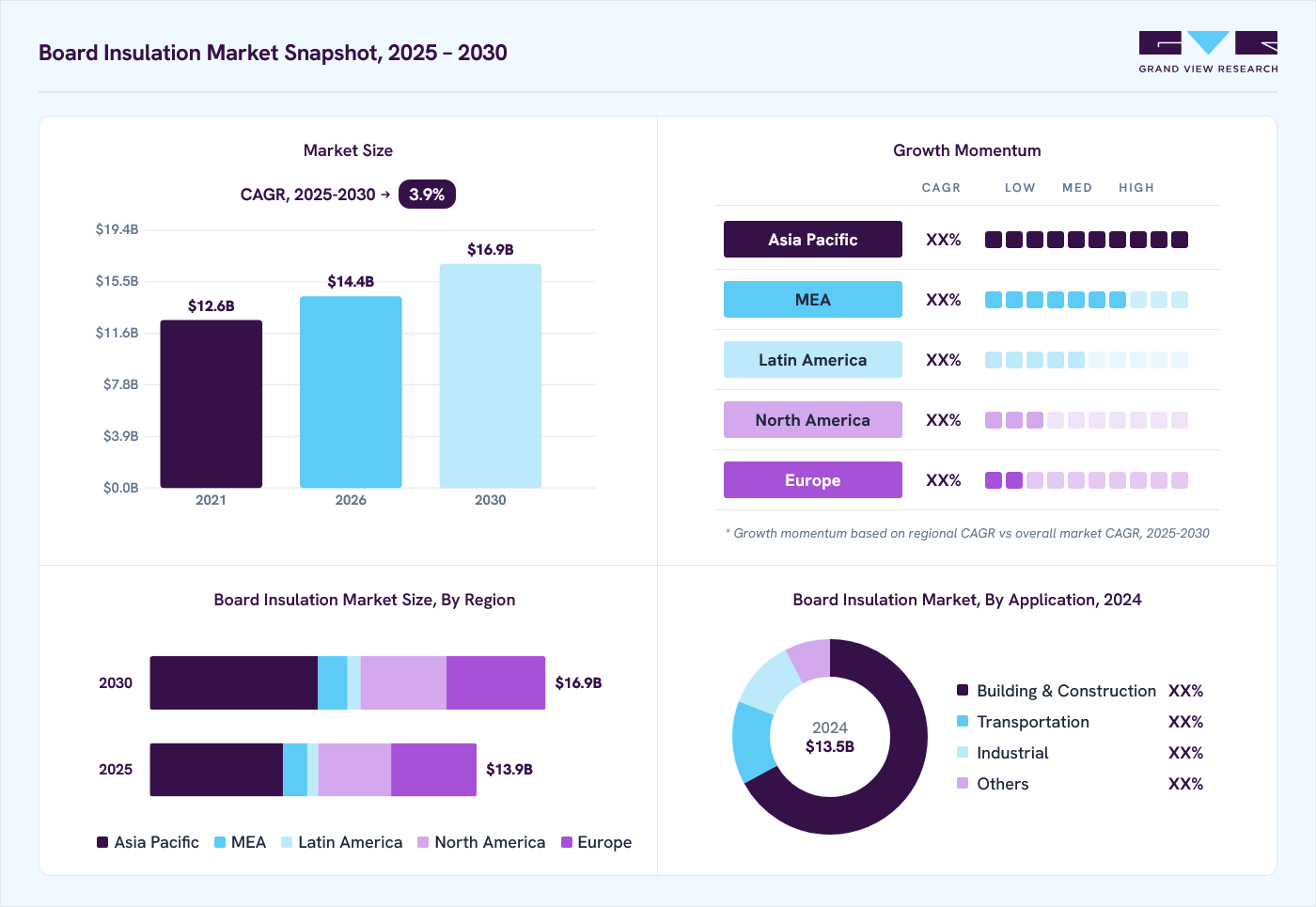
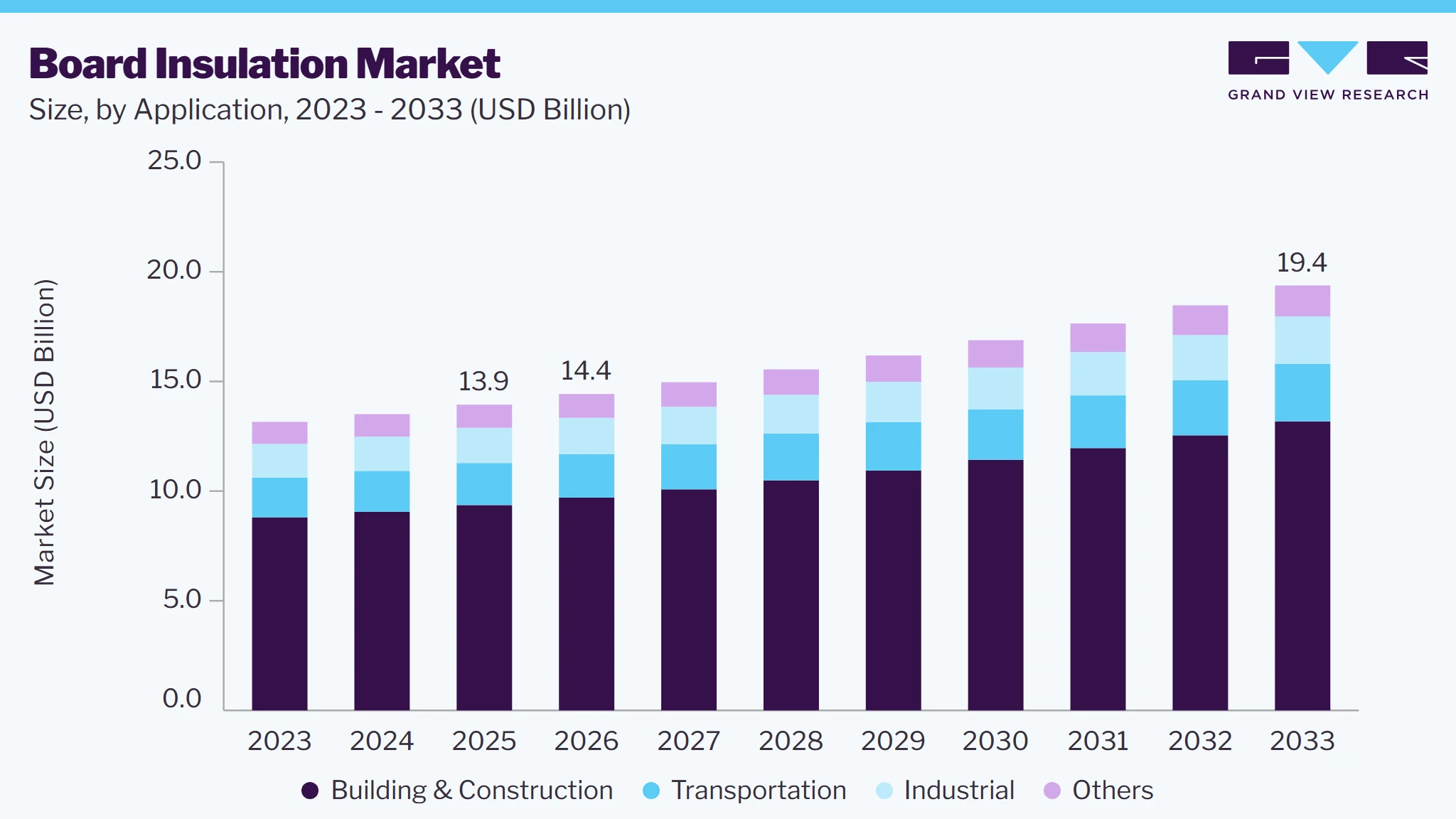
The global board insulation market size was valued at USD 13.9 billion in 2025 and is projected to grow from USD 14.4 billion in 2026 to USD 19.4 billion by 2033, at a CAGR of 4.3% from 2026 to 2033. Asia Pacific dominated the market, accounting for a revenue share of 40.8% in 2025. This growth can be attributed to the increased focus on energy efficiency and the growing demand for sustainable building materials across the globe. As the cost of energy increases, there is a growing demand for insulation materials that aid in reducing energy consumption. Board insulation is a highly effective way to insulate buildings, and this trend is expected to grow significantly during the forecast period.
 Source: Grand View Research, IR Documents, Primary Interviews, Paid DatabasesTo learn more about this report,
 Download Free Sample Report
 Key Market Trends & Insights
- By application: Building & construction segment led the market with the largest revenue share of 67.1% in 2025.
Regional Highlights
- Largest regional market: Asia Pacific (40.8% revenue share, 2025)
- By country: The China held the largest market share in 2025.
Market Size & Forecast
- Market size in 2025: USD 13.9 Billion
- Estimated market size in 2026: USD 14.4 Billion
- Projected market size by 2033: USD 19.4 Billion
- CAGR (2026-2033): 4.3%
Three ways to get this report
Buy it, customize it, or ask a question.Ask an Analyst
A direct answer, usually in 1 working day
- AccessReport author, directly
- Reply timeWithin 1 working day
- No sales callDirect answer only
- FormatEmail reply
- CostFree, no cost
Get the Full Report
What the study covers
- FormatsPDF · Excel · Dashboard
- Timeline2026–2033 annual, 2025 base
- Coverage20+ countries, 5 regions
- Companies10+ key players profiled
Customize the Report
20% free customization
- IncludeCountries, segments, points
- TailorTo your product definition
- ExtendDeeper competitor detail
- OrA fully bespoke study
- Turnaround5–10 working days
Rigid board insulation is highly effective at insulating buildings to curb the energy requirements for heating and cooling. It is easy to install, and the operating cost makes it an ideal choice for most building contractors. This is particularly important in cold climates, where it is important to minimize heat loss. As a result, the demand for boards from the building and construction industry is expected to increase during the forecast period.The rise in construction activities, especially in urban areas and developing economies, has led to a demand for effective insulation solutions. Board insulation is widely used in walls, roofs, and floors to enhance thermal management and improve indoor comfort, further supporting its market growth. The emphasis on green building standards and sustainable construction practices also propels the use of eco-friendly and energy-saving insulation materials.
 To learn more about this report, Download Free Sample Report
 Technological advancements in insulation materials have led to the development of products with enhanced thermal efficiency, moisture resistance, and durability. These innovations drive broader applications of board insulation in the construction sector and industries like automotive and manufacturing, where temperature control and energy efficiency are critical factors.
In addition, stringent government regulations and building codes have played a crucial role in driving the market. Various countries have implemented policies that mandate using insulation materials in new buildings and renovations to meet energy efficiency standards. This regulatory push has significantly increased the demand for high-performance insulation materials, including board insulation, in various construction projects.
Market Dynamics
The board insulation market is witnessing steady growth driven by rising demand for energy-efficient buildings, stringent building energy codes, increasing construction activities, and growing emphasis on sustainable infrastructure development. Insulation boards are extensively used in residential, commercial, and industrial buildings to enhance thermal performance, reduce energy consumption, and improve occupant comfort. The market is further benefiting from the adoption of green building certifications, government-supported energy conservation initiatives, and advancements in high-performance insulation materials. Growing renovation activities across developed economies and rapid urbanization in emerging markets are also creating favorable conditions for market expansion.
The growing focus on reducing building energy consumption is a major factor driving demand for board insulation products globally. Governments, developers, and property owners are increasingly investing in insulation solutions to improve thermal efficiency and comply with evolving energy performance standards. Insulation boards help minimize heat transfer, lower heating and cooling requirements, and reduce overall operating costs, making them an essential component of modern construction projects. Rising awareness regarding carbon emission reduction and energy conservation is further supporting market growth.
Additionally, green building initiatives and sustainability targets are accelerating the adoption of advanced insulation boards across residential and commercial sectors. Programs promoting net-zero energy buildings, passive house standards, and environmentally responsible construction practices are encouraging the use of high-performance insulation materials. The increasing integration of insulation systems in both new construction and retrofit projects is expected to strengthen long-term demand for board insulation products worldwide.
Fluctuations in the prices of raw materials such as petrochemical-based foams, fiberglass, mineral wool, and specialty additives present a significant challenge for insulation board manufacturers. Variations in energy costs, supply chain disruptions, and geopolitical uncertainties can increase production expenses and affect profit margins. Manufacturers often face difficulties in maintaining competitive pricing while ensuring product performance and compliance with regulatory standards. Moreover, premium insulation boards with superior thermal resistance and fire protection properties often involve higher upfront costs compared to conventional building materials.
The expanding global focus on building retrofits and energy-efficient renovation programs presents substantial opportunities for the board insulation market. Aging building stock across North America and Europe is creating strong demand for insulation upgrades aimed at improving energy performance and meeting modern regulatory requirements. Governments are increasingly offering incentives, grants, and tax benefits for energy-efficiency improvements, encouraging the adoption of advanced insulation board solutions. Furthermore, the emergence of net-zero energy buildings and carbon-neutral construction strategies is generating new growth avenues for insulation manufacturers. Demand for innovative insulation boards with enhanced thermal conductivity, moisture resistance, fire performance, and sustainability credentials is increasing across residential, commercial, and industrial applications.
Analyst Perspective
The board insulation market is evolving from a conventional thermal insulation segment into a technology-driven market centered on energy efficiency, fire safety, acoustic performance, sustainability, and advanced building envelope solutions. The strongest growth opportunities are emerging from green building construction, net-zero energy building initiatives, commercial infrastructure expansion, industrial energy-efficiency upgrades, and large-scale renovation projects aimed at reducing energy consumption and meeting increasingly stringent building performance standards. The key differentiator for companies will not be insulation material availability alone, but their ability to develop high-performance, environmentally sustainable, and regulation-compliant insulation boards while maintaining cost competitiveness and manufacturing scalability. Players with advanced material technologies, strong certification portfolios, diversified product offerings, extensive distribution networks, and deep relationships with architects, contractors, developers, and industrial end users are likely to capture premium margins and long-term growth opportunities. In contrast, smaller and less diversified participants may remain vulnerable to raw material price volatility, growing competition from alternative insulation technologies, tightening environmental regulations, pricing pressures, and fluctuations in global construction, infrastructure, and industrial investment cycles.
Application Insights
Based on application, the building & construction segment led the market with the largest revenue share of 67.1% in 2025 and is expected to grow at a CAGR of 4.5% over the forecast period. Insulating exterior walls helps improve thermal efficiency, reduces energy consumption, and enhances comfort in buildings. Interior wall insulation is used for soundproofing and controlling temperature fluctuations. Besides, it is extensively used for roof applications, providing thermal resistance and protecting buildings from heat gain and loss. It reduces energy consumption while ensuring occupant comfort. As the construction industry prioritizes energy efficiency, sustainability, and occupant comfort, the demand for board insulation is expected to grow across various applications in the building sector.
Transportation is expected to grow significantly at 3.7% CAGR over the forecast period. In automotive insulation, boards reduce noise, vibration, and harshness levels inside the vehicle. The board helps to create a quieter and more comfortable interior environment for passengers. Besides, refrigerated transport, such as trucks and containers, is extensively used on interior walls to maintain a stable temperature, ensuring the safe transportation of perishable goods with the intent of reducing energy consumption. The transportation industry seeks to improve energy efficiency and passenger comfort, and the demand for boards is expected to grow during the forecast period.
Regional Insights
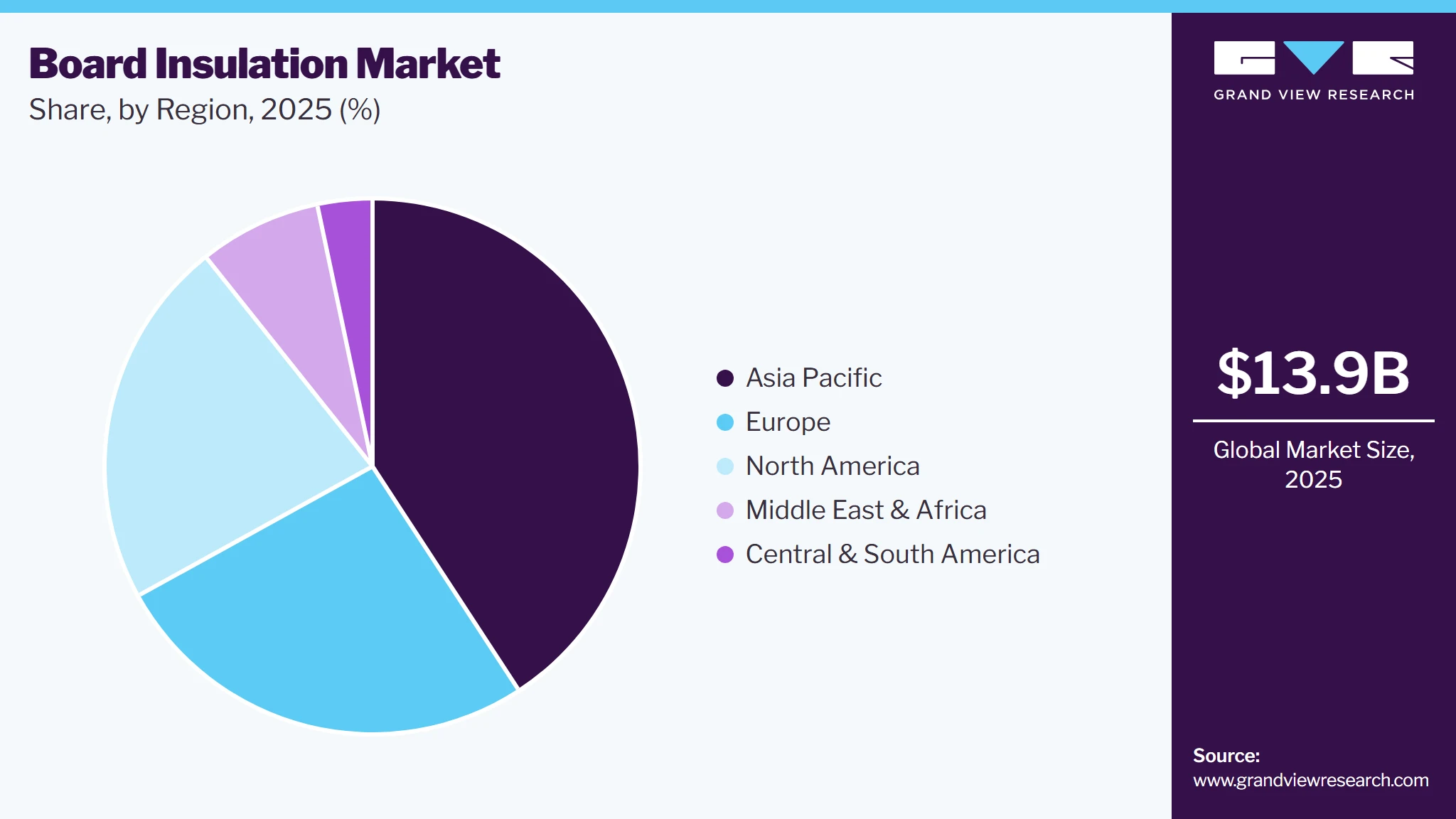
Asia Pacific dominated the board insulation market with the largest revenue share of 40.8% in 2025. The market growth in this region can be attributed to its economic growth, increased energy prices, and building regulations. Different countries in the region have varying building codes and regulations that dictate the minimum requirements for thermal insulation in buildings. These regulations have mandated all construction contractors to implement insulation materials in the construction industry. Rapid urbanization and industrialization have also led to increased construction activities, driving the demand for board insulation in this region. Increasing awareness of environmental sustainability has led to a preference for eco-friendly and recyclable materials.
 To learn more about this report, Download Free Sample Report
 The board insulation market in Asia Pacific is driven by rapid urbanization, increasing construction activities, and the growing demand for energy-efficient buildings across the region. One of the major drivers is the rising construction sector, particularly in countries like China, India, Japan, and Southeast Asian nations. The growth of infrastructure projects, including residential, commercial, and industrial buildings, is boosting the demand for insulation materials, such as board insulation, to enhance thermal efficiency and reduce energy consumption.
The board insulation market in China held the largest share in the Asia Pacific region in 2025. The growing focus on green building certifications, such as China’s Three-Star Green Building Rating System, encourages the adoption of board insulation. Developers and builders increasingly seek these certifications to meet regulatory requirements and market demand for sustainable buildings, leading to a rise in eco-friendly and energy-efficient insulation materials.
U.S. Board Insulation Market Trends
The U.S. board Insulation market is experiencing significant growth driven by the adoption of green building standards like LEED (Leadership in Energy and Environmental Design) and a growing focus on sustainability, which promote the use of eco-friendly and high-performance insulation materials. Consumers and businesses are becoming more conscious of their environmental impact, leading to greater demand for products that improve energy efficiency and reduce carbon footprints.
Middle East & Africa Board Insulation Market Trends
The Middle East & Africa board insulation market is anticipated to grow significantly at a CAGR of 3.1% over the forecast period. One of the primary drivers is the region's extreme climate conditions, particularly the high temperatures in the Middle East, which have led to an increasing demand for effective insulation materials to reduce cooling costs and improve indoor comfort. Governments in the region are promoting energy-efficient buildings through initiatives such as the UAE's Energy Strategy 2050 and Saudi Arabia’s Vision 2033, both of which emphasize sustainability and energy conservation. These policies encourage using insulation materials like board insulation in new construction and retrofitting projects.
Europe Board Insulation Market Trends
The board insulation market in Europe is experiencing notable growth, primarily fueled by increasing renovation and retrofitting activities in Europe are contributing to market growth. Many countries in the region have aging building stocks that need to be modernized to meet current energy efficiency standards. Governments are offering incentives and funding for energy-efficient renovations, such as the EU Renovation Wave initiative, which aims to improve the energy performance of millions of buildings across Europe. This initiative drives demand for insulation materials, including board insulation, to reduce energy waste in older buildings.
Key Board Insulation Company Insights
Some of the key players operating in the market include Owens Corning, Rockwell International, Saint-Gobain, and others;
-
Owens Corning offers a range of high-quality products, including FOAMULAR extruded polystyrene (XPS) insulation boards, renowned for their moisture resistance, durability, and thermal performance. Additionally, the company provides Thermafiber mineral wool insulation boards, which offer fire resistance and sound control, meeting the needs of both residential and commercial applications.
-
Rockwell International, a prominent player in the market, specializes in providing high-performance insulation solutions for commercial and industrial applications. With a focus on energy efficiency, sustainability, and durability, Rockwell's product portfolio includes an array of mineral wool insulation boards. These offerings cater to multiple needs, including thermal and acoustic insulation and fire resistance, making them suitable for walls, roofs, floors, and HVAC systems. The company’s board insulation products are engineered to meet stringent industry standards, supporting energy conservation efforts and enhancing the safety and comfort of building environments.
Key Board Insulation Companies
The following key companies have been profiled for this study on the board insulation market.
-
Owens Corning
-
Rockwell International
-
Saint-Gobain
-
Knauf Insulation
-
Llyod Insulations India Ltd
-
Polybond Insulation Pvt Ltd
-
Industrial insulation
-
BASF
-
Huntsman Corporation
-
Mitsui Chemicals, inc.
-
Rogers Corporation
-
Duna.
Competitive Benchmarking
Operating Strategies
Competitive Edge
Weaknesses
Established Players (Owens Corning, Saint-Gobain, Knauf Insulation, BASF, Huntsman Corporation, Mitsui Chemicals, Inc.)
- Expand production capacities and distribution networks to strengthen global market penetration.
- Invest in advanced insulation technologies focused on thermal efficiency, fire resistance, and sustainability.
- Pursue acquisitions, partnerships, and product portfolio diversification to enhance competitive positioning.
- Extensive product portfolios spanning fiberglass, mineral wool, EPS, XPS, polyurethane, and polyisocyanurate insulation boards.
- Strong brand recognition, established contractor relationships, and broad geographic presence.
- Significant R&D capabilities and economies of scale that support product innovation and cost optimization.
- Higher operational and manufacturing costs compared to regional competitors.
- Slower decision-making and reduced flexibility due to large organizational structures.
- Exposure to cyclical fluctuations in construction activity and raw material prices.
Emerging Players (Lloyd Insulations India Ltd, Polybond Insulation Pvt Ltd, Industrial Insulation Group, DUNA Group)
- Focus on regional markets and niche application segments with customized insulation solutions.
- Compete through cost-effective offerings and localized distribution networks.
- Expand market presence through contractor partnerships and targeted capacity investments.
- Greater agility in responding to local customer requirements and market trends.
- Competitive pricing strategies that appeal to cost-sensitive construction projects.
- Strong regional relationships with distributors, builders, and industrial customers.
- Limited manufacturing scale and geographic reach compared to global market leaders.
- Lower investment capacity for R&D and advanced product development.
- Higher vulnerability to supply chain disruptions and raw material cost volatility.
Board Insulation Market Report Scope
Report Attribute
Details
Market size in 2025
USD 13.9 billion
Estimated market size in 2026
USD 14.4 billion
Projected market size by 2033
USD 19.4 billion
Growth rate
CAGR of 4.3% from 2026 to 2033
Base year for estimation
2025
Historical data
2021 - 2024
Forecast period
2026 - 2033
Quantitative units
Volume in Kilotons and Revenue in USD million/billion and CAGR from 2026 to 2033
Report coverage
Revenue forecast, company ranking, competitive landscape, growth factors, and trends
Segments covered
Application, region
Regional scope
North America; Europe; Asia Pacific; Central & South America; Middle East & Africa
Country scope
U.S.; Canada; Mexico; Germany; UK; France; Italy; Spain; China; India; Japan; South Korea; Brazil
Key companies profiled
Owens Corning; Rockwell International; Saint-Gobain; Knauf Insulation; Llyod insualtions India Ltd; Polybond insulation Pvt Ltd; Industrial insulation; BASF SE; Huntsman Corporation; Mitsui Chemicals, Inc.; Rogers Corporation; Duna
Customization scope
Free report customization (equivalent up to 8 analysts' working days) with purchase. Addition or alteration to country, regional & segment scope.
Pricing and purchase options
Avail customized purchase options to meet your exact research needs. Explore purchase options
Global Board Insulation Market Report Segmentation
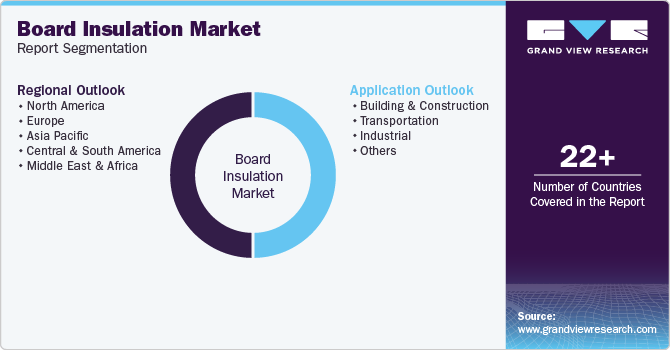
This report forecasts volume & revenue growth at country levels and provides an analysis of the industry trends in each of the sub-segments from 2021 to 2033. For this study, Grand View Research has segmented the global board insulation market based on application and region:
 To learn more about this report, Download Free Sample Report
 -
Application Outlook (Volume, Kilotons; Revenue, USD Million, 2021 - 2033)
-
Building & Construction
-
Transportation
-
Industrial
-
Others
-
-
Regional Outlook (Volume, Kilotons; Revenue, USD Million, 2021 - 2033)
-
North America
-
U.S.
-
-
Europe
-
Germany
-
UK
-
-
Asia Pacific
-
China
-
Japan
-
-
Central & South America
-
Brazil
-
-
Middle East & Africa
-
Research Methodology
The board insulation market figures in this report are based on a proven research process that combines executive interviews with secondary research from proprietary databases, company filings, and recognized regulatory and institutional sources. Market size is built through value-chain sizing-reconciling supply-side and demand-side estimates-and triangulated with bottom-up and top-down approaches. Every estimate passes multiple levels of expert validation before publication, with each board insulation segment quantified using the revenue-capture definitions in the table below.
Segment Definition
Segment - Application
Revenue capture definition
Building & Construction
Revenue generated from the sale of board insulation used to improve thermal efficiency, acoustic performance, moisture control, and fire resistance in residential, commercial, and institutional buildings. This segment captures revenues from fiberglass, mineral wool, expanded polystyrene (EPS), extruded polystyrene (XPS), polyurethane, and polyisocyanurate insulation boards supplied for walls, roofs, floors, ceilings, facades, basements, and HVAC systems across new construction and renovation projects.
Transportation
Revenue generated from the sale of board insulation used for thermal management, noise reduction, vibration damping, and fire protection in transportation applications. This segment captures revenues from insulation boards supplied to manufacturers and operators of passenger vehicles, commercial vehicles, railways, marine vessels, and aerospace equipment for use in cabins, engine compartments, cargo areas, flooring systems, and structural components to enhance energy efficiency, passenger comfort, and safety.
Industrial
Revenue generated from the sale of board insulation used to maintain temperature control, improve energy efficiency, and ensure operational safety in industrial facilities. This segment captures revenues from insulation boards supplied to manufacturing plants, power generation facilities, oil & gas operations, chemical processing units, warehouses, cold storage facilities, and industrial HVAC systems for applications involving equipment insulation, process temperature management, and fire protection.
Others
Revenue generated from the sale of board insulation used in specialized and non-traditional applications beyond building, transportation, and industrial sectors. This segment captures revenues from insulation boards utilized in agricultural buildings, educational institutions, healthcare facilities, sports and recreational infrastructure, data centers, telecommunications facilities, and other niche applications requiring thermal insulation, soundproofing, moisture resistance, and energy performance enhancement.
Estimation Model
Layer Name
Key Question
Description
Global Construction and Infrastructure Spending
What is the total addressable construction activity generating demand for insulation materials?
This layer evaluates global spending on residential, commercial, institutional, and infrastructure construction projects. Construction expenditure, building floor area additions, urbanization trends, and renovation activities are analyzed to establish the overall demand base for insulation products across developed and emerging economies.
Insulation Adoption in Buildings and Facilities
What proportion of construction projects incorporate board insulation products?
This layer assesses insulation penetration across new construction and retrofit projects. Factors such as building energy codes, green building certifications, climate conditions, energy-efficiency regulations, and adoption rates of thermal and acoustic insulation systems are analyzed to determine the addressable insulation market.
Board Insulation Product Utilization
What share of the insulation market is served by board insulation materials?
This layer evaluates the use of board insulation products relative to alternative insulation formats such as blankets, loose-fill insulation, spray foam, and reflective insulation. Analysis includes product preferences across walls, roofs, floors, facades, and HVAC applications, along with demand for fiberglass, mineral wool, EPS, XPS, polyurethane, and polyisocyanurate boards.
Board Insulation Market Revenue
What revenue is generated from the sale of board insulation products globally?
This final layer calculates market revenue by combining installed volume demand with average selling prices across product types, applications, and regions. Revenue generated from board insulation materials supplied to residential, commercial, institutional, industrial, and renovation projects is aggregated to determine the total global board insulation market size.
Delivered Customizations
This report has been delivered with the following In-depth customizations
Client Request
Customization Delivered
Value Adds
Regional Growth Opportunity Analysis
Detailed regional and country-level assessment of the board insulation market across major regions, including construction spending trends, building energy-efficiency regulations, climate-driven insulation demand, retrofit activity, urbanization rates, infrastructure investments, and green building adoption. The study further identifies high-growth countries, emerging demand clusters, investment hotspots, and region-specific growth barriers.
Enables clients to prioritize high-growth geographies, optimize market-entry strategies, allocate resources effectively, identify underserved markets, and capitalize on region-specific demand drivers and regulatory developments.
Competitive Landscape and Benchmarking Study
Comprehensive benchmarking of leading and emerging board insulation manufacturers based on product portfolio strength, manufacturing footprint, pricing strategies, innovation capabilities, distribution networks, sustainability initiatives, certification compliance, end-use industry penetration, strategic partnerships, mergers & acquisitions, and expansion activities. The analysis also evaluates competitive positioning across insulation material categories and regional markets.
Provides actionable competitive intelligence, supports strategic planning, identifies potential acquisition or partnership targets, highlights market gaps, and enables clients to strengthen differentiation strategies and competitive positioning.
Technology and Innovation Mapping
In-depth evaluation of existing and emerging insulation technologies, including advanced fiberglass formulations, high-performance mineral wool boards, vacuum insulation panels (VIPs), aerogel-based insulation materials, bio-based insulation boards, recyclable insulation solutions, fire-resistant technologies, moisture-management innovations, and next-generation manufacturing processes. The study assesses technology maturity, commercialization potential, patent activity, R&D investments, and future adoption trends.
Helps clients identify innovation opportunities, prioritize R&D investments, anticipate technology disruptions, accelerate product development initiatives, and establish long-term leadership in high-performance and sustainable insulation solutions.
Frequently Asked Questions About This Report
The board insulation market size was estimated at USD 13.9 billion in 2025 and is expected to reach USD 14.4 billion in 2026.
The board insulation market is expected to grow at a compound annual growth rate of 4.3% from 2026 to 2033 to reach USD 19.4 billion by 2033
Some of the key players operating in the Board Insulation market include Owens Corning, Rockwell International, Saint-Gobain, Knauf Insulation, Llyod Insulations India Ltd, Polybond Insulation Pvt Ltd, Industrial Insulation, BASF SE, Huntsman Corporation, Mitsui Chemicals, Inc., Rogers Corporation, and Duna.
Asia Pacific held the highest revenue share of 40.8% in 2025 of the global board insulation market.
Asia Pacific is the fastest-growing region in the board insulation market.
The building & construction segment is the fastest-growing application segment in the board insulation market.
India is the fastest-growing country in the Asia Pacific board insulation market.
The building & construction segment led the market and accounted for the largest share of 67.1% in 2025. As the construction industry prioritizes energy efficiency, sustainability, and occupant comfort, the demand for board insulation is expected to grow across various applications in the building sector
Key factors that are driving the market growth include the rising demand for board insulation in construction & building and transportation applications.
About the Author(s)
Advanced Interior Materials Research Team
Advanced Materials · Advanced Interior MaterialsThis report was authored by the advanced interior materials research team at Grand View Research - comprising two research analysts, one senior research analyst, and one industry expert - with specialized expertise in the advanced interior materials segment of the advanced materials industry. All findings are based on proprietary advanced materials databases, executive interviews, and regulatory analysis, subject to internal peer review prior to publication.
Last Updated:
Speak to Analyst

Customize this report to your needs - add regions, segments, or data points, with 20% free customization.
Or view our licence options:


ISO 9001:2015 & 27001:2022 Certified
We are GDPR and CCPA compliant! Your transaction & personal information is safe and secure. For more details, please read our privacy policy.


