
- Home
- »
- Petrochemicals
- »
-
Brazil Lubricants Market Size & Share, Industry Report, 2033GVR Report cover

Brazil Lubricants Market (2026 - 2033) Size, Share & Trends Analysis Report By Product (Industrial (Process Oils, General Industrial Oils), Marine (Engine Oil, Greases), Automotive, Aerospace, Agriculture), And Segment Forecasts
Market Size, 2025
$7.3BMarket Forecast, 2033
$10.5BCAGR, 2026–2033
4.6%Brazil Lubricants Market Summary
The Brazil lubricants market size was estimated at USD 7.3 billion in 2025 and is projected to reach USD 10.5 billion by 2033, growing at a CAGR of 4.6% from 2026 to 2033. This growth is primarily driven by steady expansion in the automotive and industrial sectors, supported by a rising vehicle parc, infrastructure development, and increased mechanization in agriculture.
Key Market Trends & Insights
- By product, the automotive segment dominated the market in 2025, accounting for 48.4% of value.
- Aerospace lubricants are expected to grow at a CAGR of 5.8% between 2026 and 2033.
Market Size & Forecast
- 2025 Market Size: USD 7.3 Billion
- 2033 Projected Market Size: USD 10.5 Billion
- CAGR (2026-2033): 4.6%
Prism AI by Grand View Research Free to tryAsk a question about the brazil lubricants marketTry asking✓Every figure cited from GVR research Prefer the report? Download free sample →
In addition, sustained demand from aftermarket services, particularly for engine, transmission, and hydraulic oils, continues to underpin market growth. Gradual recovery in manufacturing activity, growth in logistics and freight movement, and ongoing maintenance requirements of an aging vehicle and equipment fleet further contribute to lubricant consumption.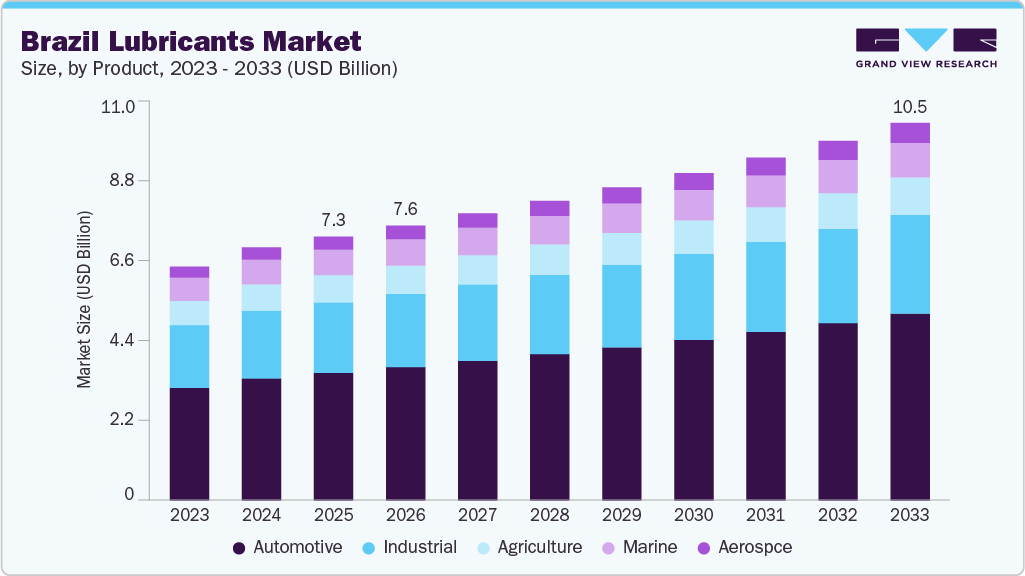 Source: Grand View Research, IR Documents, Primary Interviews, Paid DatabasesTo learn more about this report,
 Download Free Sample Report
Lubricants, which include engine oils, gear oils, hydraulic fluids, greases, and specialty products, are critical for reducing friction, improving energy efficiency, and extending equipment life. Increasing global focus on sustainable and high-performance formulations is encouraging manufacturers to innovate, while stringent environmental regulations are prompting the replacement of conventional products with synthetic and bio-based alternatives. In addition, advancements in electric and hybrid vehicle technology are influencing lubricant requirements worldwide, ensuring the market remains dynamic and forward-looking.
The lubricants market in Brazil is a direct derivative of the global industry, reflecting trends in automotive growth, industrial expansion, and aftermarket maintenance. The Brazilian lubricants industry is driven by the rising automotive manufacturing sector, the adoption of commercial and industrial machinery, and rising consumer awareness of maintenance and optimization. Global companies are actively entering the Brazilian lubricants industry with novel offerings, manufacturing bases, and enhanced logistics networks. Thus, Brazil is both receiving and contributing to the global lubricants industry due to the constant inflow of innovations from the global industry.
Regionally, Brazil has emerged as a major market in Latin America, supported by its automobile industry, industrial infrastructure, and increasing vehicle ownership. Growing demands for better engine performance, fuel efficiency, and longevity of the equipment will increase the consumption of synthetic and high-performance lubricants. Besides, the ever-growing industrial and manufacturing sectors in Brazil spur the demand for hydraulic oils, industrial greases, and specialty lubricants. All these factors, put together, underscore that while the market is in step with global influences, local opportunities also abound for growth and product differentiation.
Market Concentration & Characteristics
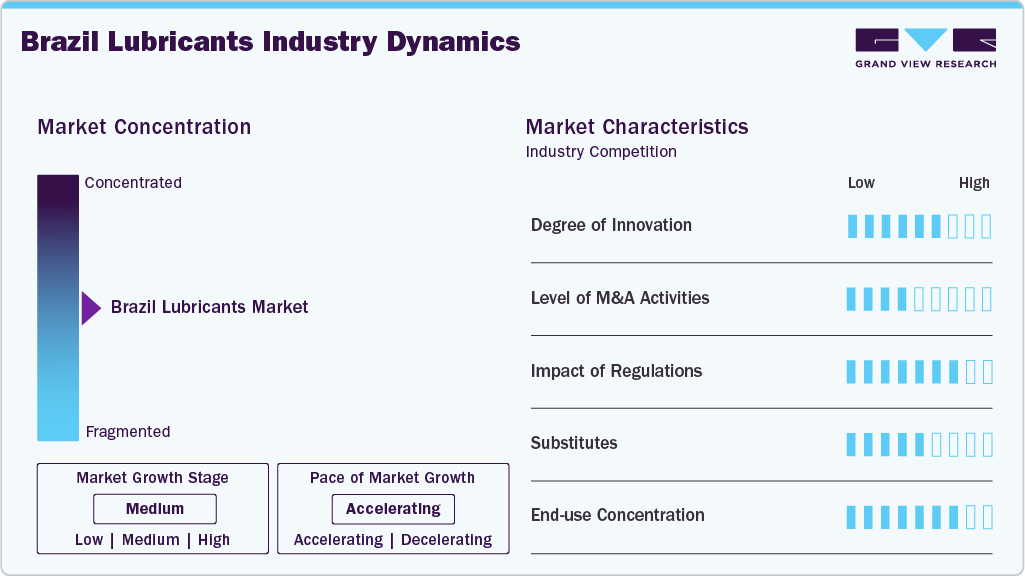
The Brazil lubricants industry is characterized by a moderately consolidated competitive landscape, with the presence of both multinational oil companies and regional lubricant manufacturers. Major global players such as Shell Plc, BP, ExxonMobil Corporation, Chevron Corporation, and Petrobras maintain a strong market presence through established distribution networks, extensive product portfolios, and long-term relationships with automotive and industrial customers. These companies primarily compete in premium and synthetic lubricant categories, leveraging brand recognition, technical expertise, and OEM approvals to strengthen market positioning.
 To learn more about this report, Download Free Sample Report
At the same time, the market also includes several domestic and regional lubricant blenders that compete on pricing, localized supply, and application-specific offerings. Demand from automotive, mining, agriculture, marine, and industrial sectors continues to support market expansion, encouraging both global and local participants to enhance production capacity and product innovation. In addition, increasing adoption of high-performance and synthetic lubricants is gradually shifting competition toward technology-driven formulations, while regulatory focus on emissions and equipment efficiency is further influencing product development strategies across the industry.
Product Insights
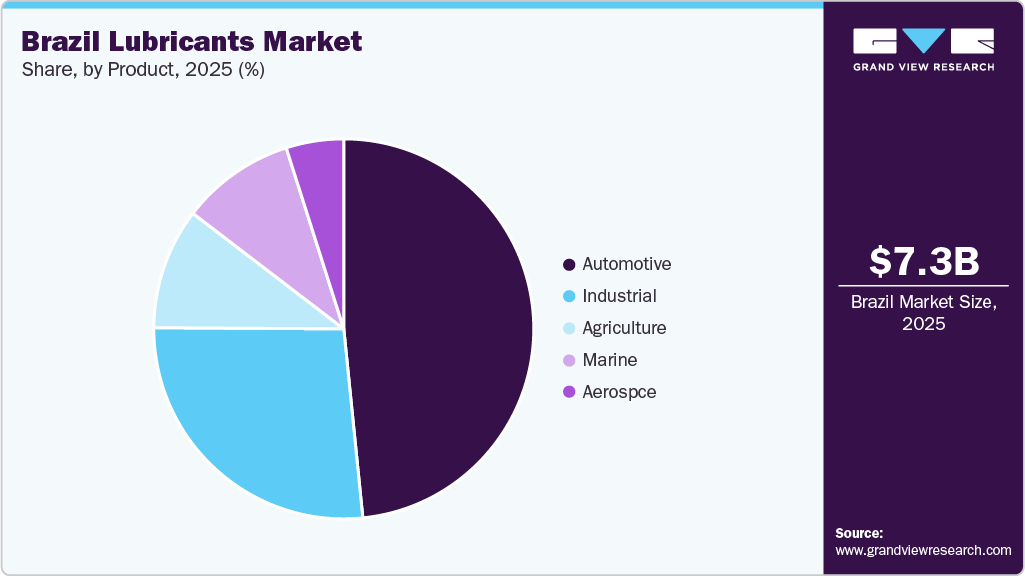
Automotive lubricants dominated the market, accounting for 48.4% of revenue in 2025. Growing sales of commercial vehicles, such as trucks and buses, as well as other forms of public and freight transport, are expected to drive demand for commercial automotive lubricants in Brazil over the forecast period. Brazil’s steady economic recovery, coupled with investments in logistics, infrastructure development, and public transportation, has supported the expansion of commercial vehicle fleets across the country.
 To learn more about this report, Download Free Sample Report
Aerospace lubricants are expected to grow at a CAGR of 5.8% between 2026 and 2033. Aerospace lubricants are used to ensure high reliability and long service life for critical aircraft components operating under high vacuum conditions and extreme temperature ranges. In Brazil, aerospace lubricants are subject to stringent performance requirements and regular scrutiny due to increasing regulatory oversight and the application of international aviation and military standards. Growth in air passenger traffic, supported by the expansion of domestic and regional air travel, along with rising defense expenditure, is expected to remain a key driver of aerospace lubricant demand over the forecast period. Brazil’s sustained investments in its defense and aerospace capabilities, including fleet modernization and maintenance, have contributed to the overall growth in the aerospace sector and, in turn, to lubricant consumption.
Key Brazil Lubricants Company Insights
Key players, such as Shell plc, Castrol, and TotalEnergies, are dominating the market.
-
Shell plc is a global energy and petrochemicals company and a manufacturer of finished lubricants, producing automotive, industrial, and marine lubricants through a worldwide network of blending plants supported by advanced R&D and proprietary technologies. In the Brazil market, Shell Plc operates through Raízen, its joint venture with Cosan, which holds the license to blend, package, distribute, and market Shell Plc-branded lubricants locally in accordance with Shell Plc’s global specifications. The company serves a wide range of industries, including automotive and transportation, industrial manufacturing, mining, marine, aviation, construction, agriculture, and power generation.
Key Brazil Lubricants Companies:
- Cosan
- Shell plc
- TotalEnergies
- ICONIC Lubrificantes
- Vibra Energia
- PETRONAS Lubricants International
- Castrol
- Ultrax Lubrificantes
- YPF
- Exxon Mobil Corporation
- FUCHS
- Lwart Environmental Solutions
Recent Developments
-
In July 2025, Petrobras announced an investment of around USD 6,171 million in Rio de Janeiro to expand and modernize its refining and petrochemical facilities. The plan includes boosting production of diesel, jet fuel, and high-quality base oils, supporting renewable fuel projects, and improving operational efficiency and sustainability across its plants
-
In January 2024, Gulf Oil International strengthened its presence in Brazil by launching Gulf Oil Brazil, which will manufacture and distribute lubricants from its local facility and license its brand to fuel stations, marking the start of a growth and collaboration phase in the Latin American market.
Brazil Lubricants Market Report Scope
Report Attribute
Details
Market size value in 2026
USD 7.6 billion
Revenue forecast in 2033
USD 10.5 billion
Growth rate
CAGR of 4.6% from 2026 to 2033
Base year for estimation
2025
Historical data
2021 - 2024
Forecast period
2026 - 2033
Quantitative units
Revenue in USD million/billion, volume in kilotons, and CAGR from 2026 to 2033
Report coverage
Revenue forecast, company ranking, competitive landscape, growth factors, and trends
Segments covered
Product
Key companies profiled
Shell plc; Cosan; TotalEnergies; ICONIC Lubrificantes; Vibra Energia; PETRONAS Lubricants International; Castrol; Ultrax Lubrificantes; YPF; Exxon Mobil Corporation; FUCHS; Lwart Environmental Solutions
Customization scope
Free report customization (equivalent to up to 8 analysts’ working days) with purchase. Addition or alteration to country, regional & segment scope.
Pricing and purchase options
Avail customized purchase options to meet your exact research needs. Explore purchase options
Brazil Lubricants Market Report Segmentation
This report forecasts revenue & volume growth at granular levels and provides an analysis of the latest industry trends in each of the sub-segments from 2021 to 2033. For this study, Grand View Research has segmented the Brazil lubricants market report based on product:
-
Product Outlook (Volume, Kilotons; Revenue, USD Million, 2021 - 2033)
-
Industrial
-
Process Oils
-
General Industrial Oils
-
Metal Working Fluids
-
Industrial Engine Oils
-
Greases
-
Other Industrial Products
-
-
Automotive
-
Engine Oil
-
OW-20
-
OW-30
-
OW-40
-
5W-20
-
5W-30
-
5W-40
-
10W-60
-
10W-40
-
15W-40
-
Other Engine Oils
-
-
Gear Oils
-
Transmission Fluids
-
Brake Fluids
-
Coolants
-
Greases
-
-
Marine
-
Engine Oil
-
Hydraulic Oil
-
Gear Oil
-
Turbine Oil
-
Greases
-
Other Marine Products
-
-
Aerospace
-
Gas Turbine Oil
-
Piston Engine Oil
-
Hydraulic Fluids
-
Other Aerospace Products
-
-
Agriculture
-
Engine Oil
-
Transmission Oil
-
Hydraulic Fluids
-
Greases
-
Other Agriculture Products
-
-
Frequently Asked Questions About This Report
Some key players operating in the Brazil lubricants market include Shell plc, Cosan, TotalEnergies, ICONIC Lubrificantes, Vibra Energia, PETRONAS Lubricants International, Castrol, Ultrax Lubrificantes, YPF, Exxon Mobil Corporation, FUCHS, and Lwart Environmental Solutions.
The Brazil lubricants market size was estimated at USD 7.3 billion in 2025 and is expected to reach USD 7.6 billion in 2026.
The Brazil lubricants market is expected to grow at a CAGR of 4.6% from 2026 to 2033 to reach USD 10.5 billion by 2033.
Automotive lubricants dominated the market with a revenue share of 48.4% in 2025. Growing sales of commercial automotive vehicles such as trucks, buses, and other forms of public and freight transport are expected to drive demand for commercial automotive lubricants in Brazil over the forecast period
This growth is primarily driven by steady expansion in the automotive and industrial sectors, supported by rising vehicle parc, infrastructure development, and increased mechanization in agriculture. In addition, sustained demand from aftermarket services, particularly for engine oils, transmission fluids, and hydraulic oils, continues to underpin market growth.
About the Author(s)
Petrochemicals Research Team
Bulk Chemicals · PetrochemicalsThis report was authored by the petrochemicals research team at Grand View Research - comprising two research analysts, one senior research analyst, and one industry expert - with specialized expertise in the petrochemicals segment of the bulk chemicals industry. All findings are based on proprietary bulk chemicals databases, executive interviews, and regulatory analysis, subject to internal peer review prior to publication.
Last Updated:
Speak to Analyst

Customize this report to your needs - add regions, segments, or data points, with 20% free customization.
Or view our licence options:


ISO 9001:2015 & 27001:2022 Certified
We are GDPR and CCPA compliant! Your transaction & personal information is safe and secure. For more details, please read our privacy policy.


