
- Home
- »
- Advanced Interior Materials
- »
-
Building Envelope Market Size, Share Report, 2026-2033GVR Report cover
![Building Envelope Market (2026 - 2033)Report]()
Building Envelope Market (2026 - 2033)
Size, Share & Trends Analysis Report By Product (Walls & Cladding Systems, Roofs, Windows & Doors), By End-use (Residential, Commercial, Industrial), By Region (North America, Europe, Asia Pacific), And Segment Forecasts
Market Size, 2025
$123.6BMarket Estimate, 2026
$130.4BMarket Forecast, 2033
$189.7BCAGR, 2026–2033
5.5%Building Envelope Market Summary
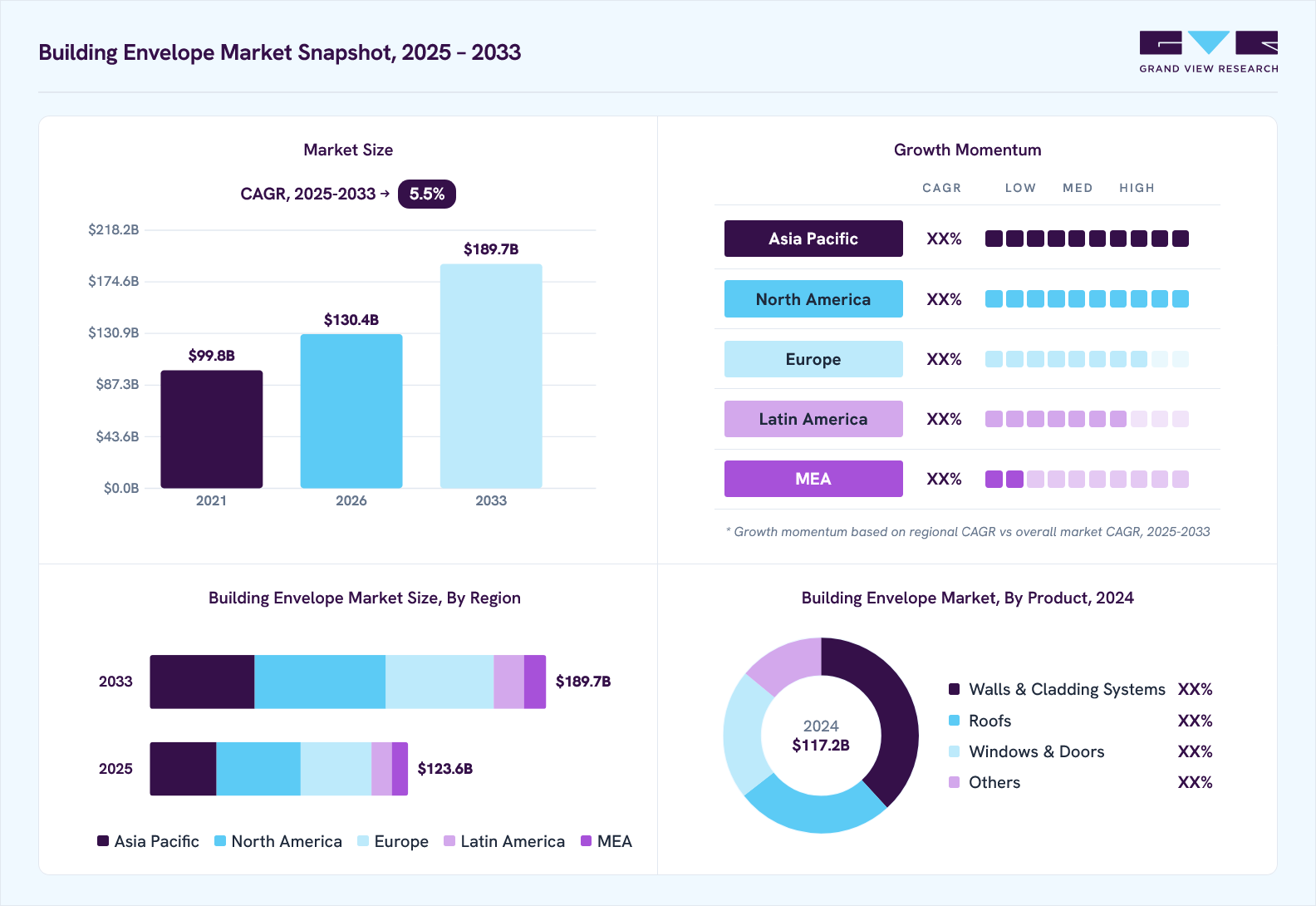
The global building envelope market size was valued at USD 123.6 billion in 2025 and is projected to grow from USD 130.4 billion in 2026 to USD 189.7 billion by 2033, at a CAGR of 5.5% from 2026 to 2033. North America dominated the market, accounting for a revenue share of 32.6% in 2025. The demand for building envelope solutions is increasing as modern construction emphasizes energy efficiency, sustainability, and occupant comfort.
Key Market Trends & Insights
- By product type: Walls & cladding segment led the market with the largest revenue share of 38.1% in 2025.
- By end use: Residential segment led the market with the largest revenue share of 42.4% in 2025.
Regional Highlights
- Largest regional market: North America (32.6% revenue share, 2025)
- Fastest-growing regional market: Asia Pacific (highest CAGR, 2026-2033)
- By country: The U.S. held the largest market share in 2025.
Market Size & Forecast
- Market size in 2025: USD 123.6 Billion
- Estimated market size in 2026: USD 130.4 Billion
- Projected market size by 2033: USD 189.7 Billion
- CAGR (2026-2033): 5.5%
Rising awareness of climate change has driven governments, businesses, and homeowners to adopt advanced building envelopes that minimize energy loss and reduce greenhouse gas emissions. Urbanization and rapid infrastructure development in emerging economies are also expanding the construction of commercial and residential buildings, further fueling demand. The global trend of green buildings and certifications such as LEED and BREEAM has strengthened the use of high-performance envelopes.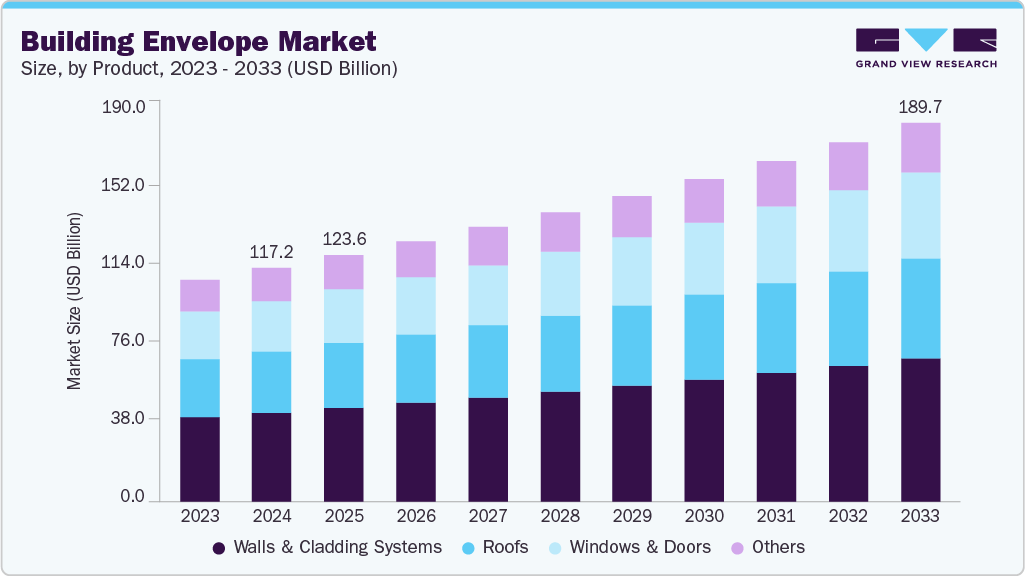
Key drivers include the surge in green building certifications, the adoption of modern construction technologies, and the integration of advanced materials that enhance performance. Walls & cladding systems are increasingly demanded for thermal regulation and protection against environmental stressors. Roofs are influenced by demand for cool roofs, green roofs, and solar-ready installations, addressing both environmental concerns and cost savings. Windows & doors drive demand through their role in reducing heat loss, improving indoor comfort, and supporting architectural design flexibility. Other building envelope components, such as shading systems and ventilated facades, benefit from rapid urban development and growing interest in smart building solutions.
Innovations include the use of composite cladding materials, 3D-printed walls, and ventilated façade systems that improve thermal comfort and aesthetics. Roofing trends highlight green roofs, photovoltaic-integrated systems, and lightweight materials that reduce structural load. Windows and doors are evolving with smart glass, double/triple glazing, and automation technologies for improved efficiency. In the "Others" category, dynamic facades, modular construction components, and digital twins for envelope performance monitoring are gaining ground. Overall, technology integration, lightweight construction, and the rise of eco-friendly materials are reshaping the building envelope landscape, aligning with net-zero building objectives.
Market Dynamics
The Building Envelope market is witnessing substantial growth driven by increasing construction activity, rising investments in commercial and residential infrastructure, growing emphasis on energy-efficient buildings, and the implementation of stringent building performance regulations. Building envelope systems, including roofing, walls, façades, insulation, windows, and doors, play a critical role in enhancing energy efficiency, occupant comfort, structural durability, and overall building performance. The growing adoption of green building practices, net-zero energy building concepts, and sustainable construction materials is further accelerating market growth. Additionally, advancements in façade technologies, high-performance insulation materials, smart glazing solutions, and weather-resistant construction systems are enabling building owners and developers to improve energy conservation while reducing long-term operating costs.
The increasing emphasis on reducing building energy consumption and carbon emissions is a key factor driving the adoption of advanced building envelope solutions. Governments across major economies are implementing stringent energy codes, building performance standards, and sustainability regulations that require improved thermal efficiency and reduced operational energy use. Building owners and developers are increasingly investing in high-performance façades, insulation systems, roofing materials, and energy-efficient glazing solutions to comply with these regulations while enhancing occupant comfort and reducing lifecycle operating costs. Growing construction activity across commercial, residential, institutional, and industrial sectors is further supporting demand for advanced building envelope systems globally.
The building envelope market faces challenges related to the high initial costs associated with advanced façade systems, premium insulation materials, high-performance glazing, and specialized installation processes. Building envelope projects often require significant upfront investment, technical expertise, and compliance with complex building codes and performance standards, which can increase project costs and implementation timelines. Additionally, fluctuations in raw material prices, labor shortages in the construction sector, and supply chain disruptions can impact project economics and profitability. For building owners and developers in cost-sensitive markets, the higher capital expenditure associated with advanced envelope solutions may limit adoption despite the long-term operational benefits.
The growing need to upgrade aging building infrastructure and improve energy performance is creating substantial opportunities for the Building Envelope market. A significant share of commercial and residential buildings worldwide was constructed before the introduction of modern energy-efficiency standards and now requires renovation to enhance thermal performance, weather resistance, durability, and sustainability. In addition, increasing investments in green building certifications, smart buildings, climate-resilient infrastructure, and net-zero construction projects are driving demand for advanced façade systems, high-performance insulation materials, energy-efficient glazing solutions, and integrated building envelope technologies. As governments, developers, and building owners continue to prioritize carbon reduction, operational efficiency, and sustainability goals, demand for innovative building envelope solutions is expected to increase significantly over the coming years.
Market Concentration & Characteristics
The market for building envelope is moderately consolidated, with a mix of global players and regional specialists. Large companies such as Saint-Gobain, BASF, Owens Corning, Rockwool, and Kingspan dominate the supply of insulation materials and advanced facades. Meanwhile, glazing giants like Nippon Sheet Glass and AGC Inc. hold strong positions in window and glass solutions. Regional players focus on cost-effective and customized solutions for local markets, particularly in Asia and Latin America. Partnerships between construction firms and material suppliers are increasing as integrated solutions are preferred over standalone products. Mergers and acquisitions are also shaping market dynamics, enhancing portfolio diversity and global reach.
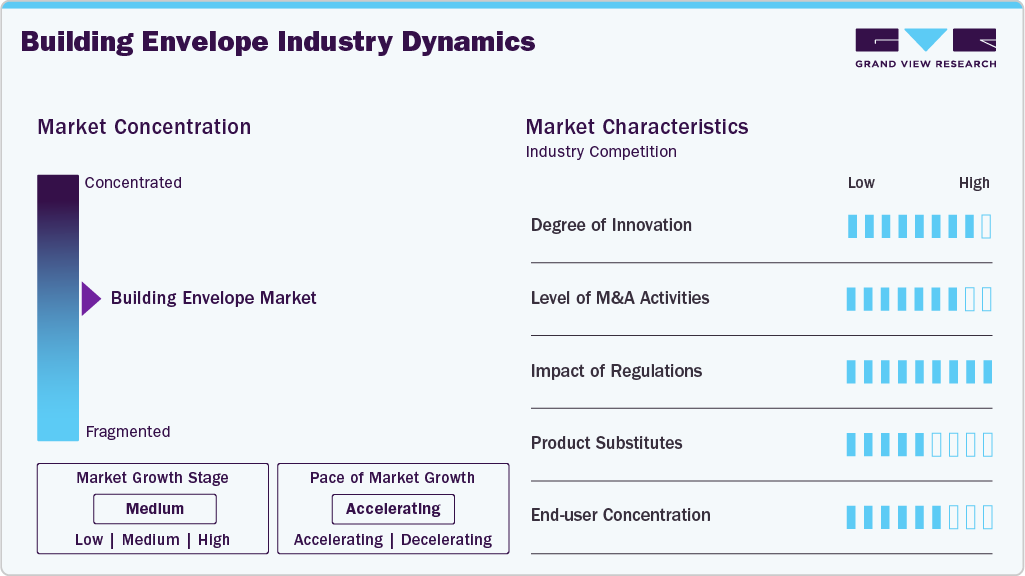
The threat of substitutes is moderate, as each segment provides unique functional and regulatory compliance features. Walls and cladding systems face limited substitution, although advanced coatings or prefabricated panels may replace traditional materials. Roofing systems may see competition from emerging membrane technologies and integrated solar structures. Windows and doors encounter substitutes in advanced shading devices or automated façade solutions, but direct replacement is unlikely due to their structural necessity. Other envelope components, like curtain walls, face minor substitution risks from prefabricated modular solutions. Overall, product necessity and regulatory compliance reduce substitution threats.
Analyst Perspective
The building envelope market is increasingly being shaped by the convergence of energy efficiency, sustainability, and building performance requirements, transforming it from a conventional construction products market into a strategically important component of modern building design. Growth is being driven by stricter energy regulations, rising adoption of green building standards, increasing investments in building retrofits, and growing demand for high-performance façades, insulation systems, and glazing solutions that improve thermal efficiency and reduce operational costs. Going forward, the key differentiator for market participants will be their ability to deliver integrated, durable, and energy-efficient envelope solutions that address evolving regulatory requirements while supporting net-zero and low-carbon building objectives. Companies with strong material innovation capabilities, advanced engineering expertise, diversified product portfolios, and established relationships across the construction value chain will be best positioned to capitalize on the growing demand for sustainable and high-performance buildings worldwide.
Product Insights
Based on product type, the walls & cladding segment led the market with the largest revenue share of 38.1% in 2025 and is expected to grow at a CAGR of 5.4% over the forecast period. The growing demand for energy-efficient and fire-resistant materials, such as aluminum composites, fiber cement, and high-performance panels, has strengthened their market dominance. Commercial and high-rise construction projects across Asia Pacific, North America, and Europe rely heavily on advanced cladding solutions for durability and compliance with green building standards. In addition, ventilated façades and rainscreen cladding systems are witnessing widespread adoption, further solidifying this segment’s leadership in the global building envelope industry.
The windows & doors segment is expected to grow at the fastest CAGR of 6.1% over the forecast period, fueled by rising demand for energy-efficient fenestration and smart building integration. Increasing adoption of double and triple-glazing, low-emissivity glass, and automated systems for natural light optimization is propelling growth. Stricter energy codes in developed economies, combined with rapid urban housing demand in emerging markets, are further boosting this segment. Moreover, smart windows with dynamic glazing and eco-friendly door materials are gaining traction, driven by the push toward net-zero energy buildings. This combination of regulatory pressure and technological innovation positions windows & doors as the most rapidly expanding segment of the building envelope industry.
End-use Insights
Based on end use, the residential segment led the market with the largest revenue share of 42.4% in 2025 and is expected to grow at a CAGR of 5.6% over the forecast period. Homeowners are increasingly investing in energy-efficient walls, cladding, roofing, and advanced window systems to reduce utility costs and enhance indoor comfort. The trend toward sustainable living has accelerated the adoption of insulated cladding panels, green roofing, and double-glazed windows in residential construction. In addition, renovation and retrofitting of old housing stock in developed regions are further boosting demand. With the growing popularity of smart homes, the residential segment continues to maintain its lead in the global building envelope industry.
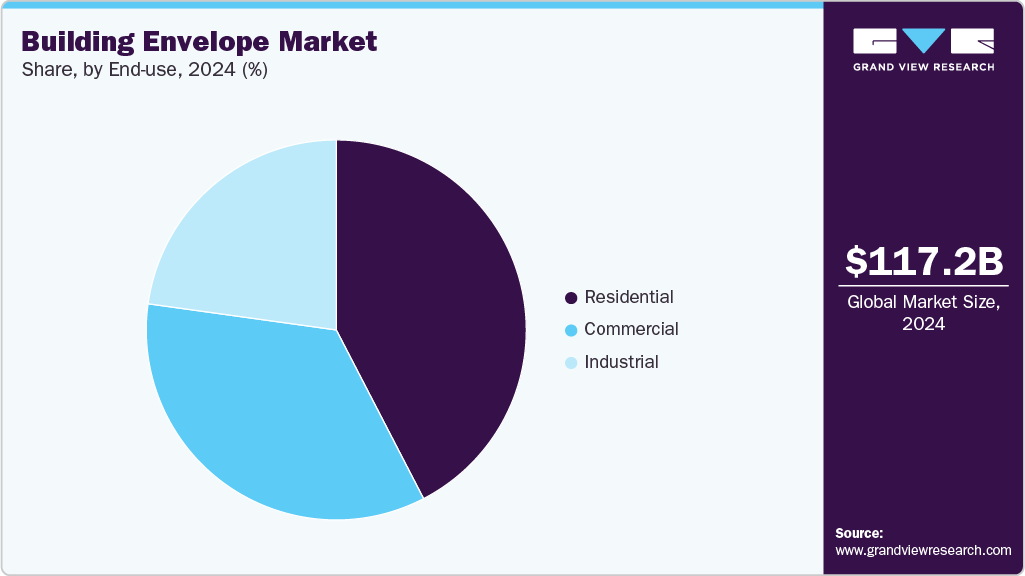
The commercial segment is expected to grow at the fastest CAGR of 6.0% over the forecast period, supported by rapid urban infrastructure development and an increasing number of office complexes, shopping centers, and institutional buildings. Energy codes and sustainability certifications such as LEED, BREEAM, and WELL are compelling commercial builders to adopt advanced façades, high-performance glazing, and solar-integrated roofing systems. Corporate sustainability goals and the need for modern, aesthetic designs are also fueling demand for innovative cladding and curtain wall systems. Emerging markets, particularly in the Asia Pacific and the Middle East, are witnessing large-scale commercial construction, making this segment a key growth driver for the future of the market.
Regional Insights
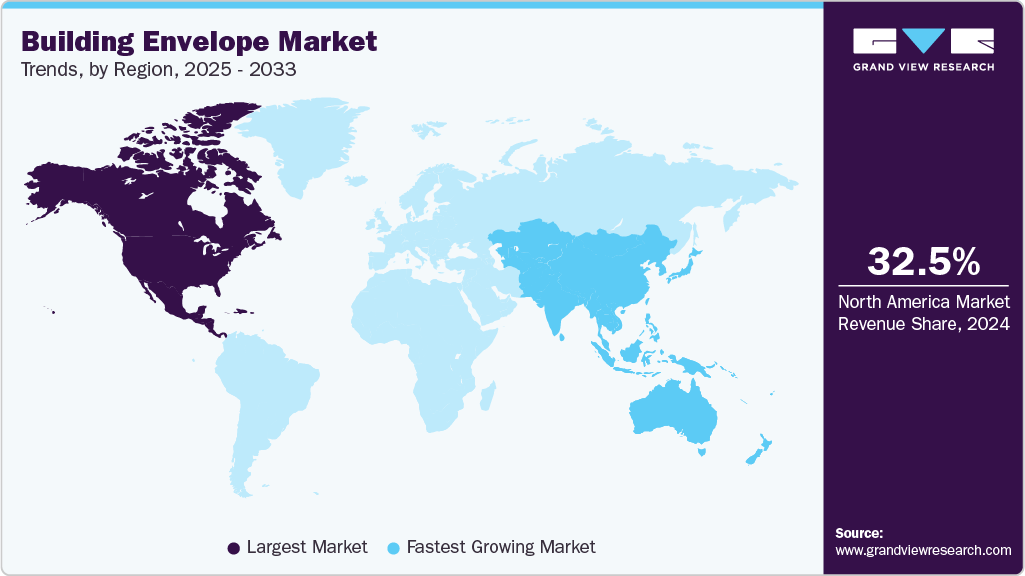
North America dominated the building envelope market with the largest revenue share of 32.6% in 2025. The market in North America is driven by stringent energy efficiency regulations and demand for sustainable retrofitting. The U.S. and Canada are actively adopting advanced insulation and glazing systems to meet zero-energy building targets. The region has a mature construction industry with increasing investments in smart and green buildings. Rising awareness of climate resilience, especially in hurricane and wildfire-prone areas, is encouraging the use of durable envelopes. Technological advancements and innovation hubs in the U.S. are fostering new product development. Retrofitting older building stock with advanced systems remains a key growth area.
U.S. Building Envelope Market Trends
The building envelope market in U.S. held the largest share in the North America region in 2025. The U.S. building envelope industry benefits from robust regulatory frameworks like ASHRAE standards and LEED certifications. Federal and state-level incentives encourage residential and commercial projects to adopt advanced insulation, facades, and glazing solutions. Urban redevelopment and retrofitting projects are particularly strong drivers. The growing emphasis on net-zero buildings aligns with the adoption of innovative materials. Moreover, construction demand in metropolitan areas continues to rise, further boosting market growth. Partnerships between technology companies and construction firms are accelerating the adoption of smart facades.
Asia Pacific Building Envelope Market Trends
Asia Pacific building envelope industry is driven by rapid urbanization, strong infrastructure investments, and government regulations promoting energy-efficient construction. Countries such as China, India, and Japan are driving demand with high-rise residential and commercial developments. Rising population and growing disposable incomes also support new housing projects. The construction boom in smart cities and industrial zones is further boosting the adoption of advanced envelopes. Increasing foreign investments in real estate, coupled with affordable labor costs, make the region a hub for large-scale projects. Green building certifications are being rapidly adopted, further encouraging sustainable building practices.
China building envelope industry is the largest contributor within the Asia Pacific region, driven by its massive construction industry and government-led energy efficiency mandates. The Chinese government’s focus on green buildings under the 14th Five-Year Plan has accelerated demand for advanced facades and insulation systems. Large-scale urban housing projects and commercial towers are driving adoption of glazing and modern envelope technologies. Domestic manufacturers are investing heavily in cost-effective, energy-efficient materials to compete globally. In addition, rapid adoption of prefabrication in China is boosting market growth. Demand is expected to remain high as China continues to urbanize at scale.
Europe Building Envelope Market Trends
Europe building envelope industry remains a leader in sustainable construction practices, heavily influenced by the EU’s Energy Performance of Buildings Directive. Countries such as Germany, France, and the UK are enforcing strict efficiency standards that boost demand for advanced building envelope systems. Adoption of green certifications like BREEAM is widespread across commercial and residential projects. The region has a mature construction sector with an emphasis on retrofitting older buildings to meet modern standards. Innovation in glazing, insulation, and lightweight materials continues to expand. Europe also leads in the use of advanced façade technologies integrating renewable energy.
Germany building envelope industry is one of the most advanced markets for building envelopes, owing to its strict energy efficiency regulations and focus on sustainable building. The country has seen widespread adoption of Passivhaus standards, which prioritize airtight and highly insulated building envelopes. Germany’s advanced manufacturing base supports innovations in glazing and façade solutions. The retrofitting of older housing stock remains a significant driver of demand. In addition, government support for renewable energy integration in buildings is encouraging the adoption of solar facades. Germany’s emphasis on quality and sustainability ensures its leadership in the European market.
Central & South America Building Envelope Market Trends
The building envelope industry in Central & South America is growing steadily due to rising urbanization and increased investments in residential and commercial infrastructure. Countries such as Brazil and Mexico are leading the adoption of efficient construction practices. Although regulations are less stringent compared to North America and Europe, the growing influence of global green building certifications is shaping demand. Affordability remains a key factor, with many local players offering cost-effective insulation and façade solutions. The region also has potential for prefabricated and modular construction, further boosting the market.
Middle East & Africa Building Envelope Market Trends
The Middle East & Africa building envelope industry is expanding rapidly due to mega infrastructure and smart city projects, particularly in the Gulf region. High demand for energy-efficient solutions is driven by extreme climatic conditions that necessitate advanced insulation and glazing. Saudi Arabia, the UAE, and Qatar are investing heavily in green building initiatives. Africa is witnessing increasing urban development, though affordability challenges persist. International players are partnering with local developers to introduce advanced envelope solutions. The region’s strong focus on sustainability and iconic architectural projects is expected to fuel significant demand growth.
Key Building Envelope Company Insights
Some of the key players operating in the market include Saint-Gobain and Rockwool International.
-
Saint-Gobain is a global leader in sustainable building materials, offering advanced solutions in insulation, façades, glazing, and roofing. In the building envelope industry, the company is recognized for its energy-efficient wall and cladding systems, smart glass technologies, and sustainable construction materials that align with net-zero targets. Its strong presence in Europe, North America, and Asia Pacific makes it a dominant player in both residential and commercial applications.
-
Rockwool International specializes in stone wool insulation products, widely used in building envelope systems for thermal, acoustic, and fire-resistant performance. The company’s solutions are crucial for walls, roofs, and façades, enabling energy efficiency and compliance with green building regulations. With sustainability at its core, Rockwool has established a strong foothold in Europe and is rapidly expanding in North America and Asia.
Kingspan Group and GAF Materials Corporation are some of the emerging market participants in the building envelope industry.
-
Kingspan Group is a leading provider of high-performance insulated panels, cladding, façades, and roofing systems. Its innovations in energy-efficient and lightweight construction materials have positioned it as a key player in modern building envelope solutions. Kingspan’s focus on net-zero energy buildings and modular construction technologies has boosted its global presence, particularly in Europe, North America, and emerging Asia Pacific markets.
-
GAF Materials Corporation is one of North America’s largest roofing manufacturers, offering shingles, membranes, and ventilation systems that form a core part of building envelopes. The company has a strong presence in residential and commercial roofing markets, with growing emphasis on reflective, solar-ready, and energy-efficient systems.
Key Building Envelope Companies
The following key companies have been profiled for this study on the building envelope market.
-
Saint-Gobain
-
Owens Corning
-
Kingspan Group
-
Rockwool International
-
BASF SE
-
DuPont de Nemours
-
GAF Materials Corporation
-
Sika AG
-
Etex Corp
-
3M Company
Competitive Benchmarking
Category
Operating Strategies
Competitive Edge
Weakness
Established Players (Saint-Gobain, ROCKWOOL International, Owens Corning)
- Invest in advanced insulation technologies, high-performance façade systems, energy-efficient glazing, and sustainable building materials.
- Strengthen partnerships with architects, contractors, developers, and infrastructure project owners while expanding manufacturing footprints and product portfolios.
- Extensive manufacturing capacity and global distribution networks.
- Strong brand recognition, diversified product offerings, deep technical expertise, and established relationships across the construction value chain.
- High exposure to construction market cycles and fluctuations in building activity.
- Significant capital investment requirements for production expansion, sustainability initiatives, and product innovation.
Emerging Players (Envel Facades, Aluplex, Permasteelisa Group)
- Focus on advanced façade engineering, customized building envelope solutions, premium architectural projects, and energy-efficient building systems.
- Target high-growth segments such as commercial buildings, airports, healthcare facilities, mixed-use developments, and sustainable construction projects.
- Specialized expertise in façade design, engineering, and project execution.
- Ability to differentiate through innovative architectural solutions, project customization, and advanced building envelope technologies.
- Smaller manufacturing scale and geographic reach compared to global building materials leaders.
- Higher dependence on project-based revenues, premium construction activity, and large commercial developments.
Recent Developments
-
In January 2025, Saint-Gobain completed the acquisition of OVNIVER Group in Mexico & Central America, further strengthening its worldwide presence in construction chemicals
-
In January 2024, Kingspan launched PowerPanel, an insulated panel with integrated solar PV.
-
In June 2025, Sika acquired Gulf Additive Factory LLC in the State of Qatar. The acquisition strengthens Sika’s foothold in the country and provides exciting opportunities for further expansion.
Building Envelope Market Report Scope
Report Attribute
Details
Market size in 2025
USD 123.6 billion
Estimated Market size in 2026
USD 130.4 billion
Projected Market size by 2033
USD 189.7 billion
Growth rate
CAGR of 5.5% from 2026 to 2033
Base year for estimation
2025
Historical data
2021 - 2024
Forecast period
2026 - 2033
Quantitative units
Revenue in USD million/billion and CAGR from 2026 to 2033
Report coverage
Revenue forecast, company ranking, competitive landscape, growth factors, and trends
Segments covered
Product Type, end use, region
Regional scope
North America; Europe; Asia Pacific; Central & South America; Middle East & Africa
Country scope
U.S.; Canada; Mexico; UK; Germany; France; Italy; China; India; Japan, UAE, Saudi Arabia, Egypt, Qatar, Kuwait, South Korea
Key companies profiled
Saint-Gobain; Owens Corning; Kingspan Group; Rockwool International; BASF SE; DuPont de Nemours; GAF Materials Corporation; Sika AG; Etex Corp; 3M Company
Customization scope
Free report customization (equivalent up to 8 analysts' working days) with purchase. Addition or alteration to country, regional & segment scope.
Pricing and purchase options
Avail customized purchase options to meet your exact research needs. Explore purchase options
Global Building Envelope Market Report Segmentation
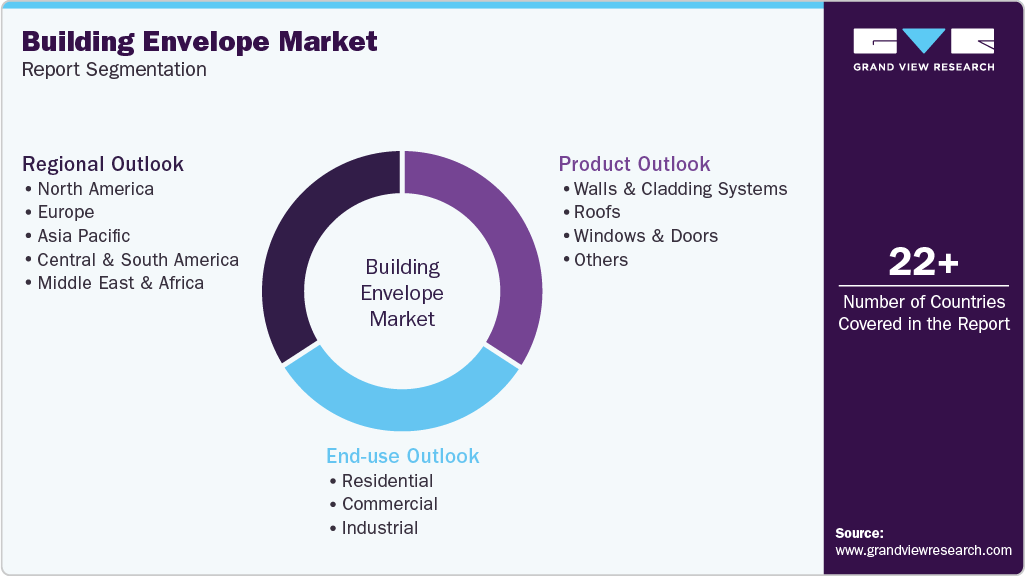
This report forecasts revenue growth at regional & country levels and provides an analysis on the industry trends in each of the sub-segments from 2021 to 2033. For this study, Grand View Research has segmented the global building envelope market report based on product, end-use, and region:
-
Product Outlook (Revenue, USD Million, 2021 - 2033)
-
Walls & Cladding Systems
-
Roofs
-
Windows & Doors
-
Others
-
-
End-use Outlook (Revenue, USD Million, 2021 - 2033)
-
Residential
-
Commercial
-
Industrial
-
-
Regional Outlook (Revenue, USD Million, 2021 - 2033)
-
North America
-
U.S.
-
Canada
-
Mexico
-
-
Europe
-
UK
-
Germany
-
France
-
Spain
-
-
Asia Pacific
-
China
-
Japan
-
India
-
South Korea
-
-
Central & South America
-
Middle East & Africa
-
Saudi Arabia
-
UAE
-
Egypt
-
Qatar
-
Kuwait
-
-
Research Methodology
The building envelope market figures in this report are based on a proven research process that combines executive interviews with secondary research from proprietary databases, company filings, and recognized regulatory and institutional sources. Market size is built through value-chain sizing - reconciling supply-side and demand-side estimates - and triangulated with bottom-up and top-down approaches. Every estimate passes multiple levels of expert validation before publication, with each building envelope segment quantified using the revenue-capture definitions in the table below.
Segment Definition
Segment
Revenue Capture Definition
Walls & Cladding Systems
Revenue generated from building envelope wall and cladding solutions installed in residential, commercial, and industrial buildings. This segment captures revenues from exterior wall systems, façade panels, curtain walls, rainscreen cladding, insulated wall panels, and related components that enhance thermal efficiency, weather protection, structural performance, and building aesthetics.
Roofs
Revenue generated from roofing systems used as part of the building envelope across residential, commercial, and industrial structures. This segment includes revenues from metal roofing, membrane roofing, green roofs, insulated roofing systems, roof coatings, and other solutions designed to provide weather resistance, energy efficiency, durability, and long-term building protection.
Windows & Doors
Revenue generated from windows, doors, glazing systems, skylights, and associated framing solutions integrated into the building envelope. This segment captures revenues from products designed to improve thermal insulation, daylighting, ventilation, security, weather resistance, and overall building energy performance.
Others
Revenue generated from other building envelope components, including insulation materials, air and vapor barriers, sealants, waterproofing systems, shading solutions, and ancillary envelope products. This segment captures revenues from solutions that contribute to building efficiency, moisture control, durability, and occupant comfort.
Segment
Revenue Capture Definition
Residential
Revenue generated from building envelope systems installed in residential buildings, including single-family homes, multi-family housing, apartments, condominiums, and residential complexes. This segment captures revenues from envelope solutions designed to enhance energy efficiency, weather protection, occupant comfort, and long-term building durability.
Commercial
Revenue generated from building envelope systems used in commercial buildings, including offices, retail centers, hotels, healthcare facilities, educational institutions, airports, and mixed-use developments. This segment captures revenues from advanced façade, roofing, glazing, and insulation solutions that improve building performance, sustainability, and aesthetics.
Industrial
Revenue generated from building envelope systems installed in industrial facilities, including manufacturing plants, warehouses, logistics centers, data centers, and processing facilities. This segment captures revenues from high-performance envelope solutions designed to provide thermal efficiency, environmental protection, structural integrity, and operational reliability in demanding industrial environments.
Estimation Model
Layer Name
Key Question
Description
Global Construction Market
What is the total market size of the global construction industry across all building and infrastructure activities?
This layer represents the overall construction market, including residential buildings, commercial buildings, industrial facilities, institutional buildings, and infrastructure projects. The market encompasses expenditures associated with new construction, renovation, refurbishment, and maintenance activities across developed and emerging economies.
Global Building Materials Market
What portion of the construction market is represented by building materials used in the building structure and exterior systems?
This layer narrows the focus to building materials utilized across construction projects, including concrete, steel, glass, insulation materials, roofing products, façade materials, doors, windows, and other construction components. The market is driven by urbanization, infrastructure development, energy-efficiency requirements, and sustainable construction practices.
Global Building Envelope Systems Market
What share of the building materials market is represented by building envelope systems?
This layer focuses specifically on products and systems that separate the interior environment of a building from external conditions. It includes walls and cladding systems, roofing systems, windows, doors, insulation materials, weather barriers, and other envelope components designed to improve energy efficiency, durability, weather resistance, and occupant comfort.
Building Envelope Market
What is the market value of building envelope products commercialized globally?
This final layer represents revenues generated from building envelope products and systems installed across residential, commercial, and industrial buildings. The market includes walls and cladding systems, roofing solutions, windows and doors, insulation materials, waterproofing systems, and related envelope technologies supplied through new construction and retrofit projects. Market growth is supported by increasing investments in energy-efficient buildings, green building initiatives, building modernization projects, and stringent building performance regulations.
Delivered Customizations
This report has been delivered with the following In-depth customizations
Client Request
Customization Delivered
Value Adds
Building Envelope Product Opportunity Assessment
Detailed analysis of walls & cladding systems, roofing systems, windows & doors, insulation materials, façade systems, weather barriers, and high-performance glazing solutions across key end-use sectors.
Identified the highest-growth building envelope segments, emerging application areas, and investment opportunities to support product development, portfolio expansion, and market entry strategies.
Competitive Landscape & Technology Benchmarking
Benchmarking of leading building envelope manufacturers based on product portfolio, technological capabilities, façade engineering expertise, manufacturing footprint, regional presence, sustainability initiatives, and strategic developments.
Provided actionable competitive intelligence to support strategic planning, partnership identification, acquisition screening, and differentiation in an increasingly performance-driven market.
Sustainability & Regulatory Compliance Assessment
Comprehensive evaluation of building energy codes, green building certification frameworks (LEED, BREEAM, etc.), net-zero building initiatives, embodied carbon reduction trends, and sustainability regulations influencing envelope design and material selection.
Enabled clients to align product offerings with evolving regulatory requirements, strengthen sustainability positioning, identify compliance-driven demand opportunities, and capitalize on the transition toward energy-efficient and low-carbon buildings.
Frequently Asked Questions About This Report
Some of the key players operating in the building envelope market include Saint-Gobain, Owens Corning, Kingspan Group, Rockwool International, BASF SE, DuPont de Nemours, GAF Materials Corporation, Sika AG, Etex Corp, and 3M Company.
The building envelope market is driven by rising demand for energy-efficient, sustainable, and technologically advanced construction solutions.
North America dominated the building envelope market with the largest revenue share of 32.6% in 2025.
The Asia Pacific region is expected to grow at the fastest CAGR over the forecast period.
The residential segment led the building envelope market with a 42.4% revenue share in 2025.
Walls & cladding segment led the market with the largest revenue share of 38.1% in 2025
The global building envelope market size was estimated at USD 123.6 billion in 2025 and is expected to reach USD 130.4 billion in 2026.
The global building envelope market is expected to grow at a compound annual growth rate of 5.5% from 2026 to 2033 to reach USD 189.7 billion by 2033.
About the Author(s)
Advanced Interior Materials Research Team
Advanced Materials · Advanced Interior MaterialsThis report was authored by the advanced interior materials research team at Grand View Research - comprising two research analysts, one senior research analyst, and one industry expert - with specialized expertise in the advanced interior materials segment of the advanced materials industry. All findings are based on proprietary advanced materials databases, executive interviews, and regulatory analysis, subject to internal peer review prior to publication.
Last Updated:
Speak to Analyst


Customize this report to your needs — add regions, segments, or data points, with 20% free customization.
Or view our licence options:


ISO 9001:2015 & 27001:2022 Certified
We are GDPR and CCPA compliant! Your transaction & personal information is safe and secure. For more details, please read our privacy policy.


