
- Home
- »
- Next Generation Technologies
- »
-
Burglar Alarm Systems Market Size & Share Report, 2033GVR Report cover

Burglar Alarm Systems Market (2026 - 2033)
Size, Share & Trends Analysis Report By Type (Wireless Alarm System, Wired Alarm System), By Component (Hardware, Software, Services), By Application (Commercial & Industrial, Residential), By Region, And Segment Forecasts
Market Size, 2025
$5.0BMarket Estimate, 2026
$5.4BMarket Forecast, 2033
$9.0BCAGR, 2026–2033
7.7%Burglar Alarm Systems Market Summary
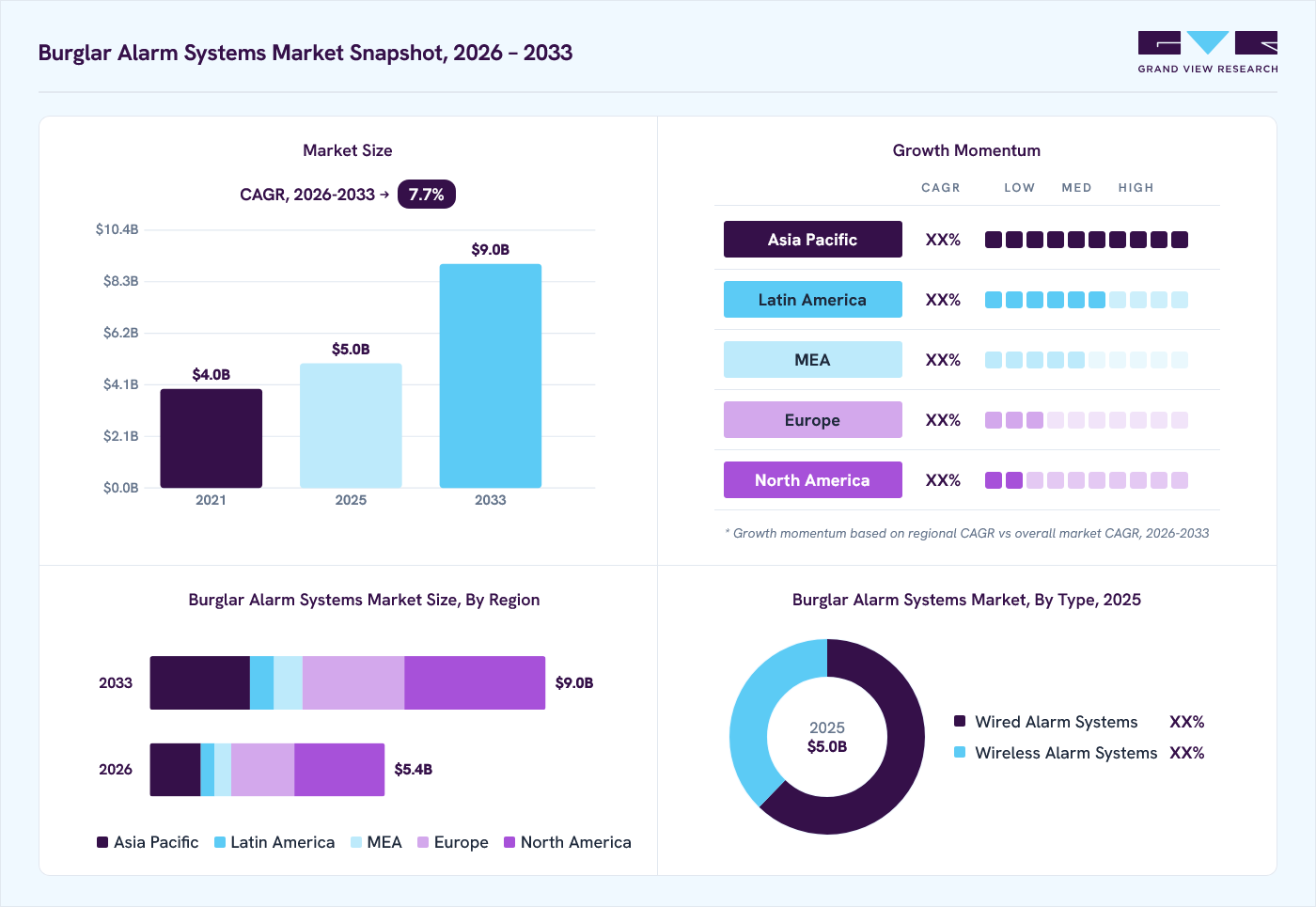
The global burglar alarm systems market size was valued at USD 5.0 billion in 2025 and is projected to grow from USD 5.4 billion in 2026 to USD 9.0 billion by 2033, at a CAGR of 7.7% from 2026 to 2033. The market in North America dominated with a revenue share of 38.9% in 2025. The market is driven by increasing adoption of smart burglar alarm systems, wireless intrusion detection solutions, residential and commercial security systems, IoT-enabled alarm monitoring, cloud-based security platforms, remote surveillance integration, AI-powered threat detection, rising security concerns, stringent building safety regulations, and smart home automation.
 Source: Grand View Research, IR Documents, Primary Interviews, Paid DatabasesTo learn more about this report,
 Download Free Sample Report
Key Market Trends & Insights
- By type: Wired alarm systems segment held the largest market share of 62.2% in 2025.
- By component: Hardware segment held the largest market share of 65.0% in 2025.
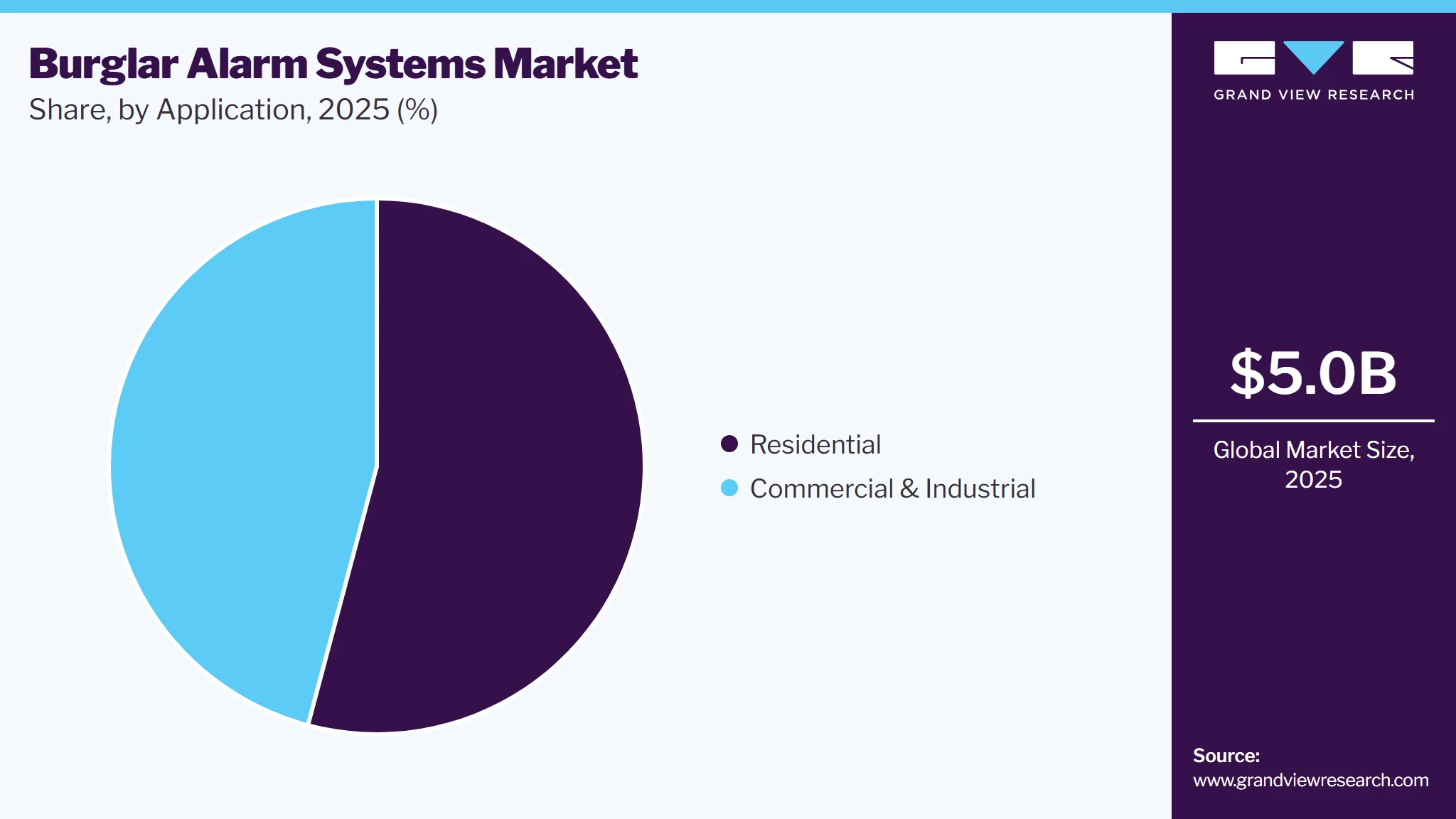
- By application: Residential segment held the largest market share of 54.1% in 2025.
Regional Highlights
- Largest regional market: North America (38.9% revenue share, 2025)
- Fastest-growing regional market: Asia Pacific (highest CAGR, 2026-2033)
- By country: The U.S. held the largest market share in 2025
Market Size & Forecast
- Market size in 2025: USD 5.0 Billion
- Estimated market size in 2026: USD 5.4 Billion
- Projected market size by 2033: USD 9.0 Billion
- CAGR (2026-2033): 7.7%
Three ways to get this report
Buy it, customize it, or ask a question.Ask an Analyst
Analyst response in 1 business day
- AccessReport author, directly
- Reply timeWithin 1 working day
- No sales callDirect answer only
- FormatEmail reply
- CostFree, no cost
Get the Full Report
What the study covers
- FormatsPDF · Excel · Dashboard
- Timeline2026–2033 annual, 2025 base
- Coverage20+ countries, 5 regions
- Companies10+ key players profiled
Customize the Report
20% free customization
- IncludeCountries, segments, points
- TailorTo your product definition
- ExtendDeeper competitor detail
- OrA fully bespoke study
- Turnaround5–10 working days
Future technologies, such as the Internet of Things (IoT), enable the introduction of smart homes. Furthermore, advances in sensor data fusion technology have raised end-user demand for advanced security systems. For instance, in November 2022, Arlo Technologies, Inc., an American company providing wireless surveillance cameras announced the release of the Arlo Home Security System. The home security system features a new, all-in-one multi-sensor with the capability of eight distinct sensing functions.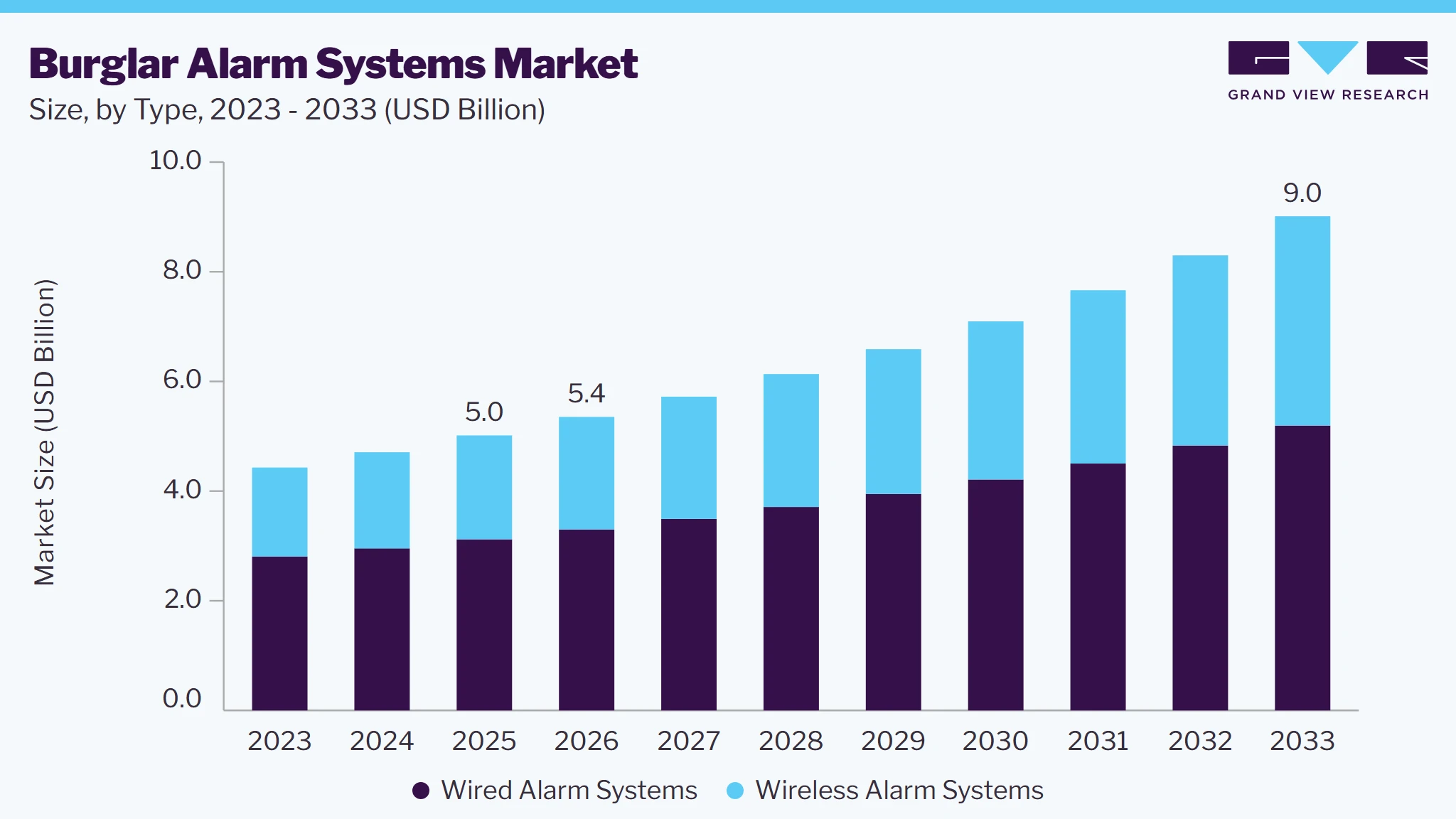 To learn more about this report, Download Free Sample Report
Market growth for burglar alarm systems has been rapid as technology improves every year, making the industry more effective. Burglar alarm systems are integrated into residential security systems, home security, and building management solutions to provide a secure foundation by lowering costs. Integration of intruder alarm systems with video security systems is a prevailing market trend.
Companies such as Honeywell, Assay Abloy, Johnson Controls, and others are constantly developing and optimizing intelligent sensor technologies to cater to the varying security demands of end-user. In addition, UL 634 is the standard for the connectors and switches used in alarm systems. Level 1 and level 2 refer to switches with advanced tamper protection and defeat resistance. While designing a security, access control system, or door protection system, reference to UL 634 is the standard approach for understanding the level of detection and tamper supervision.
Market players are prioritizing partnerships & collaborations with home security service providers to expand product offerings and services. For instance, in October 2021, ADT partnered with Redfin, a full-service real estate brokerage provider, to offer innovative home services and security monitoring for homes. The partnership will allow ADT to install sensors, alarms, and smart locks, by delivering insights into customer data. Further, this partnership would benefit the company to scale its business by providing home security solutions to Redfin customers and strengthening its position in the market.
Market Dynamics
The burglar alarm systems market is experiencing sustained growth due to increasing investments in intelligent intrusion prevention technologies across residential, commercial, and industrial facilities. The expansion of wireless burglar alarm systems, perimeter security solutions, and connected alarm monitoring services is accelerating market penetration as end users prioritize real-time threat detection and rapid emergency response. Advancements in AI-enabled security systems, motion detection sensors, door and window contact sensors, and mobile-enabled alarm management are enhancing system accuracy while reducing false alarm incidents. Growing integration with smart home security ecosystems, building automation platforms, and cloud-based security management is creating new opportunities for manufacturers and service providers to deliver scalable, remotely managed security solutions. Furthermore, increasing compliance with security regulations, rising property protection awareness, and continuous innovation in video-verified alarm systems and multi-layer intrusion detection technologies are strengthening the long-term outlook of the burglar alarm systems market.
The increasing deployment of smart burglar alarm systems across residential, commercial, and industrial properties is a major driver of the burglar alarm systems market. Growing demand for wireless intrusion detection systems, IoT-enabled alarm solutions, and cloud-based alarm monitoring is encouraging property owners to modernize conventional security infrastructure. Businesses are investing in integrated security platforms that combine burglar alarms, access control, and video surveillance to improve operational security and incident response. The expansion of smart buildings and connected homes is further accelerating the adoption of remote alarm management and mobile-enabled security systems. These developments are strengthening recurring demand for advanced burglar alarm technologies across both developed and emerging economies.
The growing frequency of property crimes and unauthorized access incidents is increasing investments in intrusion alarm systems capable of providing real-time alerts and automated emergency notifications. Organizations are prioritizing AI-powered alarm verification, motion detection sensors, and perimeter protection systems to reduce security risks and improve detection accuracy. Security service providers are expanding managed monitoring offerings to deliver continuous protection through centralized control centers. Continuous innovation in wireless communication technologies, battery efficiency, and sensor intelligence is enhancing the reliability of next-generation alarm systems. As enterprises and homeowners seek proactive security solutions, the burglar alarm systems market continues to witness sustained technology-driven growth.
The adoption of advanced burglar alarm systems is constrained by the relatively high upfront investment required for sophisticated hardware, professional installation, and system integration. Small businesses and price-sensitive residential customers often postpone upgrades because of installation expenses and recurring monitoring service fees. Integrating smart alarm systems with existing building infrastructure may require additional networking equipment and professional configuration, increasing deployment complexity. These cost-related barriers limit the penetration of premium security solutions in several developing markets. Consequently, budget considerations remain an important restraint for broader market expansion.
False alarm incidents continue to affect user confidence and create operational challenges for monitoring service providers and emergency responders. Environmental factors, improper installation, and sensor sensitivity can trigger unnecessary alerts in wireless burglar alarm systems. Frequent false alarms increase maintenance requirements and may result in additional service costs or regulatory penalties in certain regions. End users therefore demand more accurate AI-enabled intrusion detection, intelligent sensor calibration, and enhanced alarm verification capabilities. Addressing these performance limitations remains essential for improving customer satisfaction and long-term adoption.
The increasing adoption of AI-powered burglar alarm systems presents significant growth opportunities for technology providers and security service companies. Artificial intelligence enables intelligent threat analysis, behavioral pattern recognition, and automated alarm verification, improving detection accuracy while minimizing false alerts. The integration of cloud-based security management, remote monitoring platforms, and mobile security applications allows users to manage security systems from virtually any location. These capabilities are encouraging residential and commercial customers to transition from conventional alarm systems to connected security platforms. As digital transformation accelerates, demand for intelligent alarm solutions is expected to rise substantially.
Growing investments in smart cities, commercial infrastructure, and intelligent buildings are creating additional opportunities for integrated burglar alarm solutions. Security vendors are expanding portfolios that combine video surveillance, access control, perimeter intrusion detection, and centralized alarm monitoring into unified security ecosystems. Subscription-based monitoring services and cloud connectivity are generating recurring revenue opportunities for solution providers. Emerging economies are also witnessing increased demand due to expanding urban infrastructure and higher awareness of property protection technologies. These trends position the burglar alarm systems market for continued innovation and long-term commercial growth.
Market Concentration & Characteristics
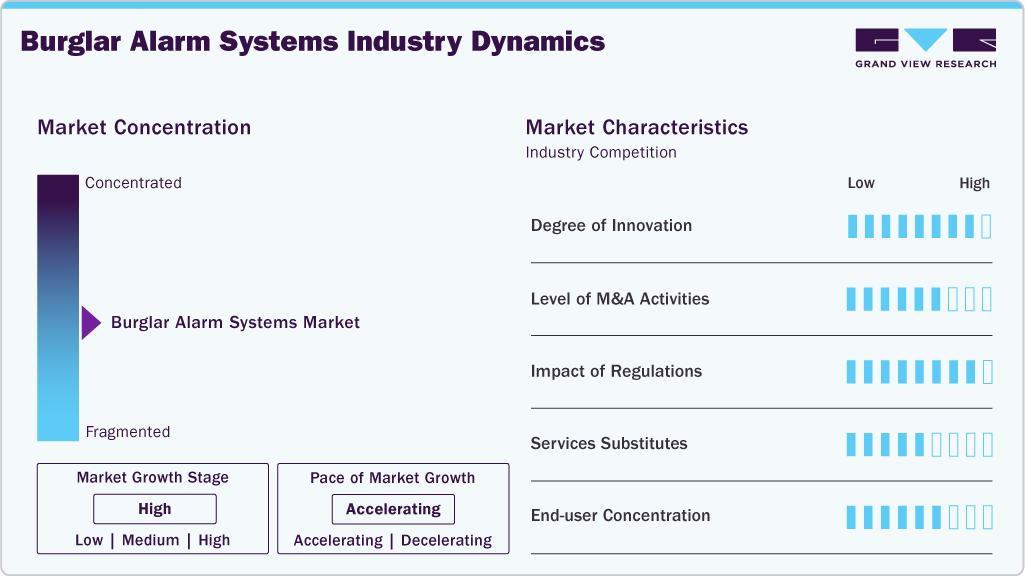
The burglar alarm systems market exhibits moderate market concentration, with a mix of established multinational security solution providers and regional manufacturers competing across residential, commercial, and industrial segments. Leading companies maintain competitive advantages through comprehensive portfolios of smart burglar alarm systems, wireless intrusion detection solutions, and cloud-based alarm monitoring services. Continuous investments in product innovation, AI integration, and connected security technologies are strengthening market positioning among key participants. Strategic collaborations with smart home platform providers, security integrators, and monitoring service companies further enhance competitive differentiation.
 To learn more about this report, Download Free Sample Report
The market is characterized by increasing demand for IoT-enabled burglar alarm systems, remote security management, and integrated building security solutions that combine intrusion detection with video surveillance and access control. Vendors are increasingly adopting subscription-based monitoring models and software-driven security platforms to generate recurring revenue streams and improve customer retention. Product differentiation is centered on intelligent threat detection, mobile application connectivity, cybersecurity capabilities, and seamless interoperability with broader smart building ecosystems. Growing regulatory compliance requirements, rising security awareness, and technological advancements continue to shape the competitive landscape and long-term evolution of the burglar alarm systems market.
Analyst Perspective
The burglar alarm systems market is expected to evolve from standalone intrusion devices to intelligent, connected security platforms. Growing adoption of edge-based processing, multi-zone alarm panels, encrypted communication protocols, and hybrid security architectures is improving system reliability and resilience. Vendors are increasingly integrating predictive maintenance, cybersecure networks, and interoperable ecosystems to meet evolving customer needs and enhance service value. The convergence of physical and digital security is also driving investments in scalable, software-defined alarm management platforms that enable real-time situational awareness. Continued advances in sensing, communication, and intelligent automation are expected to support sustainable market growth and security modernization.
COVID-19 Insights
The alarm industry across the globe witnessed a moderate demand in the year 2020. The residential segment was observed to be the potential customer of security systems. New business models, the presence of tech giants, and changing consumer preferences have increased the adoption of alarm security solutions. Amid the COVID-19 pandemic, the global burglar alarm systems market exhibited steady growth attributed to the supply chain disruptions led by lockdowns imposed by governments worldwide. As a result, the hardware segment witnessed sluggish growth during 2020.
Technological advancements such as audio analytics, voice control, and video analytics encourage market players to adopt new business strategies such as partnerships and collaboration to grab market opportunities. For instance, in January 2022, Johnson Controls announced the acquisition of FogHorn Systems, an Edge AI software solution provider for commercial and industrial Internet of Things (IoT) solutions. Through this acquisition, Johnson intends to accelerate innovation for smart autonomous buildings by merging OpenBlue technology with Foghorn. Such significant partnerships are likely to create lucrative opportunities for alarm system providers.
Type Insights
Based on type, the Wired alarm systems segment led the market with the largest revenue share of 62.2% in 2025. Wired intruder alarms are in higher demand however, wireless intruder alarms are more convenient to install. Intruder alarms have been more popular in recent years due to technological advancements and safety concerns. Furthermore, some technologies used in intruder alarms include electrical field, vibration, audio, capacitance, and photoelectric beam sensors.
For instance, in May 2022, Hangzhou Hikvision Digital Technology Co., Ltd., announced the release of a new AX Hybrid PRO alarm system. The system provides a combination of wired protection, delivering boosted flexibility with seamless wireless integration. The alarm system is suitable in varied scenarios including factories, banks, offices, and retail stores.
The wireless alarm systems segment is expected to exhibit the highest CAGR over the forecast period. Wireless commercial security systems offer a more comprehensive range of exclusive protection features, lower installation costs, and relatively simple upgrades than wired systems.
For instance, in October 2021, Inovonics Wireless Corporation announced the availability of the Inovonics mobile duress, which is meant to offer accurate interior room and floor level location when an Inovonics pendant is activated. Developed on the Inovonics cloud platform, the solution combines dependable hardware with sophisticated API and software capabilities for data access and easy integration.
Component Insights
Based on component, the hardware segment led the market with the largest revenue share of 65.0% in 2025. Alarm sensors have the most significant market share in terms of hardware. As the market evolves and moves toward cloud-based security systems, customers are anticipated to prioritize wireless security systems.
For instance, in April 2022, RISCO Group, a provider of cloud-based security systems, obtained ISO 27001 accreditation for cloud and interactive services relating to security, smart home solutions, and building management. The certification acknowledges the company's enormous efforts and significant investments to safeguard and enhance privacy and data security from cyber-attacks.
The software segment is expected to exhibit the highest CAGR over the forecast period. For instance, in May 2021, Sabec, the company that transformed the Nintendo Switch into a scientific calculator, released Spy Alarm, a new burglar alarm software for the Nintendo Switch. Spy Alarm uses the infrared sensor on the right Joy-Con to create an invisible beam. When someone or something trips the tripwire, your Switch will sound an alarm, and the incident will be recorded in the app.
Burglar alarm system providers are prioritizing spending on smart technologies. It includes artificial intelligence (AI) and the internet of things (IoT) to deliver comprehensive alarm systems to the end-users. The market players are focused on integrating wireless systems options and remote monitoring tools with burglar alarm systems, which is likely to drive the demand for security software solutions. Further, burglar alarm systems require an array of specific products, including sensors, network systems, and alarm systems supported by by-product services.
Application Insights
Based on application, the residential segment led the market with the largest revenue share of 54.1% in 2025 . Intruder alarm systems are gaining traction across the residential and commercial segments. Banking, healthcare, and education are likely to be the most susceptible industries. To offer efficient alarm systems, organizations have released several product standards.
For instance, in November 2022, Kami Vision, an AI services company announced Kami Pro Security, an industrial grade, video alarm system for application in small businesses and residences. The alarm system utilizes 24/7 professional monitoring services and vision AI to detect invaders and circulate verified video in real time through an app.
 To learn more about this report, Download Free Sample Report
The commercial & industrial segment is expected to exhibit the highest CAGR over the forecast period. Business locations are typically high-traffic regions with higher crime rates, and burglars may find commercial properties appealing. The surrounding environment also influences its safety since other businesses have implemented security measures.
As a result, commercial intruder alarm systems are sophisticated and extensive, and these systems are often designed to protect much more significant areas. Multiple layers of security systems, such as video surveillance cameras and controlled access cards, are installed throughout the facility.
Regional Insights
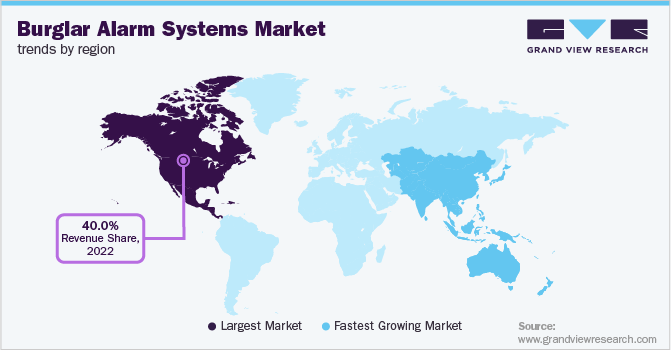
North America dominated the Burglar Alarm Systems market with the largest revenue share of 38.9% in 2025. North America is analyzed across three countries in the market study, including the U.S., Canada, and Mexico. Market players are expanding their footprints across the region through mergers and acquisitions.
For instance, in September 2021, ASSA ABLOY acquired Spectrum Brands, Inc., segment hardware and home improvement. Spectrum Brands, Inc. is a U.S.-based company and a provider of residential security solutions. The acquisition is likely to expand ASSA ABLOY’s product portfolio and reinforce its position in the residential sector in the North America region.
 To learn more about this report, Download Free Sample Report
Substantial expansion of real-estate and IT sectors across Asia Pacific is anticipated to drive the demand for smart alarm systems. In recent years, home security solutions and services are witnessing an increasing demand from countries including India, Japan, Singapore, and others, which is likely to contribute to the market growth across the region. Furthermore, several security rules and standards released by the government would support the market across Asia Pacific. Technological innovations are expected to contribute to China's significant market share.
The Europe market is expected to showcase significant growth over the forecast period. In Europe, there is a strong influence of burglar alarm systems manufacturers focused on producing technically advanced alarm systems to attract a variety of commercial office spaces and residential townships.
Implementing a high-quality security entry system to prevent intruders and potential robberies is among the crucial drivers driving the burglar alarm systems industry in the region. As a result of the Covid-19 pandemic, demand for alarm monitoring-based digital applications in the residential sector is expected to gain traction. With increased demand from commercial and retail sectors, the MEA region's burglar alarm systems market is expected to rise.
Key Company & Market Share Insights
The global burglar alarm systems market comprises several multinational and regional service providers who constantly improve their market position. The activities of market players are inclined toward strategic partnerships, collaborations, mergers & acquisitions.
For instance, in July 2021, Securitas AB announced the acquisition of Tepe Security, a well-known electronic security firm in Turkey. Securitas gains the number two position in Turkey's monitoring market due to this acquisition, which aligns with the Group's aim of expanding its electronic security and security solutions sales by 2023. Some prominent players in the global burglar alarm systems market include:
Key Burglar Alarm Systems Companies:
The following key companies have been profiled for this study on the burglar alarm systems market
-
ADT
-
ASSA ABLOY
-
Banham
-
Hangzhou Hikvision Digital Technology Co., Ltd.
-
Honeywell International, Inc
-
Inovonics Wireless Corporation
-
Johnson Controls
-
Securitas AB
-
Siemens
-
Risco Group
-
Napco Security Technologies, Inc.
Competitive Benchmarking
Operating Strategies
Competitive Edge
Weaknesses
Mature Players: ADT; Honeywell International Inc.; Johnson Controls; Siemens; ASSA ABLOY
- Mature players focus on expanding smart burglar alarm systems, AI-enabled intrusion detection, cloud-based monitoring platforms, integrated building security solutions, and managed security services.
- Their competitive advantage lies in strong global distribution networks, established brands, broad product portfolios, advanced R&D capabilities, and long-term customer relationships.
These companies may face challenges related to high operating costs, slower product commercialization, complex legacy system integration, and increasing competition from agile technology providers. Emerging Players: Hangzhou Hikvision Digital Technology Co., Ltd.; Banham; Inovonics Wireless Corporation; Risco Group; Napco Security Technologies, Inc.
- Emerging players focus on wireless burglar alarm systems, IoT-enabled security devices, intelligent monitoring solutions, niche security applications, and cost-effective intrusion detection technologies.
- Their strength comes from product innovation, flexible development capabilities, competitive pricing, specialized security expertise, and rapid adoption of connected security technologies.
Limited international presence, comparatively smaller distribution networks, lower brand recognition, and fewer financial resources may restrict expansion against established global security providers. Burglar Alarm Systems Market Report Scope
Report Attribute
Details
Market size in 2025
USD 5.0 billion
Estimated market size in 2026
USD 5.4 billion
Projected market size by 2033
USD 9.0 billion
Growth rate
CAGR of 7.7% from 2026 to 2033
Base year for estimation
2025
Historical data
2021 - 2024
Forecast period
2026 - 2033
Quantitative units
Revenue in USD million/billion and CAGR from 2026 to 2033
Report coverage
Revenue forecast, company ranking, competitive landscape, growth factors, and trends
Segments covered
Type, component, application, region
Regional scope
North America; Europe; Asia Pacific; Latin America; MEA
Country scope
U.S.; Canada; Mexico; Germany; UK; France; China; Japan; India; South Korea; Australia; Brazil; Saudi Arabia; South Africa; UAE
Key companies profiled
ADT; ASSA ABLOY; Banham; Hangzhou Hikvision Digital Technology Co., Ltd.; Honeywell International, Inc; Inovonics Wireless Corporation; Johnson Controls; Securitas AB; Siemens; Risco Group; Napco Security Technologies, Inc.
Customization scope
Free report customization (equivalent up to 8 analysts' working days) with purchase. Addition or alteration to country, regional & segment scope.
Pricing and purchase options
Avail customized purchase options to meet your exact research needs. Explore purchase options
Global Burglar Alarm Systems Market Segmentation
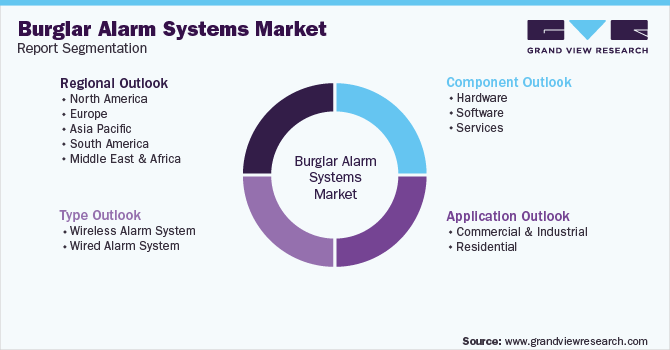
This report forecasts revenue growth at the global, regional, and country levels and provides an analysis of the latest industry trends in each of the sub-segments from 2021 to 2033. For this study, Grand View Research has segmented the global burglar alarm systems market report based on type, component, application, and region:
 To learn more about this report, Download Free Sample Report
-
Type Outlook (Revenue, USD Million, 2021 - 2033)
-
Wireless Alarm System
-
Wired Alarm System
-
-
Component Outlook (Revenue, USD Million, 2021 - 2033)
-
Hardware
-
Central Monitoring Receiver
-
Remote Terminal Unit
-
Alarm Sensors
-
Motion Detection Sensors
-
Door/Windows Sensors
-
-
Software
-
Services
-
-
Application Outlook (Revenue, USD Million, 2021 - 2033)
-
Commercial & Industrial
-
Residential
-
-
Regional Outlook (Revenue, USD Million, 2021 - 2033)
-
North America
-
U.S.
-
Canada
-
Mexico
-
-
Europe
-
U.K.
-
Germany
-
France
-
-
Asia Pacific
-
China
-
Japan
-
India
-
-
South America
-
Brazil
-
-
Middle East & Africa (MEA)
-
Research Methodology
The burglar alarm systems market figures in this report are based on a proven research process that combines executive interviews with secondary research from proprietary databases, company filings, and recognized regulatory and institutional sources. Market size is built through value-chain sizing - reconciling supply-side and demand-side estimates - and triangulated with bottom-up and top-down approaches. Every estimate passes multiple levels of expert validation before publication, with each burglar alarm systems segment quantified using the revenue-capture definitions in the table below.
Segment Definition
Segment - Type
Revenue capture definition
Wireless Alarm System
The wireless alarm system segment comprises security solutions that use wireless communication technologies to connect sensors, control panels, and monitoring devices without extensive cabling. It includes installations for residential, commercial, and industrial properties where flexible deployment and remote connectivity are prioritized.
Wired Alarm System
This segment consists of burglar alarm systems that rely on physical wiring to establish communication between security devices and central control units. These systems are commonly deployed in permanent installations requiring stable connectivity and long-term operational reliability.
Segment - Component
Revenue capture definition
Hardware
The hardware segment includes physical components such as control panels, keypads, sirens, detectors, sensors, and communication modules used within burglar alarm systems. Its scope covers the manufacture and supply of equipment required for intrusion detection and alarm activation.
Software
This software segment encompasses applications and platforms used for alarm configuration, system management, monitoring, analytics, and remote access. It also includes cloud-based security management solutions that enhance operational efficiency and user control.
Services
The services segment covers installation, maintenance, system integration, technical support, consulting, and professional monitoring associated with burglar alarm systems. It also includes managed security services that ensure continuous system performance and rapid incident response.
Segment - Application
Revenue capture definition
Commercial & Industrial
The commercial & industrial segment covers the deployment of burglar alarm systems across offices, retail facilities, warehouses, manufacturing plants, educational institutions, healthcare facilities, and other commercial properties. Demand within this segment is driven by asset protection, regulatory compliance, and operational security requirements.
Residential
This residential segment comprises burglar alarm systems installed in apartments, individual homes, villas, and residential communities to enhance occupant safety and property protection. It includes both professionally monitored and self-monitored security solutions integrated with smart home technologies.
Estimation Model
Layer Name
Key Questions
Description
Security Risk & Protection Demand Layer
Who creates demand for burglar alarm systems?
Identify demand generated by homeowners, commercial buildings, industrial facilities, retail stores, financial institutions, educational campuses, healthcare facilities, and government organizations. This layer evaluates urbanization, crime rates, property development, security awareness, smart home adoption, and regulatory requirements that establish the demand base for the burglar alarm systems market.
Security Infrastructure & Technology Investment Layer
Who invests in burglar alarm system infrastructure?
Assess investments in smart security infrastructure, wireless alarm technologies, IoT-enabled security devices, AI-powered intrusion detection, cloud-based monitoring platforms, and integrated building security solutions. This layer measures technology spending that supports advanced intrusion detection and remote security management.
System Deployment & End-User Adoption Layer
Who deploys burglar alarm systems?
Apply adoption rates of wireless and wired burglar alarm systems, monitoring services, alarm sensors, and integrated security platforms across residential, commercial, industrial, and public infrastructure sectors. This layer captures installation trends, replacement demand, and modernization of existing security systems.
Burglar Alarm Systems Market Revenue Realization Layer
How much revenue is generated through burglar alarm system adoption?
Estimate total market revenue by combining hardware sales, software licensing, installation services, maintenance contracts, monitoring subscriptions, system upgrades, and managed security services. This layer captures revenue generated across residential, commercial, industrial, institutional, and government end users.
Delivered Customizations
This report has been delivered with the following In-depth customizations
Client Request
Customization Delivered
Value Adds
Burglar Alarm Systems Technology Adoption & Growth Assessment
Analyzed burglar alarm systems market trends, including AI-powered intrusion detection, IoT-enabled security devices, wireless alarm systems, cloud-based monitoring platforms, smart home integration, and remote security management technologies.
Help identify high-growth technology segments, investment opportunities, and competitive trends across the burglar alarm systems market.
Industry-Specific Burglar Alarm Systems Deployment Analysis
Assessed adoption of burglar alarm systems across residential, commercial buildings, industrial facilities, retail, banking & financial services, healthcare, education, government, and critical infrastructure sectors.
Provides insights into end-user adoption patterns, security modernization initiatives, and market expansion opportunities across key industries.
Smart Security & Next-Generation Alarm Opportunity Assessment
Evaluated adoption of AI-enabled alarm verification, intelligent sensors, perimeter intrusion detection, integrated access control, cloud-based security platforms, and predictive security monitoring technologies.
Supports product innovation, technology investments, competitive differentiation, and expansion into high-growth smart security and connected alarm system segments.
Frequently Asked Questions About This Report
The global burglar alarm systems market size was valued at USD 5.0 billion in 2025 and is estimated at USD 5.4 billion for 2026.
The global burglar alarm systems market is expected to grow at a CAGR of 7.7% from 2026 to 2033, reaching USD 9.0 billion by 2033.
North America dominated the burglar alarm systems market with a revenue share of over 38.0% in 2025, driven by the widespread adoption of smart home security solutions, high residential and commercial security awareness, increasing investments in connected building infrastructure, rising integration of IoT and AI-enabled alarm systems, and stringent safety and insurance compliance requirements across the region.
Asia Pacific is the fastest-growing region over the forecast period.
The wired alarm systems segment led with over 62.0% revenue share in 2025, while the wireless alarm systems segment is the fastest-growing.
The residential segment led with over 54.0% of revenue in 2025, while the commercial & industrial segment is the fastest-growing.
Some key players operating in the burglar alarm system market include ADT, ASSA ABLOY, Banham, Hangzhou Hikvision Digital Technology Co., Ltd., Honeywell International, Inc, Inovonics Wireless Corporation, Johnson Controls, Securitas AB, Siemens, Risco Group, Napco Security Technologies, Inc.
The hardware segment led with a 65.0% revenue share in 2025, while software is the fastest-growing segment.
Key factors driving the burglar alarm system market include rising concerns about property crimes and unauthorized access, increasing adoption of smart home and connected security solutions, growing demand for wireless and IoT-enabled alarm systems, and expanding commercial and residential infrastructure development.
About the Author(s)
Next Generation Technologies Research Team
Technology · Next Generation TechnologiesThis report was authored by the next generation technologies research team at Grand View Research - comprising two research analysts, one senior research analyst, and one industry expert - with specialized expertise in the next generation technologies segment of the technology industry. All findings are based on proprietary technology databases, executive interviews, and regulatory analysis, subject to internal peer review prior to publication.
Last Updated:
Speak to Analyst

Customize this report to your needs - add regions, segments, or data points, with 20% free customization.
Or view our licence options:


ISO 9001:2015 & 27001:2022 Certified
We are GDPR and CCPA compliant! Your transaction & personal information is safe and secure. For more details, please read our privacy policy.


