
- Home
- »
- IT Services & Applications
- »
-
Business Software And Services Market Report, 2026-2033GVR Report cover

Business Software And Services Market (2026 - 2033)
Size, Share & Trends Analysis Report By Software (Finance, Sales & Marketing), By Service (Consulting, Managed Services), By Deployment, By End-use, By Enterprise Size, By Region, And Segment Forecasts
Market Size, 2025
$650.5BMarket Estimate, 2026
$726.3BMarket Forecast, 2033
$1,660.6BCAGR, 2026–2033
12.5%Business Software And Services Market Summary
The global business software and services market size was valued at USD 650.5 billion in 2025 and is projected to grow from USD 726.3 billion in 2026 to USD 1,660.6 billion by 2033, at a CAGR of 12.5% from 2026 to 2033. The market in North America dominated with a revenue share of 30.6% in 2025. This growth is driven by the rapid pace of digital transformation and cloud adoption across organizations worldwide.
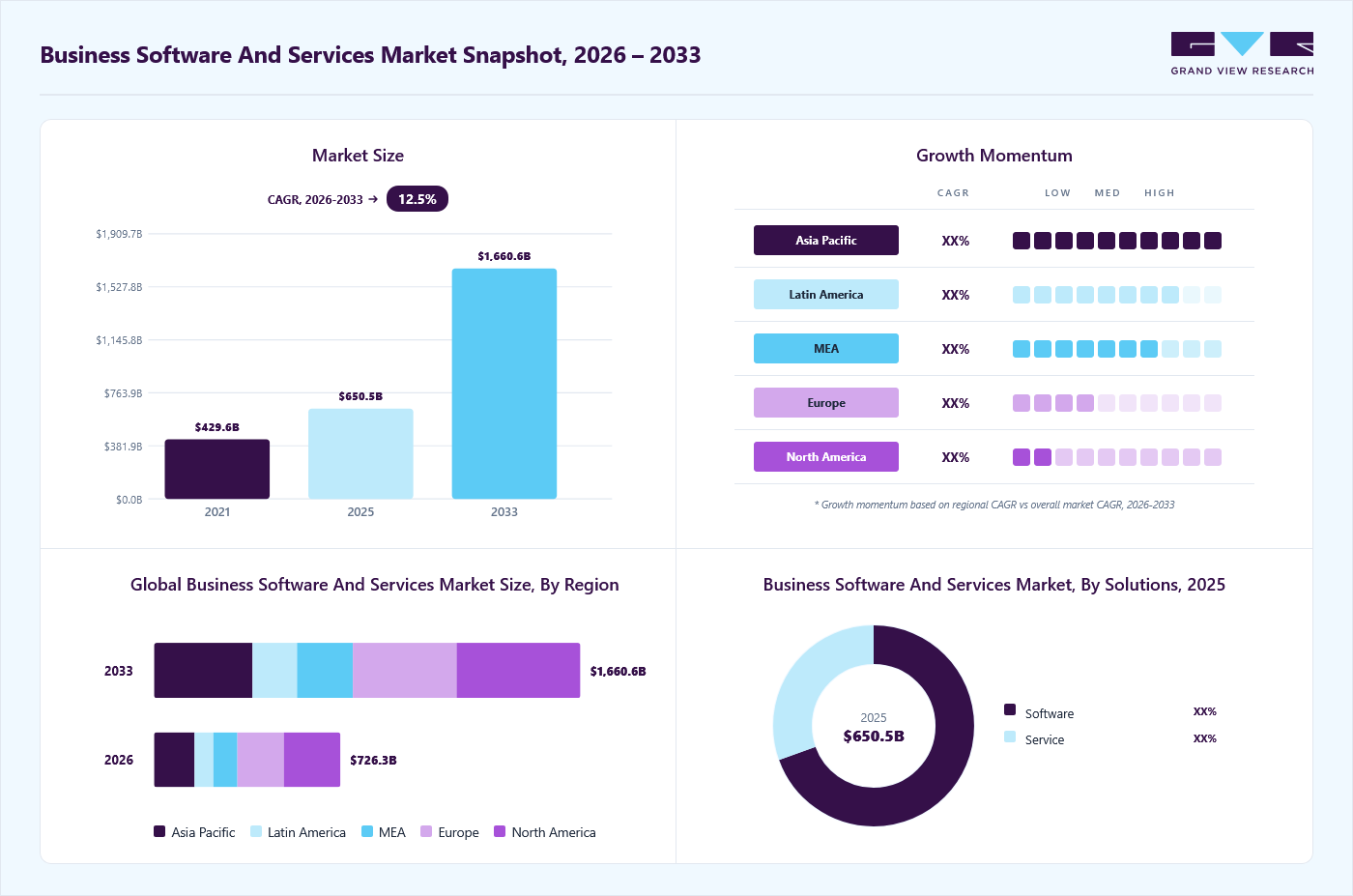 Source: Grand View Research, IR Documents, Primary Interviews, Paid DatabasesTo learn more about this report,
 Download Free Sample Report
 Key Market Trends & Insights
- By software: Finance segment dominated the market, with a revenue share of 25.4% in 2025
- By service: Support & maintenance segment held the largest market share of 41.0% in 2025
- By deployment: Cloud segment held the largest revenue share of 59.0% in 2025.
- By enterprise size: Large enterprise segment led the market with the largest revenue share of 60.8% in 2025.
- By end use: IT & telecom segment led the market with the largest revenue share of 18.1% in 2025.
Regional Highlights
- Largest regional market: North America (30.6% revenue share, 2025)
- Fastest-growing regional market: Asia Pacific (highest CAGR, 2026-2033)
- By country: The U.S. held the largest market share in 2025.
Market Size & Forecast
- Market size in 2025: USD 650.5 Billion
- Estimated market size in 2026: USD 726.3 Billion
- Projected market size by 2033: USD 1,660.6 Billion
- CAGR (2026-2033): 12.5%
Three ways to get this report
Buy it, customize it, or ask a question.Ask an Analyst
Analyst response in 1 business day
- AccessReport author, directly
- Reply timeWithin 1 working day
- No sales callDirect answer only
- FormatEmail reply
- CostFree, no cost
Get the Full Report
What the study covers
- FormatsPDF · Excel · Dashboard
- Timeline2026–2033 annual, 2025 base
- Coverage20+ countries, 5 regions
- Companies10+ key players profiled
Customize the Report
20% free customization
- IncludeCountries, segments, points
- TailorTo your product definition
- ExtendDeeper competitor detail
- OrA fully bespoke study
- Turnaround5–10 working days
The market growth is driven by the increasing demand for automation in business processes. Organizations are leveraging software solutions to streamline operations, enhance productivity, and reduce operational costs. With advancements in artificial intelligence (AI) and machine learning (ML), businesses can now integrate intelligent automation into tasks such as customer service, data analytics, and workflow management, further accelerating the adoption of business software. As companies shift to digital-first strategies, they are investing in business software and services industry to improve customer experience, optimize supply chains, and enable remote work. The rise of cloud computing has also played a pivotal role, allowing businesses to access scalable and cost-effective software solutions without the need for extensive infrastructure investments. Cloud-based Software-as-a-Service (SaaS) platforms have particularly gained traction, enabling real-time collaboration, secure data access, and flexibility in managing operations. To learn more about this report, Download Free Sample Report
 Moreover, the growing emphasis on data-driven decision-making is propelling the demand for advanced analytics and business intelligence tools. Businesses are increasingly relying on software to extract actionable insights from vast amounts of data, improving strategic planning and competitiveness. Coupled with the rise of cybersecurity concerns, organizations are also investing heavily in software solutions that ensure compliance, protect sensitive data, and mitigate risks in an evolving threat landscape. These factors collectively highlight the robust growth potential of the business software and services industry, catering to the dynamic needs of modern enterprises.
Enterprise software and services are widely utilized in end-use industries such as BFSI, government, healthcare, manufacturing, and retail as they facilitate the simplification of corporate operations. To accomplish data privacy and security goals, business software and services provide easy and quick access to unstructured data obtained through data analytics. Furthermore, the implementation of enterprise solutions leads to a significant reduction in raw material and inventory costs, allowing businesses to boost their profitability. Many businesses are implementing business solutions to improve their operational efficiency by combining administrative systems into a single software. Departmental data is linked with real-time updates in business solution modules, resulting in improved data transparency. Businesses select the software and solutions best suited to their requirements.
Market Dynamics
The business software and services market is experiencing robust growth as organizations across industries accelerate digital transformation initiatives to improve operational efficiency, enhance customer experiences, and support data-driven decision-making. Enterprises are increasingly adopting cloud-based software solutions, enterprise applications, automation platforms, analytics tools, and managed services to streamline business processes and improve organizational agility. The growing integration of artificial intelligence (AI), machine learning (ML), robotic process automation (RPA), cybersecurity solutions, and advanced analytics into business operations is further driving market expansion. Additionally, the shift toward hybrid work environments and increasing demand for scalable, subscription-based software models are encouraging organizations to invest in modern business software and outsourced IT services.
The rapid pace of digital transformation and cloud adoption is a significant driver of the business software and services market. Organizations are increasingly modernizing legacy systems and investing in cloud-based enterprise applications, customer relationship management (CRM), enterprise resource planning (ERP), human capital management (HCM), collaboration tools, and business intelligence platforms to enhance productivity and competitiveness. Cloud deployment enables businesses to reduce infrastructure costs, improve scalability, support remote workforces, and accelerate innovation. Furthermore, the growing use of AI-powered software, automation technologies, and data analytics solutions is helping enterprises optimize operations, improve customer engagement, and make more informed business decisions. As companies continue prioritizing digital initiatives, demand for business software and associated professional and managed services is expected to grow significantly.
For instance, in May 2026, SAP announced the launch of its Autonomous Enterprise strategy at SAP Sapphire 2026, introducing a unified Business AI Platform that embeds AI-driven automation and intelligent agents across critical enterprise functions, including finance, supply chain management, procurement, human resources, and customer experience. The initiative enables organizations to modernize legacy operations, improve business agility, and accelerate cloud-led digital transformation. Such developments highlight how organizations are increasingly investing in advanced software platforms to support digital transformation strategies, reinforcing growth across the business software and services market.
Data security concerns, privacy regulations, and integration complexities remain key restraints for the business software and services market. As organizations increasingly rely on cloud-based applications and interconnected digital ecosystems, protecting sensitive business and customer data has become more challenging. Compliance requirements related to data protection regulations often require significant investments in governance, cybersecurity infrastructure, and risk management frameworks.
In addition, integrating modern software platforms with existing legacy systems can be costly and time-consuming, particularly for large enterprises with complex IT environments. Organizations may face challenges related to data migration, interoperability, customization requirements, and employee training, potentially delaying software deployments and increasing implementation costs. These factors can slow adoption rates, especially among small and medium-sized enterprises with limited IT resources and budgets.
The increasing adoption of AI-powered business applications, intelligent automation, and industry-specific software solutions presents substantial opportunities for the Business Software and Services Market. Enterprises are rapidly deploying generative AI, predictive analytics, robotic process automation, and intelligent workflow management tools to improve operational efficiency, reduce costs, and enhance decision-making capabilities. AI-driven software is enabling organizations to automate repetitive tasks, personalize customer interactions, and generate actionable business insights from large datasets.
Furthermore, growing demand for vertical-specific software solutions across healthcare, banking, financial services, manufacturing, retail, education, and government sectors is creating new revenue opportunities for software vendors and service providers. The expansion of Software-as-a-Service (SaaS) delivery models, low-code/no-code development platforms, and managed digital transformation services is also enabling broader adoption among organizations of all sizes. As enterprises continue investing in automation, AI, and cloud-native technologies, the market is expected to witness significant long-term growth opportunities.
Analyst Perspective
The business software & services market sits at the center of several transformative growth trends, including accelerating digital transformation initiatives, increasing cloud adoption, the integration of artificial intelligence (AI) into business processes, and the growing need for operational efficiency across enterprises. Organizations are increasingly investing in software solutions such as ERP, CRM, HCM, supply chain management, analytics, and workflow automation platforms to streamline operations, enhance decision-making, and improve customer experiences. The market is further supported by rising demand for remote and hybrid work solutions, data-driven business strategies, and the modernization of legacy enterprise systems.
Software Insights
Based on software, the finance segment led the market with the largest revenue share of 25.4% in 2025. The segment is expected to benefit from the growing demand for financial management tools in businesses and enterprises for activities such as planning, budgeting, analysis, and reporting. Financial management software is widely used in the BFSI industry in North America for risk compliance and improvements in business operation efficiency and productivity. The increasing number of mobile applications facilitating financial data management and providing several other use cases related to financing is further anticipated to offer numerous growth opportunities to the market over the forecast period
The sales & marketing segment is expected to grow at a significant CAGR of 12.6% over the forecast period due to the increasing focus on customer-centric strategies. Businesses are leveraging sales and marketing software to gain deeper insights into customer behavior, preferences, and buying patterns. Customer Relationship Management (CRM) systems, in particular, have become indispensable tools, enabling organizations to build stronger relationships, enhance customer experiences, and improve retention rates.
Service Insights
Based on service, the support & maintenance segment led the market with the largest revenue share of 41.0% in 2025, due to the rising complexity of software ecosystems as businesses adopt advanced technologies such as cloud computing, artificial intelligence (AI), and the Internet of Things (IoT). These technologies demand specialized support and regular maintenance to ensure optimal performance, compatibility, and seamless integration with existing systems.
The managed services segment is expected to grow at a significant CAGR over the forecast period. The growing emphasis on cybersecurity is also driving demand in this segment. With the rising frequency and sophistication of cyberattacks, businesses are turning to MSPs to provide robust security solutions, including threat monitoring, incident response, and compliance management. Managed services ensure that organizations can stay ahead of potential vulnerabilities and meet industry-specific regulatory requirements without the need for significant internal investments.
Deployment Insights
Based on deployment, the cloud segment led the market with the largest revenue share of 59.0% in 2025, owing to the increasing demand for scalability and flexibility. Cloud-based solutions allow organizations to scale their operations seamlessly, accommodating fluctuating workloads and business needs without significant infrastructure investments. This flexibility makes the cloud an attractive option for businesses of all sizes, from startups to large enterprises, enabling them to adapt quickly to market changes.
The on-premise segment is expected to grow at a significant CAGR over the forecast period. Many businesses, especially in highly regulated industries such as finance, healthcare, and government, prefer on-premise deployment to ensure compliance with stringent data protection and privacy regulations. Hosting software and services on local servers provides organizations with complete control over access, security protocols, and data storage.
End-use Insights
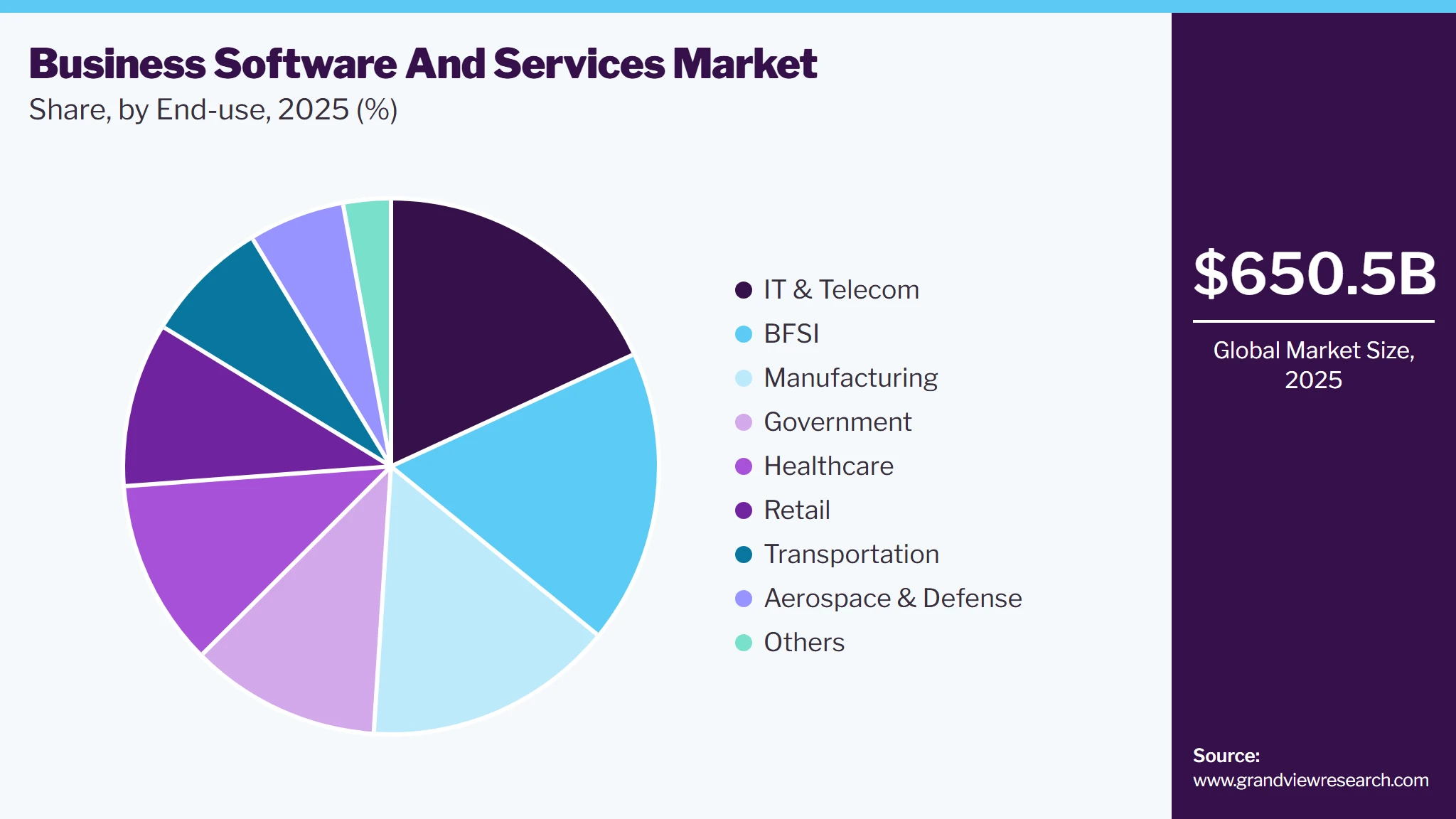
Based on end use, the IT & telecom segment led the market with the largest revenue share of 18.1% in 2025, owing to the growing adoption of cloud computing and virtualization in the sector. Cloud-based solutions provide telecom operators and IT service providers the flexibility to scale resources, reduce infrastructure costs, and support next-generation technologies like 5G, edge computing, and the Internet of Things (IoT). These innovations demand sophisticated software to manage the increased complexity of networks, data flows, and service delivery.
 To learn more about this report, Download Free Sample Report
 The healthcare segment is expected to grow at a significant CAGR over the forecast period. The rise of data analytics and artificial intelligence (AI) is also fueling growth in the healthcare software market. Healthcare organizations are increasingly using AI-driven solutions to enhance diagnostics, predict patient outcomes, and optimize treatment plans. Data analytics platforms are enabling providers to extract actionable insights from large volumes of clinical data, which can improve decision-making, reduce costs, and enhance operational efficiency.
Enterprise Size Insights
BBased on enterprise size, the large enterprise segment led the market with the largest revenue share of 60.8% in 2025, attributed to the growing emphasis on data-driven decision-making. Large enterprises generate massive volumes of data, and leveraging this data effectively is critical for maintaining a competitive edge. Advanced analytics, business intelligence tools, and artificial intelligence (AI) capabilities enable organizations to derive actionable insights, optimize strategies, and identify new growth opportunities. This need for sophisticated analytics solutions fuels investments in business software tailored for large-scale data processing and visualization.
The small & medium enterprises segment is expected to grow at a significant CAGR over the forecast period. The increasing focus on cost-effective solutions that enable SMEs to streamline operations and remain competitive. Business software, particularly cloud-based options, offers SMEs affordable access to advanced tools for managing finances, operations, customer relationships, and marketing, without the need for significant upfront investments in infrastructure.
Regional Insights
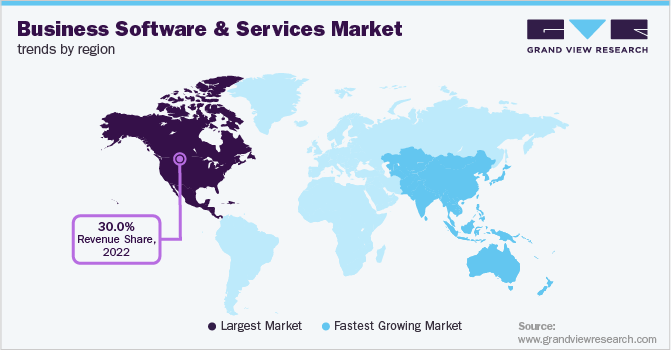
North America dominated the global business software and services market with the largest revenue share of 30.6% in 2025. Cloud computing and Software-as-a-Service (SaaS) solutions are dominating the market. Organizations are increasingly shifting to cloud-based platforms due to their scalability, flexibility, and cost-effectiveness.
 To learn more about this report, Download Free Sample Report
 U.S. Business Software And Services Market Trends
The business software and services market in the U.S. held the largest share in the North America region in 2025. AI and automation technologies are gaining traction as businesses in the U.S. look to enhance operational efficiency and reduce costs. The integration of AI-powered tools, such as chatbots for customer service, predictive analytics for marketing, and robotic process automation (RPA) for administrative tasks, is driving growth in the business software sector.
Europe Business Software And Services Market Trends
The business software and services market in Europe is anticipated to register at a considerable CAGR from 2025 to 2030. With the implementation of the General Data Protection Regulation (GDPR) and increasing concerns over data breaches, cybersecurity remains a top priority for European businesses. The demand for business software that helps organizations comply with data protection regulations is growing.
The UK business software and services market is expected to grow at a rapid CAGR during the forecast period. Business intelligence (BI) and data analytics are increasingly being used by UK organizations to make informed, data-driven decisions. Companies are adopting advanced analytics platforms to track key performance indicators (KPIs), monitor market trends, analyze customer behavior, and optimize their operations.
The business software and services market in Germany accounted for a substantial market share in Europe in 2024. German SMEs are adopting cloud-based business solutions, CRM software, accounting tools, and HR management systems to automate tasks and improve operational efficiency. SaaS platforms that provide a range of functionalities at an affordable price are particularly attractive to SMEs, allowing them to compete with larger enterprises in an increasingly digital economy.
Asia Pacific Business Software And Services Market Trends
The business software and services industry in the Asia Pacific is anticipated to grow at the fastest CAGR from 2026 to 2033. Digital transformation is a key theme in the APAC region as organizations in sectors such as manufacturing, retail, banking, and healthcare are adopting new business software solutions to enhance productivity, streamline operations, and meet consumer expectations.
The Japan business software and services market is expected to grow at a rapid CAGR during the forecast period. Japan has a developed IT infrastructure, which supports the growth of business software and services. The country’s advanced telecom networks, high-speed internet, and data centers enable businesses to run sophisticated software solutions, including those requiring high-performance computing.
The business software and services market in China held a substantial market share in Asia Pacific in 2024. As the country continues to embrace digital finance, there is a growing demand for FinTech software solutions, including payment processing, lending platforms, and wealth management tools. The use of AI and big data in the financial services industry is enabling more efficient risk management, credit scoring, fraud detection, and customer service.
Key Business Software And Services Company Insights
Key players operating in the business software and services industry are Microsoft, Oracle, SAP SE, IBM Corporation, and Infor. The companies are focusing on various strategic initiatives, including new product development, partnerships & collaborations, and agreements to gain a competitive advantage over their rivals.
Key Business Software And Services Companies
The following key companies have been profiled for this study on the business software and services market.
-
Acumatica, Inc.
-
Deltek, Inc.
-
Epicor Software Corporation
-
IBM Corporation
-
Infor
-
Microsoft
-
MicroStrategy Incorporated
-
NetSuite Inc.
-
Oracle
-
SAP SE
-
SYSPRO
-
Unit4
Competitive Benchmarking
Category
Operating Strategies
Competitive Edge
Weakness
Established Players (IBM Corporation, Microsoft, Oracle, SAP SE, Infor)
- Expand cloud-based business application portfolios, integrate AI and automation capabilities across enterprise workflows, and strengthen industry-specific solutions through acquisitions, partnerships, and continuous product innovation.
- Focus on cross-selling ERP, CRM, HCM, analytics, and managed services to existing enterprise customers.
- Extensive global presence, strong brand recognition, large installed customer bases, and comprehensive software ecosystems.
- Robust R&D capabilities, partner networks, and deep expertise in enterprise digital transformation enable end-to-end solution delivery.
- Complex product portfolios may increase implementation time and costs.
- Large organizational structures can slow innovation cycles and responsiveness to niche customer requirements.
- Higher pricing may limit adoption among cost-sensitive SMEs.
Emerging Players (Acumatica, Inc., Deltek, Inc., MicroStrategy Incorporated, SYSPRO)
- Focus on cloud-native solutions, vertical-specific offerings, and SME-targeted software platforms.
- Differentiate through ease of deployment, flexible pricing models, personalized customer support, and specialized functionality for selected industries or business processes.
- Greater agility in product development, faster implementation timelines, and stronger focus on specific industries or customer segments.
- Ability to offer tailored solutions and competitive pricing compared to larger vendors.
- Smaller customer bases, limited global reach, and lower brand visibility.
- Fewer resources for large-scale R&D, AI innovation, and international expansion compared to established market leaders.
Recent Developments
-
In January 2025, IBM revealed its plans to acquire Applications Software Technology LLC, an Oracle consultancy. The acquisition is expected to strengthen IBM's Oracle solutions, enabling the company to help clients in North America, the UK, and Ireland overcome common challenges in public sector cloud transformations, such as transitioning legacy systems, addressing skill shortages, and meeting high security and compliance demands. This move aims to deliver more effective digital transformation results with Oracle Cloud Applications.
-
In October 2024,Acumatica, Inc. introduced its new Professional Services Edition, designed to help small and midsized professional services firms improve efficiency and accelerate growth. This latest addition expands the company’s industry-specific product offerings, providing specialized features and capabilities to enhance collaboration and operational performance. Tailored for firms in architecture, engineering, IT, and more sectors, the solution is crafted to support the unique needs of these industries, enabling firms to optimize their workflows and drive business success.
Business Software And Services Market Report Scope
Report Attribute
Details
Market size in 2025
USD 650.5 billion
Estimated market size in 2026
USD 726.3 billion
Projected market size by 2033
USD 1,660.6 billion
Growth rate
CAGR of 12.5% from 2026 to 2033
Base year for estimation
2025
Historical data
2021 - 2024
Forecast period
2026 - 2033
Quantitative units
Revenue in USD million/billion and CAGR from 2026 to 2033
Report coverage
Revenue forecast, company market share, competitive landscape, growth factors, and trends
Segments covered
Software, service, deployment, enterprise size, end use, region
Regional scope
North America; Europe; Asia Pacific; Latin America; MEA
Country scope
U.S.; Canada; Mexico; U.K.; Germany; France; China; India; Japan; Australia; South Korea; Brazil; UAE; Saudi Arabia; South Africa
Key companies profiled
Acumatica, Inc.; Deltek, Inc.; Epicor Software Corporation; IBM Corporation; Infor; Microsoft; MicroStrategy Incorporated; NetSuite Inc.; Oracle; SAP SE; SYSPRO; Unit4
Customization scope
Free report customization (equivalent up to 8 analysts' working days) with purchase. Addition or alteration to country, regional & segment scope.
Pricing and purchase options
Avail customized purchase options to meet your exact research needs. Explore purchase options
Global Business Software And Services Market Report Segmentation
This report forecasts revenue growth at global, regional, and country levels and provides an analysis of the latest industry trends in each of the sub-segments from 2021 to 2033. For this study, Grand View Research has segmented the global business software and services market report based on software, service, deployment, enterprise size, end-use, and region.
-
Software Outlook (Revenue, USD Billion, 2021 - 2033)
-
Finance
-
Sales & Marketing
-
Human Resource
-
Supply Chain
-
Others
-
-
Service Outlook (Revenue, USD Billion, 2021 - 2033)
-
Consulting
-
Managed Services
-
Support & Maintenance
-
-
Deployment Outlook (Revenue, USD Billion, 2021 - 2033)
-
Cloud
-
On-premise
-
-
Enterprise Size Outlook (Revenue, USD Billion, 2021 - 2033)
-
Large Enterprises
-
Small & Medium Enterprises
-
-
End-use Size Outlook (Revenue, USD Billion, 2021 - 2033)
-
Aerospace & Defense
-
BFSI
-
Government
-
Healthcare
-
IT & Telecom
-
Manufacturing
-
Retail
-
Transportation
-
Others
-
-
Regional Outlook (Revenue, USD Billion, 2021 - 2033)
-
North America
-
U.S.
-
Canada
-
Mexico
-
-
Europe
-
UK
-
Germany
-
France
-
-
Asia Pacific
-
Japan
-
China
-
India
-
South Korea
-
Australia
-
-
Latin America
-
Brazil
-
-
MEA
-
UAE
-
Saudi Arabia
-
South Africa
-
-
Research Methodology
Segment Definition
Segment - Software
Revenue capture definition
Finance
Revenue is generated through licensing, subscription (SaaS), implementation, customization, and upgrade fees for financial management software, including accounting, budgeting, treasury management, financial planning & analysis (FP&A), tax management, and governance, risk, and compliance (GRC) solutions.
Sales & Marketing
Revenue is derived from subscriptions, licensing, and professional services associated with customer relationship management (CRM), marketing automation, campaign management, customer analytics, lead management, and digital advertising platforms.
Human Resource
Revenue includes software subscriptions, licensing, implementation, and support fees for human capital management (HCM), payroll, workforce management, talent acquisition, employee engagement, learning management, and performance management solutions.
Supply Chain
Revenue is generated from software licenses, SaaS subscriptions, consulting, and maintenance services related to supply chain planning, procurement, inventory management, warehouse management, logistics, transportation management, and supplier collaboration platforms.
Others
Revenue encompasses enterprise software solutions such as project portfolio management, enterprise asset management, business intelligence, analytics, collaboration tools, content management, workflow automation, and industry-specific business applications.
Segment - Service
Revenue capture definition
Consulting
Revenue is generated from advisory, strategy development, digital transformation planning, software selection, process optimization, implementation planning, and technology roadmap services associated with business software deployments.
Managed Services
Revenue includes recurring fees from outsourced application management, cloud operations, software administration, performance monitoring, security management, data management, and business process support services.
Support & Maintenance
Revenue is derived from annual maintenance contracts, technical support subscriptions, software updates, bug fixes, patch management, user training, and ongoing system enhancement services.
Segment - Deployment
Revenue capture definition
Cloud
Revenue is generated through recurring SaaS subscriptions, platform usage fees, cloud-hosted application services, consumption-based pricing models, and cloud infrastructure-related software services delivered via public, private, or hybrid cloud environments.
On-premise
Revenue includes perpetual software licenses, implementation fees, hardware integration costs, customization services, maintenance contracts, and upgrade fees associated with software deployed within customer-owned infrastructure.
Segment - Enterprise Size
Revenue capture definition
Large Enterprises
The large enterprises segment, with respect to the number of employees, typically comprises organizations employing more than 1,000 employees for multinational corporations.
SMEs
The SMEs segment, with respect to the number of employees, generally includes organizations employing between 10 and 999 employees.
Segment - End Use
Revenue capture definition
Aerospace & Defense
Revenue is generated from software solutions supporting project management, asset lifecycle management, regulatory compliance, supply chain operations, workforce management, and mission-critical business processes within aerospace and defense organizations.
BFSI
Revenue includes software spending on financial management, risk and compliance management, customer relationship management, fraud detection, analytics, workforce management, and operational automation solutions used by banking and financial institutions.
Government
Revenue is derived from software procurement, implementation, and managed services supporting public administration, citizen services, budgeting, procurement, workforce management, records management, and regulatory compliance.
Healthcare
Revenue is generated from business software used for financial operations, workforce management, procurement, supply chain management, compliance management, customer engagement, and healthcare administration functions.
IT & Telecom
Revenue includes spending on enterprise resource planning (ERP), CRM, service management, workforce management, billing, analytics, and operational software supporting telecom operators and IT service providers.
Manufacturing
Revenue is derived from software supporting production planning, supply chain management, procurement, inventory optimization, quality management, workforce management, and enterprise resource planning functions.
Retail
Revenue includes software expenditures on customer relationship management, inventory management, merchandising, workforce scheduling, marketing automation, omnichannel operations, and business analytics solutions.
Transportation
Revenue is generated from software used for fleet management, logistics optimization, workforce management, procurement, asset management, route planning, and operational analytics.
Others
Revenue encompasses software and related services deployed across sectors such as education, energy & utilities, media & entertainment, hospitality, professional services, and non-profit organizations for business process management and operational efficiency.
Estimation Model
Layer
Question
Analysis
Business Software & Services Addressable Layer
Who can benefit from business software and services?
Identify the total number of enterprises across industries and regions that can benefit from software solutions for finance, HR, sales, marketing, supply chain, and business operations.
Technology Access Layer
Who can deploy business software and services?
Apply factors such as IT infrastructure, cloud readiness, internet connectivity, technology budgets, and partner ecosystems to determine organizations capable of deploying business software solutions.
Adoption & Capacity Utilization Layer
Who actively uses business software and services?
Apply software adoption rates, digital transformation initiatives, cloud migration trends, and ERP/CRM/HCM penetration to estimate active users of business software and services.
Monetization Layer
How much revenue is generated?
Assess revenue potential through software licenses, SaaS subscriptions, implementation, consulting, managed services, support & maintenance, and other recurring service revenues generated from active users.
Delivered Customizations
This report has been delivered with the following In-depth customizations
CLIENT REQUEST
CUSTOMIZATION DELIVERED
VALUE ADDS
AI-Powered Enterprise Software Adoption Trends
Conducted a focused analysis of AI-enabled business software applications across ERP, CRM, HCM, supply chain management, customer service, and business intelligence platforms, including generative AI, predictive analytics, and workflow automation use cases.
Helps stakeholders identify high-growth software segments, evaluate AI adoption trends, and assess opportunities for product innovation and competitive differentiation.
SME Digital Transformation & Cloud Software Penetration Analysis
Evaluated software spending patterns, SaaS adoption rates, cloud migration trends, and technology investment priorities among small and medium-sized enterprises across key regions.
Provides insights into underserved customer segments, market expansion opportunities, and effective go-to-market strategies targeting SMEs.
Low-Code/No-Code Platform Market Assessment
Assessed adoption of low-code and no-code application development platforms, citizen developer initiatives, and enterprise application modernization programs.
Helps organizations evaluate software democratization trends, development efficiency gains, and new platform revenue opportunities.
Frequently Asked Questions About This Report
Key factors include the rapid digital transformation, cloud adoption, rising demand for enterprise software, operational modernization, productivity improvement, and enhanced business competitiveness.
North America dominated with 30.6% revenue share in 2025.
Asia Pacific is the fastest-growing region over the forecast period.
Key players operating in the business software and services market include Acumatica, Inc.; Deltek, Inc.; Epicor Software Corporation; IBM Corporation; Infor; Microsoft; MicroStrategy Incorporated; NetSuite Inc.; Oracle; SAP SE; SYSPRO; Unit4
The global business software and services market size was estimated at USD 650.5 billion in 2025 and is expected to reach USD 726.3 billion in 2026.
The global business software and services market is expected to witness a compound annual growth rate of 12.5% from 2026 to 2033 to reach USD 1,660.6 billion by 2033.
The finance segment led with a 25.4% revenue share in 2025, while the sales & marketing segment is the fastest-growing segment.
The support & maintenance segment led with a 41.0% revenue share in 2025, while the managed services segment is the fastest-growing segment.
Cloud segment held the largest revenue share of 59.0% in 2025.
About the Author(s)
IT Services & Applications Research Team
Technology · IT Services & ApplicationsThis report was authored by the it services & applications research team at Grand View Research - comprising two research analysts, one senior research analyst, and one industry expert - with specialized expertise in the it services & applications segment of the technology industry. All findings are based on proprietary technology databases, executive interviews, and regulatory analysis, subject to internal peer review prior to publication.
Last Updated:
Speak to Analyst

Customize this report to your needs - add regions, segments, or data points, with 20% free customization.
Or view our licence options:


ISO 9001:2015 & 27001:2022 Certified
We are GDPR and CCPA compliant! Your transaction & personal information is safe and secure. For more details, please read our privacy policy.


