
- Home
- »
- Petrochemicals
- »
-
1,3 Butadiene Market Size, Share & Trends Report 2026-2033GVR Report cover

1,3 Butadiene Market (2026 - 2033)
Size, Share & Trends Analysis Report By Application (Organic, SBR, Butadiene Rubber, SB Latex, ABS, HMDA, NBR, Others), By Region (North America, Europe, Asia Pacific, Middle East & Africa), And Segment Forecasts
Market Size, 2025
$46.7BMarket Estimate, 2026
$50.2BMarket Forecast, 2033
$83.9BCAGR, 2026–2033
7.6%1,3 Butadiene Market Summary
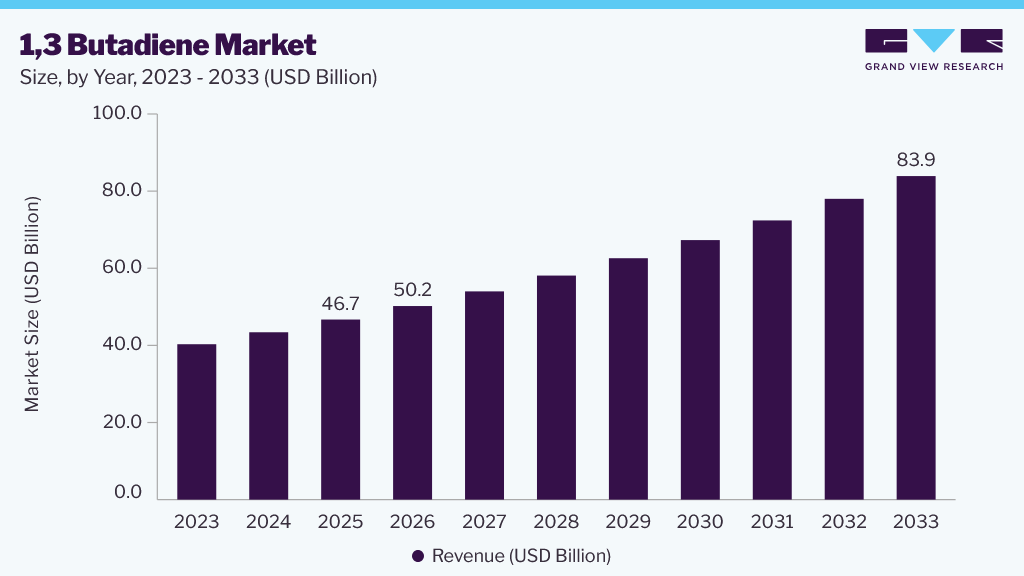
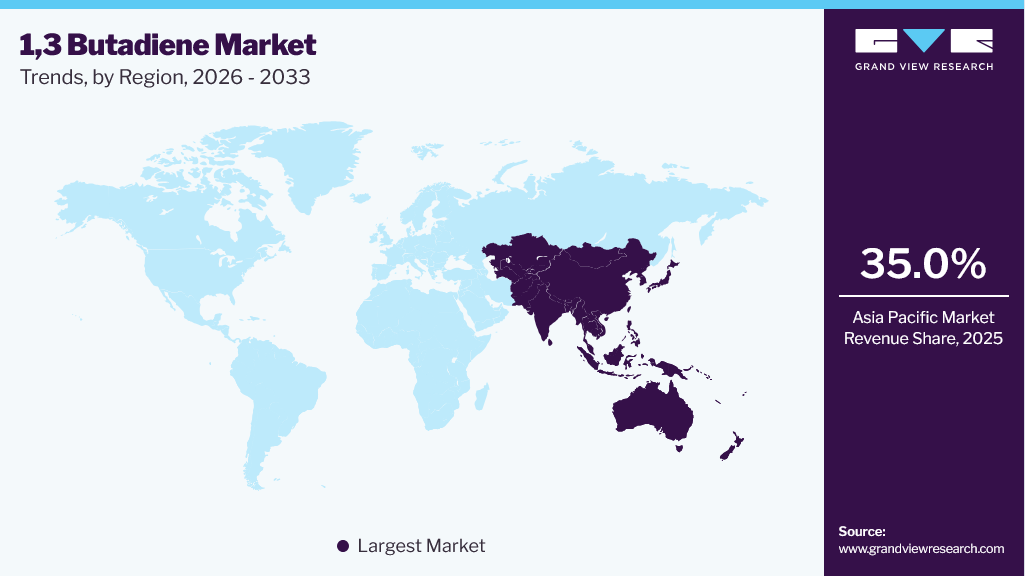
The global 1,3 butadiene market size was valued at USD 46.7 billion in 2025 and is projected to grow from USD 50.2 billion in 2026 to USD 83.9 billion in 2033, at a CAGR of 7.6% from 2026 to 2033. Asia Pacific dominated the market, accounting for a revenue share of 35.0% in 2025. The compound's significant role in producing synthetic rubber, mainly for automotive tires, drives the demand.
Key Market Trends & Insights
- By application: The butadiene rubber segment dominated the market and accounted for approximately 30.0% market share in 2025.
- By application: The HMDA segment is expected to grow at the fastest CAGR of over 10.0% over the forecast period.
Regional Highlights
- Largest regional market: Asia Pacific (35.0% revenue share, 2025)
Market Size & Forecast
- Market size in 2025: USD 46.7 Billion
- Estimated market size in 2026: USD 50.2 Billion
- Projected market size by 2033: USD 83.9 Billion
- CAGR (2026-2033): 7.6%
Three ways to get this report
Buy it, customize it, or ask a question.Ask an Analyst
Analyst response in 1 business day
- AccessReport author, directly
- Reply timeWithin 1 working day
- No sales callDirect answer only
- FormatEmail reply
- CostFree, no cost
Get the Full Report
What the study covers
- FormatsPDF · Excel · Dashboard
- Timeline2026–2033 annual, 2025 base
- Coverage20+ countries, 5 regions
- Companies10+ key players profiled
Customize the Report
20% free customization
- IncludeCountries, segments, points
- TailorTo your product definition
- ExtendDeeper competitor detail
- OrA fully bespoke study
- Turnaround5–10 working days
With the expansion of the automotive industry in developing regions such as Asia-Pacific and Latin America, the need for synthetic rubber has surged. As economies expand and infrastructure grows, the number of vehicles on the road increases, leading to higher demand for durable, high-performance tires. For instance, in February 2025, Bridgestone Americas announced the debut of its latest tire featuring ENLITEN Technology: the all-new Bridgestone Turanza Prestige. The product was developed to enhance ride comfort, reflecting the growing demand for high-performance tires and supporting the consumption of synthetic rubber materials such as styrene-butadiene rubber (SBR), a major downstream application of 1,3-butadiene.
 Source: Grand View Research, IR Documents, Primary Interviews, Paid DatabasesTo learn more about this report,
 Download Free Sample Report
Moreover, 1,3-butadiene (BD) is used to produce various plastics and resins, including acrylonitrile-butadiene-styrene (ABS) and styrene-butadiene rubber (SBR). These materials are widely used in the construction, electronics, and consumer goods industries. For instance, in October 2025, LG Chem announced its participation in K 2025, the world’s premier trade fair for plastics and rubber, to be held in Düsseldorf, Germany. LG Chem showcased its high-value-added, eco-friendly materials developed through its differentiated technologies, including ABS products for appliances, automotive, and consumer applications, highlighting continued demand for engineering plastics derived from 1,3-butadiene. The construction industry has seen robust growth, with increased investments in residential, commercial, and infrastructural projects. This growth necessitates a steady supply of construction materials, many of which are derived from 1,3 butadiene, contributing to its rising demand.
In addition, advancements in manufacturing processes and the development of more efficient production technologies for 1,3-butadiene have increased its demand. These advancements have made the production process more cost-effective and sustainable, encouraging more manufacturers to adopt 1,3 butadiene-based materials in their products. This has been most noticeable in regions where industrialization is advancing rapidly, with a growing emphasis on adopting modern manufacturing practices.
Furthermore, the global shift towards lightweight and fuel-efficient vehicles has driven demand for high-performance plastics and elastomers, in which 1,3-butadiene is extensively utilized. As automotive manufacturers strive to meet stringent environmental regulations and consumer demand for fuel efficiency, using materials that can reduce vehicle weight without compromising safety and performance has become critical. This trend has significantly increased demand for 1,3-butadiene, which is necessary for producing these advanced materials.
The increasing focus on sustainable and eco-friendly products has led to the exploration of bio-based alternatives to traditional petrochemical-derived materials. While this is still an emerging trend, the potential of bio-based 1,3-butadiene to reduce the environmental impact of synthetic rubber and plastic production is garnering interest. This adds another dimension to the demand dynamics of 1,3 butadiene as industries seek to innovate and adopt more sustainable practices. For instance, in January 2024, Michelin, IFPEN, and Axens inaugurated the first industrial-scale demonstrator plant in France for producing bio-based 1,3-butadiene from bioethanol under the BioButterfly project.
Analyst Perspective
The market is expected to grow strongly over the forecast period due to rising demand from the automotive, construction, and plastics industries. Increasing production of high-performance tires and synthetic rubber products in emerging economies continues to be one of the major driving forces. In addition, the rising adoption of ABS resins and other butadiene-based polymers in the automotive, electronics, and consumer goods industries is further augmenting market demand. In addition, advances in manufacturing processes are helping to increase efficiency and sustainability along the entire supply chain. Growing focus on lightweight vehicles and fuel efficiency is expected to increase the use of butadiene-based elastomers and plastics. In addition, ongoing research and development efforts towards bio-based butadienes are expected to open new avenues of growth.
Application Insights
The butadiene rubber segment dominated the market, accounting for approximately 30.0% of the market share in 2023. The market growth is being fueled by various factors. Butadiene rubber offers better abrasion resistance and low-temperature flexibility, making it suitable for diverse climatic conditions and operational environments. This adaptability enhances its use across global markets, especially in regions experiencing rapid industrialization and infrastructure development. In addition, advancements in polymer technology have spurred innovations in butadiene rubber formulations, leading to improved product attributes, including higher tensile strength, reduced rolling resistance in tires, and enhanced adhesion to various substrates. These developments further widen its application scope, attracting manufacturers across different sectors to integrate butadiene rubber into their product offerings.
Companies are undertaking efforts to ensure a consistent flow of the supply chain and operations. For instance, in June 2025, Evonik Industries announced that it would localize the final production step of its POLYVEST ST-E 60 in Shanghai, China. This decision highlights the company’s commitment to enhancing supply security and customer proximity in Asia, thereby meeting growing demand from applications including tires, rubber compounds, adhesives, coatings, and sealants. The expansion reflects the increasing industrial demand for high-performance polybutadiene materials across Asia.
HMDA is expected to grow at the fastest CAGR of more than 10.0% over the forecast period. HMDA is a crucial ingredient in the manufacture of nylon 66. Nylon 66, produced from HMDA and adipic acid, is widely used in the textile sector. It imparts durability, tear resistance, and reinforcement to textiles used in outdoor equipment. HMDA plays a crucial role in water treatment procedures by acting as a corrosion inhibitor. Its primary function is to safeguard water pipes, boilers, and cooling systems from corrosion. As industries increasingly prioritize sustainable practices, demand for HMDA has surged due to the growing emphasis on efficient water treatment.
Regional Insights
North America 1,3 butadiene market is expected to grow significantly over the forecasted period. The automotive sector drives market growth for 1,3-butadiene in the region. As vehicle production increases to meet consumer demand, particularly in the United States and Canada, there is a corresponding rise in the need for high-performance tires and other rubber components. These components are vital for improving fuel efficiency, enhancing safety, and extending vehicle lifespans, thereby driving up demand for 1,3-butadiene. Advances in polymer technology have expanded synthetic rubber's applications beyond automotive use. Industries such as construction, electronics, and healthcare rely heavily on materials like acrylonitrile-butadiene-styrene (ABS) and styrene-butadiene rubber (SBR) derived from 1,3 butadiene. These materials offer superior properties such as durability, flexibility, and resistance to heat and chemicals, making them indispensable for a wide range of products, from household appliances to medical equipment.
U.S. 1,3 Butadiene Market Trends
The 1,3 butadiene market in the U.S. dominated the regional market with a revenue share of more than 63.0% in 2025. The surge in disposable income and consumer purchasing power has increased demand for products that use 1,3-butadiene. Furthermore, population growth and evolving lifestyles have contributed to the increased demand for goods that rely on this compound. The automotive industry, in particular, drives strong demand for 1,3-butadiene. It plays a crucial role in manufacturing materials such as styrene-butadiene rubber, acrylonitrile-butadiene-styrene resin, and nitrile rubber, which are essential for producing tires used in automobiles and trucks.
Europe 1,3 Butadiene Market Trends
The 1,3 butadiene market in Europe is expected to see significant growth over the forecast period. Butadiene is an essential ingredient in the production of synthetic rubber. Styrene-butadiene rubber (SBR) is commonly used in various industrial products, such as tires, hoses, and belts. SBR polymer finds application in a wide range of products, including molded goods, carpet backing, and shoe soles. The addition of butadiene enhances the flexibility of various plastics. Butadiene is crucial for producing synthetic rubbers and elastomers such as polybutadiene rubber (PBR) and nitrile rubber (NR). The demand for tires, footwear, and consumer goods is a key factor influencing the production and consumption of butadiene in Europe.
The UK 1,3 Butadiene market is expected to grow rapidly in the coming years. The electronics and electrical industry significantly drives demand for 1,3 butadiene in the UK. Synthetic rubbers produced from 1,3-butadiene are used to manufacture electronic components, cables, and wires. These materials provide insulation and protection against environmental factors, enhancing the longevity and performance of electronic devices. With the continuous advancement in technology and the increasing consumer adoption of electronic gadgets, there is a growing need for reliable, high-performance materials, thereby increasing the demand for 1,3-butadiene.
The 1,3 butadiene market in Germany held a substantial share in 2025. One significant driver of increased demand in Germany is the automotive industry's reliance on synthetic rubbers for tire production. As Germany remains a powerhouse in automotive manufacturing, with brands such as Volkswagen, BMW, and Mercedes-Benz, there is a consistent need for high-performance tires. 1,3 butadiene enhances these tires' durability, elasticity, and overall performance.
Asia Pacific 1,3 Butadiene Market Trends
The 1,3 butadiene market in the Asia Pacific dominated the global market in 2025 and is expected to maintain its dominance throughout the forecast period, with a market share exceeding 35.0%. The market dominated in 2025. Asia-Pacific is currently the leading player in the butadiene market and is expected to experience the highest growth rate in the coming years. 1,3 Butadiene is a crucial raw material for producing synthetic rubbers, particularly styrene-butadiene rubber (SBR) and polybutadiene rubber (PBR). These synthetic rubbers are used extensively in the automotive industry to manufacture tires, hoses, and various parts. As the Asia-Pacific region, especially countries such as China and India, continues to witness rapid industrialization and urbanization, demand for automobiles and automotive components is expected to rise. This growth has increased demand for synthetic rubbers, thereby driving demand for 1,3-butadiene.
 To learn more about this report, Download Free Sample Report
Furthermore, 1,3-butadiene (BD) is a key ingredient in producing other essential chemicals, such as adiponitrile, which is used to manufacture nylon 6,6, a vital material in the textile and automotive sectors. In addition, the region's chemical manufacturing sector has been expanding significantly, supported by favorable government policies, infrastructural developments, and petrochemical investments. This growth has enhanced the Asia-Pacific region's capacity to produce and consume 1,3-butadiene in larger quantities.
China 1,3 butadiene market held a substantial share in 2025. The growth of China's automotive sector drives market growth. China is one of the largest consumers of synthetic rubber, a major product derived from 1,3 butadiene. As China expands its automotive manufacturing capabilities and domestic vehicle production, the demand for synthetic rubber for tires and other automotive components has increased. In addition to its role in the automotive sector, 1,3-butadiene is also used to produce other synthetic materials, such as ABS (acrylonitrile butadiene styrene) plastics, which are widely used in electronics, appliances, and consumer goods manufacturing. The rapid growth of China's manufacturing sector and the expanding middle-class population have spurred demand for these products, thereby boosting consumption of 1,3-butadiene, a critical component in ABS production.
1,3 butadiene market in India is expected to grow rapidly in the coming years. India's construction sector is significantly increasing the demand for 1,3-butadiene. With ongoing infrastructure projects and urban development initiatives across the country, there is a continuous need for various rubber products used in construction, such as seals, gaskets, and adhesives. These products rely heavily on synthetic rubber, driving up consumption of 1,3-butadiene. Moreover, the Indian manufacturing sector, including electronics, consumer goods, and machinery, also contributes to the demand for synthetic rubber. Many of these industries use rubber components in their production processes, further fueling demand for 1,3-butadiene as a feedstock.
Key 1,3 Butadiene Company Insights
The 1,3 butadiene industry features a range of global, regional, and local players, making it a competitive market. The world’s leading companies are using partnerships, collaborations, acquisitions, mergers, and agreements as strategies to withstand the intense competition and increase their market share. For instance, in January 2024, Evonik announced the expansion of its capacities for hydroxyl-terminated polybutadienes (HTPB) in Central and South America. This expansion aims to meet the growing demand for these specialized polybutadiene products, crucial in aerospace, defense, and electronics for applications like solid rocket fuels and adhesives. The increased capacity is part of Evonik's strategic effort to strengthen its market position and support customers in the region with a reliable supply.
- BASF manufactures a diverse array of chemicals, including solvents, amines, resins, adhesives, electronic-grade chemicals, industrial gases, basic petrochemicals, and inorganic chemicals like Z-Cote. Key clients in this sector include the pharmaceutical, construction, textile, and automotive industries.
- Evonik Industries is a specialty chemical company owned by RAG-Stiftung. It offers a wide range of products, including surfactants, polymers, resins, and additives. These products cater to diverse industries, such as agriculture, renewable energy, paints and coatings, paper and printing, metals and oil, electronics, food and animal feed, personal care, pharmaceuticals, plastics, rubber, automotive, and construction.
Key 1,3 Butadiene Companies
The following key companies have been profiled for this study on the 1,3 butadiene market:
-
BASF SE
-
Lyondell Basell Industries Holdings B.V
-
Lanxess AG
-
LG Chem
-
Evonik Industries
-
Braskem S.A.
-
TPC Group Inc.
-
SABIC
-
Haldia Petrochemicals Limited
-
ExxonMobil
-
Shell Chemicals
-
INEOS Group
-
Reliance Industries
-
Formosa Petrochemical Corporation
-
Versalis
Recent Developments
-
In July 2025, Zeon Corporation started construction of a bench-scale facility at its Tokuyama Plant to demonstrate technology for the highly efficient production of butadiene from ethanol derived from plant-based and other sustainable materials.
-
In January 2024, Evonik announced the expansion of its capacities for hydroxyl-terminated polybutadienes (HTPB) in Central and South America. This expansion aims to meet the growing demand for these specialized polybutadiene products, crucial in aerospace, defense, and electronics for applications like solid rocket fuels and adhesives. The increased capacity is part of Evonik's strategic effort to strengthen its market position and support customers in the region with a reliable supply.
-
In January 2024, Michelin, IFP Energies nouvelles, and Axens inaugurated the first industrial-scale BioButterfly demonstrator plant in France for producing bio-based 1,3-butadiene from bioethanol. Further proof of the 3 partners’ commitment to producing renewable butadiene. The project aims to commercialize renewable butadiene production and reduce dependence on fossil-based feedstocks for synthetic rubber manufacturing.
1,3 Butadiene Market Report Scope
Report Attribute
Details
Market size in 2025
USD 46.7 billion
Estimated market size in 2026
USD 50.2 billion
Projected market size by 2033
USD 83.9 billion
Growth rate
CAGR of 7.6% from 2026 to 2033
Base year estimation
2025
Actual data
2021 – 2024
Forecast period
2026 – 2033
Quantitative units
Revenue in USD billion, and CAGR from 2026 to 2033
Report coverage
Revenue forecast, company ranking, competitive landscape, growth factors, and trends
Segments covered
Application, region
Regional Scope
North America; Europe; Asia Pacific; Central & South America; MEA
Country Scope
U.S.; Canada; Mexico; Germany; UK; France; Italy; Spain; China; Japan; India; South Korea; Brazil; Argentina; Saudi Arabia; South Africa
Key companies profiled
BASF SE; Lyondell Basell Industries Holdings B.V; Lanxess AG; LG Chem; Evonik Industries; Braskem S.A.; TPC Group Inc.; SABIC; Haldia Petrochemicals Limited; ExxonMobil; Shell Chemicals; INEOS Group; Reliance Industries; Formosa Petrochemical Corporation; Versalis
Customization scope
Free report customization (equivalent up to 8 analysts working days) with purchase. Addition or alteration to country, regional & segment scope.
Pricing and purchase options
Avail of customized purchase options to meet your exact research needs. Explore purchase options
Global 1,3 Butadiene Market Report Segmentation
This report forecasts revenue growth at global, regional, and country levels and provides an analysis of the latest industry trends and opportunities in each of the sub-segments from 2021 to 2033. For this study, Grand View Research has segmented the global 1,3 butadiene market report based on application and region:
-
Application Outlook (Revenue, USD Billion, 2021 - 2033)
-
Organic
-
SBR
-
Butadiene Rubber
-
SB Latex
-
ABS
-
HMDA
-
NBR
-
Others
-
-
Regional Outlook (Revenue, USD Billion, 2021 - 2033)
-
North America
-
U.S.
-
Canada
-
Mexico
-
-
Europe
-
Germany
-
UK
-
France
-
Italy
-
Spain
-
-
Asia Pacific
-
China
-
Japan
-
India
-
South Korea
-
-
Central & South America
-
Brazil
-
Argentina
-
-
Middle East and Africa
-
South Africa
-
Saudi Arabia
-
-
Frequently Asked Questions About This Report
The global 1,3 butadiene market size was valued at USD 46.7 billion in 2025 and is estimated at USD 50.2 billion in 2026.
The global 1,3 butadiene market is expected to grow at a CAGR of 7.6% from 2026 to 2033, reaching USD 83.9 billion.
The butadiene rubber 1,3 butadiene segment accounted for the largest revenue share of approximately 30.0% in 2025.
Key players in the market include BASF SE, LyondellBasell Industries Holdings B.V., Lanxess AG, LG Chem, Evonik Industries, Braskem S.A., TPC Group Inc., SABIC, Haldia Petrochemicals Limited, ExxonMobil, Shell Chemicals, INEOS Group, Reliance Industries, Formosa Petrochemical Corporation, Versalis, and others.
Asia Pacific dominated, with more than 35.0% of revenue in 2025.
About the Author(s)
Petrochemicals Research Team
Bulk Chemicals · PetrochemicalsThis report was authored by the petrochemicals research team at Grand View Research - comprising two research analysts, one senior research analyst, and one industry expert - with specialized expertise in the petrochemicals segment of the bulk chemicals industry. All findings are based on proprietary bulk chemicals databases, executive interviews, and regulatory analysis, subject to internal peer review prior to publication.
Last Updated:
Speak to Analyst

Customize this report to your needs - add regions, segments, or data points, with 20% free customization.
Or view our licence options:


ISO 9001:2015 & 27001:2022 Certified
We are GDPR and CCPA compliant! Your transaction & personal information is safe and secure. For more details, please read our privacy policy.


