
- Home
- »
- Plastics, Polymers & Resins
- »
-
Chloroprene Rubber Market Size & Share Report, 2026-2033GVR Report cover

Chloroprene Rubber Market (2026 - 2033)
Size, Share & Trends Analysis Report By Application (Textile, Automotive, Electrical & Electronics, Construction), By Region (North America, Europe, Asia Pacific, Latin America, MEA), And Forecasts
Market Size, 2025
$1.2BMarket Estimate, 2026
$1.3BMarket Forecast, 2033
$2.0BCAGR, 2026–2033
7.4%Chloroprene Rubber Market Summary
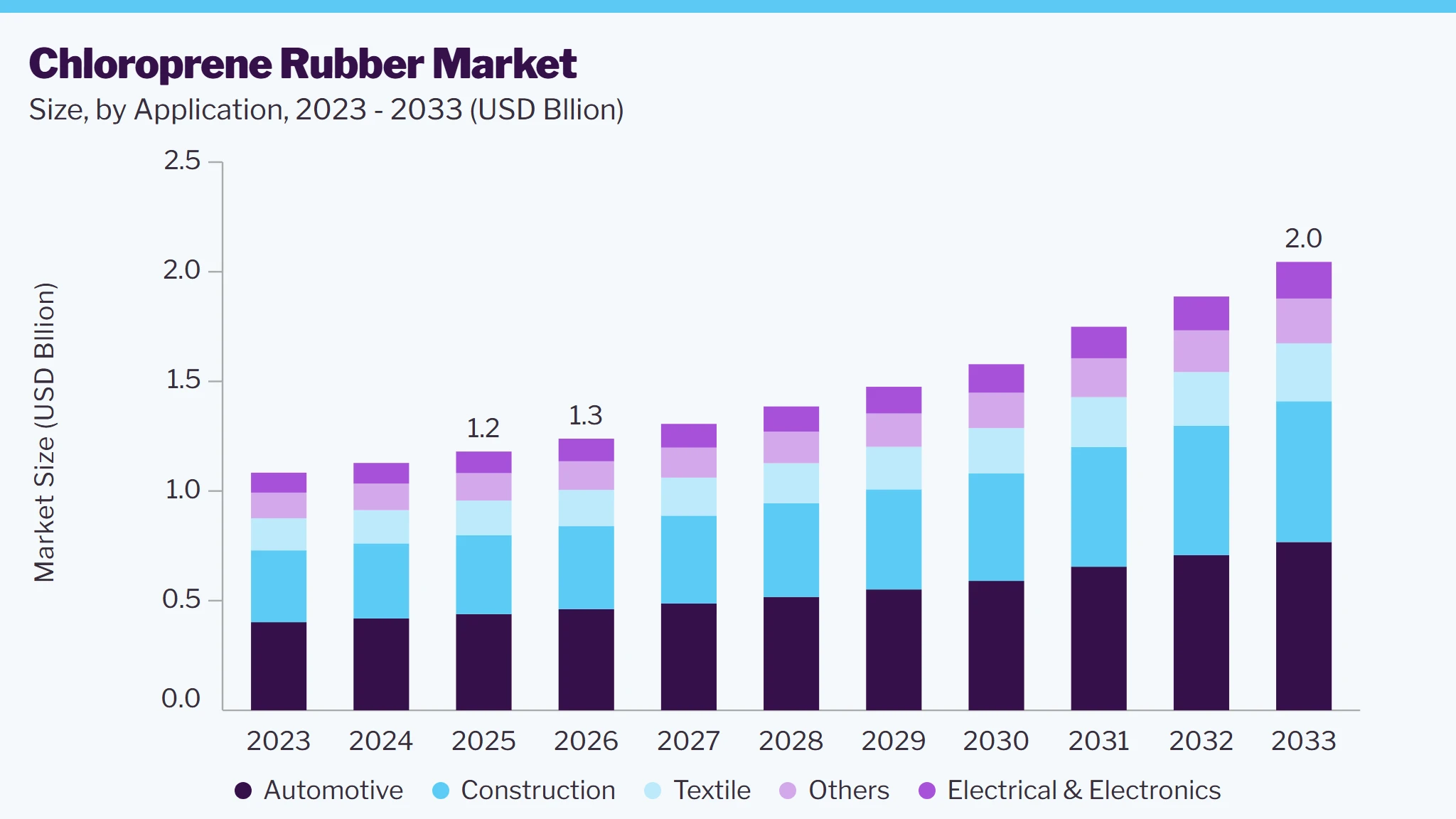
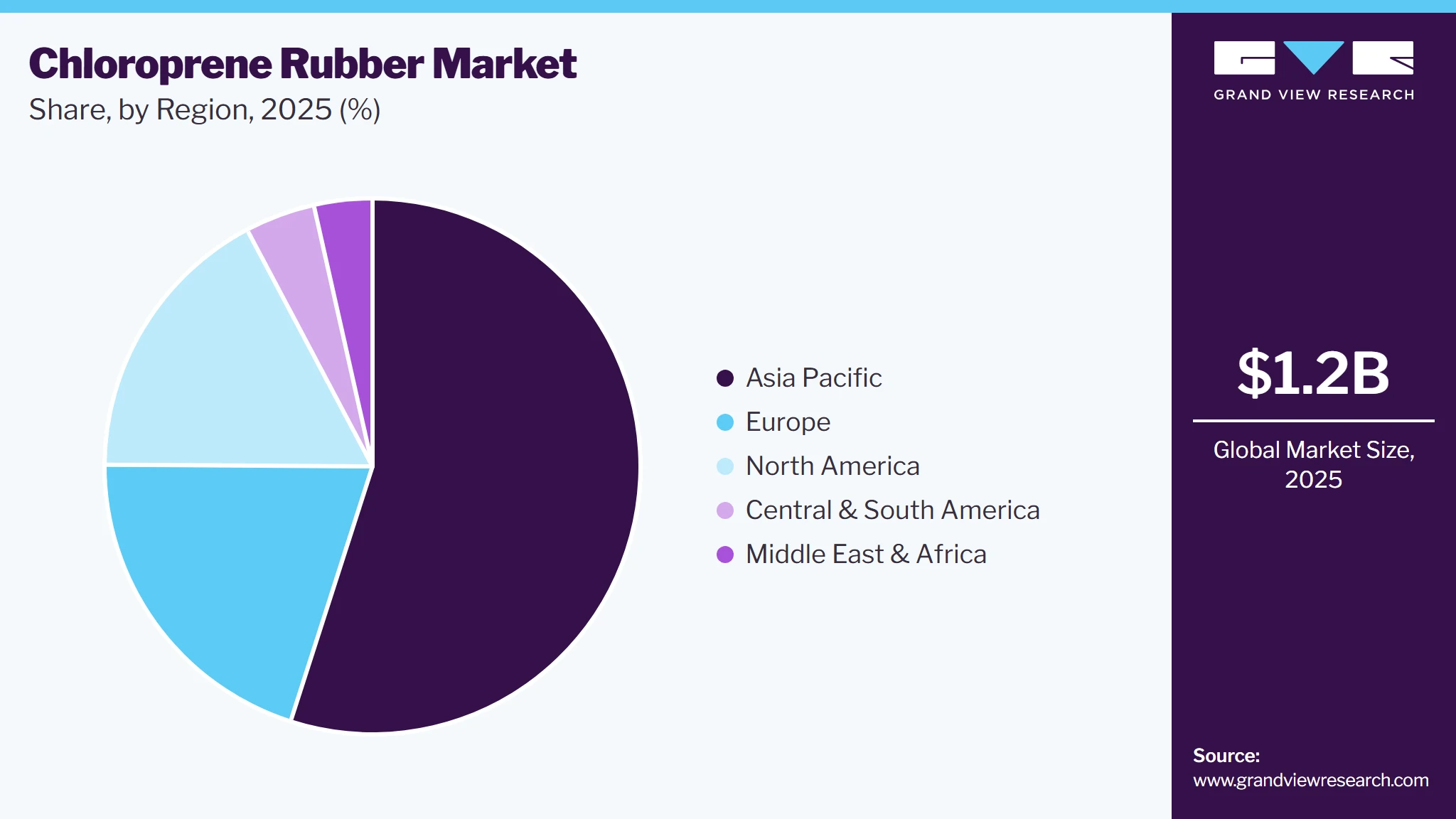
The chloroprene rubber market size was valued at USD 1.2 billion in 2025 and is projected to grow from USD 1.3 billion in 2026 to USD 2.0 billion by 2033, at a CAGR of 7.4% from 2026 to 2033. Asia Pacific dominated the chloroprene rubber market with the largest revenue share of 54.9% in 2025. Growing demand for sustainable packaging and increasing adoption of biodegradable materials across the packaging, food, pharmaceutical, and biomedical industries are driving the chloroprene rubber market growth.
 Source: Grand View Research, IR Documents, Primary Interviews, Paid DatabasesTo learn more about this report,
 Download Free Sample Report
Key Market Trends & Insights
- By application: Automotive segment held the largest market share of 37.2% in 2025.
Regional Highlights
- Largest regional market: Asia Pacific (54.9% revenue share, 2025)
- By country: China held the largest market share in 2025
Market Size & Forecast
- Market size in 2025: USD 1.2 Billion
- Estimated market size in 2026: USD 1.3 Billion
- Projected market size by 2033: USD 2.0 Billion
- CAGR (2026-2033): 7.4%
Prism AI by Grand View Research Free to tryAsk a question about the chloroprene rubber marketTry asking✓Every figure cited from GVR research Prefer the report? Download free sample →Rising use of polyhydroxyalkanoates (PHA) in environmentally friendly plastics further supports demand. In addition, chloroprene rubber is gaining wider acceptance in biomedical applications due to its excellent biocompatibility, biodegradability, and wound healing capabilities, strengthening long-term market expansion.
 To learn more about this report, Download Free Sample Report
This growth is attributed to the significant increase in demand from the automotive and construction industries, which is notable, as these sectors require durable and high-performance materials. In addition, advancements in manufacturing technologies and a focus on sustainability are propelling market expansion. Furthermore, the rising need for weather-resistant products and the growing adoption of chloroprene rubber in electric vehicles further enhance its market appeal, particularly in regions such as Europe and North America.
Chloroprene rubber, also known as neoprene, is a synthetic rubber that exhibits remarkable resistance to heat, ozone, and various chemicals, making it suitable for diverse applications. The increasing demand for chloroprene rubber is significantly influenced by its wide usage across multiple sectors, including automotive, construction, electrical, and textiles. As developing regions such as Asia Pacific and the Middle East undergo rapid industrialization, the need for chloroprene rubber is expected to rise sharply. Investment in research and development further enhances market prospects, particularly as the global shift towards energy-efficient vehicles accelerates.
Furthermore, the automotive sector's growth is a crucial factor driving this market. The rising production of passenger and commercial vehicles necessitates materials that can endure extreme conditions, which chloroprene rubber provides through its superior thermal stability and durability. This material is essential for manufacturing components such as gaskets, seals, and hoses that are integral to vehicle performance.
In addition to automotive applications, the construction industry increasingly relies on chloroprene rubber for its ability to withstand environmental challenges. Its resistance to ozone and UV radiation makes it ideal for outdoor applications such as roofing membranes and construction seals. Moreover, as industries continue to prioritize high-performance materials capable of withstanding demanding environments, chloroprene rubber's versatility and durability position it as a preferred choice in various applications.
Market Dynamics
Durable, heat-resistant, and weather-stable applications across automotive, construction, electrical, and textile uses shape chloroprene rubber demand. Revenue is concentrated in Asia Pacific, where vehicle production, infrastructure spending, and manufacturing intensity support steady offtake. At the same time, North America and Europe remain more specification-led, tied to performance requirements and regulatory compliance. The commercial structure is relatively concentrated, with a limited set of producers serving OEMs, compounders, and industrial converters through long-term supply relationships. This favors suppliers that can balance technical consistency, application support, and regional availability across end-use clusters.
Automotive production remains the clearest demand engine for chloroprene rubber because the material is widely used in seals, gaskets, hoses, and other components that must retain performance under heat, oil, ozone, and vibration exposure. As vehicle platforms become more durability-focused and packaging becomes tighter, OEMs and tier suppliers continue to prioritize elastomers that can sustain dimensional stability and service life in demanding assemblies. This keeps chloroprene rubber embedded in critical vehicle systems rather than in low-value substitution uses.
The same performance logic is extending demand into electric vehicles and infrastructure-heavy construction uses. Chloroprene rubber continues to gain relevance in roofing membranes, waterproofing systems, bridge bearings, and weather seals, while also supporting electrical insulation and protective components where reliability is more important than unit cost. Europe and North America are reinforcing this trend through stronger compliance expectations and higher specification intensity, which supports premium grades and more application-specific supply relationships.
Chloroprene rubber remains exposed to a relatively narrow commercial base because a large share of demand is tied to automotive and construction cycles. When vehicle output softens or infrastructure spending slows, consumption can decelerate quickly. The market also faces substitution pressure in price-sensitive applications from other elastomers that can deliver acceptable performance at lower cost or with easier processing. As a result, chloroprene rubber is often retained only where its weatherability, chemical resistance, and thermal durability are essential. This limits broad-based volume expansion and keeps growth dependent on premium specifications rather than easy material switching.
Suppliers that develop higher-performance, lower-emission chloroprene rubber grades for EV seals, wire and cable protection, roofing membranes, and waterproofing systems can capture premium demand. The strongest opportunity lies in regional production and application support, especially where customers are upgrading material standards and seeking longer-life solutions for harsh environments.
Analyst Perspective
Chloroprene rubber is moving from a conventional elastomer market into a more specification-driven and performance-led phase. Automotive seals, gaskets, hoses, and electrical protection will remain the main demand base. Still, the next growth cycle will be shaped by higher expectations for durability, weather resistance, and compliance across EV platforms and infrastructure-grade construction uses. Europe will continue to reward lower-emission and regulation-ready formulations, while Asia Pacific will remain the volume center because of manufacturing depth and end-use concentration. The suppliers that win over the next 5 to 10 years will be those that combine formulation capability, regional supply security, and strong application engineering with credible sustainability programs. Competitive advantage will increasingly come from integration, customer qualification, and local responsiveness rather than from scale alone. The main risks remain end-use cyclicality, substitution pressure in price-sensitive applications, and margin compression from concentrated competition and compliance costs.
Application Insights
Based on application, the automotive segment led the market with the largest revenue share of 37.2% in 2025. This growth is attributed to its essential role in producing various components such as hoses, gaskets, and seals. In addition, the increasing demand for vehicles that prioritize efficiency and durability has led manufacturers to seek materials that can withstand harsh conditions. Furthermore, chloroprene rubber's excellent resistance to heat, chemicals, and oils makes it an ideal choice for high-performance automotive applications, thereby enhancing its utilization in this rapidly evolving industry.
The construction industry is expected to grow at a CAGR of 6.4% from 2025 to 2030, owing to its durability and weather resistance, making it suitable for a range of applications including seals, waterproof membranes, and bridge bearings. In addition, the ongoing global construction boom, particularly in emerging markets, is significantly boosting the demand for this material. Furthermore, as infrastructure projects expand and the need for reliable construction materials grows, chloroprene rubber's properties ensure it meets the rigorous demands of modern construction practices, thereby driving its market growth in this sector.
Regional Insights
Asia Pacific dominated the chloroprene rubber market with the largest revenue share of 54.9% in 2025. This growth is attributed to the rapid industrialization and urbanization, particularly in countries such as China and India. In addition, the booming automotive and construction sectors are significant contributors, as they increasingly utilize chloroprene rubber for its durability and resistance to harsh environmental conditions. Furthermore, ongoing investments in infrastructure development and a growing manufacturing base enhance the demand for high-performance materials, positioning chloroprene rubber as a key player in meeting these evolving industry needs.
 To learn more about this report, Download Free Sample Report
China Chloroprene Rubber Market Trends
The chloroprene rubber market in China accounted for the largest market revenue share in the Asia Pacific in 2025, primarily driven by surge in automotive production and infrastructure projects. The country's focus on modernizing its manufacturing capabilities and increasing exports has led to higher consumption of chloroprene rubber across various applications. Furthermore, the push for energy-efficient vehicles and sustainable construction practices is promoting the adoption of chloroprene rubber due to its favorable properties, ensuring that it remains a preferred material in both traditional and emerging industries.
Europe Chloroprene Rubber Market Trends
Europe chloroprene rubber market is expected to grow at a CAGR of 6.0% over the forecast period, owing to stringent environmental regulations that encourage the use of sustainable materials. In addition, the automotive sector's demand for lightweight and high-performance components is driving the need for chloroprene rubber, which offers excellent resistance to heat and chemicals. Furthermore, the construction industry is increasingly relying on this material for applications requiring durability and weather resistance, such as roofing membranes and seals, further bolstering market growth in the region.
The chloroprene rubber market in Germany led the European market and held the largest revenue share in 2024, driven by a strong manufacturing base and a commitment to innovation. Furthermore, the country's automotive industry, known for its high standards and quality, drives demand for advanced materials such as chloroprene rubber in components such as gaskets and seals. Moreover, Germany's focus on renewable energy and sustainable construction practices enhances the appeal of chloroprene rubber, as it aligns with the growing emphasis on environmentally friendly solutions across various sectors.
North America Chloroprene Rubber Market Trends
The North America chloroprene rubber market is expected to grow significantly over the forecast period, owing to increasing demand from automotive and construction industries. In addition, the shift towards electric vehicles has heightened the need for high-performance materials that can withstand extreme conditions, making chloroprene rubber a suitable choice. Furthermore, ongoing infrastructure investments are driving the use of this versatile material in construction applications, ensuring that it remains integral to meeting industry standards for durability and performance.
U.S. Chloroprene Rubber Market Trends
The chloroprene rubber market in the U.S. held the largest revenue share in 2024 within the North American market, primarily driven by the rising demand from the automotive and construction sectors. In addition, the automotive industry relies heavily on chloroprene rubber for critical components such as seals, gaskets, and hoses, which require high resistance to heat and chemicals. Furthermore, the ongoing infrastructure development projects enhance the need for durable materials in construction applications such as roofing and waterproofing. Moreover, increasing awareness of chloroprene rubber's environmental benefits compared to natural rubber is promoting its adoption across various industries.
Key Chloroprene Rubber Company Insights
Key companies in the global chloroprene rubber industry include DuPont Performance Elastomers, Lanxess AG, Tosoh Corporation, and others. These companies are implementing numerous strategies to enhance their competitive edge. These include focusing on innovation and technological advancements to improve product quality and performance. In addition, companies are also investing in research and development to create environmentally friendly alternatives, aligning with sustainability trends. Furthermore, strategic partnerships and collaborations are being pursued to expand market reach and diversify product offerings.
-
Showa Denko K.K. manufactures chloroprene rubber under its various product lines, catering to diverse applications such as automotive parts, electrical insulation, and adhesives. Operating within the chemical manufacturing segment, Showa Denko focuses on innovation and sustainability, continuously enhancing its product offerings to meet the evolving needs of industries that require durable and resilient materials.
-
Denka Group produces this synthetic rubber for various applications, such as automotive components, industrial seals, and waterproofing materials. Denka operates primarily in the chemical and materials segment, emphasizing research and development to create innovative solutions that address market demands. With a commitment to quality and performance, Denka Group plays a crucial role in supplying chloroprene rubber to various industries worldwide.
Key Chloroprene Rubber Companies:
The following key companies have been profiled for this study on the chloroprene rubber market.
-
DuPont Performance Elastomers
-
Showa Denko K.K.
-
Denka Group
-
Shanxi Synthetic Rubber Group Co. Ltd.
-
Chongqing Longevity Salt and Chemical Co. Ltd.
-
Lanxess AG
-
Tosoh Corporation
-
Nairit Plant CJSC
-
Zenith Industrial Rubber Products Pvt. Ltd.
-
Asahi Kasei Chemicals Corporation
-
Dow Chemical Company.
-
ARLANXEO
-
SEDO Chemicals Neoprene GmbH
- Qingdao Nova Rubber
Competitive Benchmarking
Category
Operating Strategies
Competitive Edge
Weakness
Established Players (DuPont Performance Elastomers, Showa Denko K.K., Denka Group, Lanxess AG, Tosoh Corporation, Asahi Kasei Chemicals Corporation, Dow Chemical Company, ARLANXEO, SEDO Chemicals Neoprene GmbH)
- Maintain broad product portfolios across automotive, industrial, and specialty elastomer grades.
- Invest in compounding, technical service, and regional supply reliability.
- Use partnerships and R&D to defend account stickiness and compliance.
- Strong brand recognition and long-standing qualification with OEMs and industrial buyers.
- Larger distribution reach and better ability to support multi-region customers.
- Better integration across chemical platforms, formulation, and downstream support
- Higher fixed cost base and heavier compliance burden.
- Slower product refresh cycles compared with smaller specialty players.
- Greater exposure to legacy assets and mature-market pricing pressure
Emerging Players (Shanxi Synthetic Rubber Group Co. Ltd., Chongqing Longevity Salt and Chemical Co. Ltd., Nairit Plant CJSC, Zenith Industrial Rubber Products Pvt. Ltd., Qingdao Nova Rubber)
- Focus on regional supply, targeted grades, and price-led account wins.
- Serve downstream converters and smaller OEMs with faster response times.
- Build presence through domestic channels, export niches, and product customization.
- Faster decision-making and shorter commercialization cycles.
- Greater flexibility in cost positioning and small-batch supply.
- Ability to address niche demand pockets with tailored products.
- Limited scale and weaker production integration.
- Narrower customer base and lower global brand recognition.
- Less pricing power and more exposure to feedstock or logistics shocks
Chloroprene Rubber Market Report Scope
Report Attribute
Details
Market size in 2025
USD 1.18 billion
Estimated market size in 2026
USD 1.24 billion
Projected market size by 2033
USD 2.0 billion
Growth rate
CAGR of 7.4% from 2026 to 2033
Base year for estimation
2025
Historical data
2021 - 2024
Forecast period
2026 - 2033
Quantitative units
Revenue in USD million/billion, volume in kilotons, and CAGR from 2026 to 2033
Report coverage
Revenue forecast, company ranking, competitive landscape, growth factors, and trends
Segments covered
Application, region
Regional scope
North America, Asia Pacific, Europe, Latin America, the Middle East, and Africa
Country scope
U.S., Germany, China, Japan, and India
Key companies profiled
DuPont Performance Elastomers; Showa Denko K.K.; Denka Group; Shanxi Synthetic Rubber Group Co., Ltd.; Chongqing Longevity Salt and Chemical Co., Ltd.; Lanxess AG; Tosoh Corporation; Nairit Plant CJSC; Zenith Industrial Rubber Products Pvt. Ltd.; Asahi Kasei Chemicals Corporation; Dow Chemical Company.; ARLANXEO; SEDO Chemicals Neoprene GmbH; Qingdao Nova Rubber.
Customization scope
Free report customization (equivalent to up to 8 analysts' working days) with purchase addition or alteration to country, regional & segment scope.
Pricing and purchase options
Avail customized purchase options to meet your exact research needs. Explore purchase options
Global Chloroprene Rubber Market Report Segmentation
This report forecasts revenue growth at global, regional, and country levels and analyzes the latest industry trends in each sub-segment from 2021 to 2033. For this study, Grand View Research has segmented the global chloroprene rubber market report based on application, and region.
 To learn more about this report, Download Free Sample Report
-
Application Outlook (Volume, Kilotons; Revenue, USD Million, 2021 - 2033)
-
Automotive
-
Electrical & Electronics
-
Construction
-
Textile
-
Others
-
-
Regional Outlook (Volume, Kilotons; Revenue, USD Million, 2021 - 2033)
-
North America
-
U.S.
-
-
Europe
-
Germany
-
-
Asia Pacific
-
China
-
Japan
-
India
-
-
Latin America
-
Middle East and Africa
-
Research Methodology
The chloroprene rubber market figures in this report are based on a proven research process that combines executive interviews with secondary research from proprietary databases, company filings, and recognized regulatory and institutional sources. Market size is built through value-chain sizing - reconciling supply-side and demand-side estimates - and triangulated with bottom-up and top-down approaches. Every estimate passes multiple levels of expert validation before publication, with each chloroprene rubber segment quantified using the revenue-capture definitions in the table below.
Segment Definition
Segment - Application
Revenue capture definition
Automotive
Revenue is captured through sales of chloroprene rubber compounds and finished elastomer inputs used in seals, gaskets, hoses, belts, vibration parts, and other vehicle components supplied to OEMs and tier suppliers.
Electrical & Electronics
Revenue is captured through insulation-grade material sold into cable jackets, wire harnesses, connectors, grommets, protective sleeves, and equipment components that require heat and chemical resistance.
Construction
Revenue is captured through membrane, seal, and waterproofing demand in roofing, bridge bearings, expansion joints, glazing, and structural protection systems purchased by contractors and material converters.
Textile
Revenue is captured through coated fabrics, laminates, protective garments, belts, and industrial textile components, where chloroprene rubber provides flexibility, abrasion resistance, and environmental durability.
Others
Revenue is captured from medical, adhesive, consumer, industrial, and specialty uses that do not fall into the core application buckets, often sold through niche compounders and converters.
Estimation Model
Layer Name
Key Question
Description
Demand Mapping Layer
Where does demand originate?
Application consumption was mapped first to anchor revenue intensity across automotive, construction, electrical, textile, and other uses.
Regional Weighting Layer
Which regions drive revenue?
Asia Pacific, North America, Europe, Latin America, and MEA were weighted to reflect manufacturing concentration and end-use clustering.
Supplier Validation Layer
Who influences market supply?
Company presence, integration, and customer reach were used to align the model with commercial reality and avoid overstating demand.
Market Sanity Layer
Does estimation align commercially?
Production signals, end-use disclosures, and historical movement were reconciled to remove double-counting, anomalies, and fragmented trade noise.
Delivered Customizations
This report has been delivered with the following In-depth customizations
CLIENT REQUEST
CUSTOMIZATION DELIVERED
VALUE ADDS
Country-level market split
Expanded the report to include country-level views across the United States, Germany, China, Japan, and India, with application-specific demand interpretation for each market and a clearer view of localized end-use intensity.
Improves regional comparability and supports prioritization of sales, sourcing, and capacity decisions across core demand centers.
Application opportunity map
Added a sharper application lens across automotive, electrical and electronics, construction, textile, and other uses, with revenue capture logic tied to buying patterns, performance needs, and conversion channels.
Helps identify where commercial value is concentrated and where premium-grade demand is most likely to emerge.
Company benchmarking view
Included a competitive benchmark framework that separates mature and emerging players by scale, integration, market presence, and customer reach, with concise strengths and operating patterns.
Clarifies the competitive hierarchy and supports faster assessment of partner, supplier, and rival positioning.
Frequently Asked Questions About This Report
Asia Pacific dominated the chloroprene rubber market with the largest revenue share of 54.9% in 2025. This is attributable to growth in the automobile sector creating more demand for tires and other automotive related products in the region.
Some key players operating in the chloroprene rubber market include Tosoh Corporation, Denka Company Limited, ARLANXEO , SEDO Chemicals Neoprene GmbH, and QingDao Nova Rubber.
Key factors that are driving the chloroprene rubber market growth include increasing demand in automotive, construction, electrical & electronics textile, and other industries such as medical & consumer goods across the world.
The chloroprene rubber market size was estimated at USD 1.2 billion in 2025 and is projected to grow from USD 1.3 billion in 2026
Suppliers that develop higher-performance, lower-emission chloroprene rubber grades for EV seals, wire and cable protection, roofing membranes, and waterproofing systems can capture premium demand. The strongest opportunity lies in regional production and application support, especially where customers are upgrading material standards and seeking longer-life solutions for harsh environments.
Durable, heat-resistant, and weather-stable applications across automotive, construction, electrical, and textile uses shape chloroprene rubber demand.
The chloroprene rubber market in China accounted for the largest market revenue share in the Asia Pacific in 2025.
The global chloroprene rubber market is expected to grow at a CAGR of 7.4% from 2026 to 2033, reaching USD 2.0 billion by 2033.
Based on application, the automotive segment led the market with the largest revenue share of 37.2% in 2025.
About the Author(s)
Plastics, Polymers & Resins Research Team
Bulk Chemicals · Plastics, Polymers & ResinsThis report was authored by the plastics, polymers & resins research team at Grand View Research - comprising two research analysts, one senior research analyst, and one industry expert - with specialized expertise in the plastics, polymers & resins segment of the bulk chemicals industry. All findings are based on proprietary bulk chemicals databases, executive interviews, and regulatory analysis, subject to internal peer review prior to publication.
Last Updated:
Speak to Analyst

Customize this report to your needs - add regions, segments, or data points, with 20% free customization.
Or view our licence options:


ISO 9001:2015 & 27001:2022 Certified
We are GDPR and CCPA compliant! Your transaction & personal information is safe and secure. For more details, please read our privacy policy.


