
- Home
- »
- Advanced Materials
- »
-
Circular Economy in Mining Market Size Report, 2026-2033GVR Report cover
![Circular Economy In Mining Market (2026 - 2033)Report]()
Circular Economy In Mining Market (2026 - 2033)
Size, Share & Trends Analysis Report By Application (Tailings Reprocessing & Metal Recovery, Mine Water Recycling & Treatment), By Commodity (Base Metals, Precious Metals), By Region, And Segment Forecasts
Market Size, 2025
$24.8BMarket Estimate, 2026
$27.0BMarket Forecast, 2033
$50.1BCAGR, 2026–2033
9.2%Circular Economy In Mining Market Summary
The circular economy in mining market size was valued at USD 24.8 billion in 2025 and is projected to grow from USD 27.0 billion in 2026 to USD 50.1 billion by 2033, at a CAGR of 9.2% from 2026 to 2033. Asia Pacific dominated the circular economy in mining market with the largest revenue share of 38.9% in 2025. The growth is driven by rising demand for critical minerals such as metals, cobalt, and others, alongside the increasing adoption of sustainable, low-emission extraction technologies.

Key Market Trends & Insights
- By application: Tailings reprocessing & metal recovery segment held the largest market share of 71.8% in 2025.
- By commodity: Base metals segment held the largest market share of 52.8% in 2025.
Regional Highlights
- Largest regional market: Asia Pacific (38.9% revenue share, 2025)
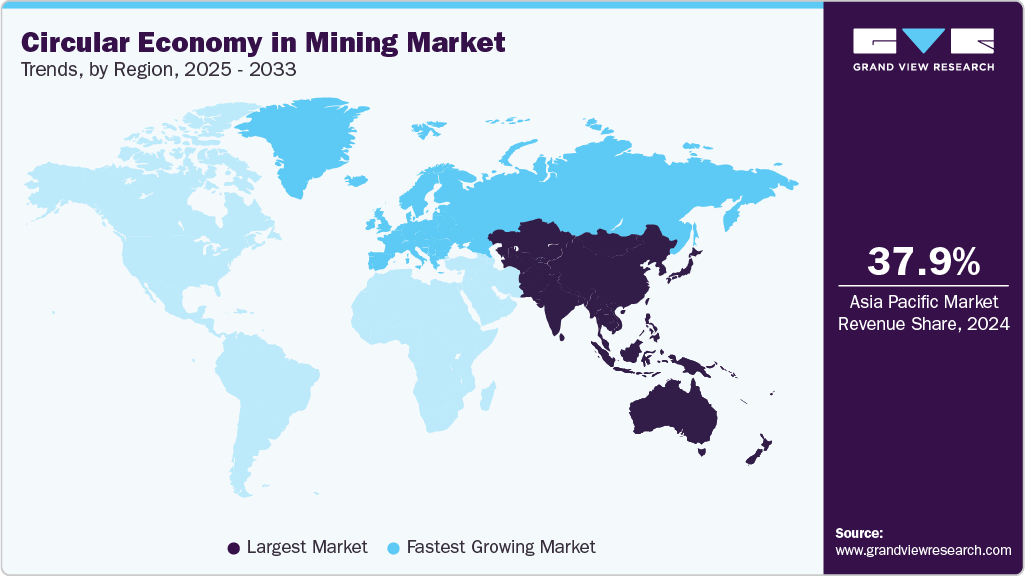
- Fastest-growing regional market: MEA (highest CAGR, 2026-2033)
- By country: China held the largest market share in 2025.
Market Size & Forecast
- Market size in 2025: USD 24.8 Billion
- Estimated market size in 2026: USD 27.0 Billion
- Projected market size by 2033: USD 50.1 Billion
- CAGR (2026-2033): 9.2%
Enhanced waste recycling, resource efficiency, and government initiatives aimed at strengthening mineral security and reducing import dependency are further fueling the adoption of circular economy practices in mining. Sustainability is central to market expansion, with companies and governments emphasizing energy-efficient operations, ethical sourcing, and traceable supply chains to minimize environmental impact. Integrating recycled and secondary materials through circular economy initiatives reduces reliance on virgin ores, promotes resource efficiency, and aligns mining operations with Environmental, Social, and Governance (ESG) standards. These practices position electrochemical processing as a key enabler of sustainable metal production while supporting global environmental targets.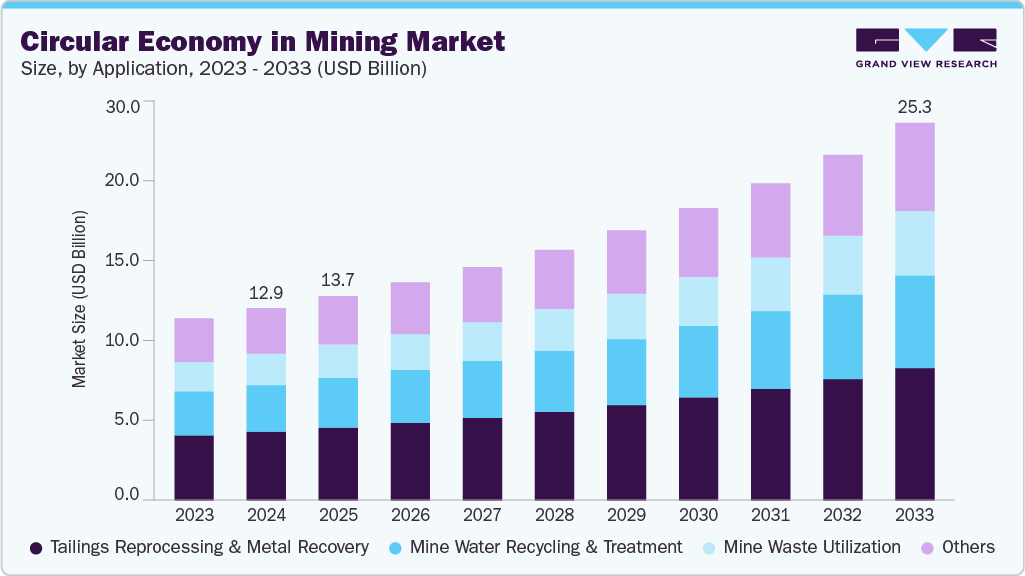
Technological innovations enhance process efficiency, reduce operational costs, and enable recovery from complex ores and mining waste. Supportive government policies and strategic initiatives to secure critical minerals are accelerating adoption across major regions, including Asia Pacific, North America, and Latin America. As global energy transitions increase the demand for metals and critical minerals, circular economy solutions, particularly electrochemical processing, are emerging as environmentally responsible, commercially viable, and strategically essential for the modern mining industry.
Market Dynamics
The growing emphasis on resource efficiency and critical mineral security is a major driver for the circular economy in the mining market. Rising demand for minerals used in electric vehicles, renewable energy systems, and advanced electronics has increased pressure on mining companies to maximize resource utilization while reducing dependence on virgin ore extraction. This has accelerated investments in technologies that recover valuable metals from mine tailings, waste rock, and low-grade deposits, transforming mining waste into commercially viable secondary resources. Companies are increasingly adopting closed-loop processing, metal recovery systems, and waste valorization strategies to improve operational efficiency and extend the life of existing mining assets, creating strong momentum for circular economy practices across the sector.
The rapid expansion of electric vehicles, renewable energy infrastructure, energy storage systems, and advanced electronics has significantly increased global demand for critical minerals such as lithium, copper, nickel, cobalt, graphite, and rare earth elements. As the availability of high-grade mineral deposits becomes more constrained and geopolitical risks affect supply chains, governments and mining companies are placing greater emphasis on securing reliable sources of these essential materials. This has accelerated the adoption of circular economy strategies that recover valuable minerals from mine tailings, waste rock, and previously discarded materials, reducing dependence on primary extraction while strengthening long-term resource availability.
Resource security has become a strategic priority for many countries seeking to reduce import dependence and build resilient domestic supply chains for critical raw materials. Mining companies are responding by investing in advanced recovery technologies, tailings reprocessing projects, and integrated resource management systems that maximize mineral extraction throughout the mining lifecycle. These initiatives improve overall resource efficiency, extend the productive life of existing mining assets, and create additional revenue opportunities from materials that were previously considered waste. As demand for critical minerals continues to outpace new mine development, circular economy practices are expected to play an increasingly important role in ensuring sustainable mineral supply and supporting market growth.
The adoption of circular economy practices in the mining industry requires significant capital investment in advanced mineral recovery technologies, tailings reprocessing plants, water recycling systems, waste treatment infrastructure, and digital monitoring solutions. In addition to high initial installation costs, companies must also bear ongoing expenses related to technology upgrades, operational maintenance, regulatory compliance, and workforce training. These financial requirements can be particularly challenging for small and medium sized mining companies with limited access to capital, delaying the implementation of circular economy initiatives. The long payback period associated with many resource recovery projects further increases investment risks, limiting the pace of market adoption despite the long term environmental and economic benefits.
The rapid growth of electric vehicles, renewable energy systems, consumer electronics, and energy storage technologies is generating increasing volumes of end of life batteries, electronic waste, and industrial scrap that contain valuable critical minerals. This creates a significant opportunity for the circular economy in the mining market through the expansion of critical mineral recycling and urban mining. By recovering materials such as lithium, cobalt, nickel, copper, and rare earth elements from secondary sources, mining companies can reduce dependence on virgin resource extraction while addressing supply chain constraints and resource scarcity.
Analyst Perspective
The circular economy in the mining market is becoming a strategic priority for the global mining industry as companies shift from traditional resource extraction to more sustainable, resource-efficient operating models. Growing demand for critical minerals used in electric vehicles, renewable energy systems, and advanced electronics is encouraging mining companies to recover valuable materials from tailings, mine waste, and secondary resources while reducing dependence on virgin ore extraction. Increasing regulatory pressure, stronger ESG commitments, and the need to improve resource security are accelerating investments in tailings reprocessing, mine water recycling, waste valorization, and advanced metal recovery technologies.
Application Insights
Based on application, tailings reprocessing & metal recovery segment led the market with the largest revenue share of 71.8% in 2025 due to their large-scale efficiency in recovering valuable metals and reusing process water. Mine waste utilization is gaining traction, supported by converting overburden, slag, and waste rock into construction aggregates and backfill materials. These processes enhance resource efficiency, reduce waste generation, and minimize environmental footprint, forming the foundation of sustainable and low-impact mining operations.
The market is witnessing consistent growth driven by rising demand for critical minerals essential for renewable energy, electric mobility, and industrial manufacturing. Circular mining practices are increasingly prioritized for their ability to optimize material recovery, ensure long-term resource security, and reduce dependency on virgin ores. Advancements in reprocessing technologies, water recycling systems, and waste-to-value innovations improve operational efficiency and environmental compliance, positioning circular economy models as a strategic pathway toward sustainable and resilient mining operations.
Commodity Insights
Based on commodity, base metals segment accounted for the largest market revenue share of 52.8% in 2025. The industry is driven by strong demand for base metals, which remain the largest contributor due to their widespread use in industrial, construction, and infrastructure applications. Circular practices such as tailings reprocessing and mine waste utilization enable efficient copper, nickel, and zinc recovery from low-grade ores and secondary sources. Advancements in material recovery, waste reprocessing, and energy-efficient refining technologies are improving yield, reducing environmental footprint, and ensuring a consistent supply for downstream industries.
Precious metals represent another key segment witnessing steady expansion, supported by growing demand from jewelry, electronics, and automotive catalyst applications. Circular mining processes, including reprocessing mine tailings and e-waste recycling, are increasingly utilized to recover gold, silver, and platinum with minimal environmental impact. Innovations in extraction and purification technologies enhance recovery from complex waste streams, reflecting the industry’s focus on sustainability and resource optimization.

Due to their reuse in construction materials, fertilizers, and chemical manufacturing, industrial minerals such as limestone, silica, and phosphates are also gaining importance within circular mining frameworks. The “others” segment, encompassing critical and emerging minerals such as lithium, cobalt, and rare earth elements, is expected to experience rapid growth driven by the global shift toward clean energy, electric vehicles, and advanced manufacturing. Circular recovery solutions, including secondary sourcing and closed-loop recycling, are helping secure the supply of these high-value materials while aligning with environmental and energy transition goals.
Regional Insights
The circular economy in mining market in North America is experiencing significant growth, driven by the increasing demand for critical minerals essential for defense, clean energy, and high-tech industries. Governments invest in domestic processing capabilities to reduce reliance on foreign suppliers and enhance supply chain resilience. For instance, the U.S. Department of Defense has allocated USD 20 million to establish a cobalt refinery in Ontario, Canada, to secure a stable supply chain for cobalt, a crucial material for electric vehicle batteries, electronics, and military hardware.
U.S. Circular Economy in Mining Market Trends
In the United States, states like Oklahoma are positioning themselves as critical mineral processing hubs. The state hosts facilities for lithium refining, battery recycling, rare earth magnet production, and electronic waste recycling. These initiatives are part of a broader strategy to support battery and EV supply chains and reduce dependence on foreign sources. Additionally, BHP is considering reopening defunct copper mines in Arizona in response to major policy shifts under U.S. President Donald Trump. The company's CEO highlighted a "breathtaking" turnaround in the U.S. approach to critical mineral supply, citing enhanced support for mining, faster permitting, and trade protection measures as key motivators.
Asia Pacific Circular Economy in Mining Market Trends
Asia Pacific dominated the circular economy in mining market with the largest revenue share of 38.9% in 2025. The circular economy in mining market in China held the largest share in the Asia Pacific region in 2025. The circular economy in mining market in Asia Pacific is fueled by rapid industrialization, increasing energy transition demands, and strong government support for strategic mineral reserves. Nations including China, India, and South Korea actively invest in electrochemical processing infrastructure to secure domestic supplies of lithium, cobalt, and rare earth elements.
These measures strengthen supply chain security and promote sustainable extraction and processing practices in line with growing regional and global environmental standards. However, Japan, Spain, and South Korea have expressed concerns over unsustainable copper processing fees, warning that current market conditions are making operations unsustainable.
Europe Circular Economy in Mining Market Trends
The circular economy in mining market in Europe is accelerating the development of electrochemical processing capabilities to support its green energy transition and reduce dependence on external sources for critical minerals. The European Union has launched 47 strategic projects across 13 countries focused on extracting, processing, and recycling essential metals like aluminium, lithium, and rare earth elements. These initiatives aim to enhance regional resource self-sufficiency, foster sustainable practices, and strengthen the competitiveness of Europe’s clean energy, defense, and high-tech industries. A recent report indicates that improved materials management, including reduction, reuse, and recovery measures, could help the EU industry reduce between 189 and 231 million tonnes of CO₂ equivalent per year.
Middle East And Africa Circular Economy in Mining Market Trends
The circular economy in the mining market in the Middle East and Africa is driven by increasing pressure to improve resource efficiency, reduce mining waste, and strengthen the environmental sustainability of mineral extraction and processing activities. Governments across the region are increasingly promoting resource conservation, industrial diversification, and waste management initiatives, encouraging mining companies to recover valuable metals and minerals from tailings, slag, waste rock, and other secondary resources. The expansion of mining activities for copper, gold, iron ore, phosphate, and other critical minerals is further increasing the volume of mining waste, creating opportunities for recycling, reuse, and resource recovery technologies.
Key Circular Economy In Mining Company Insights
Key players operating in the circular economy in mining market are undertaking various initiatives to strengthen their presence and increase the reach of their products and services. Strategies such as expansion activities and partnerships are key in propelling the market growth. Some of the key players operating in the market include Anglo American plc, Boliden Group, DRDGOLD Limited, and Others.
-
Anglo American plc, established in 1917 and headquartered in London, United Kingdom, is a leading diversified mining company integrating circular economy practices. Through its FutureSmart Mining initiative, the company emphasizes water recycling, tailings reprocessing, and renewable energy use to minimize waste and carbon emissions. Anglo American focuses on developing sustainable mining technologies, promoting material reuse, and achieving long-term resource efficiency across its global sites.
-
Boliden Group, founded in 1931 and headquartered in Stockholm, Sweden, is a significant mining and smelting company recognized for its strong commitment to circular economy principles. The company operates some of Europe’s most extensive metal recycling facilities, reprocessing copper, zinc, and precious metals from electronic waste and industrial by-products. Boliden’s strategy centers on reducing environmental impact through waste valorization, energy recovery, and closed-loop material cycles.
-
DRDGOLD Limited, established in 1895 and headquartered in Johannesburg, South Africa, is a pioneer in circular mining focused on re-mining and reprocessing historical gold tailings. The company transforms waste materials into usable resources through advanced recovery techniques that reduce environmental liabilities and restore mined land. DRDGOLD’s operations contribute to sustainable urban mining and resource circularity while generating economic value from legacy waste.
Key Circular Economy In Mining Companies:
The following key companies have been profiled for this study on the circular economy in mining market.
-
Anglo American plc
-
Antofagasta plc
-
BHP Group Plc
-
Boliden Group
-
DRDGOLD Limited
-
Newmont Corporation
-
Rio Tinto
-
Sibanye-Stillwater
-
Teck Resources Limited
-
Umicore NV
Competitive Benchmarking
Category
Operating Strategies
Competitive Edge
Weakness
Established Players (e.g. Anglo American, BASF, Boliden)
- Mature participants in the circular economy in mining market primarily focus on integrating resource recovery, waste valorization, water recycling, and energy efficiency initiatives into existing mining operations.
- These companies adopt comprehensive circular economy frameworks that maximize the recovery of valuable minerals from tailings, waste rock, and mine residues while minimizing environmental impacts.
- Established players possess significant competitive advantages through their extensive mining infrastructure, large volumes of recoverable mining waste, and strong financial capabilities.
- Their ownership of existing mine sites enables efficient implementation of circular economy initiatives without requiring entirely new resource development projects.
- Despite their market leadership, mature players face challenges related to high implementation costs and the complexity of upgrading existing mining operations.
- Retrofitting legacy mines with advanced recycling, waste recovery, and water treatment technologies often requires substantial capital investment and operational modifications.
Emerging & Regional Players (e.g. Aqua Metals, Redwood Materials)
- Emerging participants in the circular economy in mining market generally focus on specialized recovery technologies, innovative waste processing solutions, and strategic collaborations with mining companies.
- Rather than operating large mining assets, these companies often provide technology platforms for tailings reprocessing, critical mineral recovery, mine water recycling, and industrial waste utilization.
- Emerging companies benefit from operational flexibility and the ability to rapidly develop and deploy innovative circular economy solutions.
- Their technology driven business models enable faster adaptation to changing sustainability requirements and evolving mining industry challenges.
- Emerging participants face significant challenges related to technology commercialization, funding requirements, and market adoption.
- Scaling innovative recovery technologies from pilot projects to commercial operations requires considerable capital investment, technical validation, and long implementation timelines.
Recent Developments
-
Boliden Group, in July 2025, received approval from Sweden’s Land and Environment Court for a new remediation method at its Maurliden site. Instead of depositing tailings in a storage facility, it will use paste made from tailings, binding agents, and water to backfill open pits and underground mines. This extends the life of the Boliden Area by around 10 years, reduces land use, enhances tailings recycling, and improves environmental performance.
-
In mid-2025, Boliden Group commissioned NCC to build a sand recycling plant in Skellefteå, Sweden. The plant will include a sand recycling building, silo, media bridge, and required technical installations. Construction will start in Q3 2025 and be completed in 2026. This initiative supports the circular reuse of by-products and reduces dependence on virgin raw materials.
-
In 2025, Sibanye-Stillwater and DRDGOLD entered a strategic partnership in which Sibanye-Stillwater will vend selected surface gold processing assets and tailings storage facilities to DRDGOLD in exchange for a 38% stake. The collaboration includes the West Rand Tailings Retreatment Project (WRTRP), which is focused on reprocessing historical waste to recover gold, minimize environmental impact, and promote circular resource use.
Circular Economy In Mining Market Report Scope
Report Attribute
Details
Market definition
The circular economy in mining market is defined as the annual market value of minerals, metals, aggregates, water, and other materials recovered from mining waste streams (tailings, waste rock, mine water, slag, and other mine residues) that are reused, sold, or circulated back into economic activity.
Market size in 2025
USD 24.8 billion
Estimated market size in 2026
USD 27.0 billion
Projected market size by 2033
USD 50.1 billion
Growth rate
CAGR of 9.2% from 2026 to 2033
Base year for estimation
2025
Historical data
2021 - 2024
Forecast period
2026 - 2033
Quantitative units
Revenue in USD million and CAGR from 2026 to 2033
Report coverage
Revenue forecast, company ranking, competitive landscape, growth factors, and trends
Segments covered
Component, commodity, and region.
Regional scope
North America; Europe; Asia Pacific; Latin America; Middle East & Africa
Country scope
U.S., Canada, Mexico, Finland, Sweden, Russia, Poland, India, China, Indonesia, Australia, Brazil, Chile, Peru, Zambia, South Africa, Saudi Arabia, Ghana
Key companies profiled
Anglo American plc; Boliden Group; DRDGOLD Limited; BHP Group Plc; Antofagasta plc; Rio Tinto; Sibanye-Stillwater; Teck Resources Limited; Umicore NV; Newmont Corporation
Customization scope
Free report customization (equivalent up to 8 analysts' working days) with purchase. Addition or alteration to country, regional & segment scope.
Pricing and purchase options
Avail customized purchase options to meet your exact research needs. Explore purchase options
Global Circular Economy In Mining Market Report Segmentation
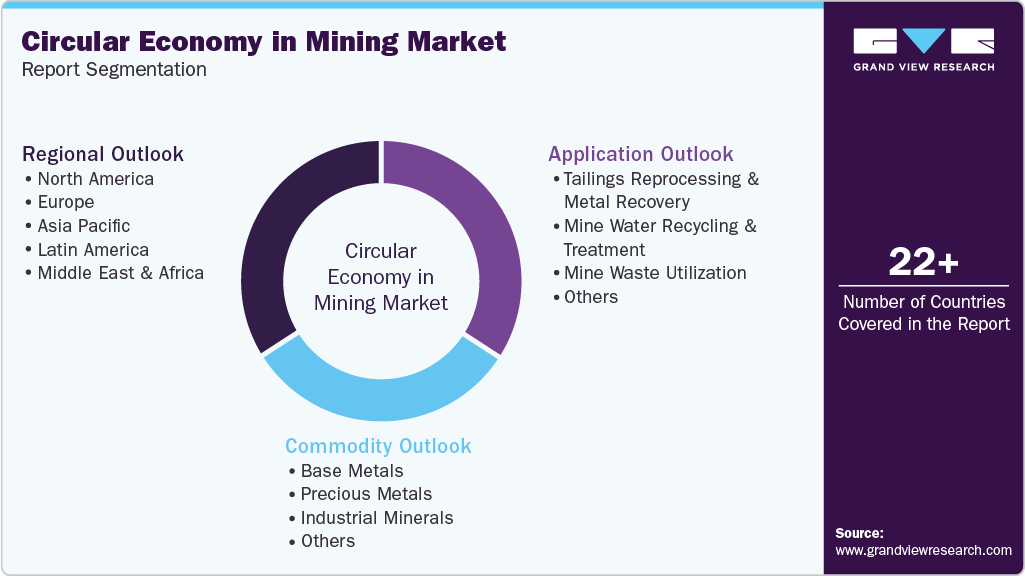
This report forecasts revenue growth at the global, regional, and country levels and analyzes the latest trends in each sub-segment from 2021 to 2033. For this study, Grand View Research has segmented the global circular economy in the mining market report on basis of application, commodity, and region:
-
Application Outlook (Revenue, USD Million, 2021 - 2033)
-
Tailings Reprocessing & Metal Recovery
-
Mine Water Recycling & Treatment
-
Mine Waste Utilization
-
Others
-
-
Commodity Outlook (Revenue, USD Million, 2021 - 2033)
-
Base Metals
-
Precious Metals
-
Industrial Minerals
-
Others
-
-
Regional Outlook (Revenue, USD Million, 2021 - 2033)
-
North America
-
U.S.
-
Canada
-
Mexico
-
-
Europe
-
Germany
-
France
-
UK
-
Italy
-
-
Asia Pacific
-
China
-
India
-
Japan
-
South Korea
-
-
Latin America
-
Brazil
-
-
Middle East & Africa
-
South Africa
-
-
Research Methodology
The circular economy in mining market figures in this report are based on a proven research process that combines executive interviews with secondary research from proprietary databases, company filings, and recognized regulatory and institutional sources. Market size is built through value-chain sizing - reconciling supply-side and demand-side estimates - and triangulated with bottom-up and top-down approaches. Every estimate passes multiple levels of expert validation before publication, with each circular economy in mining segment quantified using the revenue-capture definitions in the table below.
Segment Definition
Component
Revenue Capture Definition
Tailings Reprocessing & Metal Recovery
Revenue from this segment is generated through the recovery of valuable metals and minerals from historical and active mine tailings using advanced extraction and processing technologies. Market value includes income from tailings reprocessing services, recovered metal sales, and associated resource recovery solutions.
Mine Water Recycling & Treatment
Revenue in this segment is captured from systems and services that treat, recycle, and reuse water generated during mining operations to reduce freshwater consumption and ensure regulatory compliance. It includes water treatment technologies, recycling infrastructure, and operational water management solutions.
Mine Waste Utilization
Revenue for this segment is derived from the conversion of mine waste, waste rock, and byproducts into commercially valuable materials for applications such as construction, cement production, aggregates, and industrial raw materials. The market encompasses technologies and services that enable waste valorization and secondary resource utilization.
Others
Revenue in this segment is generated from additional circular economy solutions in mining, including land rehabilitation, material reuse programs, carbon utilization, renewable energy integration, and resource optimization services.
Commodity
Revenue Capture Definition
Base Metals
This segment captures the value generated from circular economy activities involving base metals such as copper, aluminum, zinc, lead, and nickel recovered through recycling, tailings reprocessing, and secondary resource utilization.
Precious Metals
This segment accounts for income generated from the recovery and reuse of precious metals such as gold, silver, platinum, and palladium from mine waste, tailings, and secondary material streams.
Industrial Minerals
This segment represents earnings derived from the recovery, recycling, and reuse of industrial minerals such as phosphate, limestone, gypsum, silica, and potash from mining residues and byproducts.
Others
This segment includes revenue generated from circular economy initiatives involving specialty minerals, rare earth elements, gemstones, water, and other mining commodities that fall outside the primary categories.
Estimation Model
Layer Name
Key Question
Description
Mining Waste & Resource Recovery Demand Base Layer
What forms the demand base?
Identify global mining activities generating tailings, waste rock, mine water, and end of life mining materials across metal and mineral extraction operations. Assess mining production volumes, environmental regulations, and sustainability initiatives that create demand for circular economy solutions. This layer establishes the total addressable opportunity for resource recovery and waste valorization in the mining industry.
Circular Economy Solution Penetration Layer
Where are circular economy practices utilized?
Estimate the penetration of circular economy practices across mining operations, including tailings reprocessing, metal recovery, mine water recycling, waste utilization, remanufacturing, and secondary raw material recovery. Analyze adoption across base metals, precious metals, industrial minerals, and critical mineral mining operations in different regions.
Resource Recovery Intensity Layer
How much material is recovered and reused?
Analyze resource recovery intensity based on the volume of mining waste processed, recovery technologies, metal extraction efficiency, water reuse rates, and byproduct utilization. Evaluate the recovery of valuable minerals and metals from tailings, waste streams, and secondary resources. Recovery intensity varies according to ore grade, mining methods, processing technologies, and regulatory requirements.
Revenue Layer
How is market revenue generated?
Market revenue represents the annual economic value of secondary minerals, metals, industrial minerals, recycled mine water, and other recoverable materials generated from circular economy practices in mining. The market is quantified based on the sales value of recovered materials obtained through tailings reprocessing, mine waste utilization, mine water recycling, and other resource recovery activities that reintroduce mining-derived materials into productive use. Revenue generation is driven by recovered material volumes, commodity prices, recovery rates, and the commercial adoption of circular mining practices. The market value is influenced by metal and mineral prices, regulatory support for resource efficiency, technological improvements in material recovery, and investments in sustainable mining operations.
Delivered Customizations
This report has been delivered with the following In-depth customizations
Client Request
Customization Delivered
Value Adds
Regional Segmentation
Detailed regional analysis of the circular economy in mining market across North America, Europe, Asia Pacific, Latin America, and Middle East & Africa. Included evaluation of mining waste generation, tailings management practices, critical mineral recovery initiatives, mine water recycling infrastructure, regulatory frameworks, sustainability targets, and investments in resource recovery technologies.
Identified high growth regions implementing circular mining practices and resource recovery initiatives. Enabled strategic expansion planning based on mining activity, environmental regulations, and government sustainability programs. Supported regional demand forecasting and investment prioritization.
Competitive Benchmarking
Benchmarking analysis of leading mining companies, technology providers, engineering firms, and recycling solution providers based on project portfolio, technology capabilities, resource recovery efficiency, geographic footprint, sustainability performance, strategic partnerships, operational scale, and innovation initiatives. Included comparison of companies specializing in tailings reprocessing, mine water treatment, and mining waste valorization.
Assisted in evaluating competitive positioning, technological strengths, and market leadership opportunities. Supported partnership assessments, acquisition evaluations, and competitive differentiation strategies.
Opportunity Assessment
Identification of high growth opportunities across critical mineral recovery, legacy tailings rehabilitation, mine water reuse, industrial waste valorization, carbon reduction initiatives, renewable energy integration at mining sites, and digital technologies supporting circular mining operations. Assessed future demand potential driven by ESG commitments, decarbonization targets, resource efficiency initiatives, and increasing investments in sustainable mining practices.
Enabled prioritization of high return investment opportunities and emerging circular mining business models. Supported long term strategic planning, technology investments, and business development initiatives aligned with sustainability and critical mineral supply chain resilience.
Frequently Asked Questions About This Report
Middle East & Africa registered the fastest CAGR over the forecast period.
Based on commodity, base metals accounted for largest revenue share of 52.8% in 2025.
The key players operating in the circular economy in mining market are Anglo American; Aqua Metals; BASF; Boliden; Epiroc; Fortum; Glencore; Heraeus Holding; Redwood Materials; Tenova; Umicore.
The circular economy in mining market size was estimated at USD 24.8 billion in 2025 and is expected to reach USD 27.0 billion in 2026.
The circular economy in mining market is expected to grow at a compound annual growth rate of 9.2% from 2026 to 2033 to reach USD 50.1 billion by 2033.
The global circular economy in mining market is driven by rising demand for critical minerals, stricter environmental regulations and ESG pressures, and technological advancements in resource recovery that enable efficient recycling and waste reduction.
Asia Pacific dominated the market with revenue share of 38.9% in 2025.
Based on application, tailings reprocessing & metal recovery accounted for largest revenue share of 71.8% in 2025.
China held the largest market share in 2025.
About the Author(s)
Advanced Materials Research Team
Research · Advanced MaterialsThis report was authored by the advanced materials research team at Grand View Research - comprising two research analysts, one senior research analyst, and one industry expert - with specialized expertise in the advanced materials segment of the research industry. All findings are based on proprietary research databases, executive interviews, and regulatory analysis, subject to internal peer review prior to publication.
Last Updated:
Speak to Analyst


Customize this report to your needs — add regions, segments, or data points, with 20% free customization.
Or view our licence options:


ISO 9001:2015 & 27001:2022 Certified
We are GDPR and CCPA compliant! Your transaction & personal information is safe and secure. For more details, please read our privacy policy.


