
- Home
- »
- Advanced Interior Materials
- »
-
Clean-In-Place Market Size & Share Report, 2026-2033GVR Report cover

Clean-In-Place Market (2026 - 2033)
Size, Share & Trends Analysis Report By Type (Single-Use CIP System, Reuse CIP System), By Offering Type (Single-Tank Systems, Two-Tank Systems, Multi-Tank Systems), By End Use, By Region, And Segment Forecasts
Market Size, 2025
$15.1BMarket Estimate, 2026
$17.0BMarket Forecast, 2033
$35.0BCAGR, 2026–2033
10.9%Clean-In-Place Market Summary
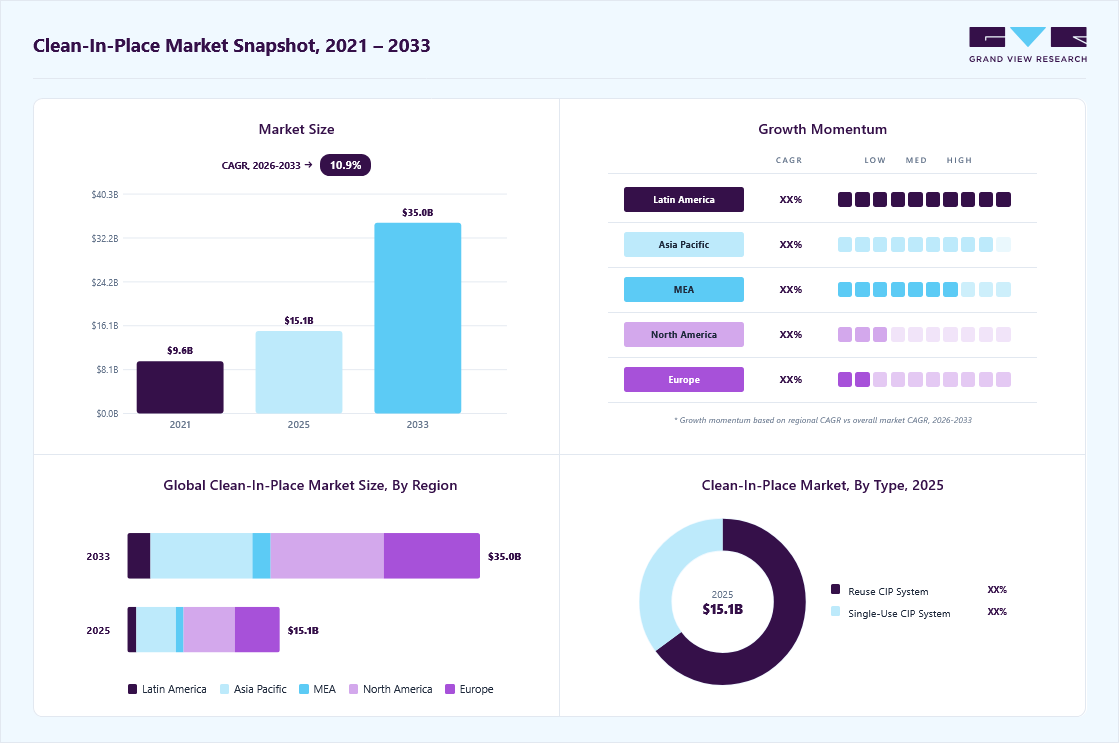
The global clean-in-place market size was valued at USD 15.1 billion in 2025 and is projected to grow from USD 17.0 billion in 2026 to USD 35.0 billion by 2033, at a CAGR of 10.9% from 2026 to 2033. The market in North America dominated with a revenue share of 33.7% in 2025. The market is primarily driven by the growing need for stringent hygiene and safety standards across industries such as food & beverage, pharmaceuticals, and cosmetics.
 Source: Grand View Research, IR Documents, Primary Interviews, Paid DatabasesTo learn more about this report,
 Download Free Sample Report
 Key Market Trends & Insights
- By type: The reuse CIP systems segment dominated the market, capturing 64.8% of the total share in 2025.
- In terms of end use: The pharmaceutical segment is anticipated to witness strong growth, expanding at a CAGR of 11.7% from 2026 to 2033.
- By offering type: The multi-tank CIP systems segment accounted for the largest share of 42.6% in 2025.
Regional Highlights
- Largest regional market: North America (33.7% revenue share, 2025)
- Fastest-growing regional market: Latin America (highest CAGR, 2026-2033)
- By country: The U.S. held the largest market share in 2025.
Market Size & Forecast
- Market size in 2025: USD 15.1 Billion
- Estimated market size in 2026: USD 17.0 Billion
- Projected market size by 2033: USD 35.0 Billion
- CAGR (2026-2033): 10.9%
Three ways to get this report
Buy it, customize it, or ask a question.Ask an Analyst
Analyst response in 1 business day
- AccessReport author, directly
- Reply timeWithin 1 working day
- No sales callDirect answer only
- FormatEmail reply
- CostFree, no cost
Get the Full Report
What the study covers
- FormatsPDF · Excel · Dashboard
- Timeline2026–2033 annual, 2025 base
- Coverage20+ countries, 5 regions
- Companies10+ key players profiled
Customize the Report
20% free customization
- IncludeCountries, segments, points
- TailorTo your product definition
- ExtendDeeper competitor detail
- OrA fully bespoke study
- Turnaround5–10 working days
 To learn more about this report, Download Free Sample Report
Regulatory bodies are becoming more stringent about contamination control, product quality, and traceability, pushing manufacturers to adopt automated cleaning systems. The growing focus on operational efficiency and cost optimization also drives the market. CIP systems significantly reduce downtime by eliminating the need to dismantle equipment for cleaning, allowing faster turnaround between production cycles. They also optimize the use of water, energy, and cleaning chemicals, especially in reuse systems, helping industries lower operational costs and meet sustainability goals. In addition, the adoption of automation, digital monitoring, and smart sensors is making CIP systems more efficient and easier to control, further encouraging their adoption in both large-scale and small-batch production environments.Market Dynamics
The growing demand from food & beverage, dairy, pharmaceutical, and personal care industries is expected to significantly propel the clean in place (CIP) market. This growth spans automated CIP systems, centralized and decentralized cleaning units, and consumables such as cleaning chemicals, sanitizers, detergents, and monitoring solutions designed to ensure hygienic processing and regulatory compliance. Increasing emphasis on food safety, contamination prevention, and operational efficiency is encouraging manufacturers to adopt advanced CIP technologies across production facilities.
Beyond food and pharmaceutical applications, industries such as biotechnology, cosmetics, and chemical processing are increasingly driving demand for CIP systems. Production equipment in these sectors requires frequent and highly reliable cleaning to prevent product contamination, maintain product quality, and comply with stringent hygiene standards. Clean in place systems allow companies to reduce manual cleaning efforts, minimize production downtime, optimize water and chemical usage, and improve overall plant productivity, making CIP technology a preferred solution for modern industrial cleaning operations.
Clean in place market faces challenges due to the high initial investment required for automated cleaning systems, integrated control units, and advanced monitoring technologies. Small and medium-sized manufacturers often face budget constraints when upgrading existing production facilities with CIP infrastructure. In addition, the operational complexity associated with system integration, validation procedures, and maintenance requirements can limit adoption, particularly in facilities with older equipment or limited technical expertise. These factors may slow the implementation of advanced CIP solutions across certain industrial sectors.
Market Concentration & Characteristics
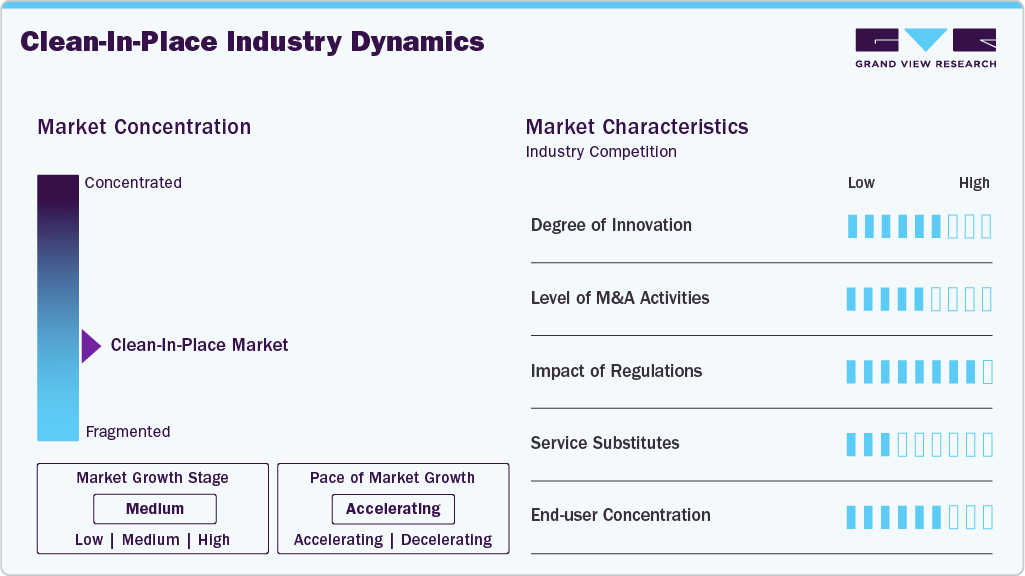
The clean-in-place market is moderately fragmented, with a mix of large global process engineering companies and numerous regional and specialized system integrators. While major players such as Alfa Laval, GEA Group, and Tetra Pak hold strong positions due to their broad product portfolios, global reach, and advanced automation capabilities, they do not dominate the market entirely. A significant share is held by smaller firms offering customized CIP systems tailored to specific industry needs, particularly in food processing, pharmaceuticals, and regional markets.
Innovation in the clean-in-place industry is strong and accelerating, largely shaped by automation, digital tools, and sustainability goals. Modern systems are moving beyond basic cleaning functions to include smart sensors, real-time data tracking, and analytics that help optimize cleaning cycles and reduce resource use. For instance, in September 2025, Ecolab introduced its CIP IQ platform, which uses advanced monitoring and data insights to improve cleaning efficiency and visibility across operations. This reflects a broader shift toward intelligent, connected CIP solutions that help manufacturers enhance productivity while minimizing water, energy, and chemical consumption.
 To learn more about this report, Download Free Sample Report
 Regulations have a strong influence on the CIP industry, particularly in industries where hygiene is critical. Sectors such as food processing and pharmaceuticals must adhere to strict standards to ensure product safety and prevent contamination. This has made automated cleaning systems a necessity rather than a choice, as they deliver consistent, verifiable cleaning results. Companies rely on CIP systems to meet compliance requirements, maintain quality standards, and reduce the risk of recalls or production issues.
Demand for CIP systems is concentrated in a few major industries, with food & beverage and pharmaceuticals leading adoption due to their high hygiene requirements. These sectors account for a significant share of the market because they require frequent, reliable cleaning. At the same time, usage is gradually expanding into areas such as chemicals and cosmetics, where efficiency and contamination control are becoming more important. This creates a market that is somewhat concentrated but steadily diversifying as new industries adopt CIP solutions.
Type Insights
Reuse CIP systems held the leading share of the market in 2025, mainly due to their cost efficiency and suitability for large-scale operations. These systems are designed to recycle cleaning solutions, such as water and detergents, helping reduce overall consumption and operating costs over time. Industries like food & beverage and chemicals, where production runs are continuous and cleaning cycles are frequent, rely heavily on reuse systems to maintain efficiency while meeting hygiene standards. Their ability to handle high volumes and deliver consistent cleaning performance makes them the preferred choice for established manufacturing facilities.
Single-use CIP systems are gaining momentum at a CAGR of 10.1%, particularly in pharmaceutical and biopharmaceutical applications. These systems eliminate the need to reuse cleaning agents, reducing the risk of cross-contamination and simplifying validation processes. They are especially useful in small-batch production and facilities that require high flexibility. Although they entail higher recurring costs due to disposable components, their advantages in sterility, ease of operation, and faster changeovers are driving increased adoption, making this segment one of the fastest-growing in the clean-in-place industry.
Offering Type Insights
Multi-tank CIP systems accounted for the largest share in 2025, at 42.6%, mainly due to their ability to support complex, high-volume cleaning operations. These systems use separate tanks for different cleaning stages, such as detergents, rinsing, and sanitization, allowing better control over each step of the process. This setup improves cleaning efficiency, reduces cross-contamination risk, and enables partial reuse of cleaning solutions. Industries such as food & beverage and pharmaceuticals prefer multi-tank systems because they meet strict hygiene standards while enabling continuous production and large-scale processing.
Two-tank CIP systems are experiencing strong growth at a 11.1% CAGR, driven by their balance of cost and performance. They typically separate cleaning and rinsing functions, offering type better efficiency than single-tank systems while remaining more affordable and less complex than multi-tank setups. These systems are well-suited for mid-sized operations or facilities looking to upgrade from basic configurations without significant capital investment. Their ability to optimize resource usage and reduce downtime is encouraging adoption across emerging markets and smaller manufacturing units.
End Use Insights
The food & beverage sector held the largest share of the CIP market with 45.2% share in 2025, driven by strict hygiene requirements and high production volumes. Processing environments such as dairy, beverage, and packaged-food facilities require frequent, reliable cleaning to prevent contamination and maintain product quality. CIP systems are widely used to clean pipelines, tanks, and processing equipment without interrupting operations, making them essential for continuous production. The need to comply with food safety standards and avoid product recalls further strengthens the adoption of automated cleaning solutions in this sector.
 To learn more about this report, Download Free Sample Report
 The pharmaceutical industry is the fastest-growing segment in the CIP market, supported by increasing demand for sterile and contamination-free manufacturing. CIP systems play a critical role in cleaning reactors, mixing vessels, and process lines while ensuring compliance with strict regulatory standards. The rise of biologics, vaccines, and small-batch production is also driving the need for flexible and highly controlled cleaning processes. As companies focus on validation, traceability, and efficiency, the adoption of advanced and automated CIP systems continues to accelerate in this sector.
Regional Insights
North America led the CIP market in 2025 with 33.7% share, supported by its strong base of food processing and pharmaceutical manufacturing industries. The region benefits from early adoption of automation, well-established hygiene standards, and continuous investments in advanced processing technologies. Companies here focus on improving efficiency, traceability, and sustainability, which drives steady demand for modern CIP systems across large-scale production facilities.
 To learn more about this report, Download Free Sample Report
 U.S. Clean-In-Place Market Trends
The U.S. clean-in-place industry led in North America, supported by its strong presence in the pharmaceutical, biotechnology, and food processing industries. High automation adoption, strict regulatory frameworks, and ongoing investments in advanced manufacturing infrastructure drive demand for efficient, validated cleaning systems. A key example is the September 2025 announcement by Pharmaceutical Research and Manufacturers of America, highlighting nearly USD 500 billion in new U.S.-based biopharmaceutical manufacturing and infrastructure investments. This surge in domestic manufacturing and innovation further strengthens the need for advanced CIP systems to ensure hygiene, compliance, and operational efficiency across facilities.
Europe Clean-In-Place Market Trends
Europe is experiencing steady growth, supported by strict regulatory frameworks and a strong focus on sustainability. Manufacturers in this region emphasize reducing water, energy, and chemical usage, which encourages the adoption of efficient CIP technologies. The presence of established food and pharmaceutical industries, along with ongoing technological advancements, supports consistent demand.
The Germany clean-in-place market dominated the European CIP industry due to its strong industrial base and advanced food & beverage manufacturing sector. High levels of automation, along with strict hygiene and quality standards, continue to drive demand for efficient cleaning systems across production facilities. In January 2025, Coca-Cola Europacific Partners announced an investment of about USD 169.6 million to expand and modernize its operations in Germany. This includes upgrades to production and packaging capabilities, reflecting ongoing efforts to enhance efficiency. Such developments increase the need for reliable CIP systems to support high-capacity, hygienic manufacturing environments.
The Franceclean-in-place market is steadily expanding in the CIP market, supported by its strong pharmaceutical manufacturing landscape. According to French Healthcare, the country has around 271 pharmaceutical production facilities and produces approximately 3.5 billion boxes of medicines each year. This large-scale output, combined with strict regulatory requirements, drives consistent demand for advanced cleaning solutions. As the country continues to strengthen domestic drug production and improve manufacturing capabilities, the adoption of efficient CIP systems is expected to rise further.
Asia Pacific Clean-In-Place Market Trends
Asia Pacific is witnessing rapid growth, driven by expanding industrialization and rising demand for processed food, beverages, and pharmaceutical products. Countries like China and India are seeing increased investments in manufacturing infrastructure, along with growing awareness of hygiene and quality standards. The shift toward automation and the need to upgrade existing facilities are accelerating the adoption of CIP systems across the region.
The China clean-in-place market is witnessing strong growth in the CIP industry, driven by rapid industrial expansion and increasing demand for processed food, beverages, and pharmaceuticals. The country is upgrading its manufacturing infrastructure to meet higher hygiene and quality standards, which is encouraging the adoption of automated cleaning systems. In addition, the government's focus on food safety and the expansion of domestic pharmaceutical production are pushing companies to invest in efficient and reliable CIP solutions across large-scale facilities.
The India clean-in-place market is emerging as a key growth market for CIP systems, supported by the expansion of its food processing and pharmaceutical industries. According to Ministry of Food Processing Industries, processed food exports reached USD 10.09 billion in 2024-2025, with strong contributions from segments such as processed fruits and vegetables, pulses, and cereal-based products. The sector has also attracted USD 7.21 billion in FDI over the past decade ending 2024-25. This growth in production and investment is increasing the need for advanced cleaning systems to maintain hygiene, improve efficiency, and support large-scale manufacturing operations.
Latin America Clean-In-Place Market Trends
Latin America fastest growing region in the CIP market as food processing and beverage industries continue to develop. Improving regulatory standards and increasing exports of processed goods are encouraging manufacturers to adopt better cleaning solutions. While adoption is still growing, investments in modern production facilities are creating new opportunities for CIP system providers.
The Brazil clean-in-place industry led the clean-in-place market in Latin America, supported by its large food & beverage industry and expanding pharmaceutical sector. The country is one of the region’s major producers of processed foods, dairy, and beverages, which require strict hygiene and efficient cleaning processes. Growing investments in industrial automation and modernization of production facilities are further driving the adoption of CIP systems.
Middle East & Africa Clean-In-Place Market Trends
The Middle East & Africa region is showing steady progress, supported by growing food processing, dairy, and pharmaceutical sectors. Governments are investing in local manufacturing capabilities to reduce import dependence, which is driving the need for efficient and hygienic production systems. As awareness of quality standards increases, the demand for CIP solutions is expected to rise across the region.
The Saudi Arabia clean-in-place market led the Clean-In-Place (CIP) market in the Middle East & Africa, driven by strong investments in food processing, dairy, and pharmaceutical manufacturing. Government initiatives such as Saudi Vision 2030 are encouraging local production and reducing reliance on imports, which is accelerating the development of modern manufacturing facilities. As industries expand, there is a growing need for efficient and automated cleaning systems to meet hygiene standards and improve operational efficiency.
Key Clean-In-Place Company Insights
Some of the key players operating in the market include Alfa Laval, GEA Group Aktiengesellschaft, and SPX FLOW.
-
Alfa Laval provides Clean-In-Place (CIP) solutions for hygienic industries such as food, dairy, and beverages, allowing equipment like tanks and pipelines to be cleaned without disassembly. Its systems automate the circulation of cleaning liquids to remove residues and maintain product safety and quality. The company offers flexible, modular setups along with specialized components to suit different processing needs. These solutions help improve efficiency, cut downtime, and reduce water, energy, and chemical consumption while meeting strict hygiene requirements.
-
GEA Group Aktiengesellschaft offers Clean-In-Place (CIP) and Sterilize-In-Place (SIP) systems for sectors like food, dairy, beverages, and pharmaceuticals. Its solutions can be configured from semi-automated to fully automated setups, enabling consistent and efficient cleaning without interrupting operations. The company integrates these systems into both individual machines and complete production lines to maintain hygiene and product quality. Its approach also focuses on reducing cleaning time, optimizing resource use, and minimizing the risk of contamination.
Key Clean-In-Place Companies:
The following key companies have been profiled for this study on the clean-in-place market.
- SPX Flow
- GEA Group Aktiengesellschaft
- ALFA LAVAL
- Tetra Pak International S.A.
- Sani-Matic
- Suncombe
- KHS Group
- GOMA
- Millitec Ltd
- INOXPA
- Centec LLC
- Pick Heaters, Inc.
- Wayne Chemical, Inc
- Highland Equipment Inc.
- Shanghai Fude Machinery Manufacturing Co. Ltd.
Competitive Benchmarking
Operating Strategies
Competitive Edge
Weaknesses
Mature Players: SPX Flow; GEA Group Aktiengesellschaft; ALFA LAVAL; Tetra Pak International S.A.; Sani-Matic
- Strong investments in automated cleaning technologies, hygienic processing systems, and smart manufacturing solutions
- Expansion of advanced CIP systems integrated with IoT-enabled monitoring and automated process controls
- Focus on food & beverage, pharmaceutical, dairy, biotechnology, and personal care applications
- Strong global presence and expertise in hygienic processing and automated cleaning technologies
- High operational efficiency, process reliability, and compliance with stringent sanitation standards
- Extensive global distribution, after-sales service, and technical support networks
- High installation and operational costs compared to conventional manual cleaning methods
- Dependence on capital investments in automated processing and hygienic manufacturing facilities
- Complex system integration, validation procedures, and skilled operator requirements
Emerging Players: Centec LLC; Pick Heaters, Inc.; Wayne Chemical, Inc; Highland Equipment Inc.; Shanghai Fude Machinery Manufacturing Co. Ltd.
- Focus on customized CIP solutions and application-specific hygienic processing requirements
- Expansion into regional food processing, dairy, and pharmaceutical manufacturing facilities
- Increasing emphasis on flexible, automated, and resource-efficient cleaning capabilities
- Competitive pricing and flexibility in customized CIP system integration projects
- Strong responsiveness to customer-specific sanitation, cleaning validation, and process optimization requirements
- Growing adoption across food & beverage, dairy, biotechnology, and personal care industries
- Comparatively lower global market penetration and brand visibility
- Limited financial capacity for large-scale R&D and international expansion activities
- Lower product diversification compared to multinational industrial automation and processing equipment providers
Recent Developments
-
In June 2025, Suncombe launched its new MobileCIP systems, offering flexible and automated cleaning for hygienic industries. These mobile units can be easily moved across production areas, making them useful where fixed systems are not available. The design focuses on lowering water, energy, and chemical use through more efficient cleaning cycles. It also includes advanced controls to improve monitoring, efficiency, and compliance.
-
In May 2024, Tetra Pak introduced its “Factory Sustainable Solutions” concept with integrated plant systems to improve efficiency across operations. The approach connects utilities like water, energy, and cleaning processes to optimize overall performance. It helps reduce resource consumption by improving energy use and minimizing water waste. This supports manufacturers in lowering costs while advancing their sustainability targets.
Clean-In-Place Market Report Scope
Report Attribute
Details
Market size in 2025
USD 15.1 billion
Estimated market size in 2026
USD 17.0 billion
Projected market size by 2033
USD 35.0 billion
Growth rate
CAGR of 10.9% from 2026 to 2033
Historical data
2021 - 2024
Forecast period
2026 - 2033
Quantitative units
Revenue in USD billion and CAGR from 2026 to 2033
Report coverage
Revenue forecast, company market position analysis, competitive landscape, growth factors, and trends
Segments covered
Type, offering type, end use, region
Regional scope
North America; Europe; Asia Pacific; Latin America; Middle East & Africa
Country Scope
U.S.; Canada; Mexico; Spain; France; Germany; Italy; UK; China; India; Japan; Australia; South Korea; Brazil; Argentina; Saudi Arabia; UAE; South Africa
Key companies profiled
SPX FLOW; GEA Group Aktiengesellschaft; Alfa Laval; Tetra Pak International S.A.; Sani-Matic; Suncombe; KHS Group; Goma Engineering Pvt. Ltd.; Millitec Ltd; INOXPA; Centec LLC; Pick Heaters, Inc.; Wayne Chemical, Inc.; Highland Equipment Inc.; Shanghai Fude Machinery Manufacturing Co. Ltd.
Customization scope
Free report customization (equivalent up to 8 analysts working days) with purchase. Addition or alteration to country, regional & segment scope.
Pricing and purchase options
Avail customized purchase options to meet your exact research needs. Explore purchase options
Global Clean-In-Place Market Report Segmentation
This report forecasts revenue growth at global, regional & country levels, and provides an analysis on the latest trends and opportunities in each of the sub-segments from 2021 to 2033. For the purpose of this study, Grand View Research has segmented the global clean-in-place market on the basis of type, offering type, end use, and region:
 To learn more about this report, Download Free Sample Report
 -
Type Outlook (Revenue, USD Billion, 2021 - 2033)
-
Single-Use CIP System
-
Reuse CIP System
-
-
Offering Type Outlook (Revenue, USD Billion, 2021 - 2033)
-
Single-Tank Systems
-
Two-Tank Systems
-
Multi-Tank Systems
-
Others
-
-
End Use Outlook (Revenue, USD Billion, 2021 - 2033)
-
Chemical
-
Cosmetics
-
Food & Beverage
-
Pharmaceutical
-
Others
-
-
Regional Outlook (Revenue, USD Billion, 2021 - 2033)
-
North America
-
U.S.
-
Canada
-
Mexico
-
-
Europe
-
Spain
-
Germany
-
Italy
-
France
-
UK
-
-
Asia Pacific
-
China
-
India
-
Japan
-
Australia
-
South Korea
-
-
Latin America
-
Brazil
-
Argentina
-
-
Middle East & Africa
-
Saudi Arabia
-
UAE
-
South Africa
-
-
Delivered Customizations
This report has been delivered with the following In-depth customizations
Client Request
Customization Delivered
Value Adds
Regional Segmentation
Detailed market estimates and forecasts for the CIP Market across North America, Europe, Asia Pacific, Latin America, and Middle East & Africa. Country-level demand analysis covering food & beverage, dairy, pharmaceutical, biotechnology, personal care, and chemical processing industries.
Identify high-growth regional markets and hygienic processing investment hotspots. Support regional expansion planning, distributor network optimization, production facility modernization strategies, and demand forecasting.
Competitive Benchmarking
Detailed benchmarking of leading CIP system providers based on automation capabilities, cleaning efficiency, hygienic design standards, process control technologies, water and chemical optimization, regional presence, and strategic initiatives.
Enable competitive intelligence and technology benchmarking. Support product positioning, partnership evaluation, operational efficiency improvement, and innovation strategy development.
Opportunity Assessment
Identification of emerging growth opportunities driven by increasing food safety regulations, expansion of pharmaceutical and biotechnology manufacturing, rising adoption of automated processing facilities, sustainability initiatives focused on water and chemical reduction, and growing demand for hygienic production environments.
Prioritize high-growth applications and investment opportunities. Support innovation roadmap development, operational efficiency enhancement, and long-term strategic planning.
Frequently Asked Questions About This Report
The reuse CIP systems segment led with a 64.8% revenue share in 2025.
The multi-tank CIP systems held the largest revenue share of 42.6% in 2025.
The food & beverage sector held the largest share (over 45.2%) in 2025 and pharmaceutical industry is the fastest-growing.
The Latin America is the fastest-growing region over the forecast period.
North America dominated with a 33.7% revenue share in 2025.
Key players include SPX FLOW; GEA Group Aktiengesellschaft; Alfa Laval; Tetra Pak International S.A.; Sani-Matic; Suncombe; KHS Group; Goma Engineering Pvt. Ltd.; Millitec Ltd; INOXPA; Centec LLC; Pick Heaters, Inc.; Wayne Chemical, Inc.; Highland Equipment Inc.; Shanghai Fude Machinery Manufacturing Co. Ltd.
The global clean-in-place market size was estimated at USD 15.1 billion in 2025 and is expected to reach USD 17.0 billion in 2026.
The global clean-in-place market is expected to grow at a compound annual growth rate of 10.9% from 2026 to 2033 to reach USD 35.0 billion by 2033.
The clean-in-place market is fueled by an increasing emphasis on food safety and strict hygiene regulations, along with advancements in CIP technologies, including the development of more efficient cleaning agents and the integration of IoT-based monitoring systems.
About the Author(s)
Advanced Interior Materials Research Team
Advanced Materials · Advanced Interior MaterialsThis report was authored by the advanced interior materials research team at Grand View Research - comprising two research analysts, one senior research analyst, and one industry expert - with specialized expertise in the advanced interior materials segment of the advanced materials industry. All findings are based on proprietary advanced materials databases, executive interviews, and regulatory analysis, subject to internal peer review prior to publication.
Last Updated:
Speak to Analyst

Customize this report to your needs - add regions, segments, or data points, with 20% free customization.
Or view our licence options:


ISO 9001:2015 & 27001:2022 Certified
We are GDPR and CCPA compliant! Your transaction & personal information is safe and secure. For more details, please read our privacy policy.


