
- Home
- »
- Biotechnology
- »
-
Cloning And Mutagenesis Market Size Report, 2023-2030GVR Report cover

Cloning And Mutagenesis Market (2023 - 2030)
Size, Share & Trends Analysis Report By Product (Cloning Kits, Mutagenesis Kits), By Technology (Topo PCR Cloning, Blunt End Cloning), By End-user, By Region, And Segment Forecasts
Market Size, 2022
$2.3BMarket Estimate, 2026
$4.9BMarket Forecast, 2030
$9.4BCAGR, 2023–2030
19.0%Report Overview
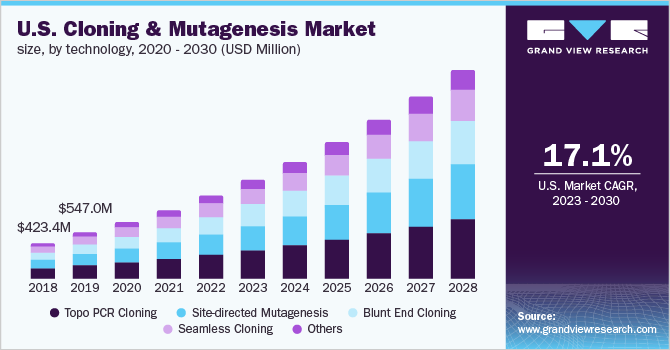
The global cloning and mutagenesis market size was valued at USD 2.3 billion in 2022 and is projected to grow from USD 4.9 billion in 2026 to USD 9.4 billion by 2030, at a CAGR of 19.0% from 2023 to 2030. North America dominated the market, accounting for a revenue share of 35.0% in 2022. Cloning is a technique in which an identical genetic replica or exact, identical organism or biological entity, tissue, or cell is produced by natural or artificial means. The artificial clone technology is performed using a biotechnology method. For instance, nuclear transfer and embryo splitting in animals are performed by using artificial cloning technology. Mutagenesis is a technique in which the DNA of an organism is altered or changed, which results in the mutation of the genes. Cloning and mutagenesis methods are used to confirm the mutation effects in vitro and in vivo and study the structure and function of proteins.
 Source: Grand View Research, IR Documents, Primary Interviews, Paid DatabasesTo learn more about this report,
 Download Free Sample Report
 The outbreak of COVID-19 led to an increased usage of cloning and mutagenesis products in the past two years. Several key biotechnology and pharmaceutical companies and cloning and mutagenesis kit manufacturers have increased their R&D activities globally by adopting novel techniques for producing therapies, kits, and vaccines for COVID-19. For instance, in September 2022, CanSino Biologics Inc. received approval from China’s National Medical Products Administration for emergency use of an inhalable version of the adenovirus-vectored COVID-19 vaccine. It is developed by cloning an optimized plasminogen activator signal peptide gene in the Ad5 vector along with the full-length gene of the S protein.
The prevalence of chronic diseases and genetic disorders is increasing globally. For instance, according to the WHO, cancer is one of the leading causes of death worldwide, causing almost one in six deaths, while cardiovascular diseases lead to an estimated 17.9 million deaths each year. In cancer, personalized medicine utilizes specific information about an individual’s tumor to aid diagnosis, plan treatment, identify the treatment effect, and make a prognosis.
 To learn more about this report, Download Free Sample Report
 Hence, with such increasing demand for personalized medicine, the adoption of cloning and mutagenesis tools, such as PCR, is expected to rise in the near future. For instance, in November 2021, Genes2Me launched a molecular product range, which includes cloning, next-generation technology, and enzyme technology among other product categories. The product range contains the Fantom High-Fidelity PCR DNA polymerase, which can significantly improve PCR test sensitivity, making it a feasible cornerstone for cloning technology. Hence, increasing demand for personalized medicine is likely to fuel market growth over the forecast period.
Moreover, the growing focus on protein engineering for drug development is escalating the growth prospects for the market. Cloning and mutagenesis are the basic methodologies employed in protein engineering during drug development. These techniques help researchers in the modification of protein sequences through the insertion, deletion, or substitution of nucleotides to develop therapeutic proteins. In addition, these techniques aid in the development of more efficient and safer drugs that can be readily available at a lower cost. For instance, currently, there are more than 200 peptide and protein drugs approved by the FDA. Thus, increasing focus on protein engineering for drug development is predicted to boost the market growth during the projection period.
Furthermore, rising demand for genetically modified products such as crops is accelerating market growth. Genetically modified insect-resistant and herbicide-tolerant seeds have gained immense popularity and crops have witnessed rapid adoption, thus contributing to the growth of the agricultural industry. Cloning and mutagenesis have allowed genetic alterations in crops, improvement of soil productivity, and efficient pest control. For instance, in October 2022, GM mustard was approved by Genetic Engineering Appraisal Committee GEAC for commercial release. This initiative is expected to catalyze crop improvement to meet nutritional needs. The advent of unique genetic resources and genome modification techniques such as cloning and mutagenesis is predicted to improve understanding of plant biology over the coming years.
Product Insights
The cloning kits segment dominated the market in 2022 and captured a share of more than 35.0%. Cloning kits find a wide range of applications in biopharmaceuticals, gene therapy, and gene analysis among others. In the biopharmaceutical industry, these kits are widely used to produce human proteins with biomedical applications. For instance, tissue plasminogen activator (tPA) is used to prevent clots and treat strokes. Similarly, in gene analysis, cloning kits are used in research laboratories to build recombinant and artificial versions of gene that help biologists to understand the normal gene in an organism’s function. Thus, such applications of these kits in the biotechnology sector are likely to fuel the segment growth during the forecast period.
The mutagenesis kits are expected to grow at the fastest rate over the forecast period. Mutagenesis kits are used to engineer proteins, investigate the effects of mutagens, and clone DNA. These kits are also used in medical applications such as curing diseases such as beta thalassemia, research and treatment of diseases including cancer and HIV, and helping immunocompromised patients. Hence, increasing applications of mutagenesis kits in biomedical research are boosting the adoption of kits in R&D activities, thereby driving the market.
Technology Insights
The TOPO PCR cloning segment dominated the market with a share of over 25.0% in 2022. In this technology, DNA fragments are cloned into specific vectors by using the inherent biological activity of DNA topoisomerase I. This technology offers several advantages such as ligation and restriction-free cloning, simple design of primers, no requirement of post-PCR procedures, and high efficiency compared to regular TA cloning. Therefore, the advantages of this technology over others are boosting the applications of TOPO PCR cloning in various end-users, including pharmaceutical and biopharmaceutical companies and academic and research institutes.
The site-directed mutagenesis segment is anticipated to be the fastest-growing segment with a CAGR of 20.12% during the forecast period. Site-directed mutagenesis technology is used to make intentional and specific mutating alterations to the DNA sequence of a gene. This technology has applications in genetic studies and gene technology and protein engineering by allowing precise modification of a gene and protein modification. Moreover, key players in the market are providing novel site-directed mutagenesis based kits that simplify and speed up site directed mutagenesis. For instance, Thermo Fisher Scientific, Inc. offers a Phusion Site-Directed Mutagenesis Kit that is an efficient and versatile tool for introducing point mutations, insertions, or deletions into any type of plasmid DNA. Such product offerings based on site-directed mutagenesis technology are likely to boost market growth over the forecast years.
End-user Insights
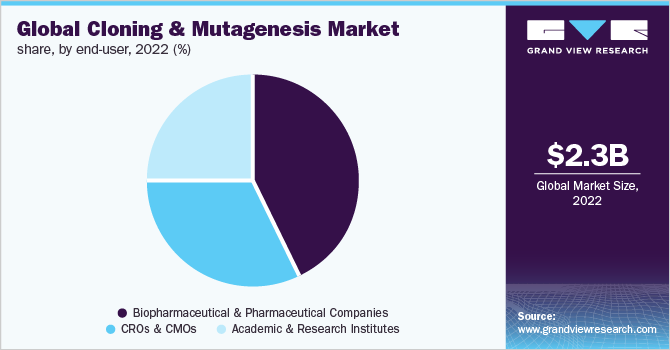
The biopharmaceutical and pharmaceutical companies segment captured the largest share of over 40.0% in 2022. Pharmaceutical and biopharmaceutical companies are focused on drug discovery and development due to the rising prevalence of diseases. The cloning and mutagenesis techniques help in the therapeutic modulation of disease-associated genes. Cloning for pharmacologic products is most appropriate in the preclinical area of drug discovery. Successful therapeutic agents derived from cloning include growth hormone, erythropoietin, synthetic insulin, and vaccine. Moreover, these techniques can significantly impact human therapeutics by providing new cells for tissue engineering and transplantation. Such broad applications of cloning and mutagenesis in the biopharmaceutical and pharmaceutical industry drive the segment.
 To learn more about this report, Download Free Sample Report
 CROs and CMOs are expected to grow at the fastest rate over the forecast period. Pharmaceutical and biopharmaceutical companies are outsourcing cloning and mutagenesis to CROs and CMOs for numerous reasons. These outsourcing initiatives have the potential to save time and increase productivity. Several CROs and CMOs are offering cloning and mutagenesis services to pharmaceutical and biopharmaceutical companies. Some leading service providers in the market are ALLELE LIFE SCIENCES; Azenta Life Sciences; Charles River Laboratories; Luminous BioSciences, LLC; and OriGene Technologies, Inc. For instance, Azenta Life Sciences offers specialized technical support such as custom DNA constructs for downstream applications.
Regional Insights
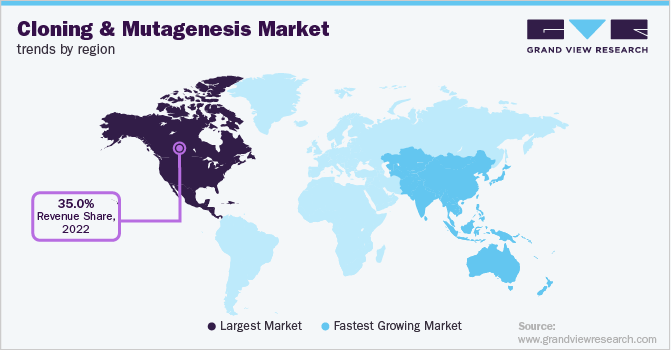
North America dominated the overall market with a share of over 35.0% in 2022. This major share can be attributed to the high demand for biotechnology techniques. In addition, higher penetration of genomic and proteomic-based platforms in the region has led to an increase in the adoption of cloning and mutagenesis tools. Presence of innovators and key market players has resulted in higher penetration of the products in the region. For instance, in May 2021, Telesis Bio, Inc., a U.S.-based company, announced the addition of long fragment cloning to its BioXp system. This initiative helps researchers to clone into custom vectors hand-free overnight and produce multivariant, error corrected vectors.
 To learn more about this report, Download Free Sample Report
 The Asia Pacific market is expected to grow at the fastest rate of 21.82% from 2023 to 2030 due to the rising demand for novel therapeutics in the region. Furthermore, improving economy, increasing R&D investment by governments, and rapid infrastructural development are some of the factors that are boosting regional growth. In addition, several regional players are receiving funding for developing a treatment for various chronic diseases such as cancer. For instance, in June 2022, Immuneel Therapeutics raised series A funding of USD 15 million to develop affordable gene and cell therapy for cancer patients in India. Such initiatives in this region are likely to propel market growth during the study period.
Key Companies & Market Share Insights
Major players in the market are executing numerous strategies including facility expansions, collaborations, partnerships, novel product launches, and mergers and acquisitions to expand their market presence. For instance, Takara Bio, Inc. announced the expansion of its manufacturing facility, the Center for Gene and cell processing in Japan in February 2022. The new facility is set to manufacture products, which include the applications of cloning and mutagenesis tools in regenerative medicine, cancer immunotherapy drugs, gene therapy, and DNA and RNA vaccines. Some prominent players in the global cloning and mutagenesis market include:
-
Agilent Technologies, Inc.
-
Thermo Fisher Scientific, Inc.
-
New England Biolabs
-
Takara Bio Inc.
-
Merck KGaA
-
Promega Corporation
-
Bio-Rad Laboratories, Inc.
-
Danaher
-
Jena Bioscience GmbH
-
Assay Genie
-
TransGen Biotech Co., Ltd.
Cloning And Mutagenesis Market Report Scope
Report Attribute
Details
Market size in 2022
USD 2.3 billion
Estimated market size in 2026
USD 4.9 billion
Projected market size by 2030
USD 9.4 billion
Growth rate
CAGR of 19.0% from 2023 to 2030
Base year for estimation
2022
Historical data
2018 - 2021
Forecast period
2023 - 2030
Quantitative units
Revenue in USD million/billion and CAGR from 2023 to 2030
Report coverage
Revenue forecast, company ranking, competitive landscape, growth factors, and trends
Segments covered
Product, technology, end-user, region
Regional scope
North America; Europe; Asia Pacific; Latin America; MEA
Country scope
U.S.; Canada; Germany; U.K.; France; Italy; Spain; Denmark; Sweden; Norway; Japan; China; India; South Korea; Australia; Thailand; Brazil; Mexico; Argentina; South Africa; Saudi Arabia; UAE; Kuwait
Key companies profiled
Takara Bio Inc.; Agilent Technologies, Inc.; Thermo Fisher Scientific, Inc.; New England Biolabs; Merck KGaA; Promega Corporation;
Bio-Rad Laboratories, Inc.; Danaher; Jena Bioscience GmbH; Assay Genie; TransGen Biotech Co., Ltd.
Customization scope
Free report customization (equivalent up to 8 analyst’s working days) with purchase. Addition or alteration to country, regional & segment scope.
Pricing and purchase options
Avail customized purchase options to meet your exact research needs. Explore purchase options
Global Cloning And Mutagenesis Market Segmentation
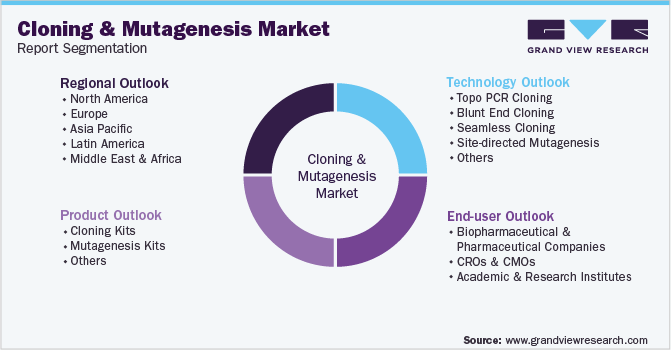
This report forecasts revenue growth at the global, regional, and country levels and provides an analysis of the latest industry trends and opportunities in each of the sub-segments from 2018 to 2030. For the purpose of this report, Grand View Research has segmented the global cloning and mutagenesis market report on the basis of product, technology, end-user, and region:
 To learn more about this report, Download Free Sample Report
 -
Product Outlook (Revenue, USD Million, 2018 - 2030)
-
Cloning Kits
-
Mutagenesis Kits
-
Others
-
-
Technology Outlook (Revenue, USD Million, 2018 - 2030)
-
Topo PCR Cloning
-
Blunt End Cloning
-
Seamless Cloning
-
Site-directed Mutagenesis
-
Others
-
-
End-user Outlook (Revenue, USD Million, 2018 - 2030)
-
Biopharmaceutical & Pharmaceutical Companies
-
CROs & CMOs
-
Academic & Research Institutes
-
-
Regional Outlook (Revenue, USD Million, 2018 - 2030)
-
North America
-
U.S.
-
Canada
-
-
Europe
-
Germany
-
U.K.
-
France
-
Italy
-
Spain
-
Denmark
-
Sweden
-
Norway
-
-
Asia Pacific
-
Japan
-
China
-
India
-
South Korea
-
Australia
-
Thailand
-
-
Latin America
-
Brazil
-
Mexico
-
Argentina
-
-
Middle East & Africa
-
South Africa
-
Saudi Arabia
-
UAE
-
Kuwait
-
-
Frequently Asked Questions About This Report
The global cloning and mutagenesis market size was valued at USD 2.3 billion in 2022 and is estimated at USD 4.9 billion for 2026.
The global cloning and mutagenesis market is expected to grow at a CAGR of 19.0% from 2023 to 2030, reaching USD 9.4 billion by 2030.
North America dominated with a revenue share of 35.0% in 2022.
Some key players operating in the cloning and mutagenesis market include Takara Bio Inc.; Agilent Technologies, Inc.; Thermo Fisher Scientific, Inc.; New England Biolabs.; Merck KGaA; Promega Corporation, Bio-Rad Laboratories, Inc.; Danaher; Jena Bioscience GmbH; Assay Genie; and TransGen Biotech Co., Ltd.
Growing focus on protein engineering for drug development and increasing demand for genetically modified products are major factors driving the market. In addition, the rising prevalence of genetic disorders and chronic diseases is increasing the demand for personalized medicine.
About the Author(s)
Biotechnology Research Team
Healthcare · BiotechnologyThis report was authored by the biotechnology research team at Grand View Research - comprising two research analysts, one senior research analyst, and one industry expert - with specialized expertise in the biotechnology segment of the healthcare industry. All findings are based on proprietary healthcare databases, executive interviews, and regulatory analysis, subject to internal peer review prior to publication.
Last Updated:
Speak to Analyst -

Customize this report to your needs - add regions, segments, or data points, with 20% free customization.
Or view our licence options:


ISO 9001:2015 & 27001:2022 Certified
We are GDPR and CCPA compliant! Your transaction & personal information is safe and secure. For more details, please read our privacy policy.


