
- Home
- »
- Next Generation Technologies
- »
-
Cloud Intrusion Protection Software Market Report 2026-2033GVR Report cover
![Cloud Intrusion Protection Software Market (2026 - 2033)Report]()
Cloud Intrusion Protection Software Market (2026 - 2033)
Size, Share & Trends Analysis Report By Component (Software, Services), By Security (Cloud Intrusion Detection Systems), By Deployment, By Enterprise Size, By End Use, By Region, And Segment Forecasts
Market Size, 2025
$2.0BMarket Estimate, 2026
$2.3BMarket Forecast, 2033
$9.3BCAGR, 2026–2033
21.8%Cloud Intrusion Protection Software Market Summary
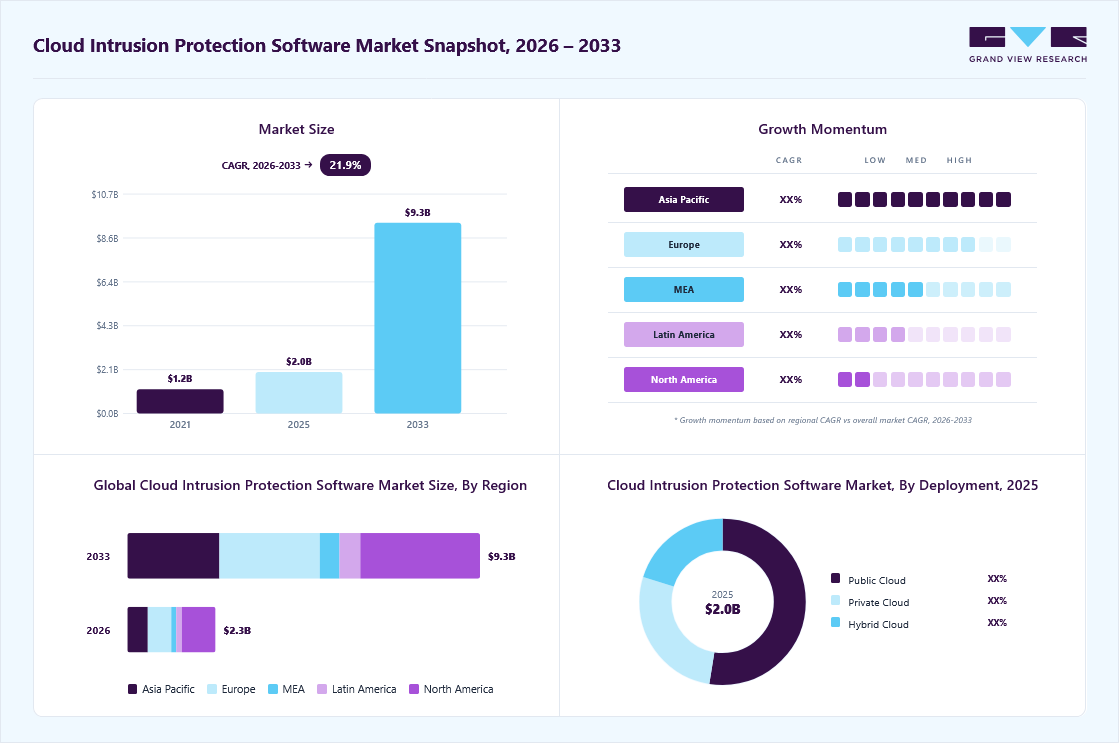
The global cloud intrusion protection software market size was valued at USD 2.0 billion in 2025 and is projected to grow from USD 2.3 billion in 2026 to USD 9.3 billion by 2033, at a CAGR of 21.8% from 2026 to 2033. The market in North America dominated with a revenue share of 38.8% in 2025. The rapid increase in cyberattacks targeting cloud environments, growing adoption of multi-cloud and hybrid cloud infrastructures, and the rising need for real-time threat detection and prevention drive market growth.
Key Market Trends & Insights
- By component: Software segment held the largest market share of 64.8% in 2025.
- By enterprise: Large segment held the largest market share in 2025.
- By deployment: Public cloud segment held the largest market share in 2025.
- By end use: BFSI segment held the largest market share in 2025.
Regional Highlights
- Largest regional market: North America (38.8% revenue share, 2025)
- Fastest-growing regional market: Asia Pacific (highest CAGR, 2026-2033)
- By country: U.S. held the largest market share in 2025
Market Size & Forecast
- Market size in 2025: USD 2.0 Billion
- Estimated market size in 2026: USD 2.3 Billion
- Projected market size by 2033: USD 9.3 Billion
- CAGR (2026-2033): 21.8%
Organizations are increasingly prioritizing proactive security measures to safeguard sensitive data and maintain business continuity, which is significantly increasing demand for cloud intrusion protection solutions. A key driver of this market is the escalating frequency and complexity of cyber threats in cloud environments. As businesses migrate critical workloads to the cloud, attackers are leveraging advanced techniques such as zero-day exploits, ransomware, and AI-driven attacks to breach systems. This has created a strong need for advanced intrusion detection and prevention systems that can identify anomalies, monitor network traffic in real time, and automatically respond to threats. As a result, organizations are investing heavily in integrated security solutions such as next-generation firewalls with intrusion prevention capabilities to strengthen their cloud security posture.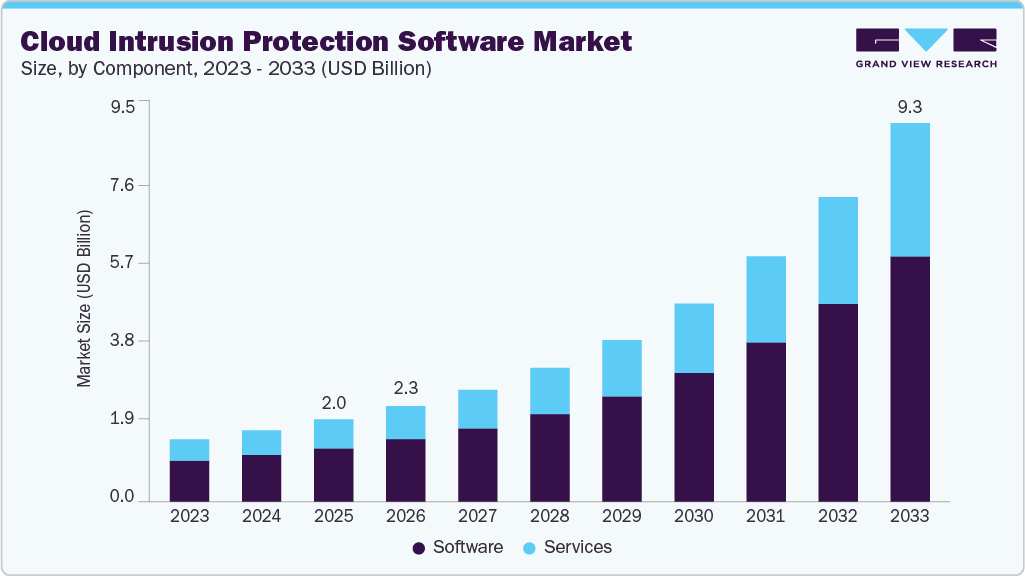
The accelerated adoption of multi-cloud and hybrid cloud environments drives the market growth. Organizations are increasingly deploying workloads across multiple cloud platforms to enhance flexibility, scalability, and cost efficiency. However, this distributed architecture introduces complex security challenges, including visibility gaps and inconsistent security policies. As a result, businesses are investing in unified intrusion protection solutions that can provide centralized monitoring, consistent policy enforcement, and seamless protection across diverse cloud environments.
The growing regulatory pressure and compliance requirements are also driving market expansion. Governments and regulatory bodies worldwide are introducing stricter cybersecurity frameworks to protect critical infrastructure and sensitive data. These regulations require organizations to implement strong security measures, including continuous monitoring, threat detection, and incident response capabilities. Consequently, enterprises are adopting cloud intrusion protection solutions to meet compliance standards, avoid financial penalties, and maintain customer trust.
In addition, the increasing integration of artificial intelligence and automation in cybersecurity is further fueling market growth. Modern intrusion protection solutions leverage AI and machine learning to analyze large volumes of data, identify emerging threats, and automate response mechanisms. This not only improves detection accuracy but also reduces response time and operational burden on security teams. As cyber threats continue to evolve in complexity and scale, the demand for intelligent, automated cloud security solutions is expected to grow significantly over the forecast period.
Component Insights
The software segment accounted for the largest revenue share of 64.8% in 2025. This dominance is driven by the increasing need for advanced, automated threat detection and prevention as organizations face more frequent and sophisticated cyber threats in cloud environments. Cybersecurity vendors have begun extending intrusion protection capabilities specifically for cloud workloads. For instance, in October 2025, Intrusion Inc. launched Intrusion Shield Cloud on the AWS Marketplace, which brings autonomous network threat detection and real-time blocking directly to AWS cloud environments, allowing cloud customers to proactively prevent malicious traffic from impacting workloads. This trend highlights how software solutions that integrate real-time analytics, automated enforcement, and threat intelligence are becoming essential for strong cloud security, further solidifying their share of the market.
The services segment is anticipated to grow at the fastest CAGR during the forecast period, due to the increasing reliance of organizations on managed security services and expert support to address the complexity of cloud intrusion protection. Many enterprises, particularly small and medium-sized businesses, lack the in-house expertise to effectively deploy, configure, and monitor advanced security solutions. Services such as consulting, implementation, managed monitoring, and incident response help organizations optimize their cloud security posture, ensure continuous threat detection, and reduce operational burden on internal IT teams. For instance, in April 2025, CrowdStrike expanded its partnership with Google Cloud, enabling joint customers to leverage enhanced cloud workload protection services and integrated threat detection capabilities. As cyber threats become more sophisticated and regulatory requirements stricter, the demand for professional services that complement software solutions is expected to accelerate rapidly.
Security Insights
The next-generation firewall (NGFW) with IPS segment dominated the market in 2025. This growth is primarily driven by the increasing demand for integrated and real-time threat prevention solutions that combine multiple security functionalities within a single platform. Organizations are prioritizing NGFW solutions with built-in intrusion prevention capabilities as they provide deep packet inspection, application-level visibility, and automated threat blocking, enabling more effective protection against advanced and evolving cyber threats. As cloud environments become more complex and distributed, enterprises prefer consolidated security architectures that reduce tool sprawl, improve operational efficiency, and enable faster response to threats. This has significantly accelerated the adoption of NGFW with IPS as a comprehensive solution for securing cloud networks.
The cloud intrusion prevention systems (IPS) segment is expected to register the fastest CAGR from 2026 to 2033, due to the increasing need for proactive and automated threat mitigation in cloud environments. Unlike detection-based solutions, cloud IPS actively blocks malicious traffic and prevents potential breaches in real time, making it highly effective against advanced and fast-evolving cyber threats such as ransomware and zero-day attacks. As organizations continue to migrate critical workloads to the cloud, the demand for solutions that can not only identify but also immediately respond to threats is rising significantly. In addition, the growing integration of AI and machine learning in IPS solutions enhances their ability to analyze traffic patterns, detect anomalies, and enforce security policies dynamically, further driving adoption across enterprises seeking strong and continuous cloud protection.
Deployment Insights
The public cloud segment dominated the market in 2025. This growth is primarily driven by the widespread adoption of public cloud infrastructure by organizations seeking scalability, cost efficiency, and rapid deployment of applications. As enterprises increasingly move critical workloads to public cloud environments, the risk of cyber threats such as ransomware, data breaches, and unauthorized access grows significantly. Public cloud providers and organizations are therefore investing heavily in intrusion protection services to monitor network traffic, detect anomalies in real time, and implement automated threat responses. These managed and professional services help ensure continuous protection for cloud workloads, reduce operational complexity for in-house IT teams, and enhance compliance with security regulations, making the public cloud deployment model a key contributor to market growth.
The hybrid cloud segment is expected to register the fastest CAGR from 2026 to 2033, due to the increasing need for flexibility and control in managing diverse IT environments. Organizations are adopting hybrid cloud strategies to balance the scalability of public cloud with the security and compliance benefits of private cloud infrastructure. However, this combination creates complex security challenges, including inconsistent visibility, fragmented security policies, and increased attack surfaces. As a result, enterprises are increasingly relying on specialized intrusion protection services to ensure seamless security across both environments. These services provide centralized monitoring, unified threat detection, and coordinated response mechanisms, enabling organizations to maintain consistent protection while optimizing performance and regulatory compliance across hybrid cloud deployments.
Enterprise Size Insights
The large enterprises segment dominated the market in 2025. The market growth is driven by the high volume of sensitive data and complex IT infrastructures managed by large organizations, which make them prime targets for sophisticated cyberattacks. These enterprises operate across multiple geographies and cloud environments, increasing their exposure to security risks and driving the need for advanced intrusion protection solutions. In addition, large enterprises have greater financial resources and dedicated cybersecurity teams, enabling them to invest in comprehensive security frameworks, including real-time monitoring, threat intelligence, and automated response systems. This strong focus on proactive security and risk management significantly contributes to the dominance of this segment in the market.
The SMEs segment is expected to register the fastest CAGR from 2026 to 2033. This growth is driven by the increasing exposure of small and medium-sized enterprises to cyber threats as they rapidly adopt cloud-based solutions for business operations. SMEs often have limited in-house cybersecurity expertise and budget constraints, making them more vulnerable to attacks such as phishing, ransomware, and data breaches. As a result, there is a growing demand for cost-effective, easy-to-deploy cloud intrusion protection solutions that offer automated threat detection and response. In addition, the availability of subscription-based and managed security services is enabling SMEs to access advanced protection without significant upfront investment, further accelerating adoption in this segment.
End Use Insights
The BFSI segment accounted for the largest market share in 2025. This dominance is driven by the high volume of sensitive financial data and transactions handled by banks, financial institutions, and insurance companies, making them prime targets for cyberattacks. The increasing incidence of fraud, data breaches, and ransomware attacks in the financial sector has compelled organizations to adopt advanced intrusion protection solutions to safeguard customer information and ensure secure digital transactions. In addition, strict regulatory and compliance requirements related to data security and privacy are pushing BFSI organizations to implement real-time monitoring, threat detection, and automated response systems, further strengthening the demand for cloud intrusion protection software in this segment.
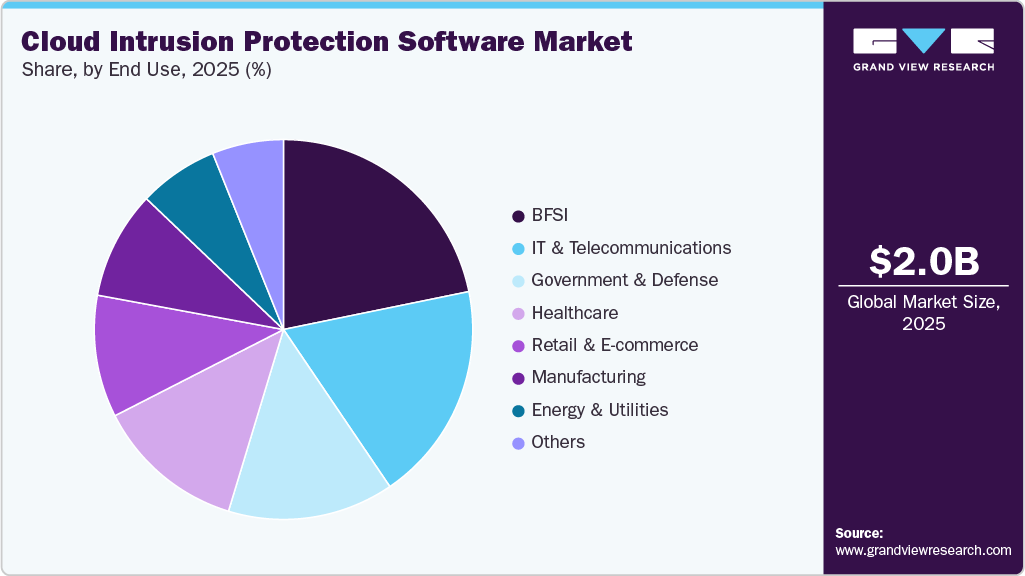
The IT & telecommunications segment is anticipated to register the fastest CAGR during the forecast period. This growth is driven by the rapid expansion of cloud-based infrastructure, 5G networks, and data-intensive applications, which significantly increase the attack surface for cyber threats. IT and telecom companies handle vast volumes of real-time data traffic and are critical enablers of digital services, making them prime targets for sophisticated cyberattacks such as distributed denial-of-service (DDoS) and network intrusions. As a result, there is a strong need for advanced cloud intrusion protection solutions that can provide continuous network monitoring, real-time threat detection, and automated response. In addition, the ongoing rollout of next-generation connectivity and edge computing is further driving the adoption of strong security solutions to ensure uninterrupted service delivery and protect network integrity.
Regional Insights
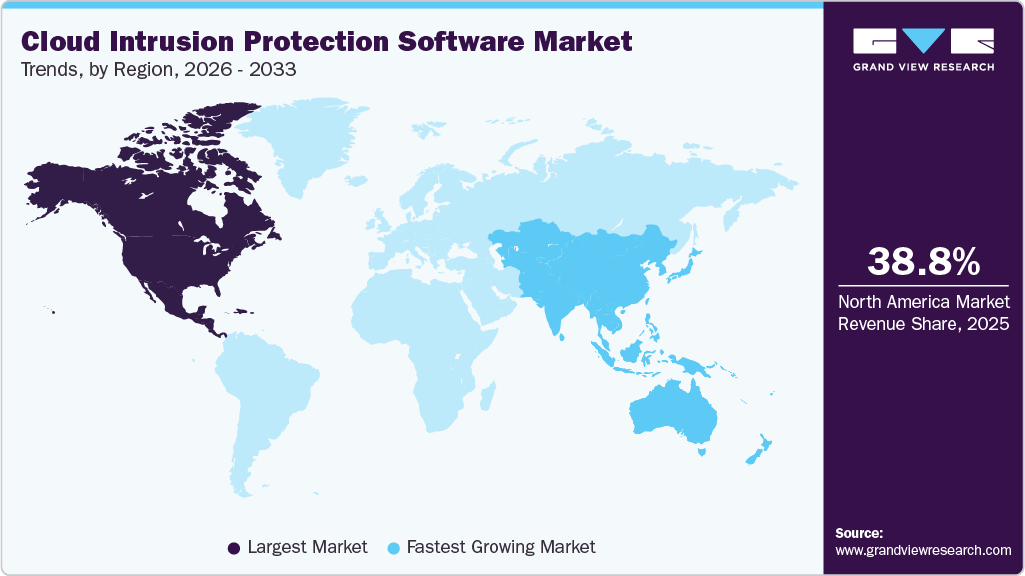
The cloud intrusion protection software industry in North America accounted for the largest market share of 38.8% in 2025. The region’s dominance is driven by the early adoption of advanced cloud technologies, the strong presence of leading cybersecurity vendors, and high investment in digital transformation across industries. Organizations in North America are highly focused on strengthening their cybersecurity frameworks due to the increasing frequency of sophisticated cyberattacks targeting critical infrastructure and enterprise systems. In addition, strict regulatory requirements related to data protection and privacy, along with the widespread adoption of multi-cloud and hybrid cloud environments, are further accelerating the demand for advanced intrusion protection solutions across the region.
U.S. Cloud Intrusion Protection Software Market Trends
The U.S. cloud intrusion protection software industry is projected to grow significantly during the forecast period. This growth is driven by the rising number of high-profile cyberattacks and the increasing focus on national cybersecurity initiatives aimed at protecting critical infrastructure and digital ecosystems. For instance, in March 2026, the White House released a new national cybersecurity strategy and accompanying executive actions focusing on securing critical infrastructure, modernizing federal networks with advanced technologies such as zero trust and cloud security, and strengthening defenses against evolving cyber threats. These initiatives are encouraging both public and private sector organizations to invest in advanced intrusion detection and prevention solutions. Furthermore, the presence of major cloud service providers, along with strong federal support for cybersecurity innovation and compliance, is significantly contributing to the expansion of the market in the U.S.
Asia Pacific Cloud Intrusion Protection Software Market Trends
The cloud intrusion protection software industry in the Asia Pacific is expected to grow at the fastest CAGR from 2026 to 2033. The market growth is supported by rapid digital transformation, increasing adoption of cloud computing across emerging economies, and the expanding base of internet users and connected devices in the region. Governments and enterprises in countries such as India, China, and Japan are investing heavily in cloud infrastructure and cybersecurity frameworks to support digital economies. In addition, the rising number of cyberattacks targeting financial institutions, telecom networks, and e-commerce platforms is driving demand for advanced intrusion protection solutions. The growing adoption of hybrid and multi-cloud environments, along with increasing awareness of data protection and regulatory compliance, is further accelerating market growth in the Asia Pacific region.
The China cloud intrusion protection software industry is projected to grow steadily during the forecast period, driven by strong government support for cybersecurity and data protection, along with the rapid expansion of domestic cloud service providers. China’s increasing focus on data sovereignty and strict cybersecurity regulations is compelling organizations to deploy advanced security solutions, including intrusion detection and prevention systems. In addition, the country’s large-scale digital ecosystem, supported by widespread adoption of cloud computing, artificial intelligence, and industrial internet, is increasing the risk of cyber threats. This is encouraging enterprises to invest in strong cloud intrusion protection solutions to secure critical infrastructure and maintain compliance with national cybersecurity policies.
Europe Cloud Intrusion Protection Software Market Trends
The cloud intrusion protection software industry in Europe is experiencing steady growth, supported by strong regulatory frameworks, increasing focus on data privacy, and rising investments in cybersecurity infrastructure across the region. Regulations such as GDPR are compelling organizations to adopt advanced security solutions to protect sensitive data and ensure compliance. In addition, the European Union is significantly strengthening its cybersecurity capabilities through large-scale funding initiatives; for instance, under the Digital Europe Programme (2021-2027), the EU has committed USD 2.20 billion in investments toward cybersecurity capacity building and the deployment of advanced cybersecurity infrastructure and tools across public administrations and enterprises. This strong policy support, combined with the growing adoption of cloud technologies and increasing cyber threats targeting critical infrastructure, is driving demand for cloud intrusion protection solutions across Europe.
The UK cloud intrusion protection software industry is projected to grow significantly during the forecast period, driven by the increasing frequency of cyberattacks on financial services, government institutions, and digital service providers. The country’s strong focus on enhancing national cybersecurity resilience, along with initiatives to secure critical infrastructure and digital ecosystems, is encouraging organizations to invest in advanced intrusion detection and prevention solutions.
Key Cloud Intrusion Protection Software Company Insights
Some prominent players in the cloud intrusion protection software industry include Cisco Systems, Inc., NSFOCUS, Broadcom, SAP SE, IBM, Google Cloud, among others.
-
Cisco Systems, Inc. is a global technology company specializing in networking, cybersecurity, and cloud-based security solutions. The company offers a comprehensive portfolio of cloud security products, including its Cloud Protection Suite, which delivers end-to-end protection across hybrid and multi-cloud environments. Its offerings include capabilities such as real-time threat detection, intrusion prevention, deep visibility into application behavior, and AI-driven security analytics, enabling organizations to detect and block malicious activity, including zero-day threats and encrypted attacks. Cisco’s solutions, such as Secure Firewall with integrated intrusion prevention system (IPS) and Multicloud Defense, provide automated threat blocking, segmentation, and protection against lateral movement across cloud environments.
-
NSFOCUS is a global cybersecurity company specializing in network, application, and cloud security solutions, with headquarters in Beijing and Santa Clara and a presence across more than 50 offices worldwide. The company offers a comprehensive portfolio of security products, including cloud-based and hybrid solutions such as DDoS protection, web application firewalls (WAF), next-generation firewalls (NGFW), and intrusion detection and prevention systems (IDS/IPS). Its cloud security capabilities are delivered through a multi-tenant, distributed cloud platform that enables real-time threat detection, traffic monitoring, and automated mitigation across cloud and hybrid environments.
Key Cloud Intrusion Protection Software Companies:
The following key companies have been profiled for this study on the cloud intrusion protection software market.
- AT&T Intellectual Property
- Barracuda Networks, Inc.
- Broadcom
- Check Point Software Technologies Ltd.
- Cisco Systems, Inc.
- Fortinet, Inc.
- Google Cloud
- IBM
- Juniper Networks, Inc.
- Microsoft
- NSFOCUS
- Palo Alto Networks
- Radware
- Sophos
- Trend Micro Incorporated
Recent Developments
-
In December 2025, Palo Alto Networks and Google Cloud announced a landmark expansion of their strategic partnership to strengthen cloud and AI security capabilities. The collaboration focuses on integrating Palo Alto’s AI-powered security platforms, including VM-Series firewalls and Prisma SASE, directly into Google Cloud infrastructure to deliver real-time threat prevention, deep packet inspection, and unified security across hybrid and multi-cloud environments.
-
In November 2025, Trend Micro partnered with AWS to deliver simplified cloud intrusion prevention deployment, enabling organizations to activate IPS protection with a one-click implementation model. This development improves accessibility of cloud IPS while maintaining strong real-time threat prevention across cloud workloads.
Cloud Intrusion Protection Software Market Report Scope
Report Attribute
Details
Market size in 2025
USD 2.0 billion
Market size value in 2026
USD 2.3 billion
Revenue forecast in 2033
USD 9.3 billion
Growth rate
CAGR of 21.8% from 2026 to 2033
Actual data
2021 - 2025
Forecast period
2026 - 2033
Quantitative units
Revenue in USD billion and CAGR from 2026 to 2033
Report coverage
Revenue forecast, company share, competitive landscape, growth factors, and trends
Segments covered
Component, security, deployment, enterprise size, end use, region
Regional scope
North America; Europe; Asia Pacific; Latin America; MEA
Country scope
U.S.; Canada; Mexico; UK; Germany; France; China; India; Japan; Australia; South Korea; Brazil; UAE; Saudi Arabia; South Africa
Key companies profiled
AT&T Intellectual Property; Broadcom; Barracuda Networks, Inc.; Check Point Software Technologies Ltd.; Cisco Systems, Inc.; Fortinet, Inc.; Google Cloud; IBM; Juniper Networks, Inc.; Microsoft; NSFOCUS; Palo Alto Networks; Radware; Sophos; Trend Micro Incorporated
Customization scope
Free report customization (equivalent to 8 analysts working days) with purchase. Addition or alteration to country, regional & segment scope.
Pricing and purchase options
Avail customized purchase options to meet your exact research needs. Explore purchase options
Global Cloud Intrusion Protection Software Market Report Segmentation
This report forecasts revenue growth at global, regional, and country levels and provides an analysis of the latest industry trends in each of the sub-segments from 2021 to 2033. For this study, Grand View Research has segmented the cloud intrusion protection software market report based on component, security, deployment, enterprise size, end use, and region:
-
Component Outlook (Revenue, USD Million, 2021 - 2033)
-
Software
-
Services
-
-
Security Outlook (Revenue, USD Million, 2021 - 2033)
-
Cloud Intrusion Detection Systems (IDS)
-
Cloud Intrusion Prevention Systems (IPS)
-
Next-Generation Firewall (NGFW) with IPS
-
Others
-
-
Deployment Outlook (Revenue, USD Million, 2021 - 2033)
-
Public Cloud
-
Private Cloud
-
Hybrid Cloud
-
-
Enterprise Size Outlook (Revenue, USD Million, 2021 - 2033)
-
Large Enterprises
-
SMEs
-
-
End Use Outlook (Revenue, USD Million, 2021 - 2033)
-
BFSI
-
Government & Defense
-
Healthcare
-
IT & Telecommunications
-
Retail & E-commerce
-
Manufacturing
-
Energy & Utilities
-
Others
-
-
Regional Outlook (Revenue, USD Million, 2021 - 2033)
-
North America
-
U.S.
-
Canada
-
Mexico
-
-
Europe
-
Germany
-
UK
-
France
-
-
Asia Pacific
-
China
-
India
-
Japan
-
South Korea
-
Australia
-
-
Latin America
-
Brazil
-
-
Middle East & Africa
-
UAE
-
Saudi Arabia
-
South Africa
-
-
Frequently Asked Questions About This Report
The software segment accounted for the largest revenue share in 2025 in the cloud intrusion protection software market, driven by the increasing need for advanced, automated threat detection and prevention as organizations face more frequent and sophisticated cyber threats in cloud environments.
Some key players operating in the market include AT&T Intellectual Property; Broadcom; Check Point Software Technologies Ltd.; Cisco Systems, Inc.; Fortinet, Inc.; Google Cloud; IBM; Juniper Networks, Inc.; Microsoft; NSFOCUS; Palo Alto Networks; Radware; Sophos; Sophos Ltd.; Trend Micro Incorporated, and Others.
Factors such as the rising frequency and sophistication of cyberattacks, increasing adoption of cloud computing across enterprises, growing demand for real-time threat detection and prevention, strict government regulations on data security, rapid shift toward hybrid and multi-cloud environments, and the need for advanced security solutions to protect sensitive data and critical infrastructure play a key role in accelerating the cloud intrusion protection software market.
The global cloud intrusion protection software market size was estimated at USD 2.0 billion in 2025 and is expected to reach USD 2.3 billion in 2026.
The global cloud intrusion protection software market is expected to grow at a compound annual growth rate of 21.8% from 2026 to 2033 to reach USD 9.3 billion by 2033.
North America dominated with a 38.8% revenue share in 2025.
The next-generation firewall (NGFW) with IPS segment held the largest revenue share in 2025, while the cloud intrusion prevention systems (IPS) segment is the fastest-growing.
The public cloud segment held the largest revenue share in 2025, while the hybrid cloud segment is the fastest-growing.
Large enterprises segment held the largest share in 2025, while the SMEs segment is the fastest-growing.
The BFSI segment held the largest revenue share in 2025, while the IT & telecommunications segment is the fastest-growing.
About the Author(s)
Next Generation Technologies Research Team
Technology · Next Generation TechnologiesThis report was authored by the next generation technologies research team at Grand View Research - comprising two research analysts, one senior research analyst, and one industry expert - with specialized expertise in the next generation technologies segment of the technology industry. All findings are based on proprietary technology databases, executive interviews, and regulatory analysis, subject to internal peer review prior to publication.
Last Updated:
Speak to Analyst

Need a Tailored Report?
Customize this report to your needs — add regions, segments, or data points, with 20% free customization.
Or view our licence options:


ISO 9001:2015 & 27001:2022 Certified
We are GDPR and CCPA compliant! Your transaction & personal information is safe and secure. For more details, please read our privacy policy.












