
- Home
- »
- Consumer F&B
- »
-
Cocoa Butter Market Size And Share Report, 2026-2033GVR Report cover
![Cocoa Butter Market Size, Share & Trends Report]()
Cocoa Butter Market (2026 - 2033) Size, Share & Trends Analysis Report By Processing Method (Raw/Unrefined, Refined, Deodorized), By Form (Solid, Liquid), By End Use-Application (B2B, B2C), By Region (North America, Asia Pacific, Central & South America, MEA), And Segment Forecasts
Market Size, 2025
$10.9BMarket Estimate, 2026
$11.4BMarket Forecast, 2033
$16.0BCAGR, 2026–2033
4.9%Cocoa Butter Market Summary
The global cocoa butter market size was valued at USD 10.9 billion in 2025 and is projected to grow from USD 11.4 billion in 2026 to USD 16.0 billion by 2033, at a CAGR of 4.9% from 2026 to 2033. Europe dominated the global market in 2025 with a revenue share of 37.5%. The market is anticipated to be driven by factors such as rising demand for premium & organic chocolate, expansion of the cosmetics & personal care industry, increasing pharmaceutical applications, and growth of global confectionery consumption.

Key Market Trends & Insights
- The Asia Pacific cocoa butter industry is growing at the fastest CAGR of 5.8% over the forecast period from 2026 to 2033.
- Based on the processing method, the refined cocoa butter segment in the global cocoa butter market accounted for a share of 34.4% in 2025.
- By form, the liquid cocoa butter is expected to grow at a CAGR of 5.3% from 2026 to 2033.
- By end use-application, the B2B segment dominated the market with a revenue share of 81.1% in 2025.
Market Size & Forecast
- 2025 Market Size: USD 10.9 Billion
- 2026 Market Size: USD 11.4 billion
- 2033 Projected Market Size: USD 16.0 Billion
- CAGR (2026-2033): 4.9%
- Europe: Largest market in 2025
- Asia Pacific: Fastest growing market
The rising demand for premium and organic chocolate is significantly boosting the cocoa butter market, as consumers increasingly prefer high-quality, clean-label, and ethically sourced confectionery products. Premium chocolate brands rely heavily on cocoa butter to deliver superior texture, rich flavor, and smooth mouthfeel, which directly boosts their consumption. In addition, the growing shift toward organic and sustainably produced foods has led manufacturers to use organic cocoa butter to meet clean-ingredient expectations. As disposable incomes rise and consumers seek indulgent yet healthier treats, the demand for premium and organic chocolates continues to expand, strengthening the overall cocoa butter industry growth.Moreover, the expansion of the cosmetics and personal care industry is driving strong demand for cocoa butter, as brands increasingly incorporate natural, plant-based ingredients into skincare and beauty formulations. Cocoa butter’s moisturizing, healing, and antioxidant properties make it a preferred choice for lotions, creams, lip balms, and body butters. With rising consumer awareness about clean beauty, chemical-free products, and sustainability, manufacturers are using cocoa butter to cater to evolving preferences. In addition, the growth of premium skincare, anti-aging products, and specialty personal care items further boosts the usage of cocoa butter, supporting overall market expansion.

The market is also witnessing increasing interest in the cocoa butter improves (CBIS) market, which focuses on enhancing texture, melting behavior, and processing efficiency in chocolate and bakery applications. CBIs help manufacturers achieve consistent product quality while managing raw-material uncertainties in cocoa supply. Their ability to improve crystallization and their compatibility with cocoa butter make them attractive to premium confectionery brands. As consumer preferences shift toward affordable, clean-label, and plant-based products, CBEs, CBIs, CBSs, and CBRs collectively support innovation, operational flexibility, and broader product diversification across global industries.
Market Dynamics
The increasing use of cocoa butter in cosmetics and personal care formulations is significantly supporting market growth. Its moisturizing, emollient, and antioxidant properties make it a widely preferred ingredient in skincare, haircare, lip care, and body care products. Rising consumer demand for natural, plant-based, and clean-label beauty products is encouraging manufacturers to incorporate cocoa butter into premium cosmetic formulations. For instance, several global skincare and beauty brands utilize cocoa butter in lotions, creams, body butters, and lip balms to enhance product nourishment and texture. The growing popularity of organic and sustainable personal care products is further accelerating the adoption of cocoa butter across the cosmetics industry.
Frequent fluctuations in cocoa bean prices are creating significant cost pressures for the cocoa butter market. Variations in climatic conditions, crop productivity, geopolitical instability, and supply-demand imbalances in major cocoa-producing countries such as the Ivory Coast and Ghana directly affect raw material availability and procurement costs. Adverse weather conditions and reduced harvest yields may lead to sharp price increases, impacting production expenses and profit margins for manufacturers. These pricing uncertainties also create challenges in long-term sourcing, inventory management, and pricing strategies across the global cocoa butter industry.
Consumer Insights for the Cocoa Butter Market:
Consumers are showing a strong shift toward natural, clean-label, and ethically sourced products. Modern consumers, especially in regions such as Europe and North America, increasingly prefer skincare, confectionery, and food products made with plant-based and minimally processed ingredients. This trend is driving the adoption of cocoa butter in both beauty and food applications due to its natural origin, moisturizing properties, and perceived health benefits. Consumers are also becoming more conscious about ingredient transparency and sustainability, pushing brands to offer certified organic, fair-trade, and responsibly sourced cocoa butter products.

Moreover, the demand patterns indicate growing interest in premium and specialty products across cosmetics, chocolates, and personal care categories. Younger consumers, including millennials and Gen Z, show a strong inclination toward vegan, cruelty-free, and environment-friendly products, accelerating the use of cocoa butter in vegan chocolates, skincare essentials, and artisanal beauty products. At the same time, the rising popularity of online retail and social media-led beauty trends influences buying decisions, making consumers more aware of cocoa butter’s benefits. These insights highlight a market with expanding preference for high-quality, sustainable, and multifunctional cocoa butter-based products.
Processing Methods Insights
The deodorized cocoa butter led the market and accounted for a share of 51.4% in 2025 in the cocoa butter market. The deodorized cocoa is driven by its wide application across food, cosmetics, and pharmaceutical industries. Its neutral aroma, light color, and consistent texture make it the preferred choice for chocolate manufacturing, bakery products, and premium skincare formulations. Consumers and manufacturers increasingly favor deodorized cocoa butter because it blends easily with other ingredients and supports clean-label product development. Rising demand for refined, versatile, and allergen-friendly formulations further strengthened this segment’s dominance in the market.
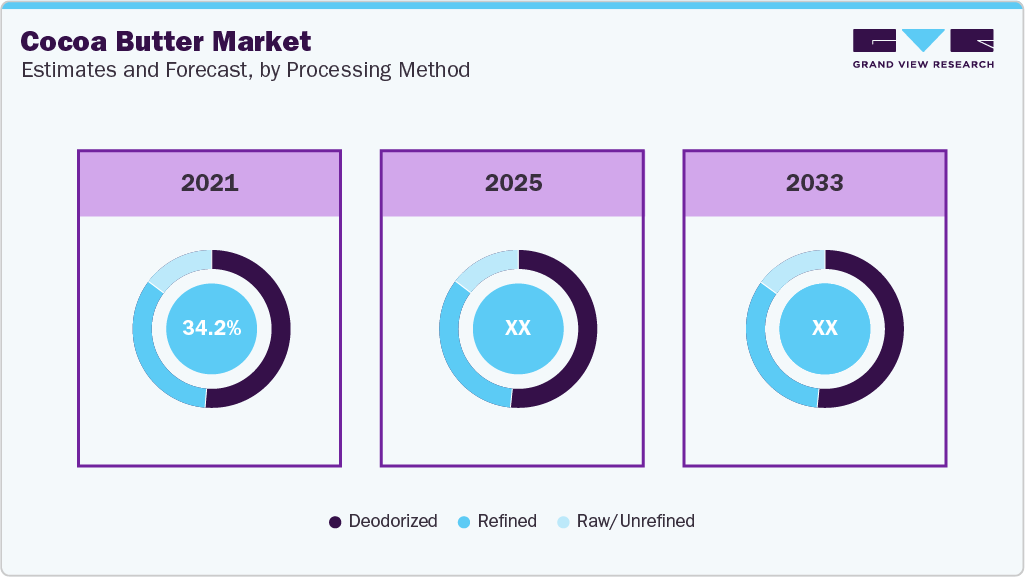
The raw/unrefined cocoa butter is expected to grow at a significant CAGR of 5.3% over the forecast period from 2026 to 2033, supported by rising consumer preference for natural, minimally processed, and nutrient-rich ingredients. Unrefined cocoa butter retains its natural antioxidants, aroma, and beneficial fatty acids, making it highly attractive for organic skincare, clean-label cosmetics, and artisanal chocolate products. Its growing use in DIY beauty routines and premium personal care formulations is further accelerating demand. Increased awareness of sustainably sourced and chemical-free products is also expected to boost the segment’s growth during the forecast period.
Form Insights
The solid cocoa butter segment led the market, accounting for 71.8% of revenue in 2025. This segment growth is driven by its extensive use in chocolate manufacturing, confectionery, skincare, and pharmaceutical applications. Solid cocoa butter offers better stability, longer shelf life, and ease of handling during processing, making it the preferred choice for large-scale industrial production. Its ability to maintain consistent texture and melting properties in premium chocolates and cosmetics further supports its dominance. Rising demand for high-quality, natural ingredients across food and personal care categories continues to strengthen this segment’s leadership.
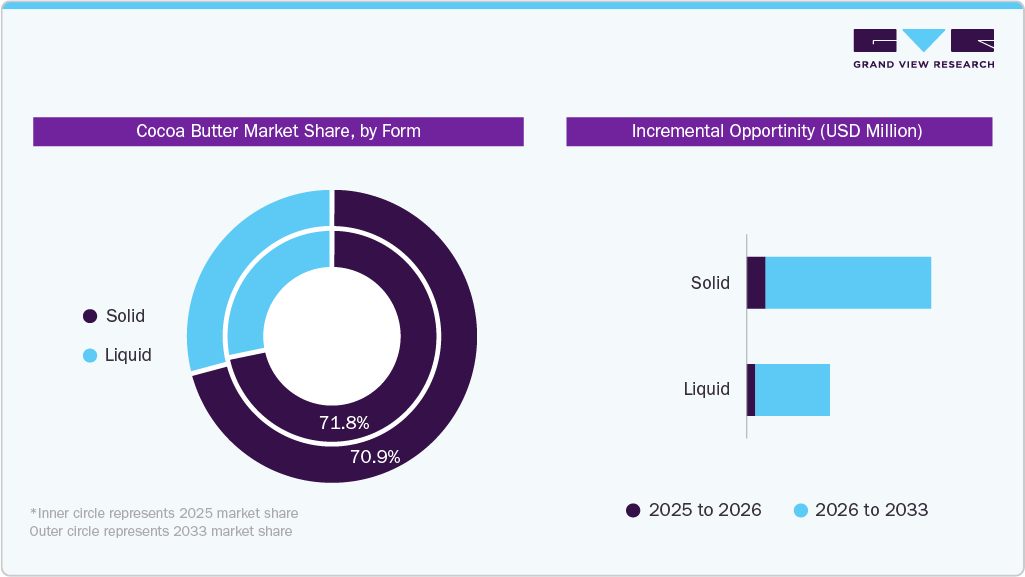
The liquid cocoa butter is expected to grow at the fastest CAGR of 5.3% over the forecast period from 2026 to 2033, supported by its rising use in cosmetics, personal care, and specialty food applications. Liquid cocoa butter offers superior ease of blending, quicker absorption, and convenient formulation compatibility, making it ideal for lotions, serums, hair products, and therapeutic skincare. Its increasing adoption in clean beauty and natural cosmetic formulations is further accelerating demand. In addition, the growing trend toward ready-to-use liquid ingredients in artisanal chocolate and gourmet food processing is expected to drive strong growth for this segment throughout the forecast period.
End Use-Application Insights
The B2B segment dominated the market in 2025, with an 81.1% revenue share, driven by strong demand from large-scale manufacturers in the food & beverage, cosmetics, and pharmaceutical industries. Food & beverages dominated the B2B segment. Bulk purchases by chocolate producers, bakery brands, skincare formulators, and supplement manufacturers significantly contributed to the segment’s leadership. The need for consistent quality, stable supply, and cost-efficient sourcing encourages businesses to procure cocoa butter directly from suppliers and processors. In addition, the growing industrial-scale production and rising utilization of cocoa butter in diversified commercial applications continue to strengthen the prominence of the B2B segment.
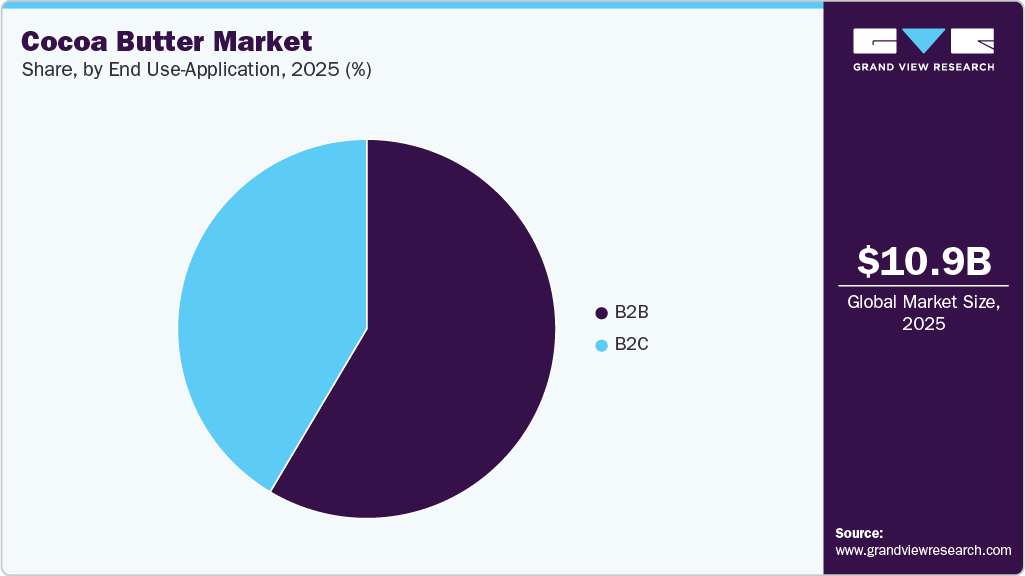
The B2C segment is expected to grow at the fastest CAGR of 5.9% over the forecast period. The rising consumer interest in natural, organic, and clean-label products across skincare, confectionery, and wellness categories is boosting the market. Increasing availability of cocoa butter through supermarkets, specialty stores, and online platforms is boosting direct consumer purchases. Growing awareness of its benefits for hydration, skin repair, and DIY beauty routines is further accelerating demand. In addition, the expansion of e-commerce and influencer-driven beauty trends continues to support strong growth prospects for the B2C segment throughout the forecast period.
Regional Insights
The North America cocoa butter industry is expected to grow at a CAGR of 4.7% over the forecast period. The growing demand for premium chocolates, natural personal care products, and clean-label food ingredients is driving the market in the region. Consumers in the region are showing a strong preference for organic, sustainably sourced, and minimally processed cocoa butter, particularly within the beauty and wellness sectors. Growing applications in pharmaceuticals, along with rising adoption of plant-based and vegan formulations, are further boosting market growth. Expanding retail availability and innovation in specialty confectionery and skincare products also support the region’s positive outlook.
U.S. Cocoa Butter Market Trends
The cocoa butter industry in the U.S. is anticipated to grow at a CAGR of 4.8% over the forecast period, driven by strong demand for premium chocolates, artisanal confectionery, and clean-label food products in the country. Rising consumer interest in natural, organic, and sustainably sourced ingredients is significantly boosting cocoa butter usage in both food and personal care applications. The expanding beauty and wellness sector, particularly for products featuring plant-based moisturizers, further supports market growth. In addition, growing innovation in skincare formulations, along with the increasing popularity of vegan and chemical-free products, is expected to fuel continued demand across the forecast period.
Europe Cocoa Butter Market Trends
The cocoa butter industry in Europe dominated the global industry and held the revenue share of 37.5% in 2025. The strong demand for premium chocolates, organic personal care products, and ethically sourced ingredients is driving the industry. European consumers show a high preference for fair-trade and sustainably produced cocoa butter, encouraging manufacturers to invest in transparent supply chains. Growth is also supported by the region’s large cosmetics and confectionery industries, which rely heavily on refined and specialty cocoa butter grades. Regulatory focus on clean-label formulations further boosts adoption across food, skincare, and pharmaceutical applications. Rising artisanal chocolate production and premium beauty trends continue to strengthen market expansion.

The Germany cocoa butter industry accounted for a revenue share of 7.9% in 2025. The industry benefits from the country’s strong chocolate manufacturing base and rising demand for high-quality, sustainably sourced ingredients. German consumers prioritize organic, fair-trade, and minimally processed cocoa products, driving steady growth in both food and skincare segments. Premium confectionery brands are expanding their use of deodorized and specialty cocoa butter to meet evolving taste preferences. In addition, the country’s well-established natural cosmetics industry supports widespread usage in lotions, balms, and vegan personal care products. Increasing focus on ethical sourcing and clean formulations continues to shape market momentum.
The cocoa butter industry in the UK is witnessing steady growth, driven by increasing demand from the confectionery, bakery, cosmetics, and personal care industries. Cocoa butter is widely used in premium chocolate production due to its smooth texture, rich flavor, and melting properties. Growing consumer preference for high-quality chocolates, clean-label products, and natural cosmetic ingredients continues to support market expansion. The rising popularity of vegan and plant-based products has further increased the use of cocoa-derived ingredients in food and beauty applications. In addition, advancements in sustainable cocoa sourcing and ethical supply chain practices are encouraging manufacturers to strengthen their cocoa butter offerings, contributing to the market's long-term growth prospects in the UK.
Asia Pacific Cocoa Butter Market Trends
The cocoa butter industry in the Asia Pacific is expected to grow at the fastest CAGR of 5.8% over the forecast period, owing to rising disposable incomes, increasing chocolate consumption, and growing adoption of Western confectionery trends. Countries across the region are witnessing stronger demand for skincare and beauty products featuring plant-based ingredients, boosting cocoa butter use in lotions, body butters, and premium cosmetics. The region’s expanding food processing sector also supports higher utilization in bakery and dessert applications. In addition, the rise of e-commerce platforms is broadening consumer access to raw and refined cocoa butter, further accelerating market growth across emerging economies.
The India cocoa butter industry accounted for a revenue share of 9.0% in 2025, driven by rising urbanization, increasing consumption of premium chocolates, and the expanding personal care industry. Indian consumers are increasingly interested in natural, chemical-free skincare solutions, boosting demand for unrefined and organic cocoa butter. Growth in artisanal chocolate brands, along with heightened awareness of vegan and sustainable beauty trends, is also shaping market expansion. Meanwhile, the bakery and confectionery sectors are incorporating more cocoa butter for improved texture and flavor. The rapid rise of online retail further enhances accessibility and adoption, supporting the market as manufacturers explore cost-effective options.
The cocoa butter industry in China is growing steadily due to factors such as rising chocolate consumption, expanding bakery production, and increasing demand for premium confectionery products. The cosmetics industry also contributes to growth, as cocoa butter is widely used in skincare formulations due to its moisturizing and natural properties.
Central & South America Cocoa Butter Market Trends
The cocoa butter industry in Central & South America is expected to grow at a CAGR of 5.2% over the forecast period. The market benefits from the region’s proximity to cocoa-producing countries and increasing investment in local processing industries. Demand is rising in both domestic and export-oriented confectionery sectors, with manufacturers focusing on premium and specialty chocolate varieties. Consumers are also showing increased interest in natural skincare products, supporting growth in personal care applications. Countries in the region are promoting sustainable agriculture and traceable cocoa sourcing, which strengthens market competitiveness. Expansion of small-scale chocolate makers and beauty brands further contributes to the region’s positive market outlook.
Middle East & Africa Cocoa Butter Market Trends
The cocoa butter industry in the Middle East and Africa is anticipated to grow at a CAGR of 4.9% over the forecast period. The market growth is attributed to rising demand for premium confectionery, luxury beauty products, and imported chocolate varieties. Growing awareness of natural moisturizers and plant-based skincare ingredients is boosting the use of cocoa butter in personal care formulations across the region. In Africa, proximity to cocoa-growing countries supports local processing opportunities, while Middle Eastern markets rely heavily on imports for high-quality cocoa butter. Increasing urbanization, higher disposable incomes, and the popularity of premium international brands further drive market growth across food, beauty, and wellness applications.
Key Cocoa Butter Company Insights
Leading companies in the cocoa butter market leverage advanced processing capabilities, global sourcing networks, and strong supplier partnerships to maintain a competitive advantage. Major players such as Cargill, Olam International, and Barry Callebaut drive growth through product innovation, sustainability programs, and vertically integrated operations. Meanwhile, specialized firms like Amano Chocolate and Blommer Chocolate Company focus on premium segments and evolving consumer preferences. Strategic initiatives, including mergers and acquisitions, capacity expansions, and investments in traceable and clean-label cocoa butter, reflect a strong industry emphasis on differentiation, quality, and responsible sourcing.

Key Cocoa Butter Companies:
The following key companies have been profiled for this study on the cocoa butter market.
-
Barry Callebaut AG
-
Cargill Incorporated
-
Olam International (Ofi)
-
Fuji Oil Co., Ltd.
-
Ecom Agroindustrial Corp.
-
JB Foods Limited
-
Natra S.A.
-
Blommer Chocolate Company
-
United Cocoa Processor
-
Guan Chong Berhad
Recent Developments
-
In September 2025, Palmer’s expanded its skincare portfolio by launching the Cocoa Butter Formula Tahitian Vanilla range, Brazilian Coco Firming Oil, and a new Shimmer Radiance Stick, strengthening its body care offerings with enhanced hydration and indulgent formulations to meet evolving consumer preferences.
-
In January 2025, Tonatel Group introduced the Tonatel Cocoa Butter Luxury Body Lotion in Nigeria, marking its entry into vegan skincare. The launch highlighted the company’s focus on natural, plant-based products and expanding local production of quality cocoa butter formulations.
Cocoa Butter Market Report Scope
Report Attribute
Details
Market size value in 2025
USD 10.9 billion
Market size value in 2026
USD 11.4 billion
Revenue Forecast in 2033
USD 16.0 billion
Growth rate
CAGR of 4.9% from 2026 to 2033
Actuals
2021 - 2025
Forecast period
2026 - 2033
Quantitative units
Revenue in USD billion, and CAGR from 2026 to 2033
Report coverage
Revenue forecast, company ranking, competitive landscape, growth factors, and trends
Segments covered
Processing method, form, end use-application, region
Regional scope
North America; Europe; Asia Pacific; Central & South America; Middle East & Africa
Country scope
U.S.; Canada; Mexico; UK; Germany; France; Italy; Spain; China; India; Japan; Australia & New Zealand; South Korea; Brazil; Argentina; UAE; South Africa
Key companies profiled
Barry Callebaut AG; Cargill Incorporated; Olam International (Ofi); Fuji Oil Co., Ltd.; Ecom Agroindustrial Corp.; JB Foods Limited; Natra S.A.; Blommer Chocolate Company; United Cocoa Processor; Guan Chong Berhad
Customization scope
Free report customization (equivalent up to 8 analysts’ working days) with purchase. Addition or alteration to country, regional & segment scope.
Pricing and purchase options
Avail customized purchase options to meet your exact research needs. Explore purchase options
Global Cocoa Butter Market Report Segmentation
This report forecasts revenue growth at global, regional & country levels and provides an analysis of the latest trends and opportunities in each of the sub-segment from 2021 to 2033. For this study, Grand View Research has segmented the global cocoa butter market report on the basis of processing method, form, end use-application, and region.

-
Processing Method Outlook (Revenue, USD Billion, 2021 - 2033)
-
Raw/Unrefined
-
Refined
-
Deodorized
-
-
Form Outlook (Revenue, USD Billion, 2021 - 2033)
-
Solid
-
Liquid
-
-
End Use-Application Outlook (Revenue, USD Billion, 2021 - 2033)
-
B2B
-
Food & Beverage
-
Cosmetics & Personal Care
-
Pharmaceuticals
-
Others
-
-
B2C
-
Supermarkets & Hypermarkets
-
Specialty Stores
-
Convenience Stores
-
Online
-
Others (D2C, etc)
-
-
-
Regional Outlook (Revenue, USD Billion, 2021 - 2033)
-
North America
-
U.S.
-
Canada
-
Mexico
-
-
Europe
-
Germany
-
UK
-
France
-
Italy
-
Spain
-
-
Asia Pacific
-
China
-
India
-
Japan
-
Australia & New Zealand
-
South Korea
-
-
Central & South America
-
Brazil
-
Argentina
-
-
Middle East & Africa
-
South Africa
-
UAE
-
-
Frequently Asked Questions About This Report
The global cocoa butter market size was estimated at USD 10.9 billion in 2025 and is expected to reach USD 11.4 billion in 2026.
The global cocoa butter market is expected to grow at a compound annual growth rate (CAGR) of 4.9% from 2026 to 2033 to reach USD 16.0 billion by 2033.
The deodorized cocoa market led the overall cocoa butter market and accounted for a share of more than 50% in 2025. The deodorized cocoa is driven by its wide application across food, cosmetics, and pharmaceutical industries.
Some key players operating in the global cocoa butter market include Barry Callebaut AG; Cargill Incorporated; Olam International (Ofi); Fuji Oil Co., Ltd.; Ecom Agroindustrial Corp.; JB Foods Limited; Natra S.A.; Blommer Chocolate Company; United Cocoa Processor; and Guan Chong Berhad.
The market is anticipated to be driven by factors such as rising demand for premium & organic chocolate, expansion of cosmetics & personal care industry, increasing pharmaceutical applications, and growth of global confectionery consumption.
About the Author(s)
Consumer F&B Research Team
Consumer Goods · Consumer F&BThis report was authored by the consumer f&b research team at Grand View Research - comprising two research analysts, one senior research analyst, and one industry expert - with specialized expertise in the consumer f&b segment of the consumer goods industry. All findings are based on proprietary consumer goods databases, executive interviews, and regulatory analysis, subject to internal peer review prior to publication.
Last Updated:
Speak to Analyst


Customize this report to your needs — add regions, segments, or data points, with 20% free customization.
Or view our licence options:


ISO 9001:2015 & 27001:2022 Certified
We are GDPR and CCPA compliant! Your transaction & personal information is safe and secure. For more details, please read our privacy policy.


