
- Home
- »
- Next Generation Technologies
- »
-
Communication Software Market Size Report, 2026-2033GVR Report cover
![Communication Software Market (2026 - 2033)Report]()
Communication Software Market (2026 - 2033)
Size, Share & Trends Analysis Report By Communication Type (Video Conferencing, Unified Communication Platforms), By Deployment (Cloud-Based (SaaS), On-premise, Hybrid), By Enterprise Size, By Industry Vertical, By Region, And Segment Forecasts
Market Size, 2025
$11.6BMarket Estimate, 2026
$13.2BMarket Forecast, 2033
$33.9BCAGR, 2026–2033
14.4%Communication Software Market Summary
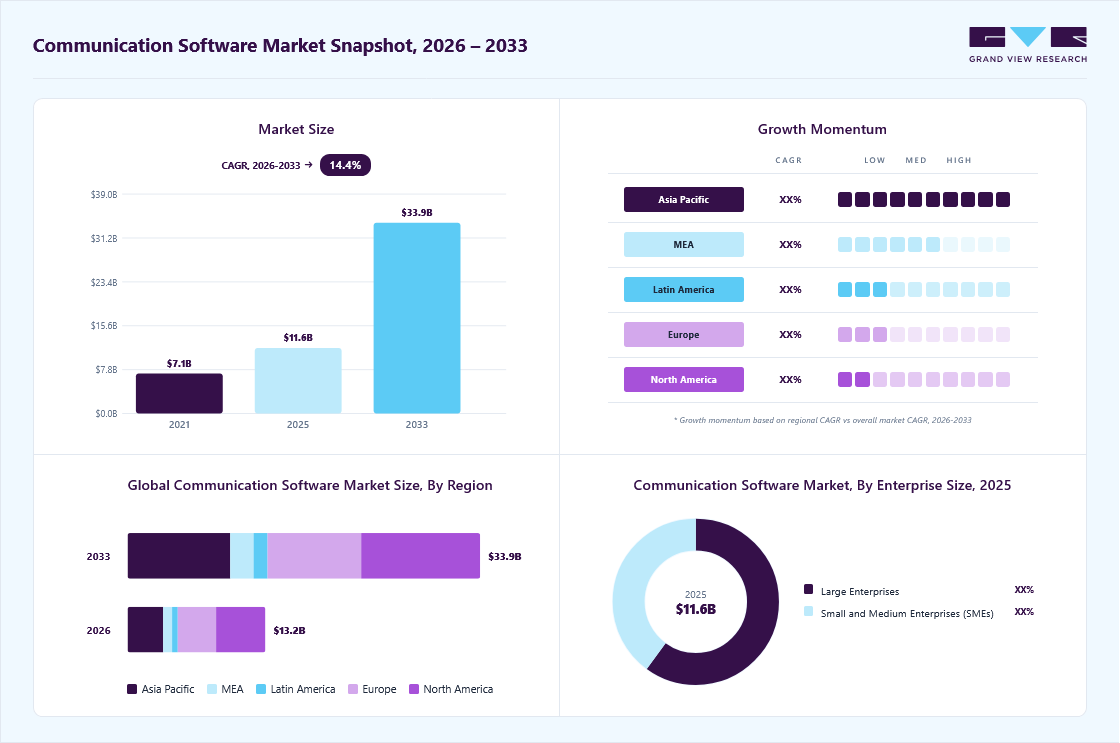
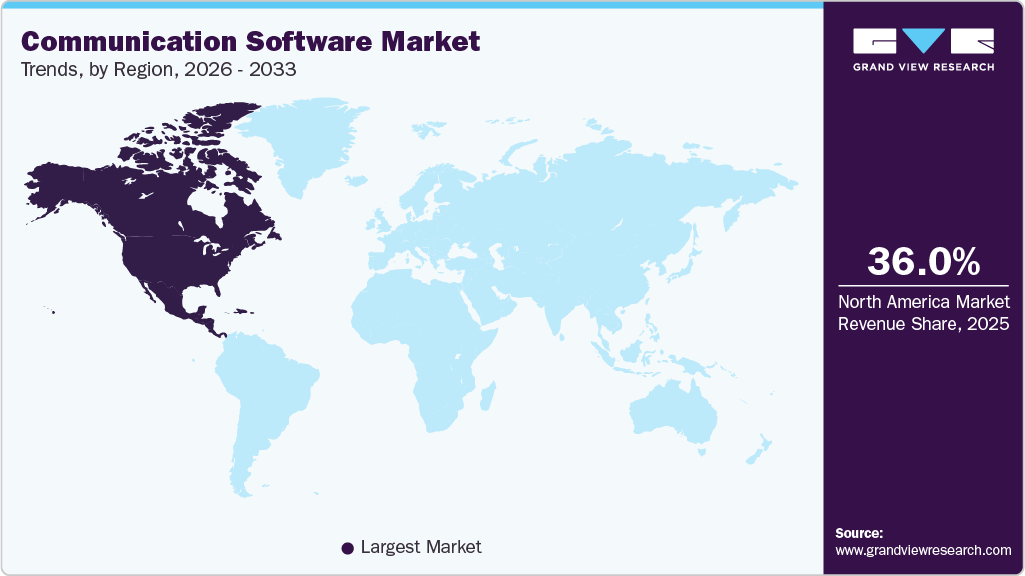
The global communication software market size was valued at USD 11.6 billion in 2025 and is projected to grow from USD 13.2 billion in 2026 to USD 33.9 billion by 2033, at a CAGR of 14.4% from 2026 to 2033. The market in North America dominated with a revenue share of 36.0% in 2025. The increasing reliance on digital communication tools across industries has transformed communication software from a support function into a core enterprise infrastructure component, driving the market growth.
Key Market Trends & Insights
- By communication type: Video conferencing segment held the largest market share of 28.6% in 2025.
- By deployment: Cloud-based (SaaS) segment held the largest market share in 2025.
- By enterprise size: Large enterprise segment held the largest market share in 2025.
- By industry vertical: IT & telecom segment held the largest market share in 2025.
Regional Highlights
- Largest regional market: North America (36.0% revenue share, 2025)
- By country: U.S. held the largest market share in 2025
Market Size & Forecast
- Market size in 2025: USD 11.6 Billion
- Estimated market size in 2026: USD 13.2 Billion
- Projected market size by 2033: USD 33.9 Billion
- CAGR (2026-2033): 14.4%
The global shift toward remote and hybrid work has fundamentally transformed how organizations operate, making communication software a critical business enabler. Companies are increasingly supporting distributed teams across geographies, which has significantly increased reliance on digital tools such as video conferencing, instant messaging, and collaboration platforms. This shift has led to a sustained surge in demand for seamless, real-time communication solutions. These tools enable employees to stay connected, collaborate effectively, and maintain productivity regardless of location. In addition, they support employee engagement through virtual interactions and team coordination. As hybrid work becomes a long-term norm, organizations continue investing in advanced communication technologies to ensure business continuity, operational efficiency, and a consistent employee experience.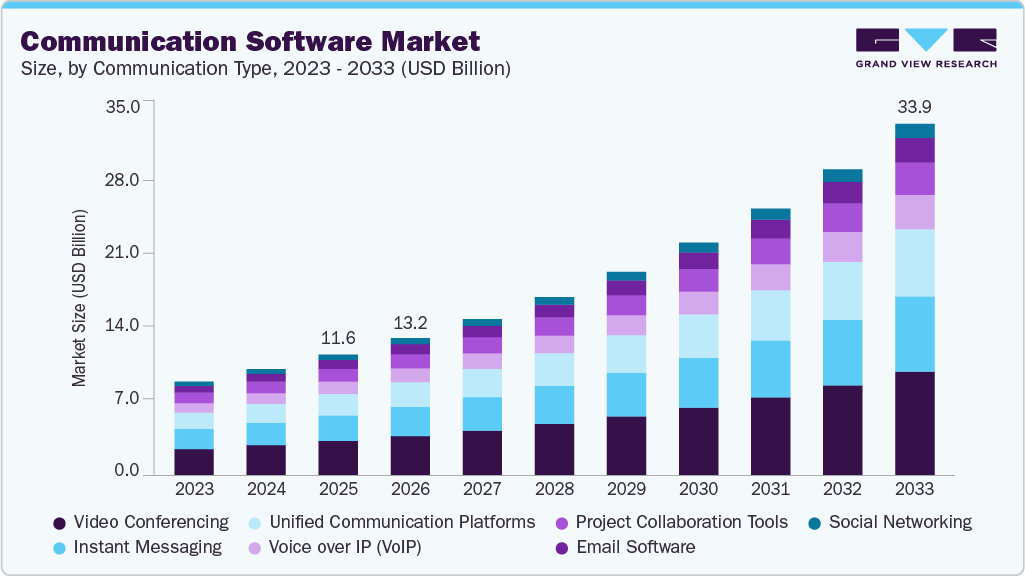
The rapid adoption of cloud computing and SaaS-based models is significantly accelerating growth in the communication software market. Cloud-based solutions provide organizations with high scalability and flexibility, allowing them to easily adjust usage based on business needs. They also eliminate large upfront infrastructure costs, making advanced communication tools more affordable. Subscription-based pricing further lowers entry barriers, especially for small and medium-sized enterprises (SMEs). As a result, more businesses can adopt these solutions, expanding the overall market and driving widespread adoption across industries of varying sizes and digital maturity levels.
Market saturation in developed regions, especially among large enterprises, limits growth opportunities for communication software vendors. Many organizations have already implemented advanced communication platforms, leaving less room for new customer acquisition. As a result, the market is shifting from first-time adoption to system upgrades, enhancements, and replacements. This transition slows overall growth rates and intensifies competition among vendors to retain existing customers and differentiate through innovation and added features.
Communication Type Insights
The video conferencing segment dominated the market and accounted for the revenue share of 28.6% in 2025. The growth of global and distributed teams is a key driver for video conferencing adoption in the coming years. As organizations expand across regions, employees often work from different locations and time zones, making in-person collaboration difficult. Video conferencing enables real-time, face-to-face communication, helping teams stay aligned and connected. It improves coordination, speeds up decision-making, and ensures seamless collaboration across borders. Additionally, it reduces dependency on business travel, lowering costs while maintaining communication effectiveness and enhancing overall operational efficiency in global business environments.
The unified communication platforms segment is anticipated to grow at the fastest CAGR during the forecast period. The growing demand for integrated communication solutions is driving adoption of unified communication platforms. Organizations are replacing multiple standalone tools with all-in-one platforms that combine messaging, voice, video, and collaboration features. This consolidation simplifies workflows, reduces the need to switch between applications, and enhances overall productivity. By providing a seamless communication experience, unified platforms help enterprises improve efficiency, streamline operations, and support better collaboration across teams and departments.
Deployment Insights
The cloud-based (SaaS) segment dominated the market and accounted for the largest revenue share in 2025. Lower upfront costs and subscription-based pricing are major drivers of cloud-based communication software adoption. Unlike traditional on-premises systems, cloud solutions eliminate the need for expensive hardware, infrastructure, and maintenance investments. Instead, organizations pay a predictable monthly or annual fee, shifting spending from capital expenditure (CapEx) to operational expenditure (OpEx). This makes advanced communication tools more accessible, particularly for small and medium-sized enterprises (SMEs) with limited budgets. As a result, more businesses can adopt and scale these solutions easily, significantly expanding market reach and accelerating overall adoption across industries.
The hybrid segment is expected to grow at a significant CAGR during the forecast period. Organizations are combining the scalability of cloud solutions with the control of on-premise systems. Hybrid models allow businesses to store sensitive or critical data locally while using cloud platforms for communication and collaboration. This approach ensures better data governance, improved security, and operational flexibility, enabling companies to optimize performance while meeting regulatory and business requirements.
Enterprise Size Insights
The large enterprise segment dominated the market and accounted for the largest revenue share in 2025. Large enterprises have complex and large-scale communication requirements due to their operations across multiple locations, departments, and time zones. This creates a strong need for robust and scalable communication platforms that can handle high volumes of interactions. Integrated solutions help streamline both internal collaboration and external communication with clients and partners. By centralizing communication tools, organizations can improve coordination, enhance productivity, and ensure consistent communication, enabling efficient management of large, geographically dispersed teams and business operations.
The small & medium enterprises segment is expected to grow at a significant CAGR during the forecast period. Low-cost cloud and SaaS adoption is a key growth driver for SMEs in the communication software market. Cloud-based solutions offer affordable, subscription-based pricing, eliminating the need for large upfront investments in infrastructure. This allows small and medium-sized businesses to access advanced communication tools without financial strain. As a result, SMEs can enhance collaboration, improve efficiency, and scale their operations easily, driving increased adoption of communication software across this segment.
Industry Vertical Insights
The IT & Telecom segment dominated the market and accounted for the largest revenue share in 2025. The presence of a large distributed workforce is a key driver for communication software in the IT and telecom sector. With teams spread across different regions and time zones, seamless communication becomes essential for coordination and productivity. Video conferencing, messaging, and unified communication platforms enable real-time interaction and collaboration. These tools help organizations maintain efficiency, ensure quick decision-making, and keep globally dispersed teams connected, driving strong demand for advanced communication solutions.
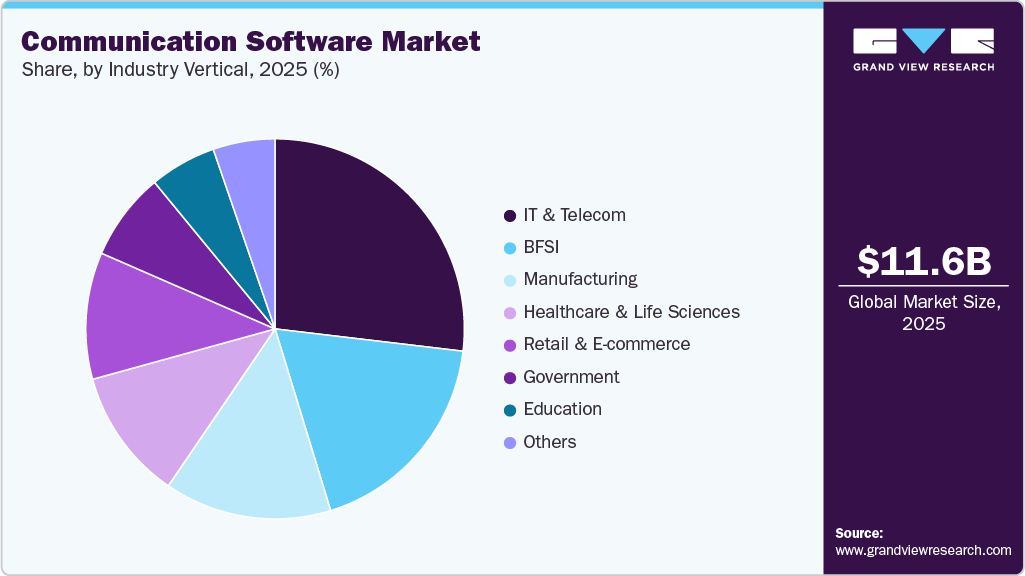
The healthcare & life sciences segment is expected to grow at a significant CAGR over the forecast period. The need for real-time clinical collaboration is a major driver in healthcare communication software adoption. Medical professionals require instant communication to coordinate patient care, discuss diagnoses, and respond quickly during emergencies. Communication platforms enable seamless interaction among doctors, nurses, and specialists, ensuring timely information sharing. This improves decision-making, enhances patient outcomes, and increases operational efficiency, making real-time communication tools essential in modern healthcare environments.
Regional Insights
North America dominated the global market with the largest revenue share of 36.04% in 2025. North America has one of the highest adoption rates of cloud-based and SaaS communication solutions. Organizations prefer cloud platforms for scalability, flexibility, and cost efficiency, accelerating market growth.
U.S. Communication Software Market Trends
The communication software industry in the U.S. is expected to grow significantly at a CAGR of 13.1% from 2026 to 2033. The region hosts leading companies such as Microsoft, Zoom Video Communications, Cisco Systems, and Google. Their continuous innovation, product development, and ecosystem expansion significantly boost market adoption.
Europe Communication Software Market Trends
The communication software industry in Europe is anticipated to register considerable growth from 2026 to 2033. The growing adoption of hybrid work models in Europe is driving demand for communication software. As organizations embrace flexible work environments, employees need reliable tools for collaboration and connectivity. Video conferencing, messaging, and unified communication platforms enable seamless interaction, ensuring productivity, efficient teamwork, and consistent communication across remote and in-office work settings.
The UK communication software market is expected to grow rapidly in the coming years. High cloud and SaaS penetration is driving communication software adoption in the UK. Organizations, especially SMEs, prefer cloud-based solutions for their scalability, flexibility, and cost efficiency. These platforms reduce infrastructure needs and enable easy access to advanced communication tools, supporting business growth, improving collaboration, and accelerating digital transformation across industries.
Communication software market in Germany held a substantial market share in 2025. Germany’s strong industrial and enterprise base drives demand for advanced communication software. Large manufacturing firms require secure, scalable solutions to coordinate operations across factories, offices, and supply chains. These tools enable real-time collaboration, improve efficiency, and ensure smooth communication between teams, supporting complex, multi-location business environments and enhancing overall operational performance.
Asia Pacific Communication Software Market Trends
Asia Pacific communication software industry held a significant share in the global market in 2025. Rapid digital transformation across Asia Pacific is accelerating the adoption of communication software. Enterprises are leveraging these tools to modernize business operations, enable seamless collaboration, and improve overall productivity. As organizations digitize workflows and processes, communication platforms become essential for efficiency, faster decision-making, and maintaining competitiveness in a rapidly evolving business environment.
Communication software market in Japan is expected to grow rapidly in the coming years. Japan is increasingly adopting cloud and hybrid communication solutions as organizations seek to balance innovation with data control. While cloud platforms offer scalability and flexibility, hybrid models allow sensitive data to remain on-premises. This approach enables businesses to modernize communication systems while maintaining security, compliance, and operational control.
The China communication software market held a substantial market share in 2025. China’s expanding SME and startup ecosystem is driving strong adoption of communication software. These businesses prefer cost-effective, cloud-based solutions that require minimal upfront investment. Such tools enable them to scale operations, enhance collaboration, and improve efficiency. As the number of SMEs grows, demand for flexible and affordable communication platforms continues to rise.
Key Communication Software Company Insights
Key players operating in the communication software industry are Microsoft Corporation, Zoom Video Communications, Cisco Systems, Google, Salesforce, RingCentral, 8x8, Mitel, Avaya, Vonage, Twilio, Sinch, Bandwidth Inc., Slack Technologies, and Mattermost. The companies are focusing on various strategic initiatives, including new product development, partnerships & collaborations, and agreements to gain a competitive advantage over their rivals. The following are some instances of such initiatives.
Key Communication Software Companies:
The following key companies have been profiled for this study on the communication software market.
- Microsoft Corporation
- Zoom Video Communications
- Cisco Systems
- Salesforce
- RingCentral
- 8x8
- Mitel
- Avaya
- Vonage
- Twilio
- Sinch
- Bandwidth Inc.
- Slack Technologies
- Mattermost
Recent Developments
-
In March 2026, Avaya announced the launch of Avaya Nexus, a mission-critical voice platform designed for highly regulated industries such as healthcare, government, and financial services. The solution emphasizes zero-downtime reliability, high-quality voice clarity, and advanced security. It supports hybrid and cloud deployments, allowing organizations to modernize without replacing existing systems. The platform also integrates AI capabilities such as real-time transcription and analytics, enabling enterprises enhance communication while maintaining strict compliance and operational control.
-
In March 2026, Twilio announced a partnership with KPN which will enable nationwide Rich Communication Services (RCS) business messaging in the Netherlands. This solution enhances traditional SMS with interactive features such as verified sender identity, images, and action buttons, making communication more engaging and secure. It allows businesses to modernize customer interactions without complex integration, while ensuring wide reach through SMS fallback. The collaboration also expands access to millions of users, supporting scalable and data-driven customer engagement.
-
In November 2025, RingCentral announced an Agentic Voice AI Communications Suite that integrates AI across the entire communication lifecycle before, during, and after interactions. The suite includes AI Receptionist (AIR) for call handling and lead capture, AI Virtual Assistant (AVA) for real-time guidance, and AI Conversation Expert (ACE) for post-call insights. These tools automate workflows, enhance customer engagement, and provide actionable intelligence, helping businesses improve productivity, optimize communication processes, and drive better customer outcomes.
Communication Software Market Report Scope
Report Attribute
Details
Market size in 2025
USD 11.6 billion
Estimated market size in 2026
USD 13.2 billion
Projected market size by 2033
USD 33.9 billion
Growth rate
CAGR of 14.4% from 2026 to 2033
Actual data
2021 - 2025
Forecast period
2026 - 2033
Quantitative units
Revenue in USD million/billion and CAGR from 2026 to 2033
Report enterprise size
Revenue forecast, company share, competitive landscape, growth factors, and trends
Segments covered
Communication type, deployment, enterprise size, industry vertical, region
Regional scope
North America; Europe; Asia Pacific; Latin America; MEA
Country scope
U.S.; Canada; Mexico; UK; Germany; France; China; India; Japan; Australia; South Korea; Brazil; UAE; Saudi Arabia; South Africa
Key companies profiled
Microsoft Corporation; Zoom Video Communications; Cisco Systems; Google; Salesforce; RingCentral; 8x8; Mitel; Avaya; Vonage; Twilio; Sinch; Bandwidth Inc.; Slack Technologies; Mattermost
Customization scope
Free report customization (equivalent to 8 analysts working days) with purchase. Addition or alteration to country, regional & segment scope.
Pricing and purchase options
Avail customized purchase options to meet your exact research needs. Explore purchase options
Global Communication Software Market Report Segmentation
This report forecasts revenue growth at the global, regional, and country levels and provides an analysis of the latest industry trends in each of the sub-segments from 2021 to 2033. For this study, Grand View Research has segmented the global communication software market report based on communication type, deployment, enterprise size, industry vertical, and region.
-
Communication Type Outlook (Revenue, USD Billion, 2021 - 2033)
-
Email Software
-
Instant Messaging
-
Social Networking
-
Video Conferencing
-
Voice over IP (VoIP)
-
Unified Communication Platforms
-
Project Collaboration Tools
-
-
Deployment Outlook (Revenue, USD Billion, 2021 - 2033)
-
Cloud-Based (SaaS)
-
On-premise
-
Hybrid Deployment
-
-
Enterprise Size Outlook (Revenue, USD Billion, 2021 - 2033)
-
Small & Medium Enterprises
-
Large Enterprise
-
-
Industry Vertical Outlook (Revenue, USD Billion, 2021 - 2033)
-
BFSI
-
Government
-
Healthcare and Life Sciences
-
IT & Telecom
-
Manufacturing
-
Education
-
Retail and E-commerce
-
Others
-
-
Regional Outlook (Revenue, USD Billion, 2021 - 2033)
-
North America
-
U.S.
-
Canada
-
Mexico
-
-
Europe
-
UK
-
Germany
-
France
-
-
Asia Pacific
-
China
-
India
-
Japan
-
South Korea
-
Australia
-
-
Latin America
-
Brazil
-
-
Middle East & Africa
-
UAE
-
Saudi Arabia
-
South Africa
-
-
Frequently Asked Questions About This Report
The video conferencing segment led with a 28.6% revenue share in 2025, while the unified communication platforms segment is the fastest-growing.
The cloud-based (SaaS) segment held the largest revenue share in 2025.
The large enterprise segment held the largest revenue share in 2025.
IT & telecom segment held the largest share in 2025.
The global communication software market size was valued at USD 11.6 billion in 2025 and is estimated at USD 13.2 billion for 2026.
The global communication software market is expected to grow at a CAGR of 14.4% from 2026 to 2033, reaching USD 33.9 billion by 2033.
North America dominated with a 36.0% revenue share in 2025.
Key players include Microsoft Corporation; Zoom Video Communications; Cisco Systems; Google; Salesforce; RingCentral; 8x8; Mitel; Avaya; Vonage; Twilio; Sinch; Bandwidth Inc.; Slack Technologies; Mattermost
The increasing reliance on digital communication tools across industries has transformed communication software from a support function into a core enterprise infrastructure component, driving market growth.
About the Author(s)
Next Generation Technologies Research Team
Technology · Next Generation TechnologiesThis report was authored by the next generation technologies research team at Grand View Research - comprising two research analysts, one senior research analyst, and one industry expert - with specialized expertise in the next generation technologies segment of the technology industry. All findings are based on proprietary technology databases, executive interviews, and regulatory analysis, subject to internal peer review prior to publication.
Last Updated:
Speak to Analyst


Customize this report to your needs — add regions, segments, or data points, with 20% free customization.
Or view our licence options:


ISO 9001:2015 & 27001:2022 Certified
We are GDPR and CCPA compliant! Your transaction & personal information is safe and secure. For more details, please read our privacy policy.


