
- Home
- »
- Power Generation & Storage
- »
-
Community Energy Storage Market Size Report, 2026-2033GVR Report cover

Community Energy Storage Market (2026 - 2033)
Size, Share & Trends Analysis Report By Component (Hardware, Software, Services), By Battery Type, By Application, By Region, And Segment Forecasts
Market Size, 2025
$4.8BMarket Estimate, 2026
$5.3BMarket Forecast, 2033
$13.7BCAGR, 2026–2033
14.7%Community Energy Storage Market Summary
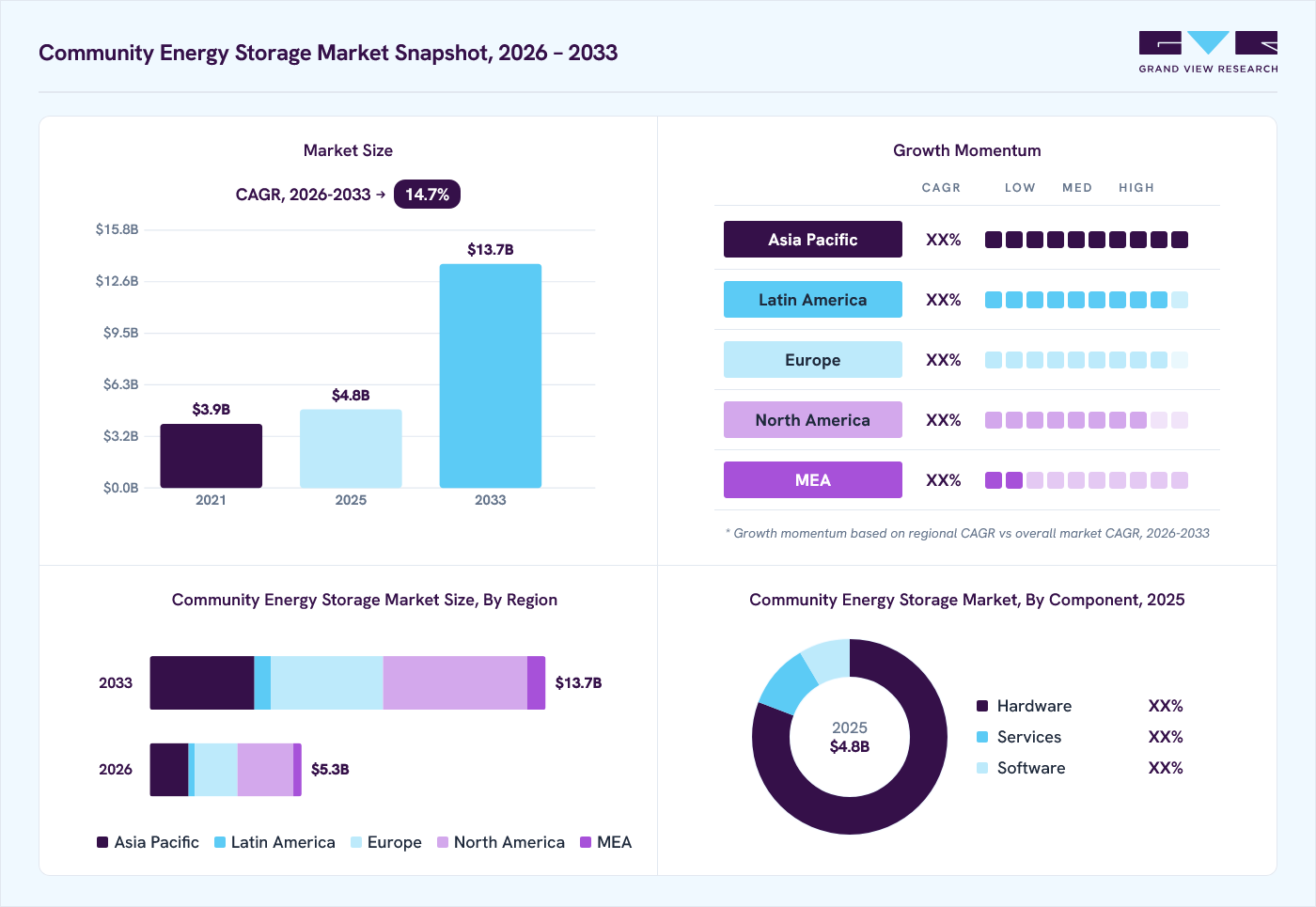
The global community energy storage market size was valued at USD 4.8 billion in 2025 and is projected to grow from USD 5.3 billion in 2026 to USD 13.7 billion by 2033, at a CAGR of 14.7% from 2026 to 2033. The market in North America dominated with a revenue share of 36.8% in 2025. Community Energy Storage (CES) is a localized battery energy storage system that serves multiple homes, businesses, or community facilities by storing electricity and supplying it during periods of high demand, outages, or low renewable generation.
 Source: Grand View Research, IR Documents, Primary Interviews, Paid DatabasesTo learn more about this report,
 Download Free Sample Report
Key Market Trends & Insights
- By component: Hardware held the largest revenue share of 80.7% in 2025
- By battery type: Lithium-ion held the largest revenue share of 88.0% in 2025
- By application: Residential segment held the largest revenue share of 32.7% in 2025
Regional Highlights
- Largest regional market: North America (36.8% revenue share, 2025)
- Fastest-growing regional market: Asia Pacific (highest CAGR, 2026-2033)
- By country: Mexico is expected to grow at a CAGR of 16.9% from 2026 to 2033
Market Size & Forecast
- Market Size in 2025: USD 4.8 Billion
- Estimated Market Size in 2026: USD 5.3 Billion
- Projected Market Size by 2033: USD 13.7 Billion
- CAGR (2026-2033): 14.7%
Prism AI by Grand View Research Free to tryAsk a question about the community energy storage market✓Every figure cited from GVR research Prefer the report? Download free sample →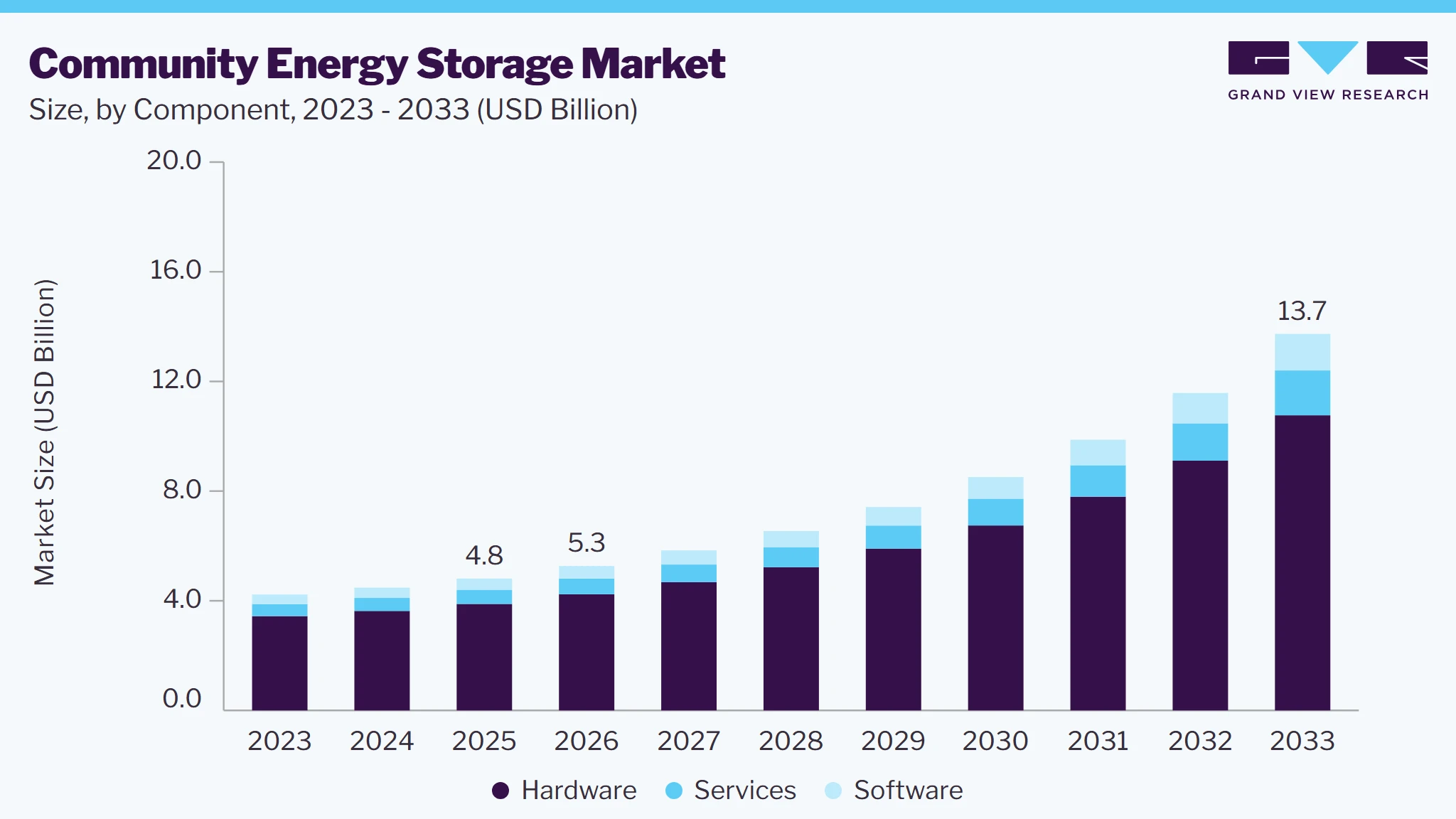 To learn more about this report, Download Free Sample Report
Market Dynamics
The community energy storage market is experiencing strong growth, driven by the increasing integration of renewable energy, rising electricity demand, and the need for more resilient and decentralized power systems. Utilities and local governments are investing in shared battery storage solutions to reduce peak demand, improve grid stability, and enhance energy reliability while avoiding costly grid infrastructure upgrades. Supportive government incentives, falling battery costs, and the expansion of smart grid technologies are further accelerating market adoption. However, high upfront capital costs, regulatory uncertainties, and challenges related to ownership models, revenue streams, and grid interconnection remain key constraints affecting large-scale deployment.
The increasing deployment of solar and wind power is driving demand for community energy storage systems to manage the variability of renewable electricity generation. These systems store excess energy during periods of high generation and supply it during peak demand or when renewable output declines. Community energy storage also enhances grid reliability, reduces peak load, and supports the transition toward decentralized energy systems. Falling battery prices and supportive government policies are further accelerating market adoption.
In October 2024, the U.S. Department of Energy (DOE) announced funding under its Grid Resilience and Innovation Partnerships (GRIP) Program for projects that include community-scale battery energy storage integrated with renewable energy. The initiative focuses on improving grid resilience, expanding clean energy access, and strengthening local electricity infrastructure, particularly in rural and underserved communities. Such investments highlight the growing role of community energy storage in supporting renewable energy integration and grid modernization.
The high initial investment required for battery systems, power electronics, installation, and grid integration remains a major restraint for the community energy storage market. Many utilities and local communities face challenges securing financing, especially when long-term revenue streams and cost-recovery mechanisms are unclear. Regulatory uncertainty regarding ownership and compensation for grid services further limits project viability. These factors can delay large-scale deployment despite the growing need for distributed energy storage.
The integration of community energy storage systems into virtual power plants presents a significant growth opportunity for the market. By connecting shared battery systems with distributed renewable energy resources, utilities and energy aggregators can provide grid-balancing services, participate in electricity markets, and generate new revenue streams. Advances in smart energy management platforms, AI-based optimization, and peer-to-peer energy trading are further expanding the commercial potential of community energy storage.
Analyst Perspective
The community energy storage (CES) market is shifting from conventional battery deployment toward intelligent, grid-integrated storage models, with value increasingly derived from energy optimization rather than storage capacity alone. A key emerging trend is the integration of AI-enabled energy management systems, virtual power plant (VPP) platforms, and distributed energy resources, enabling multiple community batteries to be coordinated for peak shaving, demand response, renewable-energy balancing, and grid stability. The growing adoption of long-duration storage technologies such as flow batteries is also expected to diversify the technology mix beyond lithium-ion systems. Overall, the market is moving toward software-driven, flexible, and multi-service storage models that can improve asset utilization and strengthen the economic case for community-scale deployment.
Component Insights
The hardware component dominated the community energy storage industry, accounting for the largest revenue share of 80.7% in 2025. This dominance is attributed to the high upfront costs associated with batteries, power conversion systems, energy management equipment, and other supporting infrastructure. The growing deployment of community-scale battery storage systems is further increasing demand for physical storage hardware. Declining battery costs and improvements in energy density are supporting wider adoption of hardware-based energy storage solutions.
The software segment is anticipated to grow at the fastest CAGR of 16.5% during the forecast period. This growth is driven by increasing adoption of energy management systems, real-time monitoring, and advanced analytics for community energy storage assets. Software solutions enable utilities and operators to optimize battery charging and discharging, improve grid flexibility, and manage distributed energy resources more efficiently. Growing integration of AI-enabled forecasting and automated energy optimization is further supporting segment expansion.
Battery Type Insights
The lithium-ion segment dominated the community energy storage market, accounting for the largest revenue share of 88.0% in 2025. This dominance is attributed to the high energy density, declining battery costs, and established supply chains of lithium-ion technology. Its proven performance and scalability make it well-suited for community energy storage applications that require reliable, efficient energy management. In addition, continued improvements in battery safety, cycle life, and charging efficiency are supporting its widespread deployment.
The flow batteries segment is expected to grow at the fastest CAGR of 15.3% over the forecast period. This growth is driven by their long-duration energy storage capabilities, which make them suitable for balancing variable renewable power generation. Flow batteries also offer high cycle life, low degradation, and flexible capacity scaling, supporting their use in community-scale storage applications. Increasing demand for reliable grid flexibility and long-duration storage is expected to further accelerate the adoption.
Application Insights
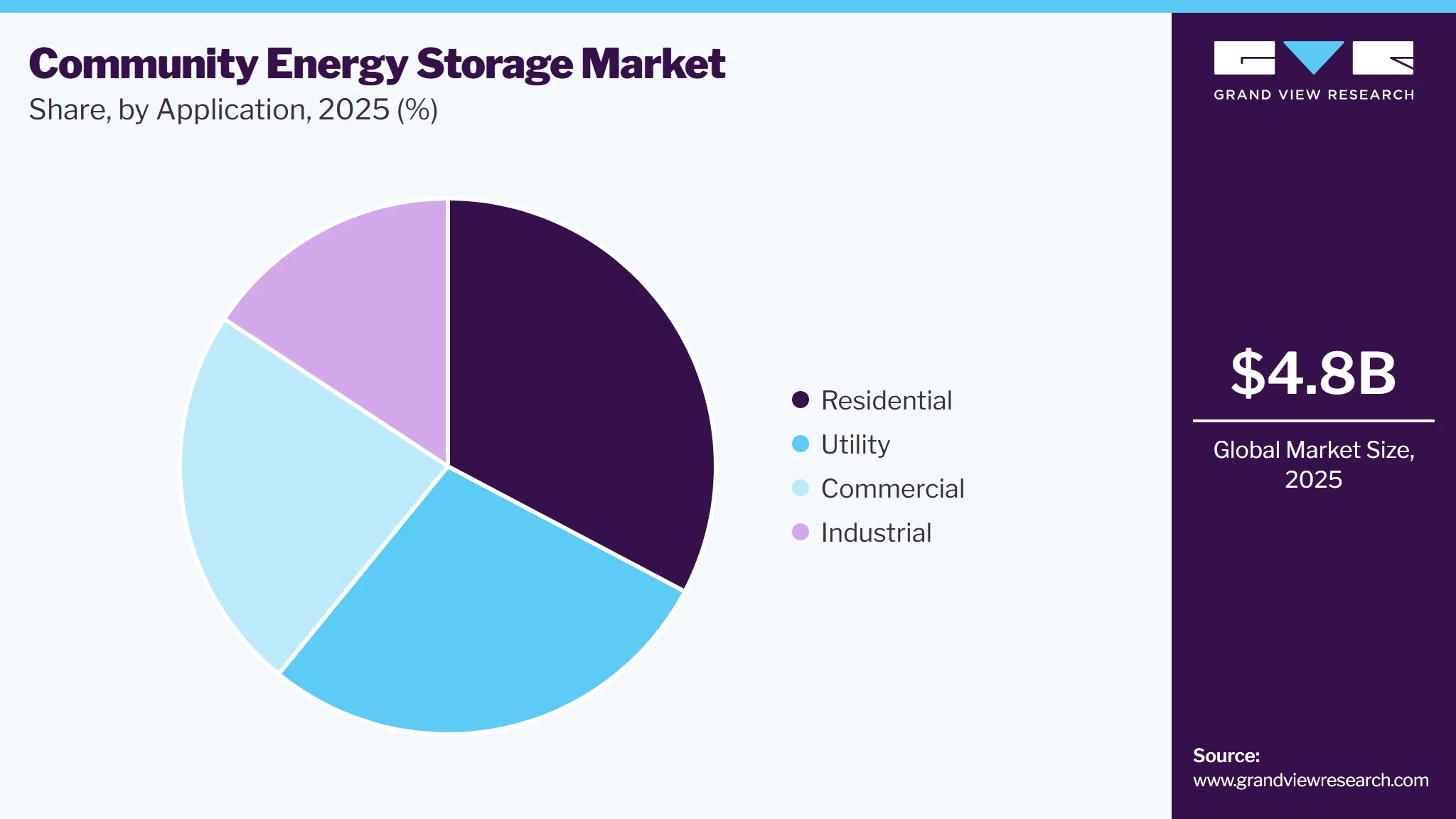
The residential segment dominated the community energy storage industry, accounting for the largest revenue share of 32.7% in 2025. This dominance is driven by rising demand for reliable backup power, lower electricity costs, and greater integration of distributed renewable energy systems. Community energy storage enables households to access shared battery capacity without bearing the full cost of individual storage systems. Increasing adoption of rooftop solar and growing interest in energy resilience are further supporting demand across the residential segment. Moreover, utilities are increasingly deploying community-scale systems to improve grid reliability and provide households with more affordable access to energy storage.
 To learn more about this report, Download Free Sample Report
The commercial segment is anticipated to register the second-fastest CAGR of 15.2% over the forecast period. This growth is driven by rising electricity demand from commercial facilities and the need to reduce peak-hour energy costs. Community energy storage systems help businesses manage load fluctuations, improve power reliability, and optimize energy consumption. The increasing integration of rooftop solar and distributed energy resources is further supporting adoption in commercial applications. Growing emphasis on energy efficiency and grid-interactive buildings is expected to create further demand for community energy storage solutions.
Regional Insights
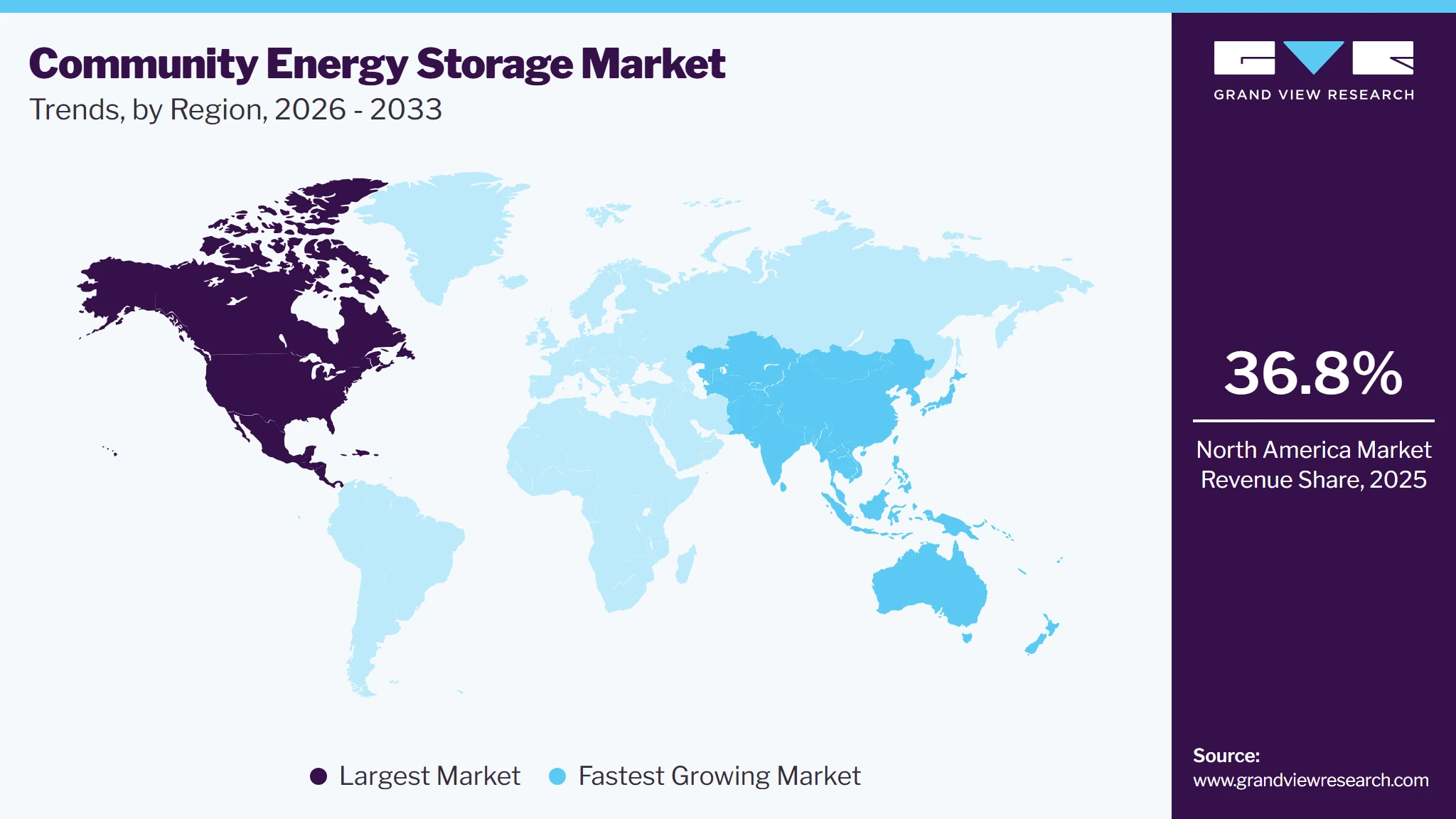
The North America community energy storage market accounted for the largest revenue share of 36.8% in 2025. This growth is driven by advanced grid modernization initiatives, high adoption of renewable energy, and increasing investments in distributed energy resources. Utilities across the region are deploying community battery systems to improve grid reliability, reduce peak electricity demand, and enhance resilience against extreme weather events. Favorable government incentives, supportive energy storage policies, and the expansion of smart grid infrastructure are accelerating market growth. Growing electrification and rising demand for flexible energy management solutions continue to strengthen the adoption of community energy storage across the region.
 To learn more about this report, Download Free Sample Report
U.S. Community Energy Storage Market Trends
The U.S. community energy storage industry is witnessing significant growth due to increasing investments in grid modernization, renewable energy integration, and distributed energy resources. Utilities are deploying community battery systems to improve grid reliability, reduce peak demand, and provide backup power during extreme weather events. Federal funding programs, supportive state-level energy storage policies, and the expansion of virtual power plants are accelerating market adoption. Rising electrification and the growing need for resilient and flexible energy infrastructure are expected to drive continued growth in the U.S. market.
Europe Community Energy Storage Market Trends
Europe is a prominent market for community energy storage, driven by ambitious decarbonization targets, rising renewable energy deployment, and increasing investments in grid flexibility. Community-scale battery systems are being deployed to improve renewable energy integration, strengthen grid resilience, and support decentralized energy networks. According to SolarPower Europe's European Market Outlook for Battery Storage 2025–2029, Europe installed 21.9 GWh of battery energy storage systems in 2024, a 15% increase from the previous year, raising the region's cumulative battery storage capacity to 61.1 GWh. The report also projects annual battery storage installations to reach 29.7 GWh in 2025 and nearly 120 GWh by 2029, highlighting the strong momentum for battery deployment that will support the expansion of community energy storage solutions.
The UK community energy storage market is growing steadily, driven by increasing renewable energy deployment, grid modernization, and the need for greater energy flexibility. Community battery systems are being adopted to improve local energy resilience, reduce peak electricity demand, and support the integration of distributed solar and wind power. Favorable regulatory frameworks, expanding flexibility markets, and investments in smart grid infrastructure are encouraging the deployment of shared energy storage systems. The country's focus on achieving net-zero emissions and strengthening energy security is expected to further accelerate market growth.
Asia Pacific Community Energy Storage Market Trends
The Asia Pacific community energy storage industry is expected to grow at the fastest CAGR of 15.2% over the forecast period. This is driven by rapid renewable energy deployment, rising electricity demand, and large-scale investments in grid modernization. Governments across the region are promoting battery energy storage to improve grid flexibility, strengthen energy security, and support distributed renewable energy systems. The expansion of smart grids and decentralized energy infrastructure is further accelerating the adoption of community energy storage solutions. According to the International Energy Agency (IEA), global battery storage deployments reached a record 108 GW in 2025, with China accounting for around 60% of global battery storage additions, highlighting the region's leadership in energy storage deployment and creating significant opportunities for community energy storage.
Latin America Community Energy Storage Market Trends
The Latin America community energy storage industry is gaining momentum as investments in renewable energy, grid modernization, and distributed energy resources continue to increase. Community battery systems are being adopted to improve grid reliability, enhance energy resilience, and support the integration of solar and other renewable energy sources. Rising electricity demand, efforts to expand energy access, and supportive government initiatives are encouraging the deployment of shared energy storage solutions. The region's ongoing transition toward cleaner and more decentralized power systems is expected to drive sustained market growth.
Middle East & Africa Community Energy Storage Market Trends
The Middle East & Africa community energy storage industry is witnessing gradual growth, supported by increasing investments in renewable energy, rural electrification, and grid modernization initiatives. Community battery systems are being adopted to improve energy reliability, support distributed solar installations, and enhance electricity access in remote and off-grid areas. Governments and utilities are increasingly investing in energy storage to strengthen grid resilience and reduce dependence on conventional power generation. The growing focus on sustainable energy infrastructure and energy security is expected to drive the adoption of community energy storage solutions across the region.
Key Community Energy Storage Company Insights
Some of the key players operating in the global community energy storage market include Tesla, Inc. and Fluence Energy, Inc.
-
Tesla, Inc. is a leading provider in the community energy storage industry, offering advanced battery energy storage solutions through its Megapack and Powerwall product portfolios. The company supports utilities, energy developers, and communities in deploying shared battery systems that improve grid reliability, integrate renewable energy, and provide backup power during outages. Tesla is also expanding community energy storage through VPP programs, enabling distributed battery assets to deliver grid services and optimize energy use. Its strong expertise in battery technology, software-driven energy management, and large-scale storage deployment positions the company as a key market player.
-
Fluence Energy, Inc. is a prominent energy storage technology provider in the community energy storage market, delivering battery energy storage systems and digital energy management solutions for utilities and renewable energy projects. The company's storage platforms help communities improve grid flexibility, manage peak electricity demand, and increase the integration of renewable energy sources. Fluence also offers AI-enabled software for optimizing battery performance, energy trading, and grid operations, enhancing the value of community-scale storage projects. Its global project experience, advanced storage technologies, and strong utility partnerships make Fluence a significant market participant.
Key Community Energy Storage Companies
The following key companies have been profiled for this study of the community energy storage market.
-
BYD Company Ltd.
-
Canadian Solar Inc.
-
Contemporary Amperex Technology Co., Limited (CATL)
-
Fluence Energy, Inc.
-
Hitachi Energy Ltd.
-
Huawei Digital Power Technologies Co., Ltd.
-
LG Energy Solution, Ltd.
-
Schneider Electric SE
-
Sungrow Power Supply Co., Ltd.
-
Tesla, Inc.
Competitive Benchmarking
Category
Operating Strategies
Competitive Edge
Weakness
Established Players (BYD Company Ltd.; Canadian Solar Inc.; Contemporary Amperex Technology Co., Limited (CATL); Hitachi Energy Ltd.; LG Energy Solution, Ltd.; Schneider Electric SE; Sungrow Power Supply Co., Ltd.; Tesla, Inc.)
- Leverage large-scale battery manufacturing capabilities, global supply chains, and established utility partnerships to deploy community energy storage systems across residential, commercial, and grid applications.
- Invest in advanced battery chemistries, energy management software, and smart grid technologies to improve system efficiency, safety, and lifecycle performance.
- Expand integrated energy solutions by combining battery storage with solar PV, EV charging, and virtual power plant platforms to deliver end-to-end energy management services.
- Strong global brand recognition, extensive project portfolios, and proven experience in delivering utility-scale and distributed energy storage systems.
- Significant financial resources and R&D capabilities enable continuous innovation, rapid commercialization, and large-scale manufacturing.
- Well-established sales, service, and distribution networks support faster deployment and long-term customer support across multiple regions.
- Large organizational structures can slow decision-making and delay the adoption of new business models or niche market opportunities.
- High dependence on global battery material supply chains exposes operations to raw material price volatility and geopolitical risks.
- Premium product offerings and integrated solutions may result in higher upfront costs compared to smaller regional competitors.
Emerging Players (Fluence Energy, Inc.; Huawei Digital Power Technologies Co., Ltd.)
- Focus on AI-enabled energy management software, digital platforms, and flexible battery solutions tailored for community and distributed energy storage projects.
- Collaborate with utilities, renewable energy developers, and local governments through strategic partnerships to accelerate market penetration.
- Develop scalable and modular energy storage solutions that can be rapidly deployed for community microgrids, renewable integration, and grid flexibility applications.
- Greater flexibility and faster innovation cycles enable quick adoption of new technologies and customer-specific solutions.
- Strong expertise in software optimization, energy analytics, and intelligent battery management enhances system performance and revenue generation.
- Agile business models allow rapid expansion into emerging community energy storage and virtual power plant opportunities.
- Smaller global footprint and limited manufacturing capacity compared to established industry leaders.
- Greater reliance on partnerships and third-party suppliers for project execution, battery procurement, or market expansion.
- Limited brand recognition and shorter operating history may reduce competitiveness in large utility procurements and government-backed projects.
Recent Developments
-
In September 2025, Fluence Energy, Inc. commenced manufacturing of its next-generation Smartstack energy storage platform at a fully automated production facility in Vietnam. The modular, high-density battery energy storage solution delivers approximately 30% higher energy density than conventional AC-based systems while reducing transportation and installation complexity. The manufacturing facility has an annual production capacity of 35 GWh, enabling Fluence to meet growing global demand for community and utility-scale energy storage solutions. The development strengthens the company's ability to support renewable energy integration, grid resilience, and community energy storage deployments worldwide.
Community Energy Storage Market Report Scope
Report Attribute
Details
Market Definition
Revenue generated from the sales of battery energy storage systems deployed at the community or neighborhood level to serve multiple residential, commercial, municipal, or mixed-use consumers through a shared electricity distribution network.
Market size in 2025
USD 4.8 billion
Estimated market size in 2026
USD 5.3 billion
Projected market size by 2033
USD 13.7 billion
Growth rate
CAGR of 14.7% from 2026 to 2033
Base year for estimation
2025
Historical data
2021 - 2024
Forecast period
2026 - 2033
Quantitative units
Revenue in USD million/billion and CAGR from 2026 to 2033
Report coverage
Revenue forecast, competitive landscape, growth factors, and trends
Segments covered
Component, battery type, application, and region
Regional scope
North America; Europe; Asia Pacific; Latin America; Middle East & Africa
Country scope
U.S.; Canada; Mexico; Germany; UK; France; Italy; Spain; China; India; Japan; South Korea; Australia; Brazil; Argentina; UAE; Saudi Arabia; South Africa
Key companies profiled
BYD Company Ltd.; Canadian Solar Inc.; Contemporary Amperex Technology Co., Limited (CATL); Fluence Energy, Inc.; Hitachi Energy Ltd.; Huawei Digital Power Technologies Co., Ltd.; LG Energy Solution, Ltd.; Schneider Electric SE; Sungrow Power Supply Co., Ltd.; Tesla, Inc.
Customization scope
Free report customization (equivalent up to 8 analysts working days) with purchase. Addition or alteration to country, regional & segment scope.
Pricing and purchase options
Avail customized purchase options to meet your exact research needs. Explore purchase options
Global Community Energy Storage Market Report Segmentation
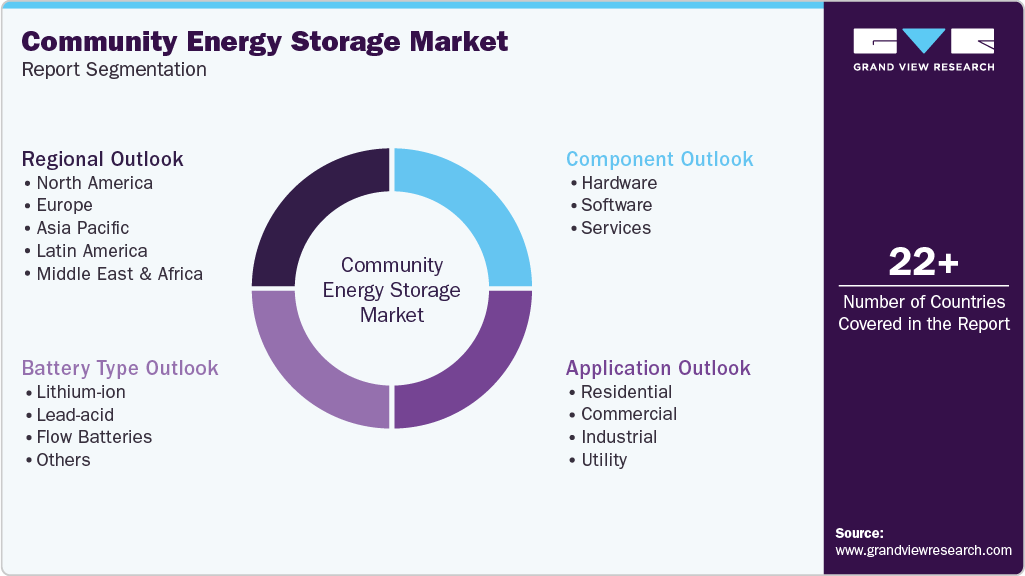
This report forecasts revenue growth at the global, regional, and country levels and provides an analysis of the latest industry trends in each of the sub-segments from 2021 to 2033. For this study, Grand View Research has segmented the global community energy storage market report based on component, battery type, application, and region:
 To learn more about this report, Download Free Sample Report
-
Component Outlook (Revenue, USD Million/Billion, 2021 - 2033)
-
Hardware
-
Software
-
Services
-
-
Battery Type Outlook (Revenue, USD Million/Billion, 2021 - 2033)
-
Lithium-ion
-
Lead-acid
-
Flow Batteries
-
Others
-
-
Application Outlook (Revenue, USD Million/Billion, 2021 - 2033)
-
Residential
-
Commercial
-
Industrial
-
Utility
-
-
Regional Outlook (Revenue, USD Million/Billion, 2021 - 2033)
-
North America
-
U.S.
-
Canada
-
Mexico
-
-
Europe
-
Germany
-
UK
-
France
-
Italy
-
Spain
-
-
Asia Pacific
-
China
-
India
-
Japan
-
South Korea
-
Australia
-
-
Latin America
-
Brazil
-
Argentina
-
-
Middle East & Africa
-
Saudi Arabia
-
UAE
-
South Africa
-
-
Research Methodology
The community energy storage market figures in this report are based on a proven research process that combines executive interviews with secondary research from proprietary databases, company filings, and recognized regulatory and institutional sources. Market size is built through value-chain sizing-reconciling supply-side and demand-side estimates-and triangulated with bottom-up and top-down approaches. Every estimate passes multiple levels of expert validation before publication, with each community energy storage segment quantified using the revenue-capture definitions in the table below.
Segment Definition
Component
Revenue capture definition
Hardware
Includes revenue generated from the sale of physical community energy storage system components, including batteries, battery enclosures, power conversion systems, inverters, transformers, monitoring devices, and other electrical equipment deployed in shared energy storage installations.
Software
Covers revenue from energy management platforms, battery management systems, monitoring software, optimization tools, demand response platforms, and digital solutions used to manage, control, and optimize community energy storage operations.
Services
Captures revenue from installation, integration, maintenance, repair, consulting, grid services, technical support, and operational services provided throughout the lifecycle of community energy storage systems.
Battery Type
Revenue capture definition
Lithium-ion
Includes revenue generated from lithium-ion battery-based community energy storage systems, including lithium iron phosphate (LFP) and other lithium-ion chemistries used for residential, commercial, municipal, and utility-supported shared storage applications.
Lead-acid
Covers revenue from lead-acid battery-based community energy storage solutions, including flooded and valve-regulated lead-acid (VRLA) systems deployed for backup power, load management, and small-scale community storage applications.
Flow Batteries
Captures revenue from flow battery-based community energy storage systems, including vanadium redox flow batteries and other electrochemical flow technologies designed for long-duration energy storage and grid support applications.
Others
Represents revenue from emerging and alternative battery technologies used in community energy storage systems, including sodium-ion, nickel-based, zinc-based, solid-state, and metal-air batteries deployed for distributed energy storage, backup power, and grid support applications.
Application
Revenue capture definition
Residential
Includes revenue generated from community energy storage systems serving multiple residential consumers through shared storage infrastructure, enabling energy cost optimization, backup power, renewable energy integration, and demand management.
Commercial
Covers revenue from community energy storage deployments serving commercial facilities such as offices, retail centers, schools, and public buildings through shared electricity storage systems for peak load management, energy savings, and grid support.
Industrial
Captures revenue from community-scale storage systems deployed for industrial users, including manufacturing facilities, industrial parks, and processing sites requiring energy reliability, demand charge reduction, and renewable power integration.
Utility
Represents revenue from large-scale community energy storage systems owned or operated by utilities or grid operators to support grid balancing, renewable energy integration, peak demand management, and distributed energy resource optimization.
Estimation Model
Layer No.
Layer Name
Key Question
Description
01
Component Layer
Which components contribute to market demand?
Assess demand across hardware, software, and services involved in community energy storage deployments. Analyze adoption based on battery system requirements, energy management needs, installation complexity, grid integration capabilities, lifecycle management, and demand for digital optimization solutions.
02
Battery Type Layer
Which battery technologies drive market adoption?
Evaluate community energy storage demand across lithium-ion, lead-acid, flow batteries, and other emerging battery technologies such as sodium-ion, nickel-based, zinc-based, solid-state, and metal-air batteries. Analyze adoption based on energy density, storage duration, cost competitiveness, safety, lifecycle performance, scalability, and suitability for distributed energy storage applications.
03
Application Layer
Which applications generate the highest demand for CES?
Assess demand across residential, commercial, industrial, and utility applications. Analyze deployment trends based on electricity demand patterns, renewable energy integration, peak load management, backup power requirements, grid stability needs, demand charge reduction, and distributed energy resource management.
04
Revenue Layer
How is market revenue generated?
Market revenue is quantified through the sale of community energy storage systems, including battery storage hardware, energy management software, installation, maintenance, and operational services. Revenue is influenced by battery technology costs, system capacity, electricity pricing, renewable energy adoption, grid modernization initiatives, regulatory support, and investments in distributed energy storage infrastructure.
Delivered Customizations
We have successfully delivered the following deep-dive customizations:
Client Request
Customization Delivered
Value Adds
Battery Technology-Level Opportunity Assessment
Market analysis was performed across lithium-ion, lead-acid, flow batteries, and other emerging battery technologies by evaluating energy density, storage duration, safety characteristics, cost competitiveness, supply chain availability, technological maturity, and suitability for community-scale energy storage deployments.
Enabled identification of high-potential battery technologies based on performance requirements, cost optimization, long-duration storage needs, scalability, and future market adoption potential.
Application-Level Opportunity Assessment
A comprehensive analysis was conducted across residential, commercial, industrial, and utility applications by evaluating electricity consumption patterns, renewable energy integration requirements, grid reliability needs, peak demand management, backup power requirements, and regulatory support for distributed energy storage deployment.
Identified high-growth application areas with strong demand drivers, enabling stakeholders to prioritize market entry strategies, optimize product offerings, and target end users with the highest adoption potential.
Regional Opportunity Assessment
Region-level analysis was conducted to assess community energy storage adoption based on renewable energy penetration, grid modernization initiatives, energy storage policies, distributed energy resource programs, electricity pricing trends, and investments in smart grid infrastructure.
Identified attractive regions with favorable regulatory frameworks, increasing renewable energy integration, growing energy storage demand, and strong investment potential for community-scale storage solutions.
Frequently Asked Questions About This Report
The global community energy storage market size was valued at USD 4.8 billion in 2025 and is estimated at USD 5.3 billion for 2026.
The global community energy storage market is expected to grow at a CAGR of 14.7% from 2026 to 2033, reaching USD 13.7 billion by 2033.
Increasing renewable energy integration, grid modernization initiatives, rising electricity demand, and government incentives for distributed energy storage are driving the growth of the community energy storage market.
The North America region dominated the community energy storage market with a revenue share of 36.8% in 2025.
The U.S. dominated the North America region market with a revenue share of 87.4% in 2025.
Asia Pacific is anticipated to register the fastest CAGR of 15.2% over the forecast period.
Based on battery type, the lithium-ion segment accounted for largest revenue share of 88.0% in 2025.
Based on application, the residential segment accounted for largest revenue share of 32.7% in 2025.
The key players operating in the community energy storage market are BYD Company Ltd., Canadian Solar Inc., Contemporary Amperex Technology Co., Limited (CATL), Fluence Energy, Inc., Hitachi Energy Ltd., Huawei Digital Power Technologies Co., Ltd., LG Energy Solution, Ltd., Schneider Electric SE, SUNGROW, Tesla, Inc., and others.
About the Author(s)
Power Generation & Storage Research Team
Energy & Power · Power Generation & StorageThis report was authored by the power generation & storage research team at Grand View Research - comprising two research analysts, one senior research analyst, and one industry expert - with specialized expertise in the power generation & storage segment of the energy & power industry. All findings are based on proprietary energy & power databases, executive interviews, and regulatory analysis, subject to internal peer review prior to publication.
Last Updated:
Speak to Analyst

Customize this report to your needs - add regions, segments, or data points, with 20% free customization.
Or view our licence options:


ISO 9001:2015 & 27001:2022 Certified
We are GDPR and CCPA compliant! Your transaction & personal information is safe and secure. For more details, please read our privacy policy.


