
- Home
- »
- Advanced Interior Materials
- »
-
Copper Foil for Battery Market Size And Share Report, 2033GVR Report cover

Copper Foil For Battery Market (2026 - 2033)
Size, Share & Trends Analysis Report By Application (Electric Vehicles, Energy Storage Systems, Consumer Electronics), By Thickness (Ultra-thin (?5 µm, incl. 4.5/4 µm), 6 µm, 8 µm, Thick (>8 µm)), By Region, And Segment Forecasts
Market Size, 2025
$15.7BMarket Estimate, 2026
$25.2BMarket Forecast, 2033
$58.7BCAGR, 2026–2033
12.8%Copper Foil for Battery Market Summary
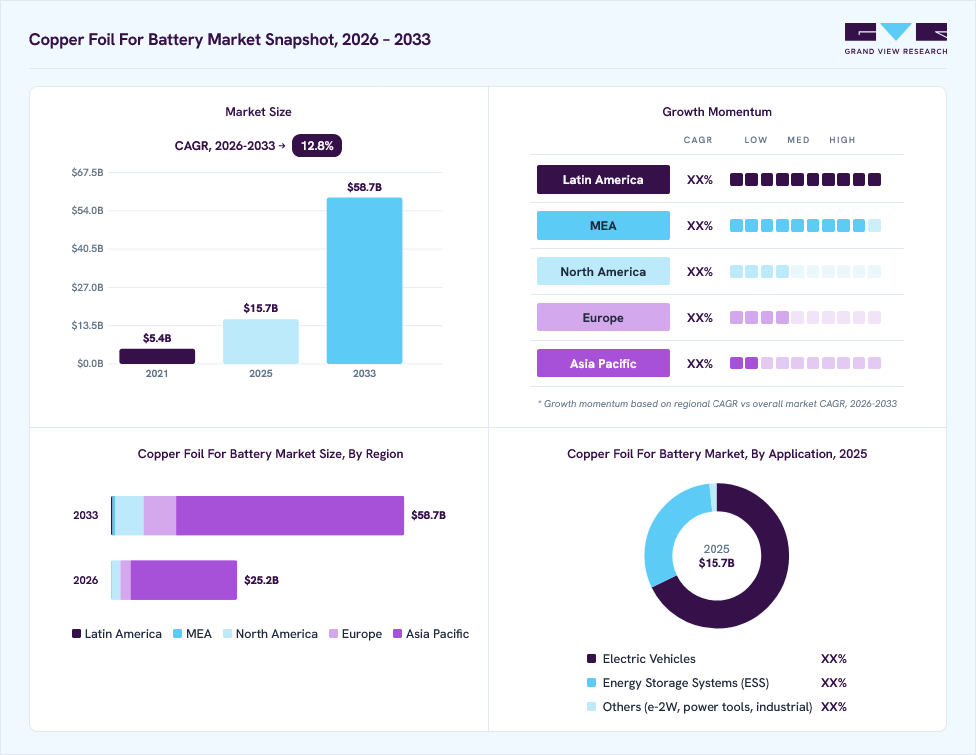
The global copper foil for battery market size was valued at USD 15.7 billion in 2025 and is projected to grow from USD 25.2 billion in 2026 to USD 58.7 billion by 2033, at a CAGR of 12.8% from 2026 to 2033. Asia Pacific dominated the market, accounting for a revenue share of 85.0% in 2025. Growth is primarily driven by rising demand for high-performance lithium-ion batteries across electric vehicles (EVs), energy storage systems (ESS), and consumer electronics.
 Source: Grand View Research, IR Documents, Primary Interviews, Paid DatabasesTo learn more about this report,
 Download Free Sample Report
Key Market Trends & Insights
- By application: Electric vehicles held the largest revenue share of 65.5% in 2025.
- By thickness: Ultra-thin (≤5 µm, incl. 4.5/4 µm) segment is expected to grow at the fastest CAGR of 21.6% from 2026 to 2033.
Regional Highlights
- Largest regional market: Asia Pacific (85.0% revenue share, 2025)
- Fastest-growing regional market: Latin America (fastest CAGR, 2026-2033)
Market Size & Forecast
- Market Size in 2025: USD 15.7 Billion
- Estimated Market Size in 2026: USD 25.2 Billion
- Projected Market Size by 2033: USD 58.7 Billion
- CAGR (2026-2033): 12.8%
Three ways to get this report
Buy it, customize it, or ask a question.Ask an Analyst
Analyst response in 1 business day
- AccessReport author, directly
- Reply timeWithin 1 working day
- No sales callDirect answer only
- FormatEmail reply
- CostFree, no cost
Get the Full Report
What the study covers
- FormatsPDF · Excel · Dashboard
- Timeline2026–2033 annual, 2025 base
- Coverage20+ countries, 5 regions
- Companies10+ key players profiled
Customize the Report
20% free customization
- IncludeCountries, segments, points
- TailorTo your product definition
- ExtendDeeper competitor detail
- OrA fully bespoke study
- Turnaround5–10 working days
Increasing EV production, expanding battery manufacturing capacity, and growing investments in renewable energy storage are supporting demand for battery-grade copper foil, which serves as the anode current collector in lithium-ion batteries.Growing emphasis on sustainable manufacturing is encouraging copper foil producers to improve resource efficiency, reduce production waste, and optimize copper utilization. Copper foil is an essential component of lithium-ion battery anodes, and improvements in foil thickness, production yields, and material recovery can help reduce copper consumption per unit of capacity. Manufacturers are increasingly focusing on process optimization, recycling production scrap, and improving the recovery of copper from manufacturing waste.
 To learn more about this report, Download Free Sample Report
Technological advancements in electrodeposited copper foil production are expanding the performance capabilities of high-quality copper foil. Manufacturers are improving electrodeposition processes, drum surface characteristics, thickness control, and surface-treatment techniques to produce thinner foils with consistent physical and electrical properties. These developments are particularly important for ultra-thin copper foil measuring 5 µm or less, including 4.5 µm and 4 µm grades, which can help reduce current collector weight and increase the proportion of active materials within a cell. Improvements in tensile strength, elongation, surface uniformity, and handling characteristics are also helping manufacturers address the processing challenges associated with thinner foil.
Market Dynamics
Increasing demand for lithium-ion batteries across EVs, ESS, and consumer electronics is driving demand for copper foil. Copper foil functions as the anode current collector, providing electrical conductivity and supporting electron transfer during charging and discharging. Growth in EV production, expansion of manufacturing capacity, and investments in electrification are increasing the requirement for reliable, high-performance current collector materials. Automakers and manufacturers are also focusing on improving energy density, driving range, charging performance, and weight efficiency, supporting the use of advanced copper foil grades.
The expansion of energy storage installations and continued demand for portable electronic devices are further broadening copper foil consumption across applications. Grid-scale and commercial energy storage systems use lithium-ion technology to support renewable energy integration, electricity balancing, and backup power requirements. Meanwhile, smartphones, laptops, tablets, and other portable electronics require compact cells with reliable electrical performance. These applications create demand for copper foil with different thicknesses and performance characteristics, depending on design and operating requirements.
High capital investment and stringent production requirements can constrain the manufacturing and adoption of battery-grade copper foil. Producing ultra-thin grades requires precise control over thickness uniformity, surface roughness, tensile strength, elongation, and defect levels. Pinholes, surface imperfections, or variations in material properties can affect electrode processing, battery performance, and manufacturing yields. Production facilities also require specialized equipment, high-purity copper inputs, controlled operating conditions, and rigorous quality assurance, increasing capital and operating expenditure.
The expansion of renewable energy generation and the increasing deployment of battery-based energy storage systems are creating opportunities for copper foil manufacturers. Solar and wind installations require storage solutions to manage intermittent electricity generation, improve grid stability, and support reliable power delivery. Lithium-ion batteries are increasingly used in utility-scale storage projects, commercial and industrial installations, and residential energy storage systems, supporting demand for copper foil used in battery anode current collectors. Investments in grid modernization, renewable energy integration, and distributed energy infrastructure are creating additional opportunities for suppliers serving the energy storage systems segment.
Analyst Perspective
The copper foil for battery industry is increasingly benefiting from the expansion of lithium-ion battery manufacturing across electric vehicles, energy storage systems, and consumer electronics. Growing emphasis on battery energy density, weight reduction, charging performance, and production efficiency is encouraging the adoption of advanced copper foil grades, particularly ultra-thin products measuring 5 µm or less. Manufacturers are investing in electrodeposition technology, precision thickness control, and surface treatments to improve mechanical strength, electrode adhesion, and production consistency. At the same time, capacity expansion, copper price volatility, and evolving battery technologies are shaping competitive strategies.
Application Insights
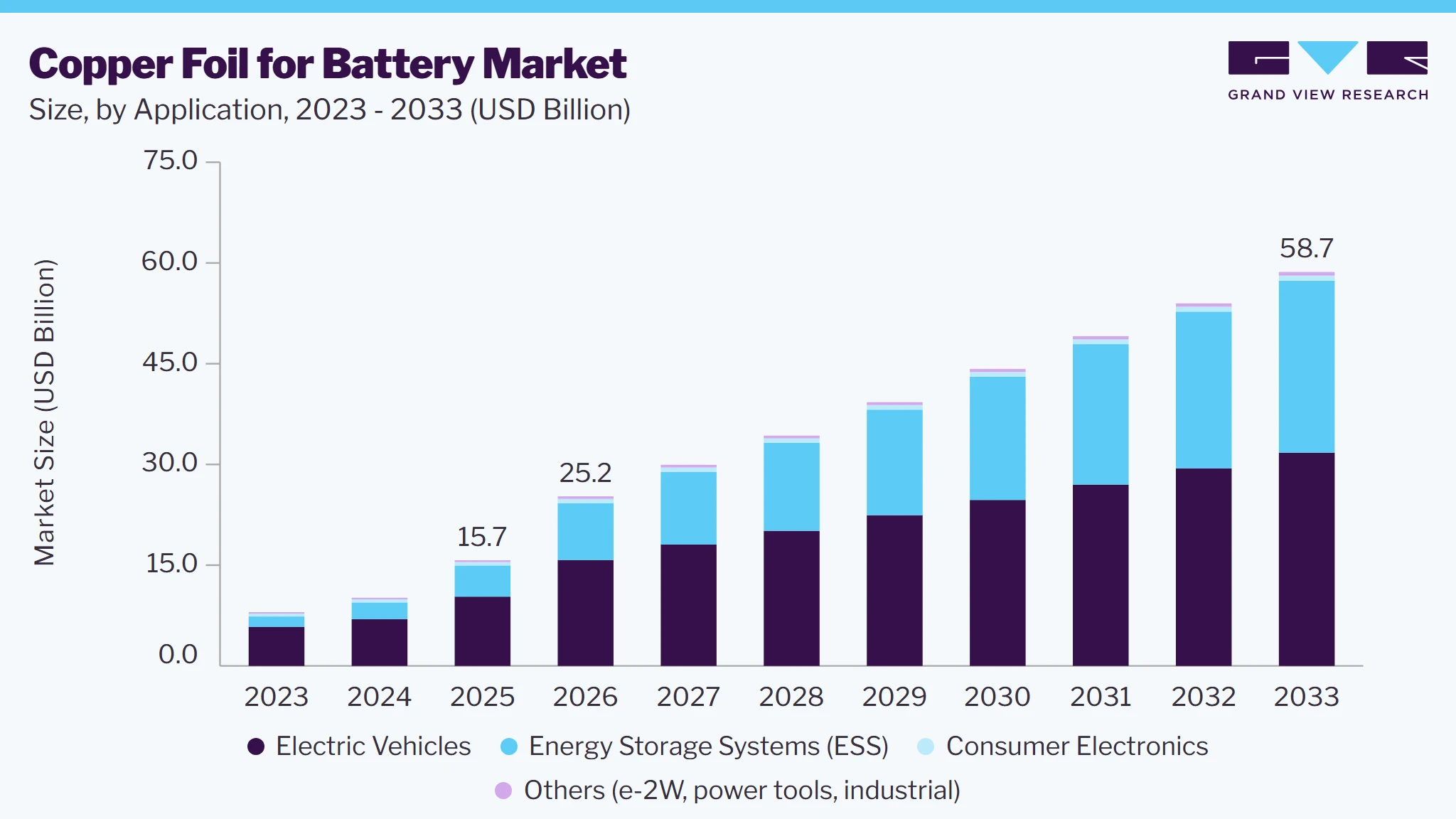
The electric vehicles segment dominated the copper foil for battery market, accounting for a revenue share of 65.5% in 2025. Its dominance is primarily attributed to the growing adoption of electric passenger cars, commercial vehicles, buses, and two-wheelers powered by rechargeable battery systems. Copper foil functions as the anode current collector in lithium-ion batteries, supporting electrical conductivity and efficient operation. Rising EV production, expanding manufacturing capacity, and investments in vehicle electrification are driving demand for battery-grade copper foil.
The ESS segment is projected to grow at the fastest CAGR of 17.2% during the forecast period. Growth is driven by increasing deployment of battery storage to support renewable energy integration, grid stability, peak-load management, and backup power requirements. Expanding solar and wind power installations are increasing the need for storage solutions that can manage fluctuations in electricity generation and improve power supply reliability. Lithium-ion batteries are being deployed across utility-scale projects, commercial and industrial facilities, and residential installations, supporting demand for copper foil used in battery manufacturing.
Thickness Insights
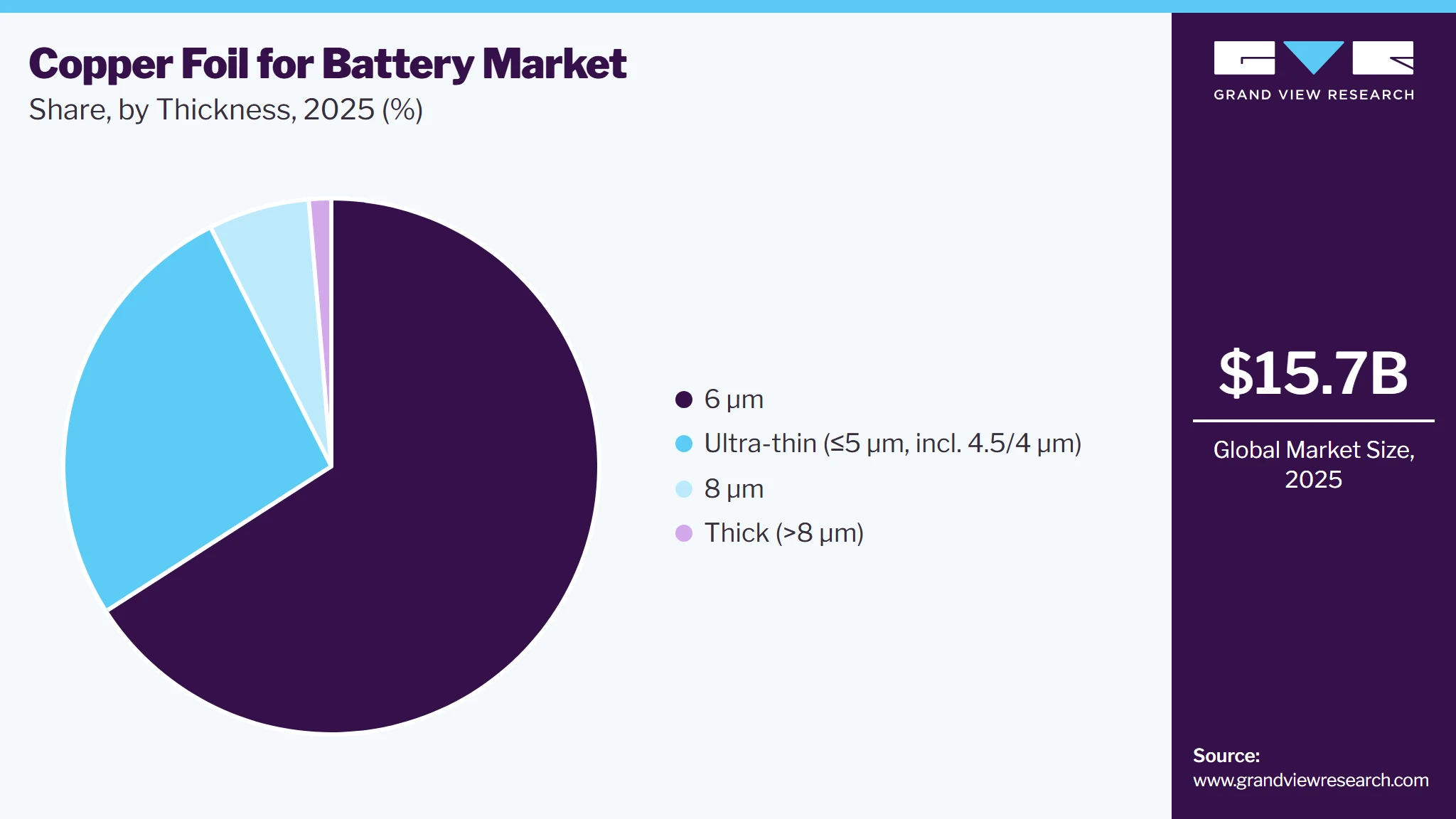
The 6 µm segment dominated the copper foil for battery industry, accounting for 65.9% of the total revenue share in 2025. Its leading position is supported by a balance of electrical conductivity, mechanical strength, processability, and material efficiency in lithium-ion battery manufacturing. Battery cell manufacturers widely use 6 µm copper foil to optimize current collector weight while maintaining the performance and reliability required for high-volume electrode production. Increasing battery demand across EVs, ESS, and consumer electronics continues to support adoption.
 To learn more about this report, Download Free Sample Report
The ultra-thin segment (≤5 µm, including 4.5 µm and 4 µm grades) is projected to grow at the fastest CAGR of 21.6% during the forecast period. Growth is driven by battery manufacturers' efforts to reduce current collector weight and increase the proportion of active materials within battery cells, thereby improving energy density. This is particularly important for EV batteries, where weight reduction and driving range are key performance considerations. Advancements in electrodeposition technology, thickness control, tensile strength, and surface treatment are improving the commercial feasibility of ultra-thin foil production.
Regional Insights
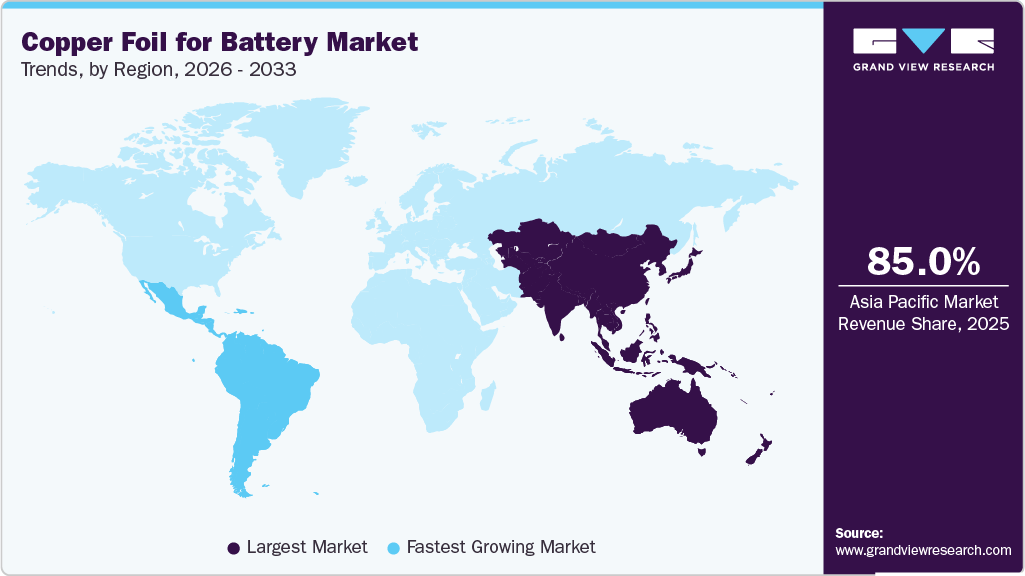
Asia Pacific dominated the copper foil for battery market with a revenue share of 85.0% in 2025. The region is a major hub for battery-grade copper foil production and consumption, supported by an extensive lithium-ion battery manufacturing ecosystem across China, Japan, and South Korea. Established production capabilities, integrated supply chains, and strong demand from electric vehicles, consumer electronics, and energy storage systems are supporting growth. Investments in battery gigafactories, advancements in electrode manufacturing, and increasing adoption of ultra-thin grades are further strengthening demand. Southeast Asian countries are also developing battery and EV manufacturing capabilities, creating additional opportunities for suppliers.
 To learn more about this report, Download Free Sample Report
The China copper foil for battery market plays a central role owing to its large-scale lithium-ion battery production, extensive EV manufacturing base, and established network of copper foil producers. Strong domestic demand from electric vehicles and energy storage systems is supporting production and capacity expansion, while manufacturers are increasingly developing ultra-thin grades to improve battery energy density and material efficiency. The country's integrated ecosystem spanning battery materials, cell manufacturing, and EV production supports cost competitiveness and supply-chain coordination.
North America Copper Foil for Battery Market Trends
Demand in the North America copper foil for battery industry is supported by investments in electric vehicle manufacturing, battery production facilities, and energy storage infrastructure. Automakers are expanding their electrification strategies, while battery manufacturers are strengthening regional supply chains to reduce dependence on imported components. Government incentives and policies supporting domestic battery manufacturing are encouraging investments in lithium-ion battery production. Increasing deployment of energy storage systems to support renewable energy integration is also contributing to demand.
U.S. Copper Foil for Battery Market Trends
The U.S. is a key contributor to regional demand, supported by investments in domestic battery manufacturing, electric vehicle production, and grid-scale energy storage. Federal and state-level initiatives promoting clean energy technologies and domestic supply chains have encouraged investment in battery cell production and related materials. Growing deployment of stationary storage systems, particularly alongside solar power installations, is further supporting demand for lithium-ion batteries.
Europe Copper Foil for Battery Market Trends
Demand in the copper foil for battery industry is driven by vehicle electrification, investments in battery manufacturing, and the transition toward renewable energy. Automakers are expanding their electric vehicle portfolios, while battery producers are developing regional manufacturing capabilities to strengthen supply chain resilience. The European Union's decarbonization objectives and battery-related sustainability requirements are encouraging improvements in resource efficiency, material traceability, and recycling. Increasing deployment of renewable energy storage is also supporting demand for lithium-ion batteries.
Latin America Copper Foil for Battery Market Trends
The Latin America copper foil for battery industry is expected to grow at the fastest CAGR over the forecast period. The demand is supported by the gradual expansion of electric mobility, renewable energy installations, and battery storage infrastructure. Countries such as Brazil and Mexico offer opportunities through automotive manufacturing, clean energy investment, and the development of EV-related supply chains. The region's role in the battery ecosystem is also supported by lithium resources in Argentina, Chile, and Bolivia, although resource availability does not automatically translate into local copper foil manufacturing capacity.
Middle East & Africa Copper Foil for Battery Market Trends
Demand in the MEA copper foil for battery industry is expected to develop gradually as countries invest in renewable energy, grid modernization, electric mobility, and battery storage. In the Middle East, large-scale solar projects and energy diversification initiatives are creating opportunities for battery storage systems, while emerging EV assembly and charging infrastructure may support longer-term demand. In Africa, renewable energy projects, off-grid electricity systems, and the need for reliable power supply provide potential areas for expansion.
Key Copper Foil For Battery Company Insights
Some of the key players operating in the market include Nuode New Materials Co., Ltd. and SK Nexilis.
-
Nuode New Materials Co., Ltd., established in 1987, is a China-based manufacturer specializing in copper foil and materials for lithium-ion batteries. The company offers battery-grade electrolytic copper foil used as an anode current collector in applications such as electric vehicles, energy storage systems, and consumer electronics. Its product portfolio includes different thickness grades designed to meet battery manufacturers' requirements for electrical conductivity, mechanical strength, and processing performance. It focuses on developing high-performance, ultra-thin copper foil to improve battery energy density and material efficiency.
-
SK Nexilis is a South Korea-based manufacturer specializing in high-performance copper foil for lithium-ion batteries and advanced electronic applications. The company supplies battery-grade copper foil for anode current collectors in electric vehicles, energy storage systems, and other rechargeable battery applications. Its product development focuses on ultra-thin foil, mechanical strength, elongation, and consistent surface properties to support advanced battery designs and high-volume electrode manufacturing. It has also pursued manufacturing expansion outside South Korea to support the international battery supply chain.
-
Lotte Energy Materials Co., Ltd., formerly Iljin Materials, is a South Korea-based manufacturer of advanced copper foil for rechargeable batteries and electronic applications. The company produces battery-grade copper foil used as an anode current collector in lithium-ion batteries, serving applications across electric vehicles, energy storage systems, and consumer electronics. Its product portfolio includes ultra-thin, high-strength copper foil designed to enhance battery energy density, enable electrode processing, and improve mechanical reliability. The company has invested in expanding its production capabilities and strengthening its presence in international battery supply chains.
Key Copper Foil for Battery Companies
The following key companies have been profiled for this study of the copper foil for battery market.
-
Anhui Tongguan Copper Foil
-
Chang Chun Group
-
Furukawa Electric
-
Guangdong Jiayuan Technology
-
Jiujiang Defu Technology
-
Londian Wason
-
Lotte Energy Materials
-
Nuode New Materials
-
SK Nexilis
-
Solus Advanced Materials
Competitive Benchmarking
Category
Operating Strategies
Competitive Edge
Weakness
Established Players (Nuode New Materials; SK Nexilis; Lotte Energy Materials; Guangdong Jiayuan Technology; Jiujiang Defu Technology; Londian Wason; Chang Chun Group; Anhui Tongguan Copper Foil; Solus Advanced Materials; Furukawa Electric)
- Pursue long-term supply agreements with battery manufacturers to secure demand visibility and improve production planning.
- Localize manufacturing and expand regional production networks to serve battery plants in key automotive and industrial hubs.
- Develop differentiated copper foil grades tailored to battery chemistry, electrode design, and customer-specific performance requirements.
- Extensive production experience enables consistent output across demanding thickness and quality specifications.
- Established customer qualification processes and technical support capabilities facilitate integration into battery manufacturing lines.
- Economies of scale and established procurement networks can improve production efficiency and cost competitiveness.
- Capacity expansion can create financial pressure when battery demand grows more slowly than anticipated.
- Reliance on energy-intensive production processes exposes manufacturers to electricity price volatility.
- Maintaining consistent quality at ultra-low thicknesses can increase production complexity and reduce manufacturing yields.
Emerging & Regional Players (Nippon Denkai; Zhongyi Technology; Jiangxi Copper Foil Technology; Jiangxi Tongbo Technology; Hailiang; Far East Copper Foil; Baoming Technology; Shuangxing New Materials)
- Target specialized customer requirements through product development focused on thin-gauge foil, enhanced mechanical properties, and alternative current collector designs.
- Build technical collaborations with research institutions and battery developers to accelerate product testing and commercialization.
- Prioritize selective capacity investments and product diversification to manage capital commitments while pursuing new applications.
- Focused product development can enable faster adaptation to specific customer requirements and emerging battery designs.
- Existing copper-processing or materials expertise can provide a foundation for developing specialized foil products.
- Composite current collector technologies offer potential weight-saving and safety-related benefits if technical and commercial targets are achieved.
- Gaining qualification with major battery producers can require substantial time, testing, and engineering resources.
- Lower production volumes may limit purchasing leverage and increase unit manufacturing costs.
- New composite foil technologies face uncertainty around commercial-scale yields, performance validation, and widespread customer adoption.
Recent Developments
-
In March 2026, SK Nexilis announced its participation in InterBattery 2026 in Seoul, where it showcased seven copper foil products and next-generation technologies for all-solid-state and lithium-metal batteries. The company also highlighted potential applications extending beyond electric vehicles to energy storage systems, drones, robotics, and aerospace. The development reflects efforts to expand copper foil technology into emerging battery chemistries and a broader range of electrification applications.
-
In February 2026, Nuode New Materials announced the scaled production of its 3.5 µm ultra-thin lithium-ion battery copper foil. The development addresses battery manufacturers' efforts to reduce current collector weight and copper consumption while improving energy density and production cost efficiency. The company highlighted the progression from conventional 8 µm foil toward 6 µm, 4.5 µm, and thinner grades as battery technologies evolve. The advancement strengthens Nuode's product portfolio for electric vehicles, energy storage systems, and lightweight electronic devices, while demonstrating the industry's shift toward thinner, higher-performance current collectors.
Copper Foil for Battery Market Report Scope
Report Attribute
Details
Market Definition
Copper foil for battery market size represents the consumption of battery-grade copper foil used as the anode current collector in lithium-ion (incl. semi/all-solid-state) battery cells.
Market size in 2025
USD 15.7 billion
Estimated market size by 2026
USD 25.2 billion
Projected market size by 2033
USD 58.7 billion
Growth rate
CAGR of 12.8% from 2026 to 2033
Base year for estimation
2025
Historical data
2021 - 2024
Forecast period
2026 - 2033
Quantitative units
Revenue in USD million/billion, volume in kilotons, and CAGR from 2026 to 2033
Report coverage
Revenue forecast, volume forecast, competitive landscape, growth factors, and trends
Segments covered
Application, thickness, region
Regional scope
North America; Europe; Asia Pacific; Latin America; Middle East & Africa
Country scope
U.S.; Canada; Mexico; Germany; Hungary; France; Poland; Sweden; China; Japan; India; South Korea; Brazil; Morocco; Saudi Arabia
Key companies profiled
Anhui Tongguan Copper Foil; Chang Chun Group; Furukawa Electric; Guangdong Jiayuan Technology; Jiujiang Defu Technology; Londian Wason; Lotte Energy Materials; Nuode New Materials; SK Nexilis; Solus Advanced Materials
Customization scope
Free report customization (equivalent up to 8 analysts working days) with purchase. Addition or alteration to country, regional & segment scope.
Pricing and purchase options
Avail customized purchase options to meet your exact research needs. Explore purchase options
Global Copper Foil For Battery Market Report Segmentation
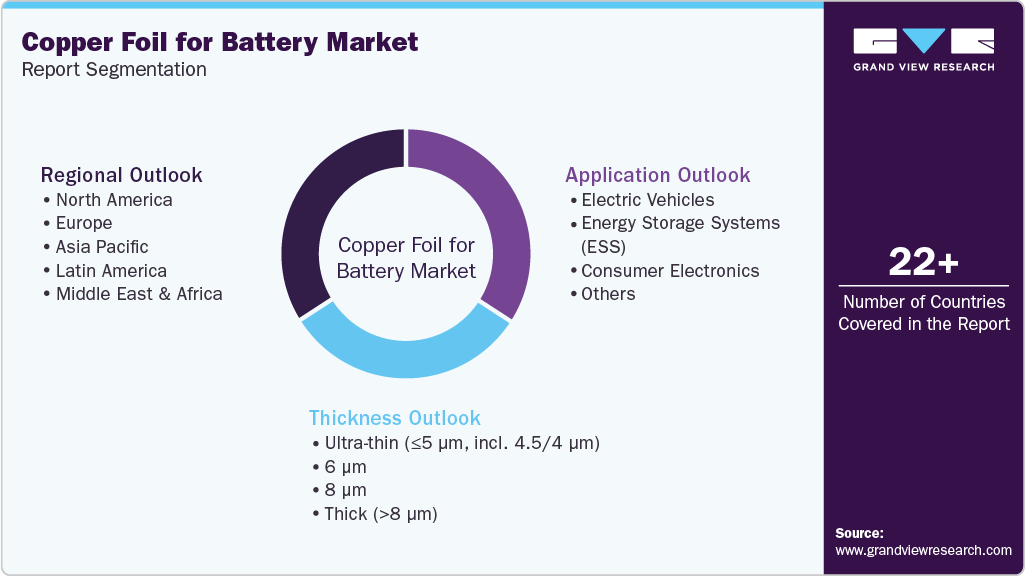
This report forecasts revenue and volume growth at the global, regional & country levels and provides an analysis of the latest industry trends in each of the sub-segments from 2021 to 2033. For this study, Grand View Research has segmented the global copper foil for battery market report based on application, thickness, and region:
 To learn more about this report, Download Free Sample Report
-
Application Outlook (Volume, Kilotons; Revenue, USD Million/Billion, 2021 - 2033)
-
Electric Vehicles
-
Energy Storage Systems (ESS)
-
Consumer Electronics
-
Others
-
-
Thickness Outlook (Volume, Kilotons; Revenue, USD Million/Billion, 2021 - 2033)
-
Ultra-thin (≤5 µm, incl. 4.5/4 µm)
-
6 µm
-
8 µm
-
Thick (>8 µm)
-
-
Regional Outlook (Volume, Kilotons; Revenue, USD Million/Billion, 2021 - 2033)
-
North America
-
U.S.
-
Canada
-
Mexico
-
-
Europe
-
Germany
-
Hungary
-
France
-
Poland
-
Sweden
-
-
Asia Pacific
-
China
-
Japan
-
India
-
South Korea
-
-
Latin America
-
Brazil
-
-
Middle East & Africa
-
Morocco
-
Saudi Arabia
-
-
Research Methodology
The copper foil for battery market figures in this report are based on a proven research process that combines executive interviews with secondary research from proprietary databases, company filings, and recognized regulatory and institutional sources. Market size is built through value-chain sizing-reconciling supply-side and demand-side estimates-and triangulated with bottom-up and top-down approaches. Every estimate passes multiple levels of expert validation before publication, with each copper foil for battery segment quantified using the revenue-capture definitions in the table below.
Segment Definition
Application
Revenue Capture Definition
Electric Vehicles
Revenue is captured from the sale of battery-grade copper foil used as an anode current collector in lithium-ion batteries for electric passenger vehicles, commercial vehicles, buses, two-wheelers, and other electric mobility applications.
Energy Storage Systems
Revenue is derived from the sale of copper foil used in lithium-ion batteries deployed in utility-scale energy storage, grid stabilization, renewable energy integration, commercial and industrial storage, and residential battery systems.
Consumer Electronics
Revenue is generated from copper foil used as an anode current collector in lithium-ion batteries for smartphones, laptops, tablets, wearable devices, digital cameras, and other portable electronic products.
Others
Includes revenue from copper foil used in lithium-ion batteries for power tools, industrial equipment, drones, robotics, medical devices, and other battery-powered applications not covered under the primary categories.
Thickness
Revenue Capture Definition
Ultra-thin (≤5 µm, incl. 4.5/4 µm)
Revenue is captured from the sale of ultra-thin electrolytic copper foil with a thickness of 5 µm or less, including 4.5 µm and 4 µm grades, used as anode current collectors in lithium-ion batteries. These products support reduced current collector weight, improved energy density, and optimized material utilization, particularly in advanced electric vehicle batteries.
6 µm
Revenue is derived from the sale of 6 µm battery-grade copper foil used in lithium-ion battery anode current collectors. This thickness offers a balance of mechanical strength, electrical conductivity, processability, and material efficiency, supporting widespread use in electric vehicles, energy storage systems, and consumer electronics.
8 µm
Revenue is generated from the sale of 8 µm copper foil used in lithium-ion battery manufacturing, where mechanical strength, handling characteristics, and electrode processing requirements influence material selection. These products serve battery applications across electric vehicles, energy storage systems, consumer electronics, and other rechargeable battery-powered equipment.
Thick (>8 µm)
Revenue is captured from the sale of battery-grade copper foil with a thickness greater than 8 µm, used in applications requiring specific mechanical, electrical, or manufacturing characteristics. These grades can serve selected lithium-ion battery designs, industrial batteries, and other specialized applications where thicker current collectors are suitable for the required electrode configuration and operating conditions.
Estimation Model
Layer Name
Key Question
Description
Addressable Battery Manufacturing Base
Where is copper foil demand generated?
Assess lithium-ion battery production across electric vehicles, energy storage systems, consumer electronics, and other battery-powered applications. Quantify battery cell manufacturing capacity, annual production, and output by country and application to identify the addressable demand for battery-grade copper foil.
Application & Thickness Utilization Layer
What proportion of battery production uses copper foil, and which thickness grades are required?
Determine copper foil consumption across identified battery applications and manufacturing processes. Evaluate the adoption of ultra-thin (≤5 µm, including 4.5 µm and 4 µm), 6 µm, 8 µm, and thick (>8 µm) grades, accounting for battery chemistry, cell design, electrode configuration, and manufacturing requirements.
Volume & Consumption Layer
How much copper foil is consumed annually?
Calculate annual copper foil demand by applying application-specific consumption coefficients to lithium-ion battery production volumes. Incorporate average copper foil requirements per kWh of battery capacity, differences in battery chemistry and design, production yields, and manufacturing scrap. Demand is quantified in kilotons and can also be assessed by application and thickness category.
Pricing & Revenue Layer
What is the monetary value of copper foil demand?
Estimate revenue by multiplying the calculated copper foil sales volume by the applicable average selling price per ton. Pricing should account for thickness, mechanical and surface properties, product specifications, processing requirements, and application. Revenue estimates should reflect copper foil manufacturers' sales and exclude downstream battery cell value, installation costs, and other services unless explicitly included in the scope.
Delivered Customizations
This report has been delivered with the following In-depth customizations
Client Request
Customization Delivered
Value Adds
Battery Manufacturing Capacity & Utilization
Assessment of lithium-ion battery manufacturing capacity, actual production, capacity utilization, and planned expansions by country and application, covering EVs, ESS, and consumer electronics.
Identifies demand-generating manufacturing hubs, evaluates potential supply-demand gaps, and highlights opportunities for copper foil suppliers.
Raw Material Cost & Price Sensitivity
Assessment of copper cathode prices, sulfuric acid costs, electricity consumption, processing expenses, and their influence on copper foil production costs and selling prices.
Identifies major cost drivers, assesses exposure to raw material price volatility, and supports cost competitiveness analysis.
Regional Supply Chain & Trade Analysis
Assessment of production and consumption by country, cross-border trade flows, import dependence, export exposure, and regional concentration of copper foil manufacturing.
Identifies supply-chain dependencies, alternative sourcing locations, and opportunities to establish or diversify regional supply relationships.
About the Author(s)
Advanced Interior Materials Research Team
Advanced Materials · Advanced Interior MaterialsThis report was authored by the advanced interior materials research team at Grand View Research - comprising two research analysts, one senior research analyst, and one industry expert - with specialized expertise in the advanced interior materials segment of the advanced materials industry. All findings are based on proprietary advanced materials databases, executive interviews, and regulatory analysis, subject to internal peer review prior to publication.
Last Updated:
Speak to Analyst

Customize this report to your needs - add regions, segments, or data points, with 20% free customization.
Or view our licence options:


ISO 9001:2015 & 27001:2022 Certified
We are GDPR and CCPA compliant! Your transaction & personal information is safe and secure. For more details, please read our privacy policy.


