
- Home
- »
- Advanced Interior Materials
- »
-
Data Center HVAC Systems Market Size Report, 2026-2033GVR Report cover
![Data Center HVAC Systems Market (2026 - 2033)Report]()
Data Center HVAC Systems Market (2026 - 2033)
Size, Share & Trends Analysis Report By Product (CRAH, CRAC, Chillers, Cooling Towers, Fan Wall, In-Row Cooling), By Deployment (New Installation), By Data Center Type (Colocation, Hyperscale), By Region, And Segment Forecasts
Market Size, 2025
$4.4BMarket Estimate, 2026
$4.8BMarket Forecast, 2033
$10.2BCAGR, 2026–2033
11.3%Data Center HVAC Systems Market Summary
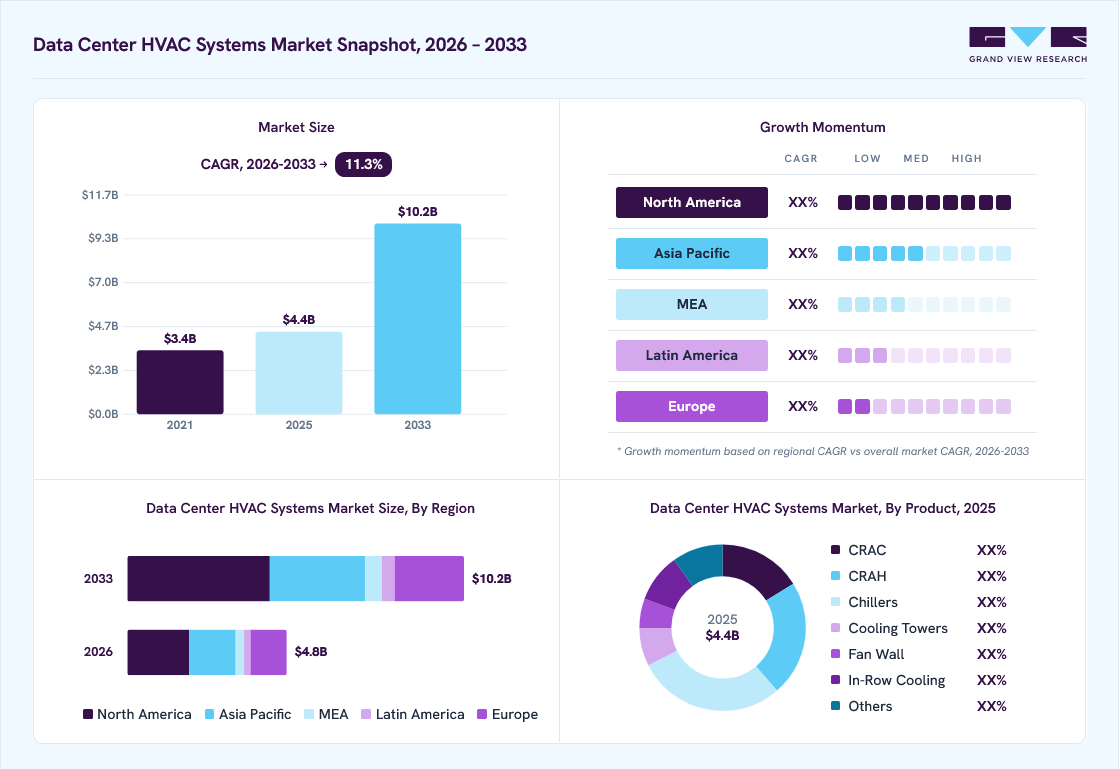
The global data center HVAC systems market size was valued at USD 4.4 billion in 2025 and is projected to grow from USD 4.8 billion in 2026 to USD 10.2 billion by 2033, at a CAGR of 11.3% from 2026 to 2033. The market in North America dominated with a revenue share of 38.6% in 2025. The industry is being driven by the rapid expansion of hyperscale and colocation data centers, supported by growing cloud computing, digital services, and AI workloads.
Key Market Trends & Insights
- By product: Chillers segment held the largest market share of 28.8% in 2025.
- By deployment: New installation segment held the largest market share of 74.4% in 2025.
- By data center type: Hyperscale segment held the largest market share of 34.5% in 2025.
Regional Highlights
- Largest regional market: North America (38.6% revenue share, 2025)
- By country: The U.S. held the largest market share in 2025.
Market Size & Forecast
- Market size in 2025: USD 4.4 Billion
- Estimated market size in 2026: USD 4.8 Billion
- Projected market size by 2033: USD 10.2 Billion
- CAGR (2026-2033): 11.3%
The increasing deployment of high-performance computing and AI servers is raising heat generation within data centers, creating greater demand for reliable and high-capacity cooling systems. As operators expand computing infrastructure to accommodate growing workloads, investments in chillers, CRAH units, CRAC systems, cooling towers, fan walls, and other thermal management solutions are increasing.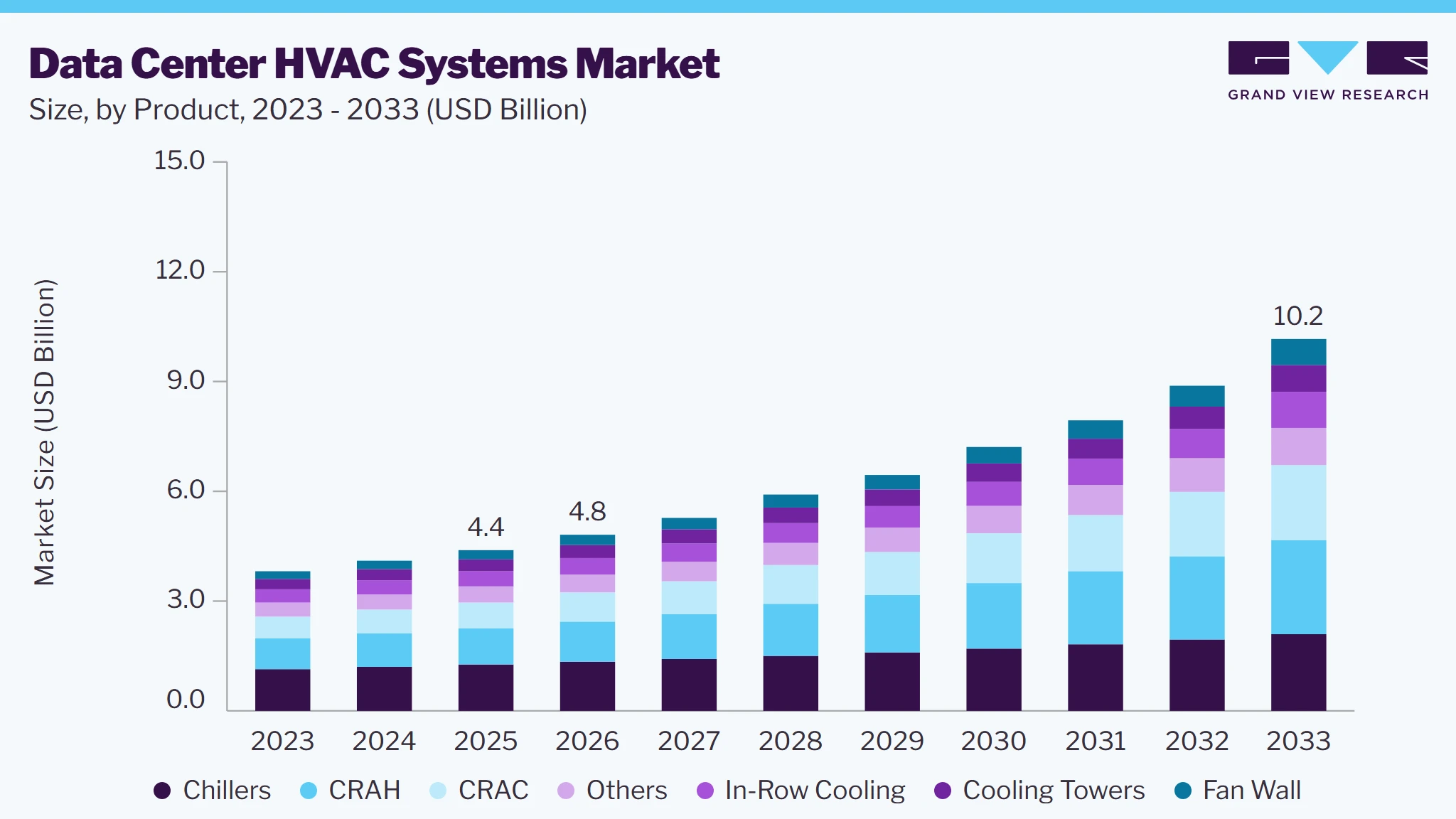
Market Dynamics
The industry is also supported by rising rack power density and the growing need for energy-efficient cooling. AI and high-performance computing workloads require greater cooling capacity and more precise temperature management, encouraging data center operators to adopt advanced cooling technologies such as in-row cooling and high-efficiency chilled-water systems. In addition, efforts to reduce energy consumption, improve operational efficiency, and support sustainability objectives are encouraging operators to upgrade existing cooling infrastructure and replace older, less-efficient systems.
The growing deployment of AI, machine learning, and high-performance computing is increasing heat generation within data centers. High-density servers require more effective thermal management than conventional computing infrastructure, encouraging operators to invest in higher-capacity chillers, CRAH systems, fan walls, in-row cooling, and other advanced solutions. This trend is also encouraging the development of cooling architectures capable of supporting both conventional air cooling and newer high-density cooling requirements.
The expansion of AI infrastructure is also encouraging data center operators to reconsider existing cooling designs as computing densities increase. New facilities are being designed with greater cooling capacity and flexibility, while existing facilities may require upgrades to accommodate higher-density workloads. This creates demand across both new installation and replacement applications and supports the adoption of more efficient and scalable HVAC technologies.
High capital and operating costs can restrain the adoption of advanced data center HVAC systems, particularly where facilities require extensive cooling infrastructure, specialized equipment, and complex installation. Advanced cooling configurations can also require additional piping, controls, heat-exchange equipment, and facility modifications. In existing data centers, retrofitting these systems can be disruptive and costly, making operators more cautious about replacing functioning equipment unless efficiency, capacity, or reliability benefits justify the investment.
The growing need to reduce energy consumption and improve the efficiency of data center operations creates opportunities for manufacturers offering advanced cooling solutions. Operators are evaluating high-efficiency chillers, free-cooling systems, intelligent controls, fan-wall configurations, in-row cooling, and hybrid cooling architectures to manage increasing thermal loads while improving overall facility efficiency. The growing requirements of AI infrastructure further create opportunities for solutions that can integrate conventional HVAC with high-density and liquid-cooling technologies.
Industry Concentration & Characteristics
The market is concentrated, with a limited number of established global manufacturers holding significant positions across precision cooling, chillers, air handling, and thermal management solutions. However, the presence of specialized regional manufacturers and niche technology providers across cooling towers, in-row cooling, fan-wall systems, and advanced thermal management creates a competitive environment. Overall, the market is concentrated, balancing the strong presence of leading manufacturers with opportunities for smaller and specialized players.
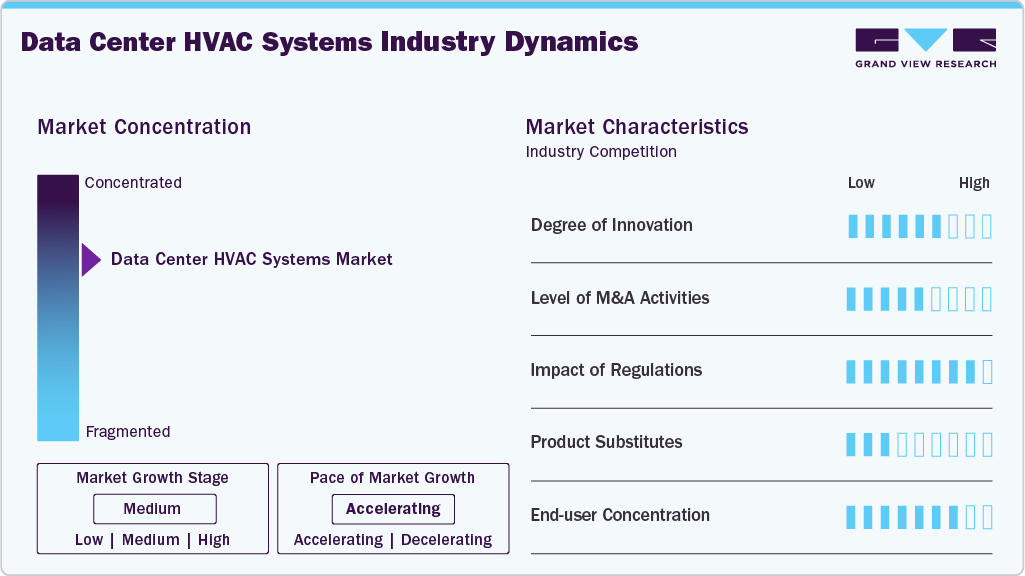
The market has a high degree of innovation, driven by increasing rack densities, AI workloads, and the need for more efficient thermal management. Innovation is focused on high-efficiency chillers, advanced CRAH and CRAC systems, fan-wall configurations, in-row cooling, free cooling, intelligent controls, and hybrid air- and liquid-cooling architectures. The rapid evolution of cooling technologies reflects the need to manage higher heat loads while reducing energy and water consumption.
Regulation has a moderate to high impact on the market because data center cooling is closely linked to electricity consumption, water use, refrigerants, and environmental performance. Energy-efficiency standards, refrigerant regulations, building codes, and sustainability requirements are encouraging operators to adopt efficient cooling equipment and reduce water and carbon impacts. Regulatory frameworks are increasingly emphasizing measurable indicators such as cooling efficiency, energy efficiency, water usage, and carbon performance, influencing both new installations and replacement decisions.
The market has relatively high end-user concentration, particularly because a significant share of large-scale cooling demand comes from hyperscale and colocation operators with large data center campuses. These customers typically require high-capacity, reliable, and customized cooling infrastructure and often make procurement decisions based on efficiency, scalability, reliability, and long-term operating costs. However, enterprise, telecom, edge, and government data centers provide a broader customer base, reducing the degree of concentration across the overall market.
Analyst Perspective
The market is positioned for sustained growth as the rapid expansion of AI, cloud computing, and high-performance computing increases data center power density and thermal loads. The growing need for reliable, scalable, and energy-efficient cooling is encouraging investment in chillers, CRAH and CRAC systems, fan walls, in-row cooling, and advanced thermal-management solutions. In particular, the accelerating shift toward AI infrastructure is creating opportunities for higher-capacity and hybrid cooling architectures, while the replacement of aging equipment provides an additional source of demand. Overall, the market is transitioning from conventional room-based cooling toward more efficient, high-density, and application-specific cooling systems, creating opportunities for both established manufacturers and specialized technology providers.
Product Insights
The chillers segment led the market with the largest revenue share of 28.8% in 2025, supported by the widespread use of centralized cooling systems in large-scale hyperscale and colocation facilities. Chillers provide high-capacity and reliable cooling and can be integrated with CRAH units and heat-rejection systems to manage the substantial thermal loads generated by large server environments. Their scalability and suitability for high-density computing infrastructure continue to support their strong market position.
The CRAC segment is expected to register the fastest CAGR of 14.4% from 2026 to 2033, driven by increasing demand for flexible and self-contained cooling systems across enterprise, edge, modular, and smaller data center facilities. CRAC units can operate independently without requiring a centralized chilled-water plant, making them suitable for distributed facilities and applications where installation flexibility is important. Increasing data center deployment at the edge and the need to upgrade existing cooling infrastructure are further supporting demand for modern, energy-efficient CRAC systems.
Deployment Insights
The new installation segment dominated the market in 2025, driven by the continued construction of new hyperscale, colocation, enterprise, and other data center facilities. Growing demand for cloud computing, AI, and high-performance computing is encouraging operators to expand capacity and develop new facilities, creating substantial demand for HVAC infrastructure during the initial construction and fit-out stages. New facilities also provide opportunities to deploy modern, energy-efficient cooling systems designed for higher rack densities and evolving computing requirements.
The replacement segment is expected to register the fastest CAGR of 12.0% over the forecast period, supported by the aging of installed cooling infrastructure and the increasing need to improve energy efficiency and cooling performance. As existing data centers accommodate higher-density workloads, older HVAC systems may require replacement or upgrading to provide greater capacity, reliability, and efficiency. Equipment aging can also increase cooling energy consumption, encouraging operators to modernize older systems and adopt more advanced cooling technologies.
Data Center Type Insights
The hyperscale segment dominated the market in 2025, primarily due to the large scale and high cooling requirements of hyperscale facilities. These data centers support cloud computing, AI, and other intensive digital workloads, requiring substantial and highly reliable cooling infrastructure. The continued expansion of hyperscale capacity is therefore supporting demand for high-capacity chillers, CRAH systems, cooling towers, fan walls, and other advanced cooling solutions.
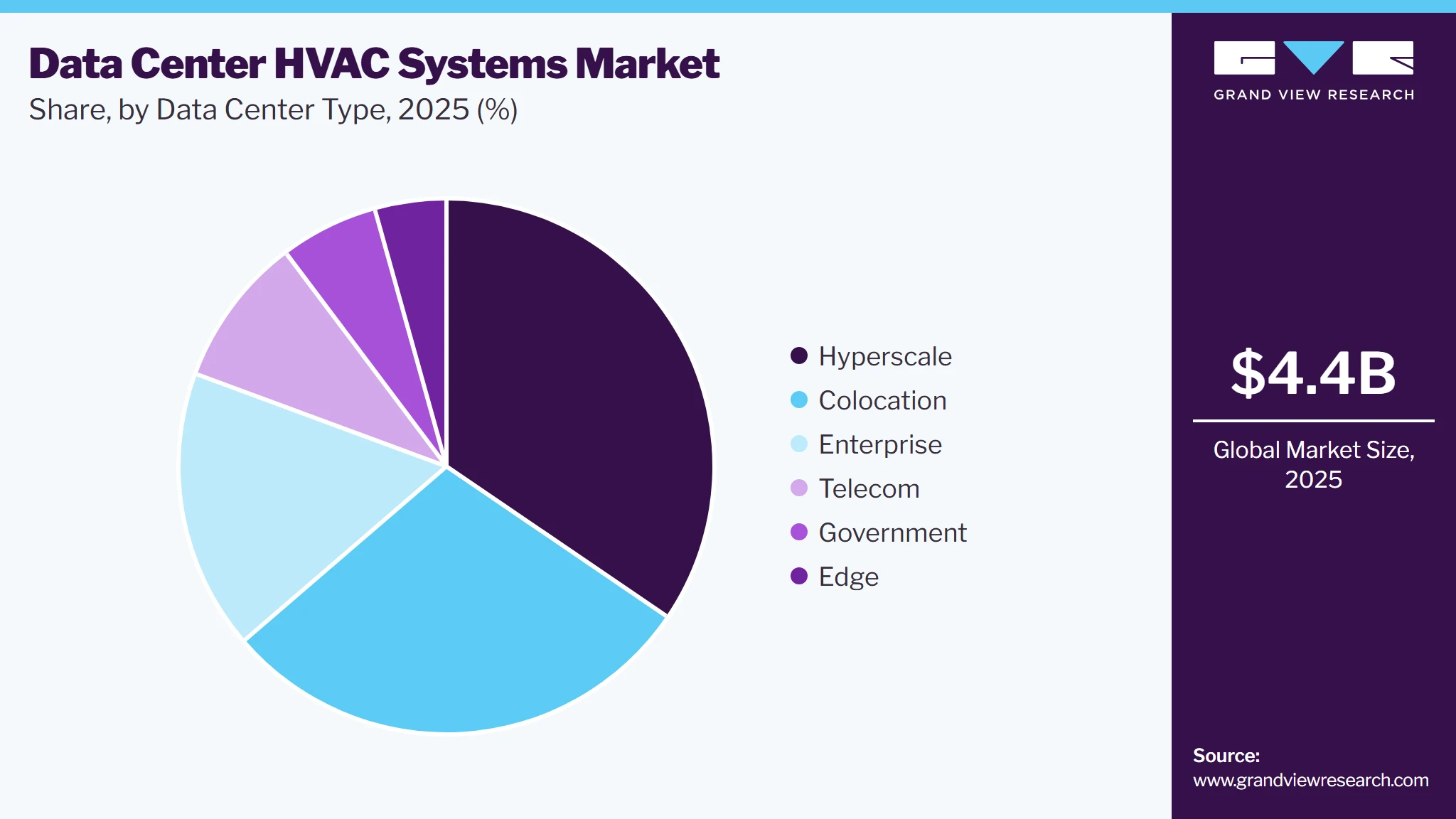
The enterprise segment is expected to witness a significant CAGR of 11.3% from 2026 to 2033, supported by increasing digitalization and the growing adoption of AI and high-performance computing by businesses. Enterprises are increasingly upgrading their internal data center infrastructure to accommodate higher computing densities and evolving workloads, creating demand for modern and energy-efficient cooling systems. In addition, the need to replace aging HVAC equipment and improve cooling performance is supporting replacement opportunities within enterprise facilities.
Regional Insights
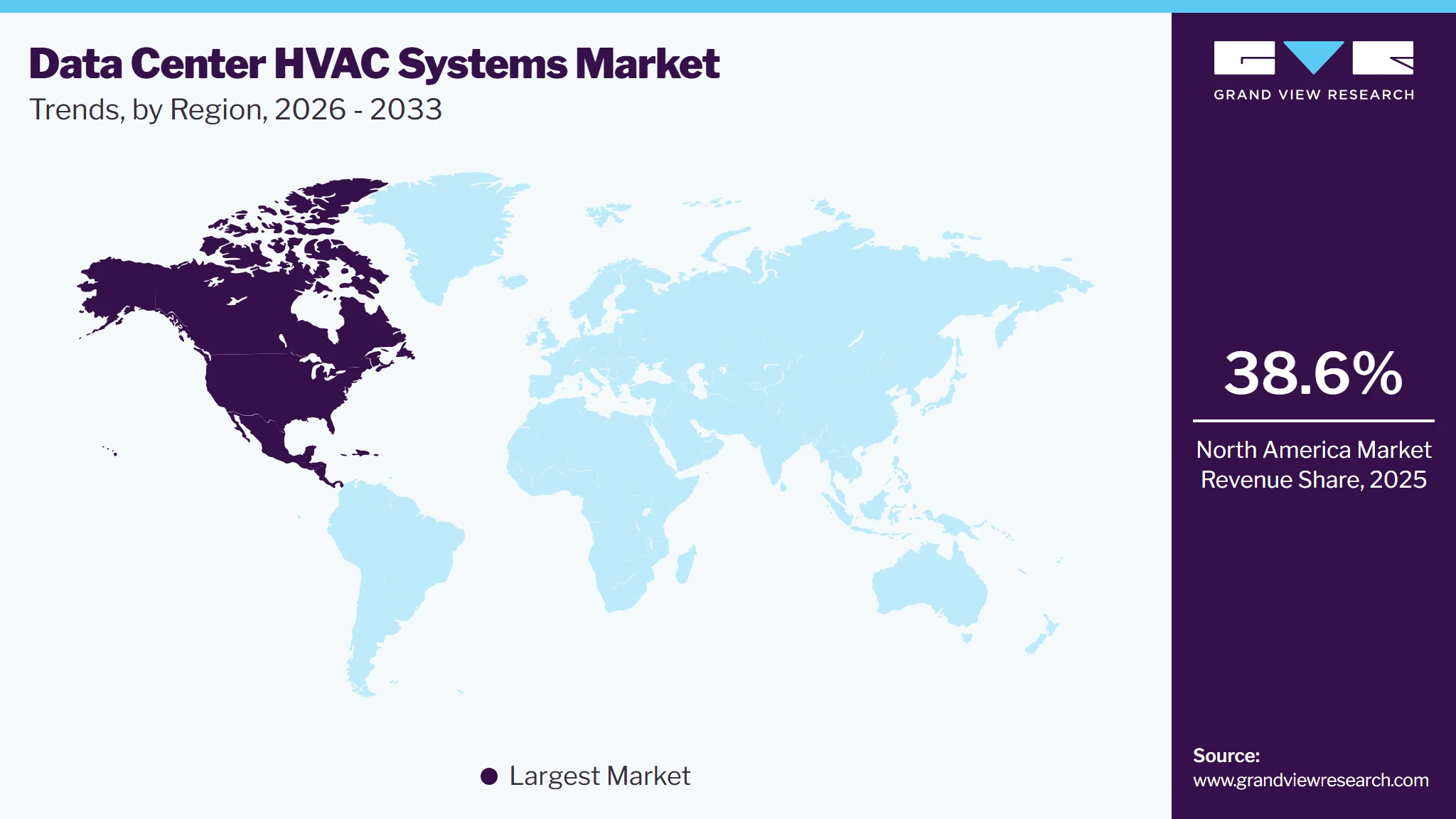
The North America data center HVAC systems market dominated, accounting for a revenue share of 38.6% in 2025, and is also expected to witness the fastest CAGR, supported by extensive hyperscale and colocation infrastructure and strong investment in AI-oriented data centers. The region is witnessing rapid development of large-scale facilities, particularly in the U.S., while increasing rack densities are encouraging the adoption of high-capacity and advanced cooling technologies. Power availability and grid constraints are also encouraging operators to prioritize efficient and scalable thermal-management solutions.
U.S. Data Center HVAC Systems Market Trends
The data center HVAC systems market in the U.S. led the region in 2025, supported by the rapid expansion of data center infrastructure and increasing power requirements from computing facilities. According to the U.S. Energy Information Administration (EIA), data center servers accounted for an estimated 7% of U.S. commercial-sector electricity consumption in 2025. EIA projects data center server electricity consumption to reach 446-818 billion kWh by 2050, depending on the scenario, compared with substantially lower levels currently. Importantly for HVAC demand, EIA estimates that space cooling in data center floorspace can be up to 2.9 times as energy-intensive as cooling in non-data-center floorspace, while electricity used for data center space cooling in the high-demand scenario is projected to be 84 billion kWh higher in 2050 than in the counterfactual baseline. These trends highlight the growing requirement for high-capacity, energy-efficient cooling infrastructure as U.S. data centers expand and accommodate increasingly intensive computing workloads.
Europe Data Center HVAC Systems Market Trends
The data center HVAC systems market in Europe is expected to grow steadily as data center operators expand capacity while placing greater emphasis on energy efficiency and environmental performance. Increasing adoption of cloud and AI services is creating additional cooling requirements, while sustainability objectives and evolving energy-efficiency requirements are encouraging investment in efficient cooling architectures, heat-rejection systems, and facility modernization.
The Germany data center HVAC systems market dominated Europe, supported by its established digital infrastructure, strong industrial base, and growing demand for cloud computing, AI, and data-driven services. The country is also experiencing continued development of data center and large-scale battery storage projects, which the Federal Network Agency expects to contribute to consistently higher power demand across future energy scenarios. Increasing computing intensity, alongside Germany’s focus on energy efficiency and climate-neutral infrastructure, is creating demand for reliable and energy-efficient cooling systems, particularly for large and high-density data centers.
The data center HVAC systems market in the UK is expected to witness strong growth. According to the UK Office for National Statistics, data centers serving external organizations increased from 221 in 2020 to 239 in 2024, while their electricity consumption reached 4.5 TWh in 2024, equivalent to 2% of Great Britain’s grid electricity consumption. More importantly, the UK Government forecasts that the country will require at least 6 GW of AI-capable data center capacity by 2030, around three times the capacity available today.
Asia Pacific Data Center HVAC Systems Market Trends
The data center HVAC systems market in Asia Pacific is expected to witness strong growth, driven by accelerating digitalization, cloud adoption, and the expansion of AI infrastructure across major economies. Increasing development activity in established data center hubs as well as emerging locations is creating opportunities for both conventional HVAC systems and advanced cooling technologies. The growing presence of hyperscale and specialized high-performance computing facilities is further supporting demand for reliable and scalable cooling infrastructure.
The China data center HVAC systems market dominated Asia Pacific as the country is developing a nationally integrated computing network under the “East Data, West Computing” initiative, with large computing hubs being developed in resource-rich western regions, while demand remains strong in the eastern technology centers. The rapid growth of AI workloads is increasing server density and heat loads, encouraging data center operators to adopt more efficient and advanced cooling architectures. China’s green data center policies are also supporting upgrades toward energy-efficient HVAC, natural cooling, liquid cooling, and other thermal-management technologies.
The data center HVAC systems market in India is expected to grow strongly. According to the Government of India, installed data center capacity increased from 375 MW in 2020 to around 1,575 MW in 2026, while electricity demand from data centers is estimated to reach about 17 GW by 2031-32. The government also reports growing adoption of direct-to-chip liquid cooling, adiabatic cooling, immersion cooling, and closed-loop liquid cooling, particularly as high-density racks are deployed for AI and high-performance computing. These developments are creating opportunities for both conventional HVAC equipment and advanced cooling solutions in new and expanding Indian data centers.
Middle East & Africa Data Center HVAC Systems Market Trends
The data center HVAC systems market in the Middle East & Africa is expected to register continued growth as governments, enterprises, and technology providers invest in digital infrastructure, cloud services, and data center capacity. Increasing demand for localized computing infrastructure and the development of new data center facilities are creating opportunities for cooling systems suited to challenging climatic conditions. The region's focus on energy efficiency and reliable operation is also encouraging the adoption of advanced thermal-management solutions.
The Saudi Arabia data center HVAC systems market is expected to witness strong growth, supported by the development of new data center infrastructure under Vision 2030. The country’s hot and arid climate makes reliable and efficient cooling particularly important for maintaining data center performance, while increasing computing density is creating demand for higher-capacity and advanced thermal-management solutions. Government-backed digital infrastructure initiatives and growing investment in AI-ready data centers are further supporting opportunities for chillers, CRAH and CRAC systems, cooling towers, in-row cooling, and other energy- and water-efficient cooling technologies.
Latin America Data Center HVAC Systems Market Trends
The data center HVAC systems market in Latin America is expected to experience significant growth. Brazil and Argentina remain important data center markets in this region, while emerging locations are attracting new investment as operators seek additional capacity and connectivity. This expansion is creating opportunities for HVAC suppliers supporting both new facilities and capacity additions.
The Brazil data center HVAC systems market is expected to witness strong growth as the country has emerged as a key digital infrastructure hub in Latin America, with government initiatives focused on strengthening data center capacity, AI infrastructure, cloud computing, and digital sovereignty. The increasing deployment of high-performance computing facilities and expansion of data center capacity are expected to raise cooling requirements, creating opportunities for chillers, CRAH and CRAC systems, cooling towers, and other energy-efficient HVAC solutions.
Key Data Center HVAC Systems Company Insights
Some of the key players operating in the data center HVAC systems market include Vertiv Group Corp., Schneider Electric, and Johnson Controls.
-
Vertiv Group Corp. is a global provider of critical digital infrastructure solutions, supporting data centers, telecommunications, and other mission-critical applications. The company offers an integrated portfolio covering thermal management, critical power, racks and enclosures, monitoring and management, and related services. Its thermal-management portfolio includes room cooling, in-row and rack cooling, free-cooling chillers, evaporative cooling, heat rejection, and liquid cooling solutions, positioning the company strongly within the market.
-
Schneider Electric is a global energy technology company providing solutions for the electrification, automation, and digitalization of energy management and industrial systems. Its data center portfolio focuses on improving the efficiency, reliability, and sustainability of critical infrastructure through integrated power and cooling solutions, digital monitoring, automation, and EcoStruxure-based technologies. The company supports data center operators in managing increasing power and thermal requirements while improving operational efficiency and resilience, making it a significant participant in the market.
Key Data Center HVAC Systems Companies
The following key companies have been profiled for this study on the data center HVAC systems market.
-
Vertiv Group Corp.
-
Schneider Electric
-
Johnson Controls
-
STULZ GMBH
-
Rittal Pvt. Ltd.
-
Trane Technologies
-
Carrier
-
Daikin Industries, Ltd.
-
Mitsubishi Electric Power Products Inc.
-
Munters
-
Delta Electronics, Inc.
-
ALFA LAVAL
-
Danfoss A/S
-
Eaton
-
Kirloskar
Competitive Benchmarking
Category
Operating Strategies
Competitive Edge
Weakness
Established Players (e.g., Vertiv Group Corp.; Schneider Electric; Johnson Controls; STULZ GmbH; Rittal Pvt. Ltd.)
- Invest heavily in advanced cooling technologies to support rising rack densities and AI-driven workloads.
- Expand integrated cooling portfolios covering precision air cooling, chillers, heat rejection, and high-density cooling.
- Strengthen global service, engineering, and system-integration capabilities to support large data center projects.
- Strong installed base and established relationships with major data center operators.
- Broad product portfolios allow them to address different cooling requirements and data center scales.
- Established R&D capabilities and global distribution networks support rapid deployment of new cooling technologies.
- Higher operating and product-development costs associated with advanced cooling technologies.
- Large organizational structures can make customization and response to niche requirements less flexible.
Emerging & Regional Players (e.g., Trane Technologies; Carrier; Daikin Industries, Ltd.; Mitsubishi Electric Power Products Inc.; Munters; Delta Electronics, Inc.; Alfa Laval; Danfoss A/S; Eaton; Kirloskar)
- Focus on specialized cooling technologies and customized solutions for specific data center applications.
- Expand capabilities in high-density, liquid, modular, and energy-efficient cooling systems.
- Target regional data center expansion through localized manufacturing, partnerships, and application-specific solutions.
- Greater flexibility in developing customized solutions for regional operating conditions.
- Specialized expertise in components such as heat exchangers, chillers, thermal management, and liquid-cooling systems.
- Ability to respond quickly to emerging requirements from AI, edge, and high-density data center applications.
- Comparatively smaller global service networks and installed bases can limit access to large multinational data center projects.
- Narrower product portfolios may require collaboration with other equipment providers for complete cooling solutions.
- Lower brand recognition and limited scale can make it more challenging to compete for large, standardized hyperscale deployments.
Recent Developments
-
In February 2026, Schneider Electric established a Motivair liquid cooling manufacturing facility in Bengaluru, strengthening its capabilities to serve India’s growing high-density data center and AI infrastructure requirements. The facility expands local production of advanced thermal-management solutions and contributes to Schneider Electric’s broader manufacturing network. It also enhances India’s role in the company’s global supply chain while supporting the increasing adoption of liquid cooling for AI-driven data center applications.
-
In January 2026, Trane launched its DCDA series Coolant Distribution Unit (CDU), developed specifically for data centers in the Asia Pacific region. The solution is designed to address the increasing heat loads associated with high-density computing and AI infrastructure. Available in multiple cooling capacities and supporting both in-row and in-room deployment, the CDU offers flexible and scalable liquid-cooling configurations.
Data Center HVAC Systems Market Report Scope
Report Attribute
Details
Market size in 2025
USD 4.4 billion
Estimated market size in 2026
USD 4.8 billion
Projected market size by 2033
USD 10.2 billion
Growth rate
CAGR of 11.3% from 2026 to 2033
Historical data
2021 - 2024
Forecast period
2026 - 2033
Quantitative units
Revenue in USD billion and CAGR from 2026 to 2033
Report coverage
Revenue forecast, company ranking, competitive landscape, growth factors, and trends
Segments covered
Product, deployment, data center type, region
Regional scope
North America; Europe; Asia Pacific; Latin America; Middle East & Africa; Africa
Country scope
U.S.; Canada; Mexico; UK; Germany; France; Spain; Italy; China; Japan; India; Australia; South Korea; Brazil; Argentina; Saudi Arabia; UAE; South Africa
Key companies profiled
Vertiv Group Corp.; Schneider Electric; Johnson Controls; STULZ GmbH; Rittal Pvt. Ltd.; Trane Technologies; Carrier; Daikin Industries, Ltd.; Mitsubishi Electric Power Products Inc.; Munters; Delta Electronics, Inc.; Alfa Laval; Danfoss A/S; Eaton; Kirloskar
Customization scope
Free report customization (equivalent up to 8 analysts working days) with purchase. Addition or alteration to country, regional & segment scope.
Pricing and purchase options
Avail customized purchase options to meet your exact research needs. Explore purchase options
Global Data Center HVAC Systems Market Report Segmentation
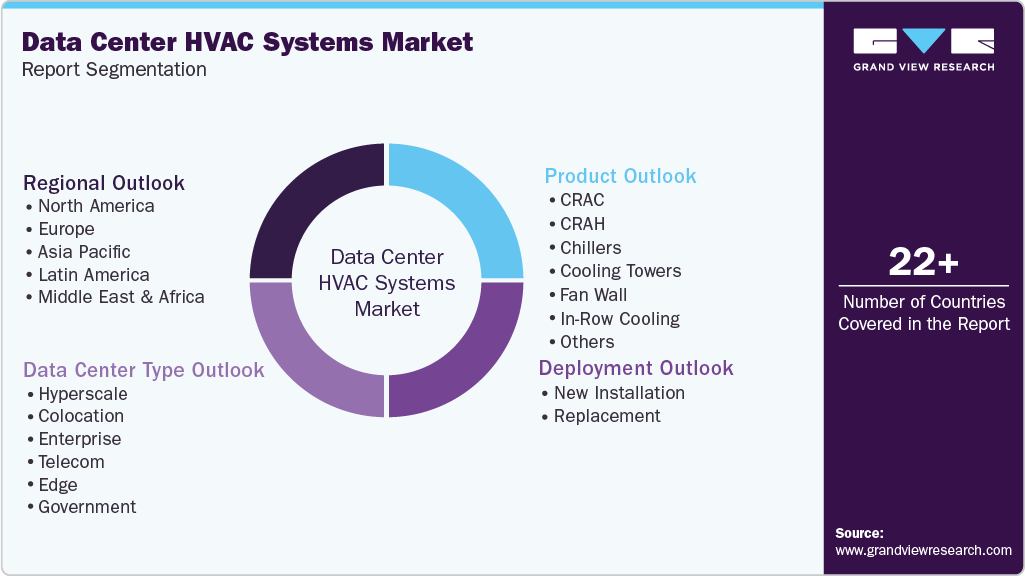
This report forecasts revenue growth at global, regional, and country levels and provides an analysis of the latest industry trends in each of the sub-segments from 2021 to 2033. For this study, Grand View Research has segmented the global data center HVAC system market report based on product, deployment, data center type, and region:
-
Product Outlook (Revenue, USD Billion, 2021 - 2033)
-
CRAC
-
CRAH
-
Chillers
-
Cooling Towers
-
Fan Wall
-
In-Row Cooling
-
Others
-
-
Deployment Outlook (Revenue, USD Billion, 2021 - 2033)
-
New Installation
-
Replacement
-
-
Data Center Type Outlook (Revenue, USD Billion, 2021 - 2033)
-
Hyperscale
-
Colocation
-
Enterprise
-
Telecom
-
Edge
-
Government
-
-
Regional Outlook (Revenue, USD Billion, 2021 - 2033)
-
North America
-
U.S.
-
Canada
-
Mexico
-
-
Europe
-
Germany
-
France
-
Italy
-
Spain
-
UK
-
-
Asia Pacific
-
China
-
India
-
Japan
-
South Korea
-
Australia
-
-
Latin America
-
Brazil
-
Argentina
-
-
Middle East & Africa
-
Saudi Arabia
-
UAE
-
South Africa
-
-
Research Methodology
The data center HVAC systems market figures in this report are based on a proven research process that combines executive interviews with secondary research from proprietary databases, company filings, and recognized regulatory and institutional sources. Market size is built through value-chain sizing-reconciling supply-side and demand-side estimates-and triangulated with bottom-up and top-down approaches. Every estimate passes multiple levels of expert validation before publication, with each data center HVAC systems segment quantified using the revenue-capture definitions in the table below.
Segment Definition
Product
Revenue Capture Definition
CRAC
Revenue generated from the sale of computer room air conditioning units designed to provide dedicated cooling and humidity control for data center environments.
CRAH
Revenue generated from the sale of computer room air handling units that use chilled water or other cooling media to condition and circulate air within data centers.
Chillers
Revenue generated from the sale of chiller systems used to produce and circulate chilled water for data center cooling applications.
Cooling Towers
Revenue generated from the sale of cooling tower systems used to reject heat from water-based data center cooling systems to the surrounding environment.
Fan Wall
Revenue generated from the sale of fan wall systems comprising multiple fans used to provide high-volume and efficient airflow for data center cooling.
In-Row Cooling
Revenue generated from the sale of cooling units installed between or adjacent to server racks to provide localized cooling for high-density computing environments.
Others
Revenue generated from the sale of other data center HVAC and thermal management equipment not covered under the specified product categories.
Deployment
Revenue Capture Definition
New Installation
Revenue generated from the sale of HVAC systems and equipment installed in newly constructed data centers or newly developed data center capacity.
Replacement
Revenue generated from the sale of HVAC systems and equipment used to replace existing or aging cooling infrastructure in operational data centers.
Data Center Type
Revenue Capture Definition
Hyperscale
Revenue generated from the sale of HVAC systems and equipment to large-scale data center facilities operated for extensive cloud computing, AI, digital services, and high-performance computing workloads, typically requiring high-capacity and scalable cooling infrastructure.
Colocation
Revenue generated from the sale of HVAC systems and equipment to data centers operated by third-party providers that lease computing space, power, and infrastructure to multiple customers, requiring reliable and flexible cooling capacity to support diverse workloads.
Enterprise
Revenue generated from the sale of HVAC systems and equipment for data centers owned and operated by individual businesses to support internal IT, applications, databases, cloud services, and business-critical computing operations.
Telecom
Revenue generated from the sale of HVAC systems and equipment for telecommunications and network infrastructure facilities that support connectivity, data transmission, 5G networks, and other communication services, often requiring reliable cooling across distributed locations.
Edge
Revenue generated from the sale of HVAC systems and equipment for smaller, distributed data center facilities positioned closer to users and data sources, supporting applications such as content delivery, IoT, 5G, autonomous systems, and real-time computing.
Government
Revenue generated from the sale of HVAC systems and equipment for data centers owned, operated, or commissioned by government agencies and public-sector organizations to support government services, secure information systems, defense-related applications, and digital infrastructure.
Estimation Model
Layer Name
Key Question
Description
Data Center Market Scope
What is the addressable data center base?
Identify the global data center scope by facility type, geography, capacity, and operating status to establish the overall demand base for HVAC systems.
Cooling Capacity Requirement
How much cooling infrastructure is required?
Assess data center IT capacity, rack density, cooling architecture, and corresponding HVAC capacity requirements across CRAC, CRAH, chillers, cooling towers, fan walls, and in-row cooling.
HVAC Equipment Sales
How much HVAC equipment is sold?
Estimate annual equipment sales generated through new installations and replacement activity across different data center types, products, and regions.
Market Revenue
What is the total market revenue?
Aggregate revenue generated from the sale of data center HVAC equipment across all product categories, deployment types, data center types, and geographic markets.
Delivered Customizations
This report has been delivered with the following In-depth customizations
Client Request
Customization Delivered
Value Adds
Regional Segmentation
Delivered a detailed regional and country-level assessment covering North America, Europe, Asia Pacific, Latin America, and Middle East & Africa, with focused analysis of key countries including the U.S., Germany, UK, China, India, Saudi Arabia, and Brazil.
Provides a clear view of regional market leadership, growth opportunities, country-level demand trends, and data center development patterns, supporting geographic expansion and investment decisions.
Competitive Benchmarking
Delivered competitive analysis covering 15 key market participants, categorized into established and emerging/regional players, along with assessment of their operating strategies, competitive advantages, product capabilities, and market weaknesses.
Enables comparison of competitive positioning, technology capabilities, product coverage, and strategic strengths, helping identify market leaders and potential areas for differentiation.
Opportunity Assessment
Delivered an opportunity assessment covering product, deployment, data center type, and regional dynamics, with emphasis on high-growth areas such as CRAC, replacement demand, enterprise facilities, AI-driven high-density computing, and advanced cooling technologies.
Helps identify high-potential market segments and emerging demand pockets, supporting product prioritization, market-entry strategies, and future growth planning.
Frequently Asked Questions About This Report
The global data center HVAC systems market size was valued at USD 4.4 billion in 2025 and is estimated at USD 4.8 billion for 2026.
The new installation segment dominated the market, accounting for 74.4% of global revenue in 2025, driven by continued construction and expansion of data center facilities worldwide.
The global data center HVAC systems market is expected to grow at a CAGR of 11.3% from 2026 to 2033, reaching USD 10.2 billion by 2033.
North America held the largest regional share, accounting for 38.6% of the global data center HVAC systems market in 2025, supported by extensive hyperscale and colocation infrastructure and continued investment in high-density computing facilities.
The U.S. held the largest country-level market share in 2025, supported by its large installed base of data centers and continued expansion of cloud, AI, and high-performance computing infrastructure.
The chillers segment dominated the market, accounting for 28.8% of global revenue in 2025, supported by their suitability for large-scale facilities requiring centralized, high-capacity cooling.
The hyperscale segment dominated the market, accounting for 34.5% of global revenue in 2025, owing to the substantial cooling requirements of large-scale facilities supporting cloud, AI, and high-performance computing workloads.
Some of the key players operating in the global data center HVAC systems market include Vertiv Group Corp.; Schneider Electric; Johnson Controls; STULZ GmbH; Rittal Pvt. Ltd.; Trane Technologies; Carrier; Daikin Industries, Ltd.; Mitsubishi Electric Power Products Inc.; Munters; Delta Electronics, Inc.; Alfa Laval; Danfoss A/S; Eaton; Kirloskar
The market is primarily driven by the expansion of hyperscale and colocation data centers, increasing AI and high-performance computing, rising rack power densities, growing cloud infrastructure, and the need for reliable and energy-efficient thermal management. The increasing heat generated by high-density computing is also encouraging investment in advanced cooling technologies.
About the Author(s)
Advanced Interior Materials Research Team
Advanced Materials · Advanced Interior MaterialsThis report was authored by the advanced interior materials research team at Grand View Research - comprising two research analysts, one senior research analyst, and one industry expert - with specialized expertise in the advanced interior materials segment of the advanced materials industry. All findings are based on proprietary advanced materials databases, executive interviews, and regulatory analysis, subject to internal peer review prior to publication.
Last Updated:
Speak to Analyst


Customize this report to your needs — add regions, segments, or data points, with 20% free customization.
Or view our licence options:


ISO 9001:2015 & 27001:2022 Certified
We are GDPR and CCPA compliant! Your transaction & personal information is safe and secure. For more details, please read our privacy policy.


