
- Home
- »
- Medical Devices
- »
-
Dental Implants And Prosthetics Contract Manufacturing Market Report 2033GVR Report cover

Dental Implants And Prosthetics Contract Manufacturing Market (2026 - 2033)
Size, Share & Trends Analysis Report By Product (Dental Implants, Dental Prosthetics), By Service (Design & Engineering Services, Component Manufacturing Services), By End Use, By Region, And Segment Forecasts
Market Size, 2025
$1.7BMarket Estimate, 2026
$1.9BMarket Forecast, 2033
$3.4BCAGR, 2026–2033
9.0%Dental Implants And Prosthetics Contract Manufacturing Market Summary
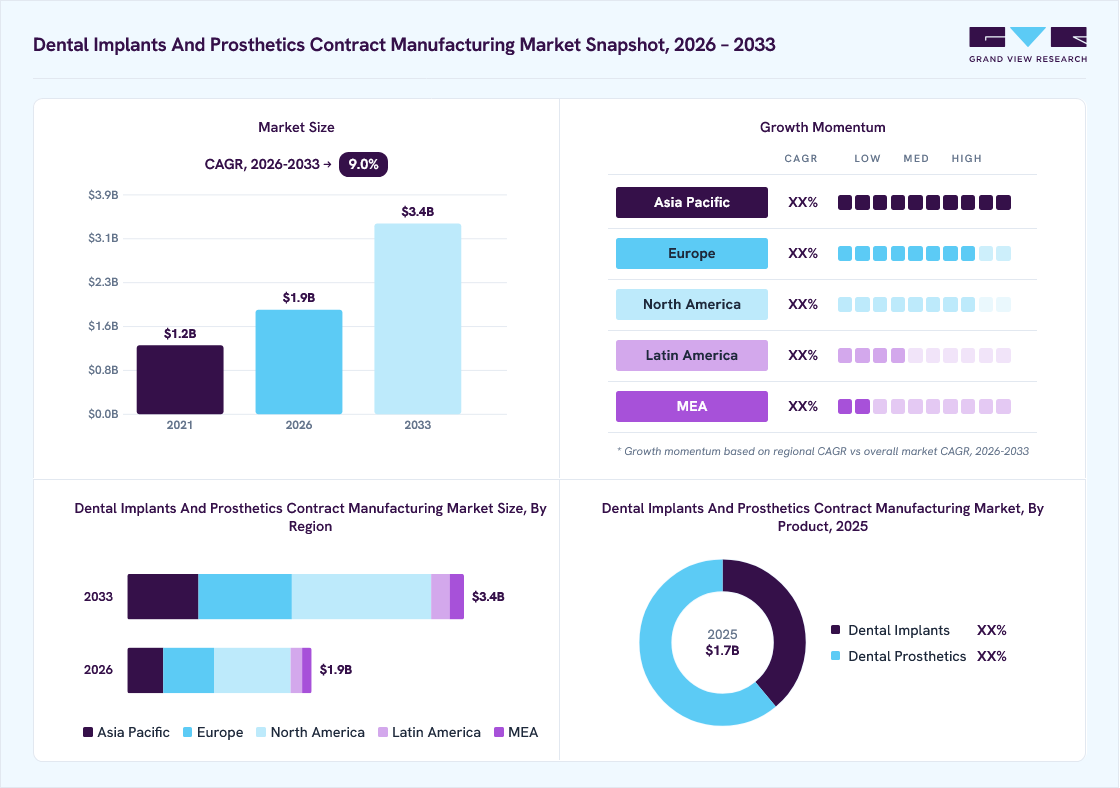
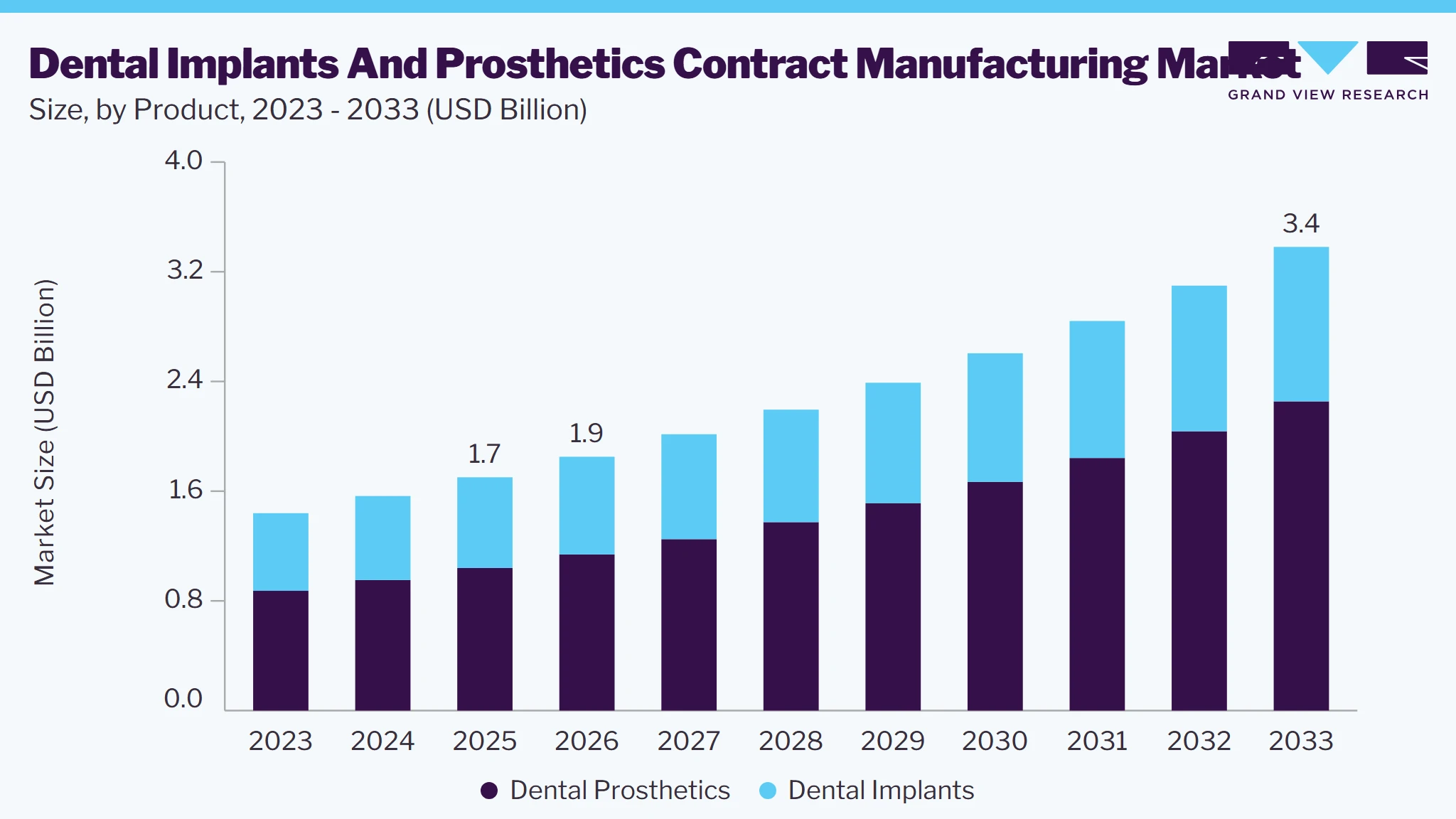
The global dental implants and prosthetics contract manufacturing market size was valued at USD 1.7 billion in 2025 and is projected to grow from USD 1.9 billion in 2026 to USD 3.4 billion by 2033, at a CAGR of 9.0% from 2026 to 2033. North America dominated the market, accounting for a revenue share of 41.5% in 2025. The market is driven by rising demand for implants, crowns, bridges, dentures, and abutments.
 Source: Grand View Research, IR Documents, Primary Interviews, Paid DatabasesTo learn more about this report,
 Download Free Sample Report
Key Market Trends & Insights
- By product: Dental prosthetics segment held the largest revenue share of 61.1% in 2025.
- By service: Quality and regulatory services segment dominated the market with the largest revenue share of 40.5% in 2025.
- By end use: Medical device companies segment led the market with the largest revenue share of 61.9% in 2025.
Regional Highlights
- Largest regional market: North America (41.5% revenue share, 2025)
- Fastest-growing regional market: Asia Pacific (highest CAGR, 2026-2033)
- By country: The U.S. dominated North America with the largest revenue share in 2025.
Market Size & Forecast
- Market size in 2025: USD 1.7 billion
- Estimated market size in 2026: USD 1.9 billion
- Projected market size by 2033: USD 3.4 billion
- CAGR (2026-2033): 9.0%
Three ways to get this report
Buy it, customize it, or ask a question.Ask an Analyst
Analyst response in 1 business day
- AccessReport author, directly
- Reply timeWithin 1 working day
- No sales callDirect answer only
- FormatEmail reply
- CostFree, no cost
Get the Full Report
What the study covers
- FormatsPDF · Excel · Dashboard
- Timeline2026–2033 annual, 2025 base
- Coverage20+ countries, 5 regions
- Companies10+ key players profiled
Customize the Report
20% free customization
- IncludeCountries, segments, points
- TailorTo your product definition
- ExtendDeeper competitor detail
- OrA fully bespoke study
- Turnaround5–10 working days
 To learn more about this report, Download Free Sample Report
Increasing rates of tooth loss, periodontal disease, and aging populations are driving increases in restorative procedure volumes. Moreover, dental device companies outsource precision machining, surface treatment, prosthetic fabrication, assembly, packaging, and quality services to reduce capital expenditure and accelerate commercialization.Market Dynamics
The dental implants and prosthetics contract manufacturing market is expanding as dental device companies increasingly outsource precision production, engineering, and quality-related activities to specialized manufacturers. The market growth is supported by rising implant procedures, increasing demand for aesthetic restorations, aging populations, and wider adoption of digitally designed dental solutions. At the same time, manufacturers are investing in CAD/CAM systems, multi-axis machining, additive manufacturing, automated inspection, and advanced surface treatments to meet tighter accuracy, customization, and turnaround requirements. Competitive differentiation is shifting from basic production capacity to integrated capabilities that cover design support, prototyping, validation, component manufacturing, assembly, packaging, and lifecycle services. Customers are prioritizing suppliers with strong quality systems, reliable capacity, regional manufacturing presence, and supply-chain resilience. Market consolidation and strategic partnerships are strengthening technical portfolios and geographic reach, while regional expansion supports shorter lead times and improved customer responsiveness. Thus, market growth be expected to increasingly favor contract manufacturers that combine technological sophistication, scalable operations, regulatory readiness, and flexible production models for both standardized and patient-specific dental products.
The market is driven by rising need for scalable, high-precision production as implant and restorative procedure volumes increase. Aging populations, tooth loss, periodontal disease, and growing acceptance of implant-supported restorations are expanding demand for implants, abutments, crowns, bridges, and dentures. Dental device companies increasingly rely on contract manufacturers because producing these components requires advanced CNC machining, CAD/CAM integration, surface modification, validated inspection, and controlled packaging capabilities. Outsourcing allows brand owners to avoid substantial capital expenditure, shorten development timelines, and add capacity without expanding internal facilities. The shift toward digital dentistry further strengthens this model because intraoral scanning and software-based design generate an increasing number of customized production files that require rapid, repeatable conversion into patient-specific components. Manufacturers that combine engineering support, materials expertise, process validation, traceability, and commercial-scale output become strategically important suppliers. Consequently, increasing procedural demand and manufacturing complexity are translating into higher outsourcing intensity across the dental implant and prosthetic value chain, supporting supply reliability, portfolio expansion, and commercialization.
The key restraint is the high regulatory and quality-assurance burden associated with manufacturing implantable and patient-contact dental devices. Contract manufacturers must demonstrate consistent process control across design transfer, raw-material qualification, machining, surface treatment, cleaning, packaging, labeling, and complaint handling. In the U.S., the FDA’s Quality Management System Regulation, effective February 2026, incorporates ISO 13485:2016 and reinforces lifecycle risk-management and manufacturing-control expectations. Similar requirements in other markets create extensive documentation, validation, audit, and change-control obligations. These requirements increase qualification timelines, operating costs, and the resources needed to maintain compliant facilities and trained personnel. Small and mid-sized suppliers may struggle to fund metrology systems, clean manufacturing environments, process validation, cybersecurity controls, and regulatory specialists. In addition, any supplier change, material modification, or process deviation can require additional testing and customer approval. This limits rapid supplier substitution, raises entry barriers, and can delay commercialization, thereby constraining market participation despite strong underlying demand. Compliance failures may trigger recalls, remediation expenses, production interruptions, reputational damage, and loss of long-term OEM contracts.
The market opportunity lies in integrated digital manufacturing for customized dental implants and prosthetics. Intraoral scanners, CAD/CAM platforms, additive manufacturing, automated milling, and digital inspection are creating a connected workflow from clinical scan to finished component. Contract manufacturers can capture greater value by moving beyond build-to-print machining and offering design-for-manufacturability, rapid prototyping, patient-specific production, surface engineering, validation, and packaging within a single program. This opportunity is particularly attractive for customized abutments, zirconia restorations, surgical guides, and complex implant-supported prostheses, where speed and accuracy materially influence clinical workflow. Suppliers that establish interoperable digital systems can receive files directly from dental laboratories or device companies, automate production planning, and reduce manual transfer errors. Moreover, regional production hubs can shorten delivery times and support localized regulatory and language requirements. By combining digital connectivity with flexible low-volume and scalable commercial manufacturing, contract manufacturers can serve premium, high-mix programs while deepening customer integration and improving margins, retention, and recurring revenue potential. The model enables differentiated pricing by complexity, turnaround time, materials, validation scope, and service integration.
Market Concentration & Characteristics
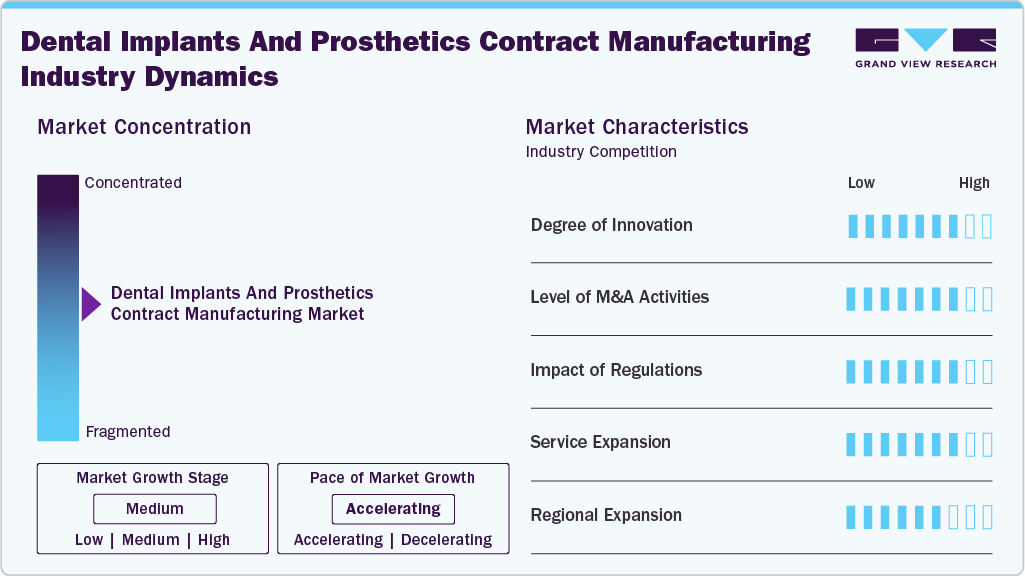
The dental implants and prosthetics contract manufacturing market growth stage is moderate, and growth is accelerating. The market is characterized by the degree of innovation, level of M&A activities, regulatory impact, service expansion, and regional expansion.
Innovation is moderate to high, driven by CAD/CAM integration, additive manufacturing, automated CNC machining, advanced surface treatments, and digital inspection systems. Contract manufacturers are adopting data-driven production controls and high-performance materials to improve precision and consistency. Moreover, customized implant and prosthetic designs are increasing demand for flexible manufacturing platforms capable of supporting prototypes, small batches, and commercial-scale production efficiently.
 To learn more about this report, Download Free Sample Report
Merger and acquisition activity remains moderate as larger contract manufacturers acquire specialized machining, engineering, packaging, and regulatory capabilities. These transactions help companies broaden service portfolios, enter new regional markets, and secure established customer relationships. Moreover, consolidation provides access to advanced equipment, skilled personnel, and validated manufacturing facilities, enabling manufacturers to offer integrated services and compete for complex global dental-device outsourcing programs.
Regulatory requirements have a significant impact on market operations due to strict standards for product safety, biocompatibility, manufacturing consistency, sterilization, and traceability. Contract manufacturers must maintain robust quality management systems, validated processes, technical documentation, and supplier controls. Furthermore, compliance with region-specific medical device regulations increases operating complexity but creates competitive advantages for manufacturers with established regulatory expertise and internationally recognized certifications.
Service expansion is increasing as manufacturers move beyond component production to provide design engineering, prototyping, process development, assembly, packaging, sterilization coordination, and regulatory support. Moreover, dental-device companies prefer integrated suppliers capable of managing multiple stages of the product lifecycle. This shift enables contract manufacturers to strengthen customer relationships, increase contract value, and differentiate through comprehensive, customized, and scalable manufacturing solutions.
Regional expansion is accelerating as contract manufacturers establish facilities, partnerships, and distribution networks near major dental-device markets. North America and Europe remain important due to established implant industries, while Asia Pacific offers lower production costs and growing technical capabilities. Furthermore, regionalized manufacturing supports shorter delivery timelines, supply-chain resilience, regulatory alignment, and improved customer service, encouraging manufacturers to diversify their geographic presence.
Analyst Perspective
The dental implants and prosthetics contract manufacturing market is shifting from transactional sourcing to integrated, lifecycle-focused partnerships. Growth is expected to depend on suppliers offering design support, precision manufacturing, validation, packaging, and regulatory compliance through a unified delivery model. The expansion of digital dentistry is driving demand for customized, high-precision prosthetic components, encouraging adoption of CAD/CAM, additive manufacturing, digital inspection, and production traceability. Meanwhile, stricter regulations and supply chain diversification are promoting regional and dual-source manufacturing networks. Competitive advantage is increasingly expected to depend on quality, speed, scalability, technical expertise, and reliable prototype-to-commercial production rather than pricing alone.
Impact of U.S. Tariffs on the Global Dental Implants and Prosthetics Contract Manufacturing Market
U.S. tariffs are increasing cost pressure across the global dental implants and prosthetics contract manufacturing market by raising prices for imported metals, components, machinery, and finished medical devices. Recent U.S. measures have imposed additional duties on selected steel, aluminum, copper, and derivative products, affecting manufacturing inputs and equipment costs. Contract manufacturers dependent on cross-border titanium, precision-machined parts, tooling, and packaging materials may experience margin compression or pass costs to dental-device companies. Furthermore, potential tariffs arising from U.S. investigations into medical-device imports create additional uncertainty for overseas suppliers. Thus, companies are diversifying suppliers, increasing regional production, renegotiating contracts, and building inventory buffers. Although tariffs may encourage U.S. manufacturing investment, they can delay sourcing transitions because qualified dental-device suppliers require extensive validation, documentation, and regulatory approval before replacement.
Technological Advancements
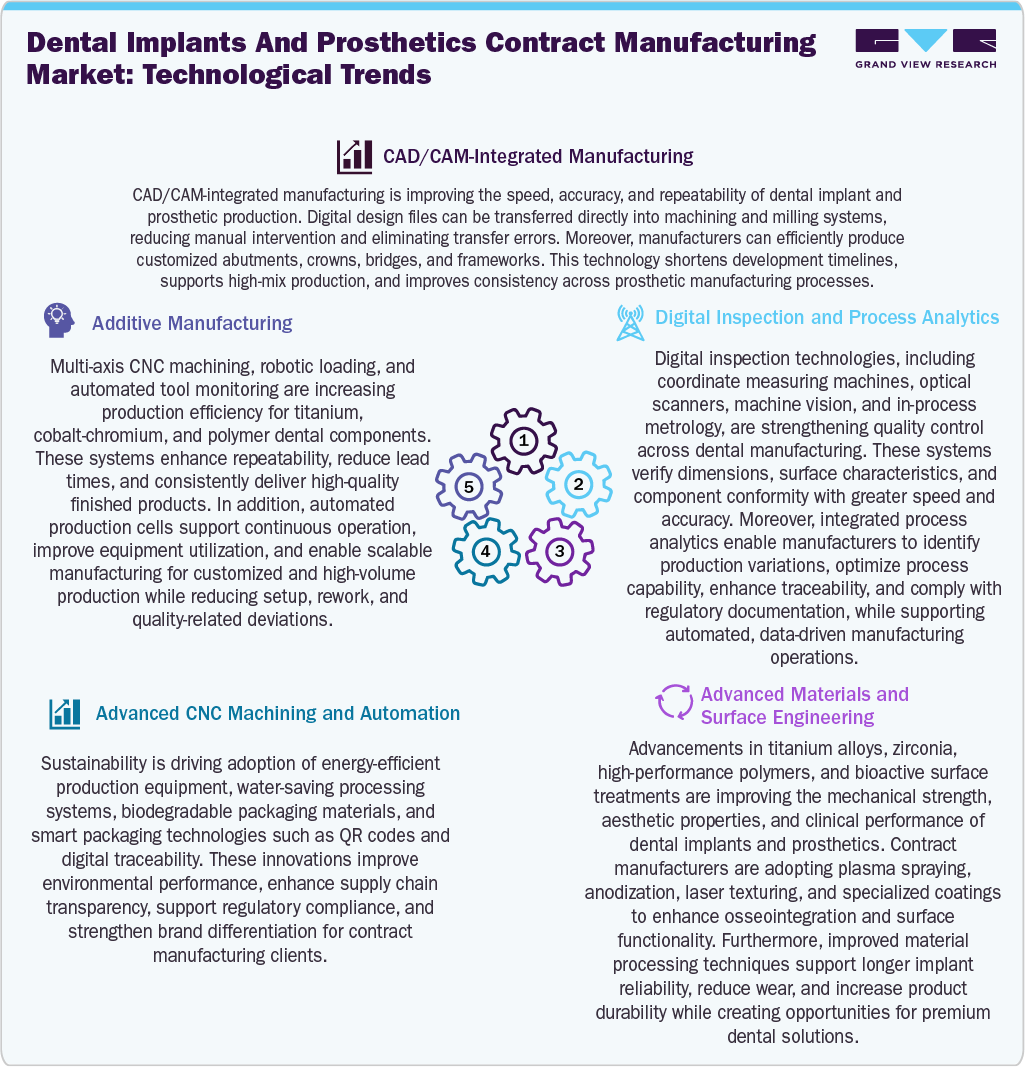
Technological advancement is transforming dental implants and prosthetics contract manufacturing into a digitally connected, highly precise, and increasingly automated production environment. CAD/CAM platforms allow clinical or engineering designs to move directly into manufacturing, while additive manufacturing supports rapid prototyping and complex patient-specific products. Advanced multi-axis machining and robotic automation improve throughput, dimensional consistency, and equipment utilization across commercial programs. Moreover, digital inspection, machine vision, and process analytics strengthen quality assurance by enabling real-time monitoring, defect detection, and complete production traceability. Developments in titanium alloys, zirconia, high-performance polymers, and surface engineering are improving product durability, aesthetics, biocompatibility, and osseointegration. Collectively, these technologies reduce development timelines, manufacturing variability, material waste, and manual processing requirements. Contract manufacturers that integrate digital design, automated production, advanced materials, and validated inspection systems is expected to be better positioned to support customized and high-volume programs while meeting increasingly demanding quality, cost, scalability, and delivery expectations.
 To learn more about this report, Download Free Sample Report
Pricing Model Analysis
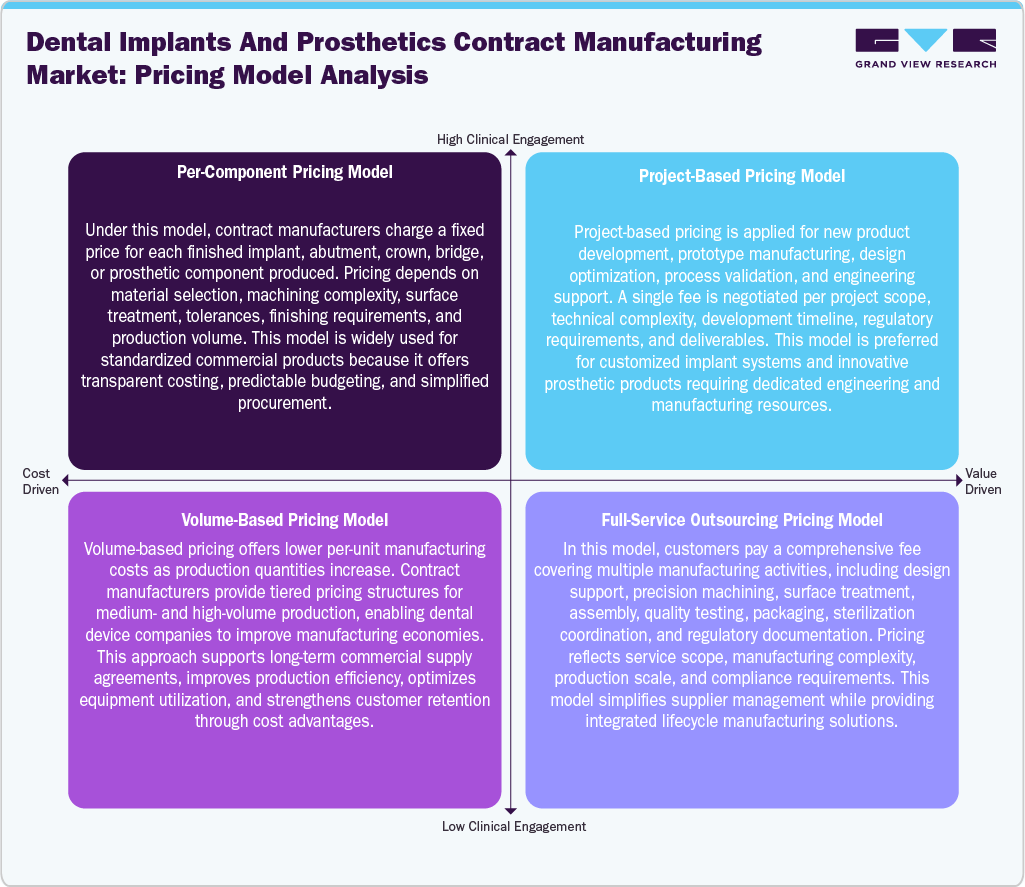
The dental implants and prosthetics contract manufacturing market utilizes multiple pricing models depending on product complexity, production scale, and customer requirements. Per-component pricing remains the most common model for standardized implants and prosthetic components, offering transparent and predictable costs. Project-based pricing is preferred for prototype development, customized implant systems, and engineering-intensive programs where pricing reflects technical scope and development activities. Volume-based pricing is widely adopted for commercial manufacturing, enabling customers to benefit from economies of scale by lowering unit costs as production volumes increase. In addition, full-service outsourcing pricing is gaining importance as dental device companies increasingly seek integrated partners capable of managing design support, manufacturing, quality assurance, packaging, sterilization coordination, and regulatory documentation under a single agreement. The growing adoption of digital dentistry, customized restorations, and comprehensive outsourcing partnerships is encouraging manufacturers to develop flexible pricing structures that balance cost efficiency, technical complexity, quality requirements, production scalability, and long-term customer relationships.
 To learn more about this report, Download Free Sample Report
Product Insights
The dental prosthetics segment led the market with the largest revenue share of 61.1% in 2025, driven by increasing demand for crowns, bridges, dentures, abutments, and implant-supported restorations. In addition, the growing prevalence of dental caries, tooth loss, and oral trauma is increasing restorative procedure volumes. Dental companies increasingly outsource prosthetic design, ceramic processing, milling, finishing, and packaging to manufacturers with specialized capabilities. Moreover, advancements in digital impressions, CAD/CAM milling, and dental 3D printing enable faster production of customized restorations. Rising consumer preference for natural-looking zirconia and ceramic prosthetics, along with increasing cosmetic dentistry expenditure, further supports segment expansion.
The dental implants segment is anticipated to register the fastest CAGR during the forecast period. The growth can be attributed to increasing prevalence of tooth loss, edentulism, periodontal disease, and age-related dental conditions. Moreover, rising patient preference for permanent tooth-replacement solutions is increasing demand for titanium and zirconia implants. Dental device companies are outsourcing precision machining, surface treatment, coating, sterilization, and packaging to specialized contract manufacturers to reduce capital expenditure. Furthermore, advances in implant design, osseointegration, CAD/CAM technology, and customized treatment planning are supporting production requirements. Expanding dental tourism and improved access to implant procedures strengthen segment growth.
Services Insights
The component manufacturing services segment held the largest revenue share of 40.5% in 2025, driven by increasing demand for high-precision dental implants, screws, abutments, frameworks, crowns, bridges, and customized prosthetic components. Moreover, dental device companies outsource CNC machining, milling, casting, injection molding, additive manufacturing, and surface treatment to reduce fixed production costs and access specialized expertise. Strict dimensional tolerances and biocompatibility requirements further increase reliance on experienced manufacturing partners. In addition, growing adoption of titanium, zirconia, and advanced dental ceramics is creating complex production requirements. Automation, digital design integration, and scalable manufacturing capacity support segment growth.
The quality and regulatory services segment is anticipated to register the fastest growth during from 2026 to 2033. The growth can be attributed to stringent requirements governing the safety, performance, traceability, and commercialization of dental implants and prosthetics. In addition, manufacturers require support for quality management systems, technical documentation, risk management, validation, biocompatibility testing, and regulatory submissions. Expanding product portfolios and entry into multiple international markets further increase compliance complexity. Moreover, dental companies increasingly outsource regulatory activities to specialized partners to accelerate approvals and reduce internal resource requirements. Growing scrutiny of manufacturing processes, sterilization, packaging integrity, post-market surveillance, and supplier quality management strengthens segment growth.
End Use Insights
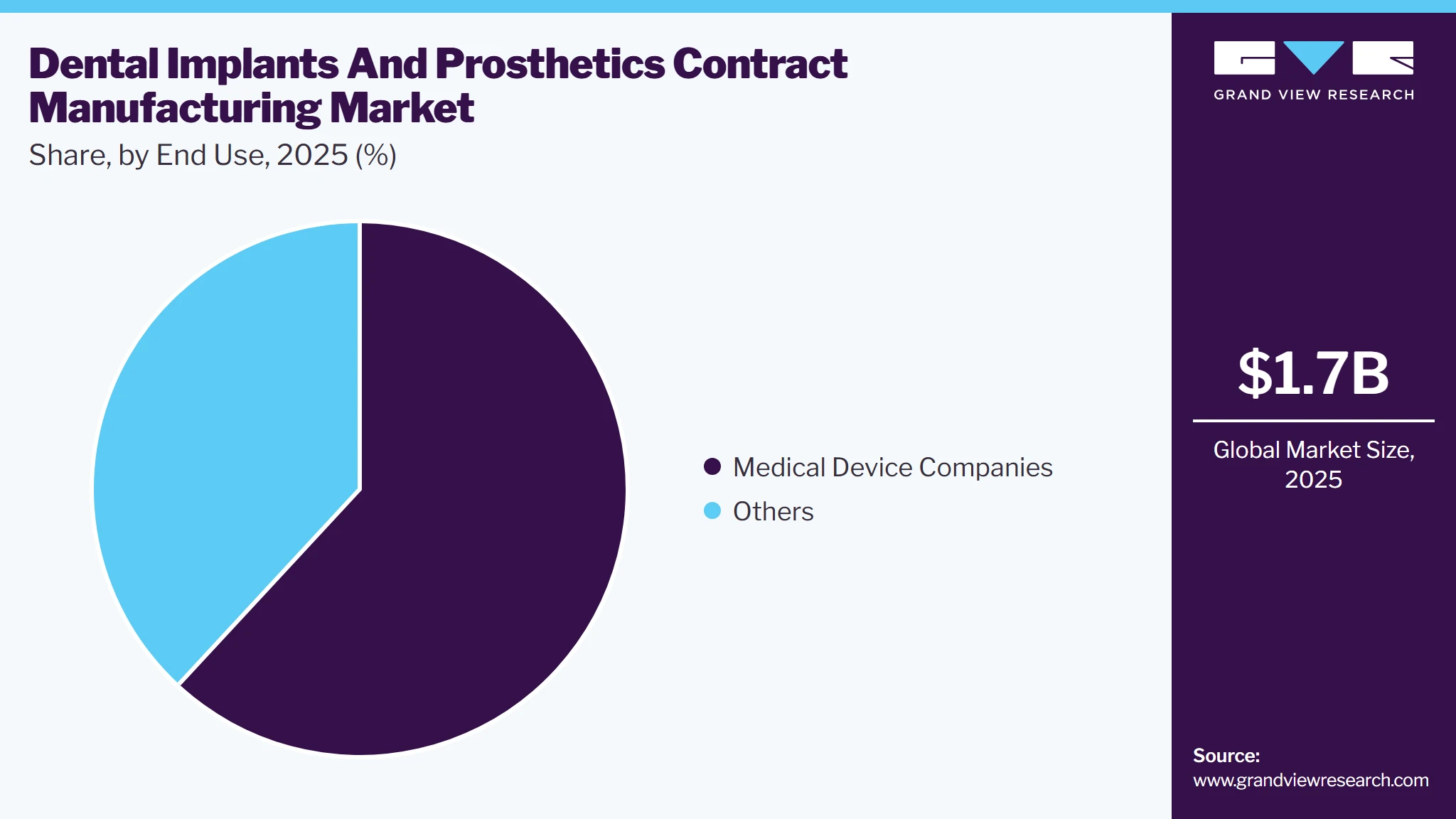
The medical device companies segment led the market with the largest revenue share of 61.9% in 2025. The growth is driven by increasing outsourcing of dental implant and prosthetic manufacturing activities to specialized production partners. Moreover, companies are seeking to reduce capital investment, improve operational flexibility, and accelerate product commercialization. Contract manufacturers provide design support, precision machining, surface treatment, assembly, packaging, sterilization, and regulatory services across the product lifecycle. In addition, expanding product portfolios and demand for customized dental solutions are increasing manufacturing complexity. Medical device companies rely on external partners to access advanced technologies, maintain regulatory compliance, manage fluctuating production volumes, and support regional market expansion.
 To learn more about this report, Download Free Sample Report
The others segment is anticipated to register the fastest growth during the forecast period, due to increasing demand from dental laboratories, clinics, research institutions, distributors, and emerging dental technology companies. In addition, independent dental laboratories outsource digital design, milling, additive manufacturing, finishing, and customized prosthetic production to improve turnaround times and control equipment costs. Start-ups depend on contract manufacturers to access technical expertise and commercial-scale production without establishing internal facilities. Moreover, academic and research organizations require prototype development and small-batch manufacturing for innovative dental products. Expanding digital dentistry and decentralized restorative workflows further support demand from these end users.
Regional Insights
North America Dental Implants and Prosthetics Contract Manufacturing Market Trends
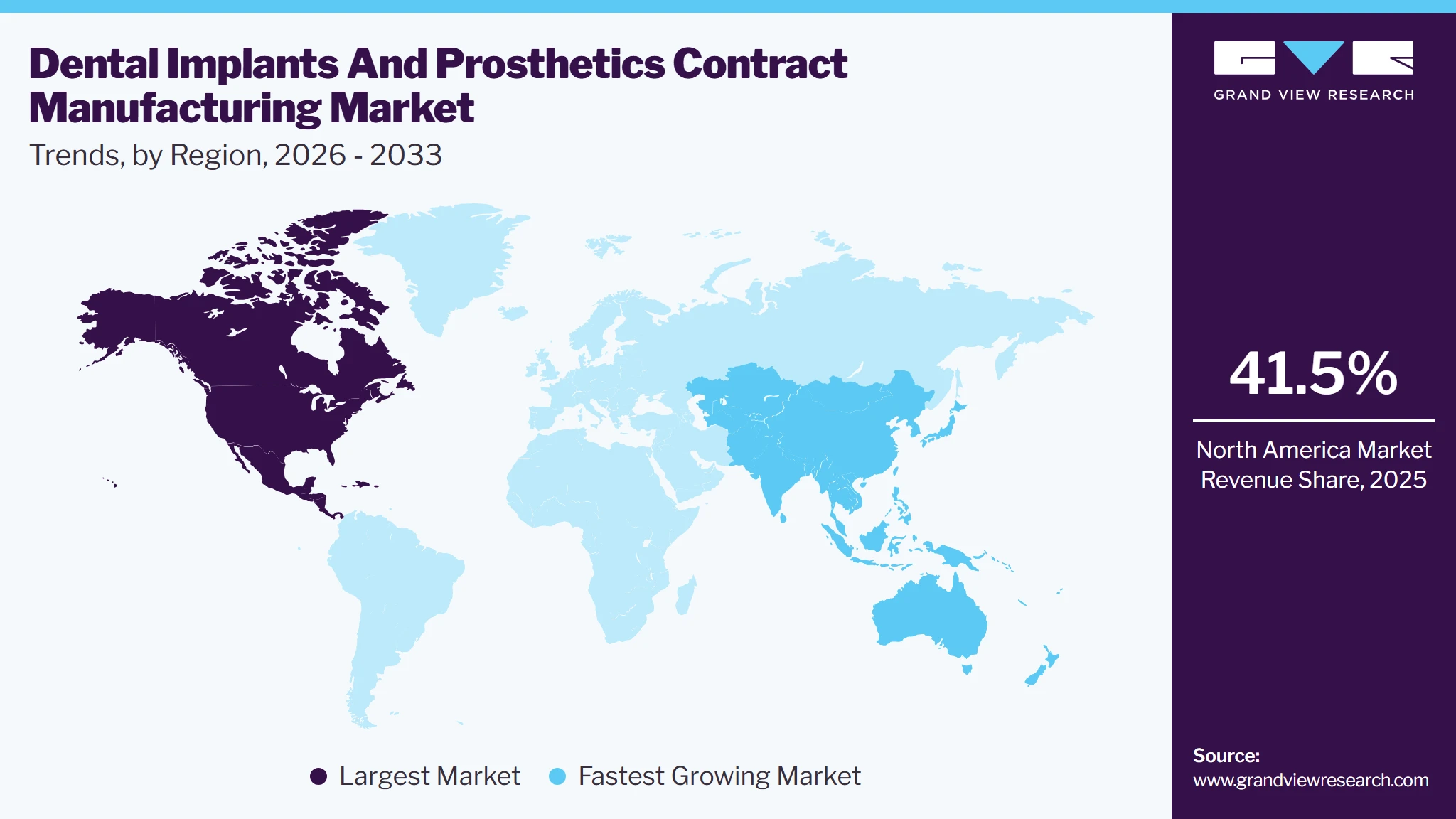
North America dominated the global dental implants and prosthetics contract manufacturing market with the largest revenue share of 41.5% in 2025,driven by high dental implant procedure volumes, advanced manufacturing infrastructure, and strong adoption of digital dentistry. In addition, dental product companies increasingly outsource precision machining, surface treatment, CAD/CAM production, assembly, packaging, and regulatory support to specialized manufacturers. Moreover, the rising prevalence of edentulism and increasing demand for aesthetic restorations are supporting scalable production of titanium implants, zirconia components, crowns, bridges, dentures, and customized abutments.
 To learn more about this report, Download Free Sample Report
U.S. Dental Implants and Prosthetics Contract Manufacturing Market Trends
The dental implants and prosthetics contract manufacturing market in the U.S. held the largest share in the North America region in 2025.The country benefits from the presence of large dental patient population, high expenditure on restorative procedures, advanced dental laboratories, and early adoption of digital workflows. In addition, implant companies increasingly outsource CNC machining, additive manufacturing, coating, sterilization, and packaging to reduce capital expenditure. Furthermore, growing demand for customized and same-day restorations is encouraging manufacturers to invest in automated inspection, CAD/CAM systems, production traceability, and flexible manufacturing capacity.
The dental implants and prosthetics contract manufacturing market in Canada is expected to grow steadily over the forecast period, driven by an aging population, increasing tooth-replacement procedures, and wider adoption of implant-supported restorations. In addition, domestic dental companies and laboratories are increasingly using external manufacturers for precision components, customized prosthetics, and regulatory-compliant production. Moreover, expanding digital dentistry and demand for aesthetically superior zirconia restorations are supporting market growth. Besides, proximity to U.S. manufacturing networks enables Canadian companies to use efficient cross-border and flexible small-batch production models.
Europe Dental Implants and Prosthetics Contract Manufacturing Market Trends
Europe accounted for a significant share of the global dental implants and prosthetics contract manufacturing market in 2025, driven by its established dental implant industry, strong engineering expertise, and widespread use of advanced restorative solutions. In addition, regional manufacturers possess extensive capabilities in precision machining, ceramic processing, surface modification, and customized prosthetic production. Moreover, increasing adoption of intraoral scanning, CAD/CAM milling, and dental 3D printing is strengthening outsourcing opportunities. Furthermore, demand for metal-free zirconia restorations and premium aesthetic products is encouraging dental brands to partner with specialized manufacturers.
The dental implants and prosthetics contract manufacturing market in Germany held the largest share of the European market in 2025, driven by the country’s advanced precision-engineering base, developed dental care infrastructure, and strong presence of dental technology companies. In addition, German manufacturers have extensive capabilities in titanium machining, zirconia processing, surface treatment, and validated quality control. Moreover, rising demand for premium restorations and digitally manufactured prosthetics is supporting outsourcing. Furthermore, strict European quality requirements favor established contract manufacturers that provide reliable documentation, production traceability, and scalable manufacturing systems.
The UK dental implants and prosthetics contract manufacturing market is expected to grow significantly over the forecast period. The market growth is supported by the country’s increasing private dental expenditure, rising preference for implant-supported restorations, and wider adoption of digital dentistry among clinics and laboratories. In addition, dental suppliers are outsourcing CAD design, customized milling, additive manufacturing, packaging, and quality services to improve turnaround times. Moreover, consolidation among dental laboratories is creating demand for scalable production. Furthermore, rising demand for aesthetic crowns, bridges, dentures, and abutments is generating opportunities for flexible manufacturers.
Asia Pacific Dental Implants and Prosthetics Contract Manufacturing Market Trends
Asia Pacific is projected to register the fastest CAGR during the forecast period, driven by the rapid expansion of dental care infrastructure, increasing disposable income, and growing awareness of restorative and aesthetic dentistry. In addition, the region offers competitive manufacturing costs, expanding technical expertise, and improving capabilities in precision machining, dental ceramics, and digital production. Moreover, international implant companies are developing local supplier networks to improve affordability and market access. Furthermore, the adoption of CAD/CAM systems, intraoral scanning, and 3D printing is enabling manufacturers to produce customized implants and prosthetics at scale.
The dental implants and prosthetics contract manufacturing market in China is rapidly growing due to expanding urban dental services, increasing implant procedure volumes, and rising demand for affordable restorative treatments. In addition, volume-based procurement initiatives have reduced implant prices and expanded patient access, encouraging companies to localize production. Moreover, Chinese manufacturers are strengthening their capabilities in titanium machining, zirconia milling, surface treatment, and digital prosthetic production. Furthermore, government support for domestic manufacturing and increasing price competition are promoting high-volume outsourcing, supplier consolidation, and investment in automated manufacturing facilities.
The dental implants and prosthetics contract manufacturing market in Japan is driven by its aging population, established dental technology ecosystem, high quality expectations, and demand for durable restorative solutions. In addition, Japanese dental companies emphasize precision, biocompatibility, surface quality, and long-term clinical performance, thereby supporting demand for specialized manufacturing partners. Moreover, the adoption of digital impressions, CAD/CAM prosthetics, and advanced ceramic materials is expanding outsourcing opportunities. Furthermore, manufacturers offering small-batch customization, rigorous process validation, and consistent component tolerances are well positioned to serve premium dental implant and prosthetic applications.
India dental implants and prosthetics contract manufacturing market is experiencing rapid expansion, attributed to competitive production costs, a growing dental patient population, and increasing adoption of implants and cosmetic restorations. In addition, the country’s extensive network of dental clinics and laboratories is driving demand for affordable crowns, bridges, dentures, abutments, and implant components. Moreover, expanding dental tourism and improving access to CAD/CAM, CNC machining, and 3D-printing technologies are strengthening domestic capabilities. Furthermore, manufacturers are pursuing international certifications and advanced quality systems to secure outsourcing contracts from global dental companies.
Latin America Dental Implants and Prosthetics Contract Manufacturing Market Trends
The dental implants and prosthetics contract manufacturing market in Latin America is expected to grow significantly, driven by expanding private dental care, increasing dental tourism, and growing awareness of implant-supported treatments. In addition, regional demand for cost-effective implants, crowns, bridges, dentures, and customized abutments is encouraging dental companies to engage specialized production partners. Moreover, outsourcing enables companies to control manufacturing expenditure and efficiently serve fragmented country markets. Furthermore, investments in digital laboratories, CAD/CAM milling, workforce training, and local distribution networks are gradually strengthening regional manufacturing capacity and improving product accessibility.
Dental Implants and Prosthetics Contract Manufacturing market in Brazil is driven by its large dental professional base, established domestic implant industry, and strong demand for restorative and aesthetic dentistry. In addition, significant procedure volumes and comparatively affordable implant treatments support scalable production of implants, abutments, crowns, bridges, and dentures. Moreover, local companies are investing in automated machining, surface engineering, digital design, and ceramic processing to improve quality and export competitiveness. Furthermore, dental tourism and increasing adoption of implant-supported full-arch restorations are expanding opportunities for specialized contract manufacturers.
Middle East & Africa Dental Implants and Prosthetics Contract Manufacturing Market Trends
The dental implants and prosthetics contract manufacturing market in MEA is driven by improving dental infrastructure, increasing private healthcare investment, and rising demand for restorative and cosmetic treatments. In addition, Gulf countries are adopting premium implant systems and digitally produced prosthetics, while selected African markets are gradually expanding urban dental services. Moreover, limited local manufacturing capacity is creating opportunities for regional partnerships, technology transfer, and import substitution. Furthermore, manufacturers providing affordable components, customized prosthetics, regulatory support, and efficient distribution are expected to drive the market growth.
The UAE Dental Implants and Prosthetics Contract Manufacturing market is driven by growing medical tourism, increasing numbers of premium dental clinics, and rising demand for implant-supported and aesthetic restorations. In addition, strong healthcare investment and digitally advanced dental practices support the adoption of customized crowns, bridges, abutments, dentures, and full-arch prosthetics. Moreover, opportunities are emerging for regional laboratories, additive manufacturing providers, and international contract manufacturers. Furthermore, the country’s free-zone infrastructure and strategic connectivity position it as a potential dental customization and distribution hub for the Middle East.
Key Dental Implants and Prosthetics Contract Manufacturing Company Insights
The key players operating across the market are adopting strategic initiatives such as service launches, mergers & acquisitions, partnerships & agreements, and expansions to gain a competitive edge in the market. For instance, in July 2025,ARCHIMED entered into a agreement to acquire ZimVie. The acquisition focuses on targeted ZimVie’s dental implant portfolio, which includes implants, abutments, restorative components, biomaterials, guided-surgery solutions, and digital workflows supporting tooth replacement and restoration procedures.
Key Dental Implants and Prosthetics Contract Manufacturing Companies
The following key companies have been profiled for this study on the dental implants and prosthetics contract manufacturing market.
-
Komet Medical
-
CPM Precision GmbH
-
Acrotec Medtech
-
Armbruster GmbH
-
Schweizer Feinwerktechnik GmbH
-
FMZ Company (FMZ GmbH)
-
BIOPLATE
-
Halder GmbH
-
Micron Products, Inc.
-
Cendres+Métaux Medtech
-
Yomura Technologies
-
ARCH Medical Solutions Corp.
-
Tectri SA
-
Wesley Coe Ltd
-
SteriPack Group
Competitive Benchmarking
Operating Strategies
Competitive Edge
Weaknesses
Established Players (Komet Medical, Acrotec Medtech, ARCH Medical Solutions Corp.)
- Established players pursue end-to-end manufacturing partnerships encompassing product development, design-for-manufacturing, precision machining, surface finishing, validation, assembly, and sterile packaging. They invest in scalable capacity, automated production, quality systems, and geographically diversified facilities. Moreover, acquisitions and capability integration enable these manufacturers to secure long-term contracts with multinational dental device companies.
- Established players benefit from extensive manufacturing experience, validated production processes, strong regulatory compliance, and established relationships with global medical device companies. Their ability to manage complex materials, tight tolerances, high-volume production, and complete product lifecycles provides differentiation. Furthermore, broad technical capabilities and financial resources support consistent quality, scalability, and supply reliability.
- Established players generally operate with higher manufacturing overheads, complex organizational structures, and relatively rigid commercial processes. Their focus on large, recurring programs may reduce flexibility for prototypes and low-volume orders. Moreover, integration challenges following acquisitions, dependence on major customers, extended qualification procedures, and exposure to regional labor costs can pressure margins and responsiveness.
Emerging Players (Schweizer Feinwerktechnik GmbH, FMZ Company (FMZ GmbH), BIOPLATE)
- Emerging players focus on specialized precision manufacturing, customized engineering, rapid prototyping, and flexible small-to-medium production volumes. They compete by developing expertise in selected dental components, materials, or machining processes. In addition, these companies pursue export opportunities, quality certifications, technology partnerships, and direct OEM relationships to expand their customer base and market visibility.
- Emerging players offer greater operational flexibility, faster decision-making, personalized customer support, and competitive pricing. Their focused manufacturing structures enable rapid customization and efficient handling of technically complex or low-volume projects. Moreover, specialized process knowledge, shorter development cycles, and willingness to accommodate evolving product requirements help them serve start-ups, regional OEMs, and niche dental companies.
- Emerging players may face limited production capacity, narrower geographic coverage, lower brand recognition, and fewer financial resources than established competitors. Their dependence on selected customers or manufacturing technologies increases commercial risk. Furthermore, investments required for automation, regulatory compliance, sterile packaging, and international expansion can strain resources and restrict participation in large, multinational supply agreements.
Recent Developments
-
In October 2025, ARCHIMED completed the acquisition of ZimVie, a company specializing in dental implant systems, restorative components, biomaterials, digital dentistry solutions, and tooth-replacement procedures. The transaction is expected to support ZimVie’s investment in implant innovation, manufacturing capabilities, digital workflows, and geographic expansion.
Dental Implants and Prosthetics Contract Manufacturing Market Report Scope
Report Attribute
Details
Market size in 2025
USD 1.7 billion
Estimated market size in 2026
USD 1.9 billion
Projected market size by 2033
USD 3.4 billion
Growth rate
CAGR of 9.0% from 2026 to 2033
Actual data
2021 - 2025
Forecast period
2026 - 2033
Quantitative units
Revenue in USD billion and CAGR from 2026 to 2033
Report coverage
Revenue forecast, company ranking, competitive landscape, growth factors, and trends
Segments covered
Product, service, end use, region
Regional scope
North America; Europe; Asia Pacific; Latin America; MEA
Country scope
U.S.; Canada; Mexico; UK; Germany; France; Italy; Spain; Denmark; Sweden; Norway; China; India; Japan; Australia; South Korea; Thailand; Brazil; Argentina; South Africa; UAE; Saudi Arabia; Kuwait; Qatar; Oman
Key companies profiled
Komet Medical; CPM Precision GmbH; Acrotec Medtech; Armbruster GmbH; Schweizer Feinwerktechnik GmbH; FMZ Company (FMZ GmbH); BIOPLATE; Halder GmbH; Micron Products, Inc.; Cendres+Métaux Medtech; Yomura Technologies; ARCH Medical Solutions Corp.; Tectri SA; Wesley Coe Ltd; SteriPack Group
Customization scope
Free report customization (equivalent up to 8 analysts working days) with purchase. Addition or alteration to country, regional & segment scope.
Pricing and purchase options
Avail customized purchase options to meet your exact research needs. Explore purchase options
Global Dental Implants And Prosthetics Contract Manufacturing Market Report Segmentation
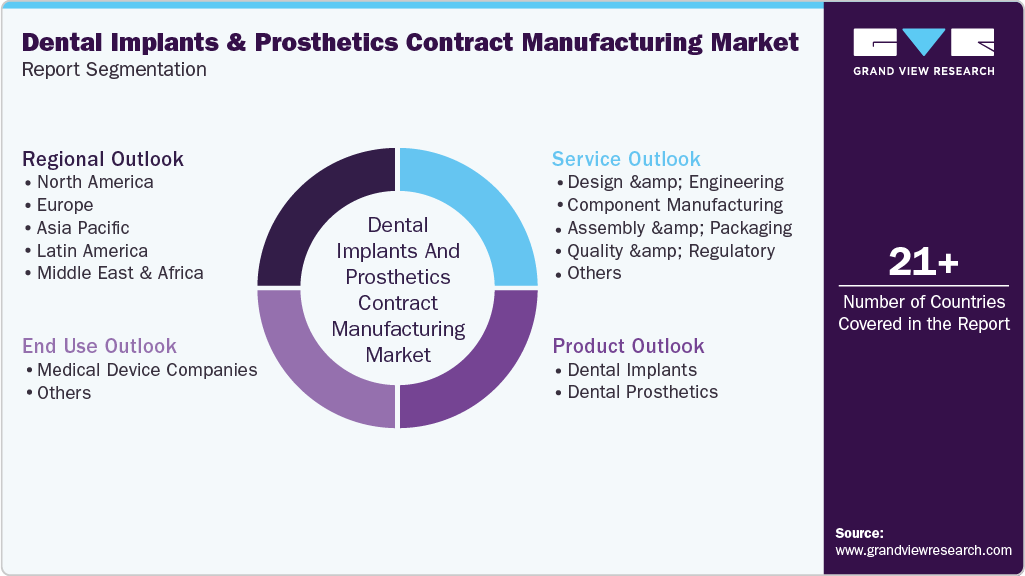
This report forecasts revenue growth at global, regional, and country levels and provides an analysis of the latest industry trends in each of the sub-segments from 2021 to 2033. For this study, Grand View Research has segmented the global dental implants and prosthetics contract manufacturing market report based on product, service, end use and region.
 To learn more about this report, Download Free Sample Report
-
Product Outlook (Revenue, USD Billion, 2021 - 2033)
-
Dental Implants
-
Titanium Implants
-
Zirconium Implants
-
-
Dental Prosthetics
-
Bridges & Crowns
-
Dentures
-
Abutments
-
-
-
Service Outlook (Revenue, USD Billion, 2021 - 2033)
-
Design & Engineering Services
-
Component Manufacturing Services
-
Assembly & Packaging Services
-
Quality & Regulatory Services
-
Others
-
-
End Use Outlook (Revenue, USD Billion, 2021 - 2033)
-
Medical Device Companies
-
Others
-
-
Regional Outlook (Revenue, USD Billion, 2021 - 2033)
-
North America
-
U.S.
-
Canada
-
Mexico
-
-
Europe
-
UK
-
Germany
-
France
-
Italy
-
Spain
-
Denmark
-
Sweden
-
Norway
-
-
Asia Pacific
-
China
-
India
-
Japan
-
Australia
-
South Korea
-
Thailand
-
-
Latin America
-
Brazil
-
Argentina
-
-
Middle East & Africa
-
South Africa
-
UAE
-
Saudi Arabia
-
Kuwait
-
Qatar
-
Oman
-
-
Research Methodology
The dental implants and prosthetics contract manufacturing market figures in this report are based on a proven research process that combines executive interviews with secondary research from proprietary databases, company filings, and recognized regulatory and institutional sources. Market size is built through value-chain sizing-reconciling supply-side and demand-side estimates-and triangulated with bottom-up and top-down approaches. Every estimate passes multiple levels of expert validation before publication, with each dental implants and prosthetics contract manufacturing segment quantified using the revenue-capture definitions in the table below.
Segment Definition
Segment - Product
Revenue capture definition
Dental Implants
The segment captures revenue generated by providing contract manufacturing services for dental implants to end users, including dental implant companies, dental laboratories, distributors, and dental care providers. The segment includes the manufacturing of endosteal, subperiosteal, and zygomatic implant systems; implant bodies; fixtures; screws; connectors; and customized implant components manufactured using titanium, zirconium, and other biocompatible materials.
Titanium Implants
The segment covers revenue generated by providing contract manufacturing services for titanium dental implants to end users. The segment includes commercially pure titanium and titanium-alloy implant bodies, threaded and tapered implants, mini implants, implant screws, surface-treated implants, plasma-sprayed implants, acid-etched implants, and customized titanium components designed for osseointegration and long-term dental restoration applications.
Zirconium Implants
The segment includes revenue generated by providing contract manufacturing services for zirconium dental implants to end users. The segment includes one-piece and two-piece zirconia implants, ceramic implant bodies, customized zirconium implant systems, metal-free implant components, surface-modified zirconia implants, and related components manufactured for patients requiring aesthetic, corrosion-resistant, and biocompatible alternatives to conventional titanium implants.
Dental Prosthetics
The segment captures revenue generated by providing contract manufacturing services for dental prosthetics to end users, including dental prosthetic companies, dental laboratories, implant manufacturers, and dental clinics. The segment includes fixed and removable dental restorations such as crowns, bridges, dentures, abutments, implant-supported prostheses, veneers, inlays, onlays, and customized restorative components manufactured using metals, ceramics, polymers, and composite materials.
Bridges & Crowns
The segment covers revenue generated by providing contract manufacturing services for dental bridges and crowns to end users. The segment includes single-unit crowns, multi-unit bridges, temporary and permanent restorations, implant-supported crowns and bridges, porcelain-fused-to-metal restorations, full-ceramic restorations, zirconia restorations, metal crowns, CAD/CAM-milled components, and customized restorative solutions designed to replace or protect damaged and missing teeth.
Dentures
The segment includes revenue generated by providing contract manufacturing services for dentures to end users. The segment includes complete dentures, partial dentures, removable dentures, fixed dentures, implant-supported overdentures, immediate dentures, flexible dentures, denture bases, artificial teeth, frameworks, attachment systems, and digitally manufactured or customized dentures designed to restore oral function and aesthetics in partially or fully edentulous patients.
Abutments
The segment captures revenue generated by providing contract manufacturing services for dental abutments to end users. The segment includes stock and customized abutments, straight and angled abutments, healing abutments, temporary abutments, multi-unit abutments, titanium and zirconia abutments, screw-retained and cement-retained components, abutment screws, and CAD/CAM-manufactured components used to connect dental implants with prosthetic restorations.
Segment - Service
Revenue capture definition
Design & Engineering Services
The segment captures revenue generated by providing contract design and engineering services for dental implants and prosthetics to end users, including dental device manufacturers, implant companies, dental laboratories, and healthcare technology firms. The segment includes product conceptualization, computer-aided design, prototyping, material selection, design-for-manufacturing, mechanical engineering, tolerance analysis, implant geometry development, prosthetic customization, CAD/CAM programming, design verification, and technical documentation support.
Component Manufacturing Services
The segment covers revenue generated by providing contract component manufacturing services for dental implants and prosthetics to end users. The segment includes precision machining, milling, turning, grinding, laser processing, additive manufacturing, injection molding, casting, surface treatment, coating, polishing, and fabrication of implant bodies, screws, abutments, crowns, bridges, denture frameworks, connectors, and other customized dental components using titanium, zirconia, ceramics, polymers, and metal alloys.
Assembly & Packaging Services
The segment includes revenue generated by providing contract assembly and packaging services for dental implants and prosthetics to end users. The segment includes subassembly and final assembly of implant systems, prosthetic kits, abutment systems, surgical components, and restorative products; cleaning, inspection, labeling, kitting, sterile and non-sterile packaging, sealing, serialization, traceability, and preparation of finished products for distribution and clinical use.
Quality & Regulatory Services
The segment captures revenue generated by providing contract quality and regulatory services for dental implants and prosthetics to end users. The segment includes quality management system support, validation, risk management, biocompatibility coordination, sterilization validation, packaging validation, process qualification, supplier quality management, technical file preparation, regulatory submissions, product registration, audit support, post-market documentation, and compliance with applicable medical device standards and regulatory requirements.
Others
The segment covers revenue generated by providing other contract manufacturing services for dental implants and prosthetics to end users that are not classified under design and engineering, component manufacturing, assembly and packaging, or quality and regulatory services. The segment includes tool and mold development, raw material sourcing, supply chain management, inventory management, warehousing, logistics support, repair and refurbishment, product testing, sterilization coordination, lifecycle management, and customized manufacturing support services.
Segment - End Use
Revenue capture definition
Medical Device Companies
The segment captures revenue generated by providing contract manufacturing services for dental implants and prosthetics to medical device companies. The segment includes services provided to dental implant manufacturers, prosthetic device companies, oral care product manufacturers, and dental technology firms for product design, engineering, component manufacturing, precision machining, surface treatment, assembly, packaging, quality testing, regulatory support, and commercial-scale production of implants, abutments, crowns, bridges, dentures, and related components.
Others
The segment includes revenue generated by providing contract manufacturing services for dental implants and prosthetics to end users other than medical device companies. The segment includes dental laboratories, dental service organizations, hospitals, dental clinics, academic and research institutions, distributors, private-label brands, and specialized dental solution providers requiring customized design, prototyping, component production, prosthetic fabrication, assembly, packaging, testing, and small- or large-batch manufacturing support.
Estimation Model
Model
Description
Outsourcing Penetration-Based Estimation Model
This model estimates the addressable contract manufacturing market by first assessing the total value of the dental implants and prosthetics manufacturing industry. Outsourcing penetration rates are then applied across implants, abutments, crowns, bridges, and dentures based on OEM manufacturing strategies and third-party production trends. The estimates are further segmented by service type, company size, and region with validation through primary assessments, production capacities, and publicly available financial disclosures to ensure market accuracy.
Bottom-Up Approach
The bottom-up model estimates the market by identifying dental implant and prosthetic contract manufacturers and aggregating revenue generated from design, precision machining, component production, assembly, packaging, and regulatory services. Company revenues are allocated by dental product, service, end use, and geography using annual reports, facility-level assessments, and investor portfolios. Adjustments are made for multiple companies, unorganized transactions, and revenue generated from non-dental medical devices.
Demand-Side Estimation
The demand-side model estimates manufacturing revenue using annual dental implant placements and prosthetic procedures including crowns, dentures, and abutments. Revenues are multiplied by average components used per treatment, outsourcing penetration, and estimated manufacturing revenue per component. Country-level adjustments are considered for implant treatment affordability, aging population, disease prevalence, adoption of CAD/CAM technology, and global market values.
Capacity and Utilization Model
The capacity-based model evaluates installed production capacity among dental contract manufacturers, including CNC machining, turning, processing, CAD/CAM milling, additive manufacturing, surface treatment, assembly, and packaging operations. Estimated production output is determined within available production cycles, yield rates, operating efficiencies, and capacity utilization. Annual production is multiplied by average manufacturer prices adjusted for product mix, materials, quality requirements, regional pricing differences, and planned facility expansions.
Final Market Estimate Summary
The final market estimate is developed by triangulating company revenues, procedure-driven demand, and manufacturing capacity outputs, followed by validation through primary interviews and secondary research. This integrated approach minimizes dependence on a single dataset and provides a consistent, commercially realistic assessment of the dental implants and prosthetics contract manufacturing market.
Delivered Customizations
This report has been delivered with the following In-depth customizations
Client Request
Customization Delivered
Value Adds
Extensive Cross-Segmentation Analysis
Provides detailed analysis across product, service, end-use, and regional combinations. It evaluates titanium and zirconium implants, prosthetic components, manufacturing services, outsourcing intensity, revenue contribution, and demand patterns, enabling identification of commercially attractive segments and niche opportunities within the dental implants and prosthetics contract manufacturing market.
Helps clients identify high-growth segment combinations, underserved customer groups, and attractive outsourcing opportunities. The analysis supports portfolio prioritization, resource allocation, pricing decisions, customer targeting, and product-service alignment, allowing companies to focus investments on manufacturing capabilities and market segments offering stronger revenue potential and competitive advantage.
Regional Extension & Market Entry Strategy
Extends the study to additional countries, subregions, or local markets. The analysis covers market attractiveness, regulatory requirements, local demand, pricing, reimbursement, manufacturing feasibility, distribution channels, entry barriers, and potential partners. It may also compare acquisition, partnership, joint venture, export, and greenfield entry strategies.
Enables clients to prioritize attractive markets and select appropriate entry routes based on demand, competition, regulations, and investment requirements. It reduces expansion risks, supports partner identification, and guides facility location, regional capacity planning, commercialization, and customer acquisition strategies across established and emerging dental manufacturing markets.
Competitive Dynamics & Supplier Benchmarking
Evaluates established and emerging contract manufacturers based on product capabilities, material expertise, precision manufacturing, quality certifications, technology adoption, capacity, geographic presence, pricing models, and service portfolios. It can also assess partnerships, acquisitions, customer concentration, and expansion strategies through a structured competitive benchmarking framework.
Supports competitor benchmarking, supplier selection, acquisition screening, and strategic positioning. The analysis identifies capability gaps, competitive strengths, partnership opportunities, and areas for differentiation. It helps clients refine value propositions, strengthen manufacturing capabilities, improve market positioning, and assess opportunities for collaboration, specialization, or consolidation within the industry.
Volume, Capacity & Emerging Technology Analysis
Assesses production volumes, installed capacity, utilization rates, outsourcing penetration, manufacturing costs, and component demand. It also evaluates CAD/CAM, additive manufacturing, automated machining, digital workflows, customized implants, surface treatments, and smart manufacturing technologies by product, company, country, or production process, subject to data availability.
Supports capacity planning, cost optimization, production scalability, and technology investment decisions. The analysis helps determine whether future demand can be met through existing operations or requires expansion. It also identifies technologies that improve precision, customization, lead times, quality consistency, and overall competitiveness in dental contract manufacturing.
Frequently Asked Questions About This Report
The global bioanalytical testing services market size was valued at USD 1.7 billion in 2025 and is estimated at USD 1.9 billion for 2026.
The global bioanalytical testing services market is expected to grow at a CAGR of 9.0% from 2026 to 2033, reaching USD 3.4 billion.
The dental prosthetics segment led with a 61.1% revenue share in 2025, while dental implants were the fastest-growing segment.
Component manufacturing services held the largest revenue share of 40.5% in 2025 and quality and regulatory services segment is the fastest-growing segment.
The medical device companies segment held the largest share of 61.9% in 2025. The growth is driven by increasing outsourcing of dental implant and prosthetic manufacturing activities to specialized production partners.
Some of the key players operating in the market include Komet Medical, CPM Precision GmbH, Acrotec Medtech, Armbruster GmbH, Schweizer Feinwerktechnik GmbH, FMZ Company (FMZ GmbH), BIOPLATE, Halder GmbH, Micron Products, Inc., Cendres+Métaux Medtech, Yomura Technologies, ARCH Medical Solutions Corp., Tectri SA, Wesley Coe Ltd, and SteriPack Group among others.
Key factors include the growing trend of outsourcing, increasing use of dental implants and prosthetics due to the rising prevalence of various dental ailments, and the complexity of manufacturing these devices, which are driving the dental implants and prosthetics contract manufacturing market.
North America dominated with a 41.5% revenue share in 2025.
Asia Pacific is the fastest-growing region over the forecast period.
About the Author(s)
Medical Devices Research Team
Healthcare · Medical DevicesThis report was authored by the medical devices research team at Grand View Research - comprising two research analysts, one senior research analyst, and one industry expert - with specialized expertise in the medical devices segment of the healthcare industry. All findings are based on proprietary healthcare databases, executive interviews, and regulatory analysis, subject to internal peer review prior to publication.
Last Updated:
Speak to Analyst

Customize this report to your needs - add regions, segments, or data points, with 20% free customization.
Or view our licence options:


ISO 9001:2015 & 27001:2022 Certified
We are GDPR and CCPA compliant! Your transaction & personal information is safe and secure. For more details, please read our privacy policy.


